Objectives Medication adherence remains a major challenge in the management of type 2 diabetes (T2D), especially in middle-income countries such as Morocco. With the rapid development of artificial intelligence, large language models, including ChatGPT, may offer new opportunities for clinical research through simulated patient profiles. This study examined the feasibility of using ChatGPT to generate culturally contextualized virtual profiles of Moroccan patients with T2D and to apply the validated Moroccan Arabic dialect version of the general medication adherence scale (GMAS). Methods: This exploratory pilot simulation study used ChatGPT-4 to generate 11 virtual profiles based on representative sociodemographic and clinical characteristics of Moroccan patients with T2D. Each profile was administered the validated Moroccan Arabic dialect version of the GMAS. Results: Four profiles (36.4%) showed high adherence, 6 (54.5%) displayed moderate adherence, and 1 (9.1%) exhibited low adherence. Expert evaluations were consistent, with all ratings ≥3 on a 4-point scale, supporting the credibility and cultural appropriateness of the profiles. The simulated patterns reflected real-world trends, with higher adherence among profiles treated with oral antidiabetic drugs, covered by health insurance, and having shorter disease duration, and lower adherence among profiles using insulin, lacking insurance, and having longer disease duration. Conclusion: ChatGPT generated credible, culturally adapted patient profiles that enabled application of a validated psychometric tool in a simulated environment. This rapid, low-cost approach may support exploratory research, healthcare training, and intervention design. Comparative studies using real patient data are needed to confirm validity.
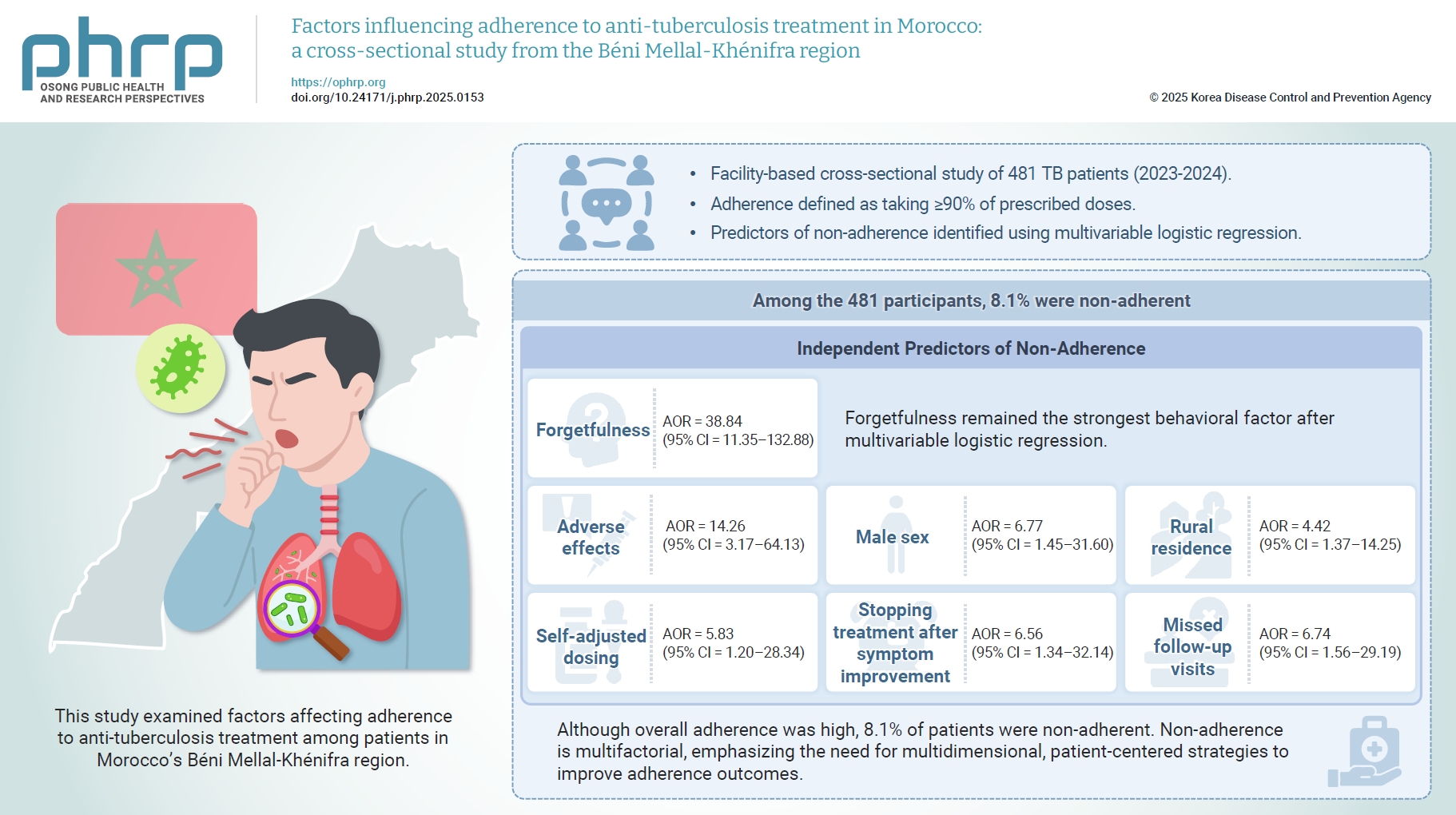
Objectives Adherence to anti-tuberculosis treatment is essential for achieving successful outcomes and preventing the emergence of drug-resistant strains. This study aimed to evaluate adherence levels and identify factors associated with non-adherence among tuberculosis patients in the Béni Mellal-Khénifra region of Morocco. We hypothesized that sociodemographic, clinical, and behavioral factors influence adherence.
Methods A facility-based cross-sectional study was conducted from January 2023 to December 2024 in 2 Tuberculosis and Respiratory Disease Diagnostic Centers in the Béni Mellal-Khénifra region. A total of 481 patients who had been on treatment for at least 2 months were recruited using convenience sampling. Data were collected through structured, pre-tested questionnaires administered in face-to-face interviews and verified against treatment cards and medical records. Adherence was defined as taking ≥90% of prescribed doses. Multivariable logistic regression was used to identify independent predictors of non-adherence.
Results Among the 481 participants, 8.1% were non-adherent. Significant predictors of non-adherence included forgetfulness (adjusted odds ratio [AOR], 38.84; 95% confidence interval [CI], 11.35–132.88), adverse effects (AOR, 14.26; 95% CI, 3.17–64.13), male sex (AOR, 6.77; 95% CI, 1.45–31.60), rural residence (AOR, 4.42; 95% CI, 1.37–14.25), self-adjusted dosing (AOR, 5.83; 95% CI, 1.20–28.34), stopping treatment after symptom improvement (AOR, 6.56; 95% CI, 1.34–32.14), and missed follow-up visits (AOR, 6.74; 95% CI, 1.56–29.19).
Conclusion Although overall adherence was high, 8.1% of patients were non-adherent. Strategies to improve adherence should focus on addressing forgetfulness, managing side effects, enhancing access in rural areas, and reinforcing patient education and follow-up systems to improve treatment outcomes in this and similar settings.
Citations
Citations to this article as recorded by
Longitudinal Observation by Optical Coherence Tomography in Patients Treated with Ethambutol: A Systematic Review and Meta-Analysis Rui Luo, Jin Ma, Yong Zhong Journal of Clinical Medicine.2026; 15(3): 1230. CrossRef
Non-Adherence to Anti-Tuberculosis Treatment and Its Determinants Among Tuberculosis Patients in Tanzania Meshack Morice, Bernadetha Hugho Kimario, Indo Ndaigeze, Damas Dismas Nyabenda Journal of Community Health.2026; 51(4): 648. CrossRef
Objectives This study was performed to evaluate the prevalence of medication adherence and its determinants among Moroccan patients with type 2 diabetes mellitus. Methods: A multicenter cross-sectional survey was conducted from February to June 2024, involving 584 patients from the Casablanca-Settat and Rabat-Sale-Kenitra regions of Morocco. Medication adherence was assessed using the general medication adherence scale. Associations between independent variables and adherence were analyzed using chi-square tests and multivariate logistic regression. Results: Medication adherence was observed in 96.2% of participants. Multivariate analysis revealed significantly lower medication adherence among patients using 2 or more oral antidiabetic drugs (adjusted odds ratio [aOR], 0.026; 95% confidence interval [CI], 0.001–0.642; p=0.026) and those with a diabetes duration of 11 to 15 years (aOR, 0.037; 95% CI, 0.001–0.956; p=0.047). Conclusion: Despite a high overall adherence rate, patients on dual or polytherapy and those with longer disease duration exhibited lower adherence in multivariate analysis. Targeted interventions are needed to improve adherence in these high-risk groups.




 First
 Prev


