Objectives Medication adherence remains a major challenge in the management of type 2 diabetes (T2D), especially in middle-income countries such as Morocco. With the rapid development of artificial intelligence, large language models, including ChatGPT, may offer new opportunities for clinical research through simulated patient profiles. This study examined the feasibility of using ChatGPT to generate culturally contextualized virtual profiles of Moroccan patients with T2D and to apply the validated Moroccan Arabic dialect version of the general medication adherence scale (GMAS). Methods: This exploratory pilot simulation study used ChatGPT-4 to generate 11 virtual profiles based on representative sociodemographic and clinical characteristics of Moroccan patients with T2D. Each profile was administered the validated Moroccan Arabic dialect version of the GMAS. Results: Four profiles (36.4%) showed high adherence, 6 (54.5%) displayed moderate adherence, and 1 (9.1%) exhibited low adherence. Expert evaluations were consistent, with all ratings ≥3 on a 4-point scale, supporting the credibility and cultural appropriateness of the profiles. The simulated patterns reflected real-world trends, with higher adherence among profiles treated with oral antidiabetic drugs, covered by health insurance, and having shorter disease duration, and lower adherence among profiles using insulin, lacking insurance, and having longer disease duration. Conclusion: ChatGPT generated credible, culturally adapted patient profiles that enabled application of a validated psychometric tool in a simulated environment. This rapid, low-cost approach may support exploratory research, healthcare training, and intervention design. Comparative studies using real patient data are needed to confirm validity.
Objectives
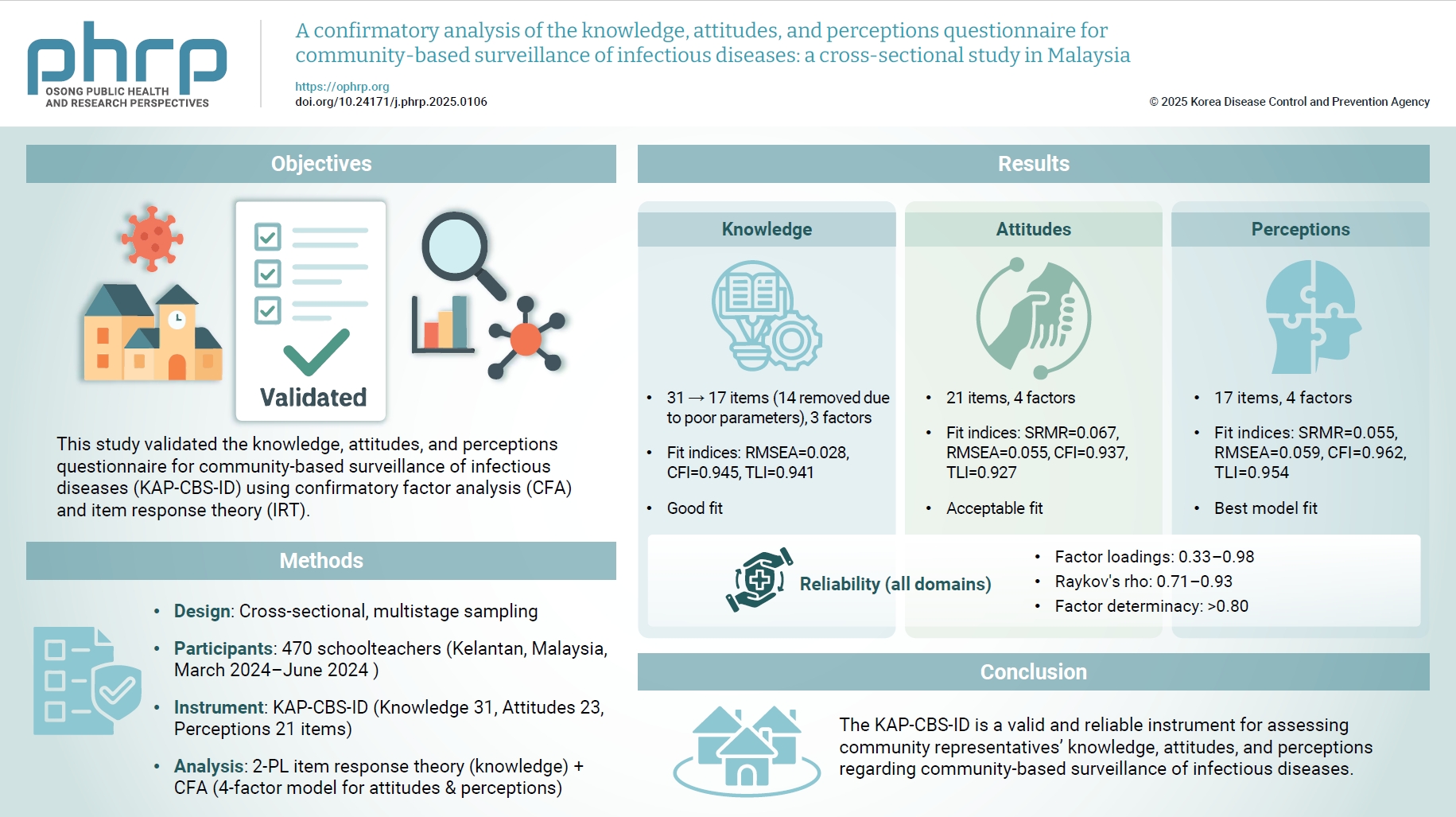
This study aimed to validate the psychometric properties of the recently developed knowledge, attitudes, and perceptions questionnaire for community-based surveillance of infectious diseases (KAP-CBS-ID questionnaire), using confirmatory factor analysis (CFA) and item response theory (IRT).
Methods
A cross-sectional study using multistage sampling recruited 470 schoolteachers from Kelantan, Malaysia. The self-administered KAP-CBS-ID questionnaire consists of 3 domains: knowledge (31 items), attitudes (23 items), and perceptions (21-items). Two-parameter logistic (2-PL) IRT analysis and CFA were performed to validate the knowledge section. For attitudes and perceptions sections, CFA proceeded using a 4-factor model to evaluate both model fit and construct validity.
Results
Two-PL IRT analysis of the knowledge section resulted in elimination of 14 items due to inadequate discrimination or difficulty parameters. The 3-factor CFA model demonstrated good fit indices for knowledge (root mean square error of approximation [RMSEA], 0.028; comparative fit index [CFI], 0.945; Tucker-Lewis index [TLI], 0.941) without any modifications. The attitudes section required re-specification, ultimately yielding 21 items across 4 factors with acceptable fit indices (standardized root mean square residual [SRMR], 0.067; RMSEA, 0.055; CFI, 0.937; TLI, 0.927). Similarly, the perceptions section was refined to 17 items across 4 factors, showing good model fit (SRMR, 0.055; RMSEA, 0.059; CFI, 0.962; TLI, 0.954). Factor loadings ranged from 0.33 to 0.98, while Raykov’s rho reliability estimates ranged from 0.71 to 0.93. Factor determinacy exceeded 80% for all factors.
Conclusion
The KAP-CBS-ID is a valid and reliable instrument for assessing community representatives’ knowledge, attitudes, and perceptions regarding community-based surveillance of infectious diseases.
Citations
Citations to this article as recorded by
Modeling social and behavioral factors associated with community participation in community-based surveillance of communicable diseases: a cross-sectional study in Kelantan, Malaysia Ahmed Azeez Hasan, Anis Kausar Ghazali, Norsa’adah Bachok, Najib Majdi Yaacob, Suhaily Mohd Hairon, Nur Amira Mohd Nadir, Fatimah Muhd Shukri Osong Public Health and Research Perspectives.2026; 17(3): 229. CrossRef



 First
 Prev


