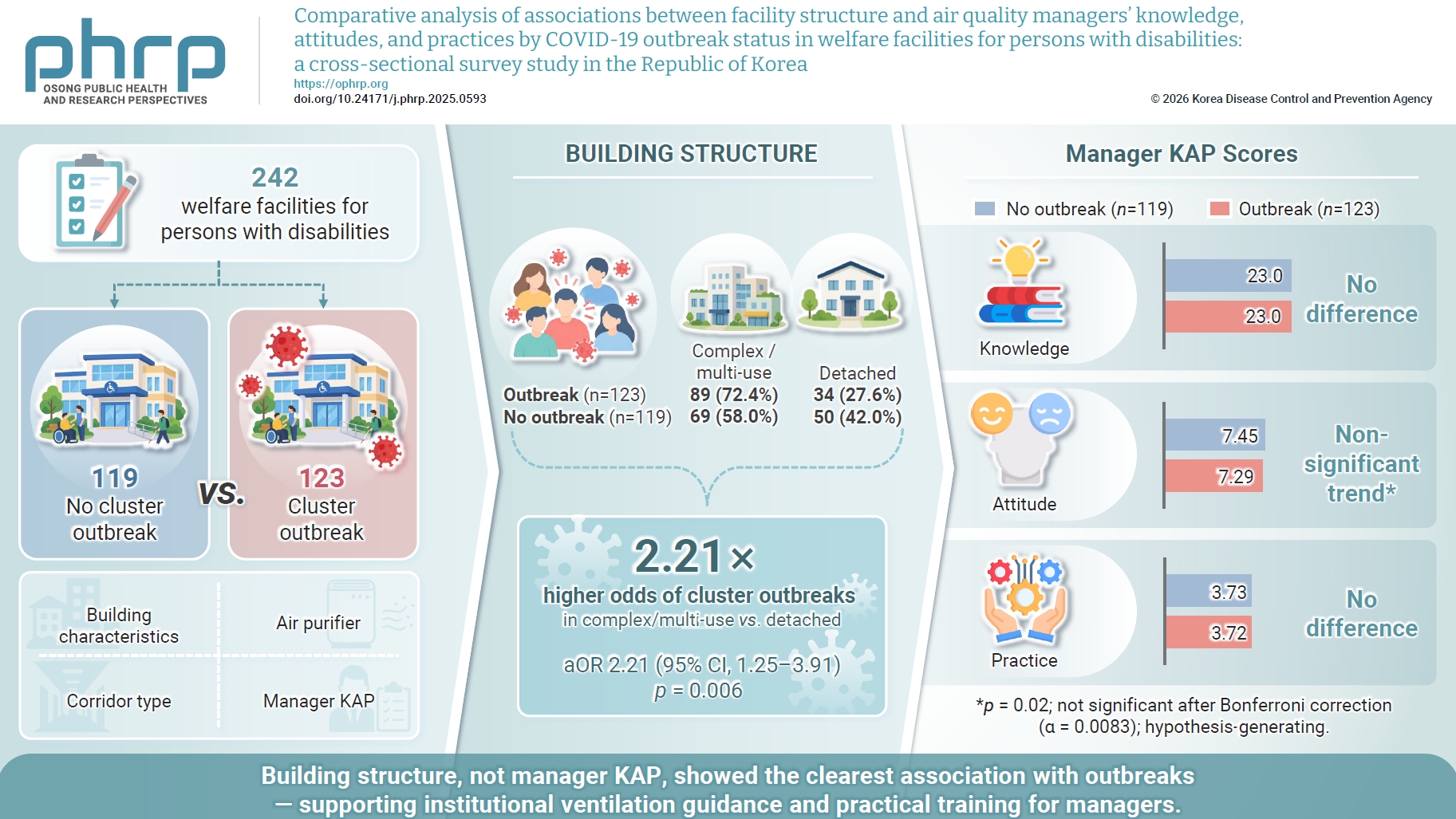
Objectives This study investigated associations between building structure and managers’ knowledge, attitudes, and practices (KAP) regarding indoor air quality in welfare facilities for persons with disabilities, comparing facilities with and without coronavirus disease 2019 (COVID-19) cluster outbreaks. Methods: A web-based survey was conducted among managers of 242 welfare facilities for persons with disabilities in the Republic of Korea. Facilities were recruited from a national sampling frame of approximately 3,000 facilities, yielding a response rate of 8.1%. The 80-item questionnaire assessed building characteristics and air quality-related KAP scores. Logistic regression was used to identify factors associated with cluster outbreaks. Results: Of the 242 facilities, 50.8% had experienced cluster outbreaks. Facilities in complex/multi-use buildings had higher odds of outbreaks than those in detached buildings did (adjusted odds ratio, 2.21; 95% confidence interval, 1.25–3.91; p=0.006). For managerial factors, facilities with outbreaks tended to have lower attitude scores (p=0.02); however, this association did not remain statistically significant after Bonferroni correction (adjusted α=0.0083). No significant differences were observed in knowledge or practice scores. Conclusion: Building structure, particularly complex/multi-use configuration, was associated with COVID-19 cluster outbreaks. Managerial KAP scores were not definitively associated with outbreaks under the conservative significance threshold, but the observed trends suggest that institutional support, ventilation guidance, and practical training for facility managers may help strengthen future infection-prevention efforts.
Objectives This study aimed to examine the scale, characteristics, risk factors, and modes of transmission in a coronavirus disease 2019 (COVID-19) outbreak at a high school in Seoul, Republic of Korea.
Methods An epidemiological survey was conducted of 1,118 confirmed cases and close contacts from a COVID-19 outbreak at an educational facility starting on May 31, 2021. In-depth interviews, online questionnaires, flow evaluations, and CCTV analyses were used to devise infection prevention measures. Behavioral and spatial risk factors were identified, and statistical significance was tested.
Results Among 3rd-year students, there were 33 confirmed COVID-19 cases (9.6%). Students who used a study room in the annex building showed a statistically significant 4.3-fold elevation in their relative risk for infection compared to those who did not use the study room. Moreover, CCTV facial recognition analysis confirmed that 17.8% of 3rd-year students did not wear masks and had the lowest percentage of mask-wearers by grade. The air epidemiological survey conducted in the study room in the annex, which met the 3 criteria for a closed space, confirmed that there was only 10% natural ventilation due to the poor ventilation system.
Conclusion To prevent and manage the spread of COVID-19 in educational facilities, advance measures that consider the size, operation, and resources of each school are crucial. In addition, various survey methodologies should be used in future studies to quickly analyze a wider range of data that can inform an evidence-based quarantine response.
Citations
Citations to this article as recorded by
Detection of a cluster of Omicron's BA.4 sublineage in Northern Senegal and identification of the first XAS recombinant variant in Senegal Martin Faye, Modeste Name Faye, Babacar Ndiaye, Moussa Moïse Diagne, Safietou Sankhe, Ndeye Marième Top, Amadou Diallo, Cheikh Loucoubar, Ndongo Dia, Amadou Alpha Sall, Ousmane Faye Virus Research.2024; 339: 199259. CrossRef




 First
 Prev


