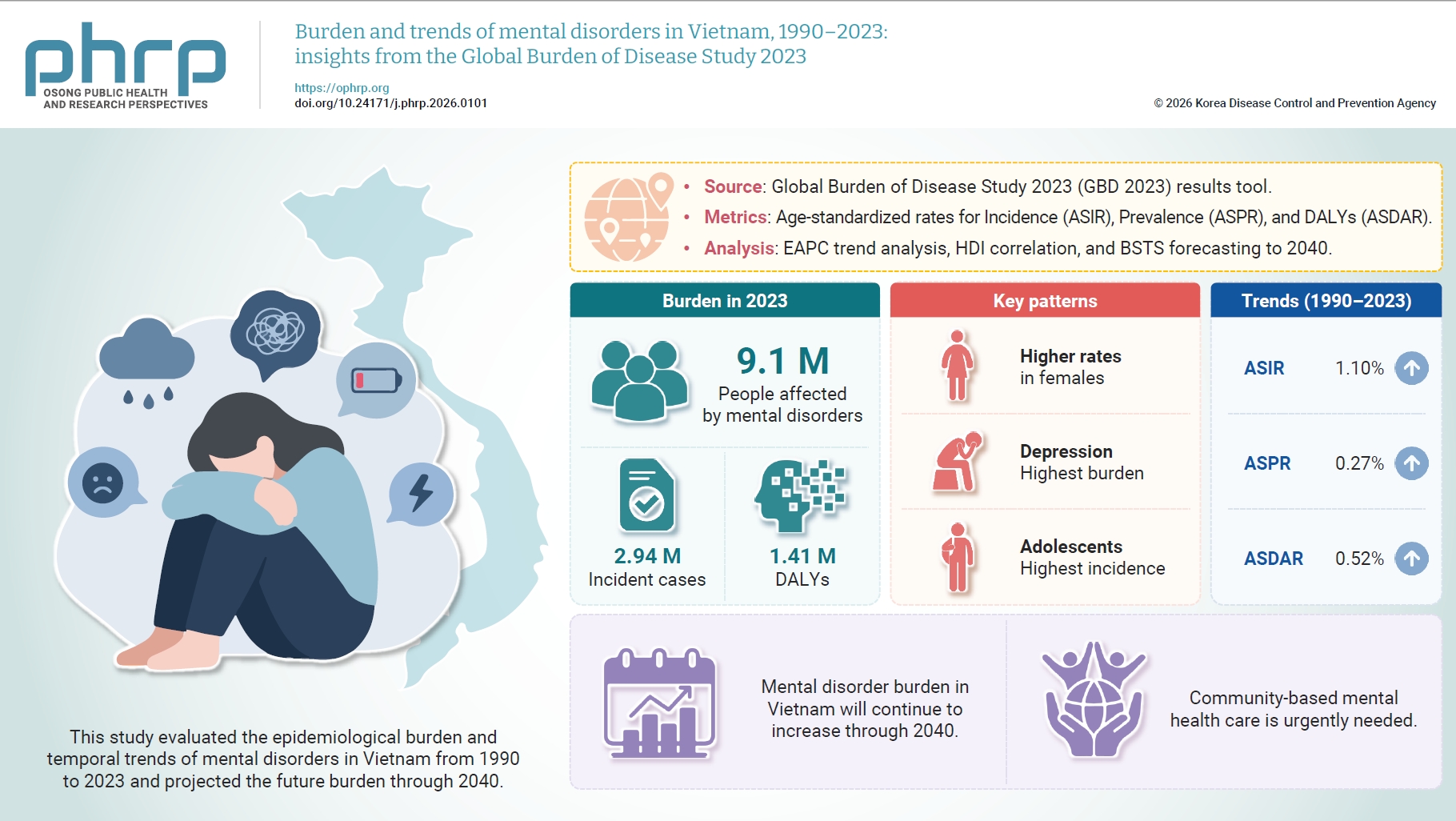
Objectives This study evaluated the epidemiological burden and temporal trends of mental disorders in Vietnam from 1990 to 2023 and projected the future burden through 2040. Methods: Global Burden of Disease Study 2023 data were used to analyze the age-standardized prevalence rate (ASPR), age-standardized incidence rate (ASIR), and age-standardized disability-adjusted life-year rate (ASDAR) by age, sex, and diagnostic subtype. Temporal trends were quantified using the estimated annual percentage change (EAPC), and Pearson correlation analysis examined associations with Vietnam’s human development index (HDI). Bayesian structural time series (BSTS) models were used to forecast the burden through 2040. Results: In 2023, approximately 9.1 million individuals in Vietnam had mental disorders, with 2.94 million annual incident cases and 1.41 million disability-adjusted life-years. Depressive disorders ranked highest across all metrics, and females consistently had higher agestandardized rates than males. Age-standardized rates increased significantly from 1990 to 2023: ASIR, 1.10% EAPC (95% confidence interval [CI], 0.87%–1.33%); ASPR, 0.27% EAPC (95% CI, 0.21%–0.33%); and ASDAR, 0.52% EAPC (95% CI, 0.46%–0.58%). Mental disorder burden was strongly positively correlated with HDI (r =0.773–0.909, all p<0.001). BSTS models projected continued increases through 2040 (ASPR, 9,003.75; ASIR, 3,307.11; ASDAR, 1,408.05 per 100,000 population). Conclusion: Mental disorders constitute an escalating public health challenge in Vietnam, with the burden increasing steadily over 3 decades and projected to continue rising through 2040. Reorientation toward an integrated, community-based care model, alongside targeted workforce expansion and systematic integration of mental health services into primary care, is essential to mitigate this growing burden.
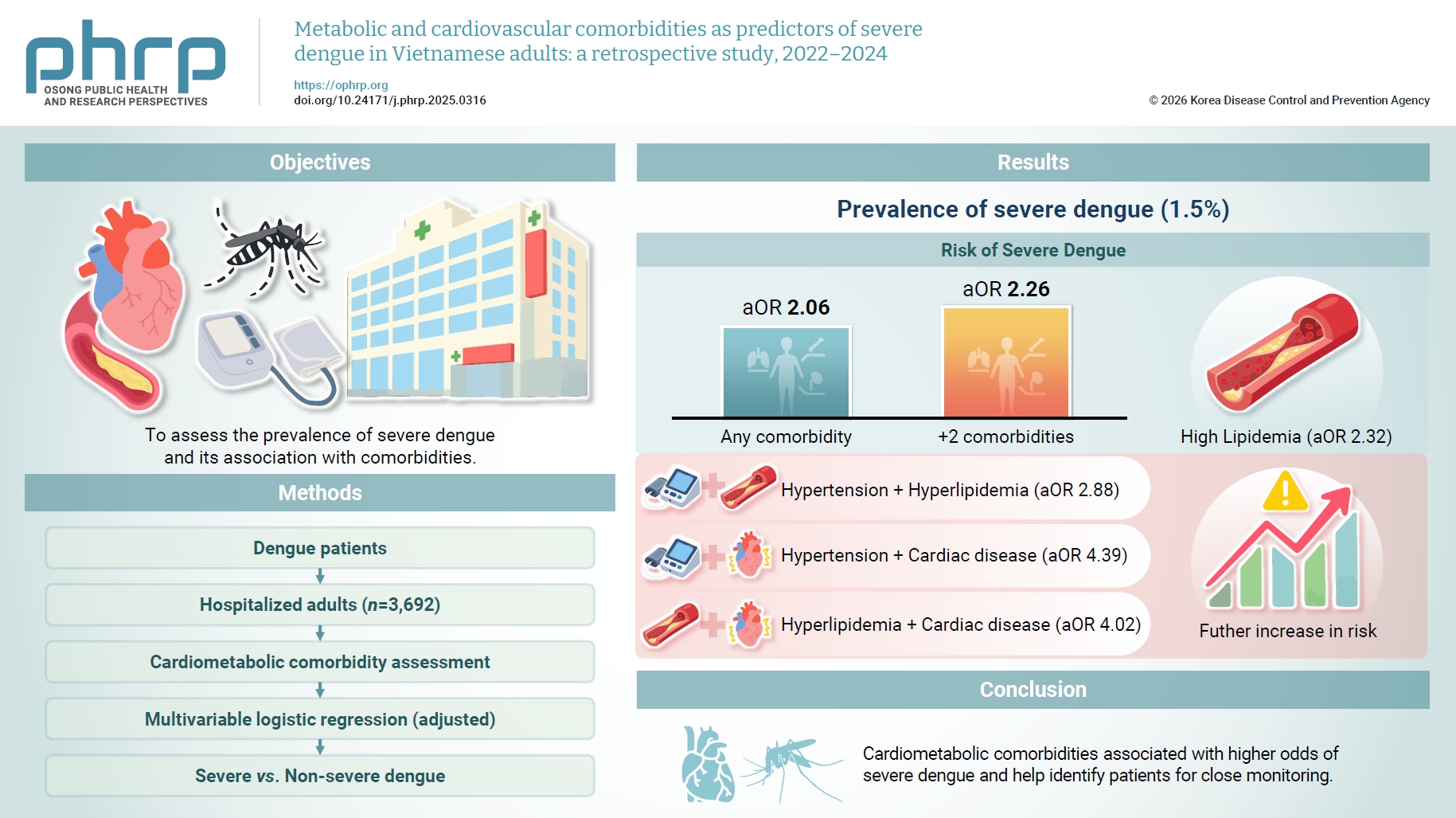
Objectives This study aimed to determine the prevalence of severe dengue and examine the associations between pre-existing comorbidities and disease severity.
Methods This retrospective study examined patients with dengue fever who received inpatient treatment at a hospital in northern Vietnam between January 1, 2022, and December 30, 2024. Patients were categorized into 2 groups—severe dengue and non-severe dengue—based on the 2009 World Health Organization criteria. Multivariable logistic regression was performed to assess factors associated with severe dengue.
Results Among 3,692 patients, the prevalence of severe dengue was 1.5%. Patients with any pre-existing comorbidity had higher odds of severe dengue compared to those without comorbidities (adjusted odds ratio [aOR], 2.06; 95% confidence interval [CI], 1.20–3.53). Having 2 or more comorbidities was also associated with higher odds of severe dengue (aOR, 2.26; 95% CI, 1.18–4.33). Among individual conditions, hyperlipidemia was associated with severe dengue (aOR, 2.32; 95% CI, 1.17–4.81). Certain combinations of comorbidities, including hypertension with hyperlipidemia (aOR, 2.88; 95% CI, 1.39–5.97), hypertension with cardiac disease (aOR, 4.39; 95% CI, 1.30–14.79), and hyperlipidemia with cardiac disease (aOR, 4.02; 95% CI, 1.19–13.53), were also associated with higher odds of severe dengue.
Conclusion Pre-existing comorbidities, particularly cardiometabolic conditions, were associated with higher odds of severe dengue. Considering comorbidity profiles at hospital admission may help identify patients who require closer clinical monitoring.
Han Thi Vo, Tien Duc Dao, Tuyen Van Duong, Tan Thanh Nguyen, Binh Nhu Do, Tinh Xuan Do, Khue Minh Pham, Vinh Hai Vu, Linh Van Pham, Lien Thi Hong Nguyen, Lan Thi Huong Le, Hoang Cong Nguyen, Nga Hoang Dang, Trung Huu Nguyen, Anh The Nguyen, Hoan Van Nguyen, Phuoc Ba Nguyen, Hoai Thi Thanh Nguyen, Thu Thi Minh Pham, Thuy Thi Le, Thao Thi Phuong Nguyen, Cuong Quoc Tran, Kien Trung Nguyen
Osong Public Health Res Perspect 2024;15(1):33-44. Published online February 19, 2024
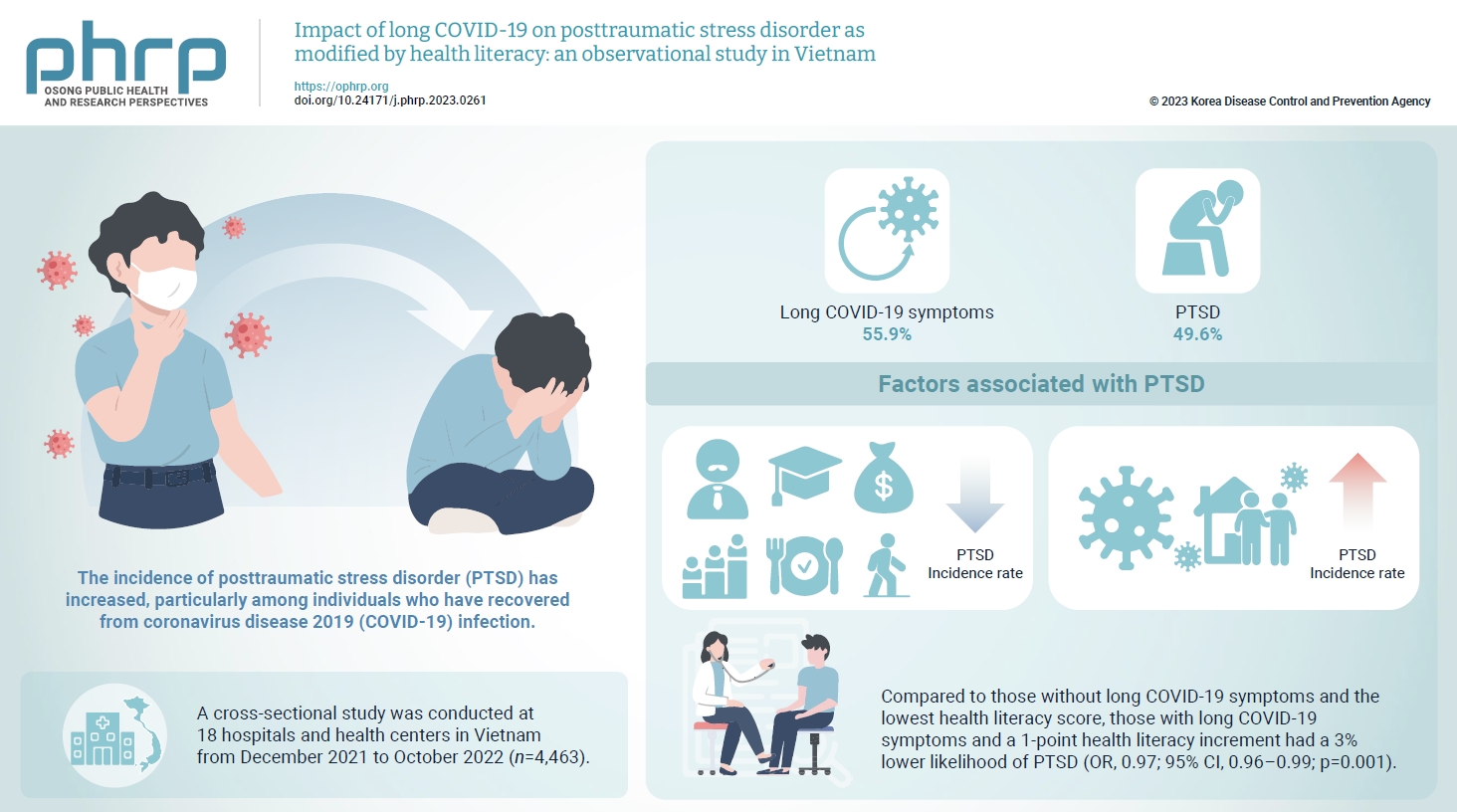
Objectives The prevalence of posttraumatic stress disorder (PTSD) has increased, particularly among individuals who have recovered from coronavirus disease 2019 (COVID-19) infection. Health literacy is considered a “social vaccine” that helps people respond effectively to the pandemic. We aimed to investigate the association between long COVID-19 and PTSD, and to examine the modifying role of health literacy in this association. Methods: A cross-sectional study was conducted at 18 hospitals and health centers in Vietnam from December 2021 to October 2022. We recruited 4,463 individuals who had recovered from COVID-19 infection for at least 4 weeks. Participants provided information about their sociodemographics, clinical parameters, health-related behaviors, health literacy (using the 12-item short-form health literacy scale), long COVID-19 symptoms and PTSD (Impact Event Scale-Revised score of 33 or higher). Logistic regression models were used to examine associations and interactions. Results: Out of the study sample, 55.9% had long COVID-19 symptoms, and 49.6% had PTSD. Individuals with long COVID-19 symptoms had a higher likelihood of PTSD (odds ratio [OR], 1.86; 95% confidence interval [CI], 1.63–2.12; p<0.001). Higher health literacy was associated with a lower likelihood of PTSD (OR, 0.98; 95% CI, 0.97–0.99; p=0.001). Compared to those without long COVID-19 symptoms and the lowest health literacy score, those with long COVID-19 symptoms and a 1-point health literacy increment had a 3% lower likelihood of PTSD (OR, 0.97; 95% CI, 0.96–0.99; p=0.001). Conclusion: Health literacy was found to be a protective factor against PTSD and modified the negative impact of long COVID-19 symptoms on PTSD.
Citations
Citations to this article as recorded by
Prospective association between long COVID and COVID-related post-traumatic stress disorder among a population-based cohort of adults diagnosed with COVID-19 in Michigan Akash Patel, Soomin Ryu, Blair Whittington, Christine Chyu, Emma Chrzanowski, Sameera Ahmed, Elizabeth Slocum, Nancy L. Fleischer Journal of Affective Disorders.2026; 410: 122009. CrossRef
Psychiatric symptoms of long COVID among adults: observational case–control study in Johannesburg, South Africa Andrew Wooyoung Kim, Someleze Swana, Simiso Sokhela, Samanta Lalla-Edward, Ncomeka Manentsa, Alexander C. Tsai, W. D. Francois Venter BJPsych Open.2026;[Epub] CrossRef
Mental health and post-traumatic stress among unprivileged people in the aftermath of COVID-19 pandemic in Southwest Bangladesh: a cross-sectional study Md. Salauddin Khan, Maliha Mahazabin, Ishita Shahid Sams, Lasker Ershad Ali, Umama Khan Cogent Mental Health.2025;[Epub] CrossRef
Exploring the psychological impact of long COVID: symptoms, mechanisms, and treatments Shi Shen, Xin Zhao, Jianxin Pei, Bijue Wang, Jingjing Hou, Ru Chai, Yiqiong Guo, Feiyu Li, Jian Hao, Zhonglan Wu Frontiers in Psychiatry.2025;[Epub] CrossRef
Pathophysiological, Neuropsychological, and Psychosocial Influences on Neurological and Neuropsychiatric Symptoms of Post-Acute COVID-19 Syndrome: Impacts on Recovery and Symptom Persistence Alex Malioukis, R Sterling Snead, Julia Marczika, Radha Ambalavanan Biomedicines.2024; 12(12): 2831. CrossRef
Objectives Tuberculosis (TB) and drug-resistant TB (DR-TB) are national health burdens in Vietnam. In this study, we investigated the prevalence of rifampicin (RIF) and/or isoniazid (isonicotinic acid hydrazide, INH) resistance in patients with suspected TB, and applied appropriate techniques to help rapidly target DR-TB. Methods: In total, 1,547 clinical specimens were collected and cultured using the BACTEC MGIT system (Becton Dickinson and Co.). A resazurin microtiter assay (REMA) was used to determine the proportions of RIF and/or INH resistance. A real-time polymerase chain reaction panel with TaqMan probes was employed to identify the mutations of rpoB and katG associated with DR-TB in clinical isolates. Genotyping of the identified mutations was also performed. Results: A total of 468 Mycobacterium tuberculosis isolates were identified using the REMA. Of these isolates, 106 (22.6%) were found to be resistant to 1 or both antibiotics. Of the resistant isolates, 74 isolates (69.8%) were resistant to isoniazid (INH) only, while 1 isolate (0.94%) was resistant to RIF only. Notably, 31 isolates (29.24%) were resistant to both antibiotics. Of the 41 phenotypically INH-resistant isolates, 19 (46.3%) had the Ser315Thr mutation. There were 8 different rpoB mutations in 22 (68.8%) of the RIF-resistant isolates. The most frequently detected mutations were at codons 531 (37.5%), 526 (18.8%), and 516 (6.3%). Conclusion: To help prevent new cases of DR-TB in Vietnam, it is crucial to gain a comprehensive understanding of the genotypic DR-TB isolates.
Citations
Citations to this article as recorded by
Identification of Potent Molecule for Rifampicin‐Resistant Mycobacterium tuberculosis using Natural Compounds by Structure‐Based Analysis Madhana Priya N, Magesh R ChemistrySelect.2026;[Epub] CrossRef
Clinical Evaluation of a Tandem qPCR-CRISPR Assay for Multidrug-Resistant or Rifampicin-Resistant Tuberculosis: A Prospective Diagnostic Accuracy Study Ying Wang, Zhe Song, Jianfeng Zeng, Yajuan Dong, Houming Liu, Jian Zeng, Xuhui Liu, Liang Fu, Xuelin Li, Shuihua Lu, Zhen Huang, Xiao-Yong Fan Microorganisms.2026; 14(8): 1750. CrossRef
<sec><title>Objectives</title><p>General health examinations (GHE) have become an increasingly common measure for preventive medicine in Vietnam. However, little is known about the factors among Viet-namese people who attend or miss GHE. Budget or time constraints remain to be evaluated for better-informed policy making. This study investigates factors affecting behaviors in attending periodic GHE. The main objectives are as follows: (1) to explore empirical relationships between influencing factors and periodic GHE frequencies, and (2) to predict the probabilities of attending GHE under associated conditions.</p></sec><sec><title>Methods</title><p>The study used a 2,068-observational dataset, obtained from a Vietnamese survey in 2016. The analysis was then performed using the methods of baseline-category logits for establishing relationships between predictor and response variables.</p></sec><sec><title>Results</title><p>Significant relationships were found among the expenditure and time consumption, health priority and sensitivity to health data, insurance status, and frequency of GHE, with most <italic>p</italic>-values = 0.01.</p></sec><sec><title>Conclusion</title><p>Generally, people attended the GHE when they had the resources and health priorities (72.7% probability). Expenditure and time remain key obstacles to the periodic GHE. Health priority and health data are important in improving rates for GHEs. Health insurance should play a positive role in promoting the GHE.</p></sec>
Citations
Citations to this article as recorded by
Multiple Chronic Conditions and Disability among Vietnamese Older Adults: Results from the Vietnamese Aging and Care Survey (VACS) Christina E. Miyawaki, Joshua M. Garcia, Kim N. Nguyen, Van Ta Park, Kyriakos S. Markides Journal of Racial and Ethnic Health Disparities.2024; 11(3): 1800. CrossRef
Sex Differences and Psychological Factors Associated with General Health Examinations Participation: Results from a Vietnamese Cross-Section Dataset Quan-Hoang Vuong, Kien-Cuong P. Nghiem, Viet-Phuong La, Thu-Trang Vuong, Hong-Kong T. Nguyen, Manh-Toan Ho, Kien Tran, Thu-Hong Khuat, Manh-Tung Ho Sustainability.2019; 11(2): 514. CrossRef
Health Care Payments in Vietnam: Patients’ Quagmire of Caring for Health versus Economic Destitution Andre Pekerti, Quan-Hoang Vuong, Tung Ho, Thu-Trang Vuong International Journal of Environmental Research an.2017; 14(10): 1118. CrossRef
Psychological and Socio-Economic Factors Affecting Social Sustainability through Impacts on Perceived Health Care Quality and Public Health: The Case of Vietnam Quan-Hoang Vuong, Thu-Trang Vuong, Tung Ho, Ha Nguyen Sustainability.2017; 9(8): 1456. CrossRef
<sec><title>Objectives</title><p>To investigate the relationship between dyslipidemia and obesity status among Viet-namese adolescents.</p></sec><sec><title>Methods</title><p>In this case-control study, 282 adolescents (6–11 years), including 88 obese cases and 194 normal-weight controls, were recruited from a population-based cross-sectional study from two provinces in Vietnam. The anthropometric, blood lipid, and other laboratory test results of the study subjects were analyzed.</p></sec><sec><title>Results</title><p>Obese children tended to have more visceral fat (Pearson’s <italic>r</italic> = 0.795, <italic>p</italic> < 0.0001) than subcutaneous fat (Pearson’s <italic>r</italic> = 0.754, <italic>p</italic> < 0.0001), and this difference was associated with an increase in blood triglyceride level (Pearson’s <italic>r</italic> = 0.232, <italic>p</italic> < 0.05) and a strikingly high rate of hypertriglyceridemia (38.6%). We also found that birth weight and parental body mass index were related to the status of obesity among the study subjects. However, only birth weight was significantly higher in the obese group than in the normal weight group. These findings indicate the effect of prenatal nutrition on childhood obesity. Furthermore, high-birth weight children had a surprisingly high rate of obesity.</p></sec><sec><title>Conclusion</title><p>Together, our data suggest that obesity increased the risk for hypertriglyceridemia, which was, at least partially, due to prenatal nutrition.</p></sec>
Citations
Citations to this article as recorded by
Rapid weight gain in first 2 years of life and BMI trajectories from 3 to <10 years: a population-based longitudinal study of 1.7 million Brazilian children Carolina Santiago-Vieira, Leah Li, Rita de Cássia Ribeiro Silva, Juliana Freitas de Mello e Silva, Enny S. Paixão, Maurício L. Barreto, Gustavo Velasquez-Melendez The Lancet Regional Health - Americas.2026; 54: 101326. CrossRef
Associations Between Nutritional Status, Cognitive Performance, and Surrogate Metabolic Profiles in School-Aged Children Jessica Jazmín Gordillo-Castañeda, Karen Sinaí Xicotencatl-Quintero, Eunice D. Farfán-García, Betsabé Jiménez Ceballos, Dulce María Meneses-Ruiz, Erick Martínez-Herrera, Paola Berenice Zárate-Segura, Arely Vergara-Castañeda, Claudia Erika Fuentes-Venado, Nutrients.2026; 18(13): 2040. CrossRef
Nutritional status and related factors in Vietnamese students in 2022 Thu Nguyen Thi, Nhat-Le Bui, Hue Vu Thi, Suong Mai Vu Ngoc, Anh Dao Ngo, Toan Nguyen Truong, Khanh-Huyen Nguyen, Viet Hoa Nguyen, Ngoc Minh Nguyen, Kien Trinh, Dinh-Toi Chu Clinical Nutrition Open Science.2024; 54: 140. CrossRef
Associations between dietary copper intake and hypertriglyceridemia among children and adolescents in the US Yumeng Shi, Huan Hu, Zuxiang Wu, Ji Wu, Zhiqiang Chen, Xiaoshu Cheng, Ping Li Nutrition, Metabolism and Cardiovascular Diseases.2023; 33(4): 809. CrossRef
Association of Platelet-Monocyte Ratio with Dyslipidemia in Saudi Arabia: A Large, Population-Based Study Mohammad A. Alfhili, Ghada A. Alotaibi, Mohammed Alfaifi, Yousef Almoghrabi, Jawaher Alsughayyir Life.2023; 13(8): 1685. CrossRef
Patterns of Dyslipidemia in the Anemic and Nonanemic Hypertensive Saudi Population: A Cross-Sectional Study Mohammad A Alfhili, Jawaher Alsughayyir, Ahmed M Basudan, Hazem K Ghneim, Mohammed Alfaifi, Hassan S Alamri, Zuhier A Awan, Mohammed R Algethami International Journal of General Medicine.2022; Volume 15: 7895. CrossRef
Eating Behaviors in Relation to Child Weight Status and Maternal Education Priscilla Ayine, Vaithinathan Selvaraju, Chandra M. K. Venkatapoorna, Yida Bao, Philippe Gaillard, Thangiah Geetha Children.2021; 8(1): 32. CrossRef
Ranking of a wide multidomain set of predictor variables of children obesity by machine learning variable importance techniques Helena Marcos-Pasero, Gonzalo Colmenarejo, Elena Aguilar-Aguilar, Ana Ramírez de Molina, Guillermo Reglero, Viviana Loria-Kohen Scientific Reports.2021;[Epub] CrossRef
Early childhood factors associated with obesity at age 8 in Vietnamese children: The Young Lives Cohort Study Tuyen Nguyen, Karen Sokal-Gutierrez, Maureen Lahiff, Lia Fernald, Susan L. Ivey BMC Public Health.2021;[Epub] CrossRef
Changes in the prevalence of obesity and hypertension and demographic risk factor profiles in China over 10 years: two national cross-sectional surveys Yongze Li, Di Teng, Xiaoguang Shi, Xiaochun Teng, Weiping Teng, Zhongyan Shan, Yaxin Lai The Lancet Regional Health - Western Pacific.2021; 15: 100227. CrossRef
Hypertension in a mountainous province of Vietnam: prevalence and risk factors Khanh Do Nam, Nhon Bui Van, Long Vo Hoang, Toan Pham Duc, Thu Tran Thi Ha, Viet Tran Tuan, Phong Phan Dinh, Huong Trinh Thi Thu, Pau Loke Show, Vu Thi Nga, Le Bui Minh, Dinh-Toi Chu Heliyon.2020; 6(2): e03383. CrossRef
The APOA5‐rs662799 Polymorphism Is a Determinant of Dyslipidemia in Vietnamese Primary School Children Nguyen T. H. Hanh, Bui T. Nhung, Le T. Hop, Le T. Tuyet, Duong T. A. Dao, Nguyen T. T. Thu, Tran Quang Binh Lipids.2020; 55(6): 683. CrossRef
An update on obesity: Mental consequences and psychological interventions Dinh-Toi Chu, Nguyen Thi Minh Nguyet, Vu Thi Nga, Nguyen Vu Thai Lien, Duc Duy Vo, Nguyen Lien, Vo Truong Nhu Ngoc, Le Hoang Son, Duc-Hau Le, Vu Bich Nga, Pham Van Tu, Ta Van To, Luu Song Ha, Yang Tao, Van-Huy Pham Diabetes & Metabolic Syndrome: Clinical Research &.2019; 13(1): 155. CrossRef
Prevalence and Risk Factors of Hypertension in the Vietnamese Elderly Nhon Bui Van, Long Vo Hoang, Tung Bui Van, Hao Nguyen Si Anh, Hien Tran Minh, Khanh Do Nam, Tuan Ngo Tri, Pau Loke Show, Vu Thi Nga, Deepak B. Thimiri Govinda Raj, Dinh-Toi Chu High Blood Pressure & Cardiovascular Prevention.2019; 26(3): 239. CrossRef
Association between salivary amylase enzyme activity and obesity in Saudi Arabia Norah Mubarak Aldossari, Eman E. El Gabry, Gihan E.H. Gawish Medicine.2019; 98(23): e15878. CrossRef
Obesity consequences from the people's perspective living in Kurdish regions of Iran: A qualitative content analysis Seyed Fahim Irandoost, Mohammad Hosein Taghdisi, Tahereh Dehdari, Bahman Bayangani, Nammam Ali Azadi Journal of Education and Health Promotion.2019;[Epub] CrossRef
An update on physical health and economic consequences of overweight and obesity Dinh-Toi Chu, Nguyen Thi Minh Nguyet, Thien Chu Dinh, Nguyen Vu Thai Lien, Khanh-Hoang Nguyen, Vo Truong Nhu Ngoc, Yang Tao, Le Hoang Son, Duc-Hau Le, Vu Bich Nga, Adam Jurgoński, Quoc-Hung Tran, Pham Van Tu, Van-Huy Pham Diabetes & Metabolic Syndrome: Clinical Research &.2018; 12(6): 1095. CrossRef




 First
 Prev


