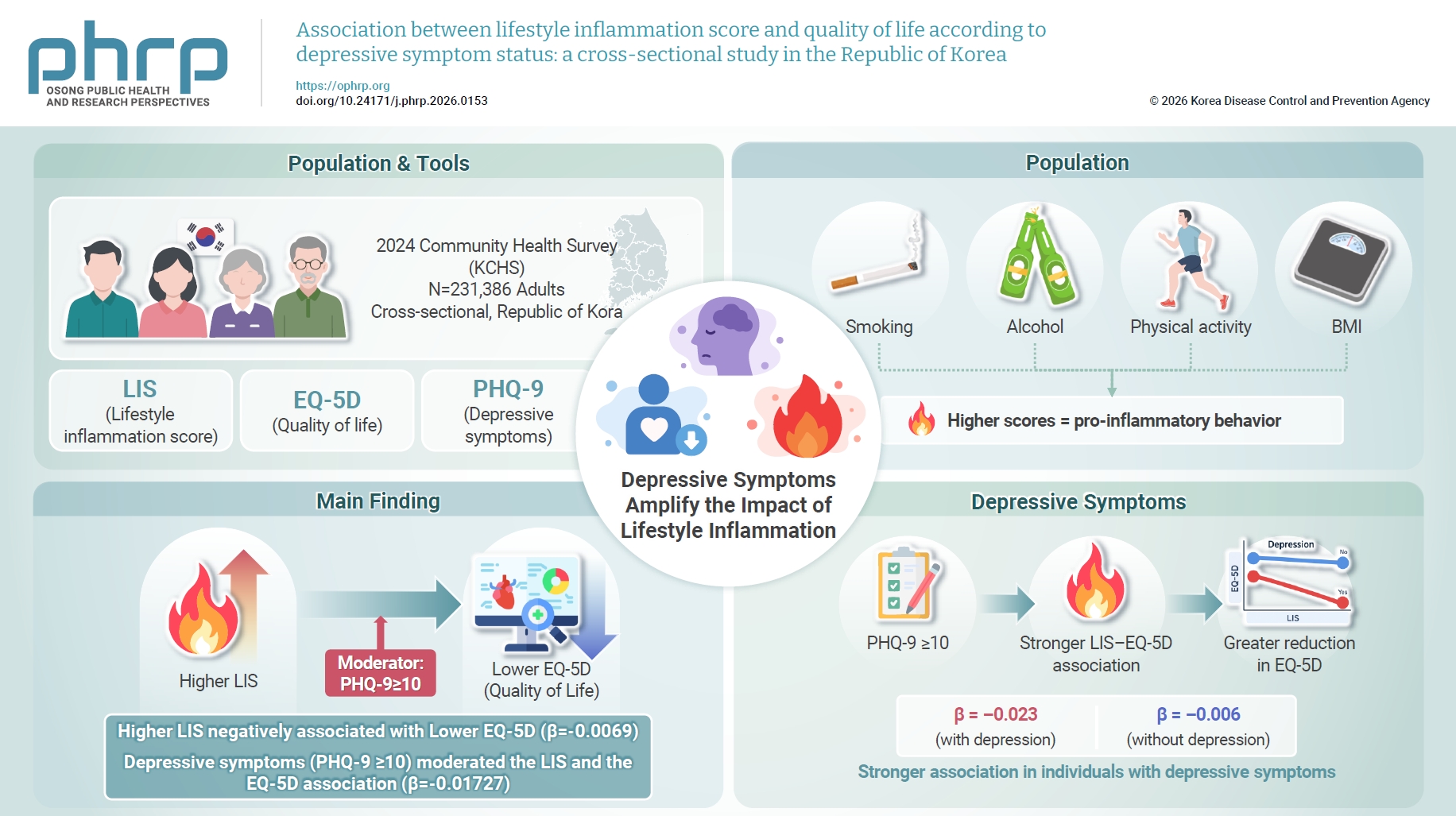
Objectives This study examined the association between lifestyle inflammation score (LIS) and health-related quality of life, assessed using the EuroQol-5 Dimensions (EQ-5D) index, among adults in the Republic of Korea. It also evaluated whether depressive symptoms moderated this association. Methods: Data from the 2024 Community Health Survey were analyzed, and 231,386 adults were included. LIS was calculated by integrating smoking, alcohol consumption, physical activity, and body mass index. The dependent variable, quality of life, was assessed using the EQ-5D index. Depressive symptoms, the moderator variable, were assessed using the Patient Health Questionnaire-9, with a score of ≥10 indicating depressive symptoms. Data were analyzed using complex-sample multivariable linear regression to examine interaction effects according to depressive symptom status, followed by simple-slope analyses. Results: After adjustment for demographic and health-related variables, LIS was significantly and negatively associated with the EQ-5D index (β= –0.0069, p< 0.001), indicating that higher levels of inflammation-related lifestyle behaviors were associated with poorer quality of life. Depressive symptoms significantly moderated the association between LIS and the EQ5D index (β= –0.01727, p< 0.001). Simple-slope analyses showed that the adverse association between LIS and quality of life was stronger among individuals with depressive symptoms (β= –0.02349) than among those without depressive symptoms (β= –0.00621). Conclusion: Inflammation-related lifestyle behaviors were associated with reduced quality of life, and this negative association was stronger among individuals with depressive symptoms. These findings suggest that considering both lifestyle-related inflammatory burden and depressive symptoms may help explain population-level differences in quality of life.
<sec>
<title>Objectives</title>
<p>Unhealthy lifestyles among young people are seriously related to incapacity and health problems in adulthood. The aim of this study was to determine the importance of a health-promoting lifestyle and its association with self-efficacy and well-being.</p></sec>
<sec>
<title>Methods</title>
<p>In this cross-sectional study, a sample of 500 students from Shahroud University of Medical Sciences (Shahroud, Iran) were randomly selected in 2017. The Persian versions of Health-Promoting Lifestyle Profile, Self-Efficacy Scale, and WHO-5 Well-Being Index were used.</p></sec>
<sec>
<title>Results</title>
<p>Among the participants, 34% of students had an abnormal imaginable well-being, and 68% of students had high self-efficacy. The mean score of a health-promoting lifestyle was 127.47 ± 19.78, which is interpreted as moderate, and the mean score of physical activity was 14.10 ± 4.95, which is poor. There was a significant relationship between well-being, and self-efficacy with health-promoting lifestyle. Age, gender, educational level, place of residence, student employment, self-efficacy, and well-being were associated with students’ lifestyles.</p></sec>
<sec>
<title>Conclusion</title>
<p>A health-promoting lifestyle of students in this study was moderate and they did not have an acceptable level of physical activity. The direct effect of well-being, and self-efficacy on lifestyle, revising students’ curriculums to improve their health behaviors, and general health indicators, can all lead to the enhancement of health-promoting lifestyles.</p></sec>
Citations
Citations to this article as recorded by
Health-promoting lifestyle as a predictor of well-being in Honduran university students: a structural equation modeling approach with mental health and sleep quality as mediators Marcio Alexander Castillo-Díaz, Carlos Alberto Henao Periañez Frontiers in Psychology.2026;[Epub] CrossRef
Association of Lifestyle Patterns With Depressive and Anxiety Symptoms Among Chinese Adolescents: A Mediating Effect of Mental Health Literacy Xue Zeng, Wenyan Tan, Zhitao Tang, Yunfei Ke, Hongbo He, Shi-Bin Wang, Marie Kristin Manthey Depression and Anxiety.2026;[Epub] CrossRef
Network analysis of well-being, perceived stress, and self-efficacy among Indian college students Md Ishraf, Sayma Jameel, Mohammad Ghazi Shahnawaz, Arsh Islam, Usama Rehman, Mohd Faijullah Khan, Pragyendu Yadhuvanshi Current Psychology.2026;[Epub] CrossRef
Physical activity and health-promoting lifestyles in adults with chronic diseases: serial indirect associations through subjective well-being and self-efficacy in multiethnic areas of Yunnan, China Hanglin Yu, Zhaozhi Liu, Hansen Li, Haodong Tian, Li Peng Frontiers in Public Health.2026;[Epub] CrossRef
Relationship Between Problematic Internet Use and Health Literacy with Health-Promoting Lifestyle among Students Sajad Javanbakht, Faeze Sobhanifar, Reza Ahmadi Jirandeh, Mohsen Vahedi, Abolfazl Rahgoi International Journal of Preventive Medicine.2026;[Epub] CrossRef
Health-promoting lifestyle among nurses working at tertiary care public hospitals Karachi: a cross-sectional study Ameer Ullah Khan, Abdur Rasheed BMC Nursing.2026;[Epub] CrossRef
The Combined Mediating Effects of Classroom Environment and Student Engagement on the Relationship Between Student Efficacy and Student Wellbeing: Path Analysis Deljie Madanlo, Eugenio Jr. Guhao Psychology and Education: A Multidisciplinary Jour.2026; 61(2): 235. CrossRef
Self‐Efficacy, Healthy and Sustainable Lifestyle, and Life Satisfaction: An Integrated Model Accounting for Self‐Reported Recreational Physical Activity Participation Status in Veterinary Students Sevim Güllü, Alp Emre Yıldız, Maciej Witkowski, Hasan Hüseyin Arı, Ozan Gündemir Veterinary Medicine and Science.2026;[Epub] CrossRef
E-health literacy and health-promoting behaviors among nursing students in China: the mediating role of self-efficacy Xi Chen, Huang Xiao Psychology, Health & Medicine.2025; 30(8): 1757. CrossRef
The Italian Version of the New General Self-Efficacy Scale (NGSES): Structural Validity, Psychometric Properties, and Measurement Invariance Alessandro Alberto Rossi, Stefania Mannarini, Federica Taccini, Gianluca Castelnuovo, Giada Pietrabissa Journal of Clinical Medicine.2025; 14(6): 1988. CrossRef
Estilo de vida entre universitários: um desafio para os futuros profissionais da saúde Gabriel Oliveira Mota, Danilo Duarte Costa, Lucas Almeida de Carvalho, Ana Clara Leite, Barbara Guimarães Sapori Lage, Maria Tereza Carvalho Almeida Revista Brasileira de Educação Médica.2025;[Epub] CrossRef
Lifestyle among college students: a challenge for future health professionals Gabriel Oliveira Mota, Danilo Duarte Costa, Lucas Almeida de Carvalho, Ana Clara Leite, Barbara Guimarães Sapori Lage, Maria Tereza Carvalho Almeida Revista Brasileira de Educação Médica.2025;[Epub] CrossRef
The lifestyle of international students in Poland during the COVID-19 pandemic Olena Kulykovets, Julita Szlachciuk, Hanna Górska-Warsewicz, Irena Ozimek, Trang Nguyen Central European Management Journal.2025; 33(3): 368. CrossRef
Üniversite Öğrencilerinin Sağlık Okuryazarlık Durumu ile Sağlıklı Yaşam Biçimi Davranışlarının İncelenmesi Mehmet Ali Şen, Ümmügülsüm Arslan, Ahmet Tanrıkulu Akdeniz Medical Journal.2025; 11(2): 198. CrossRef
Relationship Between Professional Ethics and Organizational Commitment With Self-Efficacy in Faculty Members Fatemeh Karbin, Arezou Karampourian, Salman Khazaei, Reza Mohammadi Avicenna journal of Care and Health in Operating R.2025; 3(3): 92. CrossRef
Health-promoting Lifestyle and Predicting Anxiety Caused by COVID-19 In Medical Sciences Students Mohammad Amiri, Zahra Mehmannavaz Mikal, Elham Sadeghi, Ahmad Khosravi The Open Public Health Journal.2024;[Epub] CrossRef
Feasibility and outcomes of a community-based, mobile health system-monitored lifestyle intervention in chronic stroke: A pilot study Juhee Kim, Young-Hyeon Bae, Seung Hee Ho, Hyungjoo Lee, Hyukyoung Park Technology and Health Care.2024; 32(4): 2159. CrossRef
WhatsApp‐based intervention for people with type 2 diabetes: A randomized controlled trial Esmaeel Yaagoob, Regina Lee, Michelle Stubbs, Fatimah Shuaib, Raja Johar, Sally Chan Nursing & Health Sciences.2024;[Epub] CrossRef
Investigating the Anxiety Caused by COVID-19 and its Relationship with the Self-efficacy and General Health in Iranian Nurses Mohammad Amiri, Abolfazl Jamalzadeh, Ahmad Khosravi The Open Public Health Journal.2024;[Epub] CrossRef
Psychological distress, health-promoting lifestyle and sociodemographic factors in Honduran university students: a structural equation model Marcio Alexander Castillo-Díaz, María Candelaria Martínez, Carlos Alberto Henao Periañez, Dilcia Sauceda-Acosta Health Promotion International.2024;[Epub] CrossRef
The effect of an educational intervention on healthy lifestyle knowledge and behaviour among middle-aged women Maryam Mohammadi, Sahar Mohammadnabizadeh, Leila Mowlaei, Ali Ramezankhani, Fatemeh Rakhshan, Mahsa Soleimanzadeh Health Education Journal.2024; 83(7): 747. CrossRef
Investigating the Effectiveness of the Health-promoting Lifestyle Educational Program on Suicidal Thoughts in Healthcare Workers Elaheh Abiri, Rasoul Raesi, Maryam Haji Ghasem Kashani The Open Public Health Journal.2024;[Epub] CrossRef
The Association of Self-efficacy with Self-care Behaviors, Anxiety, and Academic Motivation in Iranian Medical Sciences Students Mohammad Amiri, Elham Sadeghi, Ayda Parvane, Ahmad Khosravi The Open Public Health Journal.2024;[Epub] CrossRef
The impact of health promotion training on university students’ health perceptions, healthy lifestyle behaviors, and risky behaviors Bahar Kefel¡ Çol, Ayşe Gümüşler Başaran, Burcu Genç Köse Frontiers in Psychology.2024;[Epub] CrossRef
Context matters: criticism and accommodation by close others associated with treatment attitudes in those with anxiety Olivia A. Merritt, Karen Rowa, Christine L. Purdon Behavioural and Cognitive Psychotherapy.2023; 51(1): 21. CrossRef
The well-being of Iranian adult citizens; is it related to mental health literacy? Seyed Mohammad Hossein Mahmoodi, Maryam Rasoulian, Elaheh Khodadoust, Zahra Jabari, Sahar Emami, Masoud Ahmadzad-Asl Frontiers in Psychiatry.2023;[Epub] CrossRef
Context is belangrijk: kritiek en accommodatie door naasten in relatie tot de behandelattitude van mensen met angstklachten Olivia A. Merritt, Karen Rowa, Christine L. Purdon Gezinstherapie Wereldwijd.2023; 34(3): 262. CrossRef
Health-promoting lifestyle and its determining factors among students of public and private universities in Iran Mohammad Amiri, Mehdi Raei, Elham Sadeghi, Leila Keikavoosi-Arani, Ahmad Khosravi Journal of Education and Health Promotion.2023;[Epub] CrossRef
Physical Exercise Pattern for Undergraduate Students and Its Importance in the Quality of Life, Well-Being, and Future Patient Orientation André Souza Leite Vieira, Simony Lira Nascimento, Tamiris Aparecida de Moraes Fiorato, Laura Cintra Vinchi, Fernanda Garanhani Surita Journal of Lifestyle Medicine.2023; 13(2): 110. CrossRef
Health‐promoting behaviors and self‐efficacy among nursing students in times of uncertainty Rita Doumit, Maha Habre, Rebecca Cattan, Joelle Abi Kharma, Beena Davis Worldviews on Evidence-Based Nursing.2022; 19(6): 500. CrossRef
Hemşirelik Öğrencilerinin Sağlıklı Yaşam Biçimi Davranışları ve Sağlık Okuryazarlık Düzeyleri Şenay AKGÜN, Hümeyra HANÇER TOK, Duygu OZTAŞ Gümüşhane Üniversitesi Sağlık Bilimleri Dergisi.2021; 10(2): 247. CrossRef
Lifestyle in Female Teachers: Educational Intervention Based on Self‐Efficacy Theory in the South of Fars Province, Iran Fariba Abbasi, Leila Ghahremani, Mahin Nazari, Mohammad Fararouei, Zakieh Khoramaki, Matteo Curcuruto BioMed Research International.2021;[Epub] CrossRef
Studying the Effect of Nurses' Health-Promoting Behaviors on Nursing Care Quality Younghui Hwang, Jihyun Oh Journal of Integrative Nursing and Palliative Care.2021; 2(2): 14. CrossRef
Investigation of Health-Promoting Lifestyle and its Determinants Among Students of Medical Sciences in Iran Mohammad Amiri, Ahmad Khosravi, Niloofar Aboozarzadeh, Leila Khojasteh, Zakieh Sadeghi, Mehdi Raei The Open Public Health Journal.2020; 13(1): 627. CrossRef
Study of the Relationship Between Self-Efficacy, General Health and Burnout Among Iranian Health Workers Mohammad Amiri, Hassan Vahedi, Seyed Reza Mirhoseini, Ahmad Reza Eghtesadi, Ahmad Khosravi Osong Public Health and Research Perspectives.2019; 10(6): 359. CrossRef
<sec>
<title>Objectives</title>
<p>To describe the distribution of social factors, lifestyle habits and anthropometric measurements according to hypertension and Type-2 diabetes.</p></sec>
<sec>
<title>Methods</title>
<p>A cross-sectional study was conducted in Gaza City, Palestine that included 379 patients (20–60 years) who had hypertension and/or diabetes. Three groups of patients were involved; 106 hypertensive (HT), 109 diabetic (T2DM) and 164 hypertensive diabetics (HT + T2DM).</p></sec>
<sec>
<title>Results</title>
<p>The HT + T2DM group were older and had a higher body mass index compared to HT and T2DM groups. There were 62.3% patients who were female, 49.2% were highly educated HT patients, and 49.3% patients had a low level of education and were HT + T2DM. There were 55.8% patients who lived in large families. Patients who were passive smokers or never smoked before were mostly HT + T2DM, while active smokers and past smokers had T2DM. There were 48.2% patients who were highly physically active who had HT, 40.9% whom were moderately active had T2DM, and 53.8% of patients who had a low level of activity were HT + T2DM. Multivariate linear regression showed that having a diseased mother, living in a large family, being a past or passive smoker, or never having smoked, having a low or moderate level of activity, and having HT or HT + T2DM, were significantly associated with an increased body mass index.</p></sec>
<sec>
<title>Conclusion</title>
<p>Parental health/disease conditions and environmental factors (social network and lifestyle habits) played the greatest role in the development of obesity and disease.</p></sec>
Citations
Citations to this article as recorded by
Barriers and facilitators of lifestyle management among diabetic patients in palestine: a qualitative exploration of physician perspectives Alzahra Hamdan, Fatima Al Hanini, Therese Zink, Beesan Maraqa Discover Health Systems.2025;[Epub] CrossRef
Continuity of Chronic Disease Care in Gaza: a Commentary on Health System Collapse and Humanitarian Imperatives Mohd Sharique Katchhi, Long Chiau Ming Journal of Epidemiology and Global Health.2025;[Epub] CrossRef
Second brain: reviewing the gut microbiome’s role in lifestyle diseases Hindol Ray, Janatum Khatum, Srijan Haldar, Priyanka Bhowmik BioTechnologia.2025; 106(1): 103. CrossRef
Factors associated with physical inactivity among Palestinians with type 2 diabetes mellitus treated in resource-limited settings Ramzi Shawahna, Mohammad Jaber, Arob Zmiro, Sewar Kashkoush Scientific Reports.2024;[Epub] CrossRef
Time trends in Alzheimer’s disease mortality attributable to metabolic risks and smoking in China from 1990 to 2019: an age-period-cohort analysis Simeng Sun, Ting Zhang, Hao Yu, Ting Xia, Yunan Yao, Mengting Sun, Hongmei Liang, Qiaoyu Huang, Weiwei Wang, Huafeng Yang, Xin Hong Frontiers in Aging Neuroscience.2024;[Epub] CrossRef
Prevalence of hypertension and its associated factors among healthcare workers in the Gaza Strip, Palestine: a cross-sectional study Joma Younis, Lina Wang, Kejing Zhang, Majed Jebril, Hong Jiang, Yahui Fan, Zhaofang Li, Mei Ma, Le Ma, Zhaozhao Hui, Mao Ma, Wei Zhang BMJ Open.2024; 14(12): e076577. CrossRef
Analysis of the nutritional status in the Palestinian territory: a review study Enas A. Assaf, Haleama Al Sabbah, Ayoub Al-Jawadleh Frontiers in Nutrition.2023;[Epub] CrossRef
The hypertension cascade of care in the midst of conflict: the case of the Gaza Strip Bassam A. Abu Hamad, Zeina Jamaluddine, Gloria Safadi, Marie-Elizabeth Ragi, Raeda El Sayed Ahmad, Eszter P. Vamos, Sanjay Basu, John S. Yudkin, Mohammed Jawad, Christopher Millett, Hala Ghattas Journal of Human Hypertension.2022; 37(10): 957. CrossRef
Association between endothelial nitric oxide synthase and the renin-angiotensin-aldosterone system polymorphisms, blood pressure and training status in normotensive/pre-hypertension and hypertensive older adults: a pilot study Roberta Fernanda da Silva, Riccardo Lacchini, Lucas Cezar Pinheiro, Letícia Perticarrara Ferezin, José Eduardo Tanus-Santos, Marcelo Rizzatti Luizon, Thiago José Dionísio, Carlos Ferreira Santos, Thaís Amanda Reia, André Mourão Jacomini, Ana Maria Guilmo Clinical and Experimental Hypertension.2021; 43(7): 661. CrossRef
Breakfast characteristics, perception, and reasons of skipping among 8th and 9th-grade students at governmental schools, Jenin governance, West Bank Manal Badrasawi, Ola Anabtawi, Yaqout Al-Zain BMC Nutrition.2021;[Epub] CrossRef
Advanced Molecular Imaging (MRI/MRS/1H NMR) for Metabolic Information in Young Adults with Health Risk Obesity Khin Thandar Htun, Jie Pan, Duanghathai Pasanta, Montree Tungjai, Chatchanok Udomtanakunchai, Thanaporn Petcharoen, Nattacha Chamta, Supak Kosicharoen, Kiattisak Chukua, Christopher Lai, Suchart Kothan Life.2021; 11(10): 1035. CrossRef
Prevalence and Predictors of Co-occurring Hypertension and Depression Among Community-Dwelling Older Adults Cicily A. Gray, Omar T. Sims, Hyejung Oh Journal of Racial and Ethnic Health Disparities.2020; 7(2): 365. CrossRef
Prevalence of Type 2 Diabetes and Its Association with Added Sugar Intake in Citizens and Refugees Aged 40 or Older in the Gaza Strip, Palestine Majed Jebril, Xin Liu, Zumin Shi, Mohsen Mazidi, Akram Altaher, Youfa Wang International Journal of Environmental Research an.2020; 17(22): 8594. CrossRef



 First
 Prev


