Introduction
Chikungunya fever is a mosquito-borne infectious disease caused by chikungunya virus (CHIKV) that has reemerged in recent years and is now geographically widespread in many regions of the world. Since 2005, more than 2 million chikungunya cases have been reported in more than 110 countries across Asia, Africa, Europe, and the Americas [
1]. CHIKV, the causative agent, is an RNA virus belonging to the genus
Alphavirus in the family
Togaviridae.
Aedes aegypti and
A. albopictus are the major vectors of CHIKV [
2]. After an infected mosquito bites a susceptible person, clinical signs and symptoms of chikungunya typically appear within 2–12 days and include fever, headache, myalgia, rash, and joint pain [
3]. Viremia can occur shortly before symptom onset and generally persists for approximately 1 week after symptom onset [
1]. An estimated 3%–25% of CHIKV infections are asymptomatic [
4]. Therefore, asymptomatic or presymptomatic infected travelers returning from endemic areas may contribute to local CHIKV transmission through mosquito bites [
5].
Although CHIKV transmission is maintained primarily in endemic countries, chikungunya importation events have been reported worldwide [
6,
7]. Even when a traveler’s country of origin is non-endemic, infected travelers can cause clusters or small outbreaks after importation, as observed in Italy and France [
8,
9]. In Japan, the first imported chikungunya case was notified in 2006, and additional cases have been reported since then [
10,
11]. Domestic, or autochthonous, CHIKV transmission has not been reported in Japan [
12]. However,
A. albopictus is widely distributed in Japan, and its habitat has expanded into northern prefectures as global temperatures have increased [
13]. As climate change progresses alongside globalization in trade and travel, models predict that the geographic area at risk may expand, indicating that chikungunya transmission risk is likely to increase over time [
14,
15]. Therefore, understanding epidemiological trends in imported chikungunya cases is essential because these cases may serve as index cases for autochthonous outbreaks.
Under the Infectious Diseases Control Law, chikungunya has been a notifiable disease in Japan since February 2011. A previous study documented imported chikungunya cases in Japan from 2006 to 2016 and demonstrated the usefulness of analyzing imported cases for risk assessment [
10]. However, no subsequent studies have analyzed chikungunya risk among Japanese travelers, including the relationship between imported-case incidence and local epidemiology in travel destinations. Comparing the risk of imported infections among travelers with local epidemiology in destination countries has been highly useful for dengue virus infection, another mosquito-borne disease, in the United States, Japan, and Europe [
16–
19].
The purpose of this study was to descriptively characterize imported cases of chikungunya fever in Japan and to explore the relationship between disease incidence among Japanese travelers and incidence in their destination countries.
Materials and Methods
Epidemiological Datasets
This study analyzed 4 data sources: (1) notification data for imported chikungunya cases in Japan from 2011 to 2023; (2) statistics on Japanese international travelers visiting South and Southeast Asian countries from 2011 to 2023; (3) confirmed chikungunya cases reported to surveillance authorities in endemic countries; and (4) population census data for each travel-destination country.
In Japan, chikungunya is classified as a category IV notifiable disease under the Infectious Diseases Control Law. Confirmation of suspected chikungunya requires a positive result from at least 1 of the following laboratory methods: direct virus isolation, detection of virus-specific nucleic acid sequences by reverse transcription polymerase chain reaction, or detection of anti-CHIKV immunoglobulin M antibody or neutralizing antibody [
20]. Chikungunya cases notified from 2011 to 2023 and the country of origin for each case were retrieved from the Infectious Disease Weekly Surveillance and Annual Report of the National Institute of Infectious Diseases [
21,
22]. Sex and age data were available only for cases notified from 2011 to 2021 [
22]. From 2011 to 2023, 155 chikungunya cases were imported from 30 countries or regions. The 5 countries with the highest incidence of importation were Myanmar, India, Indonesia, the Philippines, and Thailand, which together accounted for 72.3% of imported cases. The relationship between chikungunya incidence among Japanese travelers and incidence in the destination country was analyzed for these 5 countries.
Yearly data on Japanese international travelers who visited Myanmar, India, Indonesia, the Philippines, and Thailand were obtained from the Japan National Tourist Organization [
23]; Japanese Tourism Marketing Company [
24]; Ministry of Hotels and Tourism, Myanmar [
25]; Ministry of Tourism, India [
26]; Statistics Indonesia [
27]; and Department of Tourism, the Philippines [
28]. Data on Japanese travelers visiting India in 2023 were not yet available. Monthly traveler data for Japanese travelers visiting Myanmar, Indonesia, the Philippines, and Thailand were obtained from the Japanese Tourism Marketing Company [
24]; Ministry of Hotels and Tourism, Myanmar [
25]; and Statistics Indonesia [
29]. The Myanmar and Indonesia data were restricted to 2018–2023 and 2017–2023, respectively. For India, quarterly data from 2011 to 2022 were available instead of monthly data and were obtained from the Ministry of Tourism, India [
26].
For domestically notified chikungunya cases in these endemic countries, the yearly reported number of cases for India, Indonesia, the Philippines, and Thailand was obtained from the National Center for Vector Borne Diseases Control, India [
30,
31]; Ministry of Health, Indonesia [
32]; Department of Health, the Philippines [
33,
34]; and Department of Disease Control, Thailand [
35], respectively. Data for the Philippines and Thailand were restricted to 2016–2023 and 2011–2022, respectively. Monthly data were available for the Philippines from 2016 to 2022 and for Thailand from 2011 to 2021 from the same sources. Finally, yearly population estimates for these countries from 2011 to 2023 were retrieved from World Bank Open Data [
36].
Epidemiological Analysis
A descriptive analysis of imported cases was conducted with 3 specific objectives. First, the descriptive characteristics of imported chikungunya cases in Japan were examined by assessing their distribution by age group, sex, year, and country visited.
Second, to assess the relationship between imported cases and the epidemic situation in the country of origin, the incidence of imported chikungunya cases among Japanese travelers was compared by destination with the incidence in the corresponding destination country. This comparison was performed on 2 time scales: yearly and monthly. For the yearly analysis, the notification rate of chikungunya among Japanese travelers returning from a chikungunya-endemic country was calculated by dividing the number of reported imported cases by the total number of Japanese travelers who visited that country. To calculate the notification rate of chikungunya in each endemic country, yearly total notifications were divided by population size. Country-specific yearly notification-rate trends among Japanese travelers were compared with the corresponding trends in the countries visited, and correlations were evaluated using Spearman’s rank correlation coefficient, ρ. Yearly comparisons were restricted to India, Indonesia, the Philippines, and Thailand, for which national surveillance data were publicly available. Monthly comparisons were also performed. The number of imported chikungunya cases in Japan from each chikungunya-endemic country—Myanmar, Indonesia, the Philippines, or Thailand—was aggregated by month over the period 2011–2023. Monthly data were aggregated across years because the number of cases reported in each month was small. Similarly, the total number of Japanese travelers who visited each country in each month was aggregated across the years from 2011 to 2023 for which data were available. The cumulative notification rate was then calculated by dividing the aggregated number of chikungunya cases by the aggregated number of Japanese travelers who visited the country. In addition, to analyze the relationship between monthly trends in imported and local cases, statistical correlations were assessed for the Philippines from 2016 to 2022 and Thailand from 2011 to 2021, for which monthly domestically notified case data were available. Spearman’s test was again performed.
Third, the incidence of imported chikungunya in Japan was compared between months in the high- and low-transmission seasons for each destination country. This comparison was performed by calculating the relative risk and associated 95% confidence intervals (CIs) for chikungunya importation during the high-transmission season compared with the low-transmission season. For the Philippines and Thailand, the high-transmission season was defined based on monthly domestic chikungunya notifications. For Myanmar, India, and Indonesia, for which monthly domestic case data were unavailable, historical chikungunya seasons reported in the literature were used [
37–
40].
Results
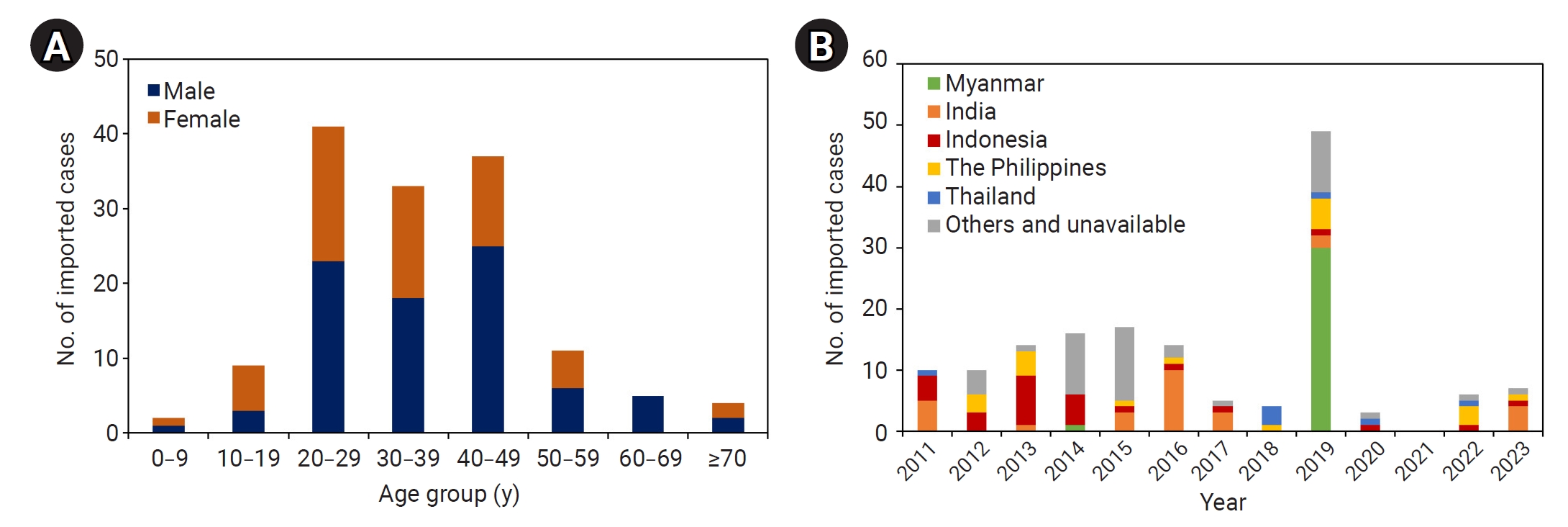
A total of 155 imported chikungunya cases were notified in Japan from 2011 to 2023. Among these cases, sex and age information was available only for 142 cases notified during 2011–2021. Of these 142 cases, 83 (58%) occurred in male individuals, and the most frequently notified age group was 20–29 years (41 cases [29%]) (
Figure 1A). From 2011 to 2023, chikungunya cases were imported from 30 countries or regions; the destination was multiple countries or unidentified for 9 cases. The 5 countries of origin with the largest number of imported chikungunya cases were Myanmar (31 cases), India (28 cases), Indonesia (27 cases), the Philippines (19 cases), and Thailand (7 cases), which together accounted for 112 cases (72.3%). The annual number of notifications was highest in 2019 (49 cases) (
Figure 1B).
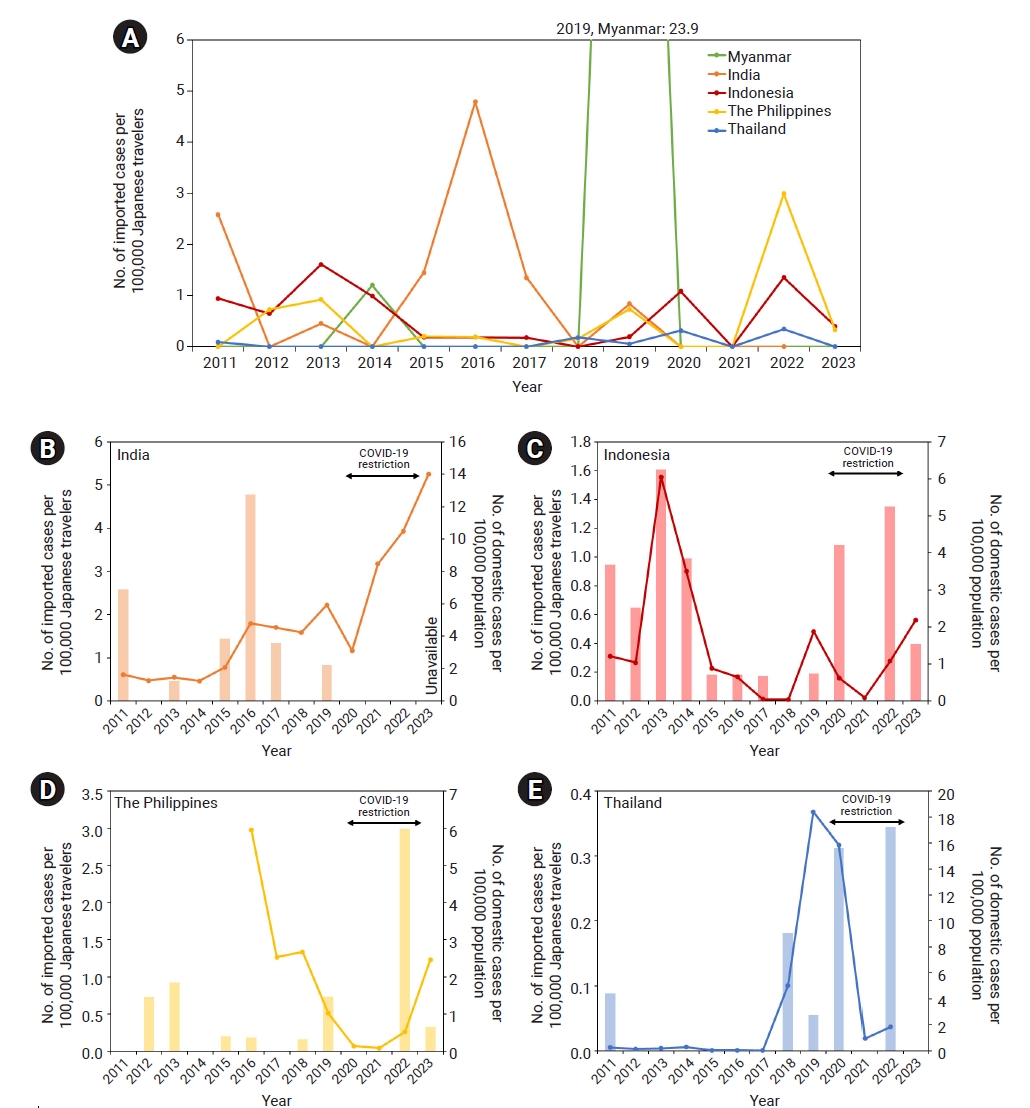
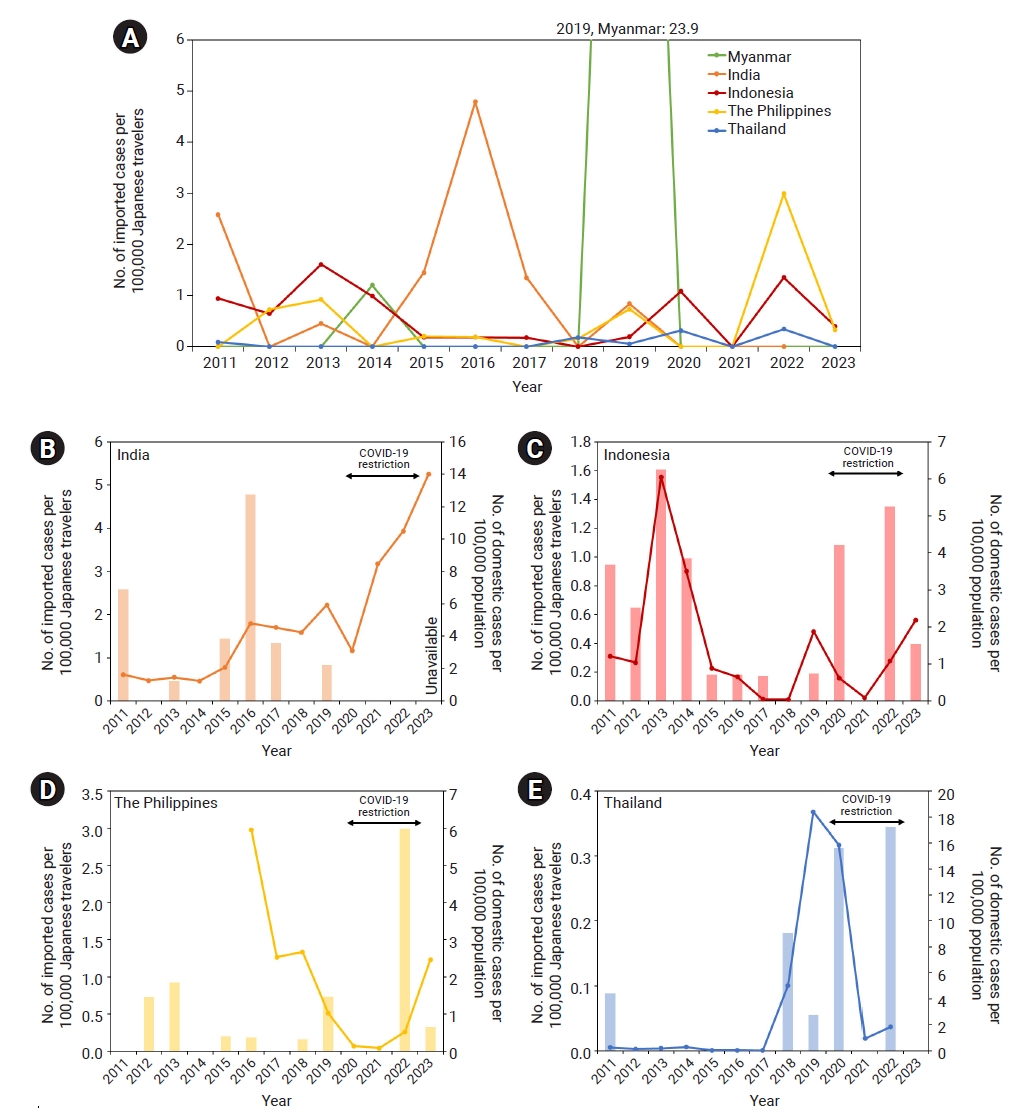
When the annual country-specific notification rate per 100,000 Japanese travelers was calculated, apparent importation peaks were identified in 2016 for India and in 2019 for Myanmar (
Figure 2A). The long-term trend in annual imported cases per 100,000 travelers visiting Indonesia and Thailand closely mirrored the trend in annual domestically reported chikungunya cases per 100,000 local residents in the country of origin (ρ=0.70,
p<0.01 for Indonesia and ρ=0.72,
p<0.01 for Thailand) (
Figure 2C,
E). For India, no imported cases were reported from 2020 to 2022 during the coronavirus disease 2019 pandemic, whereas the number of domestic cases increased during the same period; therefore, the annual number of imported cases did not show a meaningful correlation with the number of domestic cases (ρ=0.04,
p=0.92) (
Figure 2B). In the Philippines, the number of imported cases remained small, and annual imported and domestic cases were not proportional (ρ=0.15,
p=0.73) (
Figure 2D).
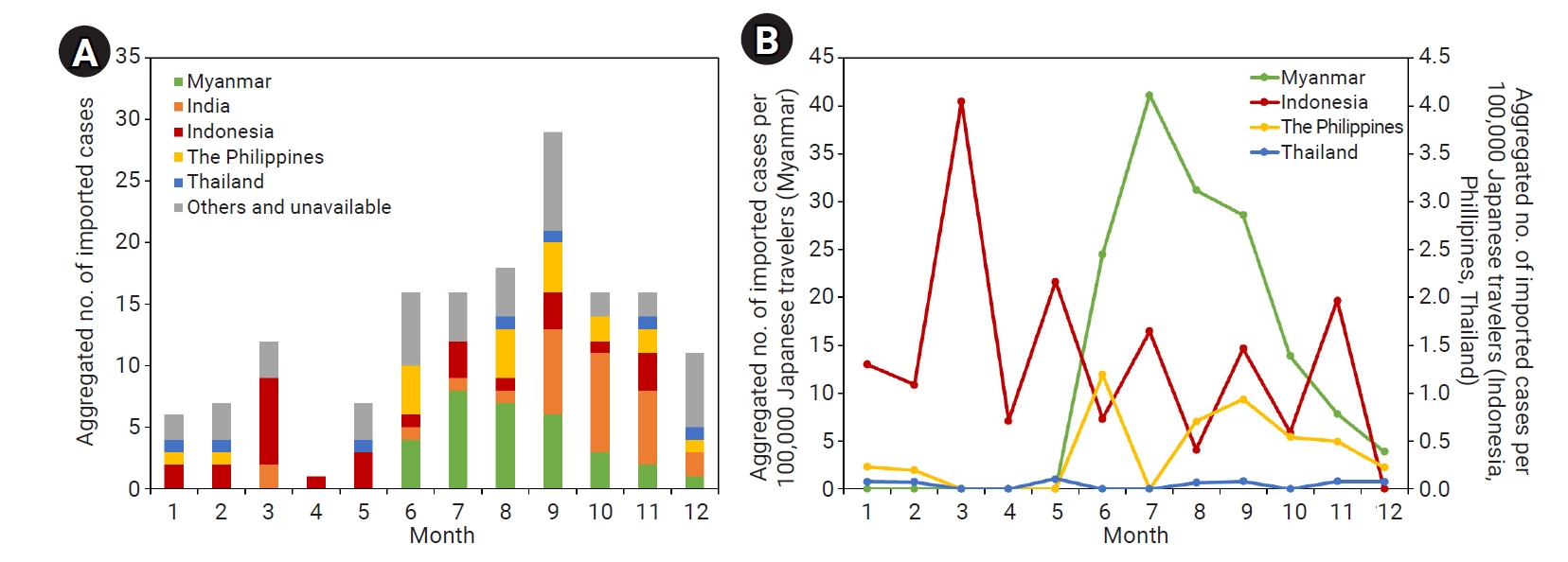
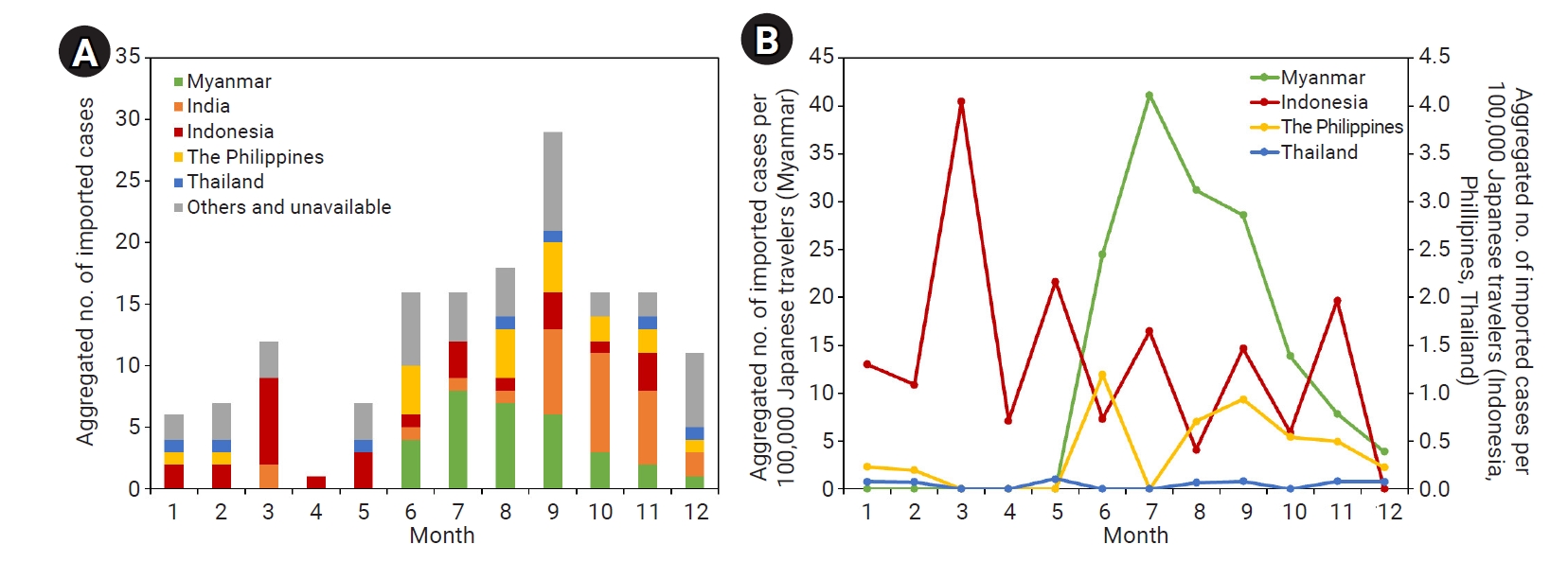
Seasonally, the aggregated number of imported cases by month from 2011 to 2023 was highest from June through November and peaked in September, although the distribution varied by country (
Figure 3A). When the monthly number of imported cases from 2011 to 2023 was calculated as cumulative monthly notifications of country-specific imported cases per 100,000 Japanese travelers, monthly trends in cases from Myanmar and the Philippines were qualitatively consistent with seasonal trends in the overall number of imported cases. For Indonesia, a country located on the equator, cumulative notification rates peaked in March, although notifications were relatively constant throughout the year. For Thailand, no apparent seasonality was identified (
Figure 3B). The monthly notification rate among Japanese travelers was weakly but significantly positively correlated with that in the destination country for the Philippines (ρ=0.26,
p=0.02) and Thailand (ρ=0.22,
p=0.01) (
Figure S1).
Among the 5 leading countries of origin, the estimated incidence of imported chikungunya cases among Japanese travelers was highest for Myanmar, followed by India, Indonesia, the Philippines, and Thailand (
Table 1). To compare estimated incidence between high- and low-transmission seasons for each country, the high-transmission seasons for the Philippines (June–October) and Thailand (June–December) were defined as consecutive months in which the aggregated monthly number of domestic chikungunya cases exceeded the annual mean (
Figure S2). The high-transmission seasons in Myanmar (May–October), India (July–December), and Indonesia (January–March) were defined based on historical chikungunya seasons reported in the literature [
37–
40]. The monthly incidence of imported cases during the high-transmission season was 12.3 (95% CI, 3.7–40.5), 7.4 (95% CI, 2.2–24.9), 12.0 (95% CI, 1.3–107.6), and 4.0 (95% CI, 1.4–11.2) times higher than that during the low-transmission season among travelers returning from Myanmar, India, Indonesia, and the Philippines, respectively. No increased risk was observed among travelers returning from Thailand (
Table 1).
Discussion
In this study, imported chikungunya cases notified through national surveillance from 2011 to 2023 were descriptively analyzed and compared with the local epidemiology in each country of origin. The 5 leading countries of origin were Myanmar, India, Indonesia, the Philippines, and Thailand, which together accounted for 72.3% of imported chikungunya cases. This distribution was similar to that of imported dengue fever, another disease transmitted by the same mosquito vectors [
18,
19]. The yearly chikungunya importation rate among Japanese travelers was correlated with the corresponding rate among local residents in the country of origin. Chikungunya outbreaks have occurred sporadically in endemic countries [
41], and epidemic years in India and Myanmar coincided with peak notification years for imported cases originating from these countries [
42,
43]. Monthly notification-rate analyses further showed that importation risk was consistent with seasonal risk in the country of origin. These findings indicate that the risk of imported chikungunya infection among Japanese travelers reflected the local epidemiology of chikungunya with respect to both seasonal and long-term patterns.
A key message of this study is that travelers should be aware of the epidemiological situation of chikungunya in their destination countries or regions, including seasonality, outbreak patterns, and long-term trends. In addition to local epidemiology, high CHIKV transmission seasons in Myanmar, India, the Philippines, and Thailand coincide with summer vacation periods in Japan, which may contribute to chikungunya importation. These findings underscore the need for travelers and clinicians to consider the local epidemiological situation in the travel destination. When infection risk is high, travelers should take appropriate preventive measures, which may include changing their destination, shifting the timing of travel, using mosquito nets or repellent, reducing skin exposure, and receiving a chikungunya vaccine, such as IXCHIQ (Valneva), which has been approved by the U.S. Food and Drug Administration and the European Medicines Agency [
44,
45]. In addition, epidemiological data on imported cases in Japan may support estimation of local incidence through back-calculation and thereby contribute to improved surveillance at the origin [
46].
These findings may also inform differential diagnosis in outpatient infectious-disease services. The incidence of imported cases from Myanmar, India, Indonesia, and the Philippines was significantly higher during the domestic high-transmission season than during the low-transmission season, indicating that the prior probability of chikungunya is elevated during epidemic periods in the country of origin. Notably, the timing of high-transmission seasons differed across countries. Indonesia had a distinct high-transmission season from January to March, whereas the high-transmission seasons in the other countries occurred mainly during the Japanese summer months. Nevertheless, the incidence of imported chikungunya among Japanese travelers increased during the high-transmission season in each destination country. Thus, information on the country of origin, such as Myanmar, India, Indonesia, the Philippines, or Thailand, together with the season and year of transmission, may contribute substantially to the identification of imported cases in clinical practice. Because chikungunya is generally mild and sometimes asymptomatic, and because symptomatic infection involves nonspecific manifestations, epidemiological information is likely important for improving ascertainment of imported cases. This information may also help guide appropriate laboratory testing for other clinically relevant arboviral infections circulating in the travel destination.
From a public health perspective in Japan, periods of increased chikungunya importation risk during summer vacation coincide with the season when the potential for autochthonous CHIKV transmission by mosquito vectors in Japan is elevated. As noted above, chikungunya often presents with nonspecific clinical manifestations that overlap with those of dengue fever and other arboviral infections. Consequently, chikungunya may be overlooked if diagnostic evaluation focuses primarily on more commonly recognized arboviral diseases, such as dengue fever. Although domestic CHIKV transmission has not yet been reported in Japan, the geographic area at risk is likely to expand in the future [
14,
15]. Therefore, appropriate diagnosis of imported cases is essential for preventing local outbreaks.
Two technical limitations of this study should be considered. First, the risk of chikungunya infection among Japanese travelers was likely underestimated because infections are often mild or asymptomatic [
1]. Incomplete ascertainment is a potential issue because the incubation period and symptomatic illness may be short, symptoms may occur and resolve during travel, making imported cases difficult to identify in Japan [
47]. In addition, chikungunya fever may be underdiagnosed because its symptoms resemble those of other diseases, including dengue fever and Zika fever, and because the diagnostic performance of serological tests is imperfect [
1,
48]. Diagnostic performance also depends on the timing of laboratory testing relative to illness onset. Second, detailed information on specific travel locations, such as locations within the country of origin, and on travelers’ behaviors, such as mosquito exposure, was unavailable. Specific living environments, including accommodations without air conditioning or screened windows and doors, and human behaviors have been reported as risk factors for chikungunya infection [
49,
50]. Differences in notification rates among destination countries, or in trends between Japanese travelers and local populations, could therefore be partly explained by differences in living environments and behaviors.
Despite these technical limitations, this study identified shared seasonal and annual chikungunya trends between Japanese travelers and local residents in the country of origin. Imported-case data may serve as a useful resource for risk assessment in destination countries and may help travelers make risk-informed decisions about travel to areas with increased chikungunya transmission. Such information could support traveler-specific prevention measures, improve diagnosis in outpatient settings, and reduce the risk of autochthonous outbreaks.