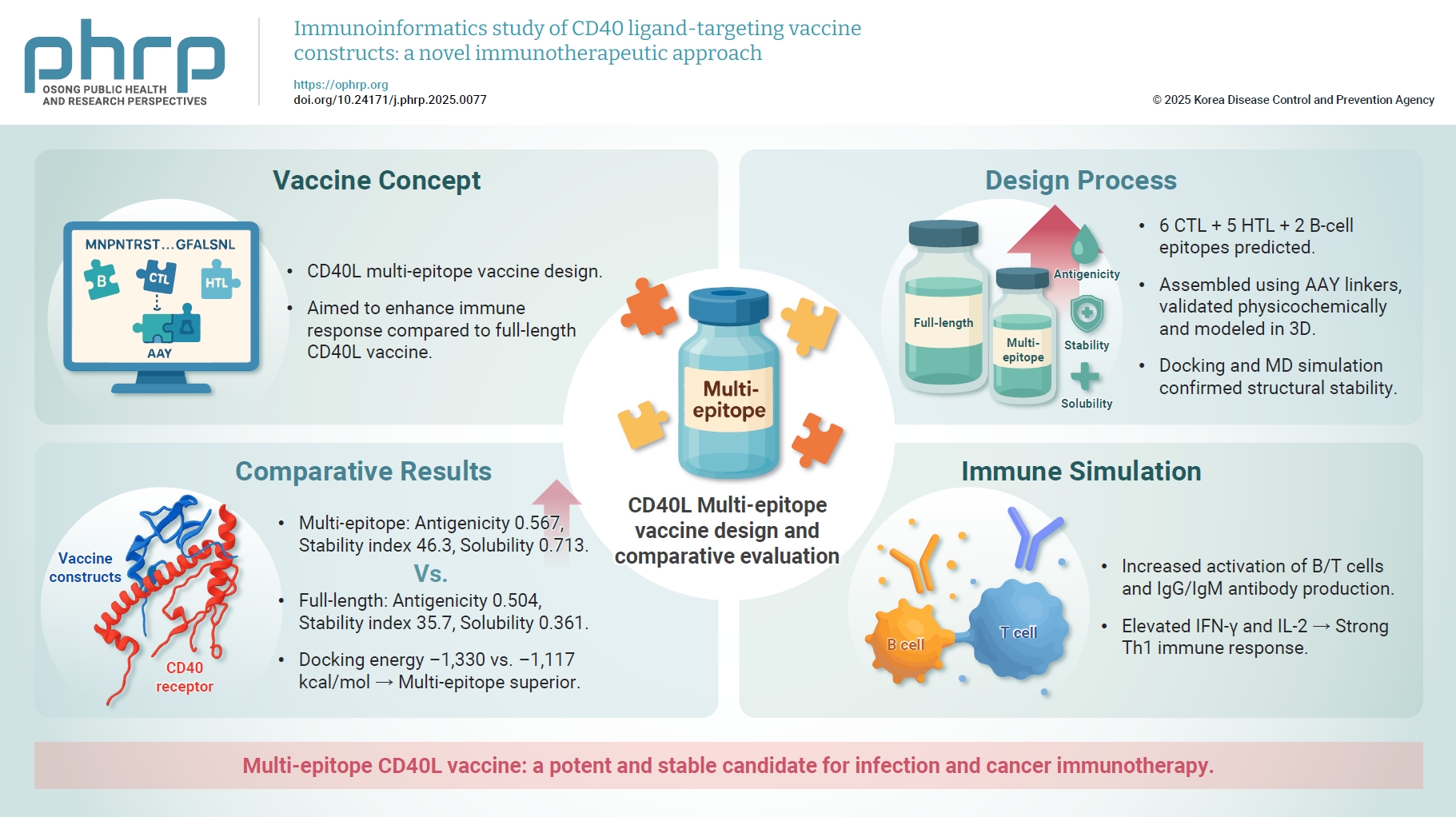
Objectives Incorporating CD40 ligand (CD40L) into vaccine strategies has shown considerable potential for enhancing immune responses. In this study, we designed and formulated a CD40Lbased multi-epitope vaccine construct using immunoinformatics approaches, and compared it to a full-length CD40L-based vaccine construct. Methods: The study commenced with the identification and screening of potential T-cell and B-cell epitopes derived from the CD40L protein, followed by the construction of a multi-epitope vaccine from these selected epitopes. We analyzed and validated the physicochemical and structural properties of the vaccine constructs. Further, we predicted disulfide bonds, performed protein-protein docking, and conducted molecular dynamics simulations to evaluate the constructs. Comparative analyses of the ligand-binding site localization were conducted using LigPlot. Additionally, simulation trajectories were analyzed using multiple descriptors, including root mean square deviations, radius of gyration, and root mean square fluctuations. Results: Our findings indicated that the CD40L multi-epitope vaccine construct possessed favorable physicochemical properties and a validated structural profile. Immune simulation studies showed a stronger affinity of the multi-epitope construct for the CD40 receptor compared to the full-length CD40L construct. Conclusion: Overall, the CD40L multi-epitope vaccine construct demonstrated greater potency in eliciting an effective immune response than the full-length CD40L construct. These results highlight a promising approach to vaccine design for the prevention or treatment of infections and cancers.
Citations
Citations to this article as recorded by
Artificial intelligence and biohealth: the Republic of Korea’s emerging priorities in health care R&D Jong-Koo Lee Osong Public Health and Research Perspectives.2025; 16(4): 309. CrossRef
Objectives This study developed deep neural network (DNN) models capable of accurately classifying major adverse cardiac events (MACE) in patients with acute myocardial infarction (AMI) after hospital discharge, across 3 follow-up intervals: 1, 6, and 12 months. Methods: DNN models were constructed to predict post-discharge MACE across 4 categories. Multiple traditional machine learning models were implemented as controls to benchmark the performance of our DNN approach. All models were evaluated based on their ability to predict MACE occurrence during the specified follow-up periods. Results: The DNN models demonstrated superior predictive performance over conventional machine learning methods, achieving high accuracies of 0.922, 0.884, and 0.913 for the 1-month, 6-month, and 12-month follow-up periods, respectively. Conclusion: The high accuracy of our DNN models highlights their practical advantages for AMI diagnosis and guidance of follow-up treatment. These models can serve as valuable decision support tools, enabling clinicians to optimize the overall management of AMI patients and potentially enhance their hospitalization experience.
Citations
Citations to this article as recorded by
Artificial intelligence and biohealth: the Republic of Korea’s emerging priorities in health care R&D Jong-Koo Lee Osong Public Health and Research Perspectives.2025; 16(4): 309. CrossRef
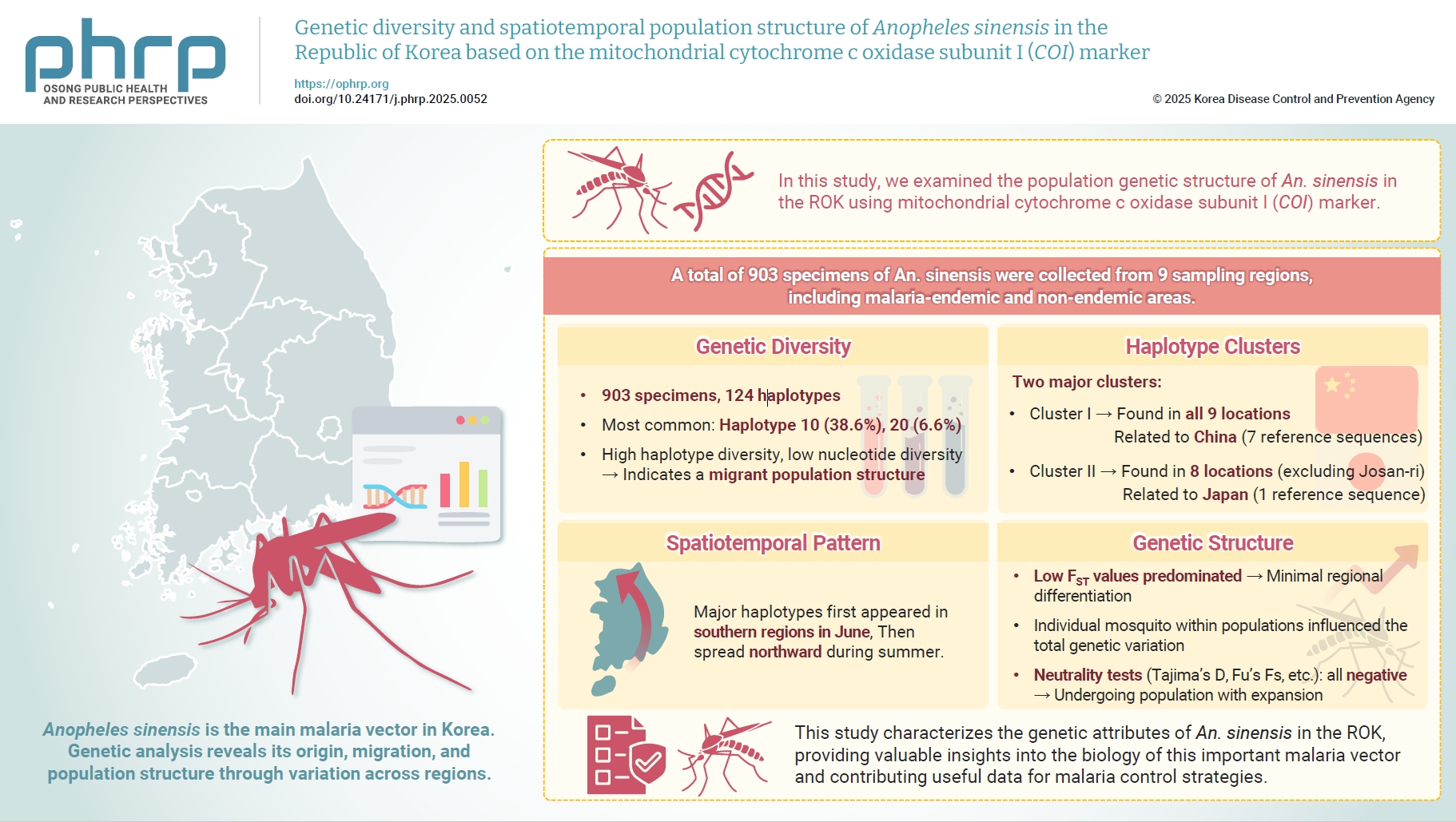
Objectives Anopheles sinensis is a predominant malaria vector found throughout the Republic of Korea (ROK). Population genetic analysis can provide insights into the origins and migration patterns of malaria vectors by assessing genetic variation and distribution among populations. Methods: In this study, we examined the population genetic structure of An. sinensis in the ROK using mitochondrial cytochrome c oxidase subunit I (COI) marker. Results: A total of 903 specimens of An. sinensis were collected from 9 sampling regions, including malaria-endemic and non-endemic areas. All populations displayed characteristics typical of migrant populations, with high haplotype diversity (Hd) and low nucleotide diversity (Pi). Network analysis identified 124 haplotypes grouped into 2 clusters. Both clusters included haplotypes from malaria-endemic and non-endemic areas. Cluster I shared its most recent common ancestry with Chinese reference sequences, while cluster II had related with Japanese reference sequences. Pairwise genetic distance (FST) analysis indicated generally low genetic differentiation among populations. Furthermore, FST values tended to increase proportionally with geographical distance between regions. Analysis of molecular variance confirmed that individual mosquitoes within the population had a large effect on the overall variation. Neutrality tests using 4 methods (Tajima’s D, Fu’s Fs, Fu and Li’s D, and Fu and Li’s F) yielded negative values, suggesting that An. sinensis populations are expanding in all studied regions. Conclusion: This study characterizes the genetic attributes of An. sinensis in the ROK, providing valuable insights into the biology of this important malaria vector and contributing useful data for malaria control strategies.
Citations
Citations to this article as recorded by
Artificial intelligence and biohealth: the Republic of Korea’s emerging priorities in health care R&D Jong-Koo Lee Osong Public Health and Research Perspectives.2025; 16(4): 309. CrossRef
Mona Gamal Mohamed, Eman Abdelaziz Ahmed Dabou, Fatma M. Ibrahim, Shaimaa Abdelsamad, Jibin Kunjavara, Kamaruddeen Mannethodi, Moayad Ahmad Wishah, Abdullah Y. Shihab, Khaled Mohammed Al-Sayaghi, Hammad Ali Fadlalmola, Mohammed Musaed Al-Jabri
Osong Public Health Res Perspect 2025;16(4):357-372. Published online June 25, 2025
Objectives This study aimed to (1) assess healthcare workers’ (HCWs) knowledge and attitudes toward mpox across 3 Gulf countries, and (2) examine factors influencing their acceptance of the mpox vaccine using the health belief model (HBM). This model evaluated perceptions related to susceptibility, severity, benefits, barriers, cues to action, and self-efficacy. Additionally, the study explored the impact of prior coronavirus disease 2019 (COVID-19) vaccination history on mpox vaccine acceptance. Methods: A cross-sectional study was conducted among 764 HCWs from the United Arab Emirates (UAE), Saudi Arabia, and Qatar. Data were collected through a structured online questionnaire based on HBM constructs. Logistic regression and structural equation modeling were employed to analyze predictors of vaccine acceptance. Results: Knowledge levels varied across the countries, with the highest proportion of good knowledge reported in the UAE (59%). UAE HCWs also demonstrated higher perceived susceptibility, perceived benefits, and intention to vaccinate compared to those in Saudi Arabia and Qatar (p<0.001). Receiving 4 doses of the COVID-19 vaccine was associated with greater acceptance of the mpox vaccine. Among the HBM constructs, perceived benefits and self-efficacy were identified as the strongest predictors of vaccine acceptance. Perceived barriers, such as fear of side effects and concerns about vaccine safety, were more prominent among HCWs in Saudi Arabia and Qatar. Conclusion: The HBM effectively explains the factors influencing mpox vaccine acceptance among Gulf HCWs. Targeted interventions that improve perceived benefits, reduce barriers, and improve self-efficacy may facilitate greater vaccine uptake and preparedness for emerging infectious diseases.
Citations
Citations to this article as recorded by
Determinants of Mpox vaccine uptake and hesitancy among healthcare workers in Port Harcourt, Nigeria Moore Ikechi Mike-Ogburia, Chiziyara Orluibna Obunwo, Elizabeth Efeelobari Letam, Ayebaemi Wilfred Dambo, Samuel Chima Agumagu, Tamunosaki Fubara-Manuel, Charles Henry Esukpa BMC Infectious Diseases.2026;[Epub] CrossRef
Knowledge and attitudes toward mpox among the Lebanese population during the second wave and their attitudes toward vaccination Mohammad Tanashat, Nour Fakih, Nour El Bizri, Mohamed Saad Rakab, Mohamed Abouzid, Karen Sleiman, Hadi Hassan, Moetasem Al Sayed, Zahraa Zibara, Ahmad Afyouni, Pascale Salameh Scientific Reports.2026;[Epub] CrossRef
Decoding Vaccine Hesitancy in Mpox Across Multiple Middle Eastern Countries: Public Knowledge, Attitudes, Worry, Conspiracy Beliefs, and Acceptance Mona Gamal Mohamed, Huda Mohamed Ali Rasheed, Manjula G. Bhagavathy, Moayad Ahmad Wishah, Dibbo Protim Ghosh, Md. Rabiul Islam, Ramya Kundayi Ravi Health Science Reports.2026;[Epub] CrossRef
Mpox Awareness and Infection Control Practices Among Hospital Nurses and Healthcare Workers in Bangladesh Hemayet Hossain, Md. Abdur Nur Sakib, Mostafizor Rahman, Zerin Tasnim Romana, Md. Hasan Ali, Snigdha Sharmin Binte Sayeed, Khadiza Akter Brishty, Md. Shahidur Rahman Chowdhury, Md. Mahfujur Rahman Public Health Challenges.2026;[Epub] CrossRef
Artificial intelligence and biohealth: the Republic of Korea’s emerging priorities in health care R&D Jong-Koo Lee Osong Public Health and Research Perspectives.2025; 16(4): 309. CrossRef
Nursing Students’ Knowledge, Attitudes, and Practices Toward Monkeypox Virus: A Cross-Sectional Survey at the University of Palermo, 2022 Barbara Ravazzolo, Francesco Leonforte, Letizia Cascio, Clara Ferrara, Federico Li Causi, Francesco Armetta, Maria Lampasona, Rinaldo Stefano Miceli, Carlo Fantini, Klara Komici, Alberto Firenze Zoonotic Diseases.2025; 6(1): 1. CrossRef
Objectives This study aimed to strengthen the core capabilities of epidemiological investigation and response teams (ERTs) at the Korea Disease Control and Prevention Agency, drawing on lessons learned from the Middle East respiratory syndrome and coronavirus disease 2019 pandemics. The primary objectives were to facilitate rapid and accurate data collection and analysis, improve communication skills, and simulate real-world on-site responses. Methods: The training program was developed using a scenario involving a novel infectious disease from the World Health Organization priority list entering a community. ERTs collected and analyzed epidemiological data and implemented control measures as they addressed the missions of the scenario. Improvement in competencies was assessed through self-evaluation surveys completed before and after training. Results: A total of 49 participants, including disease control officers, epidemiological investigation officers, researchers, and administrative officials, attended the training. Participant satisfaction with the training was high, scoring 6.4 out of 7, and the improvement in competency was statistically significant (pre-training score, 5.2; post-training score, 6.2; p<0.001). Conclusion: Scenario-based training can effectively enhance the capabilities of ERTs. Such training is essential, as emerging and re-emerging infectious diseases can exhibit unpredictable spread and potentially severe impacts. Therefore, developing diverse scenarios and conducting regular training sessions are necessary to improve the capacities of ERTs.
Citations
Citations to this article as recorded by
중앙 및 지자체역학조사반의 현장 역학조사 훈련 수요 조사 유연 김, 미 유, 진 이, 호경 송, 은경 김 Public Health Weekly Report.2026; 19(31): 1324. CrossRef
Objectives Severe trauma remains a leading cause of death in the Republic of Korea. In response, regional trauma centers were established in 2012. This study evaluated the impact of direct prehospital transport to trauma centers on in-hospital mortality among patients with severe trauma using the national trauma registry. Methods: This nationwide observational study utilized data from the Korean community-based trauma registry between 2016 and 2020. Patients with an injury severity score >15 who were directly transported from the prehospital setting were included. Variables analyzed encompassed demographics, injury mechanism, transport time, hospital level, and outcomes. The primary outcome was in-hospital mortality. Both logistic regression and decision tree models were employed. Results: A total of 24,567 patients were included. Overall mortality decreased by 5.2% during the study period. Patients transported to level 1 or 2 trauma centers had a lower mortality rate (23.6%) compared to those transported to level 3 or 4 hospitals (28.0%). The proportion of direct transports to high-level centers increased from 46.7% to 64.1% between 2016 and 2020. Despite longer transport times, patients transported to high-level institutions exhibited improved survival, particularly when transport exceeded 30 minutes, suggesting that hospital selection may be more critical than minimizing transport time. Conclusion: Direct transport to high-level trauma centers improves survival among patients with severe trauma, even when transport times are prolonged. These findings support the importance of a well-organized trauma system that emphasizes hospital capability in prehospital triage decisions.
Citations
Citations to this article as recorded by
Geospatial Optimization of Trauma Care Resource Allocation and Timely Access for Severely Injured Patients Ryan B. Choi, Deeksha Bidare, Byung Hee Kang, Junsik Kwon, Kyungwon Jung, Jeff Choi JAMA Network Open.2026; 9(9): e2636840. CrossRef
Prehospital transport prioritization and time-varying selection bias in traffic-related multi-patient incidents: a nationwide retrospective cohort study Atsushi Kubo, Shinobu Tamura, Atsushi Hiraide, Daigo Morioka, Ryu Murakami, Kenko Fukui, Shigeaki Inoue Critical Care.2026;[Epub] CrossRef
Artificial intelligence and biohealth: the Republic of Korea’s emerging priorities in health care R&D Jong-Koo Lee Osong Public Health and Research Perspectives.2025; 16(4): 309. CrossRef
Objectives This study was performed to evaluate the prevalence of medication adherence and its determinants among Moroccan patients with type 2 diabetes mellitus. Methods: A multicenter cross-sectional survey was conducted from February to June 2024, involving 584 patients from the Casablanca-Settat and Rabat-Sale-Kenitra regions of Morocco. Medication adherence was assessed using the general medication adherence scale. Associations between independent variables and adherence were analyzed using chi-square tests and multivariate logistic regression. Results: Medication adherence was observed in 96.2% of participants. Multivariate analysis revealed significantly lower medication adherence among patients using 2 or more oral antidiabetic drugs (adjusted odds ratio [aOR], 0.026; 95% confidence interval [CI], 0.001–0.642; p=0.026) and those with a diabetes duration of 11 to 15 years (aOR, 0.037; 95% CI, 0.001–0.956; p=0.047). Conclusion: Despite a high overall adherence rate, patients on dual or polytherapy and those with longer disease duration exhibited lower adherence in multivariate analysis. Targeted interventions are needed to improve adherence in these high-risk groups.
Objectives The co-occurrence of tuberculosis (TB) and diabetes mellitus presents a significant global health challenge, marked by a bidirectional relationship. This study aims to evaluate the effectiveness of the tuberculosis predictive index (TPI) score, developed by Isfandiari et al., in predicting TB occurrence among individuals living with type 2 diabetes mellitus. Methods: A case-control study was conducted using primary data collected through questionnaires administered to individuals with type 2 diabetes mellitus, with and without pulmonary TB, at the internal medicine outpatient clinic of Fatmawati General Hospital from June to August 2024. The study compared TPI scores between those with type 2 diabetes mellitus who had TB and those who did not. Results: TPI scores were significantly associated with TB risk. Individuals with both type 2 diabetes mellitus and TB had a 6.8-fold higher risk (95% confidence interval [CI], 2.6–17.6; p<0.001) than those without TB. Further chi-square analysis identified three significant risk factors: individuals with type 2 diabetes mellitus exhibiting TB-like symptoms had a 13.3-fold increased TB risk (95% CI, 5.1–34.3; p<0.001); those with a body mass index below 18.5 kg/m² had a 3.3-fold higher risk (95% CI, 1.0–11.0; p=0.039); and those living in poorly ventilated homes (ventilation ≤10%) had a 3.2-fold higher risk (95% CI, 1.0–9.8; p=0.035). Conclusion: This study demonstrates that individuals with type 2 diabetes mellitus who developed TB had significantly higher TPI scores, corresponding to a 6.8-fold increased risk compared to their counterparts without TB. The TPI score may serve as a valuable tool for predicting TB risk among populations living with type 2 diabetes mellitus.
Citations
Citations to this article as recorded by
Artificial intelligence and biohealth: the Republic of Korea’s emerging priorities in health care R&D Jong-Koo Lee Osong Public Health and Research Perspectives.2025; 16(4): 309. CrossRef
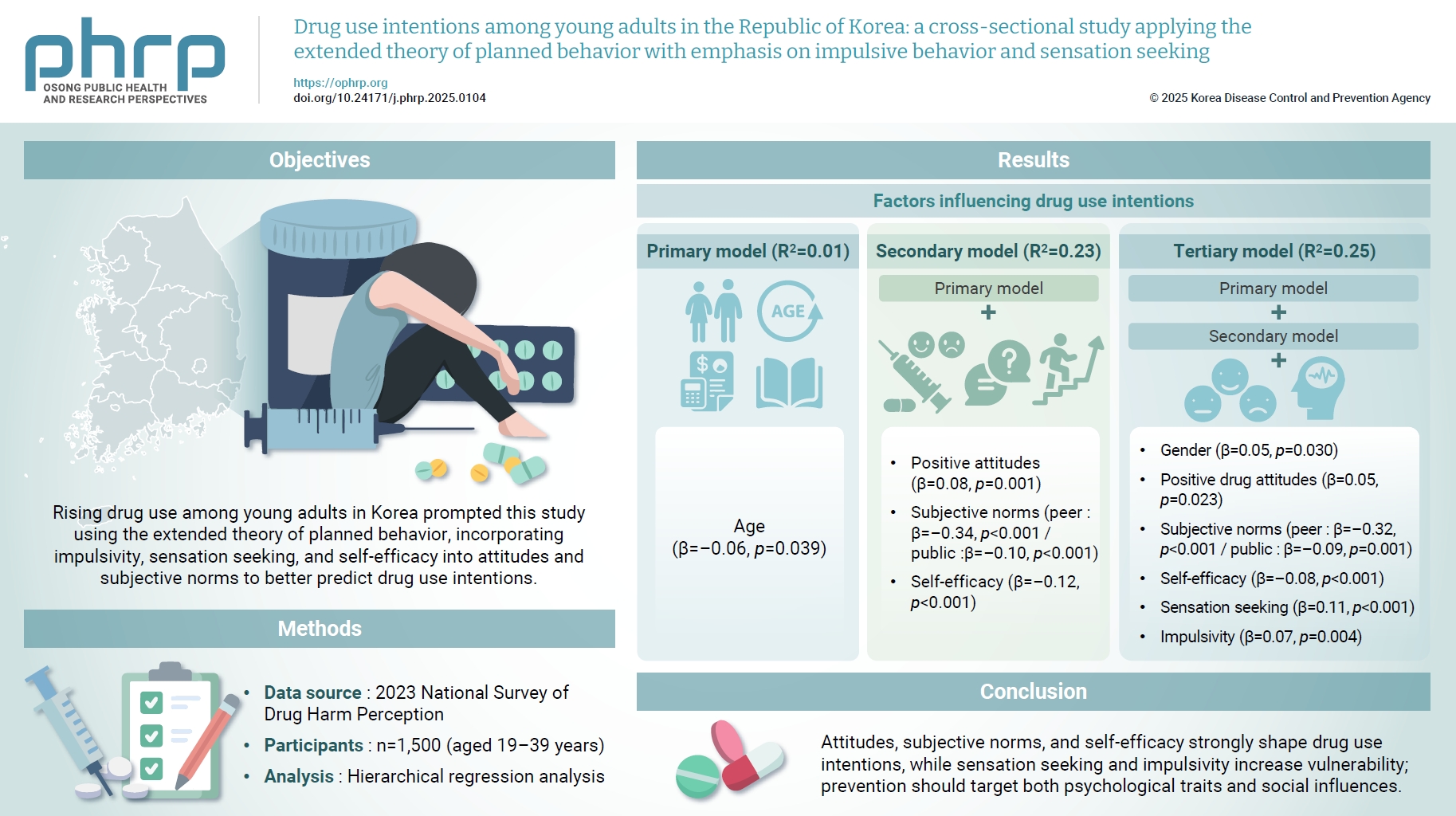
Objectives The increasing prevalence of drug use in the Republic of Korea has emerged as a significant social concern. This study applied the extended theory of planned behavior to investigate the factors influencing intentions to use drugs among young adults (aged 20–30 years) in the Republic of Korea. The study integrated personal traits—specifically, impulsivity, sensation seeking, and self-efficacy—into 2 core theory of planned behavior constructs: attitudes and subjective norms. The principal aim was to improve the prediction of drug use intentions by incorporating these variables. Methods: Data were obtained from the 2023 National Survey of Drug Harm Perception, which sampled 1,500 individuals aged 19 to 39 years. Hierarchical regression analysis was employed to assess the influence of psychological and social factors on intentions to use drugs. Results: In the primary model, age emerged as a significant predictor of drug use intentions (R2 =0.01). The secondary model showed that positive attitudes toward drugs, subjective norms, and lower self-efficacy significantly increased drug use intentions (R2 =0.23). In the final tertiary model, the addition of sensation seeking and impulsivity further amplified these intentions (R2 =0.25). Conclusion: The findings underscore the pivotal roles of attitudes, subjective norms, and selfefficacy in shaping intentions to use drugs. Sensation seeking and impulsivity were found to further elevate vulnerability. Effective prevention efforts must address both psychological traits and social influences. Future research should examine the long-term behavioral outcomes associated with these factors.
Citations
Citations to this article as recorded by
Beliefs and attitudes toward substance use and associated factors among University students in Eastern Turkey Pınar Eryılmaz, Gulpınar Aslan, Irfan Kaplan Journal of Substance Use.2026; : 1. CrossRef
Associations of Health Belief Model Constructs and Self-Control with Drug Avoidance Intention Among University Students in the Republic of Korea: A Cross-Sectional Study Jungmin Lee, Su Jung Lee Behavioral Sciences.2026; 16(9): 1653. CrossRef
Artificial intelligence and biohealth: the Republic of Korea’s emerging priorities in health care R&D Jong-Koo Lee Osong Public Health and Research Perspectives.2025; 16(4): 309. CrossRef







 First
 Prev


