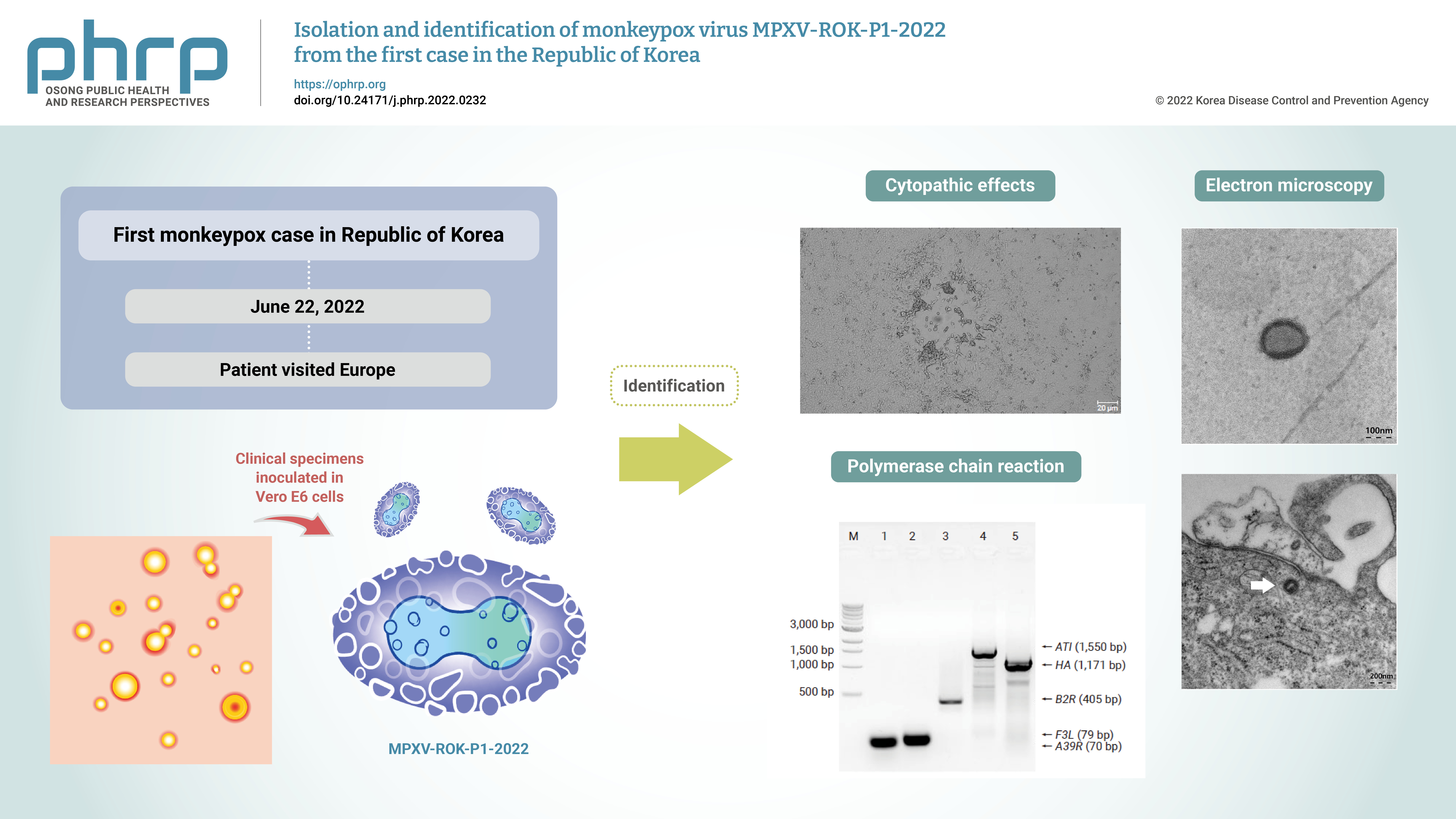
Objectives Monkeypox outbreaks in nonendemic countries have been reported since early May 2022. The first case of monkeypox in the Republic of Korea was confirmed in a patient who traveled to Europe in June 2022, and an attempt was made to isolate and identify the monkeypox virus (MPXV) from the patient’s specimens.
Methods Clinical specimens from the patient were inoculated in Vero E6 cells. The isolated virus was identified as MPXV by the observation of cytopathic effects on Vero E6 cells, transmission electron microscopy, conventional polymerase chain reaction
(PCR), and sequencing of PCR products.
Results Cytopathic effects were observed in Vero E6 cells that were inoculated with skin lesion swab eluates. After multiple passages from the primary culture, orthopoxvirus morphology was observed using transmission electron microscopy. In addition, both MPXV-specific (F3L and ATI) and orthopoxvirus-specific genes (A39R, B2R, and HA) were confirmed by conventional PCR and Sanger sequencing.
Conclusion These results indicate the successful isolation and identification of MPXV from the first patient in the Republic of Korea. The isolated virus was named MPXV-ROK-P1-2022.
Citations
Citations to this article as recorded by
MPXV: Update on Morphological and Morphogenesis Aspects Through Transmission and Scanning Electron Microscopies and 3D Reconstruction Debora Ferreira Barreto‐Vieira, Milene Dias Miranda, Marcos Alexandre Nunes da Silva, Andressa Santos de Almeida, Ana Luisa Teixeira de Almeida, Derick Mendes Bandeira, Vivian Neuza S. Ferreira, Alice Santos Rosa, Wendell Girard‐Dias, Bráulio Soares Archa Journal of Medical Virology.2025;[Epub] CrossRef
Ultrasensitive one-pot detection of monkeypox virus with RPA and CRISPR in a sucrose-aided multiphase aqueous system Yue Wang, Yixin Tang, Yukang Chen, Guangxi Yu, Xue Zhang, Lihong Yang, Chenjie Zhao, Pei Wang, Song Gao, Frederick S. B. Kibenge, Ruijie Deng, Wei Chen, Shuang Yang Microbiology Spectrum.2024;[Epub] CrossRef
Molecular Methods for Diagnosis of Monkeypox: A Mini-review Rodrigo Michelini de Oliveira Thomasi, Thais da Silva Correa, Dalise Silva do Carmo, Déborah Fernandes Rodrigues, Luiz Vinicius da Silva Correa, Sandra Rodrigues Xavier, Líria Souza Silva, Jonatas Oliveira da Silva, Michelli dos Santos, Alessandra da Silv Current Molecular Medicine.2024; 24(10): 1208. CrossRef
Factors Predicting the Intention to Engage in Self-Protective Behavior against Monkeypox Infection among Thai People Awirut Singkun, Wichan Phibarn, Wichaporn Intharachuti, Arunothai Derramon, Thitika Kimise Journal of Health Research.2024;[Epub] CrossRef
Epidemiological, Clinical, and Virological Investigation of the First Four Cases of Monkeypox in Cartagena during the 2022 Outbreak Steev Loyola, Mashiel Fernández-Ruiz, Doris Gómez-Camargo Pathogens.2023; 12(2): 159. CrossRef
원숭이두창바이러스의 분리 배양과 전장유전체 정보 분석 민지 이, 진원 김, 치환 최, 화철 신, 명민 최, 상은 이, 화중 이, 윤석 정 Public Health Weekly Report.2023; 16(15): 464. CrossRef
Overview of Diagnostic Methods, Disease Prevalence and Transmission of Mpox (Formerly Monkeypox) in Humans and Animal Reservoirs Ravendra P. Chauhan, Ronen Fogel, Janice Limson Microorganisms.2023; 11(5): 1186. CrossRef
How to cope with suspected mpox patients in the outpatient clinic Nam Joong Kim, Sun Huh Journal of the Korean Medical Association.2023; 66(5): 325. CrossRef
An Updated Review on Monkeypox Viral Disease: Emphasis on Genomic Diversity Ali Rabaan, Nada Alasiri, Mohammed Aljeldah, Abeer Alshukairiis, Zainab AlMusa, Wadha Alfouzan, Abdulmonem Abuzaid, Aref Alamri, Hani Al-Afghani, Nadira Al-baghli, Nawal Alqahtani, Nadia Al-baghli, Mashahed Almoutawa, Maha Mahmoud Alawi, Mohammed Alabdull Biomedicines.2023; 11(7): 1832. CrossRef
Monkeypox (Mpox) virus isolation and ultrastructural characterisation from a Brazilian human sample case Milene Dias Miranda, Gabriela Cardoso Caldas, Vivian Neuza Ferreira, Ortrud Monika Barth, Aline de Paula Dias da Silva, Mayara Secco Torres Silva, Beatriz Grinsztejn, Valdiléa Gonçalves Veloso, Thiago Moreno Souza, Edson Elias da Silva, Debora Ferreira Ba Memórias do Instituto Oswaldo Cruz.2023;[Epub] CrossRef
Isolation and Characterization of Monkeypox Virus from the First Case of Monkeypox — Chongqing Municipality, China, 2022 Baoying Huang, Hua Zhao, Jingdong Song, Li Zhao, Yao Deng, Wen Wang, Roujian Lu, Wenling Wang, Jiao Ren, Fei Ye, Houwen Tian, Guizhen Wu, Hua Ling, Wenjie Tan China CDC Weekly.2022; 4(46): 1019. CrossRef
Ae Kyung Park, Il-Hwan Kim, Junyoung Kim, Jeong-Min Kim, Heui Man Kim, Chae young Lee, Myung-Guk Han, Gi-Eun Rhie, Donghyok Kwon, Jeong-Gu Nam, Young-Joon Park, Jin Gwack, Nam-Joo Lee, SangHee Woo, Jin Sun No, Jaehee Lee, Jeemin Ha, JeeEun Rhee, Cheon-Kwon Yoo, Eun-Jin Kim
Osong Public Health Res Perspect 2021;12(1):37-43. Published online February 23, 2021
<p>Since a novel beta-coronavirus, severe acute respiratory syndrome coronavirus 2 (SARS-CoV-2) was first reported in December 2019, there has been a rapid global spread of the virus. Genomic surveillance was conducted on samples isolated from infected individuals to monitor the spread of genetic variants of SARS-CoV-2 in Korea. The Korea Disease Control and Prevention Agency performed whole genome sequencing of SARS-CoV-2 in Korea for 1 year (January 2020 to January 2021). A total of 2,488 SARS-CoV-2 cases were sequenced (including 648 cases from abroad). Initially, the prevalent clades of SARS-CoV-2 were the S and V clades, however, by March 2020, GH clade was the most dominant. Only international travelers were identified as having G or GR clades, and since the first variant 501Y.V1 was identified (from a traveler from the United Kingdom on December 22<sup>nd</sup>, 2020), a total of 27 variants of 501Y.V1, 501Y.V2, and 484K.V2 have been classified (as of January 25<sup>th</sup>, 2021). The results in this study indicated that quarantining of travelers entering Korea successfully prevented dissemination of the SARS-CoV-2 variants in Korea.</p>
Citations
Citations to this article as recorded by
2025년 공항만 오하수 기반 SARS-CoV-2 변이 바이러스 분석 현황 채영 이, 진선 노, 일환 김, 병수 강, 은진 김 Public Health Weekly Report.2026; 19(27): 1095. CrossRef
Wastewater-based surveillance for severe acute respiratory syndrome coronavirus 2 variants in Gwangju, Republic of Korea Chaeyoung Lee, Jungwook Park, Jin Sun No, Jongpil Kim, Jungmi Seo, Dongju Kim, Il-Hwan Kim, Eun-Jin Kim Frontiers in Microbiology.2025;[Epub] CrossRef
Replication kinetics and infectivity of SARS-CoV-2 Omicron variant sublineages recovered in the Republic of Korea Jeong-Min Kim, Dongju Kim, Jee Eun Rhee, Cheon Kwon Yoo, Eun-Jin Kim Osong Public Health and Research Perspectives.2024; 15(3): 260. CrossRef
Genomic Analysis and Tracking of SARS‐CoV‐2 Variants in Gwangju, South Korea, From 2020 to 2022 Yeong‐Un Lee, Kwangho Lee, Hongsu Lee, Jung Wook Park, Sun‐Ju Cho, Ji‐Su Park, Jeongeun Mun, Sujung Park, Cheong‐mi Lee, Juhye Lee, Jinjong Seo, Yonghwan Kim, Sun‐Hee Kim, Yoon‐Seok Chung Influenza and Other Respiratory Viruses.2024;[Epub] CrossRef
Dynamics of SARS-CoV-2 variants during the XBB wave in the Republic of Korea Jin Sun No, Ji Yeong Noh, Chae Young Lee, Il-Hwan Kim, Jeong-Ah Kim, Yu Jeong Ahn, Hyeokjin Lee, Jeong-Min Kim, Nam-Joo Lee, Dong-Wook Lee, Jeong-Hoon Kwon, JeeEun Rhee, Eun-Jin Kim Virus Research.2024; 350: 199471. CrossRef
Increased viral load in patients infected with severe acute respiratory syndrome coronavirus 2 Omicron variant in the Republic of Korea Jeong-Min Kim, Dongju Kim, Nam-Joo Lee, Sang Hee Woo, Jaehee Lee, Hyeokjin Lee, Ae Kyung Park, Jeong-Ah Kim, Chae Young Lee, Il-Hwan Kim, Cheon Kwon Yoo, Eun-Jin Kim Osong Public Health and Research Perspectives.2023; 14(4): 272. CrossRef
Rapid Emergence of the Omicron Variant of Severe Acute Respiratory Syndrome Coronavirus 2 in Korea Ae Kyung Park, Il-Hwan Kim, Chae Young Lee, Jeong-Ah Kim, Hyeokjin Lee, Heui Man Kim, Nam-Joo Lee, SangHee Woo, Jaehee Lee, JeeEun Rhee, Cheon-Kwon Yoo, Eun-Jin Kim Annals of Laboratory Medicine.2023; 43(2): 211. CrossRef
A Seroprevalence Study on Residents in a Senior Care Facility with Breakthrough SARS-CoV-2 Omicron Infection Heui Man Kim, Eun Ju Lee, Sang Won O, Yong Jun Choi, Hyeokjin Lee, Sae Jin Oh, Jeong-Min Kim, Ae Kyung Park, Jeong-Ah Kim, Chae young Lee, Jong Mu Kim, Hanul Park, Young Joon Park, Jeong-Hee Yu, Eun-Young Kim, Hwa-Pyeong Ko, Eun-Jin Kim Viral Immunology.2023; 36(3): 203. CrossRef
COVID-19 Cases and Deaths among Healthcare Personnel with the Progression of the Pandemic in Korea from March 2020 to February 2022 Yeonju Kim, Sung-Chan Yang, Jinhwa Jang, Shin Young Park, Seong Sun Kim, Chansoo Kim, Donghyok Kwon, Sang-Won Lee Tropical Medicine and Infectious Disease.2023; 8(6): 308. CrossRef
The COVID-19 pandemic and healthcare utilization in Iran: evidence from an interrupted time series analysis Monireh Mahmoodpour-Azari, Satar Rezaei, Nasim Badiee, Mohammad Hajizadeh, Ali Mohammadi, Ali Kazemi-Karyani, Shahin Soltani, Mehdi Khezeli Osong Public Health and Research Perspectives.2023; 14(3): 180. CrossRef
Online Phylogenetics with matOptimize Produces Equivalent Trees and is Dramatically More Efficient for Large SARS-CoV-2 Phylogenies than de novo and Maximum-Likelihood Implementations Alexander M Kramer, Bryan Thornlow, Cheng Ye, Nicola De Maio, Jakob McBroome, Angie S Hinrichs, Robert Lanfear, Yatish Turakhia, Russell Corbett-Detig, Olivier Gascuel Systematic Biology.2023; 72(5): 1039. CrossRef
Genomic epidemiology of SARS-CoV-2 variants in South Korea between January 2020 and February 2023 Il-Hwan Kim, Jin Sun No, Jeong-Ah Kim, Ae Kyung Park, HyeokJin Lee, Jeong-Min Kim, Nam-Joo Lee, Chi-Kyeong Kim, Chae Young Lee, SangHee Woo, Jaehee Lee, JeeEun Rhee, Eun-Jin Kim Virology.2023; 587: 109869. CrossRef
Genomic evidence of SARS‐CoV‐2 reinfection in the Republic of Korea Ae Kyung Park, Jee Eun Rhee, Il‐Hwan Kim, Heui Man Kim, Hyeokjin Lee, Jeong‐Ah Kim, Chae Young Lee, Nam‐Joo Lee, SangHee Woo, Jaehee Lee, Jin Sun No, Gi‐Eun Rhie, Seong Jin Wang, Sang‐Eun Lee, Young Joon Park, Gemma Park, Jung Yeon Kim, Jin Gwack, Cheon‐K Journal of Medical Virology.2022; 94(4): 1717. CrossRef
SARS-CoV-2 B.1.619 and B.1.620 Lineages, South Korea, 2021 Ae Kyung Park, Il-Hwan Kim, Heui Man Kim, Hyeokjin Lee, Nam-Joo Lee, Jeong-Ah Kim, SangHee Woo, Chae young Lee, Jaehee Lee, Sae Jin Oh, JeeEun Rhee, Cheon-Kwon Yoo, Eun-Jin Kim Emerging Infectious Diseases.2022; 28(2): 415. CrossRef
Humoral and Cellular Responses to COVID-19 Vaccines in SARS-CoV-2 Infection-Naïve and -Recovered Korean Individuals Ji-Young Hwang, Yunhwa Kim, Kyung-Min Lee, Eun-Jeong Jang, Chang-Hoon Woo, Chang-Ui Hong, Seok-Tae Choi, Sivilay Xayaheuang, Jong-Geol Jang, June-Hong Ahn, Hosun Park Vaccines.2022; 10(2): 332. CrossRef
Increase in Viral Load in Patients With SARS-CoV-2 Delta Variant Infection in the Republic of Korea Jeong-Min Kim, Jee Eun Rhee, Myeongsu Yoo, Heui Man Kim, Nam-Joo Lee, Sang Hee Woo, Hye-Jun Jo, Donghyok Kwon, Sangwon Lee, Cheon Kwon Yoo, Eun-Jin Kim Frontiers in Microbiology.2022;[Epub] CrossRef
Molecular Dynamics Studies on the Structural Stability Prediction of SARS-CoV-2 Variants Including Multiple Mutants Kwang-Eun Choi, Jeong-Min Kim, Jee Eun Rhee, Ae Kyung Park, Eun-Jin Kim, Cheon Kwon Yoo, Nam Sook Kang International Journal of Molecular Sciences.2022; 23(9): 4956. CrossRef
SARS-CoV-2 shedding dynamics and transmission in immunosuppressed patients Jee-Soo Lee, Ki Wook Yun, Hyeonju Jeong, Boram Kim, Man Jin Kim, Jae Hyeon Park, Ho Seob Shin, Hyeon Sae Oh, Hobin Sung, Myung Gi Song, Sung Im Cho, So Yeon Kim, Chang Kyung Kang, Pyoeng Gyun Choe, Wan Beom Park, Nam Joong Kim, Myoung-Don Oh, Eun Hwa Choi Virulence.2022; 13(1): 1242. CrossRef
Immunological and Pathological Peculiarity of Severe Acute Respiratory Syndrome Coronavirus 2 Beta Variant Sunhee Lee, Gun Young Yoon, Su Jin Lee, Young-Chan Kwon, Hyun Woo Moon, Yu-Jin Kim, Haesoo Kim, Wooseong Lee, Gi Uk Jeong, Chonsaeng Kim, Kyun-Do Kim, Seong-Jun Kim, Dae-Gyun Ahn, Miguel Angel Martinez Microbiology Spectrum.2022;[Epub] CrossRef
Clinical scoring system to predict viable viral shedding in patients with COVID-19 Sung Woon Kang, Heedo Park, Ji Yeun Kim, Sunghee Park, So Yun Lim, Sohyun Lee, Joon-Yong Bae, Jeonghun Kim, Seongman Bae, Jiwon Jung, Min Jae Kim, Yong Pil Chong, Sang-Oh Lee, Sang-Ho Choi, Yang Soo Kim, Sung-Cheol Yun, Man-Seong Park, Sung-Han Kim Journal of Clinical Virology.2022; 157: 105319. CrossRef
Model-informed COVID-19 exit strategy with projections of SARS-CoV-2 infections generated by variants in the Republic of Korea Sung-mok Jung, Kyungmin Huh, Munkhzul Radnaabaatar, Jaehun Jung BMC Public Health.2022;[Epub] CrossRef
Comparative analysis of mutational hotspots in the spike protein of SARS-CoV-2 isolates from different geographic origins Sanghoo Lee, Mi-Kyeong Lee, Hyeongkyun Na, Jinwoo Ahn, Gayeon Hong, Youngkee Lee, Jimyeong Park, Yejin Kim, Yun-Tae Kim, Chang-Ki Kim, Hwan-Sub Lim, Kyoung-Ryul Lee Gene Reports.2021; 23: 101100. CrossRef
Review of Current COVID-19 Diagnostics and Opportunities for Further Development Yan Mardian, Herman Kosasih, Muhammad Karyana, Aaron Neal, Chuen-Yen Lau Frontiers in Medicine.2021;[Epub] CrossRef
Locally harvested Covid-19 convalescent plasma could probably help combat the geographically determined SARS-CoV-2 viral variants Manish Raturi, Anuradha Kusum, Mansi Kala, Garima Mittal, Anita Sharma, Naveen Bansal Transfusion Clinique et Biologique.2021; 28(3): 300. CrossRef
Molecular Dynamics Studies on the Structural Characteristics for the Stability Prediction of SARS-CoV-2 Kwang-Eun Choi, Jeong-Min Kim, JeeEun Rhee, Ae Kyung Park, Eun-Jin Kim, Nam Sook Kang International Journal of Molecular Sciences.2021; 22(16): 8714. CrossRef
Management following the first confirmed case of SARS-CoV-2 in a domestic cat associated with a massive outbreak in South Korea Taewon Han, Boyeong Ryu, Suyeon Lee, Yugyeong Song, Yoongje Jeong, Ilhwan Kim, Jeongmin Kim, Eunjin Kim, Wonjun Lee, Hyunju Lee, Haekyoung Hwang One Health.2021; 13: 100328. CrossRef
Genomic epidemiology reveals the reduction of the introduction and spread of SARS-CoV-2 after implementing control strategies in Republic of Korea, 2020 Jung-Hoon Kwon, Jeong-Min Kim, Dong-hun Lee, Ae Kyung Park, Il-Hwan Kim, Da-Won Kim, Ji-Yun Kim, Noori Lim, Kyeong-Yeon Cho, Heui Man Kim, Nam-Joo Lee, SangHee Woo, Chae Young Lee, Jin Sun No, Junyoung Kim, JeeEun Rhee, Myung-Guk Han, Gi-Eun Rhie, Cheon K Virus Evolution.2021;[Epub] CrossRef
Il-Hwan Kim, Jun Hyeong Jang, Su-Kyoung Jo, Jin Sun No, Seung-Hee Seo, Jun-Young Kim, Sang-Oun Jung, Jeong-Min Kim, Sang-Eun Lee, Hye-Kyung Park, Eun-Jin Kim, Jun Ho Jeon, Myung-Min Choi, Boyeong Ryu, Yoon Suk Jang, Hwami Kim, Jin Lee, Seung-Hwan Shin, Hee Kyoung Kim, Eun-Kyoung Kim, Ye Eun Park, Cheon-Kwon Yoo, Sang-Won Lee, Myung-Guk Han, Gi-Eun Rhie, Byung Hak Kang
Osong Public Health Res Perspect 2020;11(5):280-285. Published online October 22, 2020
<sec>
<title>Objectives</title>
<p>The Korea Centers for Disease Control and Prevention has published “A Guideline for Unknown Disease Outbreaks (UDO).” The aim of this report was to introduce tabletop exercises (TTX) to prepare for UDO in the future.</p></sec>
<sec>
<title>Methods</title>
<p>The UDO Laboratory Analyses Task Force in Korea Centers for Disease Control and Prevention in April 2018, assigned unknown diseases into 5 syndromes, designed an algorithm for diagnosis, and made a panel list for diagnosis by exclusion. Using the guidelines and laboratory analyses for UDO, TTX were introduced.</p></sec>
<sec>
<title>Results</title>
<p>Since September 9<sup>th</sup>, 2018, the UDO Laboratory Analyses Task Force has been preparing TTX based on a scenario of an outbreak caused by a novel coronavirus. In December 2019, through TTX, individual missions, epidemiological investigations, sample treatments, diagnosis by exclusions, and next generation sequencing analysis were discussed, and a novel coronavirus was identified as the causal pathogen.</p></sec>
<sec>
<title>Conclusion</title>
<p>Guideline and laboratory analyses for UDO successfully applied in TTX. Conclusions drawn from TTX could be applied effectively in the analyses for the initial response to COVID-19, an ongoing epidemic of 2019 – 2020. Therefore, TTX should continuously be conducted for the response and preparation against UDO.</p></sec>
Citations
Citations to this article as recorded by
Use of a pathogen X tabletop exercise to assess the operational response preparedness of an emerging infectious diseases research network Rachael Lee, Jennifer Hemingway-Foday, Nefer Batsuli, L. Danielle Wagner, Aaron Macoubray, Robert F. Garry, Christine K. Johnson, Kathryn A. Hanley, Nikos Vasilakis, Souleymane Mboup, Hongying Li, Cecilia A. Sánchez, Peter M. Rabinowitz, Robert F. Breiman Frontiers in Public Health.2025;[Epub] CrossRef
Development and evaluation of the Korea Disease Control and Prevention Agency’s scenario-based training program for effective response to emerging infectious disease outbreaks Mi Yu, Eun Kyoung Kim, Kyungnam Kim, Jin Lee, Jin Hwan Jeon, Soyeon Kim, Sangwon Lee, Yunhyung Kwon Osong Public Health and Research Perspectives.2025; 16(4): 373. CrossRef
Development and evaluation of a hybrid capture-based NGS panel for comprehensive detection of respiratory pathogens Jeong-Ah Kim, Jeong-Min Kim, Chaeyoung Lee, Il-Hwan Kim, Daehwan Lee, Heesoo Lee, Jaehwan Jeong, Eun-Jin Kim Scientific Reports.2025;[Epub] CrossRef
Education Needs for Public Health Crisis Using an Importance-Performance Analysis and Borich Needs Assessment Model: Focused on Aircraft Quarantine Officials Jiyun Park, Gye Joung Yeom, Seok Hwan Kim Research in Community and Public Health Nursing.2025; 36: 361. CrossRef
<sec><title>Objectives</title>
<p>Severe acute respiratory syndrome coronavirus 2 (SARS-CoV-2) emerged in Wuhan, China, in December 2019 and has been rapidly spreading worldwide. Although the causal relationship among mutations and the features of SARS-CoV-2 such as rapid transmission, pathogenicity, and tropism, remains unclear, our results of genomic mutations in SARS-CoV-2 may help to interpret the interaction between genomic characterization in SARS-CoV-2 and infectivity with the host.</p></sec>
<sec><title>Methods</title>
<p>A total of 4,254 genomic sequences of SARS-CoV-2 were collected from the Global Initiative on Sharing all Influenza Data (GISAID). Multiple sequence alignment for phylogenetic analysis and comparative genomic approach for mutation analysis were conducted using Molecular Evolutionary Genetics Analysis (MEGA), and an in-house program based on Perl language, respectively.</p></sec>
<sec><title>Results</title>
<p>Phylogenetic analysis of SARS-CoV-2 strains indicated that there were 3 major clades including S, V, and G, and 2 subclades (G.1 and G.2). There were 767 types of synonymous and 1,352 types of non-synonymous mutation. ORF1a, ORF1b, S, and N genes were detected at high frequency, whereas ORF7b and E genes exhibited low frequency. In the receptor-binding domain (RBD) of the S gene, 11 non-synonymous mutations were observed in the region adjacent to the angiotensin converting enzyme 2 (ACE2) binding site.</p></sec>
<sec><title>Conclusion</title>
<p>It has been reported that the rapid infectivity and transmission of SARS-CoV-2 associated with host receptor affinity are derived from several mutations in its genes. Without these genetic mutations to enhance evolutionary adaptation, species recognition, host receptor affinity, and pathogenicity, it would not survive. It is expected that our results could provide an important clue in understanding the genomic characteristics of SARS-CoV-2.</p></sec>
Citations
Citations to this article as recorded by
SARS-CoV-2-ORF3a variant Q57H reduces its pro-apoptotic activity in host cells Maria Landherr, Iuliia Polina, Michael W. Cypress, Brian Rhee, Kye-Im Jeon, Sanjana Chandran, Isabel Chaput, Bridget Nieto, Young Min Bae, Bong Sook Jhun, Jin O-Uchi F1000Research.2025; 13: 331. CrossRef
Unraveling the impact of ORF3a Q57H mutation on SARS-CoV-2: insights from molecular dynamics Md. Jahirul Islam, Md. Siddik Alom, Md. Shahadat Hossain, Md Ackas Ali, Shaila Akter, Shafiqul Islam, M. Obayed Ullah, Mohammad A. Halim Journal of Biomolecular Structure and Dynamics.2024; 42(18): 9753. CrossRef
Three-Dimensional Structural Stability and Local Electrostatic Potential at Point Mutations in Spike Protein of SARS-CoV-2 Coronavirus Svetlana H. Hristova, Alexandar M. Zhivkov International Journal of Molecular Sciences.2024; 25(4): 2174. CrossRef
SARS-CoV-2-ORF3a variant Q57H reduces its pro-apoptotic activity in host cells Maria Landherr, Iuliia Polina, Michael W. Cypress, Isabel Chaput, Bridget Nieto, Bong Sook Jhun, Jin O-Uchi F1000Research.2024; 13: 331. CrossRef
Genome sequencing of SARS-Co-V-2 reveals mutations including F559I and V781D in S protein and LI123-124L in the nsp6 in 21K and 21L clades Mohamed G. Seadawy, Mohamed I. Marei, Marwa Mohanad, Ahmed A. Hmed, Ahmed R. Sofy VirusDisease.2024; 35(3): 400. CrossRef
Stability of Neutralizing Antibody of PastoCoAd Vaccine Candidates against a Variant of Concern of SARS-CoV-2 in Animal Models Mohammad Panahi, Ali Teimoori, Saber Esmaeili, Hossein Aminianfar, Alireza Milani, Seyed Younes Hosseini, Parisa Esmaeili, Alireza Biglari, Kazem Baesi Iranian Biomedical Journal.2024; 28(4): 214. CrossRef
DETERMINATION OF E PROTEIN MUTATION IN SARS-COV-2 VIRUS ISOLATES A. T. Zhunushov, A. B. Berdibaeva Biosafety and Biotechnology.2024; (16): 18. CrossRef
Geographical distribution of host's specific SARS-CoV-2 mutations in the early phase of the COVID-19 pandemic Mohammad Khalid, David Murphy, Maryam Shoai, Jonahunnatha Nesson George-William, Yousef Al-ebini Gene.2023; 851: 147020. CrossRef
SARS-CoV-2 mutations on diagnostic gene targets in the second wave in Zimbabwe: A retrospective genomic analysis C Nyagupe, L de Oliveira Martins, H Gumbo, T Mashe, T Takawira, KK Maeka, A Juru, LK Chikanda, AR Tauya, AJ Page, RA Kingsley, R Simbi, J Chirenda, J Manasa, V Ruhanya, RT Mavenyengwa South African Medical Journal.2023; 113(3): 141. CrossRef
A low dose of RBD and TLR7/8 agonist displayed on influenza virosome particles protects rhesus macaque against SARS-CoV-2 challenge Gerrit Koopman, Mario Amacker, Toon Stegmann, Ernst J. Verschoor, Babs E. Verstrepen, Farien Bhoelan, Denzel Bemelman, Kinga P. Böszörményi, Zahra Fagrouch, Gwendoline Kiemenyi-Kayere, Daniella Mortier, Dagmar E. Verel, Henk Niphuis, Roja Fidel Acar, Ivan Scientific Reports.2023;[Epub] CrossRef
Detection of IgA and IgG Antibodies against the Structural Proteins of SARS-CoV-2 in Breast Milk and Serum Samples Derived from Breastfeeding Mothers Karen Cortés-Sarabia, Vianey Guzman-Silva, Karla Montserrat Martinez-Pacheco, Jesús Alberto Meza-Hernández, Víctor Manuel Luna-Pineda, Marco Antonio Leyva-Vázquez, Amalia Vences-Velázquez, Fredy Omar Beltrán-Anaya, Oscar Del Moral-Hernández, Berenice Illa Viruses.2023; 15(4): 966. CrossRef
Evaluation of antiviral drugs against newly emerged SARS-CoV-2 Omicron subvariants Junhyung Cho, Younmin Shin, Jeong-Sun Yang, Jun Won Kim, Kyung-Chang Kim, Joo-Yeon Lee Antiviral Research.2023; 214: 105609. CrossRef
Genetic Analysis and Epitope Prediction of SARS-CoV-2 Genome in Bahia, Brazil: An In Silico Analysis of First and Second Wave Genomics Diversity Gabriela Andrade, Guilherme Matias, Lara Chrisóstomo, João da Costa-Neto, Juan Sampaio, Arthur Silva, Isaac Cansanção COVID.2023; 3(5): 655. CrossRef
Natural selection shapes the evolution of SARS-CoV-2 Omicron in Bangladesh Mohammad Tanbir Habib, Saikt Rahman, Mokibul Hassan Afrad, Arif Mahmud Howlader, Manjur Hossain Khan, Farhana Khanam, Ahmed Nawsher Alam, Emran Kabir Chowdhury, Ziaur Rahman, Mustafizur Rahman, Tahmina Shirin, Firdausi Qadri Frontiers in Genetics.2023;[Epub] CrossRef
Genomic characterization of SARS-CoV-2 from Uganda using MinION nanopore sequencing Praiscillia Kia, Eric Katagirya, Fredrick Elishama Kakembo, Doreen Ato Adera, Moses Luutu Nsubuga, Fahim Yiga, Sharley Melissa Aloyo, Brendah Ronah Aujat, Denis Foe Anguyo, Fred Ashaba Katabazi, Edgar Kigozi, Moses L. Joloba, David Patrick Kateete Scientific Reports.2023;[Epub] CrossRef
Molecular definition of severe acute respiratory syndrome coronavirus 2 receptor‐binding domain mutations: Receptor affinity versus neutralization of receptor interaction Monique Vogel, Gilles Augusto, Xinyue Chang, Xuelan Liu, Daniel Speiser, Mona O. Mohsen, Martin F. Bachmann Allergy.2022; 77(1): 143. CrossRef
Peptides and peptidomimetics as therapeutic agents for Covid‐19 Achyut Dahal, Jafrin Jobayer Sonju, Konstantin G. Kousoulas, Seetharama D. Jois Peptide Science.2022;[Epub] CrossRef
Emergence of unique SARS-CoV-2 ORF10 variants and their impact on protein structure and function Sk. Sarif Hassan, Kenneth Lundstrom, Ángel Serrano-Aroca, Parise Adadi, Alaa A.A. Aljabali, Elrashdy M. Redwan, Amos Lal, Ramesh Kandimalla, Tarek Mohamed Abd El-Aziz, Pabitra Pal Choudhury, Gajendra Kumar Azad, Samendra P. Sherchan, Gaurav Chauhan, Murta International Journal of Biological Macromolecules.2022; 194: 128. CrossRef
COVID-19: comprehensive review on mutations and current vaccines Ananda Vardhan Hebbani, Swetha Pulakuntla, Padmavathi Pannuru, Sreelatha Aramgam, Kameswara Rao Badri, Vaddi Damodara Reddy Archives of Microbiology.2022;[Epub] CrossRef
Prediction of the Effects of Nonsynonymous Variants on SARS-CoV-2 Proteins Boon Zhan Sia, Wan Xin Boon, Yoke Yee Yap, Shalini Kumar, Chong Han Ng F1000Research.2022; 11: 9. CrossRef
Identification of SARS-CoV-2 Variants and Their Clinical Significance in Hefei, China Xiao-wen Cheng, Jie Li, Lu Zhang, Wen-jun Hu, Lu Zong, Xiang Xu, Jin-ping Qiao, Mei-juan Zheng, Xi-wen Jiang, Zhi-kun Liang, Yi-fan Zhou, Ning Zhang, Hua-qing Zhu, Yuan-hong Xu Frontiers in Medicine.2022;[Epub] CrossRef
Promising inhibitors against main protease of SARS CoV-2 from medicinal plants: In silico identification OLUWAKEMI EBENEZER, MICHAEL SHAPI Acta Pharmaceutica.2022; 72(2): 159. CrossRef
Genomic surveillance of SARS-CoV-2 in the state of Delaware reveals tremendous genomic diversity Karl R. Franke, Robert Isett, Alan Robbins, Carrie Paquette-Straub, Craig A. Shapiro, Mary M. Lee, Erin L. Crowgey, Pierre Roques PLOS ONE.2022; 17(1): e0262573. CrossRef
The importance of accessory protein variants in the pathogenicity of SARS-CoV-2 Sk. Sarif Hassan, Pabitra Pal Choudhury, Guy W. Dayhoff, Alaa A.A. Aljabali, Bruce D. Uhal, Kenneth Lundstrom, Nima Rezaei, Damiano Pizzol, Parise Adadi, Amos Lal, Antonio Soares, Tarek Mohamed Abd El-Aziz, Adam M. Brufsky, Gajendra Kumar Azad, Samendra P Archives of Biochemistry and Biophysics.2022; 717: 109124. CrossRef
The mutational dynamics of the SARS-CoV-2 virus in serial passages in vitro Sissy Therese Sonnleitner, Stefanie Sonnleitner, Eva Hinterbichler, Hannah Halbfurter, Dominik B.C. Kopecky, Stephan Koblmüller, Christian Sturmbauer, Wilfried Posch, Gernot Walder Virologica Sinica.2022; 37(2): 198. CrossRef
Evolutionary dynamics of SARS-CoV-2 circulating in Yogyakarta and Central Java, Indonesia: sequence analysis covering furin cleavage site (FCS) region of the spike protein Nastiti Wijayanti, Faris Muhammad Gazali, Endah Supriyati, Mohamad Saifudin Hakim, Eggi Arguni, Marselinus Edwin Widyanto Daniwijaya, Titik Nuryastuti, Matin Nuhamunada, Rahma Nabilla, Sofia Mubarika Haryana, Tri Wibawa International Microbiology.2022; 25(3): 531. CrossRef
Prediction of the effects of the top 10 nonsynonymous variants from 30229 SARS-CoV-2 strains on their proteins Boon Zhan Sia, Wan Xin Boon, Yoke Yee Yap, Shalini Kumar, Chong Han Ng F1000Research.2022; 11: 9. CrossRef
The Mutational Landscape of SARS-CoV-2 Variants of Concern Recovered From Egyptian Patients in 2021 Mohamed G. Seadawy, Reem Binsuwaidan, Badriyah Alotaibi, Thanaa A. El-Masry, Bassem E. El-Harty, Ahmed F. Gad, Walid F. Elkhatib, Maisra M. El-Bouseary Frontiers in Microbiology.2022;[Epub] CrossRef
Genomic surveillance, evolution and global transmission of SARS-CoV-2 during 2019–2022 Nadim Sharif, Khalid J. Alzahrani, Shamsun Nahar Ahmed, Afsana Khan, Hamsa Jameel Banjer, Fuad M. Alzahrani, Anowar Khasru Parvez, Shuvra Kanti Dey, Jayanta Bhattacharya PLOS ONE.2022; 17(8): e0271074. CrossRef
Comparison of Intracellular Transcriptional Response of NHBE Cells to Infection with SARS-CoV-2 Washington and New York Strains Tiana M. Scott, Antonio Solis-Leal, J. Brandon Lopez, Richard A. Robison, Bradford K. Berges, Brett E. Pickett Frontiers in Cellular and Infection Microbiology.2022;[Epub] CrossRef
The Delta and Omicron Variants of SARS-CoV-2: What We Know So Far Vivek Chavda, Rajashri Bezbaruah, Kangkan Deka, Lawandashisha Nongrang, Tutumoni Kalita Vaccines.2022; 10(11): 1926. CrossRef
SARS-CoV-2’NİN SÜREGELEN EVRİMİ: PANDEMİNİN SONUNA NE KADAR YAKINIZ? Elmas Pınar KAHRAMAN KILBAŞ, Mustafa ALTINDİŞ Journal of Biotechnology and Strategic Health Rese.2022; 6(3): 201. CrossRef
Complete Genomic Characterisation and Mutation Patterns of Iraqi SARS-CoV-2 Isolates Jivan Qasim Ahmed, Sazan Qadir Maulud Diagnostics.2022; 13(1): 8. CrossRef
Comprehensive annotations of the mutational spectra of SARS‐CoV‐2 spike protein: a fast and accurate pipeline Mohammad Shaminur Rahman, Mohammad Rafiul Islam, Mohammad Nazmul Hoque, Abu Sayed Mohammad Rubayet Ul Alam, Masuda Akther, Joynob Akter Puspo, Salma Akter, Azraf Anwar, Munawar Sultana, Mohammad Anwar Hossain Transboundary and Emerging Diseases.2021; 68(3): 1625. CrossRef
Genomic and proteomic mutation landscapes of SARS‐CoV‐2 Christian Luke D. C. Badua, Karol Ann T. Baldo, Paul Mark B. Medina Journal of Medical Virology.2021; 93(3): 1702. CrossRef
Variant analysis of the first Lebanese SARS-CoV-2 isolates Mhamad Abou-Hamdan, Kassem Hamze, Ali Abdel Sater, Haidar Akl, Nabil El-zein, Israa Dandache, Fadi Abdel-sater Genomics.2021; 113(1): 892. CrossRef
Global SNP analysis of 11,183 SARS‐CoV‐2 strains reveals high genetic diversity Fangfeng Yuan, Liping Wang, Ying Fang, Leyi Wang Transboundary and Emerging Diseases.2021; 68(6): 3288. CrossRef
SARS-CoV-2 hot-spot mutations are significantly enriched within inverted repeats and CpG island loci Pratik Goswami, Martin Bartas, Matej Lexa, Natália Bohálová, Adriana Volná, Jiří Červeň, Veronika Červeňová, Petr Pečinka, Vladimír Špunda, Miroslav Fojta, Václav Brázda Briefings in Bioinformatics.2021; 22(2): 1338. CrossRef
Deciphering the Subtype Differentiation History of SARS-CoV-2 Based on a New Breadth-First Searching Optimized Alignment Method Over a Global Data Set of 24,768 Sequences Qianyu Lin, Yunchuanxiang Huang, Ziyi Jiang, Feng Wu, Lan Ma Frontiers in Genetics.2021;[Epub] CrossRef
Temporal increase in D614G mutation of SARS-CoV-2 in the Middle East and North Africa Malik Sallam, Nidaa A. Ababneh, Deema Dababseh, Faris G. Bakri, Azmi Mahafzah Heliyon.2021; 7(1): e06035. CrossRef
Environmental aspect and applications of nanotechnology to eliminate COVID-19 epidemiology risk Eman Serag, Marwa El-Zeftawy Nanotechnology for Environmental Engineering.2021;[Epub] CrossRef
Genomic Characterization and Phylogenetic Analysis of SARS-CoV-2 in Libya Silvia Fillo, Francesco Giordani, Anella Monte, Giovanni Faggioni, Riccardo De Santis, Nino D’Amore, Stefano Palomba, Taher Hamdani, Kamel Taloa, Atef Belkhir Jumaa, Siraj Bitrou, Ahmed Alaruusi, Wadie Mad, Abdulaziz Zorgani, Omar Elahmer, Badereddin Anna Microbiology Research.2021; 12(1): 138. CrossRef
SARS-CoV-2 Entry Related Viral and Host Genetic Variations: Implications on COVID-19 Severity, Immune Escape, and Infectivity Szu-Wei Huang, Sheng-Fan Wang International Journal of Molecular Sciences.2021; 22(6): 3060. CrossRef
Emergence of novel SARS-CoV-2 variants in the Netherlands Aysun Urhan, Thomas Abeel Scientific Reports.2021;[Epub] CrossRef
Lung organoid simulations for modelling and predicting the effect of mutations on SARS-CoV-2 infectivity Sally Esmail, Wayne R. Danter Computational and Structural Biotechnology Journal.2021; 19: 1701. CrossRef
MSC-derived exosomes carrying a cocktail of exogenous interfering RNAs an unprecedented therapy in era of COVID-19 outbreak Monire Jamalkhah, Yasaman Asaadi, Mohammadreza Azangou-Khyavy, Javad Khanali, Masoud Soleimani, Jafar Kiani, Ehsan Arefian Journal of Translational Medicine.2021;[Epub] CrossRef
Mutations and Epidemiology of SARS-CoV-2 Compared to Selected Corona Viruses during the First Six Months of the COVID-19 Pandemic: A Review Mirriam M. Nzivo, Nancy L.M. Budambula Journal of Pure and Applied Microbiology.2021; 15(2): 524. CrossRef
The First Molecular Characterization of Serbian SARS-CoV-2 Isolates From a Unique Early Second Wave in Europe Danijela Miljanovic, Ognjen Milicevic, Ana Loncar, Dzihan Abazovic, Dragana Despot, Ana Banko Frontiers in Microbiology.2021;[Epub] CrossRef
Identification of a High-Frequency Intrahost SARS-CoV-2 Spike Variant with Enhanced Cytopathic and Fusogenic Effects Lynda Rocheleau, Geneviève Laroche, Kathy Fu, Corina M. Stewart, Abdulhamid O. Mohamud, Marceline Côté, Patrick M. Giguère, Marc-André Langlois, Martin Pelchat, Dimitrios Paraskevis mBio.2021;[Epub] CrossRef
Notable and Emerging Variants of SARS-CoV-2 Virus: A Quick Glance Sagar Dholariya, Deepak Narayan Parchwani, Ragini Singh, Amit Sonagra, Anita Motiani, Digishaben Patel Indian Journal of Clinical Biochemistry.2021; 36(4): 451. CrossRef
Genomic characterization of SARS‐CoV‐2 isolates from patients in Turkey reveals the presence of novel mutations in spike and nsp12 proteins Erdem Sahin, Gulendam Bozdayi, Selin Yigit, Hager Muftah, Murat Dizbay, Ozlem G. Tunccan, Isil Fidan, Kayhan Caglar Journal of Medical Virology.2021; 93(10): 6016. CrossRef
Temporal landscape of mutational frequencies in SARS-CoV-2 genomes of Bangladesh: possible implications from the ongoing outbreak in Bangladesh Otun Saha, Israt Islam, Rokaiya Nurani Shatadru, Nadira Naznin Rakhi, Md. Shahadat Hossain, Md. Mizanur Rahaman Virus Genes.2021; 57(5): 413. CrossRef
Evolutionary trajectory of SARS-CoV-2 and emerging variants Jalen Singh, Pranav Pandit, Andrew G. McArthur, Arinjay Banerjee, Karen Mossman Virology Journal.2021;[Epub] CrossRef
Molecular characterization of SARS-CoV-2 from Bangladesh: implications in genetic diversity, possible origin of the virus, and functional significance of the mutations Md. Marufur Rahman, Shirmin Bintay Kader, S.M. Shahriar Rizvi Heliyon.2021; 7(8): e07866. CrossRef
Exploring the Binding Mechanism of PF-07321332 SARS-CoV-2 Protease Inhibitor through Molecular Dynamics and Binding Free Energy Simulations Bilal Ahmad, Maria Batool, Qurat ul Ain, Moon Suk Kim, Sangdun Choi International Journal of Molecular Sciences.2021; 22(17): 9124. CrossRef
Characterization of the SARS-CoV-2 genomes in Egypt in first and second waves of infection Abdel-Rahman N. Zekri, Abeer A. Bahnasy, Mohamed M. Hafez, Zeinab K. Hassan, Ola S. Ahmed, Hany K. Soliman, Enas R. El-Sisi, Mona H. Salah El Dine, May S. Solimane, Lamyaa S. Abdel Latife, Mohamed G. Seadawy, Ahmed S. Elsafty, Mohamed Abouelhoda Scientific Reports.2021;[Epub] CrossRef
A Global Mutational Profile of SARS-CoV-2: A Systematic Review and Meta-Analysis of 368,316 COVID-19 Patients Wardah Yusof, Ahmad Adebayo Irekeola, Yusuf Wada, Engku Nur Syafirah Engku Abd Rahman, Naveed Ahmed, Nurfadhlina Musa, Muhammad Fazli Khalid, Zaidah Abdul Rahman, Rosline Hassan, Nik Yusnoraini Yusof, Chan Yean Yean Life.2021; 11(11): 1224. CrossRef
Phylogenetic and full-length genome mutation analysis of SARS-CoV-2 in Indonesia prior to COVID-19 vaccination program in 2021 Reviany V. Nidom, Setyarina Indrasari, Irine Normalina, Astria N. Nidom, Balqis Afifah, Lestari Dewi, Andra K. Putra, Arif N. M. Ansori, Muhammad K. J. Kusala, Mohammad Y. Alamudi, Chairul A. Nidom Bulletin of the National Research Centre.2021;[Epub] CrossRef
Global Pandemic as a Result of Severe Acute Respiratory Syndrome Coronavirus 2 Outbreak: A Biomedical Perspective Charles Arvind Sethuraman Vairavan, Devarani Rameshnathan, Nagaraja Suryadevara, Gnanendra Shanmugam Journal of Pure and Applied Microbiology.2021; 15(4): 1759. CrossRef
Predicting the Molecular Mechanism of Sini Jia Renshen Decoction in Treating Severe COVID-19 Patients Based on Network Pharmacology and Molecular Docking Yi Wen Liu, Ai Xia Yang, Li Lu, Tie Hua Huang Natural Product Communications.2021;[Epub] CrossRef
Genome Sequencing of SARS-CoV-2 Shashank M. Patil, Ramith Ramu MAMC Journal of Medical Sciences.2021; 7(2): 159. CrossRef
Can SARS-CoV-2 Accumulate Mutations in the S-Protein to Increase Pathogenicity? Aditya K. Padhi, Timir Tripathi ACS Pharmacology & Translational Science.2020; 3(5): 1023. CrossRef
Optimized Pseudotyping Conditions for the SARS-COV-2 Spike Glycoprotein Marc C. Johnson, Terri D. Lyddon, Reinier Suarez, Braxton Salcedo, Mary LePique, Maddie Graham, Clifton Ricana, Carolyn Robinson, Detlef G. Ritter, Viviana Simon Journal of Virology.2020;[Epub] CrossRef
A Crowned Killer’s Résumé: Genome, Structure, Receptors, and Origin of SARS-CoV-2 Shichuan Wang, Mirko Trilling, Kathrin Sutter, Ulf Dittmer, Mengji Lu, Xin Zheng, Dongliang Yang, Jia Liu Virologica Sinica.2020; 35(6): 673. CrossRef
Host or pathogen-related factors in COVID-19 severity? Christian Gortázar, Francisco J Rodríguez del-Río, Lucas Domínguez, José de la Fuente The Lancet.2020; 396(10260): 1396. CrossRef
Host or pathogen-related factors in COVID-19 severity? – Authors' reply Lucy C Okell, Robert Verity, Aris Katzourakis, Erik M Volz, Oliver J Watson, Swapnil Mishra, Patrick Walker, Charlie Whittaker, Christl A Donnelly, Steven Riley, Azra C Ghani, Axel Gandy, Seth Flaxman, Neil M Ferguson, Samir Bhatt The Lancet.2020; 396(10260): 1397. CrossRef
Recent updates on COVID-19: A holistic review Shweta Jakhmola, Omkar Indari, Dharmendra Kashyap, Nidhi Varshney, Annu Rani, Charu Sonkar, Budhadev Baral, Sayantani Chatterjee, Ayan Das, Rajesh Kumar, Hem Chandra Jha Heliyon.2020; 6(12): e05706. CrossRef
Impact of Genetic Variability in ACE2 Expression on the Evolutionary Dynamics of SARS-CoV-2 Spike D614G Mutation Szu-Wei Huang, Sorin O. Miller, Chia-Hung Yen, Sheng-Fan Wang Genes.2020; 12(1): 16. CrossRef
Leçons biochimiques et statistiques de l’évolution du virus SARS-CoV-2 : nouveaux chemins pour combattre les virus Nicolas Cluzel, Amaury Lambert, Yvon Maday, Gabriel Turinici, Antoine Danchin Comptes Rendus. Biologies.2020; 343(2): 177. CrossRef
<p>Human norovirus are major causative agent of nonbacterial acute gastroenteritis. In general, genogroup (G) II.4 is the most prominent major genotype that circulate in human population and the environment. However, a shift in genotypic trends was observed in Korea in December 2014. In this study, we investigated the trend of norovirus genotype in detail using the database of Acute Diarrhea Laboratory Surveillance (K-EnterNet) in Korea. GII.17 has since become a major contributor to outbreaks of norovirus-related infections and sporadic cases in Korea, although the reason for this shift remain unknown.</p>
Citations
Citations to this article as recorded by
Monitoring of foodborne viruses in pre- and post-washed root vegetables in the Republic of Korea Sunho Park, Md Iqbal Hossain, Soontag Jung, Zhaoqi Wang, Daseul Yeo, Seoyoung Woo, Yeeun Seo, Myeong-In Jeong, Changsun Choi Food Control.2023; 154: 109982. CrossRef
Epidemiology of Norovirus Outbreaks Reported to the Public Health Emergency Event Surveillance System, China, 2014–2017 Yiyao Lian, Shuyu Wu, Li Luo, Bin Lv, Qiaohong Liao, Zhongjie Li, Jeanette J. Rainey, Aron J. Hall, Lu Ran Viruses.2019; 11(4): 342. CrossRef
Nearly Complete Genome Sequence of a Human Norovirus GII.P17-GII.17 Strain Isolated from Brazil in 2015 Cristina Santiso-Bellón, Azahara Fuentes-Trillo, Juliana da Silva Ribeiro de Andrade, Carolina Monzó, Susana Vila-Vicent, Roberto Gozalbo Rovira, Javier Buesa, Felipe J. Chaves, Marize Pereira Miagostovich, Jesús Rodríguez-Díaz, Jelle Matthijnssens Microbiology Resource Announcements.2019;[Epub] CrossRef
Development of SNP Markers for Norovirus Related FUT2 Gene in Oyster 守泉 闫 Hans Journal of Biomedicine.2019; 09(03): 135. CrossRef
Research on the contamination levels of norovirus in food facilities using groundwater in South Korea, 2015–2016 Jeong Su Lee, In Sun Joo, Si Yeon Ju, Min Hee Jeong, Yun-Hee Song, Hyo Sun Kwak International Journal of Food Microbiology.2018; 280: 35. CrossRef
Norovirus GII.17 Associated with a Foodborne Acute Gastroenteritis Outbreak in Brazil, 2016 Juliana da Silva Ribeiro de Andrade, Tulio Machado Fumian, José Paulo Gagliardi Leite, Matheus Ribeiro de Assis, Alexandre Madi Fialho, Sergio Mouta, Cristiane Mendes Pereira Santiago, Marize Pereira Miagostovich Food and Environmental Virology.2018; 10(2): 212. CrossRef
Phylogenetic characterization of norovirus strains detected from sporadic gastroenteritis in Seoul during 2014–2016 Young Eun Kim, Miok Song, Jaein Lee, Hyun Jung Seung, Eun-Young Kwon, Jinkyung Yu, Youngok Hwang, Taeho Yoon, Tae Jun Park, In Kyoung Lim Gut Pathogens.2018;[Epub] CrossRef
The prevalence of non-GII.4 norovirus genotypes in acute gastroenteritis outbreaks in Jinan, China Lanzheng Liu, Hengyun Guan, Ying Zhang, Chunrong Wang, Guoliang Yang, Shiman Ruan, Huailong Zhao, Xiuyun Han, Adriana Calderaro PLOS ONE.2018; 13(12): e0209245. CrossRef
Human noroviruses are major causative agents of food and waterborne outbreaks of nonbacterial acute gastroenteritis. In this study, we report the epidemiological features of three outbreak cases of norovirus in Korea, and we describe the clinical symptoms and distribution of the causative genotypes. The incidence rates of the three outbreaks were 16.24% (326/2,007), 4.1% (27/656), and 16.8% (36/214), respectively. The patients in these three outbreaks were affected by acute gastroenteritis. These schools were provided unheated food from the same manufacturing company. Two genotypes (GII.3 and GII.4) of the norovirus were detected in these cases. Among them, major causative strains of GII.4 (Hu-jeju-47-2007KR-like) were identified in patients, food handlers, and groundwater from the manufacturing company of the unheated food. In the GII.4 (Hu-jeju-47-2007KR-like) strain of the norovirus, the nucleotide sequences were identical and identified as the GII.4 Sydney variant. Our data suggests that the combined epidemiological and laboratory results were closely related, and the causative pathogen was the GII.4 Sydney variant strain from contaminated groundwater.
Citations
Citations to this article as recorded by
A systematic review and meta-analysis indicates a substantial burden of human noroviruses in shellfish worldwide, with GII.4 and GII.2 being the predominant genotypes Yijing Li, Liang Xue, Junshan Gao, Weicheng Cai, Zilei Zhang, Luobing Meng, Shuidi Miao, Xiaojing Hong, Mingfang Xu, Qingping Wu, Jumei Zhang Food Microbiology.2023; 109: 104140. CrossRef
Molecular epidemiology of norovirus infections in children with acute gastroenteritis in 2017–2019 in Tianjin, China Yulian Fang, Yanzhi Zhang, Hong Wang, Ouyan Shi, Wei Wang, Mengzhu Hou, Lu Wang, Jinying Wu, Yu Zhao Journal of Medical Virology.2022; 94(2): 616. CrossRef
Assessment of potential infectivity of human norovirus in the traditional Korean salted clam product “Jogaejeotgal” by floating electrode-dielectric barrier discharge plasma Eun Bi Jeon, Man-Seok Choi, Ji Yoon Kim, Eun Ha Choi, Jun Sup Lim, Jinsung Choi, Kwang Soo Ha, Ji Young Kwon, Sang Hyeon Jeong, Shin Young Park Food Research International.2021; 141: 110107. CrossRef
Characterizing the effects of thermal treatment on human norovirus GII.4 viability using propidium monoazide combined with RT-qPCR and quality assessments in mussels Eun Bi Jeon, Man-Seok Choi, Ji Yoon Kim, Kwang Soo Ha, Ji Young Kwon, Sung Hyeon Jeong, Hee Jung Lee, Yeoun Joong Jung, Ji-Hyoung Ha, Shin Young Park Food Control.2020; 109: 106954. CrossRef
Molecular epidemiology of genogroup II norovirus infections in acute gastroenteritis patients during 2014–2016 in Pudong New Area, Shanghai, China Caoyi Xue, Lifeng Pan, Weiping Zhu, Yuanping Wang, Huiqin Fu, Chang Cui, Lan Lu, Sun Qiao, Biao Xu Gut Pathogens.2018;[Epub] CrossRef
Review: Epidemiological evidence of groundwater contribution to global enteric disease, 1948–2015 Heather M. Murphy, Morgan D. Prioleau, Mark A. Borchardt, Paul D. Hynds Hydrogeology Journal.2017; 25(4): 981. CrossRef
Change in Concentrations of Human Norovirus and Male-Specific Coliphage under Various Temperatures, Salinities, and pH Levels in Seawater Poong Ho Kim, Yong Soo Park, Kunbawui Park, Ji Young Kwon, Hong Sik Yu, Hee Jung Lee, Ji Hoe Kim, Tae Seek Lee Korean Journal of Fisheries and Aquatic Sciences.2016; 49(4): 454. CrossRef
Norovirus outbreaks occurred in different settings in the Republic of Korea Hae-Wol Cho, Chaeshin Chu Osong Public Health and Research Perspectives.2015; 6(5): 281. CrossRef
Norovirus GII.4 is recognized as a worldwide cause of nonbacterial outbreaks. In particular, the GII.4 variant occurs every 2–3 years according to antigenic variation. The aim of our study was to identify GII.4 variants in outbreaks in Korea during 2004–2012. Partial VP1 sequence of norovirus GII.4-related outbreaks during 2004–2012 was analyzed. The partial VP1 sequence was detected with reverse transcription-polymerase chain reaction, seminested polymerase chain reaction, and nucleotide sequence of 312-314 base pairs for phylogenetic comparison. Nine variants emerged in outbreaks, with the Sydney variant showing predominance recently. This predominance may persist for at least 3 years, although new variants may appear in Korea.
Citations
Citations to this article as recorded by
Trends for Syndromic Surveillance of Norovirus in Emergency Department Data Based on Chief Complaints Soyeoun Kim, Sohee Kim, Bo Youl Choi, Boyoung Park The Journal of Infectious Diseases.2024; 230(1): 103. CrossRef
Genotypic and Epidemiological Trends of Acute Gastroenteritis Associated with Noroviruses in China from 2006 to 2016 Shu-Wen Qin, Ta-Chien Chan, Jian Cai, Na Zhao, Zi-Ping Miao, Yi-Juan Chen, She-Lan Liu International Journal of Environmental Research an.2017; 14(11): 1341. CrossRef
Objectives
The aim of this study was to characterize the pathogens responsible for causing diarrhea according to season, region of isolation, patient age, and sex as well as to provide useful data for the prevention of diarrheal disease. Methods
Stool specimens from 14,886 patients with diarrhea were collected to identify pathogenic bacteria from January 2014 to December 2014 in Korea. A total of 3,526 pathogenic bacteria were isolated and analyzed according to season, region of isolation, and the age and sex of the patient. Results
The breakdown of the isolated pathogenic bacteria were as follows: <i>Salmonella</i> spp. 476 (13.5%), pathogenic <i>Escherichia coli</i> 777 (22.0%), <i>Vibrio parahaemolyticus</i> 26 (0.74%), <i>Shigella</i> spp. 13 (0.37%), <i>Campylobacter</i> spp. 215 (6.10%), <i>Clostridium perfringens</i> 508 (14.4%), <i>Staphylococcus aureus</i> 1,144 (32.4%), <i>Bacillus cereus</i> 356 (10.1%), <i>Listeria monocytogenes</i> 1 (0.03%), and <i>Yersinia enterocolitica</i> 10 (0.3%). The isolation rate trend showed the highest ratio in the summer season from June to September for most of the pathogenic bacteria except the Gram-positive bacteria. The isolation rate of most of the pathogenic bacteria by patient age showed highest ratio in the 0–19 year age range. For isolation rate by region, 56.2% were isolated from cities and 43.8% were isolated from provinces. Conclusion
Hygiene education should be addressed for diarrheal disease-susceptible groups, such as those younger than 10 years, aged 10–19 years, and older than 70 years, and monitoring for the pathogens is still required. In addition, an efficient laboratory surveillance system for infection control should be continued.
Citations
Citations to this article as recorded by
A nationwide spatiotemporal forecasting model for bacterial gastroenteritis surveillance in South Korea Seungwon Oh, Yerin Heo, Yong Chan Kim, Seong-u Im, Dong-Sook Kim Journal of Infection and Public Health.2026; 19(10): 103357. CrossRef
A quantitative risk assessment of Bacillus cereus in tofu treated with carbon quantum dots derived from tangerine peels Yeon Ho Kim, Seul Bin Baik, Hye Kim, Seockmo Ku Food Research International.2026; 245: 120705. CrossRef
Antimicrobial Resistance Profiles and Molecular Characteristics of Salmonella enterica Serovar Agona Isolated from Food-Producing Animals During 2010–2020 in South Korea Hyun-Ju Song, Sekendar Ali, Bo-Youn Moon, Hee Young Kang, Eun Jeong Noh, Tae-Sun Kim, Su-Jeong Kim, Ji-In Kim, Yun Jin Lee, Soon-Seek Yoon, Suk-Kyung Lim Foodborne Pathogens and Disease.2025; 22(3): 210. CrossRef
Antimicrobial Susceptibility Patterns and Genetic Diversity of Campylobacter spp. Isolates from Patients with Diarrhea in South Korea So Yeon Kim, Dongheui An, Hyemi Jeong, Jonghyun Kim Microorganisms.2024; 12(1): 94. CrossRef
Comparative evaluation of two molecular multiplex syndromic panels with acute gastroenteritis Kuenyoul Park, Bo-Moon Shin Diagnostic Microbiology and Infectious Disease.2024; 109(1): 116211. CrossRef
An Outbreak of Campylobacter Jejuni Involving Healthcare Workers Detected by COVID-19 Healthcare Worker Symptom Surveillance Hye Jin Shi, Jae Baek Lee, Shinhee Hong, Joong Sik Eom, Yoonseon Park Korean Journal of Healthcare-Associated Infection .2023; 28(1): 172. CrossRef
Plant-derived nanoparticles as alternative therapy against Diarrheal pathogens in the era of antimicrobial resistance: A review Tesleem Olatunde Abolarinwa, Daniel Jesuwenu Ajose, Bukola Opeyemi Oluwarinde, Justine Fri, Kotsoana Peter Montso, Omolola Esther Fayemi, Adeyemi Oladapo Aremu, Collins Njie Ateba Frontiers in Microbiology.2022;[Epub] CrossRef
Prevalence, co-infection and seasonality of fecal enteropathogens from diarrheic cats in the Republic of Korea (2016–2019): a retrospective study Ye-In Oh, Kyoung-Won Seo, Do-Hyung Kim, Doo-Sung Cheon BMC Veterinary Research.2021;[Epub] CrossRef
Genotyping and antimicrobial susceptibility of Clostridium perfringens isolated from dromedary camels, pastures and herders Mahmoud Fayez, Ibrahim Elsohaby, Theeb Al-Marri, Kamal Zidan, Ali Aldoweriej, Elham El-Sergany, Ahmed Elmoslemany Comparative Immunology, Microbiology and Infectiou.2020; 70: 101460. CrossRef
Comparative Analysis of Aerotolerance, Antibiotic Resistance, and Virulence Gene Prevalence in Campylobacter jejuni Isolates from Retail Raw Chicken and Duck Meat in South Korea Jinshil Kim, Hyeeun Park, Junhyung Kim, Jong Hyun Kim, Jae In Jung, Seongbeom Cho, Sangryeol Ryu, Byeonghwa Jeon Microorganisms.2019; 7(10): 433. CrossRef
Guideline for the Antibiotic Use in Acute Gastroenteritis Youn Jeong Kim, Ki-Ho Park, Dong-Ah Park, Joonhong Park, Byoung Wook Bang, Seung Soon Lee, Eun Jung Lee, Hyo-Jin Lee, Sung Kwan Hong, Yang Ree Kim Infection & Chemotherapy.2019; 51(2): 217. CrossRef
Winning the War against Multi-Drug Resistant Diarrhoeagenic Bacteria Chizoba Mercy Enemchukwu, Angus Nnamdi Oli, Ebere Innocent Okoye, Nonye Treasure Ujam, Emmanuel O. Osazuwa, George Ogonna Emechebe, Kenneth Nchekwube Okeke, Christian Chukwuemeka Ifezulike, Obiora Shedrack Ejiofor, Jude Nnaemeka Okoyeh Microorganisms.2019; 7(7): 197. CrossRef
Molecular Characterization of Enterotoxigenic Escherichia coli in Foodborne Outbreak Sang-Hun Park, Hyun-Jung Seung, Hyo-Won Jeong, So-Yun Park, Ji-Hun Jung, Young-Hee Jin, Sung-Hee Han, Hee-Soon Kim, Jin-Seok Kim, Joo-Hyun Park, Ye-Ji Gong, Chae Kyu Hong, Jib-Ho Lee, Il-Young Kim, Kweon Jung Journal of Bacteriology and Virology.2018; 48(4): 113. CrossRef
Epidemiology of Listeria monocytogenes prevalence in foods, animals and human origin from Iran: a systematic review and meta-analysis Reza Ranjbar, Mehrdad Halaji BMC Public Health.2018;[Epub] CrossRef
The Epidemiological Influence of Climatic Factors on Shigellosis Incidence Rates in Korea Yeong-Jun Song, Hae-Kwan Cheong, Myung Ki, Ji-Yeon Shin, Seung-sik Hwang, Mira Park, Moran Ki, Jiseun Lim International Journal of Environmental Research an.2018; 15(10): 2209. CrossRef
Molecular characterization and antimicrobial resistance profile of Clostridium perfringens type A isolates from humans, animals, fish and their environment Jay Prakash Yadav, Suresh Chandra Das, Pankaj Dhaka, Deepthi Vijay, Manesh Kumar, Asish Kumar Mukhopadhyay, Goutam Chowdhury, Pranav Chauhan, Rahul Singh, Kuldeep Dhama, Satya Veer Singh Malik, Ashok Kumar Anaerobe.2017; 47: 120. CrossRef
Molecular characterization of antimicrobial resistant non-typhoidal Salmonella from poultry industries in Korea Jin Eui Kim, Young ju Lee Irish Veterinary Journal.2017;[Epub] CrossRef



 First
 Prev


