Objectives The aim of this study was to investigate the relationship between diabetes medication self-efficacy and quality of life in older adults with diabetes.
Methods The study included 192 older adults who attended the diabetes clinic of a public hospital in Istanbul. Data were collected between June and October 2024. Participants were informed about the study and provided both verbal and written consent. Data collection instruments comprised a sociodemographic questionnaire, the diabetes medication self-efficacy scale, and the quality of life scale for older adults.
Results Of the participants, 98 (51.0%) were women and 105 (54.7%) were aged 65 to 74 years. The mean diabetes medication self-efficacy score was 38.95±10.31, and the mean quality of life score was 18.24±6.37. A weak but statistically significant positive correlation was observed between the autonomy and satisfaction subscale of quality of life and the necessity subscale of self-efficacy (p<0.05).
Conclusion This study, which examined the relationship between self-efficacy in diabetes management and quality of life in older adults, provides valuable guidance for clinical practice aimed at improving care for this population.
Objectives This study aimed to explore the effects of a cognitive behavioral therapy (CBT) program on stroke patients, as well as their experiences participating in the program. Methods: This study employed a mixed-methods design, integrating qualitative case studies with quantitative analysis. We included 20 stroke patients, randomly divided into 2 groups of 10 each: an experimental group and a control group. The experimental group underwent a CBT program comprising 20 sessions, in addition to receiving general occupational therapy. Conversely, the control group participated in meditation relaxation sessions alongside their general occupational therapy. Both interventions were administered daily for 60 minutes, 5 days a week, over a 4-week period. Results: After the intervention, the experimental group exhibited significant improvements in depression, anxiety, self-efficacy, and rehabilitation motivation (p<0.01, p<0.05). In contrast, the control group only demonstrated a significant reduction in anxiety (p<0.05). A comparison of the changes between the 2 groups showed significant differences in depression and anxiety (p<0.01), but no significant differences in self-efficacy and rehabilitation motivation (p>0.05). In-depth interviews with 10 participants from the experimental group were conducted and analyzed, revealing 4 core themes: “psychological stability,” “physical symptom relief,” “altered daily routines,” and “challenges and hopes for change.” Conclusion: The findings of this study suggest that CBT programs may serve as a valuable intervention, offering psychological support and rehabilitation for stroke patients.
Citations
Citations to this article as recorded by
Efficacy of cognitive behavioral therapy for post-stroke fatigue: A systematic review and meta-analysis Fusen Sun, Yan Li, Fengli Liu Journal of Stroke and Cerebrovascular Diseases.2026; 35(8): 108697. CrossRef
Effects of a Cognitive Behavioral Therapy Program Combined with an Exercise Therapy Program on Balance, Gait, EEG, and Quality of Life in Patients with Chronic Stroke You-Kyoung Jang Journal of The Korean Society of Physical Medicine.2026; 21(3): 1. CrossRef
Min Jei Lee, Myung-Jae Hwang, Dong Seob Kim, Seon Kyeong Park, Jihyun Choi, Ji Joo Lee, Jong Mu Kim, Young-Man Kim, Young-Joon Park, Jin Gwack, Sang-Eun Lee
Osong Public Health Res Perspect 2023;14(5):418-426. Published online October 19, 2023
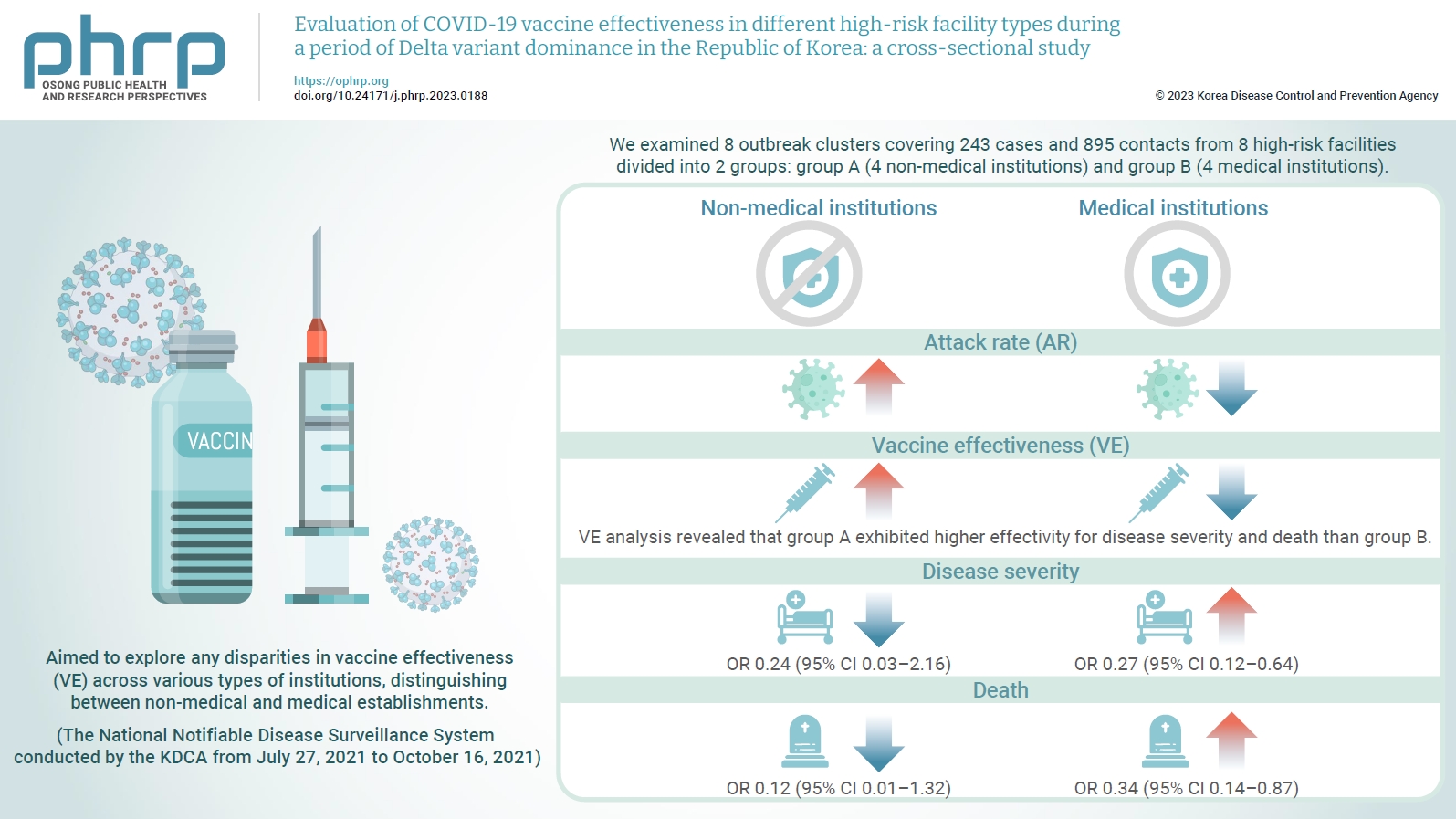
Objectives We evaluated the effectiveness of coronavirus disease 2019 vaccination in high-risk facilities in the Republic of Korea during the period when the highly transmissible Delta variant was prevalent. Additionally, we aimed to explore any disparities in vaccine effectiveness (VE) across various types of institutions, specifically distinguishing between non-medical and medical establishments. Methods: We examined 8 outbreak clusters covering 243 cases and 895 contacts from 8 high-risk facilities divided into 2 groups: group A (4 non-medical institutions) and group B (4 medical institutions). These clusters were observed from July 27, 2021 to October 16, 2021 for the attack rate (AR) and VE with respect to disease severity. A generalized linear model with a binomial distribution was used to determine the odds ratio (OR) for disease severity and death. Results: AR was notably lower in group B (medical institutions). Furthermore, VE analysis revealed that group A exhibited higher effectivity for disease severity and death than group B. The OR for disease severity was 0.24 (95% confidence interval [CI], 0.03–2.16) for group A and 0.27 (95% CI, 0.12–0.64) for group B, with the OR for death at 0.12 (95% CI, 0.01–1.32) in group A and 0.34 (95% CI, 0.14–0.87) in group B. Conclusion: Although VE may vary across institutions, our findings underscore the importance of implementing vaccinations in high-risk facilities. Customized vaccination programs, tailored response plans, and competent management personnel are essential for effectively addressing and mitigating public health challenges.
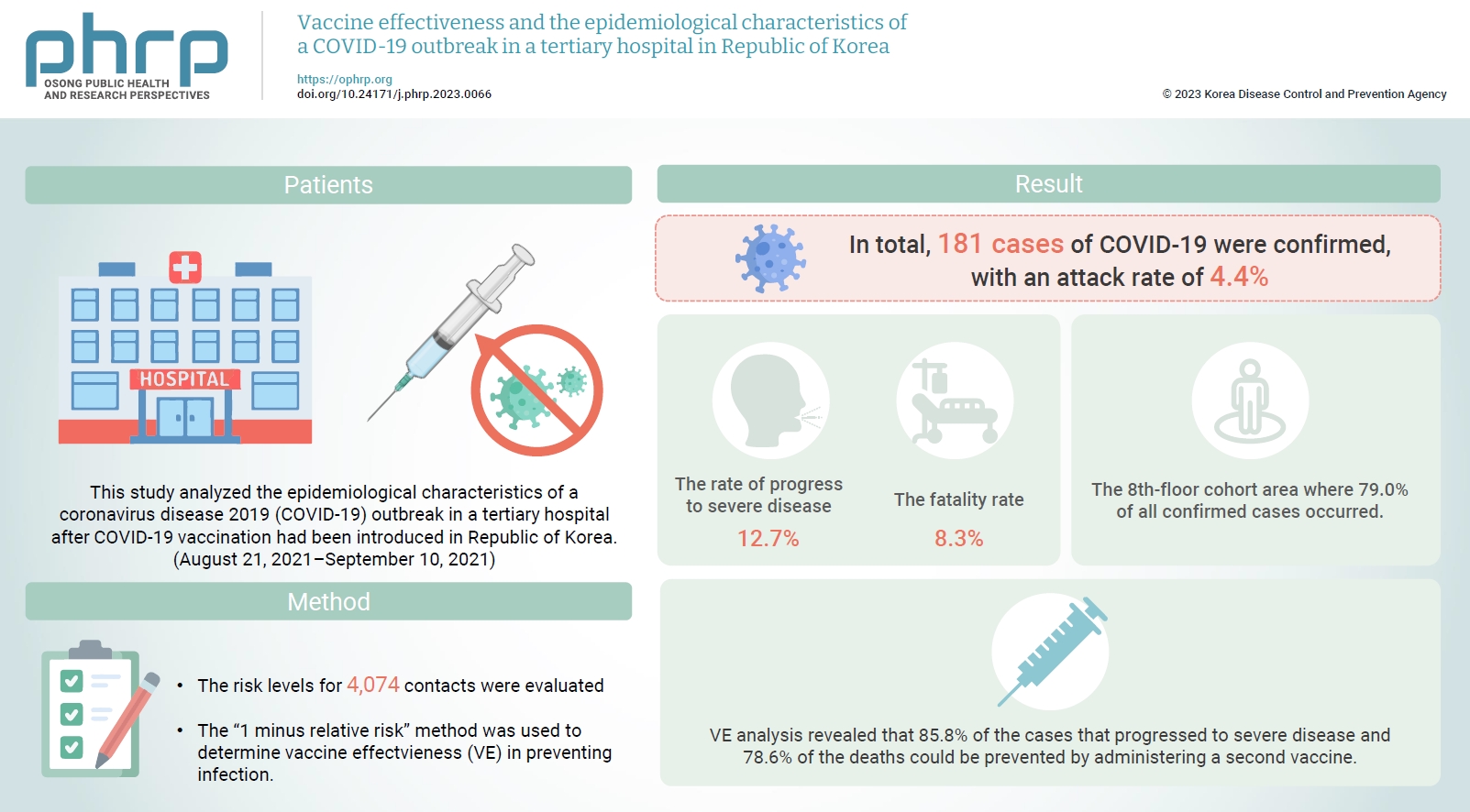
Objectives Healthcare facilities are high-risk sites for infection. This study analyzed the epidemiological characteristics of a coronavirus disease 2019 (COVID-19) outbreak in a tertiary hospital after COVID-19 vaccination had been introduced in Republic of Korea. Vaccine effectiveness (VE) and shared anti-infection strategies are also assessed.
Methods The risk levels for 4,074 contacts were evaluated. The epidemiological characteristics of confirmed cases were evaluated using the chi-square test. The “1 minus relative risk” method was used to determine VE in preventing infection, progression to severe disease, and death. In the largest affected area (the 8th floor), a separate relative risk analysis was conducted. A multivariate logistic regression analysis (with 95% confidence interval [CIs]) was used to identify transmission risk factors with a significance level <10% via the backward elimination method.
Results In total, 181 cases of COVID-19 were confirmed, with an attack rate of 4.4%. Of those cases, 12.7% progressed to severe disease, and 8.3% died. In the cohort isolation area on the 8th floor, where 79.0% of the confirmed cases occurred, the adjusted odds ratio was 6.55 (95% CI, 2.99–14.33) and 2.19 (95% CI, 1.24–3.88) for caregivers and the unvaccinated group, respectively. VE analysis revealed that 85.8% of the cases that progressed to severe disease and 78.6% of the deaths could be prevented by administering a second vaccine.
Conclusion Caregiver training for infection prevention and control is necessary to reduce infection risk. Vaccination is an important intervention to reduce the risk of progression to severe disease and death.
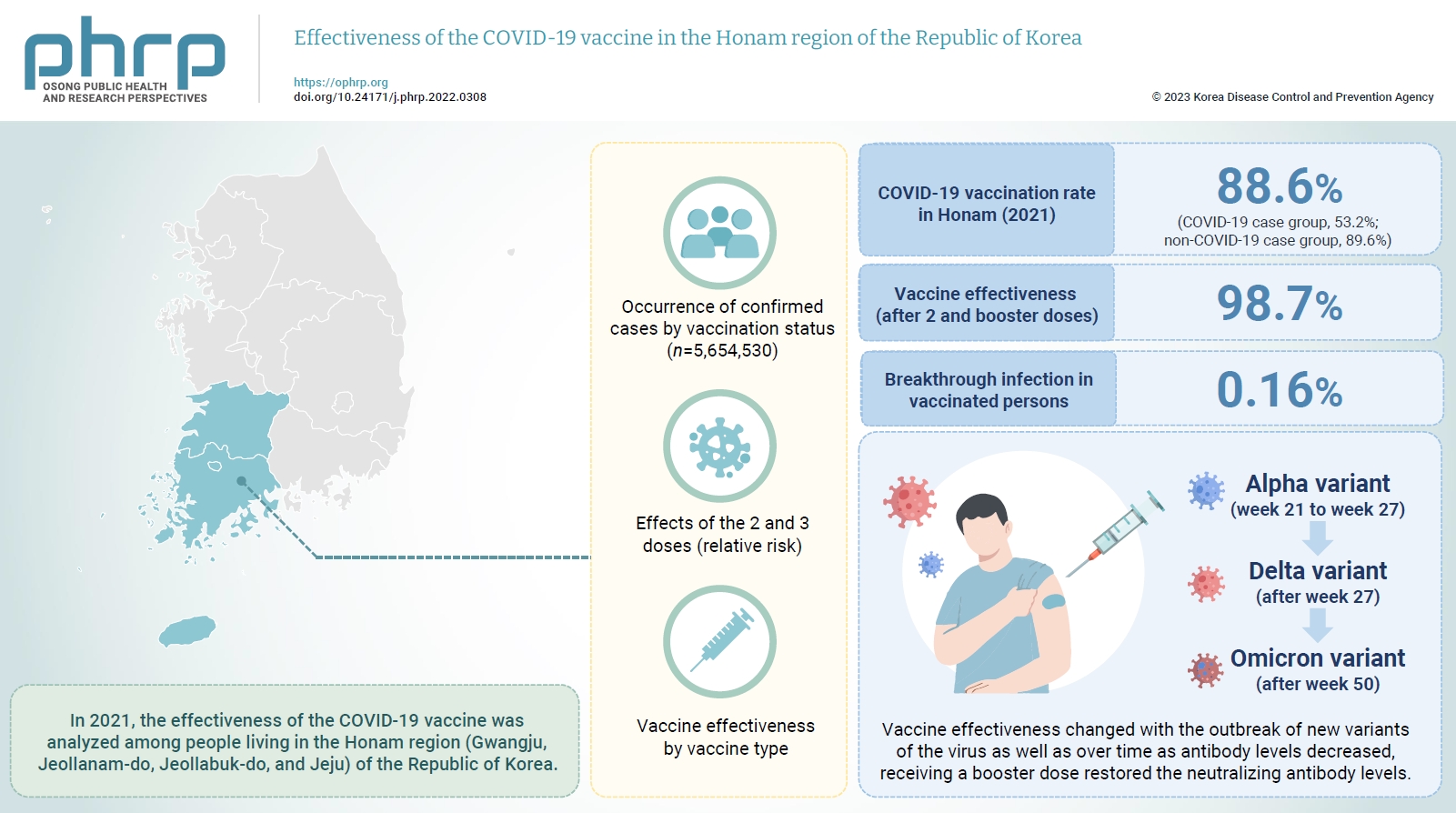
Objectives In 2021, the effectiveness of the COVID-19 vaccine was analyzed among people living in the Honam region (Gwangju, Jeollanam-do, Jeollabuk-do, and Jeju) of the Republic of Korea. And we investigated changes in the dominant virus strain.
Methods This study used the data provided by the Korean Ministry of the Interior and Safety for individuals ≥12 years old in the Honam region, and the Integrated Disease and Health Management System of the Korea Centers for Disease Control and Prevention for COVID-19-vaccinated individuals as of December 31, 2021. Statistical analyzes were performed using IBM SPSS ver. 23.0. The occurrence of confirmed cases by vaccination status, the relative risk, and vaccine effectiveness by vaccine type were calculated.
Results In 2021, the COVID-19 vaccination rate in Honam was 88.6%. The overall vaccine effectiveness (after 2 and 3 doses) was 98.7% (p<0.001). and the breakthrough infection rate was 0.16%. From week 21 to week 27 of 2021 (June 27 to July 3), the genome sequencing results were mostly alpha variants. The Delta variant emerged as the dominant variant after 27 weeks and the Omicron variant was found at 50 weeks (December 5–11).
Conclusion Vaccine effectiveness changed with the outbreak of new variants of the virus as well as over time as antibody levels decreased. that the prevention effectiveness of vaccination in Honam was >98%, and the effect among persons who received 2 doses was >90% regardless of the vaccine type. Although vaccine effectiveness decreased because of reduced antibody levels over time (as observed in breakthrough infections), receiving a booster dose restored the neutralizing antibody levels.
Changes in both the social environment (e.g., the increased use of electronic media) and the atmospheric environment (e.g., air pollution and dust) have contributed to an increasing incidence of eye disease and an increased need for eye care. Notably, the signs and symptoms of dry eye syndrome can impact the daily quality of life for various age groups, including the elderly, and usually requires active treatment. The symptoms of dry eye syndrome include tear film instability, hyperosmolarity, ocular surface inflammation and damage, and neurosensory abnormalities. As treatments for dry eye are being developed, a standardized guideline is needed to increase the efficiency of drug development and improve the quality of clinical trial data. In this paper, we present general considerations for the pharmaceutical industry and clinical trial investigators designing clinical trials focused on the development of drugs to treat dry eye syndrome.
Citations
Citations to this article as recorded by
Hypoxia, Humidity and Low Temperature on In-flight Dry Eye Ayi Adikanyaa Paramesthi, Ferdi Afian The Korean Journal of Aerospace and Environmental .2025; 35(2): 74. CrossRef
Glucose-Responsive Superlubricity of a Self-Healing Hydrogel Containing Dynamic Boronic Ester Bonds under Ocular Conditions Hongdong Wang, Yuxuan He, Qi Wang, Xiacong Zhang, Yuhong Liu, Jianhua Zhang Langmuir.2025; 41(39): 26683. CrossRef
Objectives Household contacts of confirmed cases of coronavirus disease 2019 (COVID-19) areexposed to a high risk of viral transmission, and secondary incidence is an important indicatorof community transmission. This study analyzed the secondary attack rate and mRNA vaccineeffectiveness against transmission (VET) for index cases (patients treated at home) confirmedto be infected with the Delta and Omicron variants.Methods: The subjects of the study were 4,450 index cases and 10,382 household contacts.Logistic regression analysis was performed to compare the secondary attack rate byvaccination status, and adjusted relative risk and 95% confidence intervals were identified.Results: The secondary attack rate of the Delta variant was 27.3%, while the secondary attackrate of the Omicron variant was 29.8%. For the Delta variant, groups with less than 90 daysand more than 90 days after 2 doses of mRNA vaccination both showed a VET of 37%. For theOmicron variant, a 64% VET was found among those with less than 90 days after 2 doses ofmRNA vaccination.Conclusion: This study provides useful data on the secondary attack rate and VET of mRNAvaccines for household contacts of COVID-19 cases in South Korea.
Citations
Citations to this article as recorded by
Impact of disease severity, age, sex, comorbidity, and vaccination on secondary attack rates of SARS-CoV-2: a global systematic review and meta-analysis Dewan Md. Sumsuzzman, Yang Ye, Zhen Wang, Abhishek Pandey, Joanne M. Langley, Alison P. Galvani, Seyed M. Moghadas BMC Infectious Diseases.2025;[Epub] CrossRef
Child Transmission of SARS-CoV-2 Throughout the Pandemic: An Updated Systematic Review and Meta-analysis Eugene Kwon, Gabriel Blank, Samantha Starkey, Cassidy Chapman, Conné Lategan, Hennady Shulha, Vanessa Kitchin, Sarah Silverberg, Laura Sauvé, Manish Sadarangani Pediatric Infectious Disease Journal.2025; 44(7): 696. CrossRef
Household secondary attack rates and risk factors during periods of SARS-CoV-2 Delta and Omicron variant predominance in the Republic of Korea Jin Lee, Mijeong Ko, Seontae Kim, Dosang Lim, Gemma Park, Sang-Eun Lee Osong Public Health and Research Perspectives.2023; 14(4): 263. CrossRef
<sec>
<title>Objectives</title>
<p>To evaluate the relationship between self-efficacy, general health and burnout of the staff at Shahroud University of Medical Sciences.</p></sec>
<sec>
<title>Methods</title>
<p>In 2015, 249 staff at Shahroud University of Medical Sciences (from a total reference population of 520 staff members) were selected through stratified random sampling. To collect the data, Sherer self-efficacy Scale, General Health Questionnaire and Maslach Burnout Inventory were used. The collected data were analyzed through ANOVA, Pearson correlation and Chi-square tests using SPSS 16. The relationship between self-efficacy, general health and burnout (latent factors) were studied using structural equation modeling with Stata 14.</p></sec>
<sec>
<title>Results</title>
<p>The mean age of participants was 36.97 ± 7.60 years, and the mean number of years work experience was 12.29 ± 7.57. The mean scores of general health, self-efficacy and burnout were 28.24 ± 11.14, 62.30 ± 9.21 and 81.67 ± 22.18, respectively. The results of the study showed a statistically significant relationship between self-efficacy and general health which equals −0.32. A statistically significant relationship also existed between burnout scores and general health scores (beta = 0.78).</p></sec>
<sec>
<title>Conclusion</title>
<p>The results showed that high self-efficacy improves the general health of employees at the Shahroud University of Medical Sciences and reduces burnout. Special attention should be paid to self-efficacy in the prevention of burnout.</p></sec>
Citations
Citations to this article as recorded by
Perceived Self‐Efficacy and Its Determinants for Noncommunicable Disease Prevention Among Adults in Southern Ethiopia: A Community‐Based Cross‐Sectional Study Habtamu Endashaw Hareru, Mesfin Abebe, Berhanu G. Debela, Tizalegn Tesfaye Mamo, Yohannes Addisu Wondimagegne, Yoel A. Klug BioMed Research International.2026;[Epub] CrossRef
Perceived and actual AI literacy in military organizations: a self-efficacy framework for training design Giacinto D’Urso, Giorgio Giosafatto AI & SOCIETY.2026;[Epub] CrossRef
The relationship between hospital violence and self-efficacy expectation among healthcare professionals during major public health events: The role of mental health and caring patients Lina Ha, Qingning Chang, Zihao Liu, Zhizhong Wang WORK: A Journal of Prevention, Assessment & Rehabi.2026;[Epub] CrossRef
Examining self‐efficacy among recent graduates of postgraduate dental education programs Scott P. Irwin, Steven J. Durning, Ting Dong Journal of Dental Education.2025; 89(4): 437. CrossRef
Examining the Relationships Between Existential Fulfilment, Professional Quality of Life, and Self‐Efficacy Among Counsellors, Physicians, and Nurses in Healthcare Settings Othman A. Alfuqaha Counselling and Psychotherapy Research.2025;[Epub] CrossRef
The burnout assessment tool (BAT): Validation in the Spanish population Aida Soriano, Hiacynta Warsicka, Jose M Peiró WORK: A Journal of Prevention, Assessment & Rehabi.2025; 81(2): 2791. CrossRef
Reflective teaching, teacher immunity, and burnout: Investigating possible links Hossein Navidinia, Fatemeh Zahra Gholizadeh System.2025; 135: 103865. CrossRef
Healthcare Workers’ General Health and Its Relation with Anxiety, Anger, and Posttraumatic Stress Disorder during COVID‐19 Outbreak in Southeast Iran Alireza Malakoutikhah, Leila Ahmadi Lari, Pooya Baharloo, Rasmieh Al-Amer, Mohamed Alnaiem, Hossein Khaluei, Mahlagha Dehghan, Lut Tamam Mental Illness.2024;[Epub] CrossRef
Investigating the Anxiety Caused by COVID-19 and its Relationship with the Self-efficacy and General Health in Iranian Nurses Mohammad Amiri, Abolfazl Jamalzadeh, Ahmad Khosravi The Open Public Health Journal.2024;[Epub] CrossRef
Prevalence of Burnout Among Health Workers in Iran: A Systematic Review and Meta-analysis Masoudeh Babakhanian, Maryam Qasemi kouhikheili, Fereshteh Araghian Mojarad, Fatemeh Talebian, Tahereh Yaghoubi Journal of Nursing and Midwifery Sciences.2024;[Epub] CrossRef
Exploring the relationship between psychosocial factors, work engagement, and mental health: a structural equation modeling analysis among faculty in Saudi Arabia Nawal Ayyashi, Amira Alshowkan, Emad Shdaifat BMC Public Health.2024;[Epub] CrossRef
The Association of Self-efficacy with Self-care Behaviors, Anxiety, and Academic Motivation in Iranian Medical Sciences Students Mohammad Amiri, Elham Sadeghi, Ayda Parvane, Ahmad Khosravi The Open Public Health Journal.2024;[Epub] CrossRef
Association between Job Burnout and the General Health of Healthcare Professionals during the Pandemic of COVID-19, Kermanshah, Iran (2022) Shadi Askari, Nooshin Salimi, Ehsan Bakhshi Journal of Occupational Health and Epidemiology.2024; 13(1): 33. CrossRef
Health-promoting lifestyle and its determining factors among students of public and private universities in Iran Mohammad Amiri, Mehdi Raei, Elham Sadeghi, Leila Keikavoosi-Arani, Ahmad Khosravi Journal of Education and Health Promotion.2023;[Epub] CrossRef
The relations between mental well-being and burnout in medical staff during the COVID-19 pandemic: A network analysis Chen Chen, Fengzhan Li, Chang Liu, Kuiliang Li, Qun Yang, Lei Ren Frontiers in Public Health.2022;[Epub] CrossRef
The role of organizational and supervisor support in young adult workers’ resilience, efficacy and burnout during the COVID-19 pandemic Heewon Kim, L. D. Mattson, Dacheng Zhang, Hee Jung Cho Journal of Applied Communication Research.2022; 50(6): 691. CrossRef
A psychological health support scheme for medical teams in COVID‐19 outbreak and its effectiveness Wenhong Cheng, Fang Zhang, Zhen Liu, Hao Zhang, Yifan Lyu, Hao Xu, Yingqi Hua, Jiarong Gu, Zhi Yang, Jun Liu General Psychiatry.2020;[Epub] CrossRef
Impact of the Family Environment on the Emotional State of Medical Staff During the COVID-19 Outbreak: The Mediating Effect of Self-Efficacy Na Hu, Ying Li, Su-Shuang He, Lei-Lei Wang, Yan-Yan Wei, Lu Yin, Jing-Xu Chen Frontiers in Psychology.2020;[Epub] CrossRef
Investigation of Health-Promoting Lifestyle and its Determinants Among Students of Medical Sciences in Iran Mohammad Amiri, Ahmad Khosravi, Niloofar Aboozarzadeh, Leila Khojasteh, Zakieh Sadeghi, Mehdi Raei The Open Public Health Journal.2020; 13(1): 627. CrossRef
Objectives
The present study aimed to investigate the prevalence of and factors associated with H1N1 preventive behaviors in a community-based population. Methods
A cross-sectional study was conducted in three urban and two rural communities in Korea. Interviews were conducted with 3462 individuals (1608 men and 1854 women) aged ≥ 19 years during February–March 2010. Influenza-related information including anxiety, preventive behaviors and their perceived effectiveness, vaccination status, past influenza-like illness symptoms, and sources of and trust in information was obtained. Results
Among 3462 participants, 173 reported experiencing influenza-like illness symptoms within the past 12 months. The mean H1N1 preventive behavior score was 25.5 ± 5.5 (out of a possible 40). The percent of participants reporting high perceived effectiveness and high anxiety was 46.2% and 21.4%, respectively. After controlling for potential confounders, H1N1 preventive behavior scores were predicted by a high (β = 3.577, <i>p</i> < 0.001) or moderate (β = 2.529, <i>p</i> < 0.001) perception of their effectiveness. Similarly, moderate (β = 1.516, <i>p</i> < 0.001) and high (β = 4.103, <i>p</i> < 0.001) anxiety scores predicted high preventive behavior scores. Conclusion
Effective methods of promoting population behavior change may be nationwide campaigns through mass media, as well as education and promotion by health care providers and broadcasters.
Citations
Citations to this article as recorded by
Assessment of anxiety and depression among professional healthcare workers during the COVID-19 pandemic – observational cross-sectional study Mohammed Mahmood Mohammed, Hayder Adnan Fawzi Pharmacia.2024; 71: 1. CrossRef
Exploring the changes of individuals’ travel behavior in response to COVID-19 and their influencing factors based on mobile phone data Shuli Zhou, Suhong Zhou, Fengrui Jing, Luhui Qi, Jianjun Li Journal of Transport & Health.2024; 36: 101788. CrossRef
Impacts of COVID-19 on the premiums of proximity to railway stations: An in-depth analysis using passenger flows I-Chun Tsai Research in Transportation Business & Management.2024; 56: 101185. CrossRef
The Role of Social Media in Communication and Learning at the Time of COVID-19 Lockdown—An Online Survey Mohammed Nahidh, Noor F. K. Al-Khawaja, Hala Mohammed Jasim, Gabriele Cervino, Marco Cicciù, Giuseppe Minervini Dentistry Journal.2023; 11(2): 48. CrossRef
Depressive Symptomatology in Adults during the COVID-19 Pandemic Álvaro Alexander Ocampo González, Javier Ferney Castillo García, Laura Carolina Pabón Sandoval, José Rafael Tovar Cuevas, Sirsa Aleyda Hidalgo Ibarra, Diego Alejandro Calle Sandoval, Edwin Cortés González, Kevin Steven Garcia Chica, Jonnathan Steven Pabón Journal of Investigative Medicine.2022; 70(2): 436. CrossRef
Assessing Governments’ Emergency Responses to the COVID-19 Outbreak Using a Social Network Analysis (SNA) Wignyo Adiyoso Sage Open.2022;[Epub] CrossRef
Reducing Anxiety with Nature and Gardening (RANG): Evaluating the Impacts of Gardening and Outdoor Activities on Anxiety among U.S. Adults during the COVID-19 Pandemic Megan E. Gerdes, Lucy A. Aistis, Naomi A. Sachs, Marcus Williams, Jennifer D. Roberts, Rachel E. Rosenberg Goldstein International Journal of Environmental Research an.2022; 19(9): 5121. CrossRef
Difference between Impacts of COVID-19 on Women and Men’s Psychological, Social, Vulnerable Work Situations, and Economic Well-Being Enrique Iglesias Martínez, Jorge Roces García, Estibaliz Jiménez Arberas, José Antonio Llosa International Journal of Environmental Research an.2022; 19(14): 8849. CrossRef
Anxiety in Mexican adults throughout the COVID-19 pandemic: A cross sectional study Erasmo Saucedo-Uribe, Jessica Treviño-Lozano, Pedro Jehú González-Mallozzi, Moisés Karika Enríquez-Navarro, Carlos de la Cruz-de la Cruz, Ada Nayeli Rangel-Gómez, Farid Carranza-Navarro, Dania Dalel Pardiñaz-García, Juan Manuel Fuentes-Garza Archives of Psychiatric Nursing.2022; 41: 201. CrossRef
Influence of social responsibility and pandemic awareness of nursing students on COVID-19 preventive behaviours: a cross-sectional online survey in South Korea Minji Kim, Hyeonkyeong Lee BMJ Open.2022; 12(12): e061767. CrossRef
Psychological Impact on the Orthodontic Postgraduate Residents and Their Anxiety Level during the COVID‐19 Pandemic Hareem Sultan, Sameeruddin Shaikh, Sadaf Shaheen, Hana Pervez, Syed Adnan Ali, Saman Baseer, Marco Farronato International Journal of Dentistry.2022;[Epub] CrossRef
Prevalence of Health Misinformation on Social Media: Systematic Review Victor Suarez-Lledo, Javier Alvarez-Galvez Journal of Medical Internet Research.2021; 23(1): e17187. CrossRef
Lockdowned: Everyday mobility changes in response to COVID-19 Przemysław Borkowski, Magdalena Jażdżewska-Gutta, Agnieszka Szmelter-Jarosz Journal of Transport Geography.2021; 90: 102906. CrossRef
Anxiety levels of university hospital nurses during the Covid‐19 pandemic Şeyma Yurtseven, Sevban Arslan Perspectives in Psychiatric Care.2021; 57(4): 1558. CrossRef
Assessing Mental Health of Women Living in Karachi During the Covid-19 Pandemic Shabnam Shamim Asim, Samrah Ghani, Maheen Ahmed, Anushae Asim, Afzal Fatima Karim Qureshi Frontiers in Global Women's Health.2021;[Epub] CrossRef
Assessment of the Impact of a Daily Rehabilitation Program on Anxiety and Depression Symptoms and the Quality of Life of People with Mental Disorders during the COVID-19 Pandemic Joanna Smolarczyk-Kosowska, Anna Szczegielniak, Mateusz Legutko, Adam Zaczek, Łukasz Kunert, Magdalena Piegza, Robert Pudlo International Journal of Environmental Research an.2021; 18(4): 1434. CrossRef
Determinants of Infodemics During Disease Outbreaks: A Systematic Review Javier Alvarez-Galvez, Victor Suarez-Lledo, Antonio Rojas-Garcia Frontiers in Public Health.2021;[Epub] CrossRef
Analysis of Decision Making of Energy Enterprises on Adaptive Behavior Amid COVID-19 Xiurui Yang, Jizu Li Frontiers in Energy Research.2021;[Epub] CrossRef
Women Suffered More Emotional and Life Distress than Men during the COVID-19 Pandemic: The Role of Pathogen Disgust Sensitivity Yi Ding, Jie Yang, Tingting Ji, Yongyu Guo International Journal of Environmental Research an.2021; 18(16): 8539. CrossRef
Towards a data-driven characterization of behavioral changes induced by the seasonal flu Nicolò Gozzi, Daniela Perrotta, Daniela Paolotti, Nicola Perra, Benjamin Althouse PLOS Computational Biology.2020; 16(5): e1007879. CrossRef
Social Distancing and Transmission-reducing Practices during the 2019 Coronavirus Disease and 2015 Middle East Respiratory Syndrome Coronavirus Outbreaks in Korea Won Mo Jang, Deok Hyun Jang, Jin Yong Lee Journal of Korean Medical Science.2020;[Epub] CrossRef
Levels and predictors of anxiety, depression and health anxiety during COVID-19 pandemic in Turkish society: The importance of gender Selçuk Özdin, Şükriye Bayrak Özdin International Journal of Social Psychiatry.2020; 66(5): 504. CrossRef
Trends in Infectious Disease Mortality, South Korea, 1983–2015 Young June Choe, Seung-Ah Choe, Sung-Il Cho Emerging Infectious Diseases.2018; 24(2): 320. CrossRef
Preventive behaviors by the level of recognized sensitivity to infection during the MERS outbreak in 2015 Soon Young Lee, Hee Jung Yang, Gawon Kim, Hae-Kwan Cheong, Bo Youl Choi Epidemiology and Health.2016; : e2016051. CrossRef





 First
 Prev


