Objectives Cervical cancer remains a major public health challenge in India despite advances in prevention through human papillomavirus (HPV) vaccination and screening. Although national estimates indicate gradual declines, marked regional disparities persist, and coronavirus disease 2019–related disruptions may have affected recent disease trajectories. This study assessed long-term trends, post-pandemic deviations, and progress toward World Health Organization (WHO) elimination targets in South India.
Methods This population-based observational analysis used Global Burden of Disease Study 2023 estimates for women aged 30–69 years in South India from 1990 to 2023. Pre-pandemic trends and counterfactual projections were evaluated, and age-standardized incidence rates (ASRs) were descriptively compared with the WHO elimination threshold of ≤4 cases per 100,000 woman-years.
Results Age-standardized cervical cancer incidence and mortality declined until the early 2010s but remained above national and global rates. Thereafter, declines stagnated and reversed. In 2023, incidence ranged from 26.1 per 100,000 women in Kerala to 65.8 in Telangana; all states exceeded the WHO threshold based on these ASRs. Observed rates exceeded counterfactual projections, but uncertainty envelopes included zero for every location and outcome. Thus, the findings are consistent with possible post-pandemic disruption to cervical cancer services rather than statistically demonstrated excess burden, and this ecological comparison cannot establish causality. Disability-adjusted life-year rates were highest among women aged 50–69 years.
Conclusion South India appears to have experienced a recent loss of momentum in cervical cancer control. Strengthening HPV vaccination coverage, expanding screening, and improving the resilience of cancer prevention services are essential for accelerating progress toward elimination targets.
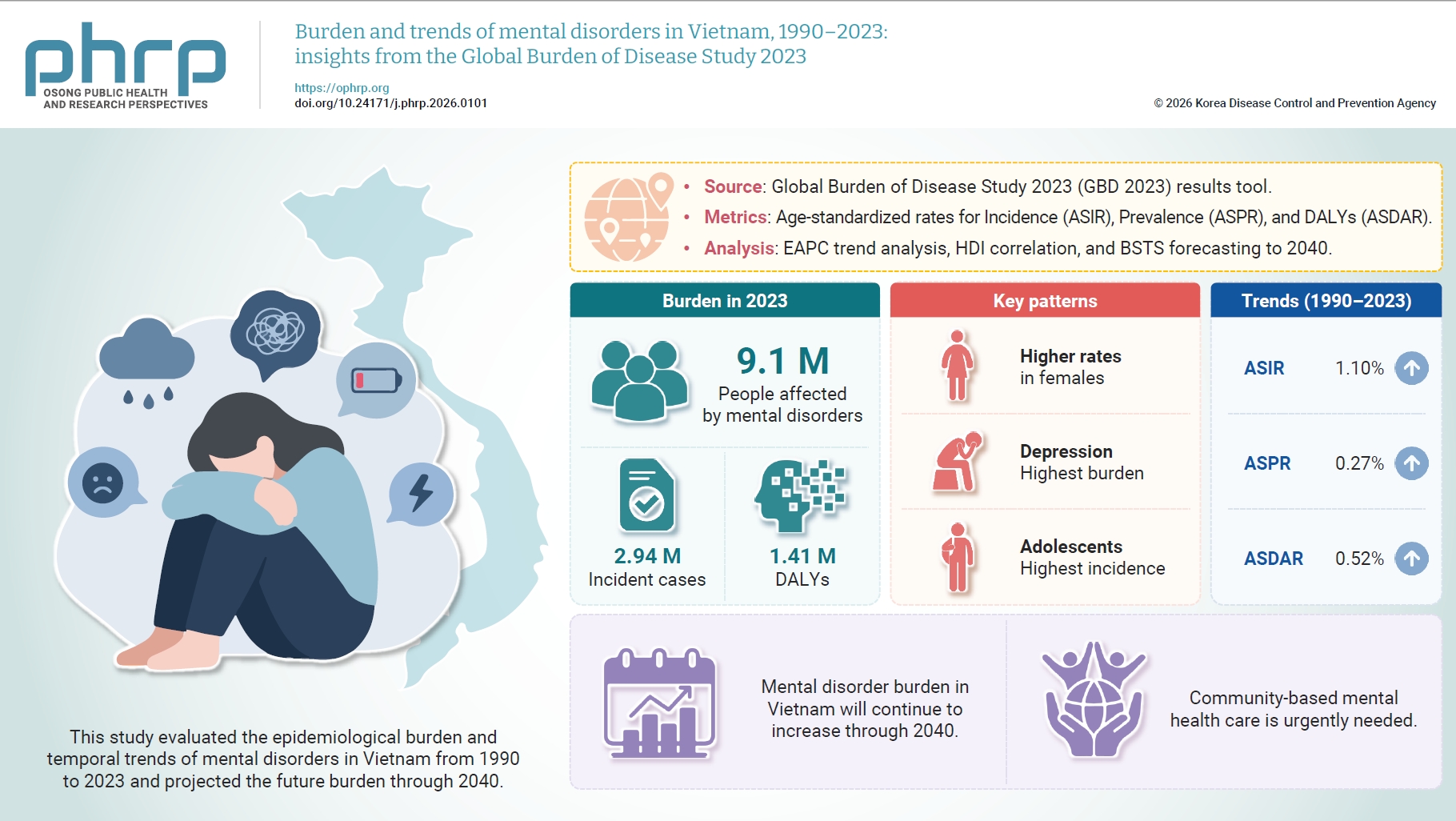
Objectives This study evaluated the epidemiological burden and temporal trends of mental disorders in Vietnam from 1990 to 2023 and projected the future burden through 2040. Methods: Global Burden of Disease Study 2023 data were used to analyze the age-standardized prevalence rate (ASPR), age-standardized incidence rate (ASIR), and age-standardized disability-adjusted life-year rate (ASDAR) by age, sex, and diagnostic subtype. Temporal trends were quantified using the estimated annual percentage change (EAPC), and Pearson correlation analysis examined associations with Vietnam’s human development index (HDI). Bayesian structural time series (BSTS) models were used to forecast the burden through 2040. Results: In 2023, approximately 9.1 million individuals in Vietnam had mental disorders, with 2.94 million annual incident cases and 1.41 million disability-adjusted life-years. Depressive disorders ranked highest across all metrics, and females consistently had higher agestandardized rates than males. Age-standardized rates increased significantly from 1990 to 2023: ASIR, 1.10% EAPC (95% confidence interval [CI], 0.87%–1.33%); ASPR, 0.27% EAPC (95% CI, 0.21%–0.33%); and ASDAR, 0.52% EAPC (95% CI, 0.46%–0.58%). Mental disorder burden was strongly positively correlated with HDI (r =0.773–0.909, all p<0.001). BSTS models projected continued increases through 2040 (ASPR, 9,003.75; ASIR, 3,307.11; ASDAR, 1,408.05 per 100,000 population). Conclusion: Mental disorders constitute an escalating public health challenge in Vietnam, with the burden increasing steadily over 3 decades and projected to continue rising through 2040. Reorientation toward an integrated, community-based care model, alongside targeted workforce expansion and systematic integration of mental health services into primary care, is essential to mitigate this growing burden.


 First
 Prev


