Objectives This study examined associations between indoor total volatile organic compound (TVOC) concentrations and urinary volatile organic compound (VOC) metabolites in Korean adults, focusing on potential sex-specific differences. We hypothesized that higher indoor TVOC exposure would be associated with higher urinary VOC metabolite concentrations and that these associations would differ by sex.
Methods We conducted a cross-sectional analysis of the 2020–2021 Korea National Health and Nutrition Examination Survey, which included the Republic of Korea’s first population-based indoor air quality survey. The analysis included 1,859 adults aged ≥19 years who participated in the indoor air quality survey from July 2020 to August 2021. Indoor TVOC concentrations (µg/m³) were measured using standardized protocols. Nine urinary VOC metabolites were quantified, creatinine-adjusted, and log-transformed. Multivariable linear regression, sex-stratified analyses, and subgroup analyses among unemployed adults were performed to reduce potential confounding from occupational exposure.
Results Indoor TVOC concentrations were positively associated with urinary 2-methylhippuric acid (2-MHA; β=0.041; 95% confidence interval [CI], 0.029–0.052) and 3,4-MHA (β=0.040; 95% CI, 0.027–0.052), with no evident sex difference in the overall sample. However, among unemployed adults, sex-by-TVOC interaction terms were statistically significant for both metabolites, and associations were stronger in males for both 2-MHA (β=0.110 vs. 0.024) and 3,4-MHA (β=0.130 vs. 0.031) than in females.
Conclusion Indoor TVOC concentrations were associated with urinary VOC metabolites, particularly 2-MHA and 3,4-MHA. These findings support considering sex-specific patterns in VOC-related risk assessment and indoor air quality surveillance, interventions, and management.
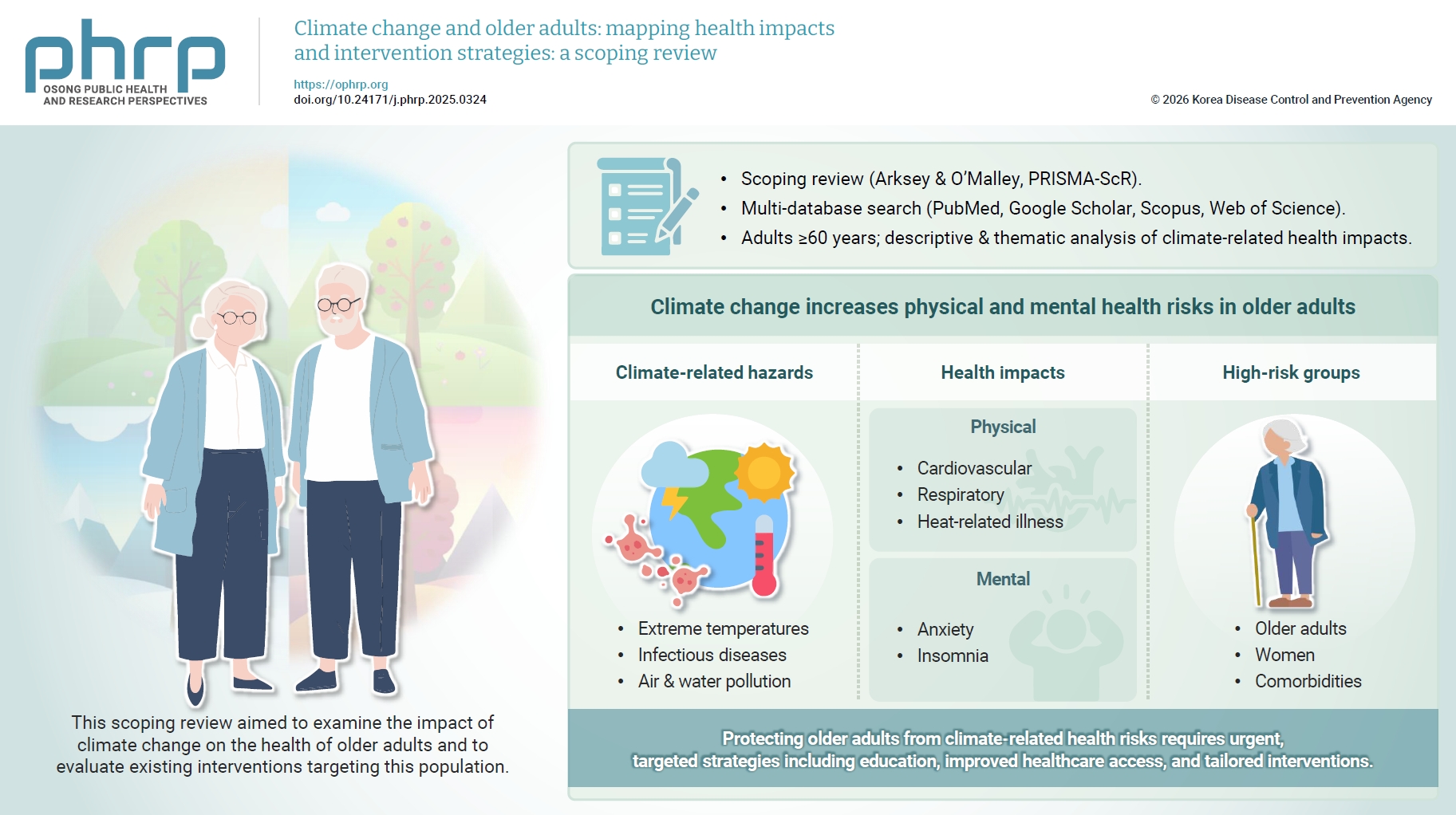
Objectives This scoping review aimed to examine the impact of climate change on the health of older adults and to evaluate existing interventions targeting this population. Methods: The review followed Arksey and O’Malley’s framework and the PRISMA-ScR guidelines. A comprehensive search was conducted across PubMed, Google Scholar, Scopus, and Web of Science. Eligible studies included those focusing on adults aged 60 years and older that examined the physical and mental health impacts of climate change across any geographic setting or level of care. Descriptive and thematic analyses were performed to identify key findings and knowledge gaps. Results: Climate change adversely affects the physical and mental health of older adults through increased exposure to infectious diseases, extreme temperatures, and poor air and water quality. Older adults are particularly vulnerable to heat-related illnesses, cardiovascular events, and respiratory conditions, with women and individuals with comorbidities at higher risk. Climate change is also associated with increased anxiety, insomnia, and other mental health concerns in this population. Social support and targeted interventions—such as community awareness programs and subsidized cooling costs—are associated with reduced risk. Community-based initiatives have demonstrated potential in reducing mortality and enhancing resilience among older adults during extreme weather events. Conclusion: Healthcare professionals should be educated about climate-related health outcomes affecting older adults. Protecting this vulnerable population requires urgent, inclusive, and targeted strategies, including education, improved healthcare access, and tailored interventions.
Objectives
The aim of this study was to describe the characteristics of hand-to-environmental contact (HEC) and to identify the factors influencing HEC behavior in Korean adults’ indoor daily life.
Methods
Thirty participants were enrolled from January 14 to February 12, 2018 after providing informed consent for being videotaped. Data were collected by recording their indoor daily lives for 2 hours, resulting in 4,732 HEC cases. To ensure the accuracy and reliability of the HEC readings, 3 training sessions were conducted for the videotape readers. Rereading and verifying randomly selected data ensured the validity of intra- and inter-reader readings.
Results
The most frequent contact items were phones, papers, computer accessories, and furniture surfaces. The contact density (frequency-duration/min) was highest for category II (items occasionally shared by others, 56.8), followed in descending order by category I (items for individual use, 35.9), and category III (public use items, 3.4). Significant differences in contact density were found according to participants’ demographic characteristics.
Conclusion
As mobile phones were the most frequent contact item, regular and strict mobile phone cleansing or disinfection strategies are needed, in addition to preventative measures taken for category II and III items. Avoiding sharing personal items with others, refraining from unnecessary HEC, and maintaining strict hand hygiene are recommended.
Citations
Citations to this article as recorded by
Developing a hand thermophysiological model to evaluate contact thermal sensation Yicong Li, Jinyuan Lou, Yi Gao, Xiang Zhou, Maohui Luo Building and Environment.2026; 304: 115020. CrossRef
Objectives
Severe acute respiratory syndrome coronavirus 2 (SARS-CoV-2) has caused devastation in over 200 countries. Italy, Spain, and the United States (US) were most severely affected by the first wave of the pandemic. The reasons why some countries were more strongly affected than others remain unknown. We identified the most-affected and less-affected countries and states and explored environmental, host, and infrastructure risk factors that may explain differences in the SARS-CoV-2 mortality burden.
Methods
We identified the top 10 countries/US states with the highest deaths per population until May 2020. For each of these 10 case countries/states, we identified 6 control countries/states with a similar population size and at least 3 times fewer deaths per population. We extracted data for 30 risk factors from publicly available, trusted sources. We compared case and control countries/states using the non-parametric Wilcoxon rank-sum test, and conducted a secondary cluster analysis to explore the relationship between the number of cases per population and the number of deaths per population using a scalable EM (expectation–maximization) clustering algorithm.
Results
Statistically significant differences were found in 16 of 30 investigated risk factors, the most important of which were temperature, neonatal and under-5 mortality rates, the percentage of under-5 deaths due to acute respiratory infections (ARIs) and diarrhea, and tuberculosis incidence (<italic>p</italic><0.05)
Conclusion
Countries with a higher burden of baseline pediatric mortality rates, higher pediatric mortality from preventable diseases like diarrhea and ARI, and higher tuberculosis incidence had lower rates of coronavirus disease 2019-associated mortality, supporting the hygiene hypothesis.
Citations
Citations to this article as recorded by
COVID-19 vaccination coverage and the effect on regional disparities in morbidity and mortality among older people in Sweden, 2021–2023 Anton Nilsson, Dominik Dietler, Carl Bonander, Malin Inghammar, Jonas Björk Scandinavian Journal of Public Health.2026; 54(4): 388. CrossRef
Prediction models of COVID-19 fatality in nine Peruvian provinces: A secondary analysis of the national epidemiological surveillance system Wendy Nieto-Gutierrez, Jaid Campos-Chambergo, Enrique Gonzalez-Ayala, Oswaldo Oyola-Garcia, Alberti Alejandro-Mora, Eliana Luis-Aguirre, Roly Pasquel-Santillan, Juan Leiva-Aguirre, Cesar Ugarte-Gil, Steev Loyola, Sizulu Moyo PLOS Global Public Health.2024; 4(1): e0002854. CrossRef
The effect of the urban exposome on COVID-19 health outcomes: A systematic review and meta-analysis Laura Houweling, Anke-Hilse Maitland-Van der Zee, Judith C.S. Holtjer, Somayeh Bazdar, Roel C.H. Vermeulen, George S. Downward, Lizan D. Bloemsma Environmental Research.2024; 240: 117351. CrossRef
Comparison of Gene Polymorphisms of ACE1 and ACE2 and the Level of Total ACE Activity in the Blood of Afghans and Iranians with COVID-19 and Its Relationship with Disease Severity Amin Morshedi Shahrebabaki, Mahsa Nikseresht, Mehdi Mahmoodi, Sadegh Zarei, Reza Hosseiniara, Ozra Sadat Esmaeili, Mohammad Reza Mirzaei, Mahmood Kahnooji, Mohammad Reza Hajizadeh Viral Immunology.2024; 37(10): 470. CrossRef
Mortality Predictors among COVID-19 Patients Admitted to the Intensive Care Unit in Sulaymaniyah City, Iraq: A Cross-Sectional Study Alyaa Amer Abdulla, Sherzad Ali Ismael Advanced Medical Journal.2024; 9(3): 98. CrossRef
Demographic Characteristics and Status of Vaccinated Individuals with a History of COVID-19 Infection Pre- or Post-Vaccination: A Descriptive Study of a Nationally Representative Sample in Saudi Arabia Yazed AlRuthia, Haya F. Al-Salloum, Omar A. Almohammed, Amani S. Alqahtani, Hana A. Al-Abdulkarim, Yousef M. Alsofayan, Sami S. Almudarra, Sara H. AlQahtani, Abdullah Almutlaq, Khaled Alabdulkareem, Bander Balkhi, Hamoud T. Almutairi, Abdullah S. Alanazi, Vaccines.2022; 10(2): 323. CrossRef
Temporal variation, socioeconomic status, and out‐of‐hospital deaths as factors that influence mortality rates among hospitalized COVID‐19 patients receiving ACEIs/ARBs Owais M. Aftab, Anurag Modak, Jai C. Patel The Journal of Clinical Hypertension.2022; 24(4): 519. CrossRef
Coinfection of leptospirosis and coronavirus disease 2019: A retrospective case series from a coastal region in South India Nitin Gupta, William Wilson, Prithvishree Ravindra, Roshini Raghu, Kavitha Saravu Journal of Medical Virology.2022; 94(9): 4508. CrossRef
Dietary, comorbidity, and geo-economic data fusion for explainable COVID-19 mortality prediction Milena Trajanoska, Risto Trajanov, Tome Eftimov Expert Systems with Applications.2022; 209: 118377. CrossRef
Paraoxonase 1 rs662 polymorphism, its related variables, and COVID-19 intensity: Considering gender and post-COVID complications Zohreh-Al-Sadat Ghoreshi, Mojtaba Abbasi-jorjandi, Gholamreza Asadikaram, Mohsen Sharif-zak, Fatemeh Seyedi, Mohammad Khaksari Haddad, Mohammadreza Zangouey Experimental Biology and Medicine.2022; : 153537022211285. CrossRef
Clinical Effect of Q192R Paraoxonase 1 Polymorphism and its Related Variables on the COVID-19 Intensity Considering Gender and Post-COVID Complications Zohreh-al-sadat Ghoreshi, Mojtaba abasi, Gholamreza Asadikaram, Mohsen sharif-zak, Mitra Rezazadeh-Jabalbarzi, Hamidreza rashidinejad, Mohammadreza Zangouey SSRN Electronic Journal .2022;[Epub] CrossRef
Risk Factors and a Novel Score (CARI-65) Predicting Mortality in COVID-19 Patients Fayaz Ahmad Sofi, Umar Hafiz Khan, Sonaullah Shah, Nazia Mehfooz, Farhana Siraj, Afshan Shabir, Tajamul Hussain Shah, Muzaffar Bindroo, Mushtaq Ahmad, Rafi Ahmed Jan, Asma Shah, Faizan Wani Indian Journal of Respiratory Care.2022; 11(2): 154. CrossRef
Variances in BCG protection against COVID-19 mortality: A global assessment Zouina Sarfraz, Azza Sarfraz, Krunal Pandav, Sarabjot Singh Makkar, Saman Hasan Siddiqui, Gaurav Patel, Tania Platero-Portillo, Bishnu Mohan Singh, Mohamed Iburahim Haja Maideen, Deepika Sarvepalli, Muzna Sarfraz, Jose Cardona-Guzman, Marcos A. Sanchez-Go Journal of Clinical Tuberculosis and Other Mycobac.2021; 24: 100249. CrossRef
<p>This study aimed to determine the presence of SARS-CoV-2 on surfaces frequently touched by COVID-19 patients, and assess the scope of contamination and transmissibility in facilities where the outbreaks occurred. In the course of this epidemiological investigation, a total of 80 environmental specimens were collected from 6 hospitals (68 specimens) and 2 “mass facilities” (6 specimens from a rehabilitation center and 6 specimens from an apartment building complex). Specific reverse transcriptase-polymerase chain reaction targeting of RNA-dependent RNA polymerase, and envelope genes, were used to identify the presence of this novel coronavirus. The 68 specimens from 6 hospitals (A, B, C, D, E, and G), where prior disinfection/cleaning had been performed before environmental sampling, tested negative for SARS-CoV-2. However, 2 out of 12 specimens (16.7%) from 2 “mass facilities” (F and H), where prior disinfection/cleaning had not taken place, were positive for SARS-CoV-2 RNA polymerase, and envelope genes. These results suggest that prompt disinfection and cleaning of potentially contaminated surfaces is an effective infection control measure. By inactivating SARS-CoV-2 with disinfection/cleaning the infectivity and transmission of the virus is blocked. This investigation of environmental sampling may help in the understanding of risk assessment of the COVID-19 outbreak in “mass facilities” and provide guidance in using effective disinfectants on contaminated surfaces.</p>
Citations
Citations to this article as recorded by
Anforderungen an die Hygiene bei der Reinigung und Desinfektion von Flächen
요양병원의 환기 상태 및 오염도 측정을 통한 개선방안 연구 혜진 김, 상은 이, 미 유, 영준 송, 정연 유, 태종 손, 충민 박, 민아 임, 유경 김, 창일 이, 성익 박, 성준 박, 숙희 박, 영준 박 Public Health Weekly Report.2024; 17(18): 717. CrossRef
Structural, Morphological, Electrical, Magnetic, and dielectric properties of Zn0.5-xCa0.1Co0.4+xFe2O4 through the sol-gel method for flexible substrates in food chemical sensing Md. Bakey Billa, Mohammad Tariqul Islam, Touhidul Alam, Iskandar Yahya, Ahmed Alzamil, Md. Shabiul Islam, Mohamed S. Soliman Materials & Design.2024; 244: 113219. CrossRef
Detection of SARS-CoV-2 on the environmental surfaces and its implications for pandemic preparedness Kazi Jamil, Nasreem Abdulrazack, Saja Fakhraldeen, Heba Kamal, Anwar Al-Mutairi, Batool Al-Feili, Imtiaz Ahmed, Vinod Kumar Frontiers in Public Health.2024;[Epub] CrossRef
How long do bacteria, fungi, protozoa, and viruses retain their replication capacity on inanimate surfaces? A systematic review examining environmental resilience versus healthcare-associated infection risk by “fomite-borne risk assessment” Axel Kramer, Franziska Lexow, Anna Bludau, Antonia Milena Köster, Martin Misailovski, Ulrike Seifert, Maren Eggers, William Rutala, Stephanie J. Dancer, Simone Scheithauer, Graeme N. Forrest, Pierre Parneix, Silvio Brusaferro Clinical Microbiology Reviews.2024;[Epub] CrossRef
The inert surface contamination of SARS-CoV-2 and the effect of disinfectants in one of the specialized and main responsible hospitals for COVID-19 patients in Ahvaz, Iran Nastaran Talepour, Yalda Hashempour, Niloofar Neisi, Mana Ghanbari, Amir Zahedi, Zeinab Ghaedrahmat, Manoochehr Makvandi, Shahram Jalilian, Amir Danyaei, Nematollah Jaafarzadeh, Abdollah Dargahi Environmental Health Engineering and Management.2024; 11(3): 265. CrossRef
Rethinking residential building design in high-density cities for enhancing pandemic resilience: Balancing importance and practicality Shijie Zhou, Meng Tian, Xuesong Xu, Lei Yuan Energy and Buildings.2024; 325: 114985. CrossRef
Assessing the impact of architectural and behavioral interventions for controlling indoor COVID-19 infection risk: An agent-based approach Anxiao Zhang, Qi Zhen, Chi Zheng, Jing Li, Yue Zheng, Yiming Du, Qiong Huang, Qi Zhang Journal of Building Engineering.2023; 74: 106807. CrossRef
Advancements in COVID-19 Testing: An In-depth Overview Rajesh Kumar, Seetha Harilal, Abdullah G. Al-Sehemi, Mehboobali Pannipara, Githa Elizabeth Mathew, Bijo Mathew Current Pharmaceutical Biotechnology.2023; 24(9): 1122. CrossRef
Coronavirus disease 2019 (COVID-19) research agenda for healthcare epidemiology Lona Mody, Ibukunoluwa C. Akinboyo, Hilary M. Babcock, Werner E. Bischoff, Vincent Chi-Chung Cheng, Kathleen Chiotos, Kimberly C. Claeys, K. C. Coffey, Daniel J. Diekema, Curtis J. Donskey, Katherine D. Ellingson, Heather M. Gilmartin, Shruti K. Gohil, An Infection Control & Hospital Epidemiology.2022; 43(2): 156. CrossRef
SARS-CoV-2 on Surfaces and HVAC Filters in Dormitory Rooms Jin Pan, Seth A. Hawks, Aaron J. Prussin, Nisha K. Duggal, Linsey C. Marr Environmental Science & Technology Letters.2022; 9(1): 71. CrossRef
COVID-19 Cluster Linked to Aerosol Transmission of SARS-CoV-2 via Floor Drains Taewon Han, Heedo Park, Yungje Jeong, Jungmin Lee, Eungyeong Shon, Man-Seong Park, Minki Sung The Journal of Infectious Diseases.2022; 225(9): 1554. CrossRef
Environmental Contamination with SARS-CoV-2 in Hospital COVID Department: Antigen Test, Real-Time RT-PCR and Virus Isolation Urška Rozman, Lea Knez, Goran Novak, Jernej Golob, Anita Pulko, Mojca Cimerman, Matjaž Ocepek, Urška Kuhar, Sonja Šostar Turk COVID.2022; 2(8): 1050. CrossRef
Using Environmental Sampling to Enable Zoonotic Pandemic Preparedness Avirup Sanyal, Sanskriti Agarwal, Uma Ramakrishnan, Kritika M. Garg, Balaji Chattopadhyay Journal of the Indian Institute of Science.2022; 102(2): 711. CrossRef
Anforderungen an die Hygiene bei der Reinigung und Desinfektion von Flächen
SARS-CoV-2 pandemic: a review of molecular diagnostic tools including sample collection and commercial response with associated advantages and limitations Harikrishnan Jayamohan, Christopher J. Lambert, Himanshu J. Sant, Alexander Jafek, Dhruv Patel, Haidong Feng, Michael Beeman, Tawsif Mahmood, Ugochukwu Nze, Bruce K. Gale Analytical and Bioanalytical Chemistry.2021; 413(1): 49. CrossRef
Contamination of inert surfaces by SARS-CoV-2: Persistence, stability and infectivity. A review Montse Marquès, José L. Domingo Environmental Research.2021; 193: 110559. CrossRef
A
Systematic Review of Surface Contamination, Stability,
and Disinfection Data on SARS-CoV‑2 (Through July 10, 2020) Noah Bedrosian, Elizabeth Mitchell, Elsa Rohm, Miguel Rothe, Christine Kelly, Gabrielle String, Daniele Lantagne Environmental Science & Technology.2021; 55(7): 4162. CrossRef
Transmission of Severe Acute Respiratory Syndrome Coronavirus 2 via Contaminated Surfaces: What Is to Be Done? Craig S Conover Clinical Infectious Diseases.2021; 72(11): 2062. CrossRef
Investigation of SARS CoV-2 virus in environmental surface Abdollah Dargahi, Farhad Jeddi, Mehdi Vosoughi, Chiman Karami, Aidin Hadisi, S. Ahamad Mokhtari, Hasan Ghobadi, Morteza Alighadri, Somayeh Biparva Haghighi, Hadi Sadeghi Environmental Research.2021; 195: 110765. CrossRef
Ist die Desinfektion öffentlicher Flächen zur Prävention von SARS-CoV-2 – infektionen sinnvoll? Günter Kampf, Lutz Jatzwauk Das Gesundheitswesen.2021; 83(03): 180. CrossRef
SARS-CoV-2 Detection Rates from Surface Samples Do Not Implicate Public Surfaces as Relevant Sources for Transmission Günter Kampf, Stephanie Pfaender, Emanuel Goldman, Eike Steinmann Hygiene.2021; 1(1): 24. CrossRef
The SARS-CoV-2 (COVID-19) pandemic in hospital: An insight into environmental surfaces contamination, disinfectants’ efficiency, and estimation of plastic waste production Faezeh seif, Zahra Noorimotlagh, Seyyed Abbas Mirzaee, Mojtaba Kalantar, Barat Barati, Mahdi Emamian Fard, Nozar Kalantar Fard Environmental Research.2021; 202: 111809. CrossRef
Prevalence of SARS-CoV-2 RNA on inanimate surfaces: a systematic review and meta-analysis Simone Belluco, Marzia Mancin, Filippo Marzoli, Alessio Bortolami, Eva Mazzetto, Alessandra Pezzuto, Michela Favretti, Calogero Terregino, Francesco Bonfante, Roberto Piro European Journal of Epidemiology.2021; 36(7): 685. CrossRef
Management following the first confirmed case of SARS-CoV-2 in a domestic cat associated with a massive outbreak in South Korea Taewon Han, Boyeong Ryu, Suyeon Lee, Yugyeong Song, Yoongje Jeong, Ilhwan Kim, Jeongmin Kim, Eunjin Kim, Wonjun Lee, Hyunju Lee, Haekyoung Hwang One Health.2021; 13: 100328. CrossRef
Non-Respiratory Droplet Transmission of COVID-19 in the Isolation Ward of a Secondary Hospital in Oman Zayid K. Al Mayahi, Nawal Al Kindi, Nasser Al Shaqsi, Noaman Al Hattali, Azza Al Hattali, Khalid Salim, Mark Beatty Infectious Diseases in Clinical Practice.2021; 29(6): e371. CrossRef
Effectiveness of antiviral metal and metal oxide thin-film coatings against human coronavirus 229E Louis-Vincent Delumeau, Hatameh Asgarimoghaddam, Tamiru Alkie, Alexander James Bryan Jones, Samantha Lum, Kissan Mistry, Marc G. Aucoin, Stephanie DeWitte-Orr, Kevin P. Musselman APL Materials.2021;[Epub] CrossRef
Rapid Review of SARS-CoV-1 and SARS-CoV-2 Viability, Susceptibility to Treatment, and the Disinfection and Reuse of PPE, Particularly Filtering Facepiece Respirators José G. B. Derraik, William A. Anderson, Elizabeth A. Connelly, Yvonne C. Anderson International Journal of Environmental Research an.2020; 17(17): 6117. CrossRef
Potential sources, modes of transmission and effectiveness of prevention measures against SARS-CoV-2 G. Kampf, Y. Brüggemann, H.E.J. Kaba, J. Steinmann, S. Pfaender, S. Scheithauer, E. Steinmann Journal of Hospital Infection.2020; 106(4): 678. CrossRef
<sec>
<title>Objectives</title>
<p>The objective of this study was to examine the socio-demographic disparities in obesity among US adults across 130 metropolitan and micropolitan statistical areas.</p></sec>
<sec>
<title>Methods</title>
<p>This study used data from the 2015 Behavioral Risk Factor Surveillance System and Selected Metropolitan/Micropolitan Area Risk Trend of 159,827 US adults aged 18 years and older. Data were analyzed using the multilevel linear regression models.</p></sec>
<sec>
<title>Results</title>
<p>According to individual level analyses, socio-demographic disparities in obesity exist in the United States. Individuals with low socioeconomic status were associated with a higher body mass index. The participants from the Midwest United States tend to have higher body mass index than those who from the South. According to metropolitan and micropolitan statistical area level analyses, secondly, there were significant differences in obesity status between different areas and the relation of obesity with 5 socio-demographic factors varied across different areas. According to geospatial mapping analyses, even though obesity status by metropolitan and micropolitan statistical area level has improved overtime, differences in body mass index between United States regions are increasing from 2007 to 2015.</p></sec>
<sec>
<title>Conclusion</title>
<p>Socio-demographic and regional disparities in obesity status persist among US adults. Hence, these findings underscore the need to take socio-environmental factors into account when planning obesity prevention on vulnerable populations and areas.</p></sec>
Citations
Citations to this article as recorded by
Established and Emerging Biomarkers to Characterize Persons at Risk for Obesity—Paving the Way for Targeted Clinical Intervention Trials—A Comprehensive Position Paper Farhad Vahid, Victoria Stopa, Laurent Malisoux, Yvan Devaux, Elsa Lamy, Fernando Capela e Silva, Sarah Forberger, Tiziana de Magistris, Antoni Sureda, Margalida Monserrat‐Mesquida, Maria Pérez‐Jiménez, Rajini Nagrani, Maria Giovanna Onorati, Michele Filip Obesity Reviews.2026;[Epub] CrossRef
Body mass index and colorectal cancer screening among cancer survivors: the role of sociodemographic characteristics Tsai Meng-Han, Pollard Elinita, Vernon Marlo, Chen Jie Cancer Causes & Control.2025; 36(7): 641. CrossRef
Burden of diseases attributable to excess body weight in 204 countries and territories, 1990–2019 Saeid Safiri, Jessica A. Grieger, Amir Ghaffari Jolfayi, Seyed Ehsan Mousavi, Seyed Aria Nejadghaderi, Asra Fazlollahi, Mark J. M. Sullman, Nahid Karamzad, Fikrettin Sahin, Kuljit Singh, Gary S. Collins, Ali-Asghar Kolahi Nutrition Journal.2025;[Epub] CrossRef
Adolescent health behavior patterns and weight status: a cross-sectional analysis Jiayan Gui, Hui Zhang, Jingyou Miao, Xinyao Liu, Lilu Ding, Qiuli Wang Frontiers in Public Health.2025;[Epub] CrossRef
Mapping Obesity Coverage in Florida Counties Using Interactive Web‐Based Mapping Tools to Support Targeted Policy and Intervention Efforts Justice Moses K. Aheto, Ovie A. Utuama, Getachew A. Dagne, Aron Weller Journal of Obesity.2025;[Epub] CrossRef
County‐level socio‐environmental factors and obesity prevalence in the United States Pedro R. V. O. Salerno, Alice Qian, Weichuan Dong, Salil Deo, Khurram Nasir, Sanjay Rajagopalan, Sadeer Al‐Kindi Diabetes, Obesity and Metabolism.2024; 26(5): 1766. CrossRef
The impact of overweight and obesity on health outcomes in the United States from 1990 to 2021 Omar Al Ta'ani, Yazan A. Al‐Ajlouni, Wesam Aleyadeh, Farah Al‐Bitar, Saqr Alsakarneh, Aseel Saadeh, Laith Alhuneafat, Basile Njei Diabetes, Obesity and Metabolism.2024; 26(11): 5455. CrossRef
Application of Machine Learning and Deep Neural Visual Features for Predicting Adult Obesity Prevalence in Missouri Butros M. Dahu, Carlos I. Martinez-Villar, Imad Eddine Toubal, Mariam Alshehri, Anes Ouadou, Solaiman Khan, Lincoln R. Sheets, Grant J. Scott International Journal of Environmental Research an.2024; 21(11): 1534. CrossRef
Supplemental Nutrition Assistance Program (SNAP)-Authorized Grocery, Convenience, Dollar, and Restaurant or Delivery Service Settings Are Associated With Increased Obesity Prevalence in Virginia Bailey Houghtaling, David Kniola, Sarah Misyak American Journal of Health Promotion.2021; 35(1): 127. CrossRef
The effects of the built environment on the general health, physical activity and obesity of adults in Queensland, Australia Siqin Wang, Yan Liu, Jack Lam, Mei-Po Kwan Spatial and Spatio-temporal Epidemiology.2021; 39: 100456. CrossRef
Exposure to air pollutants and the gut microbiota: a potential link between exposure, obesity, and type 2 diabetes Maximillian J. Bailey, Noopur N. Naik, Laura E. Wild, William B. Patterson, Tanya L. Alderete Gut Microbes.2020; 11(5): 1188. CrossRef
<sec>
<title>Objectives</title>
<p>This study investigates investigated the relationship between social and physical environments, and moderate to vigorous physical activity (MVPA) amongst adults in both rural and urban areas within Korea.</p></sec>
<sec>
<title>Methods</title>
<p>A sample of 128,735 adults from the 2013 Community Health Survey (CHS) was analyzed using a multilevel logistic analysis.</p></sec>
<sec>
<title>Results</title>
<p>Urban residents with higher satisfaction in public transportation satisfaction and rural residents with more access to sports parks, hiking trails, and bike cycle paths were more likely to be active. The MVPA of adults from rural areas correlated urban adults was uncorrelatedwith neighborhood factors, but that of rural adults was whereas no correlations were observed in adults from urban areas.</p></sec>
<sec>
<title>Conclusion</title>
<p>These differences should be considered when developing interventions strategies to enhance adult physical activity in different communities.</p></sec>
Citations
Citations to this article as recorded by
Quality of life trajectories among frail older adults in Korea: the role of social network factors Yeonsoo Shin, Giyeon Kim Aging & Mental Health.2026; : 1. CrossRef
Multivariate analysis of frequency, duration and companionship in walking behaviors among adults over 50 Hyunjun Hwang, Angela J. Haddad, Chandra R. Bhat Journal of Transport & Health.2025; 44: 102161. CrossRef
The Associations Between Physical Activity, Body Perception, and Self-Rated Health in Korean Adults: An Analysis of the 2023 Korean Community Health Survey Geun-Kook Kim, Su-Yeon Roh, Sung-Ho Hwang Medicina.2025; 61(11): 1898. CrossRef
우리나라 성인 중강도 이상 신체활동 실천율의 변화 양상과 관련 요인 윤실 고, 도현 박, 효정 배, 윤미 황, 은경 김, 찬수 박 Public Health Weekly Report.2025; 18(43): 1652. CrossRef
Associations Between the Built Environment and Physical Activity in Urban Asia: A Systematic Review Thitikorn Topothai, Chompoonut Topothai, Sarah Martine Edney, Shenglin Zheng, Zoey Tay, Viroj Tangcharoensathien, Falk Müller-Riemenschneider Journal of Physical Activity and Health.2025; : 1. CrossRef
Built and natural environment correlates of physical activity of adults living in rural areas: a systematic review Christina Müller, Lisa Paulsen, Jens Bucksch, Birgit Wallmann-Sperlich International Journal of Behavioral Nutrition and .2024;[Epub] CrossRef
Work till old age: an analysis of self-employment’s impact on depression among the older adults in China Li He, Jinxu Zhao, Man Li, Zhiyong Song, Yanling Ma, Zhixiong Yang Frontiers in Psychiatry.2024;[Epub] CrossRef
Neighborhood Environmental Factors and Physical Activity Status among Rural Older Adults in Japan Kenta Okuyama, Takafumi Abe, Xinjun Li, Yuta Toyama, Kristina Sundquist, Toru Nabika International Journal of Environmental Research an.2021; 18(4): 1450. CrossRef
Youth’s Physical Activity and Fitness from a Rural Environment of an Azores Island João Pedro Gouveia, Pedro Forte, Eduarda Coelho Social Sciences.2021; 10(3): 96. CrossRef
The Changes in Obesity Prevalence and Dietary Habits in Korean Adults by Residential Area during the Last 10 Years — Based on the 4th (2007–2009) and the 7th (2016–2018) Korea National Health and Nutrition Examination Survey Data Da-Mee Kim, Kyung-Hee Kim Korean Journal of Community Nutrition.2021; 26(1): 37. CrossRef
Regional Disparity in Adult Obesity Prevalence, and Its Determinants Bongjeong Kim Journal of Health Informatics and Statistics.2021; 46(4): 410. CrossRef
Factors Affecting Activity Limitation in the Elderly: Data Processed from the Korea National Health and Nutrition Examination Survey, 2016
Jong-Hoon Moon Osong Public Health and Research Perspectives.2019; 10(3): 117. CrossRef
Corrigendum to “Associations between Social and Physical Environments, and Physical Activity in Adults from Urban and Rural Regions”[Osong Public Health Res Perspect 2018;9(1):16–24] Bongjeong Kim, Hye Sun Hyun Osong Public Health and Research Perspectives.2018; 9(5): 283. CrossRef
<sec><title>Objectives</title><p>This study aimed to analyze changes in hematologic parameters in the residents of the areas highly contaminated by the Hebei Spirit Oil Spill in 2007 and those who participated in the clean-up activities.</p></sec><sec><title>Methods</title><p>According to demographic characteristics, health status and behavior, and level of exposure to oil, we compared the hematologic results in 2009 and 2012 among 701 residents. The hematologic parameters were composed of white blood cell (WBC) count, and levels of hemoglobin, hematocrit (Hct), aspartate aminotransferase (AST), alanine aminotransferase (ALT), glucose, glycosylated hemoglobin (HbA1c), blood urea nitrogen (BUN), creatinine (Cr), total cholesterol (T-chol), high-density lipoprotein (HDL), and triglyceride (TG).</p></sec><sec><title>Results</title><p>Paired <italic>t</italic>-test revealed that the WBC count and levels of Hct, AST, ALT, glucose, and HbA1c significantly increased, whereas the BUN, Cr, HDL, and TG levels significantly decreased. Multiple linear regression modelling showed a relationship between the level of exposure to oil and temporal changes in Hct, glucose, HbA1c, and BUN levels.</p></sec><sec><title>Conclusion</title><p>Our results suggest a relationship between level of exposure to oil and changes in hematologic parameters over 3 years. Further studies should be conducted to determine the impact of oil spill on health such as the occurrence of diseases.</p></sec>
Citations
Citations to this article as recorded by
Individual and mixture effects of BTEX occupational exposure with hematologic and hepatic profiles in petrochemical workers and the metabolic mechanism Rujian He, Hongjie Zhong, Chang He, Hailing Li, Zhanxiang Wang, Jing Zheng, Guiying Li, Taicheng An Journal of Environmental Sciences.2025; 154: 163. CrossRef
Single and mixed effects of multiple volatile organic compounds exposure on hematological parameters in the U.S. adult population Yan Zhuang, Laifu Li, Yanqi Zhang, Xuna Liu, Beibei Zeng, Boxu Zhu, Fei Dai Chemosphere.2024; 355: 141825. CrossRef
Technological disasters in Asia: Epidemiological profile from the year 2000 to 2021 Andrea Fernández García, Rick Kye Gan, José Antonio Cernuda Martínez, Pedro Arcos González Public Health Nursing.2024; 41(6): 1544. CrossRef
Latent Trajectories of Haematological, Hepatic, and Renal Profiles after Oil Spill Exposure: A Longitudinal Analysis Benjamin Atta Owusu, Apiradee Lim, Nitinun Pongsiri, Chanthip Intawong, Sunthorn Rheanpumikankit, Saijit Suksri, Thammasin Ingviya International Journal of Environmental Research an.2023; 20(4): 2871. CrossRef
Haematological, renal, and hepatic function changes among Rayong oil spill clean-up workers: a longitudinal study Benjamin Atta Owusu, Apiradee Lim, Chanthip Intawong, Sunthorn Rheanpumikankit, Saijit Suksri, Thammasin Ingviya International Archives of Occupational and Environ.2022; 95(7): 1481. CrossRef
Association between BTEX (benzene, toluene, ethylbenzene and xylene) concentration in ambient air with hematological and spirometric indices: a population-based study Hosna Moradkhani, Mostafa Leili, Jalal Puralajal, Ashraf Mazaheri Tehrani, Ayat Hossein Panahi, Mohammd Taghi Samadi, Sara Beheshtifar Human and Ecological Risk Assessment: An Internati.2022; 28(5-6): 490. CrossRef
Combine effect of exposure to petrol, kerosene and diesel fumes: On hepatic oxidative stress and haematological function in rats Solomon E Owumi, Bidemi N Oladimeji, Tobiloba C Elebiyo, Uche O Arunsi Toxicology and Industrial Health.2021; 37(6): 336. CrossRef
Associations between blood volatile organic compounds, and changes in hematologic and biochemical profiles, in a population-based study Sabit Cakmak, Christie Cole, Chris Hebbern, Julie Andrade, Robert Dales Environment International.2020; 145: 106121. CrossRef
Developing Large-Scale Research in Response to an Oil Spill Disaster: a Case Study Richard K. Kwok, Aubrey K. Miller, Kaitlyn B. Gam, Matthew D. Curry, Steven K. Ramsey, Aaron Blair, Lawrence S. Engel, Dale P. Sandler Current Environmental Health Reports.2019; 6(3): 174. CrossRef
Health effect research on Hebei Spirit Oil Spill (HEROS) in Korea: a cohort profile Myung Sook Park, Kyung-Hwa Choi, Seung-Hwa Lee, Jong-Il Hur, Su Ryeon Noh, Woo-Chul Jeong, Hae-Kwan Cheong, Mina Ha BMJ Open.2019; 9(8): e026740. CrossRef
<sec><title>Objectives</title><p>This was a comparative study between Australia and Korea that investigated whether and to what extent factors related to self-rated good health (SRGH) differ by gender among age groups.</p></sec><sec><title>Methods</title><p>This study was a secondary analysis of data that were collected in nationally representative, cross-sectional, and population-based surveys. We analyzed Australian and Korean participants > 20 years of age using 2011 data from the Australian National Nutritional Physical Activity Survey (n = 9,276) and the Korean National Health and Nutritional Examination Survey (n = 5,915). Analyses were based on multiple logistic regression after controlling for covariates.</p></sec><sec><title>Results</title><p>Factors associated with SRGH and the extent of their influence differed by gender among age groups within each nation. Australian SRGH was associated with more factors than Korean SRGH, except in participants > 65 years old. Many differences among adults aged 20–44 years were observed, particularly with regard to the influence of socioeconomic factors. Living with a spouse only influenced SRGH in men 20–44 years old in both countries, negatively for Korean men and positively for Australian men. In this same age group, SRGH was positively influenced by employment and attainment of a higher education level in Australian men but not among Korean men; among women, income, but not education, affected SRGH in Korea, whereas in Australia, women were more influenced by education than by income. Lack of chronic disease had a strong influence on SRGH in both countries and was influential in all Australians and Koreans except those ≥ 65 years old.</p></sec><sec><title>Conclusion</title><p>Broad features of society should be considered when discussing health and differences in associated factors and their influences. For focused public health interventions of population groups, it is also necessary to consider gender and age groups within social environments.</p></sec>
Citations
Citations to this article as recorded by
Factors and age-related drivers that influence self-rated bad health in police officers: A cross-sectional study Hyo Young Lee, Hyuk Im, Kyu-Min Kim Preventive Medicine Reports.2024; 42: 102748. CrossRef
The effects of medication adherence and health literacy on health‐related quality of life in older people with hypertension Nam Hee Park, Mi Sook Song, So Young Shin, Ji‐hye Jeong, Hyo Young Lee International Journal of Older People Nursing.2018;[Epub] CrossRef
Objectives
This study was conducted in order to determine any correlation between experience of harmful shops and adolescent smoking and alcohol drinking in middle and high school students. Methods
The survey was conducted using a self-administered questionnaire online via the homepage of the Ministry of Education student Health Information Center; 1888 and 1563 questionnaires were used for middle and high school students, respectively, for a total of 3451 questionnaires in the final analysis. The collected data were processed using SPSS version 21.0 and examined using frequency analysis and hierarchical linear regression. Results
In this research, 8.3% of all participants were found to have experienced smoking and 17.0% alcohol drinking. Regarding the types of harmful shops, 81.8% said they had been to a gaming place; 21.2% to a lodging place; 16.0% to a sex and entertainment place; and 6.8% to a harmful sex industry location. Sociodemographic variables had a significant effect on adolescent smoking and alcohol drinking. Regarding environmental variables, a significant difference was observed for living with parents and school location. Among adolescent experience of harmful shops, both smoking and alcohol drinking showed a significant association with harmful sex industry locations. Conclusion
National government-level management and supervision on this issue will be necessary to prevent adolescent access to harmful shops, along with more studies exploring methods for implementation of policies with more systematic control of harmful shops.
Citations
Citations to this article as recorded by
Relationship between menopausal status and suicidal behavior among the Korean population Jeongmin Son, Wanhyung Lee Maturitas.2025; 195: 108221. CrossRef
Evaluation of Individual and Community Factors Affecting Adolescents’ Mental Health: A Longitudinal Multilevel Analysis Bohye Lee, Myungsuk Choi, Mankyu Choi Applied Research in Quality of Life.2021; 16(3): 1187. CrossRef
Prevalence and Extrinsic Risk Factors for Dental Erosion in Adolescents Ana C Mafla, Ximena A Cerón-Bastidas, Maria E Munoz-Ceballos, Diana C Vallejo-Bravo, Maria C Fajardo-Santacruz Journal of Clinical Pediatric Dentistry.2017; 41(2): 102. CrossRef
Trend of Suicide Rates According to Urbanity among Adolescents by Gender and Suicide Method in Korea, 1997–2012 Kyung-Hwa Choi, Dong-Hyun Kim International Journal of Environmental Research an.2015; 12(5): 5129. CrossRef
The awareness of "School Environmental Sanitation and Cleanup Zone System" and harmful perception by shops among students, teachers and parents in Korea Aeree Sohn Korean Journal of Health Education and Promotion.2015; 32(5): 83. CrossRef
Substance Use and Sexual Behaviors of Adolescents in Multicultural Families in Korea Subin Park Psychiatry Investigation.2015; 12(4): 466. CrossRef
Health-related quality of life assessment according to socio-demographic characteristics and health behavior among Gyeonggi-do citizens: focused on gender difference Sun-Hee Joung, YeogSeon Hong, AeRee Sohn Korean Journal of Health Education and Promotion.2015; 32(3): 33. CrossRef
A Period of Storm and Stress Hae-Wol Cho, Chaeshin Chu Osong Public Health and Research Perspectives.2014; 5(3): 117. CrossRef
Characterizing Patterns of Experience of Harmful Shops among Adolescents Using Decision Tree Models Aeree Sohn Korean Journal of Health Education and Promotion.2014; 31(3): 15. CrossRef
Objectives
To investigate predictors for specific dimensions of service quality perceived by hospital employees in long-term care hospitals. Methods
Data collected from a survey of 298 hospital employees in 18 long-term care hospitals were analysed. Multivariate ordinary least squares regression analysis with hospital fixed effects was used to determine the predictors of service quality using respondents’ and organizational characteristics. Results
The most significant predictors of employee-perceived service quality were job satisfaction and degree of consent on national evaluation criteria. National evaluation results on long-term care hospitals and work environment also had positive effects on service quality. Conclusion
The findings of the study show that organizational characteristics are significant determinants of service quality in long-term care hospitals. Assessment of the extent to which hospitals address factors related to employeeperceived quality of services could be the first step in quality improvement activities. Results have implications for efforts to improve service quality in longterm care hospitals and designing more comprehensive national evaluation criteria.
Citations
Citations to this article as recorded by
Perceptions of Paramedics and Non-paramedics Related to Existence of Telemedicine in ASEAN Based on SEM-PLS M. Fariz Fadillah Mardianto , Izyan A. Wahab , Deshinta Arrova Dewi , Theofillus Vebriano, Ilham Jaya Saputra Data and Metadata.2025; 4: 732. CrossRef
The assessment of quality of care in the Indian healthcare industry: the employees’ and patients’ perspectives Karthik Padamata, Rama Devi Vangapandu Benchmarking: An International Journal.2024; 31(5): 1749. CrossRef
The perception of health care quality by primary health care managers in Ukraine Valentyna Anufriyeva, Milena Pavlova, Tetiana Stepurko, Wim Groot BMC Health Services Research.2022;[Epub] CrossRef
Primary Health Institutions and Service Quality in China: Implications for Health Policy Junfang Xu, Yuyin Zhou, Ruyu Liu, Feng Cheng, Wannian Liang International Journal of Environmental Research an.2022; 19(19): 12063. CrossRef
Lean Healthcare Readiness Evaluation among Staff in Private Hospital Nihayatul Munaa, Faizatul Ummah, M.I. Kartasurya, N. Lisnawati, A.F. Asna, N. Handayani, D.Z. Nuridzin BIO Web of Conferences.2022; 54: 00015. CrossRef
A tool to assess the quality perception of healthcare employees Ajayan Kamalasanan, Gurumoorthy Sathiyamurthi, Arun Vijay Subbarayalu International Journal of Health Care Quality Assur.2020; 33(4/5): 291. CrossRef
Dimensions of service quality in healthcare: a systematic review of literature Iram Fatima, Ayesha Humayun, Usman Iqbal, Muhammad Shafiq International Journal for Quality in Health Care.2019; 31(1): 11. CrossRef
Using the Importance–Satisfaction Model and Service Quality Performance Matrix to Improve Long-Term Care Service Quality in Taiwan Shun-Hsing Chen, Fan-Yun Pai, Tsu-Ming Yeh Applied Sciences.2019; 10(1): 85. CrossRef
Jurnal Kualitas Pelayanan Kesehatan (Studi Analitik Terhadap Pasien Rawat Jalan di RSUD Makassar) Andi Alim, Novagita Tangdilambi, Adam Badwi Jurnal Manajemen Kesehatan Yayasan RS.Dr. Soetomo.2019; 5(2): 165. CrossRef
Manufacturers’ perceived quality of electricity service and organizational performance in Nigeria Abdulrahman Muhammed, Lamidi Yusuf Journal of Transportation and Logistics.2016; 1(2): 143. CrossRef
Public Health Services for Foreign Workers in Malaysia Normah Awang Noh, Haris Abd. Wahab, Siti Hajar Abu Bakar Ah, M. Rezaul Islam Social Work in Public Health.2016; 31(5): 419. CrossRef
Objectives
Our goal was to determine the diversity and abundance of <i>Staphylococcus</i> bacteria on different components of a public transportation system in a mid-sized US city (Portland, Oregon) and to examine the level of drug resistance in these bacteria. Methods
We collected 70 samples from 2 cm × 4 cm sections from seven different areas on buses and trains in Portland, USA, taking 10 samples from each area. We isolated a subset of 14 suspected <i>Staphylococcus</i> spp. colonies based on phenotype, and constructed a phylogeny from16S rRNA sequences to assist in identification. We used the Kirbye–Bauer disk diffusion method to determine resistance levels to six common antibiotics. Results
We found a range of pathogenic <i>Staphylococcus</i> species. The mean bacterial colony counts were 97.1 on bus and train floors, 80.1 in cloth seats, 9.5 on handrails, 8.6 on seats and armrests at bus stops, 3.8 on the underside of seats, 2.2 on windows, and 1.8 on vinyl seats per 8 cm<sup>2</sup> sample area. These differences were significant (p < 0.001). Of the 14 isolates sequenced, 11 were staphylococci, and of these, five were resistant to penicillin and ampicillin, while only two displayed intermediate resistance to bacitracin. All 11 isolates were sensitive to trimethoprim-sulfamethoxazole, vancomycin, and tetracycline. Conclusions
We found six different strains of <i>Staphylococcus</i>, and while there were varying levels of drug resistance, we did not find extensive levels of multidrug-resistant bacteria, and no <i>S. aureus</i> was found. We found floors and cloth seats to be areas on buses and trains that showed particularly high levels of bacteria.
Citations
Citations to this article as recorded by
Bacterial diversity and antibiotic susceptibility profile of the isolates from public vehicles in Butwal Sub-Metropolitan City, Rupandehi, Nepal Ram Bahadur Khadka, Balram Neupane, Khimdhoj Karki, Saksham Pokharel, Julia Robinson PLOS Global Public Health.2026; 6(5): e0006421. CrossRef
Occurrence of Staphylococcus aureus and methicillin-resistant Staphylococcus aureus on frequently touched surfaces in a university environment Kristýna Brodíková, Iveta Adámková, Renáta Karpíšková Hygiena.2025; 70(2): 48. CrossRef
Impacts to canine dermal microbiota associated with repeated bathing Dakota Discepolo, Russell Kelley, Adrian Watson, Erin Perry Frontiers in Veterinary Science.2023;[Epub] CrossRef
Bacterial and fungal isolation from face masks under the COVID-19 pandemic Ah-Mee Park, Sundar Khadka, Fumitaka Sato, Seiichi Omura, Mitsugu Fujita, Kazuki Hashiwaki, Ikuo Tsunoda Scientific Reports.2022;[Epub] CrossRef
Prevalence, Characteristics, and Epidemiology of Microbial Hand Contamination Among Minnesota State Fair Attendees (2014) Meghan R. Mason, Bozena M. Morawski, Ruby L. Bayliss, Fatuma M. Noor, Sagal H. Jama, Connie L. Clabots, James R. Johnson Frontiers in Public Health.2020;[Epub] CrossRef
Prevalence and dissemination risk of antimicrobial-resistant Enterobacteriaceae from shared bikes in Beijing, China Zhi-Yu Zou, Lei Lei, Qi-Yan Chen, Yong-Qiang Wang, Chang Cai, Wan-Qi Li, Zan Zhang, Bing Shao, Yang Wang Environment International.2019; 132: 105119. CrossRef
The presence of multidrug-resistant staphylococcal isolates outside of a major hospital in London, United Kingdom Adi Idris, Ron R. Cutler Central European Journal of Public Health.2019; 27(4): 340. CrossRef
Intermediate Levels of Antibiotics May Increase Diversity of Colony Size Phenotype in Bacteria Lewis Lee, Van M. Savage, Pamela J. Yeh Computational and Structural Biotechnology Journal.2018; 16: 307. CrossRef
A molecular epidemiological study of methicillin-resistantStaphylococcienvironmental contamination in railway stations and coach stations in Guangzhou of China J.L. Lin, Y. Peng, Q.T. Ou, D.X. Lin, Y. Li, X.H. Ye, J.L. Zhou, Z.J. Yao Letters in Applied Microbiology.2017; 64(2): 131. CrossRef
Using MALDI-TOF Mass Spectrometry to Identify Drug Resistant Staphylococcal Isolates from Nonhospital Environments in Brunei Darussalam Ko S. Chong, Siti A. Shazali, Zhen Xu, Ronald R. Cutler, Adi Idris Interdisciplinary Perspectives on Infectious Disea.2016; 2016: 1. CrossRef
Non-hospital environment contamination with Staphylococcus aureus and methicillin-resistant Staphylococcus aureus: proportion meta-analysis and features of antibiotic resistance and molecular genetics Jialing Lin, Dongxin Lin, Ping Xu, Ting Zhang, Qianting Ou, Chan Bai, Zhenjiang Yao Environmental Research.2016; 150: 528. CrossRef
Methicillin-resistant Staphylococcus aureus in public transportation vehicles (buses): Another piece to the epidemiologic puzzle Jonathan K. Lutz, Joany van Balen, John Mac Crawford, John R. Wilkins, Jiyoung Lee, Rocio C. Nava-Hoet, Armando E. Hoet American Journal of Infection Control.2014; 42(12): 1285. CrossRef
Characteristics of Antibiotic Resistance of Airborne Staphylococcus Isolated from Metro Stations Feng Zhou, Yuyan Wang International Journal of Environmental Research an.2013; 10(6): 2412. CrossRef
Is the Public Transportation System Safe from a Public Health Perspective? Hae-Wol Cho, Chaeshin Chu Osong Public Health and Research Perspectives.2011; 2(3): 149. CrossRef



 First
 Prev


