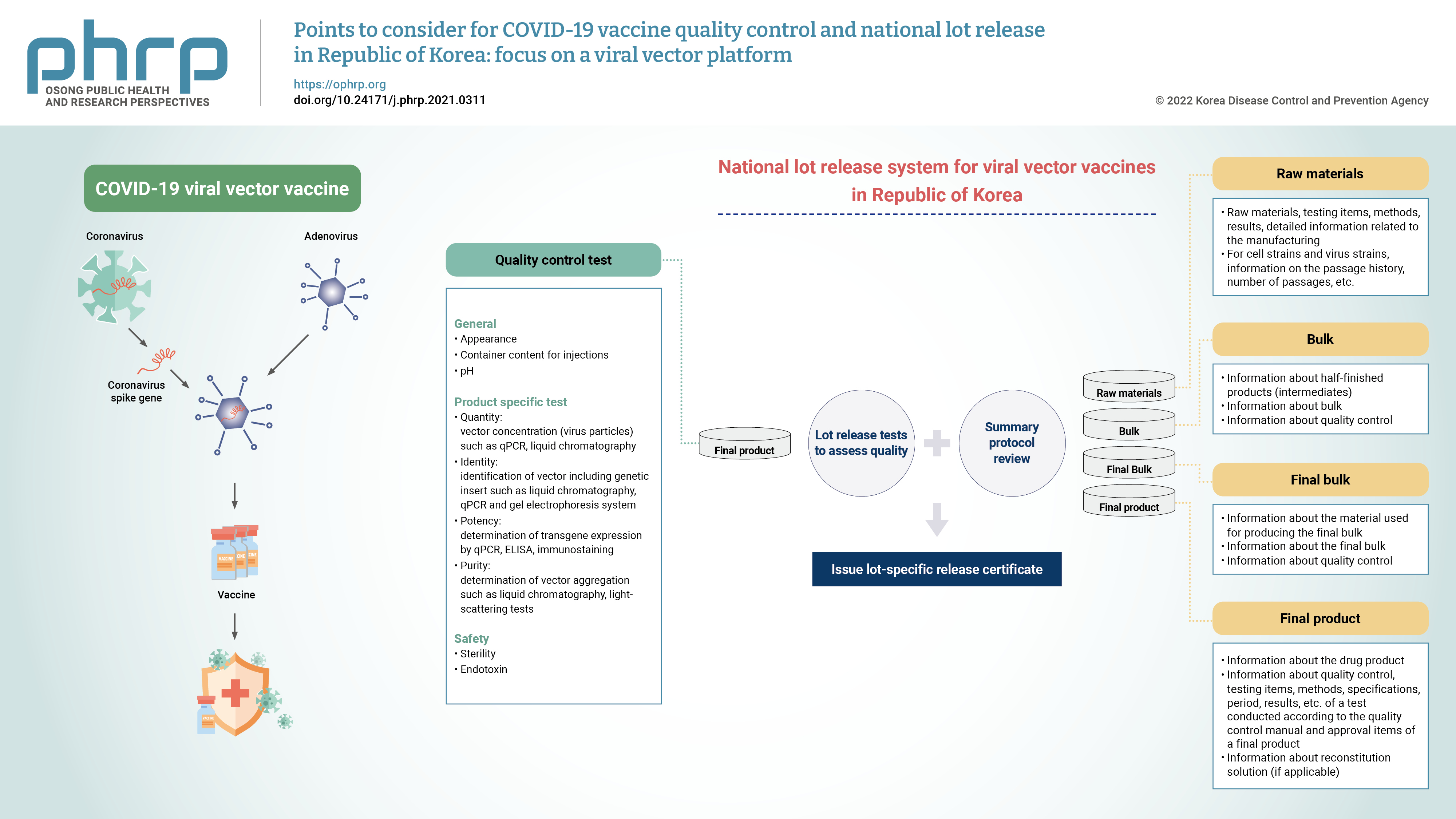
Due to the global public health crisis caused by the coronavirus disease 2019 (COVID-19) pandemic, the importance of vaccine development has increased. In particular, a rapid supply of vaccines and prompt deployment of vaccination programs are essential to prevent and overcome the spread of COVID-19. As a part of the vaccine regulations, national lot release is regulated by the responsible authorities, and this process involves the assessment of the lot before a vaccine is marketed. A lot can be released for use when both summary protocol (SP) review and quality control testing are complete. Accelerated lot release is required to distribute COVID-19 vaccines in a timely manner. In order to expedite the process by simultaneously undertaking the verification of quality assessment and application for approval, it is necessary to prepare the test methods before marketing authorization. With the prolonged pandemic and controversies regarding the effectiveness of the COVID-19 vaccine against new variants, public interest for the development of a new vaccine are increasing. Domestic developers have raised the need to establish standard guidance on the requirements for developing COVID-19 vaccine. This paper presents considerations for quality control in the manufacturing process, test items, and SP content of viral vector vaccines.
Citations
Citations to this article as recorded by
Development of an identity test for COVID-19 mRNA vaccines using SARS-CoV-2 NAT standard Miran Jo, Eunjo Lee, Ho Jung Oh, Jin Tae Hong, Kyung Hee Sohn Biosafety and Health.2025; 7(4): 224. CrossRef
Objectives
In this paper we present an age-structured epidemiological model for Chagas disease. This model includes the interactions between human and vector populations that transmit Chagas disease. Methods
The human population is divided into age groups since the proportion of infected individuals in this population changes with age as shown by real prevalence data. Moreover, the age-structured model allows more accurate information regarding the prevalence, which can help to design more specific control programs. We apply this proposed model to data from the country of Venezuela for two periods, 1961–1971, and 1961–1991 taking into account real demographic data for these periods. Results
Numerical computer simulations are presented to show the suitability of the age-structured model to explain the real data regarding prevalence of Chagas disease in each of the age groups. In addition, a numerical simulation varying the death rate of the vector is done to illustrate prevention and control strategies against Chagas disease. Conclusion
The proposed model can be used to determine the effect of control strategies in different age groups.
Citations
Citations to this article as recorded by
A description of the epidemiological dynamics of Chagas disease via mathematical modeling Rafael Lozada-Yavina, Carolina Marchant, Beatriz Cancino-Faure, Erix W. Hernández-Rodríguez, Fernando Córdova-Lepe Acta Tropica.2023; 243: 106930. CrossRef
Mathematical modeling and numerical simulations of Zika in Colombia considering mutation Diego F. Aranda L., Gilberto González-Parra, Tommaso Benincasa Mathematics and Computers in Simulation.2019; 163: 1. CrossRef
Modeling Chagas disease in Chile: From vector to congenital transmission Mauricio Canals, Dante Cáceres, Sergio Alvarado, Andrea Canals, Pedro E. Cattan Biosystems.2017; 156-157: 63. CrossRef
Objectives
Bacteriophage-encoded endolysins are a group of enzymes that act by digesting the peptidoglycan of bacterial cell walls. LysK has been reported to lyse live staphylococcal cultures. LysK proteins containing only the cysteine/histidine-dependent amidohydrolase/peptidase (CHAP) domain has the capability to show lytic activity against live clinical staphylococcal isolates, including methicillin-resistant <i>Staphylococcus aureus</i> (MRSA). The aim of this study was to clone and express LysK-CHAP domain in <i>Escherichia coli BL21 (DE3)</i> using pET22b as a secretion vector. The pET22b plasmid was used, which encoded a pelB secretion signal under the control of the strong bacteriophage T7 promoter. Methods
The <i>E. coli</i> cloning strains DH5α and BL21 (DE3) were grown at 37°C with aeration in the Luria-Bertani medium. A plasmid encoding LysK-CHAP in a pET22b backbone was constructed. The pET22b vector containing LysK-CHAP sequences were digested with NcoI and HindIII restriction enzymes. Cloning accuracy was confirmed by electrophoresis. The pET22b-LysK plasmid was used to transform the <i>E. coli</i> strain BL21. Isopropyl β-<sc>d</sc>-1-thiogalactopyranoside (IPTG) was added to a final concentration of 1mM to induce T7 RNA polymerase-based expression. Finally, western blot confirmed the expression of target protein. Results
In this study, after double digestion of pEX and pET22b vectors with HindIII and NcoI, LysK gene was cloned into two HindIII and NcoI sites in pET22b vector, and then transformed to <i>E. coli DH5α</i>. Cloning was confirmed with double digestion and analyzed with agarose gel. The recombinant pET22b-LysK plasmid was transformed to <i>E. coli BL21</i> and the expression was induced by IPTG. The expression was confirmed by Sodium dodecyl sulfate polyacrylamide gel electrophoresis (SDS-PAGE) and western blotting method. Observation of a 28.5 kDa band confirmed LysK protein expression. Conclusion
In the present study, LysK-CHAP domain was successfully cloned and expressed at the pET22b vector and <i>E. coli BL21 (DE3)</i>.
Citations
Citations to this article as recorded by
Nanobody-based nanoarchitectonics of ultra-sensitive indirect competitive chemiluminescent enzyme immunoassay for aflatoxin B1 in cereals Xiaoxiao Ke, Yubo Wang, Dan Wang, Qihua Xu, Yanping Hong, Lin Kang, Dongxu Zhang, Jianhua Xiong, Sen Liu, Yujian Luo, Zhui Tu, Wuying Yang Microchemical Journal.2026; 220: 116760. CrossRef
The gut microbiome as a modulator of antibiotic resistance: Mechanisms, dynamics, and therapeutic interventions Jia Yu, Omer Qutaiba B. Allela, Wadhah Hasan Alkhazali, Ashok Kumar Bishoyi, Rami Oweis, Pooja Varma, Aditya Kashyap, Rajashree Panigrahi, Ashish Singh Chauhan, Hayder Naji Sameer, Ahmed Yaseen, Zainab H. Athab, Mohaned Adil Microbial Pathogenesis.2026; 215: 108357. CrossRef
The XylC-mediated aromatic metabolic network modulates the metabolic response of Pseudomonas aeruginosa to deltamethrin Xiao Wei, Xiangna Zhao BMC Microbiology.2026;[Epub] CrossRef
Virobiome-mediated regulation of microbiota–gut–brain axis signaling and neuroimmune homeostasis Alireza Afkhamian, Abolfazl Saffari Natanzi, Mahin Jafaridarabjerdi, Sara Aghaei, Ali Haghjou, Mohammadreza Shafiei, Aysa Hasanzade Bashkandi, Sajjad Shahraki, Russel J. Reiter, Hamed Haddad Kashani, Yanchao Yang Cell Communication and Signaling.2026;[Epub] CrossRef
Innovative approaches to combat antibiotic resistance: integrating CRISPR/Cas9 and nanoparticles against biofilm-driven infections Abolfazl Saffari Natanzi, Mohsen Poudineh, Elham Karimi, Azad Khaledi, Hamed Haddad Kashani BMC Medicine.2025;[Epub] CrossRef
Production of mannooligosaccharides from orange peel waste with β-mannanase expressed in Trichosporonoides oedocephalis Taotao Zhou, Xin Ju, Lishi Yan, Ruiqi Fang, Xinqi Xu, Liangzhi Li Bioresource Technology.2024; 395: 130373. CrossRef
Enhancing the erythritol production of Yarrowia lipolytica by high-throughput screening based on highly sensitive artificial sensor and anchor protein cwp2 Quan Cui, Hui Liu, Chuanzhuang Guo, Jianbin Wang, Yuehan Liu, Yaqi Zhao, Ruiming Wang, Piwu Li, Ting Wang, Junqing Wang, Nan Li Journal of Industrial Microbiology and Biotechnolo.2024;[Epub] CrossRef
Antimicrobial peptides of the vaginal innate immunity and their role in the fight against sexually transmitted diseases H. Madanchi, M. Shoushtari, H.H. Kashani, S. Sardari New Microbes and New Infections.2020; 34: 100627. CrossRef
Assessment of Relationship Between Expression of Survivin Protein and Histopathology Diagnosis and Malignancy Severity in Colon Specimen Amin Jourabchin, Tahereh Mazoochi, Hamed Haddad Kashani, Tahereh Khamechian Journal of Gastrointestinal Cancer.2020; 51(1): 76. CrossRef
The effect of calcium on the adhesion of Streptococcus mutans to Human Gingival Epithelial Cells in the presence of probiotic bacteria Lactobacillus plantarum and Lactobacillus salivarius Mahboobeh Mehrabani Natanzi, Fatemeh Soleimanifard, Hamed Haddad Kashani, Mohammad Javad Azadchehr, Ahmadreza Mirzaei, Zohre Khodaii Gene Reports.2020; 20: 100710. CrossRef
Expression and characterization of family 40 Carbohydrate Binding Module (CBM) from Vibrio cholerae Non-O1 sialidase Gogula Selvi Asang, Shadariah Mamat, Nadiawati Alias, Asmad Kari Asia Pacific Journal of Molecular Biology and Biot.2020; : 26. CrossRef
Effect of intraoperative dexmedetomidine infusion during functional endoscopic sinus surgery: a prospective cohort study Mohammad Reza Fazel, Zeynab Sadat Ahmadi, Hossein Akbari, Fahimeh Abam Patient Safety in Surgery.2020;[Epub] CrossRef
Comparison of a novel herbal skin care ointment with regular ointments to treat skin around the abdominal stoma: A clinical trial study Maryam Hajikari, Soheila Mojdeh, Mohsen Shariari Polish Annals of Medicine.2019;[Epub] CrossRef
Evaluation of the serum sex hormones levels and alkaline phosphatase activity in rats’ testis after administering of berberine in experimental varicocele Hamed Najaran, Hassan Hassani Bafrani, Hamid Rashtbari, Fatemeh Izadpanah, Mohammad Reza Rajabi, Hamed Haddad Kashani, Abouzar Mohammadi Oriental Pharmacy and Experimental Medicine.2019; 19(2): 157. CrossRef
Effect of melatonin in reducing second-generation antipsychotic metabolic effects: A double blind controlled clinical trial Mansour Agahi, Negar Akasheh, Afshin Ahmadvand, Hossein Akbari, Fatemeh Izadpanah Diabetes & Metabolic Syndrome: Clinical Research &.2018; 12(1): 9. CrossRef
Dengue viruses and promising envelope protein domain III-based vaccines Hossein Fahimi, Mahshid Mohammadipour, Hamed Haddad Kashani, Farshid Parvini, Majid Sadeghizadeh Applied Microbiology and Biotechnology.2018; 102(7): 2977. CrossRef
Recombinant Endolysins as Potential Therapeutics against Antibiotic-Resistant Staphylococcus aureus: Current Status of Research and Novel Delivery Strategies Hamed Haddad Kashani, Mathias Schmelcher, Hamed Sabzalipoor, Elahe Seyed Hosseini, Rezvan Moniri Clinical Microbiology Reviews.2018;[Epub] CrossRef
A Novel Chimeric Endolysin with Antibacterial Activity against Methicillin-Resistant Staphylococcus aureus Hamed Haddad Kashani, Hossein Fahimi, Yasaman Dasteh Goli, Rezvan Moniri Frontiers in Cellular and Infection Microbiology.2017;[Epub] CrossRef
The lowering of bilirubin levels in patients with neonatal jaundice using massage therapy: A randomized, double-blind clinical trial Fatemeh Eghbalian, Haneyeh Rafienezhad, Javad Farmal Infant Behavior and Development.2017; 49: 31. CrossRef
The effect of chronic noise stress on serum levels of cortisol, gonadotropins, and sexual hormones at implantation time of mice Alireza Shafiei, Hassan Ehteram, Hossein Akbari, Masoud Motalebi Kashani, Mandana Beigi, Javad Amini Mahabadi, Tahere Mazoochi Comparative Clinical Pathology.2017; 26(4): 779. CrossRef
The Role of Probiotics in the Treatment of Dysentery: a Randomized Double-Blind Clinical Trial Alireza Sharif, Hamed Haddad Kashani, Elahe Nasri, Zahra Soleimani, Mohammad Reza Sharif Probiotics and Antimicrobial Proteins.2017; 9(4): 380. CrossRef
Assessment of 25-hydroxy vitamin D in stroke patients based on severity and type: a cross-sectional study Ebrahim Kouchaki, Mansour Sayyah, Maryam Omidvari Comparative Clinical Pathology.2017; 26(4): 811. CrossRef
Purification of Antibacterial CHAPK Protein Using a Self-Cleaving Fusion Tag and Its Activity Against Methicillin-Resistant Staphylococcus aureus Elahe Seyed Hosseini, Rezvan Moniri, Yasaman Dasteh Goli, Hamed Haddad Kashani Probiotics and Antimicrobial Proteins.2016; 8(4): 202. CrossRef
Objectives
Tuberculosis (TB) is the leading infectious disease in the developing world. Delayed-type hypersensitivity skin test diagnoses TB using tuberculin purified protein derivative (PPD), but this test is incapable of distinguishing <i>Mycobacterium tuberculosis</i> (MTB) infection from bacillus Calmette–Guérin (BCG) vaccination or an infection caused by nontuberculous mycobacteria (NTM). This study was performed to evaluate the use of recombinant early secretory antigenic target 6 (rESAT-6), a secretory protein found only in MTB, <i>Mycobacterium bovis</i>, and few other mycobacterial species, as a skin marker for MTB in guinea pigs. Methods
We prepared recombinant MTB ESAT-6 and evaluated its use as a specific antigen for MTB in guinea pigs. Results
Our results show that the purified MTB rESAT-6 antigen is capable of inducing a positive reaction only in guinea pigs sensitized to MTB. No such reaction was observed in the animals sensitized to <i>M. bovis</i>, BCG vaccination, or NTM (<i>Mycobacterium avium</i>). Conclusion
Our study results confirm that the ESAT-6 antigen is more specific to MTB infection than PPD and could be used in more specific skin tests for detection of MTB in large animals and in humans.
Citations
Citations to this article as recorded by
Biological evaluation of mimetic peptides as active molecules for a new and simple skin test in an animal model Deborah Carbonera Guedes, Aline Kuhn Sbruzzi Pasquali, João Carlos Minozzo, Craig Faulds, Ricardo Rasmussen Petterle, Carlos Ricardo Soccol, Vanete Thomaz Soccol Parasitology Research.2019; 118(1): 317. CrossRef
Application of transdermal patches with new skin test reagents for detection of latent tuberculosis Songsri Kasempimolporn, Pannatat Areekul, Wichit Thaveekarn, Rattana Sutthisri, Supatsorn Boonchang, Artikaya Sawangvaree, Visith Sitprija Journal of Medical Microbiology.2019; 68(9): 1314. CrossRef
Guinea pig infected with Mycobacterium tuberculosis via oral consumption Jianfeng Gao, Ming Guo, Li Teng, Rong Bao, Qiaoyang Xian, Xin Wang, Wenzhe Ho Journal of Applied Animal Research.2018; 46(1): 1323. CrossRef
New strategy to improve quality control of Montenegro skin test at the production level Deborah Carbonera Guedes, João Carlos Minozzo, Aline Kuhn Sbruzzi Pasquali, Craig Faulds, Carlos Ricardo Soccol, Vanete Thomaz-Soccol Revista da Sociedade Brasileira de Medicina Tropic.2017; 50(6): 788. CrossRef
Dissecting the mycobacterial cell envelope and defining the composition of the native mycomembrane Laura Chiaradia, Cyril Lefebvre, Julien Parra, Julien Marcoux, Odile Burlet-Schiltz, Gilles Etienne, Maryelle Tropis, Mamadou Daffé Scientific Reports.2017;[Epub] CrossRef
Objectives
To evaluate the ovicidal and oviposition deterrent activities of five medicinal plant extracts namely <i>Aegle marmelos</i> (Linn.), <i>Limonia acidissima</i> (Linn.), <i>Sphaeranthus indicus</i> (Linn.), <i>Sphaeranthus amaranthoides</i> (burm.f), and <i>Chromolaena odorata</i> (Linn.) against <i>Culex quinquefasciatus</i> and <i>Aedes aegypti</i> mosquitoes. Three solvents, namely hexane, ethyl acetate, and methanol, were used for the preparation of extracts from each plant. Methods
Four different concentrations—62.5 parts per million (ppm), 125 ppm, 250 ppm, and 500 ppm—were prepared using acetone and tested for ovicidal and oviposition deterrent activities. One-way analysis of variance (ANOVA) was used to determine the significance of the treatments and means were separated by Tukey's test of comparison. Results
Among the different extracts of the five plants screened, the hexane extract of <i>L. acidissima</i> recorded the highest ovicidal activity of 79.2% and 60% at 500 ppm concentration against the eggs of <i>Cx. quinquefasciatus</i> and <i>Ae. aegypti</i>, respectively. Similarly, the same hexane extract of <i>L. acidissima</i> showed 100% oviposition deterrent activity at all the tested concentrations against <i>Cx. quinquefasciatus</i> and <i>Ae. aegypti</i> adult females. Conclusion
It is concluded that the hexane extract of <i>L. acidissima</i> could be used in an integrated mosquito management program.
Citations
Citations to this article as recorded by
Development of solid-state water dispersible granule formulation from eucalyptus leaf extracts and bioefficacy assessment against mosquito larvae Sabyasachi Mandal, Soumyadeep Mandal, Dipak Kumar Hazra, Rajib Karmakar, Sunil Kumar Ghosh Journal of Dispersion Science and Technology.2026; : 1. CrossRef
Pyriproxyfen Netting Suppresses Reproductive Output and Oviposition in Anopheles Stephensi Alla Abd AL Hassan AL Hilfy Academia Open.2026;[Epub] CrossRef
Comparative efficacy of nano-formulated toxic sugar baits (Nano-TSBs) combining Datura stramonium L.+ivermectin and Azadirachta indica A. Juss+boric acid against Aedes aegypti Linnaeus, Anopheles stephensi Liston, and Culex quinquefasciatus Say (Diptera: Gulraiz Malik, Sohail Akhtar, Muhammad Babar Shahzad Afzal, Ammad Ahmad Acta Tropica.2026; 283: 108337. CrossRef
Biofabricated nanomaterials derived from Pleurotus ostreatus: novel approaches for Aedes aegypti management Esam S. Al-Malki, Suresh Mickymaray Biomass Conversion and Biorefinery.2025; 15(11): 17003. CrossRef
Lumefantrine-doped cerium oxide nanoparticles: investigating their antibacterial and mosquito larvicidal properties Udaiyan Suresh, Karuppaiya Deepajothika, Sivaperumal Sivaramakrishnan, Chellasamy Panneerselvam, Ahmed Saif, Mohammed Ali Alshehri, Ayed A. Dera 3 Biotech.2025;[Epub] CrossRef
Ovicidal and oviposition deterrence properties of Tabernaemontana divaricata (Apocynaceae) against Aedes albopictus and Culex quinquefasciatus in Sri Lanka W. M. S. H. Wijesundara, T. C. Weeraratne, W. A. Priyanka P. de Silva Arthropod-Plant Interactions.2024; 18(2): 317. CrossRef
Oviposition Deterrent Activity of Some Wild Plants for Adult Females of Chrysomya albiceps with Medical and Veterinary Importance Usama Mohammed Abu El-Ghi, Abdullah Mohammed Salman Alh, Tarek Mohamed Yousry Els, Mohamed Abdel-Monem El-Sakhawy Pakistan Journal of Biological Sciences.2024; 27(1): 8. CrossRef
Efficacy of plant products in controlling disease vector mosquitoes, a review V. Edwin Hillary, S. Antony Ceasar, S. Ignacimuthu Entomologia Experimentalis et Applicata.2024; 172(3): 195. CrossRef
Bioactivity of Sphaeranthus indicus leaf extracts on the aquatic stages of Aedes aegypti and Culex quinquefasciatus mosquitoes Alex Yagoo, M. C. John Milton, Jelin Vilvest Arthropod-Plant Interactions.2024; 18(5): 955. CrossRef
Efficacy of herbal extracts in the management of cactus pest, Dactylopius opuntiae (Hemiptera: Dactylopiidae) in Tigray Region, Ethiopia Sisay Weldegebriel Zeweld, Kiros Meles Ayimut, Mebrahtom Gebrelibanos Hiben Discover Agriculture.2024;[Epub] CrossRef
Mosquitocidal activities of Chenopodium botrys whole plant n-hexane extract against Culex quinquefasciatus I. Ilahi, A. M. Yousafzai, M. Attaullah, T. U. Haq, A. Rahim, W. Khan, A. A. Khan, S. Ullah, T. Jan, M. M. Khan, G. Rahim, N. Zaman Brazilian Journal of Biology.2023;[Epub] CrossRef
Effects of biopesticides extracted with a homemade solvent on stored maize protection Henry Ofosuhene Sintim, Kwame Duodu Ansah Agricultura Tropica et Subtropica.2023; 56(1): 125. CrossRef
Biological Activity of Cyclic Peptide Extracted from Sphaeranthus amaranthoides Using De Novo Sequencing Strategy by Mass Spectrometry for Cancer Swarnalatha Yanamadala, Sivakumar Shanthirappan, Sidhika Kannan, Narendran Chiterasu, Kumaran Subramanian, Lamya Ahmed Al-Keridis, Tarun Kumar Upadhyay, Nawaf Alshammari, Mohd Saeed, Guru Prasad Srinivasan, Rohini Karunakaran Biology.2023; 12(3): 412. CrossRef
Optimised neem oil-bilayer tablets: A safe, effective and stable tool for the prevention of vector-borne disease outbreaks by Aedes albopictus K.K. Swathy, C. Sarath Chandran, Minil Mukundan, K.R. Sreejith, K. Sourav, M.C. Jafna, Abhila V. Mukund, Shijina Kappally, Rajesh Sreedharan Nair, Jim Joseph Experimental Parasitology.2023; 251: 108550. CrossRef
Evaluation of different high doses aqueous plant extracts for the sustainable control of Aedes aegypti mosquitoes under laboratory conditions Afaq Ahmad, Gul Zamin Khan, Misbah Ullah, Nazeer Ahmed, Kamran Sohail, Irfan Ullah, Najat A. Bukhari, Kahkashan Perveen, Ijaz Ali, Ke Li Journal of King Saud University - Science.2023; 35(11): 102991. CrossRef
Volatile toxin ofLimonia acidissima(L.) produced larvicidal, developmental, repellent, and adulticidal toxicity effects onAedes aegypti(L.) Muthiah Chellappandian, Sengottayan Senthil-Nathan, Prabhakaran Vasantha-Srinivasan, Sengodan Karthi, Kandaswamy Kalaivani, Wayne Brian Hunter, Hayssam M. Ali, Mohamed Z. M. Salem, Ahmed Abdel-Megeed Toxin Reviews.2022; 41(1): 119. CrossRef
Chemical composition and mosquitocidal efficacy of panchagavya against Anopheles stephensi, Aedes aegypti and Culex quinquefasciatus Sivaji Sathiyaraj, Gunasekaran Suriyakala, Arumugam Dhanesh Gandhi, Ranganathan Babujanarthanam, K. Kaviyarasu, R. Rajakrishnan, Palaniselvam Kuppusamy, Belle Ebanda Kedi Philippe Journal of King Saud University - Science.2022; 34(4): 101960. CrossRef
Bioefficacy of Epaltes divaricata (L.) n-Hexane Extracts and Their Major Metabolites against the Lepidopteran Pests Spodoptera litura (fab.) and Dengue Mosquito Aedes aegypti (Linn.) Kesavan Amala, Sengodan Karthi, Raja Ganesan, Narayanaswamy Radhakrishnan, Kumaraswamy Srinivasan, Abd El-Zaher M. A. Mostafa, Abdullah Ahmed Al-Ghamdi, Jawaher Alkahtani, Mohamed Soliman Elshikh, Sengottayan Senthil-Nathan, Prabhakaran Vasantha-Srinivasa Molecules.2021; 26(12): 3695. CrossRef
Bio efficacy of Cinnamaldehyde from Cinnamomum verum essential oil against Culex quinquefasciatus (Diptera: Culicidae) K. Nakasen, A. Wongsrila, J. Prathumtet, P. Sriraj, T. Boonmars, T. Promsrisuk, N. Laikaew, R. Aukkanimart Journal of Entomological and Acarological Research.2021;[Epub] CrossRef
Ovicidal, larvicidal and pupicidal efficacy of silver nanoparticles synthesized by Bacillus marisflavi against the chosen mosquito species Thelma J., Balasubramanian C., Jiang-Shiou Hwang PLOS ONE.2021; 16(12): e0260253. CrossRef
Insecticidal activity and phytochemical analysis of Pyrus communis L. extracts against malarial vector, Anopheles pharoensis Theobald, 1901 (Diptera: Culicidae) Ahmed Zeinhom Ibrahem Shehata, Rola Milad Labib, Mohammad Reda Kamel Abdel-Samad Polish Journal of Entomology.2021; 90(4 - Ahead ): 209. CrossRef
Oviposition Deterrent Activity and Ovicidal Effect of Pometia pinnata Leaves Extract against Dengue Vector, Aedes aegypti (Diftera: Culicidae) Luthfi Suharyo, Rizqulla K. Arthari, Fitria S.N. Rochmah, G. Gholib, A. Sutriana, A. Engelhardt, J. Duboscq, R. Sahara Zamzami E3S Web of Conferences.2020; 151: 01013. CrossRef
Toxicological screening of marine red algae Champia parvula (C. Agardh) against the dengue mosquito vector Aedes aegypti (Linn.) and its non-toxicity against three beneficial aquatic predators Parthiban Yogarajalakshmi, Thinnaur Venugopal Poonguzhali, Raja Ganesan, Sengodan Karthi, Sengottayan Senthil-Nathan, Patcharin Krutmuang, Narayanaswamy Radhakrishnan, Faruq Mohammad, Tae-Jin Kim, Prabhakaran Vasantha-Srinivasan Aquatic Toxicology.2020; 222: 105474. CrossRef
Larvicidal and histopathological efficacy of inhabitant pathogenic bacterial strains to reduce the dengue vector competence Gopalan Rajagopal, Jeyaraj Jeyavani, Sakkanan Ilango Pest Management Science.2020; 76(11): 3587. CrossRef
Artemisia vulgaris efficacies against various stages of Aedes aegypti Vika Ichsania Ninditya, Endah Purwati, Ajeng Tyas Utami, Aprillyani Sofa Marwaningtyaz, Nadia Khairunnisa Fairuz, Rini Widayanti, Penny Humaidah Hamid Veterinary World.2020; 13(7): 1423. CrossRef
The potential use of Azolla pinnata as an alternative bio-insecticide Rajiv Ravi, Dinesh Rajendran, Wen-Da Oh, Mohd Sukhairi Mat Rasat, Zulhazman Hamzah, Intan H. Ishak, Mohamad Faiz Mohd Amin Scientific Reports.2020;[Epub] CrossRef
Ovicidal and Latent Effects of Pulicaria jaubertii (Asteraceae) Leaf Extracts on Aedes aegypti
Ahmed Z. Shehata, Tarek M. El-Sheikh, Raafat M. Shaapan, Sobhy Abdel-Shafy, Abdullah D. Alanazi Journal of the American Mosquito Control Associati.2020; 36(3): 161. CrossRef
Aspergillus flavus (Link) toxins reduces the fitness of dengue vector Aedes aegypti (Linn.) and their non-target toxicity against aquatic predator Prabhakaran Vasantha-Srinivasan, Sengodan Karthi, Muthiah Chellappandian, Athirstam Ponsankar, Annamalai Thanigaivel, Sengottayan Senthil-Nathan, Devarajan Chandramohan, Raja Ganesan Microbial Pathogenesis.2019; 128: 281. CrossRef
Toxic effect of essential oil and its compounds isolated from Sphaeranthus amaranthoides Burm. f. against dengue mosquito vector Aedes aegypti Linn. Annamalai Thanigaivel, Kanagaraj Muthu-Pandian Chanthini, Sengodan Karthi, Prabhakaran Vasantha-Srinivasan, Athirstam Ponsankar, Haridoss Sivanesh, Vethamonickam Stanley-Raja, Narayanan Shyam-Sundar, Kilapavoor Raman Narayanan, Sengottayan Senthil-Nathan Pesticide Biochemistry and Physiology.2019; 160: 163. CrossRef
A Review of the Bioactivity of Plant Products AgainstAedes aegypti(Diptera: Culicidae) Fatehia Nasser Gharsan Journal of Entomological Science.2019; 54(3): 256. CrossRef
Larvicidal, Histopathological, Antibacterial Activity of Indigenous Fungus Penicillium sp. Against Aedes aegypti L and Culex quinquefasciatus (Say) (Diptera: Culicidae) and Its Acetylcholinesterase Inhibition and Toxicity Assessment of Zebrafish (Danio re Chinnasamy Ragavendran, Venkatesan Manigandan, Chinnaperumal Kamaraj, Govindasamy Balasubramani, Joy Sebastian Prakash, Pachiappan Perumal, Devarajan Natarajan Frontiers in Microbiology.2019;[Epub] CrossRef
Insecticidal activities of Cymbopogon nordus (Linn.) wholeplant ethyl acetate extract against lymphatic filariasis vector with study on non-target organisms
International Journal of Biosciences (IJB).2019; : 311. CrossRef
Poly(Styrene Sulfonate)/Poly(Allylamine Hydrochloride) Encapsulation of TiO2 Nanoparticles Boosts Their Toxic and Repellent Activity Against Zika Virus Mosquito Vectors Kadarkarai Murugan, Anitha Jaganathan, Rajapandian Rajaganesh, Udaiyan Suresh, Jagan Madhavan, Sengottayan Senthil-Nathan, Aruliah Rajasekar, Akon Higuchi, Suresh S. Kumar, Abdullah A. Alarfaj, Marcello Nicoletti, Riccardo Petrelli, Loredana Cappellacci, Journal of Cluster Science.2018; 29(1): 27. CrossRef
Prevention and Control Strategies to Counter Zika Virus, a Special Focus on Intervention Approaches against Vector Mosquitoes—Current Updates Raj K. Singh, Kuldeep Dhama, Rekha Khandia, Ashok Munjal, Kumaragurubaran Karthik, Ruchi Tiwari, Sandip Chakraborty, Yashpal S. Malik, Rubén Bueno-Marí Frontiers in Microbiology.2018;[Epub] CrossRef
Bioefficacy of Duranta erecta leaf extract on yellow fever and dengue vector, Aedes aegypti Linn. in Nigeria Ekenma Julia Agwu, Ejikeme Gregory Odo, Felicia Ekeh, Michael Uwagbae, Godwin Ngwu, Chinelo Ehilegbu Journal of Medicinal Plants Research.2018; 12(11): 124. CrossRef
Development of an eco-friendly mosquitocidal agent from Alangium salvifolium against the dengue vector Aedes aegypti and its biosafety on the aquatic predator Annamalai Thanigaivel, Prabhakaran Vasantha-Srinivasan, Edward-Sam Edwin, Athirstam Ponsankar, Selvaraj Selin-Rani, Muthiah Chellappandian, Kandaswamy Kalaivani, Sengottayan Senthil-Nathan, Giovanni Benelli Environmental Science and Pollution Research.2018; 25(11): 10340. CrossRef
A novel herbal product based on Piper betle and Sphaeranthus indicus essential oils: Toxicity, repellent activity and impact on detoxifying enzymes GST and CYP450 of Aedes aegypti Liston (Diptera: Culicidae) Prabhakaran Vasantha-Srinivasan, Muthiah Chellappandian, Sengottayan Senthil-Nathan, Athirstam Ponsankar, Annamalai Thanigaivel, Sengodan Karthi, Edward-Sam Edwin, Selvaraj Selin-Rani, Kandaswamy Kalaivani, Filippo Maggi, Giovanni Benelli Journal of Asia-Pacific Entomology.2018; 21(4): 1466. CrossRef
Extract of Nicotiana tabacum as a potential control agent of Grapholita molesta (Lepidoptera: Tortricidae) Souvic Sarker, Un Taek Lim, Miguel Lopez-Ferber PLOS ONE.2018; 13(8): e0198302. CrossRef
Mosquito oviposition deterrents Essam Abdel-Saalam Shaalan, Deon Vahid Canyon Environmental Science and Pollution Research.2018; 25(11): 10207. CrossRef
Suaeda maritima -based herbal coils and green nanoparticles as potential biopesticides against the dengue vector Aedes aegypti and the tobacco cutworm Spodoptera litura Udaiyan Suresh, Kadarkarai Murugan, Chellasamy Panneerselvam, Rajapandian Rajaganesh, Mathath Roni, Al Thabiani Aziz, Hatem Ahmed Naji Al-Aoh, Subrata Trivedi, Hasibur Rehman, Suresh Kumar, Akon Higuchi, Angelo Canale, Giovanni Benelli Physiological and Molecular Plant Pathology.2018; 101: 225. CrossRef
Orchids as Sources of Novel Nanoinsecticides? Efficacy of Bacillus sphaericus and Zeuxine gracilis-Fabricated Silver Nanoparticles Against Dengue, Malaria and Filariasis Mosquito Vectors Kalimuthu Kovendan, Balamurugan Chandramohan, Marimuthu Govindarajan, Arulsamy Jebanesan, Siva Kamalakannan, Savariar Vincent, Giovanni Benelli Journal of Cluster Science.2018; 29(2): 345. CrossRef
Impact of Terminalia chebula Retz. against Aedes aegypti L. and non-target aquatic predatory insects Annamalai Thanigaivel, Prabhakaran Vasantha-Srinivasan, Sengottayan Senthil-Nathan, Edward-Sam Edwin, Athirstam Ponsankar, Muthiah Chellappandian, Selvaraj Selin-Rani, Jalasteen Lija-Escaline, Kandaswamy Kalaivani Ecotoxicology and Environmental Safety.2017; 137: 210. CrossRef
Biocontrol Properties of Basidiomycetes: An Overview Subramaniyan Sivanandhan, Ameer Khusro, Michael Paulraj, Savarimuthu Ignacimuthu, Naif AL-Dhabi Journal of Fungi.2017; 3(1): 2. CrossRef
Adulticidal, larvicidal, pupicidal and oviposition deterrent activities of essential oil from Zanthoxylum limonella Alston (Rutaceae) against Aedes aegypti (L.) and Culex quinquefasciatus (Say) Mayura Soonwera, Siriporn Phasomkusolsil Asian Pacific Journal of Tropical Biomedicine.2017; 7(11): 967. CrossRef
Larvicidal and Pupicidal Activities of Alizarin Isolated from Roots of Rubia cordifolia Against Culex quinquefasciatus Say and Aedes aegypti (L.) (Diptera: Culicidae) M R Gandhi, A D Reegan, P Ganesan, K Sivasankaran, M G Paulraj, K Balakrishna, S Ignacimuthu, N A Al – Dhabi Neotropical Entomology.2016; 45(4): 441. CrossRef
Inhibition and Larvicidal Activity of Phenylpropanoids from Piper sarmentosum on Acetylcholinesterase against Mosquito Vectors and Their Binding Mode of Interaction Arshia Hematpoor, Sook Yee Liew, Wei Lim Chong, Mohd Sofian Azirun, Vannajan Sanghiran Lee, Khalijah Awang, Youjun Zhang PLOS ONE.2016; 11(5): e0155265. CrossRef
Fern-synthesized silver nanocrystals: Towards a new class of mosquito oviposition deterrents? Rajapandian Rajaganesh, Kadarkarai Murugan, Chellasamy Panneerselvam, Sudalaimani Jayashanthini, Al Thbiani Aziz, Mathath Roni, Udaiyan Suresh, Subrata Trivedi, Hasibur Rehman, Akon Higuchi, Marcello Nicoletti, Giovanni Benelli Research in Veterinary Science.2016; 109: 40. CrossRef
Plant-borne ovicides in the fight against mosquito vectors of medical and veterinary importance: a systematic review Giovanni Benelli Parasitology Research.2015; 114(9): 3201. CrossRef
Efficacy of essential oil from Cananga odorata (Lamk.) Hook.f. & Thomson (Annonaceae) against three mosquito species Aedes aegypti (L.), Anopheles dirus (Peyton and Harrison), and Culex quinquefasciatus (Say) Mayura Soonwera Parasitology Research.2015; 114(12): 4531. CrossRef
Objectives
Classification of breast cancer patients into different risk classes is very important in clinical applications. It is estimated that the advent of high-dimensional gene expression data could improve patient classification. In this study, a new method for transforming the high-dimensional gene expression data in a low-dimensional space based on wavelet transform (WT) is presented. Methods
The proposed method was applied to three publicly available microarray data sets. After dimensionality reduction using supervised wavelet, a predictive support vector machine (SVM) model was built upon the reduced dimensional space. In addition, the proposed method was compared with the supervised principal component analysis (PCA). Results
The performance of supervised wavelet and supervised PCA based on selected genes were better than the signature genes identified in the other studies. Furthermore, the supervised wavelet method generally performed better than the supervised PCA for predicting the 5-year survival status of patients with breast cancer based on microarray data. In addition, the proposed method had a relatively acceptable performance compared with the other studies. Conclusion
The results suggest the possibility of developing a new tool using wavelets for the dimension reduction of microarray data sets in the classification framework.
Citations
Citations to this article as recorded by
Antimicrobial Resistance Patterns Among Bloodstream Infection Isolates in a Tertiary Care Hospital in Northwestern India: A Retrospective Study Rajendra Surje, Preeti Shrivastava, Abhishek Kumar Jain, Kanchan Gupta Journal of Madha Academy of Research and Science.2026; 1: 4. CrossRef
Role of machine learning in molecular pathology for breast cancer: A review on gene expression profiling and RNA sequencing application Sahar Rezaei, Zeinab Hamedani, Kousar Ahmadi, Parna Ghannadikhosh, Alireza Motamedi, Maedeh Athari, Hengameh Yousefi, Amir Hossein Rajabi, Alireza Abbasi, Hossein Arabi Critical Reviews in Oncology/Hematology.2025; 213: 104780. CrossRef
Diagnosing thyroid disorders: Comparison of logistic regression and neural network models Shiva Borzouei, Hossein Mahjub, NegarAsaad Sajadi, Maryam Farhadian Journal of Family Medicine and Primary Care.2020; 9(3): 1470. CrossRef
Thyroid disorder diagnosis based on Mamdani fuzzy inference system classifier Negar Asaad Sajadi, Hossein Mahjub, Shiva Borzouei, Maryam Farhadian Koomesh Journal.2020; 22(1): 107. CrossRef
Diagnosis of hypothyroidism using a fuzzy rule-based expert system Negar Asaad Sajadi, Shiva Borzouei, Hossein Mahjub, Maryam Farhadian Clinical Epidemiology and Global Health.2019; 7(4): 519. CrossRef
WaveICA: A novel algorithm to remove batch effects for large-scale untargeted metabolomics data based on wavelet analysis Kui Deng, Fan Zhang, Qilong Tan, Yue Huang, Wei Song, Zhiwei Rong, Zheng-Jiang Zhu, Kang Li, Zhenzi Li Analytica Chimica Acta.2019; 1061: 60. CrossRef
Objectives
Until the early 2000s, lymphatic filariasis would commonly break out in the coastal areas in Korea. Through steady efforts combining investigation and treatment, filariasis was officially declared eradicated in 2008. This study surveyed the density of vector species of filariasis in past endemic areas, and inspected filariasis DNA from collected mosquitoes for protection against the reemergence of filariasis. Methods
Between May and October 2009, mosquitoes were caught using the black night trap in past endemic coastal areas: Gyeongsangnam-do, Jeollanamdo, and Jeju-do. The collected mosquitoes were identified, and the extracted DNA from the collected vector mosquitoes was tested by polymerase chain reaction for <i>Brugia malayi</i> filariasis. Results
<i>Ochletotatus togoi, Anophel es (Hyrcanus)</i> group and <i>Culex pipiens</i> were most frequently caught in Jeollanam-do (Geomun Island, Bogil Island, Heuksan Island), Jeju-do (Namone-ri, Wimi-ri). and Gyeongsangnam-do (Maemul Island). DNA of <i>B malayi</i> was not found in <i>Och Togoi</i> and <i>An (Hyrcanus)</i> group as main vectors of filariasis. Conclusion
Lymphatic filariasis was not found in the vector mosquitoes collected in past endemic areas. However, considering that the proportion of vector species is quite high, there is a potential risk that filariasis could be reemerging through overseas travel or trade. Thus, there is a need to continuously monitor vector mosquitoes of lymphatic filariasis.
Citations
Citations to this article as recorded by
Barriers and Facilitators to Implementing Post-Validation Surveillance of Lymphatic Filariasis in Pacific Island Countries and Territories: A Conceptual Framework Developed from Qualitative Data Harriet L. S. Lawford, Holly Jian, ‘Ofa Tukia, Joseph Takai, Clément Couteaux, ChoCho Thein, Ken Jetton, Teanibuaka Tabunga, Temea Bauro, Roger Nehemia, Charlie Ave, Grizelda Mokoia, Peter Fetaui, Fasihah Taleo, Cheryl-Ann Udui, Colleen L. Lau, Adam T. Cr Tropical Medicine and Infectious Disease.2026; 11(1): 27. CrossRef
Utility of antifilarial antibodies for post-validation surveillance of lymphatic filariasis in Tonga Harriet L. S. Lawford, ‘Ofa Tukia, Joseph Takai, Sarah Sheridan, Selina Ward, Holly Jian, Beatris Mario Martin, Reynold ‘Ofanoa, Stefanie Vaccher, Leanne Robinson, Fiona Angrisano, Colleen L. Lau Scientific Reports.2026;[Epub] CrossRef
Current Gaps in Survey Design and Analysis for Molecular Xenomonitoring of Vector‐Borne Neglected Tropical Diseases: A Systematic Review Angus McLure, Tilahun Alamnia, Zhiwei Xu, Colleen L. Lau, Helen J. Mayfield Tropical Medicine & International Health.2025; 30(9): 893. CrossRef
The new invasive mosquito species Aedes koreicus as vector-borne diseases in the European area, a focus on Italian region: What we know from the scientific literature Sonia Ganassi, Antonio De Cristofaro, Dalila Di Criscio, Sonia Petrarca, Chiara Leopardi, Antonio Guarnieri, Laura Pietrangelo, Noemi Venditti, Roberto Di Marco, Giulio Petronio Petronio Frontiers in Microbiology.2022;[Epub] CrossRef
Monitoring migrant groups as a post-validation surveillance approach to contain the potential reemergence of lymphatic filariasis in Togo Monique Ameyo Dorkenoo, Martin Kouame Tchankoni, Degninou Yehadji, Kossi Yakpa, Mawèké Tchalim, Efoe Sossou, Rachel Bronzan, Didier Koumavi Ekouevi Parasites & Vectors.2021;[Epub] CrossRef
Geographical Genetic Variation and Sources of Korean Aedes albopictus (Diptera: Culicidae) Populations EunJung Lee, Seong-Chan Yang, Tae-Kyu Kim, Byung-Eon Noh, Hak Seon Lee, Hyunwoo Kim, Jong Yul Roh, Wook-Gyo Lee, Michel Slotman Journal of Medical Entomology.2020; 57(4): 1057. CrossRef
A systematic review of alternative surveillance approaches for lymphatic filariasis in low prevalence settings: Implications for post-validation settings Nicholas Riches, Xavier Badia-Rius, Themba Mzilahowa, Louise A. Kelly-Hope, Patrick J. Lammie PLOS Neglected Tropical Diseases.2020; 14(5): e0008289. CrossRef
An Insight into the Discovery of Potent Antifilarial Leads Against Lymphatic Filariasis Pone Kamdem Boniface, Ferreira Igne Elizabeth Current Drug Targets.2020; 21(7): 657. CrossRef
Prevention and Control Strategies for Parasitic Infections in the Korea Centers for Disease Control and Prevention Young Yil Bahk, Eun-Hee Shin, Shin-Hyeong Cho, Jung-Won Ju, Jong-Yil Chai, Tong-Soo Kim The Korean Journal of Parasitology.2018; 56(5): 401. CrossRef
Phylogeography of the Coastal Mosquito Aedes togoi across Climatic Zones: Testing an Anthropogenic Dispersal Hypothesis Teiji Sota, Peter Belton, Michelle Tseng, Hoi Sen Yong, Motoyoshi Mogi, Igor Mokrousov PLOS ONE.2015; 10(6): e0131230. CrossRef
Global warming has various effects on human health. The main indirect effects are on infectious diseases. Although the effects on infectious diseases will be detected worldwide, the degree and types of the effect are different, depending on the location of the respective countries and socioeconomical situations.Among infectious diseases, water- and foodborne infectious diseases and vector-borne infectious diseases are two main categories that are forecasted to be most affected. The effect on vector-borne infectious diseases such as malaria and dengue fever is mainly because of the expansion of the infested areas of vector mosquitoes and increase in the number and feeding activity of infected mosquitoes. There will be increase in the number of cases with water- and foodborne diarrhoeal diseases.Even with the strongest mitigation procedures, global warming cannot be avoided for decades. Therefore, implementation of adaptation measures to the effect of global warming is the most practical action we can take. It is generally accepted that the impacts of global warming on infectious diseases have not been apparent at this point yet in East Asia. However, these impacts will appear in one form or another if global warming continues to progress in future. Further research on the impacts of global warming on infectious diseases and on future prospects should be conducted.
Citations
Citations to this article as recorded by
Sustainability in healthcare: A review of the environmental impact of healthcare and laboratory medicine Melissa Whitman Clinical Microbiology Newsletter.2026; 54: 18. CrossRef
Climate change, care provisioning, and inequality: transitioning towards a sustainable economy Maria S Floro Oxford Review of Economic Policy.2026; 41(3-4): 1020. CrossRef
Role of Public Health in Wildfire: Lessons from the Field Heidi E. Brown, Erika Austhof, Daniel Ferguson, Ladd Keith EcoHealth.2026; 23(3): 516. CrossRef
Phase-resolved impacts of daytime, nighttime, and compound heatwaves on urban air quality in Delhi Renu Masiwal, Dilip Ganguly, Sandhya Jose, Ashima Sharma, Ravi K. Kunchala, Sagnik Dey Sustainable Cities and Society.2026; 150: 107819. CrossRef
Analysis of global $$hbox {CO}_2$$ emissions, population, and energy use via general fractional models and optimal control Amin Jajarmi International Journal of Dynamics and Control.2026;[Epub] CrossRef
Climbing to survive: Potential elevational shifts in warming risk for the Moltrecht's treefrog Jh‐Yu You, Desiree Andersen Bliss, Ming‐Feng Chuang Ecological Solutions and Evidence.2026;[Epub] CrossRef
Climate change, the exposome, and early-onset carcinogenesis Sherry Price, Erin J Plenzler, James R Hébert Carcinogenesis.2026;[Epub] CrossRef
Performance assessment of renewable e-fuel production from captured CO2 and green hydrogen Mohammad Alrbai, Yang Liang, Omar A. Ismail, Mohamad Y. Mustafa, Sameer Al-Dahidi, Hamzeh Duwaairi, Mosa Abusorra Energy Conversion and Management: X.2026; 32: 102347. CrossRef
Mathematical Modeling and Control of Gas Emissions, Ozone Depletion, and Ecological Sustainability Charu Arora, Sudhakar Yadav, Saurabh Kr Agrawal, Nishi Deepa Palo, Massimo Donelli, Achin Jain Mathematics.2026; 14(19): 3578. CrossRef
Ex vivo culture models to study viral infections of the liver Esther Föderl-Höbenreich, Katrin Panzitt Current Opinion in Virology.2025; 71: 101462. CrossRef
Climate Change and the Rise of Emerging and Re-Emerging Infectious Diseases in Africa: A Literature Review Robert Kwame D. Agyarko, Dennis Kithinji, Kizito Bishikwabo Nsarhaza International Journal of Environmental Research an.2025; 22(6): 903. CrossRef
Association of Post Kala-Azar Dermal Leishmaniasis pathogenesis with prolonged sunlight (ultraviolet radiations) exposure in VL endemic population of Bihar Sachidananda Behera, Mehar Darukhshan Kalim, Naveen Kumar, Vidya Nand Ravi Das, Niyamat Ali Siddiqui, Krishna Pandey, Shubhankar Kumar Singh, Vahab Ali Scientific Reports.2025;[Epub] CrossRef
Spatial age-stratified epidemiological model with applications to South African COVID-19 pandemic Raeesa Manjoo-Docrat, Nada Abdelatif, Jenny Holloway, Nontembeko Dudeni-Tlhone, Claudia Dresselhaus, Elona Mbayise, Charl Janse van Rensburg, Inger Fabris-Rotelli, Pravesh Debba, Sibusisiwe Makhanya Heliyon.2025; 11(11): e43171. CrossRef
Gas venting behavior and early detection performance in energy storage system battery modules under various thermal runaway scenarios Jong Eun Kim, Hong Sun Ryou, Young Man Lee, Seong Hyuk Lee Case Studies in Thermal Engineering.2025; 73: 106676. CrossRef
DYNAMICS OF THE ATMOSPHERIC FRACTIONAL CARBON-DIOXIDE GAS MODEL WITH DEEP NEURAL NETWORK TARIQ MAHMOOD, MUHAMMAD ARFAN, YAHYA ALMALKI, IBRAHIM MEKAWY, MOHAMED ABDALLA Fractals.2025;[Epub] CrossRef
A Mathematical Model of Solar Radiation’s Impact on Global Warming Abanum G. C., Omoregbe C.O., Obaremi L., Owoyi M., Odiaka V. Nigerian Journal of Pure and Applied Sciences.2025; : 5868. CrossRef
Analysis of Meteorological Factors Contributing to the February 2025 Epidemic of Infectious Gastroenteritis and Norovirus Food Poisoning Outbreaks in Japan Using Open Data Mamoru Noda, Eiki Yamasaki, Mari Tohya, Tomoichiro Oka, Masashi Uema Japanese Journal of Food Microbiology.2025; 42(4): 102. CrossRef
Predictive modeling for infectious diarrheal disease in pediatric populations: A systematic review Billy Ogwel, Vincent Mzazi, Bryan O. Nyawanda, Gabriel Otieno, Richard Omore Learning Health Systems.2024;[Epub] CrossRef
A review of regional variations in vulnerability to infectious diseases and policy implications for climate change and health Shabana Khan, Robin Fears, Deoraj Caussy Natural Hazards Research.2024; 4(2): 221. CrossRef
A new forecasting behavior of fractional model of atmospheric dynamics of carbon dioxide gas Jagdev Singh, Rashmi Agrawal, Kottakkaran Sooppy Nisar Partial Differential Equations in Applied Mathemat.2024; 9: 100595. CrossRef
Surface engineering for stable electrocatalysis Viet-Hung Do, Jong-Min Lee Chemical Society Reviews.2024; 53(5): 2693. CrossRef
Temperature and hospital admissions in the Eastern Mediterranean: a case study in Cyprus Yichen Wang, Souzana Achilleos, Pascale Salameh, Panayiotis Kouis, Panayiotis K Yiallouros, Elena Critselis, Kleanthis Nicolaides, Filippos Tymvios, Chrysanthos Savvides, Emily Vasiliadou, Stefania I Papatheodorou, Petros Koutrakis, Barrak Alahmad Environmental Research: Health.2024; 2(2): 025004. CrossRef
Optimal Control of Global Warming by Carbon Dioxide Mitigation Through Awareness Programmes Ahana Verma, Maninder Singh Arora, Ashish Omar, Kirti Chauhan International Journal of Environmental Research.2024;[Epub] CrossRef
Reversal of Soleus Muscle Atrophy in Older Adults: A Non-Volitional Exercise Intervention for a Changing Climate Kenneth McLeod Clinical Interventions in Aging.2024; Volume 19: 795. CrossRef
Engineering Pt–CeO2 interfaces for reverse water-gas shift (RWGS) reaction Kauê G. G. dos Santos, Alisson S. Thill, Livia P. Matte, Gustavo Z. Girotto, Mateus V. Costa, Denise R. Bohn, Fernanda Poletto, Fabiano Bernardi RSC Applied Interfaces.2024; 1(5): 992. CrossRef
A multimodal framework for extraction and fusion of satellite images and public health data Dana Moukheiber, David Restrepo, Sebastián Andrés Cajas, María Patricia Arbeláez Montoya, Leo Anthony Celi, Kuan-Ting Kuo, Diego M. López, Lama Moukheiber, Mira Moukheiber, Sulaiman Moukheiber, Juan Sebastian Osorio-Valencia, Saptarshi Purkayastha, Atika Scientific Data.2024;[Epub] CrossRef
Effects of ozone exposure on lung injury, inflammation, and oxidative stress in a murine model of nonpneumonic endotoxemia Jared Radbel, Jaclynn A Meshanni, Kinal N Vayas, Oahn Le-Hoang, Elena Abramova, Peihong Zhou, Laurie B Joseph, Jeffrey D Laskin, Andrew J Gow, Debra L Laskin Toxicological Sciences.2024; 200(2): 299. CrossRef
A critical meta-analysis of CO2-water-rock interaction in basalt for CO2 storage: A review based on global and Indian perspective Rahul Kumar Singh, Nirlipta P. Nayak, Sanjeev Kumar, Vikram Vishal Marine and Petroleum Geology.2024; 168: 107002. CrossRef
Evaluation of Infectivity and Immunogenicity of Sugar Stabilized Nairobi Sheep Disease Vaccine Ngari P. Muriuki, A. K Nyamache, Leonard O. Ateya, Yatinder S. Binepal, Caroline Wasonga, Muthamia M. Kiraithe, Ithinji G. D International Journal of Innovative Science and Re.2024; : 2204. CrossRef
Modeling the Impact of Renewable Energy Technologies on Atmospheric Carbon Dioxide Mitigation Maitri Verma, Alok Kumar Verma Journal of Optimization Theory and Applications.2024; 203(1): 1027. CrossRef
CuxOy Incorporated COF: A Potential Reusable Catalyst for the Synthesis of α‐Hydroxy Ketones and Oxazolidinones Under Atmospheric CO2 Pressure and Solvent‐Free Conditions Amitesh Roy, Priyanka Sarkar, Mohammad Shahidul Islam, Kareem Yusuf, Sk. Manirul Islam ChemCatChem.2024;[Epub] CrossRef
Roles of host and environment in shift of primary anthrax host species in Kruger National Park Sunday O. Ochai, Lourens Snyman, Amelie C. Dolfi, Abel Ramoelo, Brian K. Reilly, Judith M. Botha, Edgar H. Dekker, O. Louis van Schalkwyk, Pauline L. Kamath, Emma Archer, Wendy C. Turner, Henriette van Heerden, Emmanuel Serrano PLOS ONE.2024; 19(12): e0314103. CrossRef
Cold snaps lead to a 5-fold increase or a 3-fold decrease in disease proliferation depending on the baseline temperature Niamh McCartan, Jeremy Piggott, Sadie DiCarlo, Pepijn Luijckx BMC Biology.2024;[Epub] CrossRef
Phytochemical Investigation of Three Cystoseira Species and Their Larvicidal Activity Supported with In Silico Studies Shaza H. Aly, Ahmed M. Elissawy, Dina Salah, Nawal Abdulaziz Alfuhaid, Ola H. Zyaan, Hany I. Mohamed, Abdel Nasser B. Singab, Shaimaa M. Farag Marine Drugs.2023; 21(2): 117. CrossRef
Repellent efficacy of 20 essential oils on Aedes aegypti mosquitoes and Ixodes scapularis ticks in contact-repellency assays Hailey A. Luker, Keyla R. Salas, Delaram Esmaeili, F. Omar Holguin, Harley Bendzus-Mendoza, Immo A. Hansen Scientific Reports.2023;[Epub] CrossRef
Impacts of environmental and climatic changes on future infectious diseases Olivier Uwishema, Daniel S. Masunga, Korduni M. Naisikye, Fatemazehra G. Bhanji, Ashley J. Rapheal, Rukia Mbwana, Abubakar Nazir, Jack Wellington International Journal of Surgery.2023; 109(2): 167. CrossRef
A global scoping review on sustainability, climate migration, and climate resilience of small and medium-sized cities (SMSC) Kristin Youngquist, Megha Shrestha, Brandon Ryan, Chandana Mitra Urban Climate.2023; 49: 101546. CrossRef
Environmental degradation and economic growth: Investigating linkages and potential pathways Alex O. Acheampong, Eric Evans Osei Opoku Energy Economics.2023; 123: 106734. CrossRef
Modeling the effect of time delay in implementation of mitigation policies on the control of atmospheric greenhouse gases Alok Kumar Verma, Maitri Verma International Journal of Biomathematics.2023;[Epub] CrossRef
Climate Change, Epidemics, and Inequality Belinda Archibong, Francis Annan Review of Environmental Economics and Policy.2023; 17(2): 336. CrossRef
Microorganisms and Climate Change: A Not so Invisible Effect Ana Ibáñez, Sonia Garrido-Chamorro, Carlos Barreiro Microbiology Research.2023; 14(3): 918. CrossRef
Mathematical modeling of mitigation of carbon dioxide emissions by controlling the population pressure Maitri Verma, Alok Kumar Verma, Cherie Gautam Journal of Engineering Mathematics.2023;[Epub] CrossRef
Uniform Polyester-Based Nanoparticles Assembled via Living Crystallization-Driven Self-Assembly as Friction-Reducing Agents in Engine Oil Cinzia Clamor, Simon D. Dale, James Beament, Elizabeth Mould, Rachel K. O’Reilly, Andrew P. Dove Macromolecules.2023; 56(23): 9821. CrossRef
Climate change and water-related diseases in developing countries of Western Asia: a systematic literature review Pari Teymouri, Reza Dehghanzadeh Climate and Development.2022; 14(3): 222. CrossRef
First reported case of non-coastal Shewanella algae in the United States: A case report and literature review Steven Cooperman, Vimal Jhaveri, Dustin Kruse, Brett Sachs Foot & Ankle Surgery: Techniques, Reports & Cases.2022; 2(1): 100126. CrossRef
Climate-related disasters and agricultural land conversion: towards prevention policies Hossein Azadi, Ali Akbar Barati, Saeedeh Nazari Nooghabi, Jürgen Scheffran Climate and Development.2022; 14(9): 814. CrossRef
Review of water safety planning processes and options for improved climate resilient infrastructure in Vanuatu Emily Chistensen Rand, Tim Foster, Erie Sami, Erickson Sammy Water Practice and Technology.2022; 17(3): 675. CrossRef
Climate predictors and climate change projections for avian haemosporidian prevalence in Mexico Larissa Ortega-Guzmán, Octavio Rojas-Soto, Diego Santiago-Alarcon, Elisabeth Huber-Sannwald, Leonardo Chapa-Vargas Parasitology.2022; 149(8): 1129. CrossRef
Residential solar energy consumption and greenhouse gas nexus: Evidence from Morlet wavelet transforms Sevda Kuşkaya Renewable Energy.2022; 192: 793. CrossRef
Amine (Polyethyleneimine)-modified solid adsorbent for CO2 capture M. H. A. Rani, C.N.C. Hitam, M.R. Taib Journal of Physics: Conference Series.2022; 2259(1): 012006. CrossRef
Küresel Isınmanın Enfeksiyon Hastalıklarına Etkisi Işıl Deniz ALIRAVCI İstanbul Gelişim Üniversitesi Sağlık Bilimleri Der.2022; (16): 284. CrossRef
Development of a Novel HPLC-MS Method to Separate Polar and Non-Polar Compounds in Biodiesel/Petrodiesel Mixtures David Hamacher, Wolfgang Schrader Separations.2022; 9(8): 214. CrossRef
IMPACT OF INDUSTRIALIZATION ON THE DYNAMICS OF ATMOSPHERIC CARBON DIOXIDE: A MODELING STUDY A. K. MISRA, MAITRI VERMA International Journal of Big Data Mining for Globa.2022;[Epub] CrossRef
Optimal mitigation of atmospheric carbon dioxide through forest management programs: a modeling study Maitri Verma, Cherie Gautam Computational and Applied Mathematics.2022;[Epub] CrossRef
Business cycles, fossil energy and air pollutants: U.S. “stylized facts” Massimiliano Calvia Cleaner and Responsible Consumption.2022; 7: 100090. CrossRef
Climate change and impact on infectious diseases Jeremy Nel Wits Journal of Clinical Medicine.2022; 4(3): 129. CrossRef
Changes in temperature extremes and their relationship with ENSO in Malaysia from 1985 to 2018 Mou Leong Tan, Liew Juneng, Fredolin T. Tangang, Jing Xiang Chung, R. B. Radin Firdaus International Journal of Climatology.2021;[Epub] CrossRef
Mathematical modeling and optimal control of carbon dioxide emissions from energy sector Maitri Verma, Alok Kumar Verma, A. K. Misra Environment, Development and Sustainability.2021; 23(9): 13919. CrossRef
Historical and projected climate change over three major river basins in China from Fifth and Sixth Coupled Model Intercomparison Project models Xian Zhu, Zhenming Ji, Xiaohang Wen, Shao‐Yi Lee, Zhigang Wei, Zhiyuan Zheng, Wenjie Dong International Journal of Climatology.2021; 41(15): 6455. CrossRef
Development Process of Energy Mix towards Neutral Carbon Future of the Slovak Republic: A Review Martin Beer, Radim Rybár Processes.2021; 9(8): 1263. CrossRef
MODELING THE SURVIVAL OF HUMAN POPULATION IN A STRESSED ENVIRONMENT: EFFECT OF GLOBAL WARMING DUE TO TRAFFIC EMISSIONS SHYAM SUNDAR, RAM NARESH TRIPATHI, NIRANJAN SWAROOP International Journal of Big Data Mining for Globa.2021; 03(01): 2150001. CrossRef
Fractional approach for a mathematical model of atmospheric dynamics of CO2 gas with an efficient method Esin Ilhan, P. Veeresha, Haci Mehmet Baskonus Chaos, Solitons & Fractals.2021; 152: 111347. CrossRef
The Impact of Meteorological Factors on Communicable Disease Incidence and Its Projection: A Systematic Review Mazni Baharom, Norfazilah Ahmad, Rozita Hod, Fadly Syah Arsad, Fredolin Tangang International Journal of Environmental Research an.2021; 18(21): 11117. CrossRef
The environmental impact of industrialization and foreign direct investment Eric Evans Osei Opoku, Micheal Kofi Boachie Energy Policy.2020; 137: 111178. CrossRef
DICE-RD: an implementation of rate-related damages in the DICE model Peter Michaelis, Heiko Wirths Environmental Economics and Policy Studies.2020; 22(4): 555. CrossRef
Prevalence of Antimicrobial Resistance and Hemolytic Phenotypes in Culturable Arctic Bacteria Diana C. Mogrovejo, Laura Perini, Cene Gostinčar, Kristina Sepčić, Martina Turk, Jerneja Ambrožič-Avguštin, Florian H. H. Brill, Nina Gunde-Cimerman Frontiers in Microbiology.2020;[Epub] CrossRef
Potentially pathogenic bacteria isolated from diverse habitats in Spitsbergen, Svalbard Diana C. Mogrovejo-Arias, Florian H. H. Brill, Dirk Wagner Environmental Earth Sciences.2020;[Epub] CrossRef
Lyme Endocarditis as an Emerging Infectious Disease: A Review of the Literature Aleksandra Nikolić, Darko Boljević, Milovan Bojić, Stefan Veljković, Dragana Vuković, Bianca Paglietti, Jelena Micić, Salvatore Rubino Frontiers in Microbiology.2020;[Epub] CrossRef
Prediction of Autumn Precipitation over the Middle and Lower Reaches of the Yangtze River Basin Based on Climate Indices Heng Qian, Shi-Bin Xu Climate.2020; 8(4): 53. CrossRef
DNA metabarcoding reveals the responses of prokaryotes and eukaryotes microbiota to warming: Are the patterns similar between taxonomic and trophic groups? Karine Borges Machado, Adriana Maria Antunes, Cíntia Pelegrineti Targueta, Jordana Gontijo Fernandes, Thannya Nascimento Soares, João Carlos Nabout Ecological Indicators.2020; 115: 106452. CrossRef
Production of Antiviral Substance from Sugarcane Bagasse by Chemical Alteration of its Native Lignin Structure through Microwave Solvolysis Chihiro Kimura, Ruibo Li, Ryota Ouda, Hiroshi Nishimura, Takashi Fujita, Takashi Watanabe ChemSusChem.2020; 13(17): 4519. CrossRef
What can we learn from previous pandemics to reduce the frequency of emerging infectious diseases like COVID-19? S. Lakshmi Priyadarsini, M. Suresh, Donald Huisingh Global Transitions.2020; 2: 202. CrossRef
Do we know how mosquito disease vectors will respond to climate change? Dan Osborn, Rija Falimanalina Andriamifidy, Nils Benjamin Tjaden, Carl Beierkuhnlein, Stephanie Margarete Thomas Emerging Topics in Life Sciences.2019; 3(2): 115. CrossRef
Modeling the impact of population density on carbon dioxide emission and its control: effects of greenbelt plantation and seaweed cultivation Shyam Sundar, Ashish Kumar Mishra, Ram Naresh, J. B. Shukla Modeling Earth Systems and Environment.2019; 5(3): 833. CrossRef
Effects of inclusion of delay in the imposition of environmental tax on the emission of greenhouse gases Sapna Devi, Nivedita Gupta Chaos, Solitons & Fractals.2019; 125: 41. CrossRef
Thermal Stabilization of Viral Vaccines in Low-Cost Sugar Films Vincent Leung, Jonathan Mapletoft, Ali Zhang, Amanda Lee, Fatemeh Vahedi, Marianne Chew, Alexandra Szewczyk, Sana Jahanshahi-Anbuhi, Jann Ang, Braeden Cowbrough, Matthew S. Miller, Ali Ashkar, Carlos D. M. Filipe Scientific Reports.2019;[Epub] CrossRef
Spatiotemporal Patterns of Extreme Temperature across the Huai River Basin, China, during 1961–2014, and Regional Responses to Global Changes Peng Sun, Qiang Zhang, Rui Yao, Vijay Singh, Changqing Song Sustainability.2018; 10(4): 1236. CrossRef
Combined influence of multiple climatic factors on the incidence of bacterial foodborne diseases Myoung Su Park, Ki Hwan Park, Gyung Jin Bahk Science of The Total Environment.2018; 610-611: 10. CrossRef
Effects of elevated carbon dioxide and temperature on crop yield: a modeling study Maitri Verma, A. K. Misra Journal of Applied Mathematics and Computing.2018; 58(1-2): 503. CrossRef
Innovative trend analysis of annual and seasonal air temperature and rainfall in the Yangtze River Basin, China during 1960–2015 Lifang Cui, Lunche Wang, Zhongping Lai, Qing Tian, Wen Liu, Jun Li Journal of Atmospheric and Solar-Terrestrial Physi.2017; 164: 48. CrossRef
Urbanization, democracy, bureaucratic quality, and environmental degradation Samuel Adams, Edem Kwame Mensah Klobodu Journal of Policy Modeling.2017; 39(6): 1035. CrossRef
Comment on: Zika in Singapore: insights from One Health and social medicine JH Lange, L Cegolon Singapore Medical Journal.2017; 58(2): 113. CrossRef
A Method for Screening Climate Change-Sensitive Infectious Diseases Yunjing Wang, Yuhan Rao, Xiaoxu Wu, Hainan Zhao, Jin Chen International Journal of Environmental Research an.2015; 12(1): 767. CrossRef
Evaluation of flood frequency under non-stationarity resulting from climate indices and reservoir indices in the East River basin, China Qiang Zhang, Xihui Gu, Vijay P. Singh, Mingzhong Xiao, Xiaohong Chen Journal of Hydrology.2015; 527: 565. CrossRef
Temperature Change in the Largest Industrial City, Korea Byeong-Kyu Lee, Sang-Tae Lee Asian Journal of Atmospheric Environment.2015; 9(3): 194. CrossRef
Project MOSI: rationale and pilot‐study results of an initiative to help protect zoo animals from mosquito‐transmitted pathogens and contribute data on mosquito spatio–temporal distribution change G. Quintavalle Pastorino, M. Albertini, F. Carlsen, A. A. Cunningham, B. A. Daniel, E. Flach, H. Hofer, J. Junhold, R. Kock, S. Leather, N. Masters, R. Preziosi, A. Routh, A. W. Sainsbury, Y. Sato, W. Spencer, P. Pearce‐Kelly International Zoo Yearbook.2015; 49(1): 172. CrossRef
Experimental and modelling studies of carbon dioxide adsorption by porous biomass derived activated carbon Nor Adilla Rashidi, Suzana Yusup, Azry Borhan, Lam Hon Loong Clean Technologies and Environmental Policy.2014; 16(7): 1353. CrossRef
A nationwide survey of ixodid tick species recovered from domestic dogs and cats in Japan in 2011 Shinya Iwakami, Yasuaki Ichikawa, Hisashi Inokuma Ticks and Tick-borne Diseases.2014; 5(6): 771. CrossRef
A mathematical model to study the dynamics of carbon dioxide gas in the atmosphere A.K. Misra, Maitri Verma Applied Mathematics and Computation.2013; 219(16): 8595. CrossRef
Spatio-temporal relations between temperature and precipitation regimes: Implications for temperature-induced changes in the hydrological cycle Qiang Zhang, Jianfeng Li, Vijay P. Singh, Mingzhong Xiao Global and Planetary Change.2013; 111: 57. CrossRef



 First
 Prev


