Changes in both the social environment (e.g., the increased use of electronic media) and the atmospheric environment (e.g., air pollution and dust) have contributed to an increasing incidence of eye disease and an increased need for eye care. Notably, the signs and symptoms of dry eye syndrome can impact the daily quality of life for various age groups, including the elderly, and usually requires active treatment. The symptoms of dry eye syndrome include tear film instability, hyperosmolarity, ocular surface inflammation and damage, and neurosensory abnormalities. As treatments for dry eye are being developed, a standardized guideline is needed to increase the efficiency of drug development and improve the quality of clinical trial data. In this paper, we present general considerations for the pharmaceutical industry and clinical trial investigators designing clinical trials focused on the development of drugs to treat dry eye syndrome.
Citations
Citations to this article as recorded by
Hypoxia, Humidity and Low Temperature on In-flight Dry Eye Ayi Adikanyaa Paramesthi, Ferdi Afian The Korean Journal of Aerospace and Environmental .2025; 35(2): 74. CrossRef
Glucose-Responsive Superlubricity of a Self-Healing Hydrogel Containing Dynamic Boronic Ester Bonds under Ocular Conditions Hongdong Wang, Yuxuan He, Qi Wang, Xiacong Zhang, Yuhong Liu, Jianhua Zhang Langmuir.2025; 41(39): 26683. CrossRef
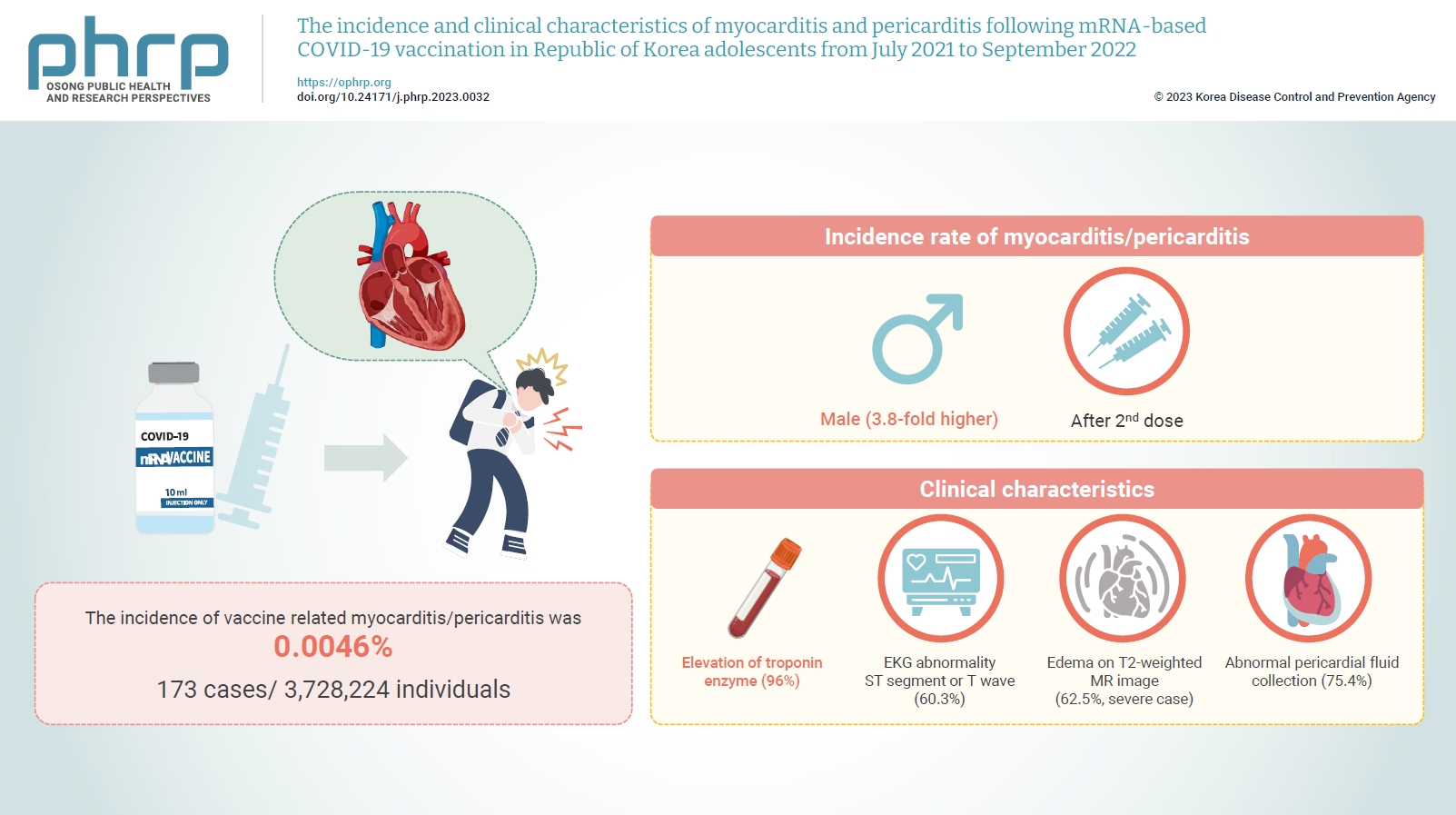
Objectives Age-specific information regarding myocarditis/pericarditis in adolescents following mRNA-based coronavirus disease 2019 (COVID-19) vaccination in Asia remains insufficient. This study investigated the incidence and clinical characteristics of myocarditis/pericarditis in Republic of Korea adolescents after mRNA-based COVID-19 vaccination.
Methods This retrospective descriptive study utilized patient data from the Korea Immunization Management System. Incidence rates were calculated according to age and sex. Clinical characteristics (symptoms/signs, laboratory values, and imaging results) were compared between mild and severe cases.
Results Between July 19, 2021 and September 30, 2022, 3,728,224 individuals aged 12 to 19 years received 6,484,165 mRNA-based COVID-19 vaccines, and 173 cases met the case definition for myocarditis/pericarditis: 151 mild (87.3%) and 22 severe (12.7%). The incidence was 3.8-fold higher in males than in females. Troponin I/ troponin T was elevated in 96% of myocarditis cases, demonstrating higher sensitivity than creatine kinase-myocardial band (67.6%) or C-reactive protein (75.2%). ST-segment or Twave on electrography abnormalities were found in 60.3% (85/141). Paroxysmal/sustained atrial/ventricular arrhythmias were more common in severe than in mild cases (45.5% vs. 16.8%, p=0.008). Edema on T2-weighted magnetic imaging occurred in 21.6% (8/37) and 62.5% (5/8) of mild and severe cases, respectively (p=0.03). Abnormal pericardial fluid collection or pericardial inflammation was found in 75.4% of pericarditis cases (49/65).
Conclusion Myocarditis/pericarditis occurred in rare cases following mRNA-based COVID-19 vaccination. Most cases were mild, but the incidence was higher in adolescent males and after the second dose. As bivalent severe acute respiratory syndrome coronavirus 2 mRNA vaccination started in Republic of Korea in October 2022, the post-vaccination incidence of myocarditis/pericarditis should be closely monitored, considering clinical characteristics.
Citations
Citations to this article as recorded by
Factors associated with carditis adverse events following SARS-COV-2-19 vaccination Kyung Hyun Min, Jun Hyeob Kim, Jin Yeon Gil, Jun Hyuk Park, Ji Min Han, Kyung Eun Lee Epidemiology and Infection.2025;[Epub] CrossRef
Unique Features and Collateral Immune Effects of mRNA-LNP COVID-19 Vaccines: Plausible Mechanisms of Adverse Events and Complications János Szebeni Pharmaceutics.2025; 17(10): 1327. CrossRef
Responses to Common Misconceptions Relating to COVID-19 Variant-Adapted mRNA Vaccines George Kassianos, Pauline MacDonald, Ivan Aloysius, Shanti Pather Vaccines.2024; 12(1): 57. CrossRef
Comparative safety of monovalent and bivalent mRNA COVID-19 booster vaccines in adolescents aged 12 to 17 years in the Republic of Korea Mijeong Ko, Seontae Kim, Seok-Kyoung Choi, Seung Hwan Shin, Yeon-Kyeng Lee, Yunhyung Kwon Osong Public Health and Research Perspectives.2024; 15(4): 364. CrossRef
Epidemiological Characteristics and Outcome of Myocarditis and Pericarditis Temporally Associated With BNT162b2 COVID-19 Vaccine in Adolescents: Korean National Surveillance Bin Ahn, Seung Hwan Shin, Myung-Jae Hwang, HyoSug Choi, Sara Na, Sangshin Park, Jue Seong Lee, Young June Choe, Yoonsun Yoon, Kyoungsan Seo, Jong Hee Kim, Hyun Mi Kang Journal of Korean Medical Science.2024;[Epub] CrossRef
To become a more stronger and safer country Jong-Koo Lee Osong Public Health and Research Perspectives.2023; 14(2): 67. CrossRef
Objectives This study aimed to classify coronavirus disease 2019 (COVID-19)-related deaths according to whether COVID-19 was listed as the cause of death, and to investigate the differences in demographic characteristics and risk factors for COVID-19 death classifications.
Methods A total of 5,625 deaths in South Korea among patients with confirmed COVID-19 from January 20, 2020 to December 31, 2021 were selected. Excluding false reports and unnatural deaths, 5,597 deaths were analyzed. Based on death report data, deaths were classified according to whether the cause of death was listed as COVID-19 (CD) or not (NCD). The epidemiological characteristics and causes of deaths were investigated using descriptive, univariate, and multivariate statistical analyses. Odds ratios (ORs) and 95% confidence intervals (CIs) were calculated to analyze the risk factors.
Results The case fatality ratio was 0.89% and increased with age. Additionally, 96.4% of the subjects had an underlying disease, and 53.4% died in winter. The proportion of NCDs was 9.3%, of whom 19.1% died at home and 39.0% were confirmed to have COVID-19 after death. Malignant neoplasms (102/416 vs. 637/4,442; OR, 1.71; 95% CI, 1.36−2.16; p<0.001) were significantly associated with NCD.
Conclusion This is the first study to analyze risk factors by cause of death using COVID-19 death report data in South Korea. These results are expected to be used as evidence for establishing a death monitoring system that can collect timely information in a new infectious disease pandemic.
Citations
Citations to this article as recorded by
A Meta-Analysis of the Association between Apolipoprotein E Polymorphisms and SARS-COV-2 Risk/Severity in the Korean Population T.-Th.-D. Nguyen, M. Zayed, D.-I. Choi, Ch.-S. Lee, B.-H. Jeong Russian Journal of Genetics.2025; 61(8): 997. CrossRef
Objectives Musculoskeletal pain is among the most common symptoms in patients diagnosed with coronavirus disease 2019 (COVID-19), and it has placed a significant burden on health worldwide during the pandemic. This study explored vaccine hesitancy and associated factors in patients with positive COVID-19 polymerase chain reaction test results who were hospitalized and had back pain.
Methods A cross-sectional study was conducted among 170 hospitalized COVID-19 patients over 18 years of age. Data were analyzed using descriptive statistics with IBM SPSS ver. 25.0.
Results COVID-19 patients who were married considered COVID-19 vaccinations riskier than unmarried COVID-19 patients. Patients who had not been vaccinated expressed higher levels of distrust towards COVID-19 vaccines than patients who had been vaccinated. Participants had relatively little hesitation toward the Sinovac vaccine. High vaccine confidence was found in all participants regardless of vaccination status. Those who had not received the COVID-19 vaccine reported higher risk perceptions than those who had received at least 1 dose of any COVID-19 vaccine.
Conclusion Measurements of the hesitancy of vaccinated and non-vaccinated patients or members of society towards vaccines can be an important parameter for health authorities to find solutions.
Citations
Citations to this article as recorded by
COVID-19 VE DAVRANIŞSAL İKTİSAT: KÜRESEL BİR PANDEMİ SIRASINDA İNSAN DAVRANIŞINI ANLAMAK İlknur ARSLAN ARAS Sağlık ve Sosyal Refah Araştırmaları Dergisi.2024; 6(1): 97. CrossRef
Objectives This study aimed to assess the scale and transmission patterns of coronavirus disease 2019 (COVID-19) in a religious village community in South Korea, to determine the risk factors of transmission, and to evaluate vaccine effectiveness.
Methods An epidemiological survey was conducted, and data were collected and analyzed from 602 villagers in the religious village community. Multivariate logistic regression analysis was used to identify the risk factors for COVID-19 transmission and to evaluate vaccine effectiveness.
Results The outbreak attack rate was 72.1% (434/602). The attack rate was high among women in their 60s, the unemployed, residents living near religious facility (<500 m), and the unvaccinated. Age, the distance between religious facility and residences, and the absence of vaccination were identified as risk factors for transmission. Vaccine effectiveness was 49.0%, and the highest effectiveness was seen in the age group of 59 years or younger (65.8%).
Conclusion This village community was isolated, with little communication with the outside world. However, the frequency of close contact between residents was relatively high, contributing to the spread of COVID-19 in the village even with relatively short exposure. Vaccination rates in the village community were also lower than those in the general public. Public health authorities should consider the potential impact of cultural factors, including religion, that could lead to the exponential spread of COVID-19 in closed village communities.
Citations
Citations to this article as recorded by
Impact of disease severity, age, sex, comorbidity, and vaccination on secondary attack rates of SARS-CoV-2: a global systematic review and meta-analysis Dewan Md. Sumsuzzman, Yang Ye, Zhen Wang, Abhishek Pandey, Joanne M. Langley, Alison P. Galvani, Seyed M. Moghadas BMC Infectious Diseases.2025;[Epub] CrossRef
Quantitative analysis of self-reporting and contact tracing in heterogeneous risk groups: a stochastic modeling study of the COVID-19 outbreak in Daegu, Korea Jiwon Han, Eunok Jung BMC Public Health.2025;[Epub] CrossRef
Trends of fear and anger on YouTube during the initial stage of the COVID-19 outbreak in South Korea Jae-Joon Lee, Jongwoo Kim, Soo-Kyoung Lee BMC Public Health.2024;[Epub] CrossRef
Objectives Coronavirus disease 2019 (COVID-19)–associated mucormycosis (CAM) has emerged as a formidable infection in patients with COVID-19. The aggressive management of CAM affects quality of life (QOL); thus, this study was designed to assess the QOL in patients with CAM at a tertiary healthcare institution.
Methods This cross-sectional study of 57 patients with CAM was conducted over 6 months using a semi-structured standard questionnaire (the abbreviated World Health Organization Quality of Life questionnaire [WHO-BREF]) and a self-rated improvement (SRI) scale ranging from 0 to 9. Cut-off values of ≤52 and <7 were considered to indicate poor QOL and poor improvement, respectively. The correlations of QOL and SRI scores were evaluated using Spearman rho values.
Results In total, 27 patients (47.4%; 95% confidence interval [CI], 34.9%–60.1%) and 26 patients (45.6%; 95% CI, 33.4%–58.4%) had poor QOL and poor SRI scores, respectively. The overall median (interquartile range) QOL score was 52 (41–63). Headache (adjusted B, −12.3), localized facial puffiness (adjusted B , −16.4), facial discoloration (adjusted B, −23.4), loosening of teeth (adjusted B, −18.7), and facial palsy (adjusted B, −38.5) wer e significantly associated with the QOL score in patients with CAM.
Conclusion Approximately 1 in 2 patients with CAM had poor QOL and poor improvement. Various CAM symptoms were associated with QOL in these patients. Early recognition is the key to optimal treatment, improved outcomes, and improved QOL in patients with CAM.
Citations
Citations to this article as recorded by
Health-related quality of life after orbital exenteration for COVID-19–associated rhino-orbital-cerebral mucormycosis in South India: a cross-sectional SF-36 study and systematic review Ashel Chelsea Dsouza, Jasleen Kaur, Swathi M, K. Md. Shoyaib Khazi, Aster Chelson Dsouza, Anudeep Sathyanarayan, Chinmayee J. T Orbit.2026; : 1. CrossRef
WHO BREF Quality of Life Score as a Prognostic Indicator of Survival in Patients recovered from COVID-19 Associated Rhino-Orbito-Cerebral Mucormycosis K. Nidhin Das, Vidhu Sharma, Vishudh Mohan, Kapil Soni, Ankita Chugh, Bikram Choudhury, Amit Goyal Indian Journal of Otolaryngology and Head & Neck S.2024; 76(4): 3441. CrossRef
Impact of prosthodontic rehabilitation on psychological status and quality of life in maxillectomy patients of coronavirus disease 2019-associated mucormycosis at a tertiary care center: A prospective clinical study P. Vijayabharathi, Surabhi Rambhau Somkuwar, Santhosh Rao, Virat Galhotra, Uvashri Selvaraj The Journal of Indian Prosthodontic Society.2024; 24(4): 351. CrossRef
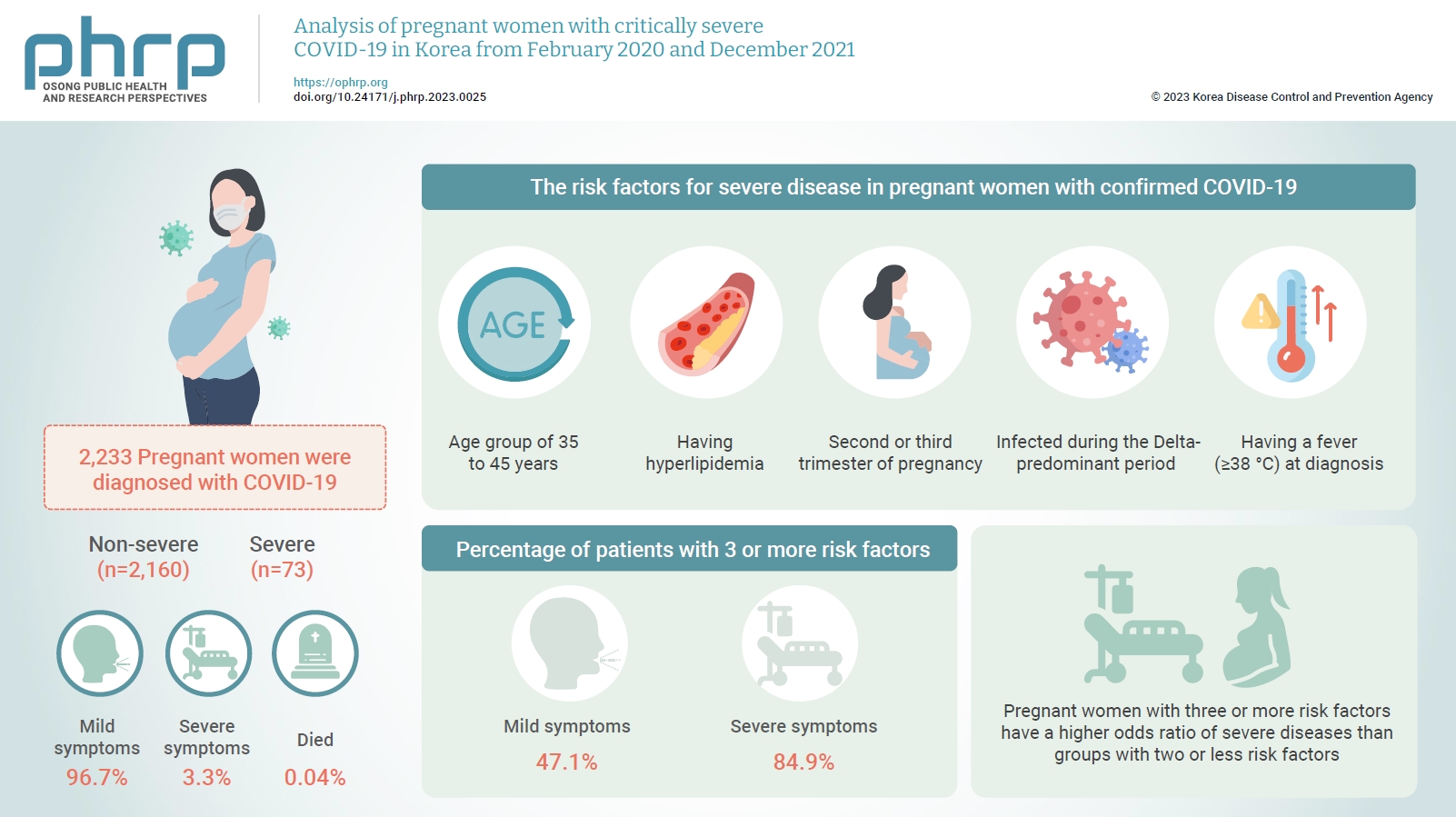
Objectives This study aimed to describe the characteristics and risk factors for severe disease in pregnant women infected with coronavirus disease 2019 (COVID-19) from the early days of the COVID-19 epidemic in Korea to the predominant period of the Delta variant.
Methods A retrospective cohort study was conducted among pregnant women diagnosed with COVID-19 between February 2020 and December 2021. Logistic regression analysis was performed to compare severe and mild cases after adjusting for pregnant women’s age, nationality, infection route, outbreak area, infection period, symptoms, underlying disease, smoking status, trimester, and COVID-19 vaccination status.
Results In total, 2,233 pregnant women were diagnosed with COVID-19 by December 2021. Among these, 96.7% had mild symptoms, 3.3% had severe symptoms, and 0.04% died. The risk factors for severe disease in pregnant women with confirmed COVID-19 were being in the age group of 35 to 45 years, having hyperlipidemia, being in the second or third trimester of pregnancy at the time of COVID-19 diagnosis, being infected during the Delta-predominant period, and having a fever (≥38 °C) at diagnosis. Furthermore, 47.1% of patients in the mild group and 84.9% of patients in the severe group had 3 or more risk factors.
Conclusion Pregnant women with COVID-19 mainly experienced mild symptoms, but those with risk factors were at a higher risk of developing severe symptoms. Therefore, treatment and follow-up management should be thoroughly implemented.
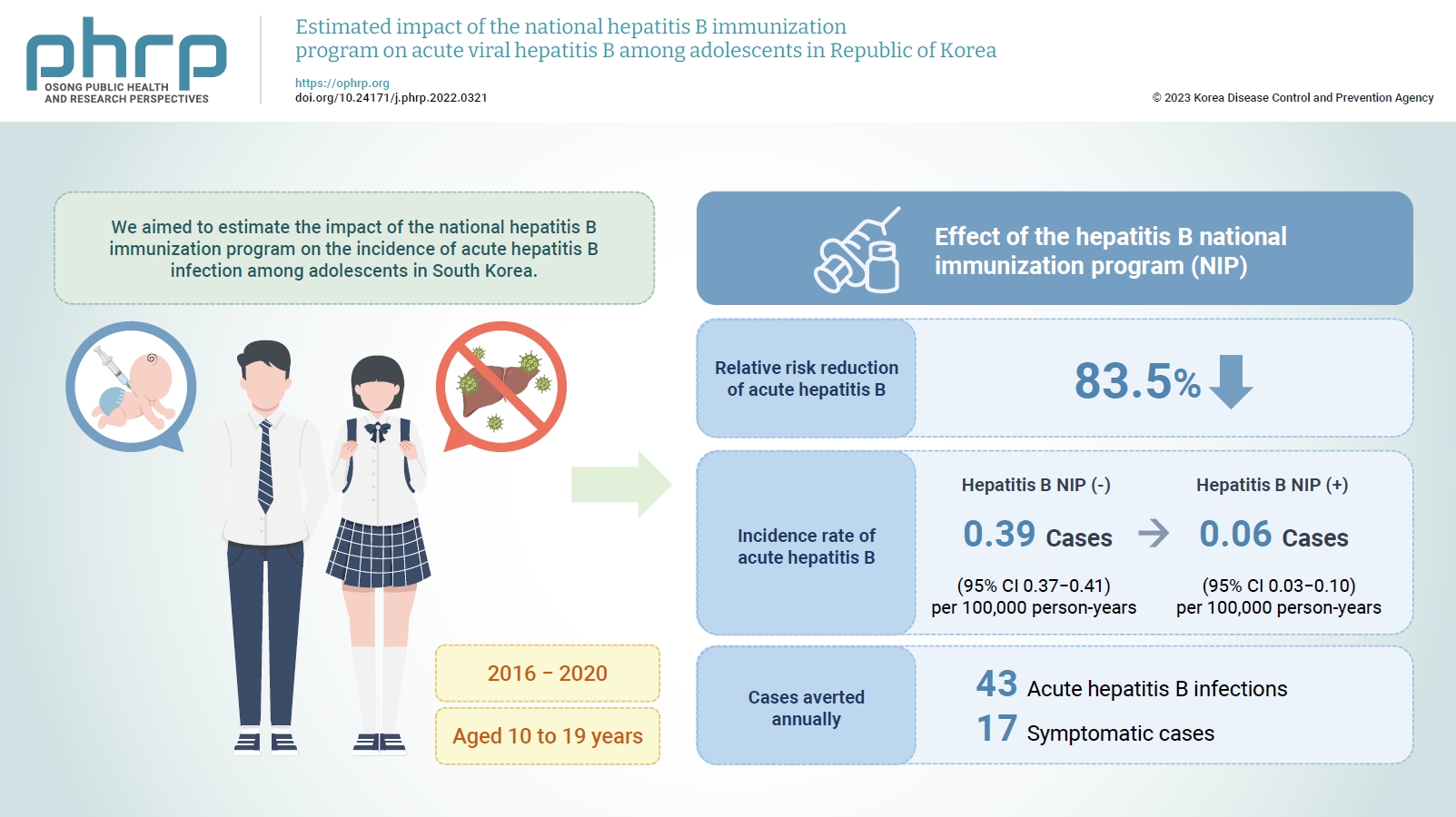
Objectives We aimed to estimate the impact of the national hepatitis B immunization program on the incidence of acute hepatitis B infection among adolescents in South Korea.
Methods We estimated the counterfactual incidence rate of reported acute hepatitis B among adolescents from 2016 to 2020 compared to the assumption that the national hepatitis B immunization program for children had not been implemented since 1995. The impact of the national hepatitis B immunization program for adolescents was measured by estimating the absolute risk reduction and averted acute hepatitis B infections among adolescents from 2016 to 2020 attributed to the national immunization program.
Results The relative risk reduction of acute hepatitis B among adolescents was estimated to be 83.5% after implementing the national hepatitis B immunization program. The incidence rate of reported acute hepatitis B infections among adolescents decreased from 0.39 to 0.06 per 100,000 person-years, and 43 acute hepatitis B infections, including 17 symptomatic cases, were averted annually from 2016 to 2020 by the national hepatitis B immunization program.
Conclusion The national hepatitis B immunization program for children was effective in preventing acute hepatitis B infection among adolescents in South Korea.
Citations
Citations to this article as recorded by
Modeling HBV transmission dynamics in Indonesia (2024–2030) using a SIVRM model: Evaluating optimal control strategies for elimination by 2030 Hashem S. Arkok, Tri Yunis Miko Wahyono, Dipo Aldila, Nurhayati Adnan Prihartono, Yury E Khudyakov PLOS One.2026; 21(2): e0341120. CrossRef
Seroprotection following hepatitis B vaccination in health care workers at a dental teaching hospital in south India Shobha Rodrigues, Jyoti Suvarna, Shivani Suvarna, Srikant Natarajan, Sandipan Mukherjee, Sowmya Narayan, Shivani Shetty Brazilian Journal of Oral Sciences.2026; 25: e266219. CrossRef
Reprogramming cancer immunity with next-generation combination therapies Nikolaos C. Kyriakidis, Carolina E. Echeverría, Jhommara Bautista, Sebastián Rivera-Orellana, María José Ramos-Medina, Camila Salazar-Santoliva, Juan S. Izquierdo-Condoy, Esteban Ortiz-Prado, Santiago Guerrero, Andrés López-Cortés Frontiers in Cell and Developmental Biology.2025;[Epub] CrossRef





 First
 Prev


