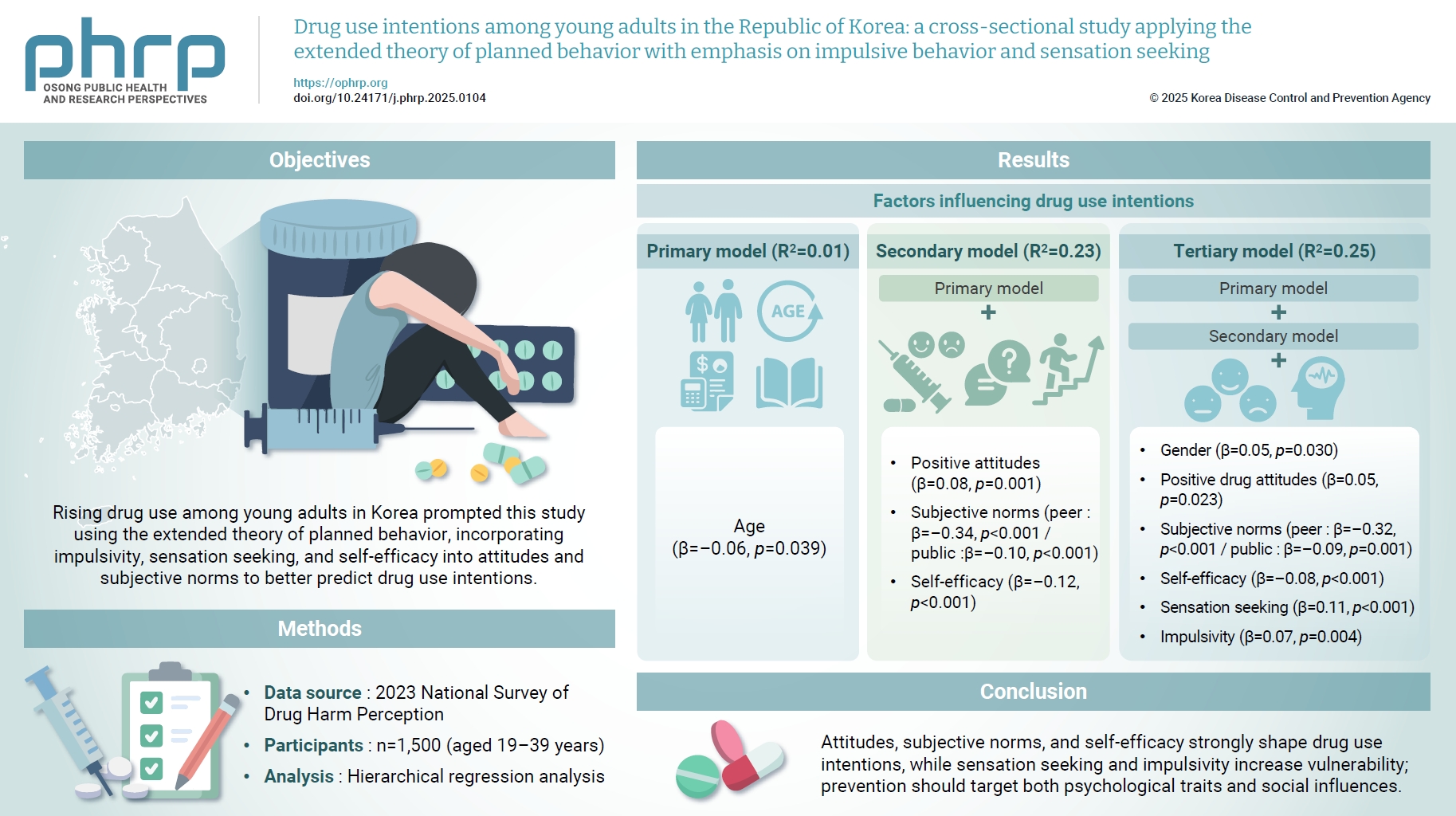
Objectives The increasing prevalence of drug use in the Republic of Korea has emerged as a significant social concern. This study applied the extended theory of planned behavior to investigate the factors influencing intentions to use drugs among young adults (aged 20–30 years) in the Republic of Korea. The study integrated personal traits—specifically, impulsivity, sensation seeking, and self-efficacy—into 2 core theory of planned behavior constructs: attitudes and subjective norms. The principal aim was to improve the prediction of drug use intentions by incorporating these variables. Methods: Data were obtained from the 2023 National Survey of Drug Harm Perception, which sampled 1,500 individuals aged 19 to 39 years. Hierarchical regression analysis was employed to assess the influence of psychological and social factors on intentions to use drugs. Results: In the primary model, age emerged as a significant predictor of drug use intentions (R2 =0.01). The secondary model showed that positive attitudes toward drugs, subjective norms, and lower self-efficacy significantly increased drug use intentions (R2 =0.23). In the final tertiary model, the addition of sensation seeking and impulsivity further amplified these intentions (R2 =0.25). Conclusion: The findings underscore the pivotal roles of attitudes, subjective norms, and selfefficacy in shaping intentions to use drugs. Sensation seeking and impulsivity were found to further elevate vulnerability. Effective prevention efforts must address both psychological traits and social influences. Future research should examine the long-term behavioral outcomes associated with these factors.
Citations
Citations to this article as recorded by
Beliefs and attitudes toward substance use and associated factors among University students in Eastern Turkey Pınar Eryılmaz, Gulpınar Aslan, Irfan Kaplan Journal of Substance Use.2026; : 1. CrossRef
Associations of Health Belief Model Constructs and Self-Control with Drug Avoidance Intention Among University Students in the Republic of Korea: A Cross-Sectional Study Jungmin Lee, Su Jung Lee Behavioral Sciences.2026; 16(9): 1653. CrossRef
Artificial intelligence and biohealth: the Republic of Korea’s emerging priorities in health care R&D Jong-Koo Lee Osong Public Health and Research Perspectives.2025; 16(4): 309. CrossRef
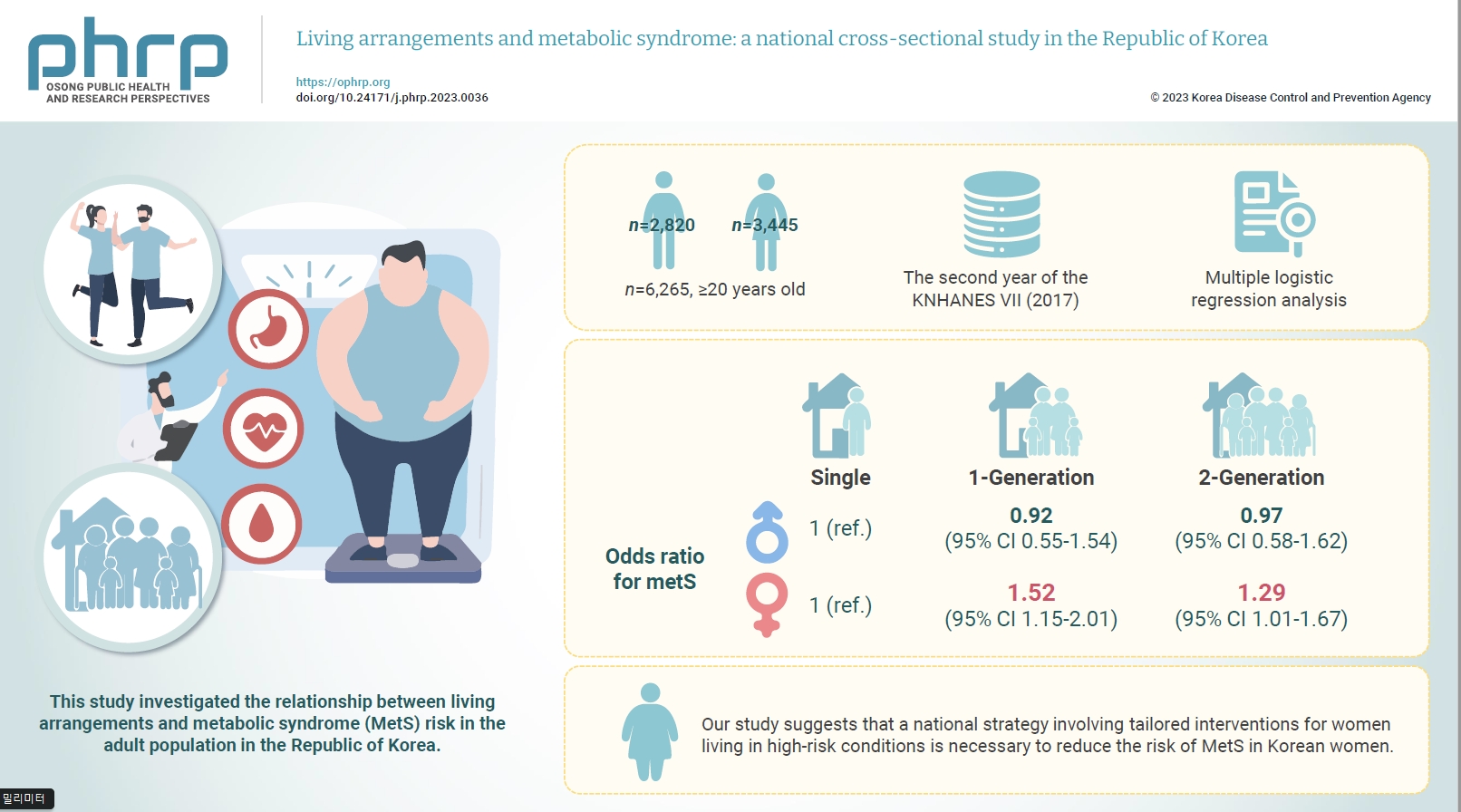
Objectives This study investigated the relationship between living arrangements and metabolic syndrome (MetS) risk in the adult population in the Republic of Korea. Methods: The samples were derived from the data collected during the second year of the seventh Korea National Health and Nutrition Examination Survey. The study targeted a total of 6,265 adults who were aged 20 years and above, and multiple logistic regression analysis was conducted. Living arrangements were classified into 4 categories: single-person households, 1-generation households, 2-generation households, and other family types. MetS was identified by the presence of at least 3 out of the 5 National Cholesterol Education Program Adult Treatment Panel III criteria. Results: For men, the odds ratio (ORs) for MetS in 1- and 2-generation households, compared to single-person households, were 0.92 (95% confidence interval [CI], 0.55–1.54) and 0.97 (95% CI, 0.58–1.62), respectively. The OR for other types of households was 0.96 (95% CI, 0.79–1.17). For women, the OR for MetS in 1- and 2-generation households, compared to single-person households, were 1.52 (95% CI, 1.15–2.01) and 1.29 (95% CI, 1.01–1.67), respectively. Conclusion: Our study suggests that a national strategy involving tailored interventions for women living in high-risk conditions is necessary to reduce the risk of MetS in Korean women.
<sec>
<title>Objectives</title>
<p>This study aimed to identify differences in drinking norms, heavy drinking, and motives between types of drinkers (abstainers, solitary, and social drinkers) in a representative sample of Korean adults.</p></sec>
<sec>
<title>Methods</title>
<p>An online survey of people registered on the electoral roll were randomly invited to be part of the “National Korean Drinking Culture Study” conducted in 2018 (<italic>n</italic> = 3,015). Participants included 1,532 men and 1,469 women aged 19–60 years. Questions included the number of times they drank in the last month, what they drank, and the volume drank. The amount of pure alcohol consumed was calculated. Drinking norms, motives, and types were determined in the survey questions.</p></sec>
<sec>
<title>Results</title>
<p>Solitary drinkers were more likely to be divorced or separated, less educated, and marginally employed. Solitary drinking peaked in those in their 30s (18.5%) and social drinkers in their 50s (68.1%). Solitary drinkers drank more frequently compared with social drinkers (6.1 vs. 3.6 times per month, <italic>p</italic> < 0.001), and consumed a significantly larger quantity of alcohol (69.5 g vs. 46.8 g per week). Solitary drinkers were more accepting of drinking-related behaviors in diverse situations compared with social drinkers. The regression analysis revealed that personal drinking motives were the most important factor influencing the frequency and quantity of alcohol consumption in both solitary and social drinking.</p></sec>
<sec>
<title>Conclusion</title>
<p>Solitary drinkers may be more vulnerable to alcohol abuse than social drinkers.</p></sec>
Citations
Citations to this article as recorded by
Childhood Circumstances and Alcohol Consumption in Portuguese People Aged 50 and Over: An Analysis of the “Survey of Health, Ageing and Retirement in Europe” Project Carolina Martins Machado, Pedro Aguiar Acta Médica Portuguesa.2026; 39(3): 178. CrossRef
Reciprocal longitudinal relationship between depressive symptoms and problematic alcohol use: a random intercept cross-lagged panel model including a nationwide sample of Korean adults Seong-Uk Baek, Jin-Ha Yoon European Archives of Psychiatry and Clinical Neuro.2026; 276(5): 2207. CrossRef
Analysis of the Association between Health Literacy and Health Behaviors in Korean Adults Seongmin JEONG, Gee Youn SONG Korean Journal of Health Promotion.2026; 26(2): 56. CrossRef
Modeling clustered count data using mixed effect discrete Weibull regression model with cubic splines Hanna Yoo Communications in Statistics - Simulation and Comp.2025; 54(7): 2710. CrossRef
Impact of binge drinking on alcoholic liver disease Jisoo Kang, Seol Hee Park, Mushira Khanam, Seo Bhin Park, Sumin Shin, Wonhyo Seo Archives of Pharmacal Research.2025;[Epub] CrossRef
Age at first drink as a predictor of all-cause mortality of middle-aged Koreans Horim A Hwang, Dong Jun Kim, Seongju Kim, Hooyeon Lee International Journal of Epidemiology.2025;[Epub] CrossRef
Hypertriglyceridemic waist phenotype in relation to diabetes mellitus and cardiovascular diseases in the Indonesian and Korean populations: evidence from two national surveys Fathimah S. Sigit, Sinyoung Cho, Farid Kurniawan, Hye-Ryeong Jeon, Ratu Ayu Dewi Sartika, Dicky L. Tahapary, Hyuktae Kwon Diabetology & Metabolic Syndrome.2025;[Epub] CrossRef
Combined Effect of Alcohol Consumption Patterns and Marital Status on All-cause Mortality Among Middle- and Old-aged People: A Longitudinal Study From Korea Yoonjung Ji, Wonhee Baek, Suran Lee Asian Nursing Research.2024; 18(4): 377. CrossRef
Social Isolation Mediates the Effects of Negative Emotionality and Resilience on Drinking to Cope and Drinking Alone Chris Segrin, Jian Jiao, R. Amanda Cooper Substance Use & Misuse.2024; 59(13): 1860. CrossRef
Drinking as Leisure Activity among Working-Age Men Minhye Kim Journal of Social Science.2023; 34(1): 243. CrossRef
Development and Validation of a Questionnaire for Assessing Drug Use Motives in the General Population in South Korea Joon-Yong Yang, Minhye Kim, Aeree Sohn Healthcare.2023; 12(1): 86. CrossRef
Do Drinking Norms, Motives, and Drinking Behaviors Differ by Age Group among Korean Women? Aeree Sohn, Sarang Jang International Journal of Environmental Research an.2022; 19(6): 3345. CrossRef
Exploring Contributing Factors of Solitary Drinking among Hong Kong Chinese Adolescents and Young Adults: A Descriptive Phenomenology Ka-Yan Ho, Katherine-Ka-Wai Lam, Cynthia-Sau-Ting Wu, Man-Nok Tong, Lai-Ngo Tang, Yim-Wah Mak International Journal of Environmental Research an.2022; 19(14): 8371. CrossRef
<sec>
<title>Objectives</title>
<p>Elderly adults are the demographic most likely to utilize emergency medical services (EMS). This study aimed to examine the difference in EMS utilization in subgroups of the elderly population by assessing the predictors for using EMS.</p></sec>
<sec>
<title>Methods</title>
<p>Using both descriptive and logistic regression analyses, this study analyses data from the 2014 Korean Health Panel Survey (<italic>n</italic> = 3,175).</p></sec>
<sec>
<title>Results</title>
<p>It was observed that certain predisposing factors such as age, sex, and marital status were significant predictors of EMS utilization. However, differences in EMS need do not fully account for the original differences observed between subgroups of elderly Koreans. While health status and disability were important predictors of elderly Koreans using EMS, place of residence did not account for subgroup differences. Nonetheless, place of residence remained particularly important predictors of EMS utilization for the elderly.</p></sec>
<sec>
<title>Conclusion</title>
<p>Emergency needs and resource availability are 2 main determinants for elderly Koreans using EMS. In addition, it was observed that the demographic subgroup profile of unmarried/divorced/separated/widowed men who were aged 75 and older was least likely to utilize EMS. Improving their resource availability to meet their EMS needs should be a top priority for national policy making to narrow elderly population subgroup differences.</p></sec>
Citations
Citations to this article as recorded by
Healthcare accessibility and financial risks for unmet health needs of the older adult population in the republic of Serbia Nikola Savić, Slobodanka Bogdanović Vasić, Branimirka Aranđelović, Katarina Pavić, Sanja Kocić, Aleksandra Arnaut, Milena Zlatanović, Jelena Stojčević-Maletić, Svetlana Ristić Frontiers in Public Health.2026;[Epub] CrossRef
Urban-rural dichotomy of emergency medical service demand: spatiotemporal patterns and heterogeneous driving mechanisms Chaowei Wu, Qianqian Yu, Yiji Li, Shiliang Huang, Changlu Li, Li Luo BMC Public Health.2026;[Epub] CrossRef
Fatores associados às causas externas em idosos atendidos pelo serviço de atendimento móvel de urgência Ana Angélica Oliveira de Brito, Beatriz Barros de Vasconcelos, Ana Maria Ribeiro dos Santos, Débora de Oliveira Lima, Maria Zélia de Araújo Madeira, Guilherme Guarino de Moura Sá, Julyanne dos Santos Nolêto, Rouslanny Kelly Cipriano de Oliveira Revista Gaúcha de Enfermagem.2024;[Epub] CrossRef
Factors associated with external causes in elderly attended by the mobile emergency care service Ana Angélica Oliveira de Brito, Beatriz Barros de Vasconcelos, Ana Maria Ribeiro dos Santos, Débora de Oliveira Lima, Maria Zélia de Araújo Madeira, Guilherme Guarino de Moura Sá, Julyanne dos Santos Nolêto, Rouslanny Kelly Cipriano de Oliveira Revista Gaúcha de Enfermagem.2024;[Epub] CrossRef
The Epidemiology of Adult Emergency Medical Services Use in Muğla Ömer Faruk Karakoyun, Kıvanç Karaman, Burcu Kaymak Golcuk, Yalcin Golcuk Paramedik ve Acil Sağlık Hizmetleri Dergisi.2024; 5(1): 1. CrossRef
Medical and social factors influencing the utilization of healthcare services among older adults in Israel during the COVID-19 lockdown Ohad Shaked, Liat Korn, Yair Shapiro, Moti Zwilling, Avi Zigdon Frontiers in Public Health.2023;[Epub] CrossRef
Social Factors Contributing to Healthcare Service Requirements during the First COVID-19 Lockdown among Older Adults Ohad Shaked, Liat Korn, Yair Shapiro, Avi Zigdon Healthcare.2022; 10(10): 1854. CrossRef
Socio-demographic characteristics and their relation to medical service consumption among elderly in Israel during the COVID-19 lockdown in 2020 as compared to the corresponding period in 2019 Ohad Shaked, Liat Korn, Yair Shapiro, Gideon Koren, Avi Zigdon, Aviad Tur-Sinai PLOS ONE.2022; 17(12): e0278893. CrossRef
Objectives
This study investigated the status of sexual identity, perceived stigma, stress, depression, and suicidal ideation and attempts. It also examined how sexual identity and “coming out” affect stress, depression, and suicidal ideation and attempts. Methods
Suicidal ideation, psychological health status, and health-related behaviors were assessed using the Internet to maximize the confidentiality of the participants, men who have sex with men (MSM). The data were collected from a total of 873 MSM aged between 19 years and 59 years in 2014. Results
Only 20.9% of the MSM had come out (18.0% voluntarily and 2.9% by others). The prevalences of perceived stress and depression among MSM were 46.7% and 42.7%, respectively, compared with 20.1% and 7.4% among general men. Approximately 32% of the MSM reported any suicidal ideation, and 3.3% had attempted suicide in the past year. The likelihood of suicidal ideation was significantly associated with being age 30–39 years [odds ratio (OR) = 1.8], high school or less (OR = 1.6), having been outed (OR = 5.2), feeling stressed (OR = 1.8), and feeling depressed (OR = 12.4) after sociodemographic factors and other perceptions were controlled for. Conclusion
The present study provides evidence that MSM are at an elevated risk for suicidal ideation and attempts with high stress and depression. Some risk factors were specific to being gay or bisexual in a hostile environment.
Citations
Citations to this article as recorded by
Sexual orientation, coming out and suicidal ideation in young French LGBP people Paul Martins, Baptiste Lignier, Thibault Chiarabini, Bénédicte Gohier, Catherine Potard L'Encéphale.2026; 52(2): 181. CrossRef
Queer Aesthetics, Straight Markets: Disneyfication in the Korean Musical Dorian Gray: A New Musical (2016) Di Cotofan Wu The Journal of Popular Culture.2026; 59(2): 71. CrossRef
Individualistic and Collectivistic Self-Esteem as Cultural Psychological Processes: Linking Cyberbullying Victimization, Internalized Homophobia, and Hopelessness Yeon Jae Hwang Journal of Cross-Cultural Psychology.2026;[Epub] CrossRef
Exploring Socio-Political Factors and Quality of Life Among LGBT Individuals in India Archana Bhattacharyya, Koteshwar Ramesh Rakesh Journal of Homosexuality.2025; 72(13): 2702. CrossRef
Building Trust and Inclusivity: Navigating Layered Stigma and Risk Communication for LGBTQ+ Individuals During COVID‐19 Outbreaks JungKyu Rhys Lim, Hyoyeun Jun, Victoria Ledford Journal of Contingencies and Crisis Management.2025;[Epub] CrossRef
Mental health of sexual and gender minorities and its association with outings in Japan: A web‐based cross‐sectional study Yusuke Kanakubo, Yoshifumi Sugiyama, Eriko Yoshida, Takuya Aoki, Rieko Mutai, Takahiro Tabuchi, Masato Matsushima Psychiatry and Clinical Neurosciences.2025; 79(9): 572. CrossRef
Stress of being outed to parents, LGBTQ family support, and depressive symptoms among sexual and gender diverse youth Peter S. McCauley, Alexander J. Del Farno, Antonia E. Caba, Benton M. Renley, Shaylynne Shuler, Lisa A. Eaton, Ryan J. Watson Journal of Research on Adolescence.2024; 34(1): 205. CrossRef
High Interest in the Use of mHealth Platform for HIV Prevention among Men Who Have Sex with Men in Nepal Kamal Gautam, Kiran Paudel, Ali Ahmed, Manisha Dhakal, Jeffrey A Wickersham, Krishna C Poudel, Sherry Pagoto, Bibhav Acharya, Keshab Deuba, Pablo K Valente, Roman Shrestha Journal of Community Health.2024; 49(4): 575. CrossRef
Health of Korean sexual and gender minorities: a narrative review of
quantitative studies Heesung So, Ssirai Kim, Sun Young Lee The Ewha Medical Journal.2024;[Epub] CrossRef
Age Differences in the Associations Between Outness and Suicidality Among LGBTQ+ Youth Brian A. Feinstein, Ethan H. Mereish, Mary Rose Mamey, Cindy J. Chang, Jeremy T. Goldbach Archives of Suicide Research.2023; 27(2): 734. CrossRef
Psychological Status of Men Who Have Sex with Men during COVID-19: An Online Cross-Sectional Study in Western China Bing Lin, Jiaxiu Liu, Wei He, Haiying Pan, Xiaoni Zhong International Journal of Environmental Research an.2023; 20(2): 1333. CrossRef
Social capital, perceived stress, and mental health of men who have sex with men in China: A cross-sectional study Xiaoyue Zhang, Ying Zhou, Kaili Zhang Frontiers in Psychology.2023;[Epub] CrossRef
HIV-related stigma, depression and suicidal ideation among HIV-positive MSM in China: a moderated mediation model Jiaqi Fu, Xu Chen, Zhenwei Dai, Yiman Huang, Weijun Xiao, Hao Wang, Mingyu Si, Yijin Wu, Ling Zhang, Shu Jing, Xin Liu, Fei Yu, Guodong Mi, Xiao-You Su BMC Public Health.2023;[Epub] CrossRef
Trends in Human Immunodeficiency Virus-Related Knowledge and Stigma among Men Who Have Sex with Men in the Republic of Korea from 2012 to 2022 Aeree Sohn Healthcare.2023; 11(24): 3135. CrossRef
HIV-Related Stigma, Sexual Identity, and Depressive Symptoms Among MSM Living With HIV in China: A Moderated Mediation Modeling Analysis Tianyue Mi, Guanghua Lan, Xueying Yang, Xiaoming Li, Shan Qiao, Zhiyong Shen, Yuejiao Zhou American Journal of Men's Health.2022;[Epub] CrossRef
Sexual Minority Stigma, Sexual Orientation Concealment, Social Support and Depressive Symptoms Among Men Who have Sex with Men in China: A Moderated Mediation Modeling Analysis Changmian Ding, Xiangfan Chen, Wei Wang, Bin Yu, Huimin Yang, Xiaoyan Li, Shumin Deng, Hong Yan, Shiyue Li AIDS and Behavior.2020; 24(1): 8. CrossRef
TRANSNATIONAL INTEREST CONVERGENCE AND GLOBAL KOREA AT THE EDGE OF RACE AND QUEER EXPERIENCES Patrick S. Thomsen Du Bois Review: Social Science Research on Race.2020; 17(2): 411. CrossRef
Is Perceived Stigma in Clinical Settings Associated With Poor Health Status Among New York City’s Residents of Color? Prabal De, Alexis Pozen, Henna Budhwani Medical Care.2019; 57(12): 960. CrossRef
Comparison of depression and anxiety between HIV-negative men who have sex with men and women (MSMW) and men who have sex with men only (MSMO): a cross-sectional study in Western China Ying Hu, Xiao-ni Zhong, Bin Peng, Yan Zhang, Hao Liang, Jiang-hong Dai, Juying Zhang, Xiao-hua Zhong, Ai-long Huang BMJ Open.2019; 9(1): e023498. CrossRef
Transgender Women's Experiences with Stigma, Trauma, and Attempted Suicide in the Dominican Republic Henna Budhwani, Kristine R. Hearld, Adrienne N. Milner, Rebecca Charow, Elaine M. McGlaughlin, Mayra Rodriguez‐Lauzurique, Santo Rosario, Robert Paulino‐Ramirez Suicide and Life-Threatening Behavior.2018; 48(6): 788. CrossRef
The Reciprocal Relationship between Suicidality and Stigma Bernardo Carpiniello, Federica Pinna Frontiers in Psychiatry.2017;[Epub] CrossRef
Fallen Flowers Hae-Wol Cho, Chaeshin Chu Osong Public Health and Research Perspectives.2016; 7(5): 279. CrossRef
Objectives
The principal objective of this study was to identify the barriers to testing for men who have sex with men (MSM) in Korea, something that might prove useful in future studies of this nature. Methods
This study was conducted at gay bars nationwide in Korea. After considering several offline locations (gay bars) where MSM candidates are commonly located, random recruitment was performed using time–location sampling. A total of 944 individuals participated in this survey. A total sample of 921 cases (23 cases were excluded) was used for analysis. A self-administered questionnaire measuring the individuals' demographics, human immunodeficiency virus (HIV)/AIDS knowledge, stigma, phobia, optimism bias, self-efficacy for condom use, and sexual practices was used. Results
About 61.8% (<i>N</i> = 569) of respondents reported having been tested at least once in their lifetime, and 38.9% (<i>N</i> = 358) acknowledged being tested within the past 12 months. After adjusting for age, education, and number of partners in a logistic regression analysis, awareness of testing place [odds ratio (OR) = 4.04], exposure to HIV prevention campaign (1.54), fear (OR = 1.13), and discrimination toward people with HIV/AIDS (OR = 0.94) were the main factors associated with HIV testing. Conclusion
To accomplish widespread HIV testing for Korean MSM, the accessibility of testing centers and advertisement of voluntary counseling and testing to MSM are needed.
Citations
Citations to this article as recorded by
Factors associated with meeting homosexual partners at fixed offline locations among MSM recruited through the internet: A cross-sectional survey Weiyong Chen, Zhongrong Yang, Xing Wang, Weiwei Wang, Geng-Feng Fu PLOS One.2025; 20(5): e0325273. CrossRef
Behavioral predictors associated with HIV screening needs in gay Korean men during the COVID-19 pandemic Rang Hee Kwon, So-Hyun Kim, Minsoo Jung, Omid Dadras PLOS ONE.2023; 18(6): e0287061. CrossRef
Trends in Human Immunodeficiency Virus-Related Knowledge and Stigma among Men Who Have Sex with Men in the Republic of Korea from 2012 to 2022 Aeree Sohn Healthcare.2023; 11(24): 3135. CrossRef
Cost-effectiveness analysis of pre-exposure prophylaxis for the prevention of HIV in men who have sex with men in South Korea: a mathematical modelling study Heun Choi, Jiyeon Suh, Woonji Lee, Jun Hyoung Kim, Jung Ho Kim, Hye Seong, Jin Young Ahn, Su Jin Jeong, Nam Su Ku, Yoon Soo Park, Joon Sup Yeom, Changsoo Kim, Hee-Dae Kwon, Davey M. Smith, Jeehyun Lee, Jun Yong Choi Scientific Reports.2020;[Epub] CrossRef
Users' Concerns Related to Online HIV Counseling in South Korea: A Descriptive Qualitative Study Han Ju Lee, Hee Sun Kang, Savitri Singh-Carlson, Kyung Sun Kim Journal of the Association of Nurses in AIDS Care.2020; 31(6): 646. CrossRef
The use of social marketing campaigns to increase HIV testing uptake: a systematic review John O. Olawepo, Jennifer R. Pharr, Axenya Kachen AIDS Care.2019; 31(2): 153. CrossRef
Non-adherence to anti-retroviral therapy among HIV infected adults in Mon State of Myanmar Win Lei Aye, Apa Puckpinyo, Karl Peltzer BMC Public Health.2017;[Epub] CrossRef
Discrimination and Stigma Hae-Wol Cho, Chaeshin Chu Osong Public Health and Research Perspectives.2015; 6(3): 141. CrossRef
Objectives
This study was conducted in order to determine any correlation between experience of harmful shops and adolescent smoking and alcohol drinking in middle and high school students. Methods
The survey was conducted using a self-administered questionnaire online via the homepage of the Ministry of Education student Health Information Center; 1888 and 1563 questionnaires were used for middle and high school students, respectively, for a total of 3451 questionnaires in the final analysis. The collected data were processed using SPSS version 21.0 and examined using frequency analysis and hierarchical linear regression. Results
In this research, 8.3% of all participants were found to have experienced smoking and 17.0% alcohol drinking. Regarding the types of harmful shops, 81.8% said they had been to a gaming place; 21.2% to a lodging place; 16.0% to a sex and entertainment place; and 6.8% to a harmful sex industry location. Sociodemographic variables had a significant effect on adolescent smoking and alcohol drinking. Regarding environmental variables, a significant difference was observed for living with parents and school location. Among adolescent experience of harmful shops, both smoking and alcohol drinking showed a significant association with harmful sex industry locations. Conclusion
National government-level management and supervision on this issue will be necessary to prevent adolescent access to harmful shops, along with more studies exploring methods for implementation of policies with more systematic control of harmful shops.
Citations
Citations to this article as recorded by
Relationship between menopausal status and suicidal behavior among the Korean population Jeongmin Son, Wanhyung Lee Maturitas.2025; 195: 108221. CrossRef
Evaluation of Individual and Community Factors Affecting Adolescents’ Mental Health: A Longitudinal Multilevel Analysis Bohye Lee, Myungsuk Choi, Mankyu Choi Applied Research in Quality of Life.2021; 16(3): 1187. CrossRef
Prevalence and Extrinsic Risk Factors for Dental Erosion in Adolescents Ana C Mafla, Ximena A Cerón-Bastidas, Maria E Munoz-Ceballos, Diana C Vallejo-Bravo, Maria C Fajardo-Santacruz Journal of Clinical Pediatric Dentistry.2017; 41(2): 102. CrossRef
Trend of Suicide Rates According to Urbanity among Adolescents by Gender and Suicide Method in Korea, 1997–2012 Kyung-Hwa Choi, Dong-Hyun Kim International Journal of Environmental Research an.2015; 12(5): 5129. CrossRef
The awareness of "School Environmental Sanitation and Cleanup Zone System" and harmful perception by shops among students, teachers and parents in Korea Aeree Sohn Korean Journal of Health Education and Promotion.2015; 32(5): 83. CrossRef
Substance Use and Sexual Behaviors of Adolescents in Multicultural Families in Korea Subin Park Psychiatry Investigation.2015; 12(4): 466. CrossRef
Health-related quality of life assessment according to socio-demographic characteristics and health behavior among Gyeonggi-do citizens: focused on gender difference Sun-Hee Joung, YeogSeon Hong, AeRee Sohn Korean Journal of Health Education and Promotion.2015; 32(3): 33. CrossRef
A Period of Storm and Stress Hae-Wol Cho, Chaeshin Chu Osong Public Health and Research Perspectives.2014; 5(3): 117. CrossRef
Characterizing Patterns of Experience of Harmful Shops among Adolescents Using Decision Tree Models Aeree Sohn Korean Journal of Health Education and Promotion.2014; 31(3): 15. CrossRef
Objectives
The purpose of this study was to ascertain the influence of media communication on risk behavior related to mad cow disease (MCD). Methods
Mothers of elementary school students in Seoul were recruited as the survey participants of this study. Results
Media reports affected risk behavior related to MCD. Also, knowledge and attitude toward MCD affects risk behavior. Conclusion
Risk-related information provided by the media should maintain consistency and objectivity. For effective risk communication, there should be an open communication between the government and public, experts, and related industries, who should all collaborate.
Citations
Citations to this article as recorded by
The influence of media consumption on public risk perception: a meta-analysis Chunhua Niu, Zhixin Jiang, Hongbing Liu, Kehu Yang, Xuping Song, Zhihong Li Journal of Risk Research.2022; 25(1): 21. CrossRef
Patterns of compliance with COVID-19 preventive measures among the public in Qatar and Kuwait Noora Lari, Noor Al-Thani Global Social Policy.2022; 22(3): 580. CrossRef
Understanding risk perception from floods: a case study from China Yi Ge, Guangfei Yang, Xiaotao Wang, Wen Dou, Xueer Lu, Jie Mao Natural Hazards.2021; 105(3): 3119. CrossRef
When beef consumption becomes politicized: Longitudinal change of US beef purchase intention and political values in Korea Byeong Je Kim, Ji-Bum Chung Food Policy.2021; 105: 102171. CrossRef
Community participation effects on preparedness behaviour through risk perception: Empirical data of hazardous chemicals from China Xiaowei Li, Tiezhong Liu International Journal of Disaster Risk Reduction.2020; 44: 101421. CrossRef
Food risk communication: analysis of the media coverage of food risk on Italian online daily newspapers Barbara Tiozzo, Anna Pinto, Federico Neresini, Stefano Sbalchiero, Nicoletta Parise, Mirko Ruzza, Licia Ravarotto Quality & Quantity.2019; 53(6): 2843. CrossRef
Perceived risks of produced water management and naturally occurring radioactive material content in North Dakota Luisa Torres, Om Prakash Yadav, Eakalak Khan Journal of Environmental Management.2017; 196: 56. CrossRef
Risk prediction of product-harm events using rough sets and multiple classifier fusion: an experimental study of listed companies in China Delu Wang, Jianping Zheng, Gang Ma, Xuefeng Song, Yun Liu Expert Systems.2016; 33(3): 254. CrossRef
Health Literacy, Health Risk Perception and Health Behavior of Elders Jeong Hee Jeong, Jung Soon Kim Journal of Korean Academy of Community Health Nurs.2014; 25(1): 65. CrossRef
Scrub typhus, also called tsutsugamushi disease, is classified as a Group 3 disease in Korea according to the National Notifiable Diseases Surveillance Systems. It is an infectious disease transmitted to humans through the bite of mites that are infected with an intracellular parasite called <i>Orientia tsutsugamushi</i> (Family: Rickettsiaceae). This study aims to identify the demographic characteristics of the infected cases according to profession, region, gender, and onset period and provide a basic data for prevention and control of the disease in the infected patients. Between 2001 and 2010, 16,741 men (36.3%) and 29,373 women (63.7%) were reported to have been infected with scrub typhus, with men being 1.6 times less infected than women. When classified according to age, it was found that 4421 persons (9.6%) were under 40 years of age; 6601 (13.1%) in their 40s; 9714 (21.1%) in their 50s; 13,067 (28.3%) in 60s; 10,128 (22.0%) in their 70s; and 2723 (5.9%) aged 80 or more. The elderly (60 years or older) represented more than half of the infected cases. When the infections were classified according to region, it was found that the county residents had the major share of infection, with a total of 1583 infected cases (59.85).
Citations
Citations to this article as recorded by
SCRUB TYPHUS – THE DANGER OF BEING UNDETECTED: LABORATORY INVESTIGATIONS AND CONTEMPORARY INFECTIONS PRASANNA VENKATESH S, ANUPRIYA A Asian Journal of Pharmaceutical and Clinical Resea.2025; : 162. CrossRef
Rickettsioses Seropositivity in Malaysia: A Six-Year Trend, 2016–2021 Bee Yong Tay, Fashihah Sherina Abdul Hadi Sabri, Zamtira Seman, Norlela Othman, Haida Subakir, Zahrul Laili Abd Hadi, Adilahtul Bushro Zaini, Norli Anida Abdullah, Nur Anisah Mohamed, Mohammad Yazid Abdad, Siti Roszilawati Ramli Tropical Medicine and Infectious Disease.2025; 10(8): 205. CrossRef
Epidemiologic features and potential year of life lost of scrub typhus in China: A nationwide surveillance analysis (2006– 2023) Pei-Ying Peng, Lei Xu, Ji-Qin Sun, Ting-Liang Yan, Zi-Liang Li, Hui-Ying Duan, Li-Juan Ma, Ya Zu, Benjamin L. Makepeace PLOS Neglected Tropical Diseases.2025; 19(10): e0013666. CrossRef
Epidemiologic changes of a longitudinal surveillance study spanning 51 years of scrub typhus in mainland China Pei-Ying Peng, Hui-Ying Duan, Lei Xu, Lin-Tao Zhang, Ji-Qin Sun, Ya Zu, Li-Juan Ma, Yan Sun, Ting-Liang Yan, Xian-Guo Guo Scientific Reports.2024;[Epub] CrossRef
Identification of Bacteria and Viruses Associated with Patients with Acute Febrile Illness in Khon Kaen Province, Thailand Rungrat Jitvaropas, Vorthon Sawaswong, Yong Poovorawan, Nutthanun Auysawasdi, Viboonsak Vuthitanachot, Sirima Wongwairot, Wuttikon Rodkvamtook, Erica Lindroth, Sunchai Payungporn, Piyada Linsuwanon Viruses.2024; 16(4): 630. CrossRef
Scrub typhus seroprevalence from an eastern state of India: findings from the state-wide serosurvey Debaprasad Parai, Matrujyoti Pattnaik, Jaya Singh Kshatri, Usha Kiran Rout, Annalisha Peter, Rashmi Ranjan Nanda, Subrat Kumar Sahoo, Asit Mansingh, Hari Ram Choudhary, Girish Chandra Dash, Ira Praharaj, Debdutta Bhattacharya, Sanghamitra Pati Transactions of The Royal Society of Tropical Medi.2023; 117(1): 22. CrossRef
Epidemiological characteristics of cases with scrub typhus and their correlation with chigger mite occurrence (2019–2021): A focus on case occupation and activity locations Se‐Jin Jeong, Jin‐Hwan Jeon, Kyung won Hwang Entomological Research.2023; 53(7): 247. CrossRef
Epidemiological Aspects of Tsutsugamushi Disease (Scrub Typhus) Outbreaks in Republic of Korea and Japan Myeong-Jin Lee, Bok Soon Han, Won-Chang Lee, Young Hwan Kwon The Korean Journal of Aerospace and Environmental .2022; 32(2): 65. CrossRef
Scrub typhus and antibiotic-resistant Orientia tsutsugamushi Chin-Te Lu, Lih-Shinn Wang, Po-Ren Hsueh Expert Review of Anti-infective Therapy.2021; 19(12): 1519. CrossRef
Seropositivity of Scrub Typhus Inpatients Attending a Tertiary Care Hospital in Western Odisha Shuvankar Mukherjee, Anshuman Dash, Shreekant Tiwari Journal of Evolution of Medical and Dental Science.2020; 9(04): 178. CrossRef
Clinical and Laboratory Predictors associated with Complicated Scrub Typhus Mi-Hee Kim, Si-Hyun Kim, Jung-Hyun Choi, Seong-Heon Wie Infection & Chemotherapy.2019; 51(2): 161. CrossRef
Molecular Epidemiology of an Orientia tsutsugamushi Gene Encoding a 56-kDa Type-Specific Antigen in Chiggers, Small Mammals, and Patients from the Southwest Region of Korea Jung Wook Park, Sun Hee Kim, Duck Woong Park, So Hyang Jung, Hye Jung Park, Mi Hee Seo, Hyeon Je Song, Jung Yoon Lee, Dong Min Kim, Choon-Mee Kim, Byong Chul Gill, Hang Jin Jeong, Jeong Min Lee, Dong Ryong Ha, Eun Sun Kim, Jae Keun Chung The American Journal of Tropical Medicine and Hygi.2018; 98(2): 616. CrossRef
Clinical Aspects of Scrub Typhus Initially Misdiagnosed as Kawasaki Disease Sung Hoon Kim, Hae Jeong Lee, Ju Suk Lee Iranian Journal of Pediatrics.2018;[Epub] CrossRef
Prevalence and risk factors for scrub typhus in South India Paul Trowbridge, Divya P., Prasanna S. Premkumar, George M. Varghese Tropical Medicine & International Health.2017; 22(5): 576. CrossRef
Central Nervous System Infection Associated with Orientia tsutsugamushi in South Korea Kon Chu, Seon-Jae Ahn, Woo-Jin Lee, Jin-Sun Jun, Jung-Ah Lim, Keun-Hwa Jung, Kyung-Il Park, Jun-Sang Sunwoo, Han Sang Lee, Sang Kun Lee, Ki-Young Jung, Jangsup Moon, Soon-Tae Lee The American Journal of Tropical Medicine and Hygi.2017; 97(4): 1094. CrossRef
Generation of protective immunity against Orientia tsutsugamushi infection by immunization with a zinc oxide nanoparticle combined with ScaA antigen Na-Young Ha, Hyun Mu Shin, Prashant Sharma, Hyun Ah Cho, Chan-Ki Min, Hong-il Kim, Nguyen Thi Hai Yen, Jae-Seung Kang, Ik-Sang Kim, Myung-Sik Choi, Young Keun Kim, Nam-Hyuk Cho Journal of Nanobiotechnology.2016;[Epub] CrossRef
Immunization with an Autotransporter Protein of Orientia tsutsugamushi Provides Protective Immunity against Scrub Typhus Na-Young Ha, Prashant Sharma, Gwanghun Kim, Yuri Kim, Chan-Ki Min, Myung-Sik Choi, Ik-Sang Kim, Nam-Hyuk Cho, David H Walker PLOS Neglected Tropical Diseases.2015; 9(3): e0003585. CrossRef
Current situation of scrub typhus in South Korea from 2001–2013 Hyeong-Woo Lee, Pyo Yun Cho, Sung-Ung Moon, Byoung-Kuk Na, Yoon-Joong Kang, Youngjoo Sohn, Seung-Ki Youn, Yeongseon Hong, Tong-Soo Kim Parasites & Vectors.2015;[Epub] CrossRef
18F-FDG PET/CT Findings of Scrub Typhus Jahae Kim, Seong Young Kwon, Sae-Ryung Kang, Sang-Geon Cho, Ho-Chun Song Clinical Nuclear Medicine.2015; 40(10): e484. CrossRef
Epidemiology of Scrub Typhus and the Eschars Patterns in South Korea from 2008 to 2012 Ji-Hyuk Park, Sun-Ja Kim, Seung-Ki Youn, Kisoo Park, Jin Gwack Japanese Journal of Infectious Diseases.2014; 67(6): 458. CrossRef
Objectives
In South Korea, men who have sex with men (MSM) are rather understudied, but are known to be at high risk for human immunodeficiency virus infection (HIV)/acquired immunodeficiency syndrome (AIDS). This study was to access HIV/AIDS knowledge, attitudes, and risk behaviors, and to identify the factors of condom use in HIV prevention. Methods
We recruited 1070 MSM in Korea, using the Internet to maximize the confidentiality of the MSM. Results
The prevalence of self-reported and sexually transmitted infections and HIV in the total sample was 10.7% and 2.7%, respectively. Factual knowledge and phobias regarding HIV/AIDS and self-efficacy were relatively high among the MSM. After controlling for age, education, marital status, and sexual identity, predictors of condom use at most recent anal sex included knowledge (OR = 1.25; <i>p</i> < 0.0001); self-efficacy (OR = 1.33; <i>p</i> = 0.02), additionally, having HIV testing (OR = 1.45; <i>p</i> = 0.02); and having a regular partner (OR = 0.53; <i>p</i> < 0.0001) were also positively associated with condom use. Conclusion
The intervention programs for MSM in Korea may need to take the idiosyncratic societal and cultural pressures of the region into consideration in order to reduce infection risk.
Citations
Citations to this article as recorded by
HIV treatment cascade and associated factors among men who have sex with men in Brazil: a cross-sectional study Ligia Kerr, Marto Leal, Ana Zaira da Silva, Ana Rita C. Motta-Castro, Regina Moreira, Luis Fernando de Macedo Brígido, Andréa F. Leal, Daniela Knauth, Maria Amélia Veras, Ana Maria de Brito, Edgar Merchán-Hermann, Ximena Pamela Díaz Bermudez, Alexandre Ke Scientific Reports.2026;[Epub] CrossRef
Physical Distancing for Gay Men from People Living with HIV During the COVID-19 Pandemic Minsoo Jung Journal of Homosexuality.2025; 72(2): 194. CrossRef
Unveiling the dynamics of HIV transmission among young homosexual and bisexual men in Korea Minsoo Jung BMC Public Health.2025;[Epub] CrossRef
Consistency of Condom Use with Lubricants and Associated Factors Among Men Who Have Sex with Men in Ghana: Evidence from Integrated Bio-Behavioral Surveillance Survey Ratif Abdulai, Edith Phalane, Kyeremeh Atuahene, Isaiah Doe Kwao, Rita Afriyie, Yegnanew A. Shiferaw, Refilwe Nancy Phaswana-Mafuya International Journal of Environmental Research an.2025; 22(4): 599. CrossRef
Mediating role of food insecurity in the relationship between perceived MSM related stigma and depressive symptoms among men who have sex with men in Nepal Kiran Paudel, Prashamsa Bhandari, Kamal Gautam, Jeffrey A. Wickersham, Toan Ha, Swagata Banik, Roman Shrestha, Cesar Infante Xibille PLOS ONE.2024; 19(1): e0296097. CrossRef
Can platform use patterns be an indicator of HIV-related risk and sub-group heterogeneity among men who have sex with men in Singapore: a latent class analysis Isabel Tavitian-Exley, Ying Hao, Mark I-C. Chen, Chen Seong Wong, Chronos Kwok, Matthias Paul Han Sim Toh Frontiers in Public Health.2024;[Epub] CrossRef
From University Students and Graduates to Male Sex Workers: The Career Decisions and Decision-Making Processes Luis Miguel Dos Santos Sage Open.2024;[Epub] CrossRef
Assessing COVID-19 Vulnerability Among HIV-positive Men Who Have Sex With Men in Korea: The Role of Vaccination and Sexual Behaviors Minsoo Jung Journal of Preventive Medicine and Public Health.2024; 57(4): 370. CrossRef
Awareness, Intention to Use Pre-Exposure Prophylaxis, and Factors Associated with Awareness among Men Who Have Sex with Men in the Republic of Korea Sarang Jang, Aeree Sohn Tropical Medicine and Infectious Disease.2024; 9(8): 170. CrossRef
Current and Future Perspectives of HIV Prevention Research Among Young Sexual Minority Men in South Korea Seul Ki Choi, Jesse Golinkoff, Willey Y. Lin, Lisa Hightow-Weidman, Kathryn Muessig, José Bauermeister Archives of Sexual Behavior.2023; 52(2): 721. CrossRef
Behavioral predictors associated with HIV screening needs in gay Korean men during the COVID-19 pandemic Rang Hee Kwon, So-Hyun Kim, Minsoo Jung, Omid Dadras PLOS ONE.2023; 18(6): e0287061. CrossRef
A Korean Post-Marketing Study of Abacavir/Dolutegravir/Lamivudine in Patients with HIV-1 Sang-Kyu Shin, Jung-Eun Cho, Eun-Bin Lee, Yeon-Sook Kim, Sook-In Jung Infection & Chemotherapy.2023; 55(3): 337. CrossRef
Trends in Human Immunodeficiency Virus-Related Knowledge and Stigma among Men Who Have Sex with Men in the Republic of Korea from 2012 to 2022 Aeree Sohn Healthcare.2023; 11(24): 3135. CrossRef
A Korean Post-Marketing Surveillance Study of Dolutegravir Single-Agent Tablets in Patients with HIV-1 Sungshin Kwon, Jung-Eun Cho, Eun-Bin Lee, Yeon-Sook Kim, Jang-Wook Sohn Infection & Chemotherapy.2022; 54(4): 711. CrossRef
Scrutinizing the knowledge and stigma of HIV/AIDS in the community level in Indonesia and the correlation to risk groups aversion to screening Lee T Sen, Pavita M S Hutauruk, Mohammad R A Putra, Salsabila B Maulida, Areska Ramadhan, Agus Sugiharto IOP Conference Series: Earth and Environmental Sci.2021; 716(1): 012089. CrossRef
The Relationship between Self-Efficacy and Spirituality in Condom use Behaviour among Msm-Plwha in Bandung, Indonesia Nirwanto K. Rahim, Agung Waluyo, Sri Yona Journal of Public Health Research.2021;[Epub] CrossRef
Factors affecting stigma communication towards people living with HIV/AIDS Hye-Won Kim, Hyejin Yang The Journal of Korean Academic Society of Nursing .2021; 27(2): 163. CrossRef
Factors influencing HIV-risk perception among MSM students at a university in Durban, South Africa Geogina Charity Gumindega, Pranitha Maharaj African Journal of AIDS Research.2021; 20(3): 244. CrossRef
Predictors of Condom Use among Gay and Bisexual Men in the Philippines Noriel P. Calaguas International Journal of Sexual Health.2020; 32(3): 188. CrossRef
Cost-effectiveness analysis of pre-exposure prophylaxis for the prevention of HIV in men who have sex with men in South Korea: a mathematical modelling study Heun Choi, Jiyeon Suh, Woonji Lee, Jun Hyoung Kim, Jung Ho Kim, Hye Seong, Jin Young Ahn, Su Jin Jeong, Nam Su Ku, Yoon Soo Park, Joon Sup Yeom, Changsoo Kim, Hee-Dae Kwon, Davey M. Smith, Jeehyun Lee, Jun Yong Choi Scientific Reports.2020;[Epub] CrossRef
Prevalence and correlates of lifetime and recent HIV testing among men who have sex with men (MSM) who use mobile geo-social networking applications in Greater Tokyo Adam O. Hill, Benjamin R. Bavinton, Gregory Armstrong, Limin Mao PLOS ONE.2019; 14(1): e0209933. CrossRef
HIV/AIDS knowledge among MSM in Brazil: a challenge for public policies Mark Drew Crosland Guimarães, Laio Magno, Maria das Graças Braga Ceccato, Raquel Regina de Freitas Magalhães Gomes, Andrea Fachel Leal, Daniela Riva Knauth, Maria Amélia de Sousa Mascena Veras, Inês Dourado, Ana Maria de Brito, Carl Kendall, Ligia Regina Revista Brasileira de Epidemiologia.2019;[Epub] CrossRef
Low sexually transmissible infection knowledge, risk perception and concern about infection among men who have sex with men and transgender women at high risk of infection Iván C. Balán, Javier Lopez-Rios, Curtis Dolezal, Christine Tagliaferri Rael, Cody Lentz Sexual Health.2019; 16(6): 580. CrossRef
Differences in Risky Sexual Behavior According to Sexual Orientation in Korean Adolescents Ji-Su Kim, Kyunghee Kim, Yeunhee Kwak Journal of Homosexuality.2019; 66(1): 17. CrossRef
Condom use social norms and self-efficacy with different kinds of male partners among Chinese men who have sex with men: results from an online survey Cheng Wang, Joseph D. Tucker, Chuncheng Liu, Heping Zheng, Weiming Tang, Li Ling BMC Public Health.2018;[Epub] CrossRef
Prevalence and Factors Associated with Inconsistent Condom Use among Men Who Have Sex with Men (MSM) Who Use Mobile Geo-Social Networking Applications in Greater Tokyo Adam O Hill, Benjamin R Bavinton, Gregory Armstrong International Journal of Environmental Research an.2018; 15(12): 2815. CrossRef
Hidden Lives of Korean LGBT adolescents : A qualitative case study 주재홍 Journal of Education & Culture.2017; 23(1): 175. CrossRef
Beliefs and Perception About HIV/AIDS, Self-Efficacy, and HIV Sexual Risk Behaviors Among Young Thai Men Who Have Sex With Men Natawan Khumsaen, Rob Stephenson AIDS Education and Prevention.2017; 29(2): 175. CrossRef
Fallen Flowers Hae-Wol Cho, Chaeshin Chu Osong Public Health and Research Perspectives.2016; 7(5): 279. CrossRef
HIV and Sexual Risk Among Men Who Have Sex With Men and Women in Asia: A Systematic Review and Meta-Analysis A. L. Bowring, V. Veronese, J. S. Doyle, M. Stoove, M. Hellard AIDS and Behavior.2016; 20(10): 2243. CrossRef
How do Sexual Identity, and Coming Out Affect Stress, Depression, and Suicidal Ideation and Attempts Among Men Who Have Sex With Men in South Korea? Byonghee Cho, Aeree Sohn Osong Public Health and Research Perspectives.2016; 7(5): 281. CrossRef
Identifying Barriers to Human Immunodeficiency Virus Testing for Men Who Have Sex with Men in South Korea Aeree Sohn, Byonghee Cho, Harvey A. Kennedy Osong Public Health and Research Perspectives.2015; 6(3): 192. CrossRef
Discrimination and Stigma Hae-Wol Cho, Chaeshin Chu Osong Public Health and Research Perspectives.2015; 6(3): 141. CrossRef
Changing Patterns of HIV Epidemic in 30 Years in East Asia S. Pilar Suguimoto, Teeranee Techasrivichien, Patou Masika Musumari, Christina El-saaidi, Bhekumusa Wellington Lukhele, Masako Ono-Kihara, Masahiro Kihara Current HIV/AIDS Reports.2014; 11(2): 134. CrossRef
‘Gay bowel syndrome’ Farhad Cooper, Tristan Barber Current Opinion in Infectious Diseases.2014; 27(1): 84. CrossRef
What is Next for HIV/AIDS in Korea? Hae-Wol Cho, Chaeshin Chu Osong Public Health and Research Perspectives.2013; 4(6): 291. CrossRef
Objectives
This study assessed the prevalence and changes of human immunodeficiency virus (HIV) knowledge and stigmatizing attitudes in 2006, 2008, and 2011. Methods
Three cross-sectional surveys were conducted in 2006, 2008, and 2011. A cross-sectional sample of high school students in Seoul, South Korea was targeted. A self-administered questionnaire measuring general and transmission and discriminatory attitudes was used. Results
Misconceptions about casual contact were widespread, even though the proportion responding incorrectly decreased significantly over the 5-year period. The respondents in all surveys displayed a high level of discrimination against those with HIV/AIDS in some situations, particularly in the idea of HIV/AIDS making the respondent feel disgusted (63.3% in 2006, 57.5% in 2008, and 52.6% in 2011), avoiding sitting with people with HIV/AIDS (50.6% in 2006, 50.5% in 2008, and 48.5% in 2011), and blaming those with HIV for becoming infected (46.6% in 2006, 42.8% in 2008, and 43.0% in 2011). Even though respondents had a high level of stigmatizing attitudes, the survey showed that the stigma has declined over the 5-year period. Conclusion
The survey results showed that public health policy should recognize that HIV stigmatizing attitudes persist in Korea. This finding has implications for the development of intervention programs focusing on reducing the levels of discrimination.
Citations
Citations to this article as recorded by
Barriers and Facilitators toward HIV Testing and Health Perceptions among African-American Men Who Have Sex with Women at a South Side Chicago Community Health Center: A Pilot Study Ian J. Cooke, Rohan D. Jeremiah, Nataka J. Moore, Karriem Watson, Michael A. Dixon, Gregory L. Jordan, Marcus Murray, Mary K. Keeter, Courtney M. P. Hollowell, Adam B. Murphy Frontiers in Public Health.2017;[Epub] CrossRef
Discrimination and Stigma Hae-Wol Cho, Chaeshin Chu Osong Public Health and Research Perspectives.2015; 6(3): 141. CrossRef
Identifying Barriers to Human Immunodeficiency Virus Testing for Men Who Have Sex with Men in South Korea Aeree Sohn, Byonghee Cho, Harvey A. Kennedy Osong Public Health and Research Perspectives.2015; 6(3): 192. CrossRef
Changing Patterns of HIV Epidemic in 30 Years in East Asia S. Pilar Suguimoto, Teeranee Techasrivichien, Patou Masika Musumari, Christina El-saaidi, Bhekumusa Wellington Lukhele, Masako Ono-Kihara, Masahiro Kihara Current HIV/AIDS Reports.2014; 11(2): 134. CrossRef
HIV Stigmatization Harms Individuals and Public Health Jun Yong Choi Infection & Chemotherapy.2014; 46(2): 139. CrossRef
What is Next for HIV/AIDS in Korea? Hae-Wol Cho, Chaeshin Chu Osong Public Health and Research Perspectives.2013; 4(6): 291. CrossRef
Can Stigma Still Distort the Spectrum of a Disease? Hae-Wol Cho, Chaeshin Chu Osong Public Health and Research Perspectives.2012; 3(2): 65. CrossRef
Knowledge, Attitudes, and Sexual Behaviors in HIV/AIDS and Predictors Affecting Condom Use among Men Who Have Sex with Men in South Korea Aeree Sohn, Byonghee Cho Osong Public Health and Research Perspectives.2012; 3(3): 156. CrossRef
Objectives
This study examined the sex differentials for specific aspects of knowledge regarding HIV, stigmatizing attitudes toward people with HIV/AIDS (PWHAs) and sexual behavior. In addition, the factors that affect stigmatizing attitudes toward PWHAs were investigated. Methods
The population of this study comprised of senior high students in Seoul, Korea. Eight high schools were selected randomly and 1566 adolescents participated in the survey. A total sample of 1548 cases (18 cases were excluded) was used for analysis. A self-administered questionnaire measuring their general and transmission and discriminatory attitudes was used. Results
The level of HIV/AIDS knowledge among Korean adolescents was low, as indicated by a correct response rate of 54% (7.0 out of 13). The students answered correctly about HIV transmission by kissing at 50.2%, toilets at 59.4%, cup sharing at 57.4%, and daily school life at 60.5%. The level of discriminatory attitudes towards HIV-infected persons was high. Boys reported a higher proportion of sexual experience (7.0% vs. 2.6%, OR=2.89, <i>p</i> < 0.001). Only 39.0% used a condom during their last sexual encounter and more girls (53.3%) than boys (35.3%) reported using a condom. Conclusions
These findings highlight the need for increasing HIV knowledge, reducing HIV stigma, and providing sex education focusing on safer sex practices.
Citations
Citations to this article as recorded by
Associated Factors of Awareness and Knowledge About HIV/AIDS Among Women of Reproductive Age in Somaliland: Insights From a Nationwide Survey Hodo Abdikarim, Yahye Hassan Muse, Abdisalam Hassan Muse, Milad Zandi AIDS Research and Treatment.2025;[Epub] CrossRef
Knowledge, Attitudes, and Practices Regarding HIV/AIDS Among Adolescents in Internally Displaced Persons (IDP) Camps in Mogadishu, Somalia: A Descriptive Cross‐Sectional Study Najib Isse Dirie, Mulki Mukhtar Hassan, Amal Naleye Ali, Mohamed Mustaf Ahmed, Jaweriya Bashir Ahmed, Abdullahi Hassan Elmi, Hamza Mohamed Abdullahi, Liban Hassan Mohamed, Marwan Al-Raeei AIDS Research and Treatment.2025;[Epub] CrossRef
Knowledge and discriminatory attitudes towards HIV/AIDS among the women of reproductive age group of Pakistan using the Multiple Indicator Cluster Survey (MICS) Remsha Hussain, Russell Kabir Global Health Journal.2024; 8(2): 74. CrossRef
Spatial variation and predictors of composite index of HIV/AIDS knowledge, attitude and behaviours among Ethiopian women: A spatial and multilevel analyses of the 2016 Demographic Health Survey Aklilu Habte, Habtamu Mellie Bizuayehu, Yosef Haile, Daniel Niguse Mamo, Yordanos Sisay Asgedom, Clement Ameh Yaro PLOS ONE.2024; 19(6): e0304982. CrossRef
Epidemiological Characteristics of HIV-Infected Individuals by the Registration for Special Exempted Calculation: A Nationwide Cohort Study Yunsu Choi, Kyoung Hwan Ahn, Soo Min Kim, Bo Youl Choi, Jungsoon Choi, Jung Ho Kim, Shin-Woo Kim, Youn Jeong Kim, Yoon Hee Jun, Bo Young Park Infection & Chemotherapy.2024; 56(4): 510. CrossRef
Socioeconomic Inequality in Knowledge About HIV and Its Contributing Factors Among Women of Reproductive Age in Sub-Saharan Africa: A Multicountry and Decomposition Analysis Achamyeleh Birhanu Teshale, Getayeneh Antehunegn Tesema HIV/AIDS - Research and Palliative Care.2023; Volume 15: 53. CrossRef
Trends in Human Immunodeficiency Virus-Related Knowledge and Stigma among Men Who Have Sex with Men in the Republic of Korea from 2012 to 2022 Aeree Sohn Healthcare.2023; 11(24): 3135. CrossRef
Comprehensive knowledge about HIV/AIDS and associated factors among women of reproductive age in sub-Saharan Africa: a multilevel analysis using the most recent demographic and health survey of each country Achamyeleh Birhanu Teshale, Yigizie Yeshaw, Adugnaw Zeleke Alem, Hiwotie Getaneh Ayalew, Alemneh Mekuriaw Liyew, Zemenu Tadesse Tessema, Getayeneh Antehunegn Tesema, Misganaw Gebrie Worku, Tesfa Sewunet Alamneh BMC Infectious Diseases.2022;[Epub] CrossRef
Knowledge of HIV/AIDS transmission modes and attitudes toward HIV/AIDS infected people and the level of HIV/AIDS awareness among the general population in the kingdom of Saudi Arabia: A cross-sectional study Fadi S. Qashqari, Radi T. Alsafi, Saeed M. Kabrah, Rayda'a A. AlGary, Sara A. Naeem, Malak S. Alsulami, Hatim Makhdoom Frontiers in Public Health.2022;[Epub] CrossRef
Prevalence and Correlates of Comprehensive HIV/AIDS Knowledge among Women Aged 15–49 Years in Pakistan Hira Siddique, Saira Abbas, Muhammad Rizwan Safdar, Muhammad Atif Ayoub, Mahnoor Shahzad Pakistan Journal of Health Sciences.2022; : 167. CrossRef
Adolescent Reproductive Health Service in Accessing HIV and AIDS Information Herlin Fitriani Kurniawati, Herlin Fitriana Kurniawati Jurnal Kebidanan Midwiferia.2022; 8(1): 44. CrossRef
Positive attitudes towards persons living with HIV in North Kosovo: The university students' perspective Marija Milic, Jelena Dotlic, Tatjana Gazibara, Milan Parlic, Desmond Nicholson, Katarina Mitic, Dragoslav Lazic, Jasmina Stevanovic Health & Social Care in the Community.2021; 29(4): 1100. CrossRef
Suboptimal medication adherence in young women living with HIV infection: a Korean nationwide claims study Eunyoung Lee, Jungmee Kim, Ji Hwan Bang, Jin Yong Lee AIDS Care.2021; 33(7): 938. CrossRef
What do patients consulting in a free sexual health center know about HIV transmission and post-exposure prophylaxis? Christelle Duteil, Elise de La Rochebrochard, Prescillia Piron, Christophe Segouin, Pénélope Troude BMC Public Health.2021;[Epub] CrossRef
Knowledge, attitudes and practices towards people living with HIV/AIDS in Lebanon Lara Youssef, Souheil Hallit, Hala Sacre, Pascale Salameh, Michelle Cherfan, Marwan Akel, Mira Hleyhel, Anthony J. Santella PLOS ONE.2021; 16(3): e0249025. CrossRef
Effect of a confirmatory testing algorithm on early acute HIV diagnosis in Korea Jin-Sook Wang, Hyo-Jung Sim, Su-Jin Park, Gye-Ryeng Park, Chun Kang, Yoon-Seok Chung Medicine.2021; 100(17): e25632. CrossRef
Factors affecting stigma communication towards people living with HIV/AIDS Hye-Won Kim, Hyejin Yang The Journal of Korean Academic Society of Nursing .2021; 27(2): 163. CrossRef
HIV/AIDS Fahad Abubakar Saulawa, Zaharaddeen Shuaibu Babandi, Aminu Lawal, Umar Muhammad Umar, Halima Omolara Olorukooba, Abdulhakeem Abayomi Olorukooba Nigerian Journal of Medicine.2021; 30(4): 426. CrossRef
Knowledge and attitudes on HIV/AIDS and HIV testing among basic school students in Tamale Metropolis, Ghana Alfred Brown Kwarteng, Yulia Skokova, Williams Agyemang-Duah Journal of Public Health.2020; 28(2): 181. CrossRef
“Who knows more, and why?” Explaining socioeconomic-related inequality in knowledge about HIV in Malawi Gowokani Chijere Chirwa Scientific African.2020; 7: e00213. CrossRef
Human immunodeficiency virus (HIV) stigma among general population in Isfahan metropolis in Central Iran Fatemeh Ebrahimi, Setayesh Sindarreh, Maryam Nasirian Journal of HIV/AIDS & Social Services.2020; 19(3): 220. CrossRef
The Symbolic Meaning of HIV: Understanding Lecturers’ Ambivalence over Teaching HIV to Dietetic Students Mutiara Tirta Prabandari Lintang Kusuma, Tandalayo Kidd, Nancy Muturi, Sandra Butin Procter, Linda Yarrow, Wei-Wen Hsu Journal of the International Association of Provid.2020;[Epub] CrossRef
A cross-sectional survey to assess the risk factors associated with stigmatizing attitudes towards patients with podoconiosis among rural youth in southern Ethiopia Kibur Engdawork, Gail Davey, Desta Ayode, Colleen M McBride, Getnet Tadele Transactions of The Royal Society of Tropical Medi.2020; 114(12): 995. CrossRef
Sexual risk behaviours and HIV knowledge and beliefs of Shan migrants from Myanmar living with HIV in Chiang Mai, Thailand Amporn Jirattikorn, Arunrat Tangmunkongvorakul, Patou Masika Musumari, Arratee Ayuttacorn, Kriengkrai Srithanaviboonchai, Cathy Banwell, Matthew Kelly International Journal of Migration, Health and Soc.2020; 16(4): 543. CrossRef
HPV Vaccination and Korean American College Women: Cultural Factors, Knowledge, and Attitudes in Cervical Cancer Prevention Minjin Kim, Haeok Lee, Peter Kiang, Teri Aronowitz, Lisa Kennedy Sheldon, Ling Shi, Sun Kim, Jeroan Allison Journal of Community Health.2019; 44(4): 646. CrossRef
Children’s Thinking about HIV/AIDS Causality, Prevention, and Social Interaction Carol K. Sigelman Journal of Child and Family Studies.2018; 27(10): 3288. CrossRef
Human Papillomavirus: A Qualitative Study of Korean American Female College Students’ Attitudes Toward Vaccination Minjin Kim, Haeok Lee, Peter Kiang, Deogwoon Kim Clinical Journal of Oncology Nursing.2017; 21(5): E239. CrossRef
Hubungan Pengetahuan HIV/AIDS dengan Stigma terhadap Orang dengan HIV/AIDS di Kalangan Remaja 15-19 Tahun di Indonesia (Analisis Data SDKI Tahun 2012) Berliana Situmeang, Syahrizal Syarif, Renti Mahkota Jurnal Epidemiologi Kesehatan Indonesia.2017;[Epub] CrossRef
Identifying Barriers to Human Immunodeficiency Virus Testing for Men Who Have Sex with Men in South Korea Aeree Sohn, Byonghee Cho, Harvey A. Kennedy Osong Public Health and Research Perspectives.2015; 6(3): 192. CrossRef
Discrimination and Stigma Hae-Wol Cho, Chaeshin Chu Osong Public Health and Research Perspectives.2015; 6(3): 141. CrossRef
Changing Patterns of HIV Epidemic in 30 Years in East Asia S. Pilar Suguimoto, Teeranee Techasrivichien, Patou Masika Musumari, Christina El-saaidi, Bhekumusa Wellington Lukhele, Masako Ono-Kihara, Masahiro Kihara Current HIV/AIDS Reports.2014; 11(2): 134. CrossRef
What is Next for HIV/AIDS in Korea? Hae-Wol Cho, Chaeshin Chu Osong Public Health and Research Perspectives.2013; 4(6): 291. CrossRef
Changes in Human Immunodeficiency Virus-related Knowledge and Stigmatizing Attitudes among Korean Adolescents from 2006 to 2011 Aeree Sohn, SungBok Park Osong Public Health and Research Perspectives.2012; 3(2): 107. CrossRef
Knowledge, Attitudes, and Sexual Behaviors in HIV/AIDS and Predictors Affecting Condom Use among Men Who Have Sex with Men in South Korea Aeree Sohn, Byonghee Cho Osong Public Health and Research Perspectives.2012; 3(3): 156. CrossRef
Can Stigma Still Distort the Spectrum of a Disease? Hae-Wol Cho, Chaeshin Chu Osong Public Health and Research Perspectives.2012; 3(2): 65. CrossRef
Human Diseases 101: Nature Versus Nurture Hae-Wol Cho, Chaeshin Chu Osong Public Health and Research Perspectives.2012; 3(1): 1. CrossRef



 First
 Prev


