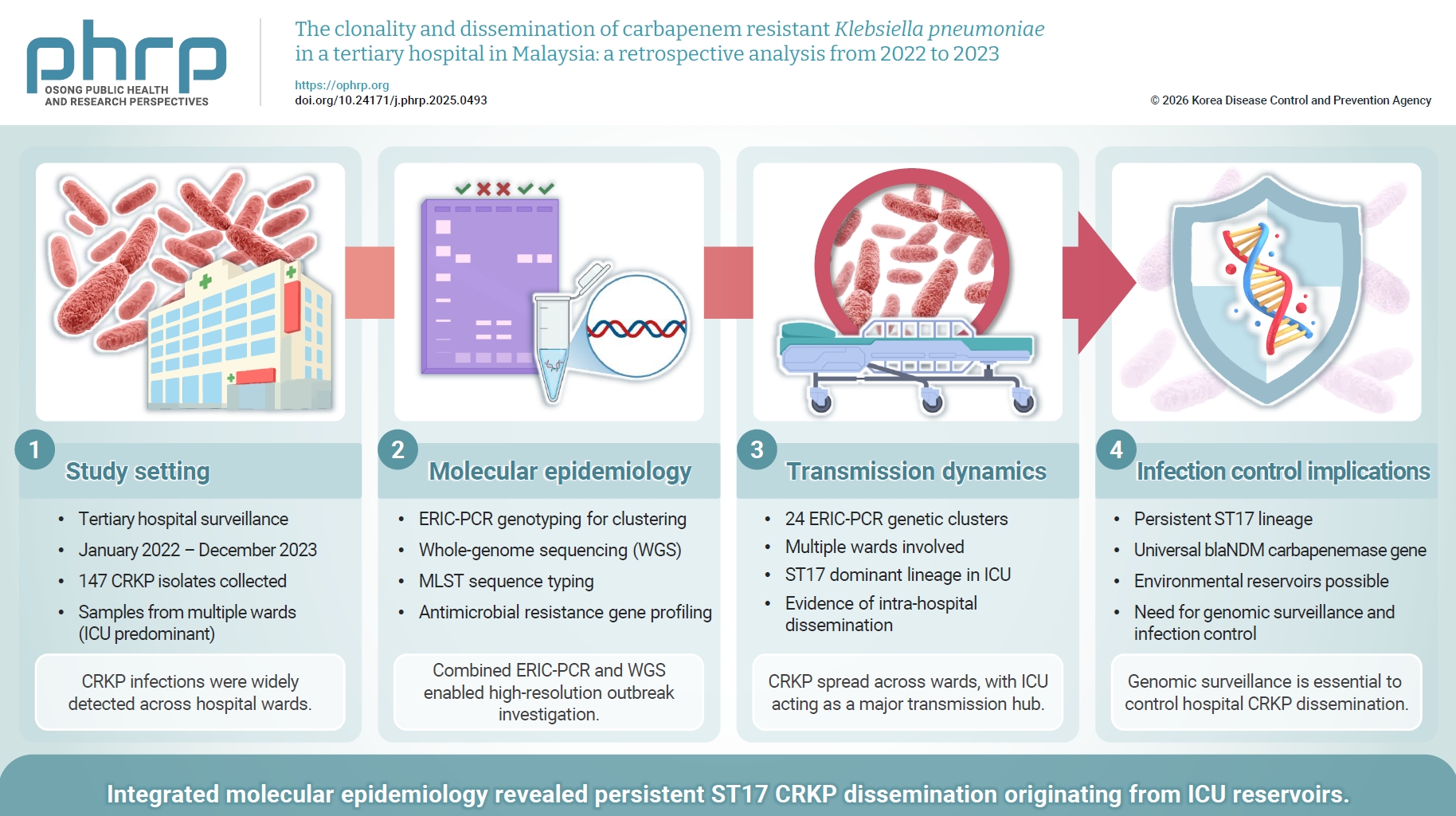
Objectives Cases of nosocomial carbapenem-resistant Klebsiella pneumoniae (CRKP) have been increasing steadily since the 1990s. In this study, we sought to assess CRKP clonal diversity and patterns of dissemination at Hospital Canselor Tuanku Muhriz (HCTM), a tertiary university hospital located in Kuala Lumpur, Malaysia. Methods: From January 2022 to December 2023, all CRKP isolates from HCTM were included in the investigation. Associated patient demographic data and clinical histories were retrieved from hospital records. Antibiotic susceptibility data for the collected isolates were obtained from the HCTM diagnostic laboratory. Molecular typing was performed using enterobacterial repetitive intergenic consensus polymerase chain reaction (ERIC-PCR) to identify genetic clusters. Based on ERIC-PCR clustering results and epidemiological investigations, selected CRKP isolates were subjected to whole-genome sequencing (WGS) to validate clonal relatedness, identify antimicrobial resistance genes, and establish phylogenomic relationships. Results: During the study period, a total of 147 CRKP isolates were recovered from various wards across HCTM. All isolates exhibited resistance to imipenem, meropenem, or ertapenem, with 124 isolates confirmed as carbapenemase producers. ERIC-PCR identified 24 genetic clusters disseminated across 23 wards within HCTM. Twelve CRKP isolates were selected for WGS based on integrated epidemiological investigation and ERIC-PCR genotyping; sequence typing revealed ST17 as the dominant circulating CRKP lineage in the intensive care unit, ward 6E, and possibly across the hospital. The carbapenemase gene bla_NDM was detected in all WGS-analyzed CRKP isolates. Conclusion: Integrating epidemiological investigation, phenotypic testing, molecular typing, and WGS is essential to understand resistance dynamics, map transmission, and guide hospital infection prevention strategies.
Objectives Klebsiella pneumoniae is known as one of the most common causes of hospitalacquired infections. Its prevalence poses substantial challenges to both hospital and public health systems, particularly due to the rise of multidrug‐resistant strains. Understanding the epidemiology and resistance properties of K. pneumoniae can inform antimicrobial stewardship and infection control programs. A cross-sectional study was employed from November 2021 to November 2023. Methods: A total of 24 isolates underwent antimicrobial susceptibility testing using the disk diffusion method, an extended-spectrum beta-lactamase (ESBL) production test, and molecular gene detection. Results: The study found that 95.8% of clinical isolates were classified as multidrug-resistant. All isolates were resistant to ampicillin (100%). A high percentage of isolates were resistant to cefazolin (91.7%), ceftriaxone (87.5%), cefotaxime (87.5%), cefepime (87.5%), ciprofloxacin (83.3%), and sulfamethoxazole-trimethoprim (83.3%). Of the 24 isolates, 87.5% harbored ESBL genes, while the frequencies for GES, NDM, SIM, and OXA-48 were 16.7%, 20.8%, 8.3%, and 41.7%, respectively. Notably, the OXA-23 and OXA-51 genes, which are typically associated with Acinetobacter baumannii, were detected in 16.7% and 20.8% of isolates, respectively. Moreover, the prevalence of virulence genes rmpA, acrAB, and tolC was 0%, 95.8%, and 87.5%, respectively. Conclusion: This study demonstrated a high level of antibiotic resistance and a significant presence of virulence genes among K. pneumoniae isolates. Consequently, these findings represent a critical public health issue that requires heightened awareness among all stakeholders, including health workers.
Citations
Citations to this article as recorded by
Computational Modeling of a Novel CTX-M β-Lactamase Escherichia coli Isolated from Yogyakarta, Indonesia Using I-TASSER Anggiresti Kinasih, Endah Retnaningrum Indonesian Journal of Medical Laboratory Science a.2026; 8(1): 51. CrossRef
Genetic profiling of the tolC component of the acrAB-TolC efflux pump in clinical Klebsiella pneumoniae isolates: a cross-sectional study in Pontianak, Indonesia Mardhia Mardhia, Delima Fajar Liana, Sari Eka Pratiwi, Mahyarudin Mahyarudin, Risa Agustina Osong Public Health and Research Perspectives.2026; 17(3): 254. CrossRef
Objectives We aimed to describe the epidemiological characteristics of carbapenemase-producing Enterobacteriaceae (CPE) outbreaks in healthcare settings in the Republic of Korea between 2017 and 2022.
Methods Under the national notifiable disease surveillance system, we obtained annual descriptive statistics regarding the isolated species, carbapenemase genotype, healthcare facility type, outbreak location and duration, and number of patients affected and recommended interventions. We used epidemiological investigation reports on CPE outbreaks reported to Korea Disease Control and Prevention Agency from June 2017 to September 2022.
Results Among the 168 reports analyzed, Klebsiella pneumoniae (85.1%) was the most frequently reported species, while K. pneumoniae carbapenemase (KPC, 82.7%) was the most common carbapenemase genotype. Both categories increased from 2017 to 2022 (p<0.01). General hospitals had the highest proportion (54.8%), while tertiary general hospitals demonstrated a decreasing trend (p<0.01). The largest proportion of outbreaks occurred exclusively in intensive care units (ICUs, 44.0%), and the frequency of concurrent outbreaks in ICUs and general wards increased over time (p<0.01). The median outbreak duration rose from 43.5 days before the coronavirus disease 2019 (COVID-19) pandemic (2017–2019) to 79.5 days during the pandemic (2020–2022) (p=0.01), and the median number of patients associated with each outbreak increased from 5.0 to 6.0 (p=0.03). Frequently recommended interventions included employee education (38.1%), and 3 or more measures were proposed for 45.2% of outbreaks.
Conclusion In the Republic of Korea, CPE outbreaks have been consistently dominated by K. pneumoniae and KPC. The size of these outbreaks increased during the COVID-19 pandemic. Our findings highlight the need for continuing efforts to control CPE outbreaks using a multimodal approach, while considering their epidemiology.
Citations
Citations to this article as recorded by
Microbiological and clinical impact of aminoglycosides on KPC-producing Klebsiella pneumoniae bacteraemia with aminoglycoside-modifying enzymes Jae Eun Seong, Sang Min Ahn, Min Han, Yong Seop Lee, Jung Ah Lee, Jae Hoon Kim, Jung Ho Kim, Jin Young Ahn, Su Jin Jeong, Nam Su Ku, Joon Sup Yeom, Hyukmin Lee, Jun Yong Choi Diagnostic Microbiology and Infectious Disease.2026; 114(1): 117111. CrossRef
Early prediction of colonization by carbapenemase-producing enterobacterales at ICU admission using machine learning Ji Hun Kim, Eunmi Yang, Yun Woo Lee, Han-Sung Kim, Hyeonji Seo Scientific Reports.2026;[Epub] CrossRef
Multidrug-resistant organism co-colonization in patients with discordant direct stool Xpert Carba-R and culture-based carbapenemase-producing Enterobacterales surveillance results Cheon-Hoo Jun, Si-Ho Kim, Hyoung Tae Kim, Yu Mi Wi Journal of Infection and Public Health.2026; 19(5): 103188. CrossRef
Comparison of clinical outcomes of patients with serial negative surveillance cultures according to a subsequent polymerase chain reaction test for carbapenemase-producing Enterobacterales H. Seo, S. Kim, Y.W. Lee, H.S. Oh, H-S. Kim, Y.K. Kim Journal of Hospital Infection.2024; 146: 93. CrossRef
Identifying Contact Time Required for Secondary Transmission ofClostridioides difficileInfections by Using Real-Time Locating System Min Hyung Kim, Jaewoong Kim, Heejin Ra, Sooyeon Jeong, Yoon Soo Park, Dongju Won, Hyukmin Lee, Heejung Kim Emerging Infectious Diseases.2024;[Epub] CrossRef
Antimicrobial activity of ceftazidime-avibactam against KPC-2-producing Enterobacterales: a cross-combination and dose-escalation titration study with relebactam and vaborbactam Min Seo Kang, Jin Yang Baek, Jae-Hoon Ko, Sun Young Cho, Keon Young Lee, Young Ho Lee, Jinyoung Yang, Tae Yeul Kim, Hee Jae Huh, Nam Yong Lee, Kyungmin Huh, Cheol-In Kang, Doo Ryeon Chung, Kyong Ran Peck, Bobby G. Warren Microbiology Spectrum.2024;[Epub] CrossRef
Performance comparison of BD Phoenix CPO detect panel with Cepheid Xpert Carba-R assay for the detection of carbapenemase-producing Klebsiella pneumoniae isolates Nazmiye Ülkü Tüzemen, Uğur Önal, Osman Merdan, Bekir Akca, Beyza Ener, Halis Akalın, Cüneyt Özakın BMC Microbiology.2024;[Epub] CrossRef
This study aimed to describe the presence and geographical distribution of Gram-negativebacteria considered critical on the priority list of antibiotic-resistant pathogens publishedby the World Health Organization, including carbapenem-resistant Enterobacteriaceae,carbapenem-resistant Acinetobacter spp., and carbapenem-resistant Pseudomonas aeruginosa.A systematic review of original studies published in 5 databases between 2010 and 2021 wasconducted, including genotypically confirmed carbapenem-resistant isolates obtained fromcanines, felines, and their settings. Fifty-one articles met the search criteria. Carbapenemresistant isolates were found in domestic canines and felines, pet food, and on veterinarymedical and household surfaces. The review found that the so-called “big five”—that is, the5 major carbapenemases identified worldwide in Enterobacterales (New Delhi metallo-βlactamase, active-on-imipenem, Verona integron-encoded metallo-β-lactamase, Klebsiellapneumoniae carbapenemase, and oxacillin [OXA]-48-like)—and the 3 most importantcarbapenemases from Acinetobacter spp. (OXA-23-like, OXA-40-like, and OXA-58-like) hadbeen detected in 8 species in the Enterobacteriaceae family and 5 species of glucose nonfermenting bacilli on 5 continents. Two publications used molecular analysis to confirmcarbapenem-resistant bacteria transmission between owners and dogs. Isolating criticallyimportant human carbapenem-resistant Gram-negative bacteria from domestic canines andfelines highlights the importance of including these animal species in surveillance programsand antimicrobial resistance containment plans as part of the One Health approach.
Citations
Citations to this article as recorded by
Reducing carbapenemase-producing Gram-negative bacilli in high-risk veterinary hospital units through targeted infection prevention and control Chavin Leelapsawas, Chutirat Torsahakul, Nicole Sirisopit Mehl, Krishaporn Kradangnga, Parinya Sroithongkham, Rusmin Indra, Parnkaew Wannamala, Luksika Keerativitayanant, Rungtip Chuanchuen, Pattrarat Chanchaithong Research in Veterinary Science.2026; 204: 106120. CrossRef
Monitoring antimicrobial resistance trends and emerging carbapenemases in Enterobacterales causing companion animal infections: a four-year study Laura Fernandes, Joana Moreira da Silva, Juliana Menezes, Cátia Marques, Cátia Caneiras, Constança Pomba Veterinary Microbiology.2026; 316: 110987. CrossRef
Clinical audit on antimicrobial stewardship effectiveness in reducing antimicrobial‐resistant bacterial colonisation in hospitalised horses Karen Mazzola, Aliai Lanci, Silvia Piva, Viviana Schisa, Jole Mariella, Raffaele Scarpellini, Francesca Freccero, Erica De Carolis, Fabio Tumietto, Carolina Castagnetti Equine Veterinary Journal.2026;[Epub] CrossRef
Beyond companionship: Current practices and future perspectives in antimicrobial resistance surveillance among companion animals Raffaele Scarpellini, Silvia Piva Research in Veterinary Science.2026; 209: 106275. CrossRef
Epidemiology and characterization of carbapenemase gene alleles expressed by Enterobacterales recovered from Nairobi river surface water and local input sources in Nairobi, Kenya Rael J. Too, Briton M. Kavulavu, George C. Gitao, Lilly C. Bebora, Dixie F. Mollenkopf, Samuel Kariuki, Thomas E. Wittum Total Environment Microbiology.2026; 2(3): 100094. CrossRef
Multilevel surveillance of antimicrobial resistance in Escherichia coli and Klebsiella pneumoniae from companion animals: Evidence from a Veterinary University Hospital before and after EU Regulation 2022/1255 R. Scarpellini, M. Giunti, F. Dondi, C. Agnoli, L. Pisoni, S. Del Magno, A. Foglia, I. Magagnoli, E. Esposito, E. Mondo, F. Tumietto, S. Piva Veterinary Microbiology.2026; 319: 111081. CrossRef
Survey-based risk factors and genomic characterization of oral and oropharyngeal Enterobacterales carriage in humans and companion animals: a One Health study W. Cooper Brookshire, K. Taylor Hellmann, D. Ashley Robinson, Keun Seok Seo Frontiers in Veterinary Science.2026;[Epub] CrossRef
NDM-5-plasmid diversity in multiple international high-risk Escherichia coli clones associated with canine and feline extraintestinal infections Pattrarat Chanchaithong, Parinya Sroithongkham, Chavin Leelapsawas, Komkiew Pinpimai, Jitrapa Yindee, Alexandra Collaud, Vincent Perreten Veterinary Microbiology.2025; 301: 110338. CrossRef
Staphylococcal skin infection isolates from dogs without recent antibiotic exposure are 100% susceptible to clindamycin W. Cooper Brookshire, Larry D. Ballard, Vernon C. Langston, Joo Youn Park, Keun-Seok Seo Frontiers in Veterinary Science.2025;[Epub] CrossRef
The European Union summary report on antimicrobial resistance in zoonotic and indicator bacteria from humans, animals and food in 2022–2023
Zoonotic potential of uropathogenic Escherichia coli lineages from companion animals Nicolas Jousserand, Frédéric Auvray, Camille Chagneau, Laurent Cavalié, Christelle Maurey, Amandine Drut, Rachel Lavoué, Eric Oswald Veterinary Research.2025;[Epub] CrossRef
Genomic analyses of Escherichia coli ST410 harbouring the blaOXA-181 carbapenemase gene from companion animals and humans in Switzerland Yvonne Spahr, Patrice Nordmann, Javier E Fernandez, Laurent Poirel, Andrea Endimiani, Vincent Perreten Journal of Applied Microbiology.2025;[Epub] CrossRef
WGS-based characterization of trans-sectoral OXA-48-producing Escherichia coli in Switzerland Valentina Donà, Patrice Nordmann, Javier E. Fernandez, Laurent Poirel, Jacqueline Findlay, Simone Schuller, Sonja Kittl, Helene Rohrbach, Andrea Endimiani, Vincent Perreten One Health Advances.2025;[Epub] CrossRef
Analysis of the Concordance Between the Use of Phenotypic Screening Tests with the β-Lactamase Gene Profile in Selected Gram-Negative Bacteria Patrycja Głowacka, Izabela Marczuk, Patrycja Wójcicka, Monika Ogórkiewicz, Marta Ciesielska, Dorota Żakowska, Paweł Rutyna, Anna Koszczyńska, Marta Łączyńska, Natalia Podsiadły, Emilia Paziewska, Beata Cieśluk-Olchowska Antibiotics.2025; 14(12): 1275. CrossRef
First report of a blaNDM-5-carrying Escherichia coli sequence type 12 isolated from a dog with pyometra in Japan Kazuki Harada, Tadashi Miyamoto, Michiyo Sugiyama, Tetsuo Asai Journal of Infection and Chemotherapy.2024; 30(9): 938. CrossRef
The European Union summary report on antimicrobial resistance in zoonotic and indicator bacteria from humans, animals and food in 2021–2022
Epidemiological analysis and prevention strategies in response to a shigellosis cluster outbreak: a retrospective case series in an alternative school in the Republic of Korea, 2023 Yeongseo Ahn, Sunmi Jin, Gemma Park, Hye Young Lee, Hyungyong Lee, Eunkyung Shin, Junyoung Kim, Jaeil Yoo, Yuna Kim Osong Public Health and Research Perspectives.2024; 15(1): 68. CrossRef
Carbapenem Resistance in Animal-Environment-Food from Africa: A Systematic Review, Recommendations and Perspectives Komla Dossouvi, Ayawovi Selom Ametepe Infection and Drug Resistance.2024; Volume 17: 1699. CrossRef
Identification of blaOXA-23 gene in resistant Pseudomonas aeruginosa strains isolated from cows and humans in Basra province, Iraq Alyaa Sabti Jasim, Abeer Laily Mohammed, Wameedh Hashim Abbas, Hanaa Khaleel Ibraheim, Hasanain A.J. Gharban Veterinary World.2024; : 1629. CrossRef
The European Union Summary Report on Antimicrobial Resistance in zoonotic and indicator bacteria from humans, animals and food in 2020/2021
Resistome-based surveillance identifies ESKAPE pathogens as the predominant gram-negative organisms circulating in veterinary hospitals Flavia Zendri, Cajsa M. Isgren, Jane Devaney, Vanessa Schmidt, Rachel Rankin, Dorina Timofte Frontiers in Microbiology.2023;[Epub] CrossRef
Unveiling the emergence of multidrug-resistant pathogens in exotic pets from France: a comprehensive study (2017-2019) Sandro Cardoso, Aurélie Le Loc’h, Inês Marques, Anabela Almeida, Sérgio Sousa, Maria José Saavedra, Sofia Anastácio, Eduarda Silveira One Health & Implementation Research.2023; 3(4): 161. CrossRef
Objectives This study aimed to identify the epidemiological characteristics of patients with carbapenem-resistant Enterobacteriaceae and Acinetobacter baumannii (CRE/ CRAB) isolates in a tertiary referral hospital in Korea. Methods: We collected and analyzed data from 528 adults admitted to a tertiary referral hospital from August 1, 2018 to February 29, 2020. The CRE/CRAB isolates were confirmed as being present at the time of patients’ admission or acquired during hospitalization based on their medical records. The t-test, chi-square test, or Fisher exact test and stepwise multiple logistic regression were performed. Results: While the proportion of community-acquired CRE/CRAB was low (6%), 20% of CRE/ CRAB isolates were identified in patients at the time of hospitalization. The risk of CRAB isolation was positively associated with mechanical ventilator use (odds ratio [OR], 3.52; 95% confidence interval [CI], 1.96−6.33) and total parenteral nutrition use (OR, 3.64; 95% CI, 1.87−7.08). Conclusion: Over 20% of CRE/CRAB isolates in a tertiary referral hospital in Korea were found at the time of patients’ admission. Furthermore, patients with mechanical ventilation and/or total parenteral nutrition tended to acquire CRAB more frequently. Thus, active surveillance for CRE/CRAB at the time of hospitalization is strongly required, particularly for patients who are expected to require mechanical ventilation or total parenteral nutrition.
Citations
Citations to this article as recorded by
Disease burden of carbapenem-resistant Enterobacterales infections in Korea C.M. Lee, J. Jung, E. Lee, S. Lee, S.Y. Cho, P.G. Choe, R. Lee, Y.K. Kim, H.J. Choi, J-H. Kim, C-J. Kim, Y.G. Kwak, K-H. Park, Y.S. Kim, S. Cheon, S.Y. Park, H.B. Kim, N.S. Ku, J. Ahn, K-H. Song, E.S. Kim, S.M. Moon, S.J. Choi Journal of Hospital Infection.2026; 172: 89. CrossRef
Epidemiological analysis and prevention strategies in response to a shigellosis cluster outbreak: a retrospective case series in an alternative school in the Republic of Korea, 2023 Yeongseo Ahn, Sunmi Jin, Gemma Park, Hye Young Lee, Hyungyong Lee, Eunkyung Shin, Junyoung Kim, Jaeil Yoo, Yuna Kim Osong Public Health and Research Perspectives.2024; 15(1): 68. CrossRef
External validation of the ICU-CARB score to predict carbapenem-resistant gram-negative bacteria carriage in critically ill patients upon ICU admission: a multicenter analysis Tong Wu, Xiaoli Wang, Ziyun Shen, Zhongwei Zhang, Yuhao Liu, Rong Fang, Qian Wang, Sheng Wang, Quanhong Zhou, Hongping Qu, Yunqi Dai, Ruoming Tan Antimicrobial Resistance & Infection Control.2024;[Epub] CrossRef
Geographical mapping and temporal trends of Acinetobacter baumannii carbapenem resistance: A comprehensive meta-analysis Masoumeh Beig, Elnaz Parvizi, Tahereh Navidifar, Narjes Bostanghadiri, Maryam Mofid, Narges Golab, Mohammad Sholeh, Mullika Traidej Chomnawang PLOS ONE.2024; 19(12): e0311124. CrossRef
Epidemiology and Risk Factors of Carbapenemase-Producing Enterobacteriaceae Acquisition and Colonization at a Korean Hospital over 1 Year Hye-Jin Kim, Jung-Hee Hyun, Hyo-Seon Jeong, Yeon-Kyeng Lee Antibiotics.2023; 12(4): 759. CrossRef
<sec>
<title>Objectives</title>
<p>Carbapenem resistance is a serious clinical and public health threat. Carbapenemase can confer carbapenem resistance, and most carbapenemase genes are plasmid encoded so resistance can easily spread. In this study, we aimed to develop a novel system based on the TaqMan platform for the rapid detection of 6 clinically prevalent carbapenemase genes: <italic>Klebsiella pneumoniae</italic> carbapenemase, New Delhi metallo-β-lactamase, oxacillinase, imipenem-hydrolyzing, Verona integron-encoded metallo-β-lactamase, and Guiana extended-spectrum β-lactamase.</p></sec>
<sec>
<title>Methods</title>
<p>The triplex assay was verified by testing genomic DNA of 6 carbapenemase-producing <italic>Klebsiella pneumoniae</italic>. It was validated with a blinded panel of 310 Enterobacteriaceae isolates, including 225 carbapenemase-producers and 85 non-producers, by direct colony triplex real-time polymerase chain reaction (PCR). The real-time PCR was performed using the ABI 7500 fast instrument (Applied Biosystems, CA, USA) and specific primers for each carbapenemase target were designed to include modified peptide-nucleic acid oligonucleotides.</p></sec>
<sec>
<title>Results</title>
<p>No amplification was detected among the negative samples. The result showed 100% concordance with the genotypes previously identified. The entire assay, including DNA extraction and real-time PCR, was completed within 2 hours.</p></sec>
<sec>
<title>Conclusion</title>
<p>The newly developed triplex real-time PCR assay was useful for the rapid, accurate and simultaneous detection of 6 carbapenemase genes in Enterobacteriaceae, suggesting its potential to allow an early decision on the appropriate treatment, management, and prevention of the spread of resistant infections in hospitals.</p></sec>
Citations
Citations to this article as recorded by
Detection of New Delhi metallo-β-lactamase (blaNDM) and oxacillinase (blaOXA-48) genes among carbapenem-resistant Enterobacteriaceae (CRE) in Jazan Region, Saudi Arabia Soheir A. A. Hagras, Gharieb S. El-Sayyad, Marwa Yousry A. Mohamed, Hani A. Ozbak, Mahitab M. Wahby, Sara Ahmed Eltigani, Neamat Hanem M. I. Dorra, Samar Elshahidy, Mostafa A. Abdel-Maksoud, Salman Alrokayan, Hassan A. Rudayni, Yasser Q. Majrabi Scientific Reports.2026;[Epub] CrossRef
Fabrication of Cost-Effective Microchip-Based Device Using Sandblasting Technique for Real-Time Multiplex PCR Detection Yiteng Liu, Zhiyang Hu, Siyu Yang, Na Xu, Qi Song, Yibo Gao, Weijia Wen Micromachines.2024; 15(8): 944. CrossRef
Fast Track Diagnostic Tools for Clinical Management of Sepsis: Paradigm Shift from Conventional to Advanced Methods Ena Gupta, Juhi Saxena, Sanni Kumar, Umang Sharma, Saundarya Rastogi, Vijay Kumar Srivastava, Sanket Kaushik, Anupam Jyoti Diagnostics.2023; 13(2): 277. CrossRef
Objectives
Plasmid-mediated AmpC β-lactamases (PMABLs) and carbapenemases are emerging groups of antimicrobial-resistance determinants. The aims of the study were to evaluate the occurrence of PMABLs and carbapenemases in clinical isolates of <i>Klebsiella pneumoniae</i> and compare the test performance of various phenotypic methods for detection of these enzymes in Iran. Methods
A total of 100 <i>K. pneumoniae</i> isolates were collected from clinical specimens obtained in Valiasr Hospital. AmpC production in all isolates was determined using the AmpC disk test, the cephamycin Hodge test, the AmpC Etest, and the boronic acid combined-disk test. In addition, carbapenemase production was determined using the modified Hodge test, the EDTA disk synergy test, and the boronic acid combined-disk test. The performances of various phenotypic methods were evaluated by the comparison of their results with polymerase chain reaction (PCR) method as the gold standard. Results
Of the 100 isolates, 19 (19%) were demonstrated to harbor the PMABL-resistance gene by the multiplex PCR method. The PCR result indicated the presence of carbapenemase genes in 12 isolates. The performance of various phenotypic tests carried out for detection of carbapenemase-producing isolates varied widely, ranging in sensitivity from 30% to 100% and in specificity from 90.8% to 100%. Conclusion
This is the first report of <i>MOX</i>-type AmpC β-lactamase and <i>bla</i><sub><i>GES</i></sub> in <i>K. pneumoniae</i> in Iran. A comparison of the phenotypic methods showed that a combination of cefoxitin plus boronic acid is optimal for detecting plasmid-mediated AmpC enzymes in <i>K. pneumoniae</i>, whereas the implementation of molecular methods is often complex, requires specially trained personnel, and is associated with higher costs.
Citations
Citations to this article as recorded by
Frequency of CIT, EBC and DHA flocks (families) of AmpC beta-lactamases in clinical isolates of Klebsiella pneumoniae collected from hospitalized patients in North of Iran Fatemeh Betiar, Mehrdad Gholami, Mohammad Karimbakhsh, Mehdi Samadi, Faezeh Elahi, Hamid Reza Goli Molecular Biology Reports.2026;[Epub] CrossRef
The Global and Regional Prevalence of Hospital-Acquired Carbapenem-Resistant Klebsiella pneumoniae Infection: A Systematic Review and Meta-analysis Xing-chen Lin, Chang-li Li, Shao-yang Zhang, Xiao-feng Yang, Meng Jiang Open Forum Infectious Diseases.2024;[Epub] CrossRef
Identification of AmpC beta-lactamase producing clinical isolates of Klebsiella pneumoniae in Guilan and investigation of inhibitory effect of thymol on Khorshid Jirdashtani, Fatemeh Mousavi, Leila Asadpour Alborz University Medical Journal.2024; 13(3): 182. CrossRef
High frequency of NDM-1 and OXA-48 carbapenemase genes among Klebsiella pneumoniae isolates in central Iran Elnaz Abbasi, Ehsanollah Ghaznavi-Rad BMC Microbiology.2023;[Epub] CrossRef
Detection of ESBL and AmpC producing Klebsiella pneumoniae ST11 and ST147 from urinary tract infections in Iran Shaghayegh Shahkolahi, Pegah Shakibnia, Shahla Shahbazi, Samira Sabzi, Farzad Badmasti, Mohammad Reza Asadi Karam, Mehri Habibi Acta Microbiologica et Immunologica Hungarica.2022;[Epub] CrossRef
Plasmid-mediated AmpC β-Lactamase Gene Analysis in Klebsiella Pneumoniae Clinical Isolates Nabi Jomehzadeh, Khadijeh Ahmadi, Hasti Shaabaninejad, Gholamali Eslami Biomedical and Biotechnology Research Journal (BBR.2022; 6(4): 582. CrossRef
Characterization of Antimicrobial Resistance Patterns of Klebsiella pneumoniae Isolates Obtained from Wound Infections Roya Ghanavati, Hossein Kazemian, Parisa Asadollahi , Hamid Heidari, Gholamreza Irajian, Fatemeh Navab-Moghadam, Shabnam Razavi Infectious Disorders - Drug Targets .2021; 21(1): 119. CrossRef
An investigation of extended-spectrum β-lactamases (ESBLs) in Klebsiella isolated from foodborne outbreaks in Iran Farnaz Hajikarim, Mohammad Mehdi Soltan Dallal, Mohammad Reza Pourmand, Milad Abdi Gene Reports.2020; 19: 100632. CrossRef
Prevalence and Mechanisms of Carbapenem Resistance in
Klebsiella pneumoniae
and
Escherichia coli
: A Systematic Review and Meta-Analysis of Cross-Sectional Studies from Iran
Mohammad Javad Nasiri, Mehdi Mirsaeidi, Seyyed Mohammad Javad Mousavi, Mania Arshadi, Fatemeh Fardsanei, Behnaz Deihim, Sara Davoudabadi, Samin Zamani, Bahareh Hajikhani, Hossein Goudarzi, Mehdi Goudarzi, Zahra Sadat Seghatoleslami, Hossein Dabiri, Payam Microbial Drug Resistance.2020; 26(12): 1491. CrossRef
Characterization of β-lactam resistance in K. pneumoniae associated with ready-to-eat processed meat in Egypt Shaymaa H. Abdel-Rhman, Grzegorz Woźniakowski PLOS ONE.2020; 15(9): e0238747. CrossRef
Multiplex PCR to detect pAmpC β-lactamases among enterobacteriaceae at a tertiary care laboratory in Mumbai, India Mubin Kazi, Kanchan Ajbani, Jeffrey A. Tornheim, Anjali Shetty, Camilla Rodrigues Microbiology.2019; 165(2): 246. CrossRef
AmpC β lactamases in Urinary Klebsiella pneumoniae Isolates: First Report of ACC Type AmpC β-lactamase Resistance in Iran Maryam Ghane, Laleh Babaeekhou, Mahdi Jafar Shanjani Journal of Advances in Medical and Biomedical Rese.2019; 27(123): 23. CrossRef
The Molecular and Clinical Epidemiology of Extended-Spectrum Cephalosporin– and Carbapenem-Resistant Enterobacteriaceae at 4 US Pediatric Hospitals Danielle M Zerr, Scott J Weissman, Chuan Zhou, Matthew P Kronman, Amanda L Adler, Jessica E Berry, Jaipreet Rayar, Jeff Myers, Wren L Haaland, Carey-Ann D Burnham, Alexis Elward, Jason Newland, Rangaraj Selvarangan, Kaede V Sullivan, Theoklis Zaoutis, Xua Journal of the Pediatric Infectious Diseases Socie.2017; 6(4): 366. CrossRef
Previous Antibiotic Exposure Increases Risk of Infection with Extended-Spectrum-β-Lactamase- and AmpC-Producing Escherichia coli and Klebsiella pneumoniae in Pediatric Patients Danielle M. Zerr, Arianna Miles-Jay, Matthew P. Kronman, Chuan Zhou, Amanda L. Adler, Wren Haaland, Scott J. Weissman, Alexis Elward, Jason G. Newland, Theoklis Zaoutis, Xuan Qin Antimicrobial Agents and Chemotherapy.2016; 60(7): 4237. CrossRef
Molecular characterization of extended-spectrum β-lactamase, plasmid-mediated AmpC cephalosporinase and carbapenemase genes among Enterobacteriaceae isolates in five medical centres of East and West Azerbaijan, Iran Mohammad Reza Sadeghi, Reza Ghotaslou, Mohammad Taghi Akhi, Mohammad Asgharzadeh, Alka Hasani
Journal of Medical Microbiology
.2016; 65(11): 1322. CrossRef
High Prevalence of AmpC β-Lactamases in Clinical Isolates of Escherichia coli in Ilam, Iran Abbas Maleki, Afra Khosravi, Sobhan Ghafourian, Iraj Pakzad, Shiva Hosseini, Rashid Ramazanzadeh, Nourkhoda Sadeghifard Osong Public Health and Research Perspectives.2015; 6(3): 201. CrossRef




 First
 Prev


