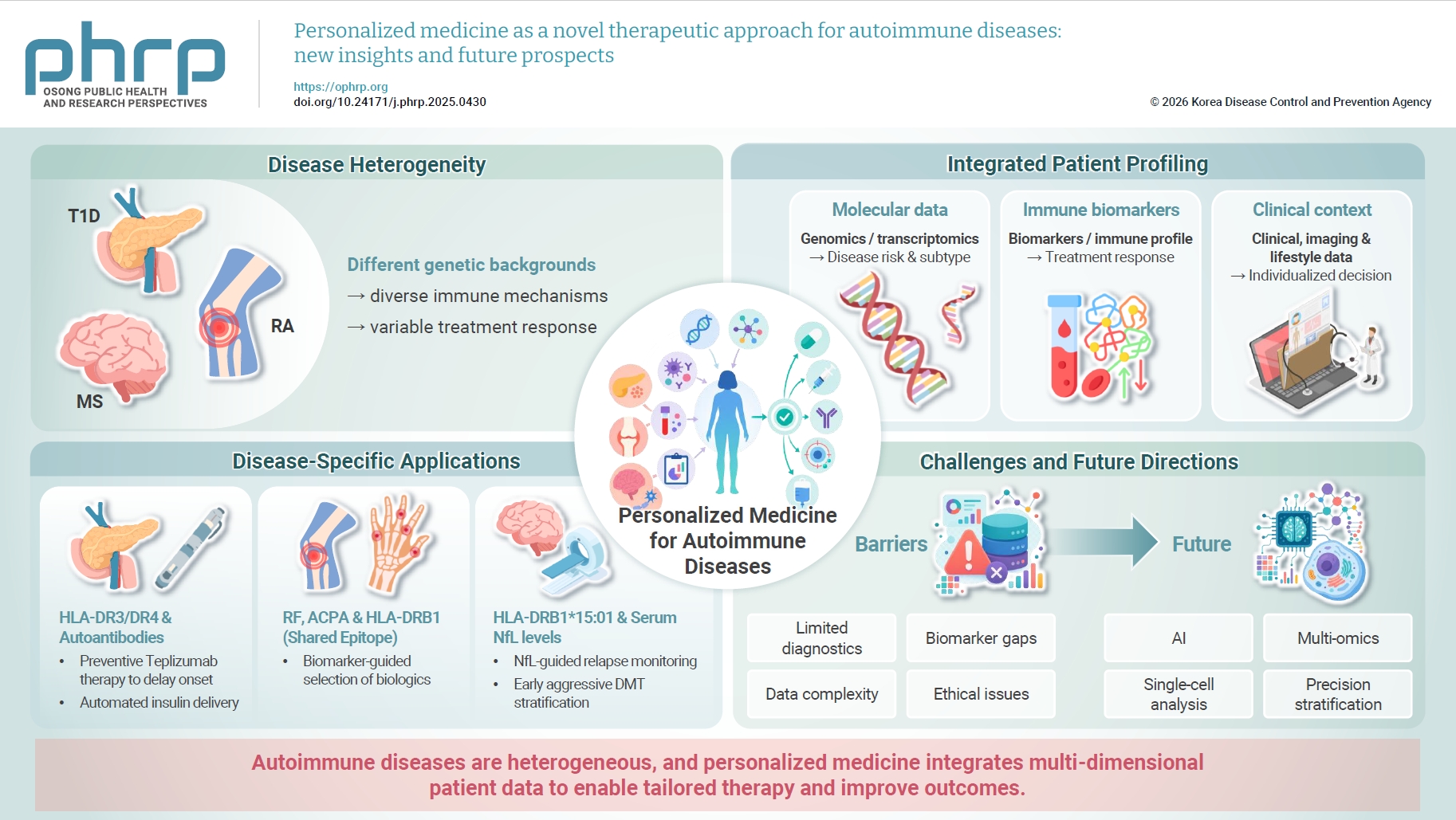
Autoimmune diseases are caused by dysfunction of the immune system, leading to inappropriate attacks on healthy tissues. Because patients have diverse genetic predispositions and heterogeneous responses to therapy, personalized medicine (PM) offers an opportunity to improve treatment effectiveness. PM uses diagnostic assessments to tailor treatment through individualized medical interventions. PM may improve therapeutic precision beyond traditional trial-and-error approaches, reduce adverse consequences, and improve outcomes by integrating genomic and transcriptomic data. PM considers genetic and molecular landscapes, immunologic factors, epigenetic influences, and environmental exposures to assess treatment response. However, challenges remain related to diagnostic access, the slow pace of biomarker identification, technological limitations, sustained patient engagement, data management, and computational requirements. Nevertheless, continued efforts to improve understanding of disease pathophysiology, gene expression, and immune regulation—together with the application of novel technologies and machine learning—may advance PM-based therapies. Additional opportunities include drug–target modeling and exploratory singlecell–based approaches to clarify patient-specific therapeutic mechanisms. This review briefly introduces the potential of PM for type 1 diabetes, rheumatoid arthritis, and multiple sclerosis.
Objectives The aim of this study was to investigate the relationship between diabetes medication self-efficacy and quality of life in older adults with diabetes.
Methods The study included 192 older adults who attended the diabetes clinic of a public hospital in Istanbul. Data were collected between June and October 2024. Participants were informed about the study and provided both verbal and written consent. Data collection instruments comprised a sociodemographic questionnaire, the diabetes medication self-efficacy scale, and the quality of life scale for older adults.
Results Of the participants, 98 (51.0%) were women and 105 (54.7%) were aged 65 to 74 years. The mean diabetes medication self-efficacy score was 38.95±10.31, and the mean quality of life score was 18.24±6.37. A weak but statistically significant positive correlation was observed between the autonomy and satisfaction subscale of quality of life and the necessity subscale of self-efficacy (p<0.05).
Conclusion This study, which examined the relationship between self-efficacy in diabetes management and quality of life in older adults, provides valuable guidance for clinical practice aimed at improving care for this population.
<sec>
<title>Objectives</title>
<p>This study was performed to examine the effects of the Korean medicine healthcare program on stroke-related factors and self-care enhancement.</p></sec>
<sec>
<title>Methods</title>
<p>This study was a quasi-experimental, pretest-posttest nonequivalent control group design study (<italic>N</italic> = 58 participants), with 28 in the treatment group (Korean medicine health care program) and 30 in the control group (no intervention). The program was conducted twice a week for 2 hours, for a total of 12 weeks.</p></sec>
<sec>
<title>Results</title>
<p>There were statistically significant differences in systolic (<italic>p</italic> = 0.005) and diastolic blood pressure (<italic>p</italic> = 0.006), cholesterol (<italic>p</italic> < 0.001), blood glucose (<italic>p</italic> < 0.001), self-esteem (<italic>p</italic> = 0.001), self-efficacy (<italic>p</italic> < 0.001), health perception (<italic>p</italic> < 0.001), and the health behavior (<italic>p</italic> < 0.001) between the experimental group and the control group.</p></sec>
<sec>
<title>Conclusion</title>
<p>Thus, the Korean medicine healthcare program was effective in managing stroke-related factors and enhancing self-care, and should be actively used to develop community health promotion strategies to prevent strokes and prepare long-term measures.</p></sec>
Citations
Citations to this article as recorded by
Stroke knowledge and health-promoting behaviors: Mediating effect of patient self-esteem GyeongChae MUN, JaeLan SHIM Patient Education and Counseling.2024; 129: 108398. CrossRef
<sec>
<title>Objectives</title>
<p>Herbal remedies such as purgative manna are used to treat neonatal jaundice. In this study Bilineaster drop (purgative manna) and phototherapy, and phototherapy treatment alone were compared by assessing phototherapy duration and number of days in hospital.</p></sec>
<sec>
<title>Methods</title>
<p>There were 150 consecutive term neonates with jaundice, weighting from 2,500 g to 4,000 g enrolled in this randomized double blind clinical trial. The neonates were randomly assigned to intervention and control groups. The control patients received only phototherapy and the intervention group underwent phototherapy treatment and purgative manna drop (5 drops per kg of body weight, 3 times a day). Direct and total measurements of bilirubin concentration in the serum were measured and the reduction in concentration of bilirubin was calculated.</p></sec>
<sec>
<title>Results</title>
<p>There were 28% of patients whose hospital duration following phototherapy was 2 days, for Bilineaster and phototherapy treatment this was 49.3% of patients. At 48 hours and 72 hours the reduction in the concentration of total bilirubin in the serum was statistically significantly different across groups (<italic>p</italic> < 0.05) but at 24 hours and 96 hours there were no significant differences between groups (<italic>p</italic> > 0.05). The reduction in direct bilirubin concentration in the serum was significantly different between groups at 72 hours and 96 hours (<italic>p</italic> > 0.001).</p></sec>
<sec>
<title>Conclusion</title>
<p>Purgative manna and phototherapy, can statistically significantly reduce total bilirubin concentration at 48 hours and 72 hours compared with phototherapy alone, and reduce the length of hospital stay for jaundiced neonates at 2 days compared with phototherapy treatment.</p></sec>
Citations
Citations to this article as recorded by
Who Are the Main Recommenders of Herbal Drugs for Treating Neonatal Jaundice? Kayvan Mirnia, Maryam Saeedi, Razieh Sangsari, Ashkan Talebi Journal of Comprehensive Pediatrics.2024;[Epub] CrossRef
Recent Advances in Adjuvant Pharmacotherapy for Neonatal Indirect Hyperbilirubinemia: A Narrative Review Seyyedeh Azade Hoseini Nouri, Marjaneh Zarkesh Journal of Comprehensive Pediatrics.2023;[Epub] CrossRef
The effect of oral use of concentrated pomegranate juice by mothers on hyperbilirubinemia in neonates under phototherapy: A randomized clinical trial Masomeh Rezapour, Yadollah Zahedpasha, Mohammad Kamalinejad, Zahra Memariani, Morteza Alijanpour, Mousa Ahmadpour-Kacho, Seyyed Ali Mozaffarpur, Hoda Shirafkan Journal of Research in Medical Sciences.2023;[Epub] CrossRef
The Effects of Clofibrate on Neonatal Jaundice: A Systematic Review Fathemeh Eghbalian, Ali Hasanpour-Dehkordi, Roya Raeisi International Journal of Preventive Medicine.2022;[Epub] CrossRef
Swapna B. Shetty, Darshan D. Divakar, M.H.N. Dalati, Sajith Vellappally, Sukumaran Anil, Marey A. Alshehry, Baher Felemban, Al S. Mamdouh, Obaid A. Alshahrani
Osong Public Health Res Perspect 2016;7(5):327-333. Published online October 31, 2016
Objectives
Fishermen are among the most vulnerable groups for human immunodeficiency virus (HIV)/AIDS with reported high prevalence. Poor knowledge base has been evidenced by a few studies. The present study was conducted to assess the knowledge regarding HIV/AIDS among fishermen of the Kutch coast, Gujarat, India. Methods
A descriptive cross-sectional study was conducted among 950 fishermen of the Kutch coast, in the months of January–February 2015. Knowledge of HIV/AIDS of fishermen was assessed using structured interview schedules with 12 questions. The information on socio-demographic characteristics was also obtained. Chi-square test and multivariate logistic regression analysis were used for statistical analysis. The confidence level and level of significance were fixed at 95% and 5%, respectively. Results
A major proportion of participants (57.2%) had no access to any potential source of information and had never heard about HIV/AIDS (65.1%). Some of them were aware of modes of transmission of AIDS but only a few of them knew about the methods of prevention. Only 23.1% of participants were observed with appropriate knowledge regarding HIV/AIDS. Bivariate and multivariate analysis revealed significant variation in the proportion of participants with appropriate knowledge with age and educational status. Conclusion
Overall, the knowledge of the fishermen community in the present study was evidenced to be poor creating an alarming situation demanding educative interventions as a part of AIDS control programs.
Citations
Citations to this article as recorded by
Prolonged Release of Anti-Retroviral Efavirenz From System Using ZIF-8 as Carrier Alinne Élida Gonçalves Alves Tabosa, Aline Silva Ferreira, Natália Millena da Silva, Débora Dolores Souza da Silva Nascimento, Leslie Raphael de Moura Ferraz, José Yago Rodrigues Silva, Severino Alves Junior, Rosali Maria Ferreira da Silva, Larissa Araúj Current HIV Research.2020; 18(6): 396. CrossRef
Prevalence of HIV infection and uptake of HIV/AIDS services among fisherfolk in landing Islands of Lake Victoria, north western Tanzania Anthony Kapesa, Namanya Basinda, Elias C. Nyanza, Martha F. Mushi, Ola Jahanpour, Sospatro E. Ngallaba BMC Health Services Research.2018;[Epub] CrossRef
Objectives
This study was intended to analyze the characteristics of infrequent and frequent outpatients visiting Korean medical facilities, and find the related variables of frequent users. Methods
The data source was the Report on the Usage and Consumption of Korean Medicine (2011) published by the Ministry of Health and Welfare and Korea Institute for Health and Social Affairs. We analyzed outpatient data using SAS 9.2. Results
As much as 46.6% of the patients used Korean medical services over 11 times in 3 months. The proportion of frequent users increased depending on age, and their proportion was high in the low-income and low-education group. People with musculoskeletal disease, stroke, hypertension, and obesity were more likely to use Korean medical services. In general, patients were satisfied with their treatment, with frequent outpatients being more satisfied than infrequent outpatients. In logistic regression analysis, age and musculoskeletal disease were significant determinants of frequency of use of Korean medical services. Conclusion
Age, musculoskeletal disease, and specific diseases were highly associated with frequent Korean medical utilization.
Citations
Citations to this article as recorded by
Analysis of the utilization of traditional medicine in Korea over 10 years (2013–2022): A repeated cross-sectional study using national health insurance data Minjung Park, Yoon Jae Lee, Seungwon Shin, Marcelo Dionisio PLOS ONE.2025; 20(4): e0321517. CrossRef
Identifying the Relationship between the Korean Medicine and Western Medicine in Factors Affecting Medical Service Use Young-eun Choi, Chul-woung Kim Healthcare.2022; 10(9): 1697. CrossRef
Association between subjective health status and frequency of visits to acupuncture clinic: A cross-sectional study Takumi Kayo, Masao Suzuki, Ryuji Kato, Naoto Ishizaki, Tadamichi Mitsuma, Fumihiko Fukuda, Vijay S. Gc PLOS ONE.2022; 17(11): e0277686. CrossRef
Characteristics of Herbal Medicine Users and Adverse Events Experienced in South Korea: A Survey Study Soobin Jang, Kyeong Han Kim, Seung-Ho Sun, Ho-Yeon Go, Eun-Kyung Lee, Bo-Hyoung Jang, Yong-Cheol Shin, Seong-Gyu Ko, Karin Kraft Evidence-Based Complementary and Alternative Medic.2017;[Epub] CrossRef
Utilization Patterns of Korean Medicine: An Analysis of the National Health Insurance Cohort Database from 2002 to 2013 Sunju Park, In-Hwan Oh, Bo-Hyoung Jang, Minjung Park, YongCheol Shin, Kanghee Moon, Seong-Gyu Ko The Journal of Alternative and Complementary Medic.2016; 22(10): 824. CrossRef




 First
 Prev


