Objectives This study aimed to explore the effects of a cognitive behavioral therapy (CBT) program on stroke patients, as well as their experiences participating in the program. Methods: This study employed a mixed-methods design, integrating qualitative case studies with quantitative analysis. We included 20 stroke patients, randomly divided into 2 groups of 10 each: an experimental group and a control group. The experimental group underwent a CBT program comprising 20 sessions, in addition to receiving general occupational therapy. Conversely, the control group participated in meditation relaxation sessions alongside their general occupational therapy. Both interventions were administered daily for 60 minutes, 5 days a week, over a 4-week period. Results: After the intervention, the experimental group exhibited significant improvements in depression, anxiety, self-efficacy, and rehabilitation motivation (p<0.01, p<0.05). In contrast, the control group only demonstrated a significant reduction in anxiety (p<0.05). A comparison of the changes between the 2 groups showed significant differences in depression and anxiety (p<0.01), but no significant differences in self-efficacy and rehabilitation motivation (p>0.05). In-depth interviews with 10 participants from the experimental group were conducted and analyzed, revealing 4 core themes: “psychological stability,” “physical symptom relief,” “altered daily routines,” and “challenges and hopes for change.” Conclusion: The findings of this study suggest that CBT programs may serve as a valuable intervention, offering psychological support and rehabilitation for stroke patients.
Citations
Citations to this article as recorded by
Efficacy of cognitive behavioral therapy for post-stroke fatigue: A systematic review and meta-analysis Fusen Sun, Yan Li, Fengli Liu Journal of Stroke and Cerebrovascular Diseases.2026; 35(8): 108697. CrossRef
Effects of a Cognitive Behavioral Therapy Program Combined with an Exercise Therapy Program on Balance, Gait, EEG, and Quality of Life in Patients with Chronic Stroke You-Kyoung Jang Journal of The Korean Society of Physical Medicine.2026; 21(3): 1. CrossRef
Objectives This systematic review describes the effectiveness of virtual reality (VR)-supported exercise therapy on upper limb motor function and activities of daily living after stroke. Methods: Studies published through January 24, 2022, were identified using CINAHL, Cochrane Library, Embase, Medline, and Web of Science. Randomized control trials comparing VR treatment with conventional therapy (CT) for upper extremity rehabilitation after stroke were included. Methodological quality was assessed using the Cochrane risk-of-bias tool. Results: Of 9 included studies, 5 concluded that the VR group outperformed control participants, 1 indicated the superiority of VR-supported exercises alone over CT, and 3 found VR comparable to CT in promoting upper limb motor function. Five studies analyzed independence in daily living, with 4 reporting no significant difference between VR and CT groups. No strong evidence indicated long-term benefits of VR-assisted exercise. All included studies demonstrated low risk of bias concerning random sequence generation, allocation concealment, outcome assessment blinding, incomplete outcome data, and selective reporting bias. However, a high risk of bias was observed regarding participant blinding due to the nature of the intervention. Conclusion: Most studies suggested that VR, used alongside CT, can improve motor function following stroke. However, the evidence was insufficient to conclude that VR outperforms conventional approaches.
Citations
Citations to this article as recorded by
Challenges and Benefits of Virtual Reality in Home-Based Poststroke Rehabilitation: Co-Design Qualitative Study Trust Saidi, Ann Marie Hestetun-Mandrup, Nenad Pavel, Ingvild Kristina Hurum Rosseland, Kathinka Granum Selmer-Olsen, Nora Synnøve Mørk, Åse Bergheim, Minna Annika Pikkarainen JMIR Human Factors.2026; 13: e78798. CrossRef
Neural correlates of virtual hand movements using ecologically valid tasks Silvia Erika Kober, Lisa Maria Berger, Daniela Kern, Guilherme Wood, Petra Schwingenschuh Frontiers in Virtual Reality.2026;[Epub] CrossRef
Artificial Intelligence in Stroke Rehabilitation: A 20‐Year Bibliometric Analysis of Digital Health Trends and Technologies Yuhua Li, Weixi Liu, Xiaomei Yuan Brain and Behavior.2026;[Epub] CrossRef
Promoting adapted physical activity through immersive virtual reality: a feasibility study in community organizations Aurélien Ramos, Sarah-Maude Ruest, Roxanne Périnet-Lacroix, Julien Marceaux, Keith Beaudoin, Danielle Levac, Martin Lemay, Marika Demers, Hubert D. Gascon, Martine Bordeleau, Krista L. Best, Maxime T. Robert Journal of Developmental and Physical Disabilities.2026;[Epub] CrossRef
Kinesiotherapy in medical rehabilitation and prevention of non-communicable diseases: the role of biofeedback, neuroplasticity, virtual reality and exoskeletons K. Korbel, A. Chalupka-Borowska, B. Depczyńska, A. Madziewicz, A. Bilska, A. Bartkowiak-Graczyk Fizjoterapia Polska.2026; 26(2/2026): 59. CrossRef
Advances in hemiplegia rehabilitation: modern therapeutic interventions to enhance activities of daily living Jing Xiong, Jin-Tian Wang, Shu Lin, Bao-Yuan Xie Frontiers in Neurology.2025;[Epub] CrossRef
Effect of virtual reality-based upper limb training on activity of daily living and quality of life among stroke survivors: a systematic review and meta-analysis Diriba Dereje Olana, Teklu Gemechu Abessa, Dheeraj Lamba, Lisa Tedesco Triccas, Bruno Bonnechere Journal of NeuroEngineering and Rehabilitation.2025;[Epub] CrossRef
Research on upper limb motor function evaluation and rehabilitation training system of stroke patients based on artificial intelligence: A usability and feasibility study from therapist and patient perspectives Qiurong Xie, Qi Zhang, Yanxin Zhang, Bo Sheng, Xiaoling Wang, Jia Luo, Jia Huang DIGITAL HEALTH.2025;[Epub] CrossRef
Efficacy of a Virtual Reality Rehabilitation Protocol Based on Art Therapy in Patients with Stroke: A Single-Blind Randomized Controlled Trial Gaetano Tieri, Marco Iosa, Antonio Fortini, Federica Aghilarre, Federico Gentili, Cristiano Rubeca, Tommaso Mastropietro, Gabriella Antonucci, Roberto De Giorgi Brain Sciences.2024; 14(9): 863. CrossRef
Elevating patient experience: Transformative strategies in hand therapy Jean Paul Brutus, Bianieff Tchiloemba, Anna Galstyan, Tom Lattré, Aviva Wolff, Alison Taylor Hand Surgery and Rehabilitation.2024; 43(5): 101764. CrossRef
Tae Jung Kim, Hak Seung Lee, Seong-Eun Kim, Jinju Park, Jun Yup Kim, Jiyoon Lee, Ji Eun Song, Jin-Hyuk Hong, Joongyub Lee, Joong-Hwa Chung, Hyeon Chang Kim, Dong-Ho Shin, Hae-Young Lee, Bum Joon Kim, Woo-Keun Seo, Jong-Moo Park, Soo Joo Lee, Keun-Hwa Jung, Sun U. Kwon, Yun-Chul Hong, Hyo-Soo Kim, Hyun-Jae Kang, Juneyoung Lee, Hee-Joon Bae
Osong Public Health Res Perspect 2024;15(1):18-32. Published online January 31, 2024
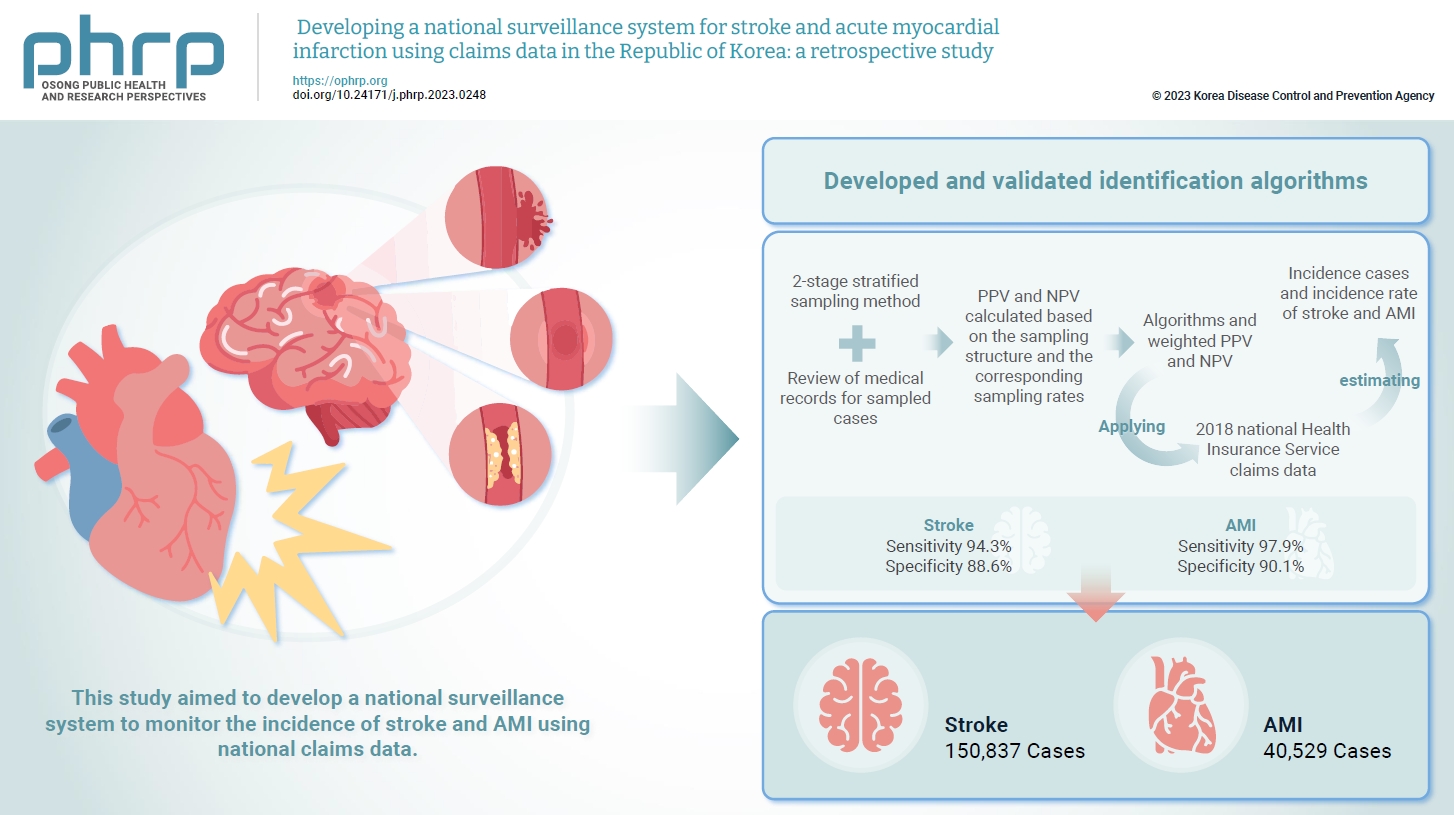
Objectives Limited information is available concerning the epidemiology of stroke and acute myocardial infarction (AMI) in the Republic of Korea. This study aimed to develop a national surveillance system to monitor the incidence of stroke and AMI using national claims data. Methods: We developed and validated identification algorithms for stroke and AMI using claims data. This validation involved a 2-stage stratified sampling method with a review of medical records for sampled cases. The weighted positive predictive value (PPV) and negative predictive value (NPV) were calculated based on the sampling structure and the corresponding sampling rates. Incident cases and the incidence rates of stroke and AMI in the Republic of Korea were estimated by applying the algorithms and weighted PPV and NPV to the 2018 National Health Insurance Service claims data. Results: In total, 2,200 cases (1,086 stroke cases and 1,114 AMI cases) were sampled from the 2018 claims database. The sensitivity and specificity of the algorithms were 94.3% and 88.6% for stroke and 97.9% and 90.1% for AMI, respectively. The estimated number of cases, including recurrent events, was 150,837 for stroke and 40,529 for AMI in 2018. The age- and sex-standardized incidence rate for stroke and AMI was 180.2 and 46.1 cases per 100,000 person-years, respectively, in 2018. Conclusion: This study demonstrates the feasibility of developing a national surveillance system based on claims data and identification algorithms for stroke and AMI to monitor their incidence rates.
Citations
Citations to this article as recorded by
Effect of a ≥50% Reduction in Low-Density Lipoprotein Cholesterol From Baseline in Patients With Ischemic Stroke Minyoul Baik, Jimin Jeon, Joonsang Yoo, Jinkwon Kim Neurology.2026;[Epub] CrossRef
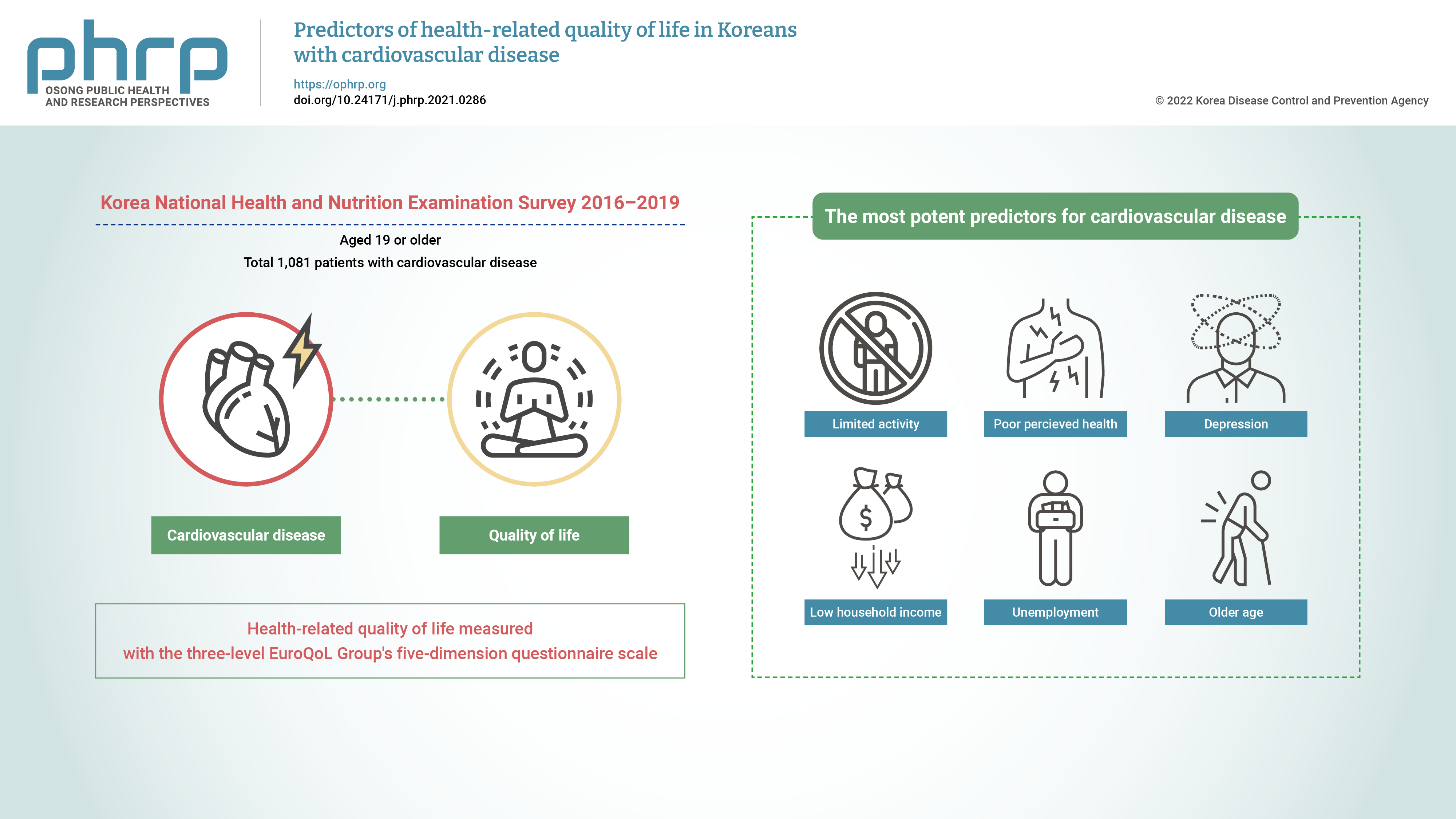
Objectives This study aimed to identify the predictors of health-related quality of life (HRQoL) in Korean adults with cardiovascular disease (CVD). Methods: This was a cross-sectional study with a stratified multistage probability sampling design. Data from the 2016 to 2019 Korea National Health and Nutrition Examination Survey (n=32,379) were used. Among the participants aged 19 years or older (n=25,995), 1,081 patients with CVD were extracted after excluding those with missing data and those who had cancer. The participants’ HRQoL was measured using the three-level EuroQoL Group’s five-dimension questionnaire (EQ-5D) scale. Data were analyzed using the t-test, one-way analysis of variance, and general linear regression for complex samples. Results: The most potent predictors of HRQoL in Korean adults with CVD were limited activity (β =−0.103, p <0.001), poor perceived health (β =−0.089, p <0.001), depression (β =−0.065, p<0.01), low household income (β=−0.033, p<0.05), unemployment (β=−0.023, p<0.05), and older age (β=−0.002, p<0.01), which explained 37.2% of the variance. Conclusion: Comprehensive interventions that address both physical and mental factors and social systems that provide financial help need to be implemented to improve the HRQoL of Korean adults with CVD.
Citations
Citations to this article as recorded by
Association between obstructive sleep Apnea–Related factors and HINT-8 utility scores in adults: a secondary analysis of the 2023 Korea National health and nutrition examination survey (KNHANES) Mima Park, Seon-Ha Kim Quality of Life Research.2026;[Epub] CrossRef
A comparison of health-related quality of life using the World Health Organization Quality of Life–BREF and 5-Level EuroQol-5 Dimensions in the Malaysian population Andrian Liem, Hui Jun Chih, Vithya Velaithan, Richard Norman, Daniel Reidpath, Tin Tin Su Osong Public Health and Research Perspectives.2025; 16(2): 126. CrossRef
Assessment of health-related quality of life and health-seeking behavior in female cardiac patients in rural setting of Pakistan: A comprehensive cross-sectional analysis Amna Zeb, Faizan Ali Razzaq, Shahbaz Ahmad Zakki, Ijaz ul Haq, Muhammad Subhan Nazar, Ussama Hafeez Clinical Epidemiology and Global Health.2025; 34: 102096. CrossRef
Factors associated with health-related quality of life in patients with coronary heart disease Febio Gutama, Melisa Intan Barliana, Irma Melyani Puspitasari Pharmacia.2022; 69(3): 771. CrossRef
Objectives The aim of this study was to investigate the effect of daily living dual-task training focused on improving attention and executive function of the upper extremities, cognitive function, and quality of life in stroke patients.
Methods We included 30 stroke patients who were hospitalized between July 2020 and October 2020. They were divided into experimental and control groups through randomization. The experimental group performed 20 minutes of dual-task training and received 10 minutes of conventional occupational therapy, while the control group performed 20 minutes of single-task training and received 10 minutes of conventional occupational therapy. Both groups underwent their respective rehabilitation for 30 minutes per session, 5 times per week for 5 weeks.
Results Both groups showed significant improvements in upper extremity function, cognitive function, and quality of life; the experimental group showed higher results for all items. A significant between-group difference was observed in the magnitude of the changes.
Conclusion In stroke patients, dual-task training that combined attention and executive function with daily living activities was found to be meaningful, as it encouraged active participation and motivation. This study is expected to be used as a foundation for future interventions for stroke patients.
Citations
Citations to this article as recorded by
Effects of dual-task training on walking and balance in stroke patients: A systematic review and network meta-analysis Yuxin Zhao, Chuanle Guo, Deqi Zhang, Xiaohui Wei, Xiaoyu Jiang, Hongyan Bi Clinical Rehabilitation.2026; 40(4): 433. CrossRef
The hand activity and behavior intervention (HABIT): a novel group to increase daily hand-use post-stroke Yishai Bachar Kirshenboim, Aviya Levy, Debbie Rand Disability and Rehabilitation.2026; 48(15): 4781. CrossRef
Effect of dual-task exercises on balance, risk for fall and activities of daily living dependency of patients with stroke: a quasi-experimental study Mona Mahmoud Ali, Dalia Abdallah Abdelatief, Mona Mohamed Saad, Heba Abdelgawad Elfeky Frontiers in Rehabilitation Sciences.2026;[Epub] CrossRef
Effects of dual-task training on attentional function among community-dwelling older adults: study protocol for a randomized controlled trial Maki Ogasawara, Hiroshi Hayashi, Kazuaki Iokawa, Takaaki Fujita, Koshi Sumigawa, Hironori Kawamata, Iori Kawasaki, Daisuke Matsumoto, Toshimasa Sone Trials.2026;[Epub] CrossRef
The Impact of Dual-Task Training Versus Single-Task Training on Cognitive and Physical Function in Neurologically Impaired Individuals: A Systematic Review and Meta-Analysis of Randomized Controlled Trials Nurdiana Zainol Abidin, Nor Shuhada Mansor, Hazwani Ahmad Yusof, Aini Ismafairus Abd Hamid, Suzana Mat Isa Perceptual and Motor Skills.2026;[Epub] CrossRef
Multidimensional effects of dual-task-focused training added to structured neurological rehabilitation in individuals with chronic stroke: a randomized controlled trial Yasemin Sahbaz, Begum Buyukerik, Yaren Urhan, Ahmet Yigit Dincel, Safa Kavak, Seyhan Erkinov, Serhat Beytekin, Yusuf Ciftci, Nergiz Batur, Ipek Yeldan, Tugba Sahbaz, Hatice Kubra Asik Fizjoterapia Polska.2026; 26(1/2026): 93. CrossRef
Factors Explaining Limited Daily Hand-use in Individuals with Fair-Good Motor Ability Post-Stroke Yishai Bachar Kirshenboim, Hala Knshiboun Sadran, Jennifer Haddad, Amitai S. Oberman, Debbie Rand NeuroRehabilitation.2026; 59(2): 331. CrossRef
Developing and Implementing an Occupation-Based Practice Service Delivery Model for Stroke Survivors in a Rural Thai Community Rehabilitation Center: Mixed Methods Feasibility Study Sorasak Suwan, Anuchart Kaunnil, Peeraya Munkhetvit, Hataichanok Apikomonkon, Sarinya Sriphetcharawut JMIR Formative Research.2026; 10: e91118. CrossRef
Effects of exercise combined with cognitive dual-task training on cognitive function and sustained effects in stroke patients: a systematic review and meta-analysis Qiang-Ming Feng, Ji-Wei Chen Disability and Rehabilitation.2025; 47(14): 3538. CrossRef
Cognitive Impairment After Stroke: Rehabilitation Strategies and SMART Goal Setting Urvashy Gopaul, Pooja Jethani, Nabila Enam, Anahita Amirpour, Olivia Crozier, Marina Charalambous, Mark Bayley Archives of Physical Medicine and Rehabilitation.2025; 106(4): 641. CrossRef
Biomechanical characteristics and neuromuscular action control mechanism of single-dual-task walking-conversion training in stroke patients Yilan Sheng, Jia Han Journal of Back and Musculoskeletal Rehabilitation.2025; 38(3): 576. CrossRef
The Effectiveness of Dual-Task Training on Upper Extremity Functions in Patients with Chronic Stroke: A Randomized Controlled Trial Su Sandi Hla Tun, Sawitri Wanpen, Nomjit Nualnetr, Uraiwan Chatchawan, Rungthip Puntumetakul NeuroRehabilitation: An International, Interdiscip.2025;[Epub] CrossRef
Eye tracking-based dual task in rehabilitation of motor and cognitive function in post-stroke patients: a literature review Marcella Sugianto, Yuda Zhou, Jifang Qiu Bulletin of Faculty of Physical Therapy.2025;[Epub] CrossRef
Effect of Dual‐Task Training on the Number of EEG Bands in Stroke Patients Borhan Asadi, Zahra Khodabakhshi, Sedigheh Sadat Naimi, Pablo Herrero, Noureddin Nakhostin Ansari, Diego Lapuente‐Hernandez Physiotherapy Research International.2025;[Epub] CrossRef
Cross-cultural adaptation, reliability, and validity of the rehabilitation activities profile (RAP) in stroke patients Leyla Kaya Ozturk, Sedef Sahin, Orkun Tahir Aran, Meral Huri Applied Neuropsychology: Adult.2025; : 1. CrossRef
Optimal exercise therapy to improve cognitive function in middle-aged and elderly patients with stroke: A systematic review with pairwise and network meta-analyses Xing-liang Duan, Qiang Xiong, Ji-wei Chen Geriatric Nursing.2025; 66: 103599. CrossRef
Effects of transcutaneous electrical nerve stimulation on cognitive function and upper limb motor function in people with chronic stroke: a study protocol for a randomised controlled trial Nga Huen Chan, Shamay S M Ng BMJ Open.2025; 15(12): e108243. CrossRef
A meta-analysis of the effects of dual-task training on cognitive function in stroke patients Ruolin Shi, Weibo Li, Xiaolu Liu, Zengxin Sun, Xinjing Ge, Peiyuan Lv, Yu Yin Frontiers in Neurology.2025;[Epub] CrossRef
Accelerometer-Derived Jerk Metrics for Detecting Intentional Upper-Limb Tremor During a Reaching Task in Healthy Adults Ji-Eun Kim, Dae-Sung Park Physical Therapy Rehabilitation Science.2025; 14(4): 593. CrossRef
Modern approaches to comprehensive rehabilitation and disability assessment criteria for patients with post-stroke cognitive impairment Airat R. Galimov, Shamil R. Salimov, Dilara R. Yagfarova, Fatima A. Kochkarova, Liliya U. Rakhimova, Anna K. Nikogosyan, Julia A. Reshulskaya, Suzanna E. Balyan, Maksim A. Chernenko, Tamara D. Ekizyan, Elizaveta D. Rogozhnikova, Aleksandra Yu. Kharzhiyant Medical and Social Expert Evaluation and Rehabilit.2025; 28(4): 201. CrossRef
Occupation-based interventions to improve occupational performance and participation in the hospital setting: a systematic review Gemma Wall, Stephen Isbel, Louise Gustafsson, Claire Pearce Disability and Rehabilitation.2024; 46(13): 2747. CrossRef
Intervention and assessment of executive dysfunction in patients with stroke: A scoping review Katsuya Sakai, Yuichiro Hosoi, Junpei Tanabe, Kathleen Bennett PLOS ONE.2024; 19(2): e0298000. CrossRef
Activities of daily living interventions on activity performance of inpatients post-stroke: A systematic review and meta-analysis Elyse Triantis, Karen PY Liu British Journal of Occupational Therapy.2024; 87(10): 598. CrossRef
Motor control and working memory in adults with neurological injuries: search neuropsychological and electrophysiological evidence of cognitive-motor interaction Julio Ernesto Pérez-Parra, Francia Restrepo-de-Mejía Human Movement.2024; 25(2): 114. CrossRef
Overview of Effects of Motor Learning Strategies in Neurologic and Geriatric Populations: A Systematic Mapping Review Li-Juan Jie, Melanie Kleynen, Guus Rothuizen, Elmar Kal, Andreas Rothgangel, Susy Braun Archives of Rehabilitation Research and Clinical T.2024; 6(4): 100379. CrossRef
The effect of five activities daily living on improving cognitive function in ischemic stroke patients Frana Andrianur, Dwi Prihatin Era, Arifin Hidayat, Ismansyah Ismansyah, Diah Setiani Healthcare in Low-resource Settings.2023;[Epub] CrossRef
Effect of Upper Limb Motor Rehabilitation on Cognition in Parkinson’s Disease: An Observational Study Valentina Varalta, Elisa Evangelista, Anna Righetti, Giovanni Morone, Stefano Tamburin, Alessandro Picelli, Cristina Fonte, Michele Tinazzi, Ilaria Antonella Di Vico, Andreas Waldner, Mirko Filippetti, Nicola Smania Brain Sciences.2022; 12(12): 1684. CrossRef
<sec>
<title>Objectives</title>
<p>This study was performed to examine the effects of the Korean medicine healthcare program on stroke-related factors and self-care enhancement.</p></sec>
<sec>
<title>Methods</title>
<p>This study was a quasi-experimental, pretest-posttest nonequivalent control group design study (<italic>N</italic> = 58 participants), with 28 in the treatment group (Korean medicine health care program) and 30 in the control group (no intervention). The program was conducted twice a week for 2 hours, for a total of 12 weeks.</p></sec>
<sec>
<title>Results</title>
<p>There were statistically significant differences in systolic (<italic>p</italic> = 0.005) and diastolic blood pressure (<italic>p</italic> = 0.006), cholesterol (<italic>p</italic> < 0.001), blood glucose (<italic>p</italic> < 0.001), self-esteem (<italic>p</italic> = 0.001), self-efficacy (<italic>p</italic> < 0.001), health perception (<italic>p</italic> < 0.001), and the health behavior (<italic>p</italic> < 0.001) between the experimental group and the control group.</p></sec>
<sec>
<title>Conclusion</title>
<p>Thus, the Korean medicine healthcare program was effective in managing stroke-related factors and enhancing self-care, and should be actively used to develop community health promotion strategies to prevent strokes and prepare long-term measures.</p></sec>
Citations
Citations to this article as recorded by
Stroke knowledge and health-promoting behaviors: Mediating effect of patient self-esteem GyeongChae MUN, JaeLan SHIM Patient Education and Counseling.2024; 129: 108398. CrossRef
<sec>
<title>Objectives</title>
<p>The purpose of this study was to examine the combined effects of Prism Adaptation (PA) plus functional electrical stimulation (FES) on stroke patients with unilateral neglect, and suggest a new intervention method for acute-phase stroke patients.</p></sec>
<sec>
<title>Methods</title>
<p>There were 30 patients included in this study from April to October 2016 that had unilateral neglect whilst hospitalized following a stroke (diagnosed by a professional). The participants, who were patients receiving occupational therapy, understood the purpose of the study and agreed to participate. The patients were randomly divided into 3 groups: PA plus FES group (Group A), PA group (Group B), and FES group (Group C). Treatments lasted for 50 minutes per day, 5 times per week, for 3 weeks in total. Reevaluation was conducted after 3 weeks of intervention.</p></sec>
<sec>
<title>Results</title>
<p>All 3 groups showed unilateral neglect reduction after the intervention, but PA plus FES (complex intervention method) was more effective than PA or FES alone [effect size: Motor-free Visual Perception Test (0.80), Albert test (0.98), CBS (0.92)].</p></sec>
<sec>
<title>Conclusion</title>
<p>The results of this study support further studies to examine complex intervention for the treatment of unilateral neglect.</p></sec>
Citations
Citations to this article as recorded by
Unilateral Spatial Neglect After Stroke: A Pragmatic Approach to Assessment and Rehabilitation Giulia Salti, Benedetta Formelli, Benedetta Piccardi, Eleonora Barucci, Anna Poggesi Journal of Clinical Medicine.2026; 15(15): 6064. CrossRef
Stroke Rehabilitation: Synopsis of the 2024 U.S. Department of Veterans Affairs and U.S. Department of Defense Clinical Practice Guidelines Blessen C. Eapen, Johanna Tran, Jennifer Ballard-Hernandez, Andrew Buelt, Carrie W. Hoppes, Christine Matthews, Svetlana Pundik, James Reston, Zahari Tchopev, Lisa M. Wayman, Tyler Koehn Annals of Internal Medicine.2025; 178(2): 249. CrossRef
Does prism adaptation treatment reduce spatial neglect and improve function? Peii Chen, Kimberly Hreha, Catrina MacPhee, Amber Salter, Gail A. Eskes Frontiers in Rehabilitation Sciences.2025;[Epub] CrossRef
European Stroke Organisation (ESO) guideline on visual impairment in stroke Fiona J Rowe, Lauren R Hepworth, María Begoña Coco-Martin, Celine R Gillebert, Luis Leal-Vega, Anja Palmowski-Wolfe, Eleni Papageorgiou, Stephen James Ryan, Karolina Skorkovska, Anne Hege Aamodt European Stroke Journal.2025; 10(4): 1087. CrossRef
Combined Effects of Visual Scanning Training and Electrical Stimulation During Walking on Activities of Daily Living in a Subacute Stroke Patient With Unilateral Spatial Neglect: A Case Study Kodai Minami, Seigo Inoue, Yuto Goto, Kyohei Jumi, Kunitsugu Kondo, Katsuhiro Mizuno, Tatsunori Watanabe Cureus.2025;[Epub] CrossRef
Significant immediate and limited long-term benefit of prism adaptation on spatial neglect: a systematic review and meta-analysis of RCTs YuanLiang Zhu, Francois Quesque, Daisuke Nishida, Sophie Jacquin-Courtois, Jacques Luaute, Eric Chabanat, Gilles Rode, Yves Rossetti Annals of Physical and Rehabilitation Medicine.2025; 68(7): 102022. CrossRef
Inclusion of People With Aphasia in Stroke Trials: A Systematic Search and Review Ciara Shiggins, Brooke Ryan, Farhana Dewan, Julie Bernhardt, Robyn O'Halloran, Emma Power, Richard I. Lindley, Gordon McGurk, Miranda L. Rose Archives of Physical Medicine and Rehabilitation.2024; 105(3): 580. CrossRef
Prism adaptation combined with eye movement training for unilateral spatial neglect after stroke: Study protocol for a single-blind prospective, randomized controlled trial Yu-xuan Yang, Ling-ling Wang, Juan Du, Yao-min Luo, Yu-lei Xie, Bo Zhang, Han Zhang Frontiers in Neurology.2023;[Epub] CrossRef
No short-term treatment effect of prism adaptation for spatial neglect: An inclusive meta-analysis Orsolya Székely, Antonia F. Ten Brink, Alexandra G. Mitchell, Janet H. Bultitude, Robert D. McIntosh Neuropsychologia.2023; 189: 108566. CrossRef
RETRACTED: A Complex Intervention Integrating Prism Adaptation and Neck Vibration for Unilateral Neglect in Patients of Chronic Stroke: A Randomised Controlled Trial Hyun-Se Choi, Bo-Min Lee International Journal of Environmental Research an.2022; 19(20): 13479. CrossRef
Non-pharmacological interventions for spatial neglect or inattention following stroke and other non-progressive brain injury Verity Longley, Christine Hazelton, Calvin Heal, Alex Pollock, Kate Woodward-Nutt, Claire Mitchell, Gorana Pobric, Andy Vail, Audrey Bowen Cochrane Database of Systematic Reviews.2021;[Epub] CrossRef
<sec>
<title>Objectives</title>
<p>The purpose of this research was to study the influences of dual task training on upper extremity function and performance of daily activities of chronic stroke patients.</p></sec>
<sec>
<title>Methods</title>
<p>Dual task training was performed on 21 patients who had suffered a chronic stroke with hemiplegia. The dual task training was performed for 30 minutes per session, for 5 days a week, for 3 weeks. There were 5 evaluations carried out over 3 weeks before and after the intervention. Changes in upper extremity function were measured by using the Box and block test. Changes in the performance of daily activities were measured using the Korea-Modified Barthel Index.</p></sec>
<sec>
<title>Results</title>
<p>The mean upper limb function score of the chronic stroke patients increased significantly from 21.88 ± 19.99 before the intervention, to 26.22 ± 15.65 after the intervention (<italic>p</italic> < 0.05), and the mean daily activities score increased significantly from 65.82 ± 12.04, to 67.29 ± 12.90 (<italic>p</italic> < 0.05).</p></sec>
<sec>
<title>Conclusion</title>
<p>Dual task training effectively improved upper extremity function, and the performance of daily activities in chronic stroke patients.</p></sec>
Citations
Citations to this article as recorded by
The hand activity and behavior intervention (HABIT): a novel group to increase daily hand-use post-stroke Yishai Bachar Kirshenboim, Aviya Levy, Debbie Rand Disability and Rehabilitation.2026; 48(15): 4781. CrossRef
The Effectiveness of Dual-Task Training on Upper Extremity Functions in Patients with Chronic Stroke: A Randomized Controlled Trial Su Sandi Hla Tun, Sawitri Wanpen, Nomjit Nualnetr, Uraiwan Chatchawan, Rungthip Puntumetakul NeuroRehabilitation: An International, Interdiscip.2025;[Epub] CrossRef
How does a motor or cognitive dual-task affect our sense of upper limb proprioception? Amanda L. Ager, Ann M. Cools, Dorien Borms, Jean-Sébastien Roy, Renato S. Melo PLOS ONE.2024; 19(3): e0299856. CrossRef
Ηand dexterities assessment in stroke patients based on augmented reality and machine learning through a box and block test Georgios Papagiannis, Αthanasios Triantafyllou, Konstantina G. Yiannopoulou, George Georgoudis, Maria Kyriakidou, Panagiotis Gkrilias, Apostolos Z. Skouras, Xhoi Bega, Dimitrios Stasinopoulos, George Matsopoulos, Pantelis Syringas, Nikolaos Tselikas, Ores Scientific Reports.2024;[Epub] CrossRef
Reaching the cognitive-motor interface: effects of cognitive load on arm choice and motor performance after stroke Cory A. Potts, Rand A. Williamson, Joshua D. Jacob, Shailesh S. Kantak, Laurel J. Buxbaum Experimental Brain Research.2024; 242(12): 2785. CrossRef
The Current State of the Literature on Dual-Task Performance Across Multiple Domains in Individuals With Chronic Poststroke Aphasia: A Scoping Review Nicole Dawson, Lauren Bislick, Lara Suarez American Journal of Speech-Language Pathology.2024; 33(6S): 3444. CrossRef
The Relationship Between Dual-Task Performance and Functional Independence in Stroke Patients Pınar OBA, Musa POLAT Turkish Journal of Science and Health.2022;[Epub] CrossRef
İnme Hastalarında Çift Yönlü Görev Aktivitesinin Etkinliği Derya Tuba BAL, Tuba KOCA, Ejder BERK, Burhan Fatih KOÇYİĞİT, Vedat NACİTARHAN Kahramanmaraş Sütçü İmam Üniversitesi Tıp Fakültes.2020; 15(3): 60. CrossRef
<sec>
<title>Objectives</title>
<p>The purpose of this study was to investigate the effect of task-oriented circuit training (TOCT) using the rehabilitation tools for upper extremity function upon the daily life of patients with acute stroke.</p></sec>
<sec>
<title>Methods</title>
<p>Eighteen patients with acute stroke were randomly allocated into either the experimental group or the control group. The experimental group performed the TOCT program using rehabilitation tools, whilst the control group had neuro-developmental treatment. Both groups received 30 minutes of treatment per session, 5~6 times per week, for 4 weeks. The assessments conducted were the Fugl-Meyer assessment, motor activity log and stroke impact scale to compare the upper extremity function and activities of daily living.</p></sec>
<sec>
<title>Results</title>
<p>The results showed a significant improvement in the TOCT group compared with the neuro-developmental treatment group in the amount of motor activity use and high stroke impact score, indicating recovery (<italic>p</italic> < 0.05).</p></sec>
<sec>
<title>Conclusion</title>
<p>The TOCT program using rehabilitation tools could have a positive impact on acute stroke patients use of their upper extremity.</p></sec>
Citations
Citations to this article as recorded by
Effectiveness of task-oriented circuit training on the motor performance of ischaemic stroke patients: a study protocol for randomised clinical trial Farjana Sharmin, Md Forhad Hossain, Mahdi Ul Bari, Abid Hasan Khan, Mohammad Anwar Hossain, Md Ershad Ali, Arnob Datta, Saiba Muhammad Sabrin, Farzana Sharmin, Harun Or Rashid, Md Rezaul Karim BMJ Open Sport & Exercise Medicine.2025; 11(2): e002604. CrossRef
Efficacy of Task-Oriented Interventions in Upper Extremity Rehabilitation Following Stroke: A Systematic Review Rafailia Peraki, Georgia Tsakni, Anna Tsiakiri, Ioanna-Giannoula Katsouri, Georgios Bablekos, Pinelopi Vlotinou Brazilian Journal of Science.2025; 4(7): 29. CrossRef
Virtual reality combined with task-oriented circuit training for upper limb rehabilitation in subacute stroke patients: A randomized controlled trial Yang Liu, Jian-Hua Li, Jing-Yan Tao, Yang-Zheng Li, Hao Xiong Medicine.2025; 104(31): e43505. CrossRef
Preliminary Efficacy of Face-to-Face, Telerehabilitation, and Home Program–Based Task-Oriented Circuit Training on the Cognitive and Motor Functions of Older Adults: A Single-Blind Randomized Feasibility Study Ceyhun Turkmen, Aysenur Karakus, Seyma Yilmaz, Feyza Sengül, Ilkem Ceren Sigirtmac American Journal of Occupational Therapy.2025; 79(5): 984. CrossRef
Adaptation and clinical application of assistive device chair for bedside sitting in acute stroke phase: two case reports Priscila Salge Mauad Rodrigues, Marcos Massao Shimano, Edimar de Oliveira, Fábio Masao Kawamura, Ana Flávia Silveira, Gustavo José Luvizutto, Luciane Aparecida Pacucci Sande de Souza Disability and Rehabilitation: Assistive Technolog.2024; 19(4): 1272. CrossRef
Standardized circuit class group training versus individualized goal-directed group training to improve upper limb function in stroke survivors during in-patient rehabilitation: a pragmatic trial S.G Rozevink, C.M Beerepoot, C.K van der Sluis, J.M Hijmans Disability and Rehabilitation.2024; 46(16): 3660. CrossRef
What is Task-Oriented Training? A Scoping Review Erin Halford, Samantha Jakubiszak, Kassidy Krug, Amanda Umphress Student Journal of Occupational Therapy.2024; 4(1): 1. CrossRef
RETRACTED: Evaluating the integration of traditional gong methods in smart home environment for the recovery of health functions of stroke patients Baoliang Wang, Hongping Su, Xiaoqian Luo, Luqiang Yin Journal of Intelligent & Fuzzy Systems.2024; 47(1_suppl): 181. CrossRef
Stroke rehabilitation: from diagnosis to therapy Xiaohong Li, Yanjin He, Dawu Wang, Mohammad J. Rezaei Frontiers in Neurology.2024;[Epub] CrossRef
Dosages of Swallowing Exercises Prescribed in Stroke Rehabilitation: A Medical Record Audit Jacinda Choy, Fereshteh Pourkazemi, Caitlin Anderson, Hans Bogaardt Dysphagia.2023; 38(2): 686. CrossRef
Bobath therapy is inferior to task-specific training and not superior to other interventions in improving arm activity and arm strength outcomes after stroke: a systematic review Simone Dorsch, Cameron Carling, Zheng Cao, Emma Fanayan, Petra L Graham, Annie McCluskey, Karl Schurr, Katharine Scrivener, Sarah Tyson Journal of Physiotherapy.2023; 69(1): 15. CrossRef
Development and Implementation of a New Model of Care for Patients With Stroke, Acute Hospital Rehabilitation Intensive SErvices Nicole Langton-Frost, Stephanie Orient, Jessica Adeyemo, Mona N. Bahouth, Kelly Daley, Bingqing Ye, Annette Lavezza, April Pruski American Journal of Physical Medicine & Rehabilita.2023; 102(2S): S13. CrossRef
Effects of the different intensities of task-oriented training on the upper extremity motor function and self-care ability of stroke survivors: study protocol for a multiarm parallel-group randomised controlled trial in a tertiary hospital in China Shengfeng Liu, Kai Zhang, Xuecha Li, Chunxiang Li, Mengsi Peng BMJ Open.2023; 13(12): e074106. CrossRef
Revisiting dose and intensity of training: Opportunities to enhance recovery following stroke Kalita Donnellan-Fernandez, Andrew Ioakim, Brenton Hordacre Journal of Stroke and Cerebrovascular Diseases.2022; 31(11): 106789. CrossRef
Effect of Task Oriented Training on Spasticity in Post Stroke Individuals Tanavi S. Patel, Suraj Kanase Journal of Ecophysiology and Occupational Health.2021; : 90. CrossRef
<sec>
<title>Background</title>
<p>In patients who have suffered a stroke, the measurement of center of pressure excursion in all directions including oblique direction, anterior-medial, anterior-lateral, posterior-medial, and posterior-lateral side is important for determining balance instability but no research has been reported.</p></sec>
<sec>
<title>Objectives</title>
<p>This study investigated weight shift in all directions to determine balance instability in stroke patients, including the oblique direction, using the multi-directional functional reach test.</p></sec>
<sec>
<title>Methods</title>
<p>Eleven subjects participated. Multi-directional functional reach test consisted of moving the unaffected arm as far as possible in 8 directions. The directions were as follows; anterior, middle of anterior and lateral in unaffected side, lateral in unaffected side, and middle of the posterior and lateral in unaffected side, posterior, middle of posterior and lateral in affected side, lateral in affected side, middle of anterior and lateral in affected side.</p></sec>
<sec>
<title>Results</title>
<p>Movement was the lowest in the affected posterior-lateral side, followed by affected posterior, affected anterior-lateral, non-affected posterior lateral, affected lateral, non-affected lateral, non-affected anterior-lateral and anterior side (<italic>p</italic> < 0.05).</p></sec>
<sec>
<title>Conclusion</title>
<p>Center of pressure excursion of the affected posterior-lateral side was the most challenging for stroke patients and their reach was lowest from posterior, to lateral, and anterior directions, whilst patients could move less on the affected side compared with the non-affected side.</p></sec>
Citations
Citations to this article as recorded by
Optimal Algorithms for Improving Pressure-Sensitive Mat Centre of Pressure Measurements Alexander Dawid Bincalar, Chris Freeman, m.c. schraefel Sensors.2025; 25(5): 1283. CrossRef
Immediate effects of circular trunk movements on reach distance and centre of pressure distance during a multidirectional seated reach task in participants with post-stroke hemiparesis: a non-randomised controlled trial Ryohei Nabeya, Hiromi Fujii, Toshiaki Sato International Journal of Therapy and Rehabilitatio.2024; 31(1): 1. CrossRef
Analysis of Forward Sitting Functional Reach Test in Hemiplegic Stroke Hirofumi HIRANO, Shinichirou ISHII, Taku YONEYAMA, Sumiko YAMAMOTO The Japanese Journal of Ergonomics.2024; 60(2): 134. CrossRef
Effects of galvanic vestibular stimulation on postural righting reactions in hemiplegia Akari Horikawa, Kazu Amimoto, Shota Horikawa, Ken Hiramoto, Masaki Nishio, Jun Yoshino, Yumi Ikeda Neuroscience Letters.2024; 827: 137735. CrossRef
Oblique direction reach test: evaluating psychometric properties in stroke population Rinita Mascarenhas, Akshatha Nayak, Abraham M. Joshua, Shyam K. Krishnan, Vani Lakshmi R. Iyer, Jaya Shanker Tedla, Ravi Shankar Reddy PeerJ.2023; 11: e16562. CrossRef
Effects of the different intensities of task-oriented training on the upper extremity motor function and self-care ability of stroke survivors: study protocol for a multiarm parallel-group randomised controlled trial in a tertiary hospital in China Shengfeng Liu, Kai Zhang, Xuecha Li, Chunxiang Li, Mengsi Peng BMJ Open.2023; 13(12): e074106. CrossRef
Efficacy of sitting balance training with delayed visual feedback among patients with stroke: a randomized crossover clinical trial Kota Sawa, Kazu Amimoto, Abdul Chalik Meidian, Keisuke Ishigami, Takuya Miyamoto, Chika Setoyama, Rikuya Suzuki, Miko Tamura, Mitsusuke Miyagami Journal of Physical Therapy Science.2022; 34(8): 540. CrossRef
Evaluation of the Effect of SPIDER System Therapy on Weight Shifting Symmetry in Chronic Stroke Patients—A Randomized Controlled Trial Paulina Magdalena Ostrowska, Rafał Studnicki, Marcin Rykaczewski, Dawid Spychała, Rita Hansdorfer-Korzon International Journal of Environmental Research an.2022; 19(23): 16214. CrossRef
Normative Reference Values for Functional, Lateral, and Oblique Direction Reach Tests in Saudi Children Aged Six to 15 Years Old and Psychometric Properties of the Oblique Direction Reach Test JS Tedla, DR Sangadala, K Gular, RS Reddy, MS Alshahrani, I Ahmad, M Abohashrh Nigerian Journal of Clinical Practice.2021; 24(4): 576. CrossRef
<sec>
<title>Objectives</title>
<p>The aims of this meta-analysis were to examine intervention methods of qualitatively, well-designed studies from the past 10 years for treating visuo-spatial neglect (VSN) in patients who had suffered a stroke, and to evaluate the combined effects of intervention.</p></sec>
<sec>
<title>Methods</title>
<p>Studies published between 2008 and 2017 on the theme of VSN were collected from PubMed, CINAHL, and MEDLINE, representative academic databases and search engines. The PEDro scale was used for evaluating the quality of methodology. The sample size, mean, and standard deviation of identified studies were used for meta-analysis.</p></sec>
<sec>
<title>Results</title>
<p>Eight studies were selected for analysis. The PEDro scores of the selected studies were ≥ 7, with 237 subjects analyzed. The results of intervention were classified into “mental function” and “activity and participation” based on the International Classification of Functioning, Disability and Health. The analyzed effect sizes for combined outcomes, mental function and, activity and participation, were 0.728 (medium effect size), 0.850 (large effect size), and 0.536 (medium effect size), respectively.</p></sec>
<sec>
<title>Conclusion</title>
<p>Intervention methods for treating VSN had a short-term effect on cognitive function (visual perception). In particular, non-invasive brain stimulation therapy showed a large effect size for VSN treatment.</p></sec>
Citations
Citations to this article as recorded by
Non-pharmacological interventions for spatial neglect or inattention following stroke and other non-progressive brain injury Verity Longley, Christine Hazelton, Calvin Heal, Alex Pollock, Kate Woodward-Nutt, Claire Mitchell, Gorana Pobric, Andy Vail, Audrey Bowen Cochrane Database of Systematic Reviews.2021;[Epub] CrossRef
Neural Mechanisms of Spatial Attention Deficits in Trauma Stefanie R. Russman Block, Daniel H. Weissman, Chandra Sripada, Mike Angstadt, Elizabeth R. Duval, Anthony P. King, Israel Liberzon Biological Psychiatry: Cognitive Neuroscience and .2020; 5(10): 991. CrossRef
Updated Approach to Stroke Rehabilitation Leroy R. Lindsay, Diane A. Thompson, Michael W. O’Dell Medical Clinics of North America.2020; 104(2): 199. CrossRef
Implementing a Rehabilitation Protocol for Spatial Neglect Assessment and Treatment in an Acute Care Hospital Kimberly Hreha, Peii Chen, Jennifer LaRosa, Christopher Santos, Cindy Gocon, A.M. Barrett Journal of Acute Care Physical Therapy.2020; 11(2): 59. CrossRef
Alertness Training Improves Spatial Bias and Functional Ability in Spatial Neglect Thomas Van Vleet, Paolo Bonato, Eric Fabara, Sawsan Dabit, Sarah‐Jane Kim, Christopher Chiu, Antonio Luigi Bisogno, Michael Merzenich, Maurizio Corbetta, Joseph DeGutis Annals of Neurology.2020; 88(4): 747. CrossRef
Objectives
The study objective was to identify the factors that influence the length of stay (LOS) in hospital for stroke patients and to provide data for managing hospital costs by managing the LOS. Methods
This study used data from the Discharge Injury Survey of the Korea Centers for Disease Control and Prevention, which included 17,364 cases from 2005 to 2008. Result
The LOS for stroke, cerebral infarction, intracerebral hemorrhage, and subarachnoid hemorrhage was 18.6, 15.0, 28.9, and 25.3 days, respectively. Patients who underwent surgery had longer LOS. When patients were divided based on whether they had surgery, there was a 2.4-time difference in the LOS for patients with subarachnoid hemorrhage, 2.0-time difference for patients with cerebral infarction, and 1.4-time difference for patients with intracerebral hemorrhage. The emergency route of admission and other diagnosis increased LOS, whereas hypertension and diabetic mellitus reduced LOS. Conclusion
In the present rapidly changing hospital environments, hospitals approach an efficient policy for LOS, to maintain their revenues and quality of assessment. If LOS is used as the indicator of treatment expenses, there is a need to tackle factors that influence the LOS of stroke patients for each disease group who are divided based on whether surgery is performed or not for the proper management of the LOS.
Citations
Citations to this article as recorded by
The relative cerebral blood volume (rCBV) <42% is independently associated with prolonged hospitalization in anterior circulation large vessel occlusion Dhairya A Lakhani, Aneri B Balar, Vaibhav Vagal, Subtain Ali, Hamza Salim, Janet Mei, Musharaf Khan, Manisha Koneru, Sijin Wen, Hanzhang Lu, Richard Wang, Argye E Hillis, Jeremy J Heit, Greg W Albers, Adam A Dmytriw, Tobias Faizy, Max Wintermark, Kambiz N The Neuroradiology Journal.2026; 39(1): 111. CrossRef
Hospital costs of non-traumatic intracranial hemorrhage in older adults in a developing country: a retrospective cohort study Zainab Saif Al-Siyabi, Omar Al-Mahrouqi, Osama Al-Senani, Suha Al-Amri, Zainab Al-Ajmi, Anfal Al-Nazwani, Fatema Taheri, Hashim Al-Hashimi, Mallak Al-Sheriyani, Mustafa Talib Al-Ani, Shima Al-Shamli, Salim Al-Abri, Tariq Al-Saadi Egyptian Journal of Neurosurgery.2026;[Epub] CrossRef
Component-specific kinematic analysis of the timed up and go test using inertial measurement units reflects neuromuscular impairments in patients after stroke Satoshi Hakukawa, Kanata Yoshihara, Shunsuke Onuma, Masahiro Ishiwatari Clinical Biomechanics.2026; 133: 106771. CrossRef
Spontaneous Intracranial Hemorrhage in Brazil: Trends, Seasonality, Pandemic Disruption, and Cost Burden Thiago Oscar Goulart, Thire Baggio Machado Marazzi, Rosane Aparecida Monteiro, Millene Rodrigues Camilo, Octávio Marques Pontes-Neto World Neurosurgery.2026; 207: 124793. CrossRef
Economic burden of ischemic stroke in an eastern European tertiary stroke center Adina Stan, Anca Gutu, Hanna Maria Dragos, Iulia Maria Vadan, Vitalie Vacaras, Nicu Catalin Draghici, Emanuel Stefanescu, Stefan Strilciuc, Fior Dafin Muresanu Balneo and PRM Research Journal.2026;[Epub] CrossRef
Effects of stroke nurse-led acute stroke management on treatment time benchmarks, intravenous thrombolysis rates, and patient outcomes: A systematic review and meta-analysis Ashok Kumar, Mukesh Kumar, Priyanka Verma, Rimesh Pal, Manisha Nagi, Karthik Vinay Mahesh, Divesh Kumar Munjal, Sukhpal Kaur, Achala Aggarwal, Bijaya Kumar Padhi, Dheeraj Khurana Journal of Stroke and Cerebrovascular Diseases.2025; 34(2): 108216. CrossRef
Development of a predictive model for prolonged length of stay in conservatively treated patients with spontaneous intracerebral hemorrhage: A retrospective study Zhong Yu, Jingjing Xing, Bing Wang, Hua Hang, Sheng Ye Journal of Clinical Neuroscience.2025; 136: 111222. CrossRef
Predictors and outcomes associated with prolonged hospital length of stay in intracerebral hemorrhage: a multicenter prospective cohort study in China Zhuangzhuang Zhang, Jieyu Li, Wenzhe Wang, Haowei Wang, Junlong Shu, Haiqiang Jin, Peng Sun, Craig S. Anderson, Zhaoxia Wang, Yining Huang, Weiping Sun BMC Medicine.2025;[Epub] CrossRef
Length of stay in hospital and rehabilitation centers after stroke in Arab countries and Saudi Arabia: a systematic review and meta-analysis Abdullah I. Alhusayni, Abdullah H. Alzahrani Annals of Saudi Medicine.2025; 45(4): 256. CrossRef
Teleneurocritical care is associated with equivalent billable charges to in-person neurocritical care for patients with acute stroke Nick M Murray, Katherine Thomas, Dean Roller, Scott Marshall, Julie Martinez, Robert Hoesch, Kyle Hobbs, Shawn Smith, Kevin Meier, Adrian Puttgen Journal of Telemedicine and Telecare.2024; 30(10): 1629. CrossRef
Teleneurocritical Care for Patients with Large Vessel Occlusive Ischemic Stroke Treated by Thrombectomy Nick M. Murray, Scott Marshall, Robert Hoesch, Kyle Hobbs, Shawn Smith, Dean Roller, Katherine Thomas, Kevin Meier, Adrian Puttgen Neurocritical Care.2023; 38(3): 650. CrossRef
Association Between Race and Length of Stay Among Stroke Patients: The National US Emergency Departments Data Set Karan Patel, Kamil Taneja, Jared Wolfe, Joseph V. Campellone, Mudassir Farooqui, Santiago Ortega‐Gutierrez, James E. Siegler Stroke: Vascular and Interventional Neurology.2023;[Epub] CrossRef
Can HRV Predict Prolonged Hospitalization and Favorable or Unfavorable Short-Term Outcome in Patients with Acute Ischemic Stroke? Joanna Aftyka, Jacek Staszewski, Aleksander Dębiec, Aleksandra Pogoda-Wesołowska, Jan Żebrowski Life.2023; 13(4): 856. CrossRef
Does the Implementation of a National Health Insurance Program Result in Rationing Care for Ischemic Stroke Management? Analysis of the Indonesian National Health Insurance Program Lisda Amalia Risk Management and Healthcare Policy.2023; Volume 16: 455. CrossRef
Systematic Review of Resource Use and Costs in the Hospital Management of Intracerebral Hemorrhage Steven Mulackal Thomas, Yarin Reindorp, Brandon R. Christophe, Edward Sander Connolly World Neurosurgery.2022; 164: 41. CrossRef
Relationship between time of referral for physiotherapy and length of stay after stroke in a Nigerian tertiary hospital: a retrospective study A. Aderonmu Joseph, O. Obembe Adebimpe Bulletin of Faculty of Physical Therapy.2022;[Epub] CrossRef
Predicting length of stay in patients admitted to stroke rehabilitation with severe and moderate levels of functional impairments Alejandro García-Rudolph, Blanca Cegarra, Eloy Opisso, Josep María Tormos, Montserrat Bernabeu, Joan Saurí Medicine.2020; 99(43): e22423. CrossRef
Propensity score matching analysis on inpatient period differences of hemorrhagic stroke survivors depending on medical insurance coverage Sang-Mi Kim, Young Kim, Seong-A Lee Physical Therapy Rehabilitation Science.2019; 8(2): 67. CrossRef
Does service heterogeneity have an impact on acute hospital length of stay in stroke? A UK-based multicentre prospective cohort study Michelle Tørnes, David McLernon, Max Bachmann, Stanley Musgrave, Elizabeth A Warburton, John F Potter, Phyo Kyaw Myint BMJ Open.2019; 9(4): e024506. CrossRef
Can differences in length of stay between Dutch university hospitals and other hospitals be explained by patient characteristics? A cross-sectional study Janine Ghielen, Sezgin Cihangir, Karin Hekkert, Ine Borghans, Rudolf Bertijn Kool BMJ Open.2019; 9(2): e021851. CrossRef
The Factors Associated with the Fatal Outcome of Stroke Andjela Milojevic Samanovic, Dragan Milovanovic, Vladimir Gajic, Aleksandar Raskovic, Dragan Milojevic Serbian Journal of Experimental and Clinical Resea.2019;[Epub] CrossRef
Evaluating the Duration of Hospitalization and Its Related Factors Among Stroke Patients Maedeh Majidi Shad, Alia Saberi, Maryam Shakiba, Shademan Rezamasouleh Caspian Journal of Neurological Sciences.2018; 4(15): 169. CrossRef
Racial differences in recurrent ischemic stroke risk and recurrent stroke case fatality Karen C. Albright, Lei Huang, Justin Blackburn, George Howard, Michael Mullen, Vera Bittner, Paul Muntner, Virginia Howard Neurology.2018;[Epub] CrossRef
Clinical Characteristics of Sleep-Disordered Breathing in Subacute Phase of Stroke Hyunkyu Jeon, Min Kyun Sohn, Minsoo Jeon, Sungju Jee Annals of Rehabilitation Medicine.2017; 41(4): 556. CrossRef
Subarachnoid Hemorrhage Patients Admitted to Intensive Care in Australia and New Zealand: A Multicenter Cohort Analysis of In-Hospital Mortality Over 15 Years Andrew A. Udy, Chelsey Vladic, Edward Robert Saxby, Jeremy Cohen, Anthony Delaney, Oliver Flower, Matthew Anstey, Rinaldo Bellomo, David James Cooper, David V. Pilcher Critical Care Medicine.2017; 45(2): e138. CrossRef



 First
 Prev


