
Hazlienor Mohd Hatta, Kamarul Imran Musa, Suhaily Mohd Hairon, Nik Mohd Hafiz Mohd Fuzi, Normaizura Mokhter, Norfaizah Sulaiman, Amutha Ayasamy, Rohani Ismail, Rohaidah Hashim, Jason Wei Jian Ng
Received March 25, 2026 Accepted August 9, 2026 Published online October 13, 2026
Objectives Nontyphoidal Salmonella (NTS) is a major cause of foodborne illness in Malaysia. Time-series modeling can characterize temporal patterns, although structural disruptions, nonlinear dynamics, and regional variability may affect model performance. This study aimed to characterize NTS seasonality in Malaysia, assess temporal stability, and explore model-based approaches for surveillance.
Methods Monthly laboratory-confirmed human NTS cases from national laboratory surveillance databases for 2018–2024 were analyzed using time-series models, including autoregressive integrated moving-average (ARIMA) models with Fourier terms and an exploratory hybrid ARIMA–long short-term memory (LSTM) model. Interrupted time-series analysis was used to assess structural stability. Anomalies were identified using 95% prediction intervals, and stratified modeling assessed regional heterogeneity.
Results NTS cases showed recurring annual seasonal patterns of moderate strength, with temporal variation over the study period. A significant decline occurred in March 2020 (β=−62.24 cases, p=0.001), followed by gradual recovery (β=2.71 cases/month, p<0.001), suggesting a marked coronavirus disease 2019 pandemic-related disruption and a subsequent positive post-intervention trend. The ARIMA(0,1,1)–Fourier (K=1) model outperformed conventional ARIMA, benchmark, and exponential smoothing models (root mean squared error, 42.9 vs. 51.37–108.79). The hybrid ARIMA–LSTM model provided modest additional improvement, particularly during high-case periods. Model-based anomaly detection identified deviations from expected patterns that coincided with documented outbreak-associated months. Regional heterogeneity in temporal dynamics suggested the need for surveillance strategies tailored to local epidemiological patterns.
Conclusion Parsimonious models captured most temporal patterns in NTS cases, with only modest gains from more complex approaches. Context-specific modeling strategies, model-based anomaly detection, and tiered surveillance frameworks may support more proactive NTS surveillance in Malaysia.
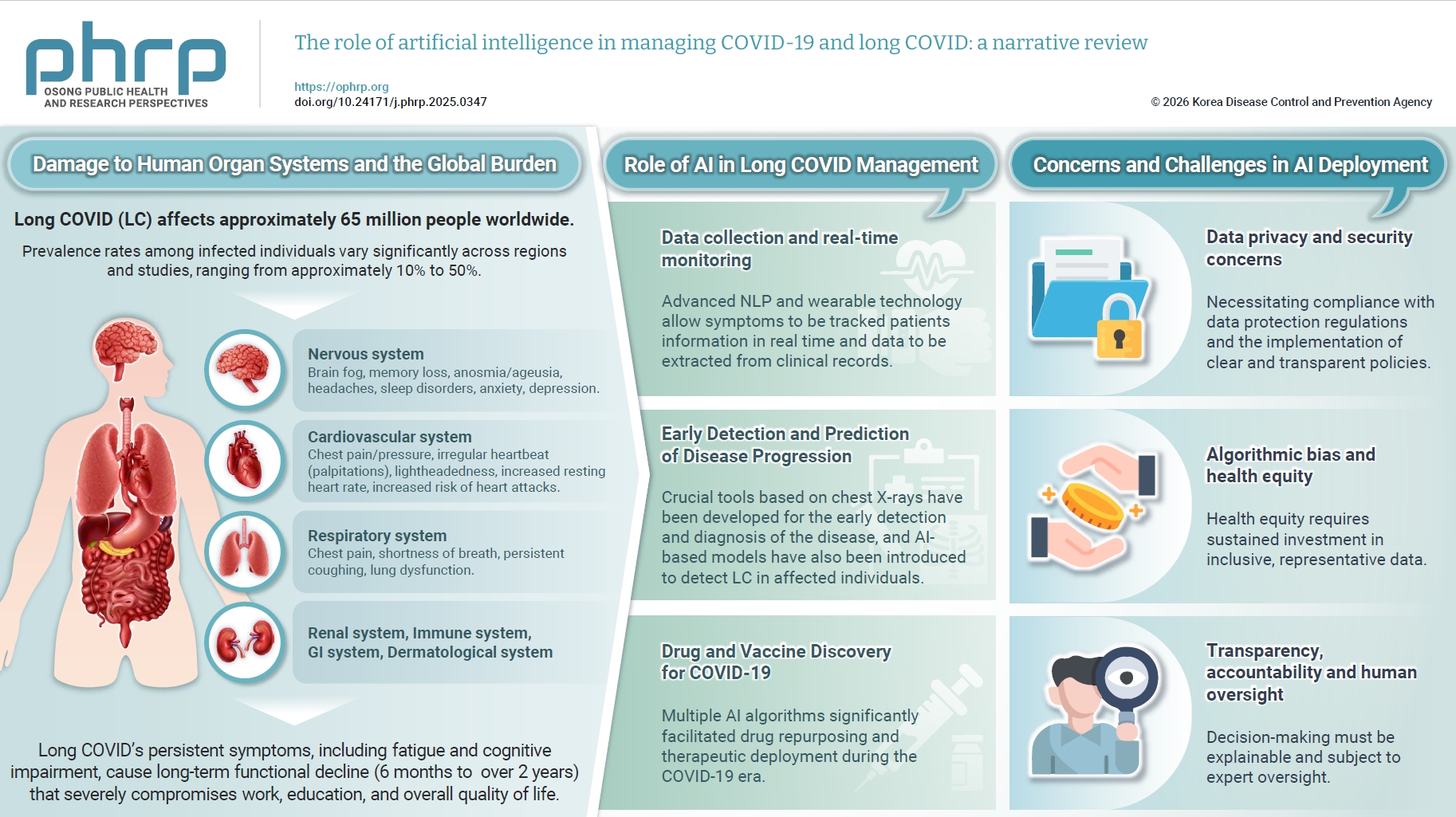
The coronavirus disease 2019 (COVID-19) pandemic had an unprecedented global impact, resulting in both positive and negative consequences. The virus not only affected millions of lives worldwide but also caused long-term harm to multiple organ systems in many survivors, thereby substantially impairing quality of life. This persistent condition is now referred to as long COVID (LC). The aim of this study is to raise awareness of LC-related organ system impacts and to highlight the key role of artificial intelligence (AI) in mitigating these effects. The present research conducts a narrative review focusing on LC-related impacts. In this context, unstructured searches were conducted to identify a total of 69 relevant studies indexed in Embase, PubMed, Web of Science, or Scopus, each of which was reviewed by at least 2 experts with sufficient domain knowledge in health sciences. Based on the authors’ perspectives and insights, the review narratively examines damage to human organ systems attributable to LC and explores the role of AI in addressing LC-related challenges. Significant ethical, practical, and societal concerns arising from the extensive use of AI, particularly major issues such as data privacy and algorithmic bias, are also discussed. LC has caused lasting impacts on human organ systems, while AI is offering substantial potential for LC-related care.
Objectives To develop and evaluate forecasting models using the Holt-Winters statistical approach and the long short-term memory (LSTM) deep learning method for weekly seasonal influenza-like illness (ILI) incidences in Saudi Arabia. The study compares model performance and assesses the predictive value added by incorporating region-specific exogenous variables within Middle Eastern epidemiological modeling.
Methods This study compared the performance of Holt-Winters and LSTM models in forecasting weekly ILI cases in Saudi Arabia, using data collected from 2017 to 2022. Time series analysis integrated exogenous variables including climatic conditions and population mobility trends. The Holt-Winters model employed both additive and multiplicative seasonal components. Model performance was evaluated using root mean squared error (RMSE), mean absolute percentage error, and R2.
Results The best-performing model, LSTM with exogenous variables, achieved an RMSE of 28.55, mean absolute error (MAE) of 0.14, R2 of 0.96, and percent bias (PBIAS) of +2.1%, indicating negligible systematic error. The LSTM model without exogenous variables demonstrated slightly lower accuracy (RMSE of 34.07, MAE of 0.18, R2 of 0.93, PBIAS of +5.8%), indicating strong predictive capability but less precision in determining peak ILI cases. The Holt-Winters model effectively captured seasonal and long-term trends, but showed a moderate performance with an RMSE of 82.57, MAE of 0.38, R2 of 0.58, and a high PBIAS of +14.2%, revealing significant unexplained variability during periods of high incidence fluctuation.
Conclusion This study highlights the respective strengths and limitations of statistical and machine learning approaches for ILI forecasting.
Citations
Citations to this article as recorded by
Early-warning prediction of visceral leishmaniasis mortality using a multivariate STL–deep learning hybrid approach on 20 years of monthly time series Fathelrhman El Guma, Maaweya Awadalla, Halah Z. Al Rawi, Bashayer Saeed, Huda M. Alshanbari, Alshaikh A. Shokeralla, Bandar Alosaimi Frontiers in Public Health.2026;[Epub] CrossRef
A hybrid STL–LightGBM framework with probabilistic forecasting for Influenza A incidence in the post-pandemic Saudi Arabia Reham M. Alahmadi, Maaweya Awadalla, Bashayer Saeed, Huda M. Alshanbari, Alshaikh A. Shokeralla, Ali Atif Yassin, Bandar Alosaimi, Fathelrhman El Guma Frontiers in Public Health.2026;[Epub] CrossRef
Bayesian inference for modeling seasonal influenza transmission under control measures Rania Saadeh, Naseam Al-Kuleab, Fathelrhman EL Guma, Alshaikh A. Shokeralla, Suliman Jamiel M. Abdalla, Mohamed A. Abdoon, Mohamed Hafez Results in Control and Optimization.2026; 23: 100714. CrossRef
Machine Learning-Based Prediction of Seasonal Influenza Trends in Saudi Arabia: A Tool for Regional Public Health Planning Alshaikh A. Shokeralla, Fathelrhman El Guma, Ali H. Abdalla, Amal E.Y. Hagsddig, Rahma AbuBakr Musa, M.A.M. Eltaweel, Abdelaziz H. Elawad, Ibrahim Elshamy International Journal of Statistics in Medical Res.2025; 14: 688. CrossRef
Objectives This study aimed to identify the optimal protein construction for designing a multi-epitope vaccine with both prophylactic and therapeutic effects against cervical cancer, utilizing an immunoinformatics approach. The construction process involved using capsid epitopes L1 and L2, as well as oncoproteins E5, E6, and E7 from human papillomavirus (HPV) types 16 and 18.
Methods An experimental in silico analysis with an immunoinformatics approach was used to develop 2 multi-epitope vaccine constructs (A and B). Further analysis was then conducted to compare the constructs and select the one with the highest potential against cervical cancer.
Results This study produced 2 antigenic, non-allergenic, and nontoxic multi-epitope vaccine constructs (A and B), which exhibited the ideal physicochemical properties for a vaccine. Further analysis revealed that construct B effectively induced both cellular and humoral immune responses.
Conclusion The multi-epitope vaccine construct B for HPV 16 and 18, designed for both prophylactic and therapeutic purposes, met the development criteria for a cervical cancer vaccine. However, these findings need to be validated through in vitro and in vivo experiments.
Citations
Citations to this article as recorded by
In-silico design and evaluation of a novel mRNA vaccine against human bocavirus 1: A neglected viral pathogen Aleeza Rubab, Asifa Sarfraz, Muhammad Umer Khan, Khaled Fahmi Fawy, Mohibullah Shah Computers in Biology and Medicine.2026; 200: 111344. CrossRef
Design of a Multi‐Epitope Vaccine Targeting α‐Synuclein for Parkinson's Disease Using Immunoinformatics Tools Tatiane Batista dos Santos, Helena de Almeida Cerqueira Kodel, Geniana da Silva Gomes, Tatiane de Oliveira Xavier Machado, Dalton Ferreira Matos, Rafael Junqueira Borges, Daniela Droppa‐Almeida, Margarete Zanardo Gomes Peptide Science.2026;[Epub] CrossRef
In-silico design of a multi-epitope vaccine candidate against Strongyloides stercoralis Yanick Aqua Stong Tangan, G. Takop Nchanji, Eric Ndumu, Abey Blessings Ayuk, Kongnyu Brandon Ngala, Melvis Berinyuy Dulandzev, Ntang Emmaculate Yaah, Lahngong Methodius Shinyuy, Cabirou Mounchili Shintouo, Bernis Neneyoh Yengo, Andreen Egbe Enowkpen, Mary BMC Infectious Diseases.2026;[Epub] CrossRef
The current landscape of therapeutic vaccination approaches for treatment of HPV-dependent malignancies Johanne Audouze-Chaud, Ann-Katrin Schlosser, Angelika B. Riemer npj Vaccines.2026;[Epub] CrossRef
Design of Multi‐Epitope DIVA‐Compatible Vaccine Candidate Against Canine Parvovirus 2 Shubham Sharma, Pratishtha Sharma, Ravindra Pal Mandar, Ram Kumar, Ashok Gaur, Mamta Gurjar, Rajesh Singathia, Braj Nandan Shringi, Sunita Choudhary, Amit Kumar Pandey Journal of Molecular Recognition.2026;[Epub] CrossRef
A bioinformatics pipeline for the design of a SART3-targeted cancer vaccine with enhanced immunogenicity Zeynab Bayat, Faezeh Mahdian-Khoo, Lida Samie, Amir Taherkhani Genomics & Informatics.2026;[Epub] CrossRef
Computational design of a novel chimeric multi-epitope vaccine against chlamydia trachomatis serovar a to prevent trachoma Muhammad Irsyad Amien, Bimanda Rizki Nurhidayat, Siti Ulfatur Rizqa, Siti Zahra Arfiani, Latiefah Noer Widiastuti, Galuh Prasasti Isbach Brazilian Journal of Microbiology.2026;[Epub] CrossRef
Computationally guided multi-epitope vaccine design targeting oncoprotein BZLF1, EBNA1, LMP1, and LMP2 for of EBV associated gastric cancer Elvin Delonio, Ysrafil Ysrafil, Herlina Eka Shinta, Sari Eka Pratiwi Journal of the Egyptian National Cancer Institute.2026;[Epub] CrossRef
Immunoinformatics Approach to Develop a Novel Chimeric L1/L2 Messenger RNA-based Vaccine Targeting a Broad Spectrum of Human Papillomavirus Species Nshimiyimana Sylvere, James Kimotho, Caroline Wangari Ngugi World's Veterinary Journal.2025; 15(2): 341. CrossRef
Multi-epitope vaccine construct against
Staphylococcus aureus
: insights from immunoinformatics and molecular dynamics simulations
K. Nachammai, P. Sangavi, K. Abishek, K. Langeswaran SAR and QSAR in Environmental Research.2025; 36(9): 795. CrossRef
Designing a Multi-Epitope Vaccine Against HPV 16, 18, 33, and 45 Targeting L1 and E7 Proteins: An Immunoinformatics Approach for Cervical Cancer Prevention and Therapy Md. Touki Tahamid Tusar, Niamul Haq, Hafizur Rahman Gazi, Raduyan Farazi, Mamun Bhuya, Md. Enamul Haque, Md. Golzar Hossain, Abdullah-Al-Jubayer Bioinformatics and Biology Insights.2025;[Epub] CrossRef
Modulation of epithelial homeostasis by HPV using Notch and Wnt June See Chong, John Doorbar Tumour Virus Research.2024; 18: 200297. CrossRef
Objectives Herpes simplex virus (HSV) infections have been reported in 60% to 95% of the adult population worldwide, making them one of the most common infectious conditions globally. HSV-1 and HSV-2 cause severe disease in immunocompromised patients. Therefore, the aim of this study was to provide information that could be used to reduce the incidence of genital herpes caused by HSV-1 and HSV-2.
Methods From September 2018 to December 2020, 59,381 specimens were collected from outpatients across primary and secondary hospitals in Korea who requested U2Bio (Seoul, Korea) to conduct molecular biological testing of their samples for sexually transmitted infections. In this study, the positivity rates of HSV-1 and HSV-2 were analyzed according to age, sex, and specimen type.
Results In the age-specific analysis of HSV-1, the highest positivity rate (0.58%) was observed in patients under 19 years of age, whereas the lowest positivity rate (0.08%) was observed in patients aged over 70 years. In the age-specific analysis of HSV-2, the highest positivity rate (2.53%) was likewise observed in patients under 19 years of age.
Conclusion Our study identified differences in the infection rates of HSV-1 and HSV-2 depending on patients’ sex and age. These differences will be useful for improving disease prevention and control measures for HSV-1 and HSV-2.
Citations
Citations to this article as recorded by
Nanomedicine in the development of vaccines against Herpesviridae: a narrative review Diana Hsin-Yu Lee, William Lee, Horacio Bach Nanomedicine.2026; 21(2): 305. CrossRef
Laboratory Diagnostic Tests for Human Herpesvirus Infections Jayoung Kim, Seri Jeong, Hae In Bang, Hyun Soo Kim Laboratory Medicine Online.2025; 15(3): 188. CrossRef
Epidemiological Characteristics of HSV-1 and HSV-2 in 177,599 Patients Based on PCR Testing in South Korea (2018–2022) Hyeong Ho Kim, Sung Hun Jang, Jeong Su Han, Jae-Sik Jeon, Jae Kyung Kim Pathogens.2025; 14(11): 1107. CrossRef
Rapid diagnosis of herpes simplex virus 1 and 2 bloodstream infections utilizing a sample-to-answer platform Wei Zhen, Farah Sheikh, Dwayne A. Breining, Gregory J. Berry, Melissa B. Miller Journal of Clinical Microbiology.2024;[Epub] CrossRef
Analysis of HSV1/2 Infection Reveals an Association between HSV-2 Reactivation and Pregnancy Sara Dovrat, Adar Shabat, Anat Yahav-Dovrat, Zvia Soufiev, Ella Mendelson, Ela Kashi-Zagdoun, Galia Rahav Viruses.2024; 16(9): 1370. CrossRef
Coronaviruses, which have been known to cause diseases in animals since the 1930s, utilize cellular components during their replication cycle. Lipids play important roles in viral infection, as coronaviruses target cellular lipids and lipid metabolism to modify their host cells to become an optimal environment for viral replication. Therefore, lipids can be considered as potential targets for the development of antiviral agents. This review provides an overview of the roles of cellular lipids in different stages of the life cycle of coronaviruses.
Citations
Citations to this article as recorded by
The Enigmatic Conserved Q134-F135-N137 Triad in SARS-CoV-2 Spike Protein: A Conformational Transducer? Marine Lefebvre, Henri Chahinian, Nouara Yahi, Jacques Fantini Biomolecules.2026; 16(1): 111. CrossRef
The role of lipid molecules in the pathogenesis of viral gastroenteritis Nastaran Khodadad, Milad Zandi, Shokufeh Akbarinia, Mona Fani, Shokrollah Salmanzadeh, Samaneh Abbasi Future Virology.2026; 21(3): 219. CrossRef
Divergent lipid utilization strategies of SARS-CoV-2 and MERS-CoV revealed by comparative multi-omics profiling of infected mouse lung tissues Yeonseo Jang, Hyeran Kim, Yufei Li, Jae-Seung Lee, Jaehoon Lee, Han-Woong Lee, Nam-Hyuk Cho, Joo-Youn Cho Frontiers in Immunology.2026;[Epub] CrossRef
Homeostasis of Calnexin Is Essential for the Growth, Virulence, and Hypovirus RNA Accumulation in the Chestnut Blight Fungus Tao Huang, Xiaoling Ma, Ziqi Zhao, Danna Qin, Weiye Qin, Jinzi Wang, Baoshan Chen, Xipu He Molecular Microbiology.2025; 123(5): 393. CrossRef
Understanding the Molecular Actions of Spike Glycoprotein in SARS-CoV-2 and Issues of a Novel Therapeutic Strategy for the COVID-19 Vaccine Yasunari Matsuzaka, Ryu Yashiro BioMedInformatics.2024; 4(2): 1531. CrossRef
Orsay Virus Infection of Caenorhabditis elegans Is Modulated by Zinc and Dependent on Lipids Luis Alberto Casorla-Perez, Ranya Guennoun, Ciro Cubillas, Bo Peng, Kerry Kornfeld, David Wang, Rebecca Ellis Dutch Journal of Virology.2022;[Epub] CrossRef
<sec>
<title>Objectives</title>
<p>Despite all the efforts and increased knowledge of rabies, the exact mechanisms of infection and mortality from the rabies virus are not well understood. To understand the mechanisms underlying the pathogenicity of rabies virus infection, it is crucial to study the tissue that the rabies virus naturally infects in humans.</p></sec>
<sec>
<title>Methods</title>
<p>Cerebellum brain tissue from 9 human post mortem cases from Iran, who had been infected with rabies virus, were examined histopathologically and immunohistochemically to evaluate the innate immune responses against the rabies virus.</p></sec>
<sec>
<title>Results</title>
<p>Histopathological examination revealed inflammation of the infected cerebellum and immunohistochemical analyses showed an increased immunoreactivity of heat shock protein 70, interleukin-6, interleukin-1, tumor necrosis factor-alpha, caspase-3, caspase-9, toll-like receptor3 and toll-like receptor4 in the infected brain tissue.</p></sec>
<sec>
<title>Conclusion</title>
<p>These results indicated the involvement of innate immunity in rabies infected human brain tissue, which may aggravate the progression of this deadly disease.</p></sec>
Citations
Citations to this article as recorded by
Evaluation of the effectiveness of cerium nanoparticles as a potential adjuvant in veterinary rabies vaccine Milad Zandi, Javad Malakootikhah, Mohammad Sadeq Khosravy, Shohreh Shahmahmoudi, Abbas Mirshafiey, Rouzbeh Bashar, Behzad Pourhossein, Firouzeh Farahtaj, Reza Ahangari Cohan, Maryam Fazeli Microbial Pathogenesis.2026; 213: 108366. CrossRef
The Critical Role of Rabies Prevention in Public Health Nazanin Shabansalmani, Maryam Fazeli, Hesamoddin Ahmadi Afzadi, Behzad Pourhossein, Rouzbeh Bashar International Journal of Environmental Health Engi.2026;[Epub] CrossRef
Peripheral human mAb therapy yields modulation of neuroinflammation and long-term functional recovery from lyssavirus infection Celeste Huaman, Yan Xu, Nathaniel M. Lott, Elise M. Santorella, Madeline Rader, Allison M. Strazzella, Caitlyn Clouse, Jocelyn M. King, Mattie Melnyk, Junping Hong, Lianying Yan, Adrian C. Paskey, Andrea E. Luquette, Francisco Malagon, Regina Z. Cer, Kimb Emerging Microbes & Infections.2026;[Epub] CrossRef
Knowledge, attitudes, and preventive behaviors toward rabies among urban residents in Bangkok, Thailand: Implications for targeted One Health rabies elimination strategies Kittithat Luenglertamorn, Taksaporn Borvornpadungkitti, Rapee Luangyawee, Siwat Choksuchat, Atithan Paoya, Anisa Techakunpongkorn, Seema Vijay Medhe, Manoj Tukaram Kamble, Saharuetai Jeamsripong Veterinary World.2026; : 4159. CrossRef
Morphological features of central and peripheral nervous system involvement in rabies with perivascular changes L.V. Moroz, A.M. Berezovskyi, O.S. Androsova, S.M. Kulias, O.O. Popovych, I.Yu. Bondaruk, V.S. Sherstiuk Reports of Morphology.2026; 32(3): 24. CrossRef
A comparative analysis of the dendritic cell response upon exposure to different rabies virus strains Keshia Kroh, Merel R. te Marvelde, Lars W. van Greuningen, Brigitta M. Laksono, Marion P. G. Koopmans, Thijs Kuiken, Corine H. GeurtsvanKessel, Carmen W. E. Embregts, Husain Poonawala PLOS Neglected Tropical Diseases.2025; 19(4): e0012994. CrossRef
Postmortem diagnosis of human rabies viral encephalitis: Insights into pathogenesis through the vigilant lens of the forensic pathologist! Ravi H Phulware, Akash Dhiman, Yashpal Sindhu, Ravi P Meshram, Salu Chandran, Arvind Kumar Medico-Legal Journal.2025; 93(4): 244. CrossRef
Molecular Mechanisms Associated with Neurodegeneration of Neurotropic Viral Infection Prapimpun Wongchitrat, Theerawut Chanmee, Piyarat Govitrapong Molecular Neurobiology.2024; 61(5): 2881. CrossRef
Systematic development of immunohistochemistry protocol for large cryosections-specific to non-perfused fetal brain Karthika Pandurangan, Jaikishan Jayakumar, Stephen Savoia, Reetuparna Nanda, S. Lata, E. Harish Kumar, Suresh S., Sudha Vasudevan, Chitra Srinivasan, Jayaraj Joseph, Mohanasankar Sivaprakasam, Richa Verma Journal of Neuroscience Methods.2024; 405: 110085. CrossRef
Biosensor as an alternative diagnostic method for rabies virus detection: A literature review Milad Zandi, Sajad Zandi, Ramin Mohammadi, Parastoo Hosseini, Samane Teymouri, Saber Soltani, Azadeh Rasouli Biotechnology and Applied Biochemistry.2022; 69(4): 1348. CrossRef
Immunohistochemical diagnosis of human infectious diseases: a review Hamadou Oumarou Hama, Gérard Aboudharam, Rémi Barbieri, Hubert Lepidi, Michel Drancourt Diagnostic Pathology.2022;[Epub] CrossRef
Mitochondrial Dysfunction in Rabies Virus-Infected Human and Canine Brains Pulleri Kandi Harsha, Sathyanarayanan Ranganayaki, Gowri Yale, Gourav Dey, Kiran K. Mangalaparthi, Anusha Yarlagadda, B. K. Chandrasekhar Sagar, Anita Mahadevan, M. M. Srinivas Bharath, Reeta S. Mani Neurochemical Research.2022; 47(6): 1610. CrossRef
A rare fatal case of rabies coexisting with COVID-19 Rabi Narayan Hota, Shalendra Singh, Rakesh Sharma, Pallavi Khandare Journal of Acute Disease.2022; 11(3): 129. CrossRef
Enhancement of immune responses by co-stimulation of TLR3 - TLR7 agonists as a potential therapeutics against rabies in mouse model Firouzeh Farahtaj, Alireza Gholami, Mohammad Sadeq Khosravy, Safoora Gharibzadeh, Hamid Mahmoudzadeh Niknam, Amir Ghaemi Microbial Pathogenesis.2021; 157: 104971. CrossRef
Establishment of Human-Induced Pluripotent Stem Cell-Derived Neurons—A Promising In Vitro Model for a Molecular Study of Rabies Virus and Host Interaction Thanathom Chailangkarn, Nathiphat Tanwattana, Thanakorn Jaemthaworn, Sira Sriswasdi, Nanchaya Wanasen, Sithichoke Tangphatsornruang, Kantinan Leetanasaksakul, Yuparat Jantraphakorn, Wanapinun Nawae, Penpicha Chankeeree, Porntippa Lekcharoensuk, Boonlert L International Journal of Molecular Sciences.2021; 22(21): 11986. CrossRef
Beneficial and Detrimental Effects of Regulatory T Cells in Neurotropic Virus Infections Malgorzata Ciurkiewicz, Vanessa Herder, Andreas Beineke International Journal of Molecular Sciences.2020; 21(5): 1705. CrossRef
Characterization of the Th17 profile immune response in cases of human rabies transmitted by dogs and its interference in the disease pathogenesis. L.B. Santos, F. Guedes, S.M. Achkar, M.I.S. Duarte, I.S.S. Katz, S.R. Silva, E.R. Fernandes Journal of Neuroimmunology.2020; 344: 577263. CrossRef
Quantitative proteomics leads to identify dog brain proteins involved in rabies virus infection: implication in understanding viral pathophysiology Suchismita Behera, Rajesh Raghunath Pharande, R. Rajendra Reddy, Sharmila B. Majee, Sandeepan Mukherjee, Amol Ratnakar Suryawanshi Journal of Proteins and Proteomics.2020; 11(4): 241. CrossRef
Feral dog bite causing paralytic rabies: Difficult diagnosis and failure of prevention Hussein Algahtani, Bader Shirah, Emna Chtourou, Osama Abuhawi, Nawal Abdelghaffar, Mohammad Alshehri Saudi Journal for Health Sciences.2020; 9(3): 260. CrossRef
<sec><title>Objectives</title><p>Rhinoviruses (RVs) cause common cold and are associated with exacerbation of chronic inflammatory respiratory diseases. Until now, no clinically effective antiviral chemotherapeutic agents to treat diseases caused by human rhinoviruses (HRVs) have been reported. We assessed the anti-HRV3 activity of sakuranetin isolated from <italic>Sorbus commixta</italic> Hedl. in human epithelioid carcinoma cervix (HeLa) cells, to evaluate its anti-rhinoviral potential in the clinical setting.</p></sec><sec><title>Methods</title><p>Antiviral activity and cytotoxicity as well as the effect of sakuranetin on HRV3-induced cytopathic effects (CPEs) were evaluated using the sulforhodamine B (SRB) method using CPE reduction. The morphology of HRV3-infected cells was studied using a light microscope.</p></sec><sec><title>Results</title><p>Sakuranetin actively inhibited HRV3 replication and exhibited antiviral activity of more than 67% without cytotoxicity in HeLa cells, at 100 μg/mL. Ribavirin showed anti-HRV3 activity similar to that of sakuranetin. Treatment of HRV-infected HeLa cells with sakuranetin visibly reduced CPEs.</p></sec><sec><title>Conclusion</title><p>The inhibition of HRV production by sakuranetin is mainly due to its general antioxidant activity through inhibition of viral adsorption. Therefore, the antiviral activity of sakuranetin should be further investigated to elucidate its mode of action and prevent HRV3-mediated diseases in pathological conditions.</p></sec>
Citations
Citations to this article as recorded by
OsPHR2 and OsMYC2 coordinate phosphate starvation-induced sakuranetin biosynthesis for enhanced rice blast resistance Linying Li, Zelong Xu, Yuqing He, Yao Zhao, Xueying Zhang, Chi Zhang, Chunlan Peng, YiYi Hong, Lanlan Wang, Xijiao Song, Gaojie Hong Plant Physiology.2026;[Epub] CrossRef
Standardized Eucalyptus maculata (Corymbia maculata) Resin Extract: Metabolomic Profiling, In Vitro and In Silico Study of Anti‐HSV Activity Samar M. Bassam, Ibrahim A. Abdelwahab, Mohamed Teleb, Dalia E. Ali Chemistry & Biodiversity.2025;[Epub] CrossRef
Etrog Citron (Citrus medica) as a Novel Source of Antiviral Agents: Overview of Its Bioactive Phytochemicals and Delivery Approaches Arik Dahan, Ludmila Yarmolinsky, Faina Nakonechny, Olga Semenova, Boris Khalfin, Sigal Fleisher-Berkovich, Shimon Ben-Shabat Pharmaceutics.2025; 17(9): 1173. CrossRef
Interaction of sakuranetin with unsaturated lipids forming Langmuir monolayers at the air-water interface: A biomembrane model Matheus Lima de Souza, André Campos Machado, Henrique Barbosa, João Henrique Ghilardi Lago, Luciano Caseli Colloids and Surfaces B: Biointerfaces.2024; 234: 113747. CrossRef
Biofortified Rice Provides Rich Sakuranetin in Endosperm Yao Zhao, Jitao Hu, Zhongjing Zhou, Linying Li, Xueying Zhang, Yuqing He, Chi Zhang, Junmin Wang, Gaojie Hong Rice.2024;[Epub] CrossRef
Antiviral activity of the water extract and ethanol extract of Sorbus commixta against influenza A virus in vitro Yewon Kim, Sanghyun Lee, Chulwoo Kim, Sun-Woo Yoon, Sejin Jeon, Mi-Na Kweon, Baik-Lin Seong, Sang-Uk Seo, Yo Han Jang Heliyon.2024; 10(20): e39049. CrossRef
Sakuranetin and its therapeutic potentials – a comprehensive review Md. Junaid, Bristy Basak, Yeasmin Akter, Syeda Samira Afrose, Afsana Nahrin, Rashiduzzaman Emran, Md. Shahinozzaman, Shinkichi Tawata Zeitschrift für Naturforschung C.2023; 78(1-2): 27. CrossRef
Comparative metabolomics of flavonoids in twenty vegetables reveal their nutritional diversity and potential health benefits Han Tao, Yao Zhao, Linying Li, Yuqing He, Xueying Zhang, Ying Zhu, Gaojie Hong Food Research International.2023; 164: 112384. CrossRef
Rice Phytoalexins: Half a Century of Amazing Discoveries; Part I: Distribution, Biosynthesis, Chemical Synthesis, and Biological Activities Alessio Valletta, Lorenzo Maria Iozia, Laura Fattorini, Francesca Leonelli Plants.2023; 12(2): 260. CrossRef
Ethanolamine phospholipids at the air-water interface as cell membranes models of microorganisms to study the nanotoxicology of sakuranetin Guilherme Henrique da Cruz Ramos Pires, Henrique Barbosa, Roberto Baptista Pereira Almeida, João Henrique Ghilardi Lago, Luciano Caseli Thin Solid Films.2023; 770: 139768. CrossRef
Antiviral Activity of Flavonoids Against Non-polio Enteroviruses Hwa-Jung Choi Journal of Bacteriology and Virology.2023; 53(1): 29. CrossRef
Novel anti‑hepatitis B virus flavonoids sakuranetin and velutin fromRhus retinorrhoea Sarfaraz Ahmed, Mohammad Parvez, Mohammed Al‑Dosari, Mazin Abdelwahid, Tawfeq Alhowiriny, Adnan Al‑Rehaily Molecular Medicine Reports.2023;[Epub] CrossRef
Antiviral Activity of Flavonoids from Geopropolis of the Brazilian Jandaira Bee against Zika and Dengue Viruses Poliana Gomes da Silva, Elton José Ferreira Chaves, Tania Maria Sarmento Silva, Gerd Bruno Rocha, Willyenne Marília Dantas, Ronaldo Nascimento de Oliveira, Lindomar José Pena Pharmaceutics.2023; 15(10): 2494. CrossRef
Metabolic engineering in Streptomyces albidoflavus for the biosynthesis of the methylated flavonoids sakuranetin, acacetin, and genkwanin Álvaro Pérez-Valero, Suhui Ye, Patricia Magadán-Corpas, Claudio J. Villar, Felipe Lombó Microbial Cell Factories.2023;[Epub] CrossRef
Antiviral Activity of Quercetin-3-Glucoside Against Non-Polio Enterovirus Hwa-Jung Choi Journal of Bacteriology and Virology.2022; 52(1): 20. CrossRef
Sakuranetin interacting with cell membranes models: Surface chemistry combined with molecular simulation Guilherme Henrique da Cruz Ramos Pires, Vitor Torres Freire, Rafael Guimarães Pereira, Leonardo José Amaral de Siqueira, Eric Umehara, João Henrique Ghilardi Lago, Luciano Caseli Colloids and Surfaces B: Biointerfaces.2022; 216: 112546. CrossRef
Production of (2S)-sakuranetin from (2S)-naringenin in Escherichia coli by strengthening methylation process and cell resistance Qiumeng Sun, Song Gao, Shiqin Yu, Pu Zheng, Jingwen Zhou Synthetic and Systems Biotechnology.2022; 7(4): 1117. CrossRef
Sakuranetin State of the Art: Physical Properties, Biological Effects, and Biotechnological Trends Leonardo Ribeiro Bernardo, Anna Rafaela Cavalcante Braga Industrial Biotechnology.2022; 18(6): 341. CrossRef
Stevia Genus: Phytochemistry and Biological Activities Update Jimena Borgo, Laura C. Laurella, Florencia Martini, Cesar A. N. Catalán, Valeria P. Sülsen Molecules.2021; 26(9): 2733. CrossRef
Phytochemistry and teratogenic potential of Mimosa tenuiflora (willd.) poir. (Fabaceae) in ruminants: A systematic review José Jailson Lima Bezerra, Anderson Angel Vieira Pinheiro, Ricardo Barbosa Lucena Toxicon.2021; 195: 78. CrossRef
DO WE KNOW RHINOVIRUSES AND THEIR CLINICAL IMPACT? Irina Georgieva, Asya Stoyanova, Svetla Angelova, Savina Stoitsova, Silvia Voleva, Neli Korsun, Lubomira Nikolaeva-Glomb PROBLEMS of Infectious and Parasitic Diseases.2021; 49(1): 5. CrossRef
Flavonoids as Antiviral Agents for Enterovirus A71 (EV-A71) Salima Lalani, Chit Laa Poh Viruses.2020; 12(2): 184. CrossRef
A Review on Sources and Pharmacological Aspects of Sakuranetin Monika Stompor Nutrients.2020; 12(2): 513. CrossRef
Ethnopharmacologically important but underestimated genus Sorbus: a comprehensive review Agnieszka Sołtys, Agnieszka Galanty, Irma Podolak Phytochemistry Reviews.2020; 19(2): 491. CrossRef
The Sorbus spp.—Underutilised Plants for Foods and Nutraceuticals: Review on Polyphenolic Phytochemicals and Antioxidant Potential Viive Sarv, Petras Rimantas Venskutonis, Rajeev Bhat Antioxidants.2020; 9(9): 813. CrossRef
Suppression of influenzaBvirus replication by sakuranetin and mode of its action Dur‐Han Kwon, Jeong‐Hun Ji, Soon‐Ho Yim, Byoung‐Soo Kim, Hwa‐Jung Choi Phytotherapy Research.2018; 32(12): 2475. CrossRef
<sec><title>Objectives</title><p>Brucellosis is a systemic disease with a wide spectrum of clinical manifestations. This study aimed to determine the seroprevalence of brucellosis in human immunodeficiency virus (HIV) infected patients in Hamadan Province in the west of Iran.</p></sec><sec><title>Methods</title><p>A total of 157 HIV-infected patients were screened through standard serological tests, including Wright’s test, Coombs’ Wright test, and 2-mercaptoethanol <italic>Brucella</italic> agglutination test (2ME test), blood cultures in Castaneda media, and CD4 counting. Data were analyzed using Stata version 11.</p></sec><sec><title>Results</title><p>Wright and Coombs’ Wright tests were carried out, and only 5 (3.2%) patients had positive serological results. However, all patients had negative 2ME results, and blood cultures were negative for <italic>Brucella</italic> spp. Moreover, patients with positive serology and a mean CD4 count of 355.8 ± 203.11 cells/μL had no clinical manifestations of brucellosis, and, and the other patients had a mean CD4 count of 335.55 ± 261.71 cells/μL.</p></sec><sec><title>Conclusion</title><p>Results of this study showed that HIV infection is not a predisposing factor of acquiring brucellosis.</p></sec>
Citations
Citations to this article as recorded by
Comparative Evaluation of Diagnostic Tests for Brucellosis in Humans and Animals: A Meta-Analytical Approach Shahid Nazir, Muhammad Farooq, Raheel Khan, Aman Ullah Khan, Ali Husnain, Muhammad Ali Hassan, Hosny El-Adawy, Heinrich Neubauer Veterinary Sciences.2025; 12(7): 638. CrossRef
A case of brucellosis concomitant with HIV infection in China Shuai-Bing Dong, Li-Ping Wang, Chao-Xue Wu, Fan Li, Yong Yue, Dong-Ri Piao, Hong-Yan Zhao, Hai Jiang Infectious Diseases of Poverty.2020;[Epub] CrossRef
Investigation of Linc-MAF-4 expression as an effective marker in brucellosis Reza Gheitasi, Fariba Keramat, Ghasem Solgi, Mehrdad Hajilooi Molecular Immunology.2020; 123: 60. CrossRef
Human Brucellosis: Risks and Prevalence among Iranian Blood Donors Residing in Endemic Areas Maryam Zadsar, Mohammad Reza Shirzadi, Mohammad Zeynali, Mahboubeh Rasouli, Gharib Karimi Transfusion Medicine and Hemotherapy.2020; 47(2): 103. CrossRef
Prevalence and risk factors of brucellosis among febrile patients attending a community hospital in south western Uganda Richard Migisha, Dan Nyehangane, Yap Boum, Anne-Laure Page, Amaia Zúñiga-Ripa, Raquel Conde-Álvarez, Fred Bagenda, Maryline Bonnet Scientific Reports.2018;[Epub] CrossRef
Human rhinoviruses and enteroviruses (family Picornaviridae) infect millions of people worldwide each year, but little is known about effective therapeutical treatment for the infection caused by these viruses. We sought to determine whether or not <i>Zanthoxylum</i> (Rutaceae) species can exhibit antiviral activity against picornaviruses. The leaf parts of four <i>Zanthoxylum</i> species were extracted with methanol, and the extracts were investigated for their antiviral activity against picornaviruses using cytopathic effects by cytopathic effect reduction. Leaf extracts of <i>Zanthoxylum piperitum</i> among four <i>Zanthoxylum</i> species were found to possess only broad-spectrum antipicornavirus activity against human rhninovirus 2 with a 50% inhibitory concentration (IC<sub>50</sub>) value of 59.48 μg/mL, human rhinovirus 3 with an IC<sub>50</sub> value of 39.94 μg/mL, coxsackie A16 virus with an IC<sub>50</sub> value of 45.80 μg/mL, coxsackie B3 virus with an IC<sub>50</sub> value of 68.53 μg/mL, coxsackie B4 virus with an IC<sub>50</sub> value of 93.58 μg/mL, and enterovirus 71 virus with an IC<sub>50</sub> value of 4.48 μg/mL. However, ribavirin did not possess antiviral activity against human rhinovirus 3 and four enteroviruses. Therefore, leaves of <i>Z. piperitum</i> showed broad-spectrum antipicornavirus activity, and may be useful as a candidate for studying picornavirus agents and development of pharmaceuticals.
Citations
Citations to this article as recorded by
LC-MS/MS profiling of Zanthoxylum piperitum (L.) DC. leaves cultivated in Egypt, isolation of its bioactive components, and interrelationships with anti-ulcerative activities: in vitro and in vivo approaches, molecular docking, and dynamics studies Nermin S. El Tayeb, Nermin A. Younis, Samar M. Mouneir, Kawkab A. Ahmed, Ahmed A. Al‐Karmalawy, Radwan Alnajjar, Azza R. Abdel-monem, Nesrin M. Fayek Journal of Ethnopharmacology.2025; 350: 119984. CrossRef
A mini review on the prospects of Fagara zanthoxyloides extract based composites: a remedy for COVID-19 and associated replica? Abiodun Oladipo, Onome Ejeromedoghene, Ademola Adebayo, Olakunle Ogunyemi, George Egejuru Physical Sciences Reviews.2024; 9(2): 1065. CrossRef
Polyherbal Syrup for Coronavirus Infection: Formulation and Evaluation Kranthi Kumar Kotta, Sunil Kumar Kadiri, Sampath Ayyappa Gouru Coronaviruses.2024;[Epub] CrossRef
Multiplicative Effects of Essential Oils and Other Active Components on Skin Tissue and Skin Cancers Hyeong Jae Kim, Jeong Hee Hong International Journal of Molecular Sciences.2024; 25(10): 5397. CrossRef
Simultaneous Analysis of Bergapten and Schinifoline in Zanthoxylum schinifolium Seeds Using HPLC and UPLC-MS/MS Systems Chang-Seob Seo Foods.2023; 12(7): 1355. CrossRef
A REVIEW ON ANTIVIRAL PLANTS EFFECTIVE AGAINST DIFFERENT VIRUS TYPES Falah Saleh Mohammed, İmran Uysal, Mustafa Sevindik Prospects in Pharmaceutical Sciences.2023; 21(2): 1. CrossRef
Cytotoxicity and Genotoxicity Evaluation of Zanthoxylum rhoifolium Lam and In Silico Studies of Its Alkaloids Rufine Azonsivo, Kelly Cristina Oliveira de Albuquerque, Ana Laura Gadelha Castro, Juliana Correa-Barbosa, Helena Joseane Raiol de Souza, Andryo Orfi de Almada-Vilhena, Gleison Gonçalves Ferreira, Anderson Albuquerque de Souza, Andrey Moacir do Rosario Ma Molecules.2023; 28(14): 5336. CrossRef
Six Express Sequence Tag–Simple Sequence Repeat Primers Reveal Genetic Diversity in the Cultivars of Three Zanthoxylum Species Yangchuan Deng, Zhoujian He, Yanlin Li, Meng Ye, Li Xiang Current Issues in Molecular Biology.2023; 45(9): 7183. CrossRef
In silico
investigation of spice molecules as potent inhibitor of SARS-CoV-2
Janmejaya Rout, Bikash Chandra Swain, Umakanta Tripathy Journal of Biomolecular Structure and Dynamics.2022; 40(2): 860. CrossRef
In silico, in vitro screening of plant extracts for anti-SARS-CoV-2 activity and evaluation of their acute and sub-acute toxicity Damle Latha, Damle Hrishikesh, Ganju Shiban, C Chandrashekar, BR Bharath Phytomedicine Plus.2022; 2(2): 100233. CrossRef
Composition, mechanisms of tingling paresthesia, and health benefits of Sichuan pepper: A review of recent progress Ngouana Moffo A. Ivane, Suleiman A. Haruna, Marcillinus Zekrumah, Fopa Kue Roméo Elysé, Mohamed Osman Hassan, Sulafa B.H. Hashim, Haroon Elrasheid Tahir, Di Zhang Trends in Food Science & Technology.2022; 126: 1. CrossRef
Zanthoxylum Species: A Review of Traditional Uses, Phytochemistry and Pharmacology in Relation to Cancer, Infectious Diseases and Sickle Cell Anemia Innocent Uzochukwu Okagu, Joseph Chinedum Ndefo, Emmanuel Chigozie Aham, Chibuike. C. Udenigwe Frontiers in Pharmacology.2021;[Epub] CrossRef
Chemical profiles and screening of potential α-glucosidase inhibitors from Sichuan pepper using ultra-filtration combined with UHPLC-Q-TOF Weili Li, Yao Wu, Yushu Liu, Yong Tang, Zhenming Che, Tao Wu Industrial Crops and Products.2020; 143: 111874. CrossRef
Compostos químicos isolados de extratos e óleos essenciais do gênero Zanthoxylum Linnaeus (Rutaceae) e seu potencial antimicrobiano Daniel Eugenio Saraiva Filho, Josenir Barreto de Sousa, Hélcio Silva dos Santos, Raquel Oliveira dos Santos Fontenelle Hoehnea.2020;[Epub] CrossRef
Chemical composition, sensory properties and application of Sichuan pepper (Zanthoxylum genus) Yue Ji, Shiming Li, Chi-Tang Ho Food Science and Human Wellness.2019; 8(2): 115. CrossRef
Immunomodulatory properties of quercetin-3-O-α-L-rhamnopyranoside from Rapanea melanophloeos against influenza a virus Parvaneh Mehrbod, Muna Ali Abdalla, Fatemeh Fotouhi, Masoumeh Heidarzadeh, Abimbola O. Aro, Jacobus N. Eloff, Lyndy J. McGaw, Folorunso O. Fasina BMC Complementary and Alternative Medicine.2018;[Epub] CrossRef
Anti-allergic Inflammatory Effects of the Essential Oil From Fruits of Zanthoxylum coreanum Nakai Rui Hong Guo, Jung Up Park, Se Jin Jo, Jae Hun Ahn, Jong Hwan Park, Ji Yoon Yang, Sung Suk Lee, Mi Jin Park, Young Ran Kim Frontiers in Pharmacology.2018;[Epub] CrossRef
Inhibitory Effects of Essential Oil from Zanthoxylum coreanum Nakai on Melanin Production: Protection Against Re-Pigmentation after Laser Treatment Ye-Na Kim, Mi-Jin Park, Zhenlong Zheng, Sung-Suk Lee, Kwang Ho Yoo, Heesu Kim Medical Lasers.2018; 7(2): 62. CrossRef
Antiviral effect of compounds derived from Angelica archangelica L. on Herpes simplex virus-1 and Coxsackievirus B3 infections Barbara Rajtar, Krystyna Skalicka-Woźniak, Łukasz Świątek, Agnieszka Stec, Anastazja Boguszewska, Małgorzata Polz-Dacewicz Food and Chemical Toxicology.2017; 109: 1026. CrossRef
Objectives
High-risk human papillomavirus (hrHPV) is known to be a representative cancer-causing agent in the genital and head and neck regions. Many studies have detected hrHPV DNA in nonsmall cell lung carcinoma. However, hrHPV–etiologic correlation in nonsmall cell lung carcinoma remains unclear. This study is designed to determine the prevalence of episomal or integrated hrHPV DNA in nonsmall cell lung carcinoma among the Korean population. Methods
Surgically resected nonsmall cell lung carcinoma tissues, including 134 cases of squamous cell carcinoma (SqCC) and 99 cases of adenocarcinoma (ADC), were examined. <i>In situ</i> hybridization (ISH) for detecting episomal or integrated hrHPV DNA was performed using the INFORM HPV III Family 16 Probe (B) in the Ventana-validated assay. Anyplex II HPV28 detection kit based on real-time polymerase chain reaction was used for HPV DNA detection and genotyping. Results
All members of the study population were of Korean ethnicity. Episomal or integrated hrHPV DNA ISH analysis result was negative in all 233 cases. One SqCC of 89 samples (42 SqCCs and 47 ADCs) was positive for an hrHPV genotype by Anyplex II HPV28 detection kit. Conclusion
Our finding did not demonstrate hrHPV–etiologic correlation in primary lung SqCC and ADC in the Korean population.
Citations
Citations to this article as recorded by
HPV and Lung Cancer: A Systematic Review Telma Sequeira, Rui Pinto, Carlos Cardoso, Catarina Almeida, Rita Aragão, Teresa Almodovar, Manuel Bicho, Maria Clara Bicho, Cristina Bárbara Cancers.2024; 16(19): 3325. CrossRef
HPV and lung cancer: A systematic review and meta‐analysis Julia Karnosky, Wolfgang Dietmaier, Helge Knuettel, Viola Freigang, Myriam Koch, Franziska Koll, Florian Zeman, Christian Schulz Cancer Reports.2021;[Epub] CrossRef
Presence and activity of HPV in primary lung cancer Talita Helena Araujo de Oliveira, Carolina Medeiros do Amaral, Bianca de França São Marcos, Kamylla Conceição Gomes Nascimento, Ana Carine de Miranda Rios, Dafne Carolina Alves Quixabeira, Maria Tereza Cartaxo Muniz, Jacinto da Costa Silva Neto, Antonio C Journal of Cancer Research and Clinical Oncology.2018; 144(12): 2367. CrossRef
Objectives
The Republic of Korea reports approximately 35,000 new tuberculosis (TB) patients each year, and the number of HIV-infected individuals is steadily increasing. Public health centers (PHCs) conduct TB diagnosis and treatment for risk groups in communities. This study aimed to identify possible trends and characteristics of HIV infection among suspected TB cases in PHCs. Methods
Study subjects were suspected TB cases in PHCs who agreed to be tested for HIV from 2001 to 2013. Trends in HIV seroprevalence were assessed through a series of annual cross-sectional analyses. We analyzed suspected TB cases, and HIV-infected individuals among suspected TB cases, by gender, age, nationality, and region. Results
The number of suspected tuberculosis cases who took an HIV test in PHCs was approximately 6,000 each year from 2001 to 2013. Among the suspected TB cases who took an HIV test, the number of those aged 20–39 is gradually decreasing, while the number of those aged 50–69 is increasing. During this period, 32 HIV-infected individuals were identified; the majority were men (94%), aged 30–49 (68%), Korean (94%), and residents in a metropolitan area (53%). HIV seroprevalence decreased from 8.2 per 10,000 persons in 2001 to 1.9 per 10,000 persons in 2013. Conclusion
This study has identified trends and characteristics of HIV infection among suspected tuberculosis cases in PHCs. This national data provides a basis for public health policy for HIV and tuberculosis infections.
Citations
Citations to this article as recorded by
Epidemiological Trends, Transmission Dynamics, and Mortality Patterns of HIV/AIDS in South Korea, 1985–2024: A Comprehensive Regression and Time Series Analysis with Projections to 2028 Hyeran Jung, Minsun Jung Viruses.2026; 18(7): 784. CrossRef
Is Tuberculosis Still the Number One Infectious Disease in Korea? Hae-Wol Cho, Chaeshin Chu Osong Public Health and Research Perspectives.2014; 5: S1. CrossRef
In December 2011, a 42-year-old male farmer was admitted to a hospital in Sanandaj (Western Iran) with fever and anemia in order to check whether he suffered from some infectious diseases. During the first 3 days after admission, the patient gradually developed progressive oliguria, fever, abdominal pain in the right upper quadrant, leukocytosis with toxic granulation, petechiae and ecchymosis, oral bleeding, and vomiting. The sonographic findings revealed splenomegaly and an increase in the thickness of the gall bladder wall. In order to manage the patient and taking into consideration the most probable differential diagnoses, diagnostic tests were performed on two blood samples collected from him, and real-time polymerase chain reaction for human cytomegalovirus was positive.
Objectives
To locate a plant with suitable phytochemicals for use as antimicrobial agents to control multidrug-resistant (MDR) bacteria as a complementary medicine, without host toxicity as monitored through cultured lymphocytes from human umbilical cord blood. Methods
The methanol crude leaf extract of the plant <i>Woodfordia fruticosa</i> was subjected to antimicrobial assay <i>in vitro</i> with nine pathogenic MDR bacteria from clinical samples. This was followed by bioassay-guided fractionation with seven non-polar to polar solvents, gas chromatography–mass spectrometry analysis of the <i>n</i>-butanol fraction, and monitoring of the host toxicity of the leaf extract with <i>in vitro</i> grown lymphocytes from human umbilical cord blood. Results
The leaf extract of <i>W</i>. <i>fruticosa</i> had a controlling capacity for MDR bacteria. The minimum inhibitory concentration and minimum bactericidal concentration of the <i>n</i>-butanol fraction were < 1.89 mg/mL extract and 9.63 mg/mL extract, respectively. The gas chromatography–mass spectrometry spectrum of the <i>n</i>-butanol fraction confirmed the presence of 13 peaks of different compounds with retention times of 9.11 minutes, 9.72 minutes, 10.13 minutes, 10.78 minutes, 12.37 minutes, 12.93 minutes, 18.16 minutes, 21.74 minutes, 21.84 minutes, 5.96 minutes, 12.93 minutes, 24.70 minutes, and 25.76 minutes. The six leading compounds were: diethyl phthalate: <bold>IUPAC name:</bold> diethyl benzene-1,2-dicarboxylate; 5-methyl-2-(1-methylethyl) phenol: <bold>IUPAC name:</bold> 5-methyl-2-propan-2-ylphenol; (E )-3,7-dimethylocta-2,6-diene-1-thiol: <bold>IUPAC name:</bold> (2Z)-3,7-dimethylocta-2,6-diene-1-thiol; 2,6,10-dodecatrien-1-ol, 3,7,11-trimethyl-, (E,E ): <bold>IUPAC name:</bold> 2,6,10-dodecatrien-1-ol; 3,7,11-trimethyl-, (E,E); 2-methoxy-4-(2-propenyl) phenol: <bold>IUPAC name:</bold> 2-methoxy-4-[(1E)-prop-1-en-1-yl]phenol; hexadecanoic acid: <bold>IUPAC name:</bold> hexadecanoic acid. Conclusion
The presence of antimicrobial compounds that are therapeutically potent against MDR bacteria was confirmed in <i>W. fruticosa.</i> The crude leaf extract showed no host toxicity with human lymphocytes; the <i>n</i>-butanol fraction of the extract was the most suitable bioactive fraction. The terpenes isolated were: 5-methyl-2-(1-methylethyl) phenol, 2-methoxy-4-(2-propenyl) phenol, 2,6-octadien-1-ol, 3,7-dimethyl-(<i>E</i>)-2,6-octadienal, 3,7-dimethylcyclohexanol, and cyclohexanol, 2-methylene-5-(1-methylethenyl) which were reported to have specifically antimicrobial activity.
Citations
Citations to this article as recorded by
Evaluation of Pharmacognostical, Phytochemical, Antioxidant activity, and Chemical composition emphasizing traditional uses of Blumea lanceolaria (Roxb.) Druce (Asteraceae) Priyanka Brahma, Junaki Mochahary, Sanjib Baruah Proceedings of the Indian National Science Academy.2026; 92(2): 490. CrossRef
Comprehensive Review of Balarishta: A Polyherbal Fermented Formulation Asha Kumari, Kanchana Swami, Purva Pareek, Sakhitha K.S, Anupam Srivastava Asian Journal of Research in Chemistry.2026; 19(1): 43. CrossRef
Phytochemical Analysis and Efficacy Determination of Sargassum cristaefolium Extract Against Aeromonas hydrophila Infection in Labeo rohita Through In Vivo and In Vitro Deepika Kurre, Mangesh M. Bhosale, Yagnesh B. Motivarash, Kiran Piyushbhai Modi, Ramesh Srinivasan Current Microbiology.2026;[Epub] CrossRef
Assessment of emerging contaminants (ECs) in the marine environment of San Cristóbal Island, Galápagos Mai Am-Shalom, Rotem Kanfy-Weinberger, Esti Kramarsky-Winter, Ariel Kushmaro, Carlos Alegría, Gabriel Vaca-Medrano, Diana A. Pazmiño, Juan Pablo Muñoz-Pérez, Maryuri Yepez, Valeria Ochoa-Herrera Regional Studies in Marine Science.2026; 98: 105101. CrossRef
Biogenic synthesis of ZnO nanoparticles using Woodfordia fruticosa extract for enhanced antibacterial and photocatalytic performance Sandeep Kumar, Deepika Kaushal Next Materials.2026; 13: 102629. CrossRef
GC‐MS Profiling, Pharmacological Predictions, Molecular Docking, and ADME Studies of Different Parts of Thymus Linearis against Multiple Target Proteins in Wound Healing Sumaira Saleem, Aamir Mushtaq, Gulzar Muhammad, Muhammad Wajid, Farhan Siddique, Fahad M. Alshabrmi, Faris F. Aba Alkhayl, Eid A. Alatawi Chemistry & Biodiversity.2025;[Epub] CrossRef
Antibiotic potential and metabolic modulation of Bacillus velezensis VTRNT 01 in response to bacterial elicitors Thanh-Dung Nguyen, Huu-Nghia Duong, Thi-Pha Nguyen, Phu-Tho Nguyen, Huu-Hiep Nguyen, Thi-Tho Nguyen, Ha-Giang Pham, Dieu-Hien Truong, Huu-Thanh Nguyen World Journal of Microbiology and Biotechnology.2025;[Epub] CrossRef
Exploring the anticancer and antioxidant properties of Lagerstroemia speciosa bark extract via phytochemical and molecular docking analysis Shahnaz Parvin Sweety, Tahsin Ahmed Rupok, Mst. Shahnaj Parvin, Jaytirmoy Barmon, Mst. Sarmina Yeasmin, Md. Ekramul Islam Journal of Genetic Engineering and Biotechnology.2025; 23(3): 100553. CrossRef
In vitro Antibacterial Activity and Secondary Metabolite Profiling of Endolichenic Fungi Isolated from Genus Parmotrema Jyotsna Chakarwarti, Vandana Anand, Sanjeeva Nayaka, Suchi Srivastava Current Microbiology.2024;[Epub] CrossRef
Effect of salinity stress on antioxidant activity and secondary metabolites of Piper betle Abhaya Kumar Sahu, Preeti Priyadarshini, Bishakha Dash, Beda Saurav Behera, Sunil Kumar Gochhi, Dipransu Pradhan, Punam Kumari Journal of Experimental Biology and Agricultural S.2024; 12(5): 705. CrossRef
Eradication of Biofilms on Catheters: Potentials of Tamarix ericoides Rottl. Bark Coating in Preventing Catheter-Associated Urinary Tract Infections (CAUTIs) Mohammed H. Karrar Alsharif, Muhammad Musthafa Poyil, Salman Bin Dayel, Mohammed Saad Alqahtani, Ahmed Abdullah Albadrani, Zainab Mohammed M. Omar, Abdullah MR. Arafah, Tarig Gasim Mohamed Alarabi, Reda M. Fayyad, Abd El-Lateef Saeed Abd El-Lateef Life.2024; 14(12): 1593. CrossRef
Anti-Inflammatory Potential and Synergic Activities of Eclipta prostrata (L.) L. Leaf-Derived Ointment Formulation in Combination with the Non-Steroidal Anti-Inflammatory Drug Diclofenac in Suppressing Atopic Dermatitis (AD) Muhammad M. Poyil, Mohammed H. Karrar Alsharif, Mahmoud H. El-Bidawy, Salman Bin Dayel, Mohammed Sarosh Khan, Zainab Mohammed M. Omar, Alaaeldin Ahmed Mohamed, Reda M. Fayyad, Tarig Gasim Mohamed Alarabi, Hesham A. Khairy, Nasraddin Othman Bahakim, Mohame Life.2024; 15(1): 35. CrossRef
Facile Synthesis of Benzimidazoles via Oxidative Cyclization of Acyclic Monoterpene Aldehyde with Diamines: Studies on Antimicrobial and in Vivo Evaluation of Zebrafish Mariyappan Vaithiyalingam, Ramasamy Mohan Kumar, Chinnaperumal Kamaraj, Vimal Sugumar, Nandhagopal Manivannan, Shine Kadaikunnan, Gajanan Ghodake Chemistry & Biodiversity.2023;[Epub] CrossRef
Woodfordia fruticosa (L.) Kurz: in vitro biotechnological interventions and perspectives Mahender Aileni, Mallesham Bulle, Ramesh Naik Malavath, Satyamraj Thurpu, Kiranmayi Bandaram, Bhargavi Balkampeta, Meghana Marri, Vijaya Simha Reddy Singasani, E. N. Murthy Applied Microbiology and Biotechnology.2023; 107(19): 5855. CrossRef
Antibacterial activity of essential oils for combating colistin-resistant bacteria Abdullah M. Foda, Mohamed H. Kalaba, Gamal M. El-Sherbiny, Saad A. Moghannem, Esmail M. El-Fakharany Expert Review of Anti-infective Therapy.2022; 20(10): 1351. CrossRef
Woodfordia fruticosa extract nanoemulsion: Influence of processing treatment on droplet size and its assessment for in vitro antimicrobial and anti-inflammatory activity Agnieszka Najda, Aarti Bains, Joanna Klepacka, Prince Chawla Frontiers in Nutrition.2022;[Epub] CrossRef
Estimation of Invitro Antifungal Activity of Ethanolic Crude Extract of Punicagranatum peel and Woodfordiafruticosa Leaves on Isolates of Candida Species Sujanamulk Bhavana, Kotya N. Maloth, Ramesh K Koothati, Rajalakshmi Chintamaneni, K. Navadeepak Kumar, Nayanala Venkata Anusha Journal of Indian Academy of Oral Medicine and Rad.2022; 34(1): 5. CrossRef
Antioxidant-Rich Woodfordia fruticosa Leaf Extract Alleviates Depressive-Like Behaviors and Impede Hyperglycemia Mohammed Abu Tayab, Kazi Ashfak Ahmed Chowdhury, Md. Jabed, Syed Mohammed Tareq, A. T. M. Mostafa Kamal, Mohammad Nazmul Islam, A. M. Kafil Uddin, Mohammad Adil Hossain, Talha Bin Emran, Jesus Simal-Gandara Plants.2021; 10(2): 287. CrossRef
Proteolytic enzyme arbitrated antagonization of helminthiasis by Cinnamomum cappara leaf extract in Pheretima posthuma Kayeen Vadakkan, Meena K Cheruvathur, Anu S Chulliparambil, Famy Francis, Anu P Abimannue Clinical Phytoscience.2021;[Epub] CrossRef
Assessment of Anti-Inflammatory and Antimicrobial Potential of Ethanolic Extract of Woodfordia fruticosa Flowers: GC-MS Analysis Agnieszka Najda, Aarti Bains, Prince Chawla, Anil Kumar, Sebastian Balant, Magdalena Walasek-Janusz, Dariusz Wach, Ravinder Kaushik Molecules.2021; 26(23): 7193. CrossRef
Plant-Based Phytochemicals as Possible Alternative to Antibiotics in Combating Bacterial Drug Resistance Hana Mohammed Al AlSheikh, Insha Sultan, Vijay Kumar, Irfan A. Rather, Hashem Al-Sheikh, Arif Tasleem Jan, Qazi Mohd Rizwanul Haq Antibiotics.2020; 9(8): 480. CrossRef
Ethnomedicinal Uses of Plant Resources in the Machhapuchchhre Rural Municipality of Kaski District, Nepal Mahendra Adhikari, Rashmi Thapa, Ripu Mardhan Kunwar, Hari Prasad Devkota, Prakash Poudel Medicines.2019; 6(2): 69. CrossRef
Screening of in vitro antimicrobial activity of plants used in traditional Indonesian medicine Andreas Romulo, Ervizal A. M. Zuhud, Johana Rondevaldova, Ladislav Kokoska Pharmaceutical Biology.2018; 56(1): 287. CrossRef
GC MS Analysis of One Ayurvedic Preparation ‘Aswagandharishtam M. Kotteswari, M. R. K. Rao, Siva Kumar, K. Prabhu, R. Lakshmi Sundaram, Shruthi Dinakar Biomedical and Pharmacology Journal.2018; 11(2): 1061. CrossRef
Phytochemical constituents, antioxidant and antibacterial activities of methanolic extract of Ardisia elliptica Nazeh M. Al-Abd, Zurainee Mohamed Nor, Marzida Mansor, Asdren Zajmi, Mohd Shahnaz Hasan, Fadzly Azhar, Mustafa Kassim Asian Pacific Journal of Tropical Biomedicine.2017; 7(6): 569. CrossRef
In vitro antibacterial activity of crude extracts of 9 selected medicinal plants against UTI causing MDR bacteria Monali P. Mishra, Sibanarayan Rath, Shasank S. Swain, Goutam Ghosh, Debajyoti Das, Rabindra N. Padhy Journal of King Saud University - Science.2017; 29(1): 84. CrossRef
Antiviral activity of selected medicinal plants and marine seaweeds on the grasserie infected larvae of silkworm, Bombyx mori Chitra Somu, Ramaraj Paulchamy, S. M. Moorthy, Janarthanan Sundaram Archives of Phytopathology and Plant Protection.2017; 50(17-18): 850. CrossRef
Screening and antibacterial efficacy of selected Indian medicinal plants Suresh Mickymaray, Mohammad Saleh Al Aboody, Pradipta Kumar Rath, Panneerselvam Annamalai, Thajuddin Nooruddin Asian Pacific Journal of Tropical Biomedicine.2016; 6(3): 185. CrossRef
Objectives
Mathematical models can be helpful to understand the complex dynamics of human immunodeficiency virus infection within a host. Most of work has studied the interactions of host responses and virus in the presence of active cytotoxic immune cells, which decay to zero when there is no virus. However, recent research highlights that cytotoxic immune cells can be inactive but never be depleted. Methods
We propose a mathematical model to investigate the human immunodeficiency virus dynamics in the presence of both active and inactive cytotoxic immune cells within a host. We explore the impact of the immune responses on the dynamics of human immunodeficiency virus infection under different disease stages. Results
Standard mathematical and numerical analyses are presented for this new model. Specifically, the basic reproduction number is computed and local and global stability analyses are discussed. Conclusion
Our results can give helpful insights when designing more effective drug schedules in the presence of active and inactive immune responses.
Citations
Citations to this article as recorded by
Mathematical model for the propagation of HIV in a population with age structure and associated risk conditions Francisco Andrés Betancourt-Arteaga, Hernán Darío Toro-Zapata, Jorge Marío García-Usuga Applied Mathematical Modelling.2026; 151: 116494. CrossRef
A Multi-Scale Model for the Spread of HIV in a Population Considering the Immune Status of People Sol de Amor Vásquez-Quintero, Hernán Darío Toro-Zapata, Dennis Alexánder Prieto-Medellín Processes.2021; 9(11): 1924. CrossRef
Qualitative investigation of cytolytic and noncytolytic immune response in an HBV model John G. Alford, Stephen A. McCoy Involve, a Journal of Mathematics.2020; 13(3): 455. CrossRef
Mathematical Model Describing HIV Infection with Time-Delayed CD4 T-Cell Activation Hernán Darío Toro-Zapata, Carlos Andrés Trujillo-Salazar, Edwin Mauricio Carranza-Mayorga Processes.2020; 8(7): 782. CrossRef
The Role of Immune Response in Optimal HIV Treatment Interventions Hernán Toro-Zapata, Angélica Caicedo-Casso, Sunmi Lee Processes.2018; 6(8): 102. CrossRef
Evaluación teórica de estrategias óptimas y sub-óptimas de terapia antirretroviral para el control de la infección por VIH Hernán Darío Toro-Zapata, Carlos Andrés Trujillo-Salazar, Dennis Alexánder Prieto-Medellín Revista de Salud Pública.2018; 20(1): 117. CrossRef
Summing Up Again Hae-Wol Cho, Chaeshin Chu Osong Public Health and Research Perspectives.2014; 5(4): 177. CrossRef
Roll the Dice Hae-Wol Cho, Chaeshin Chu Osong Public Health and Research Perspectives.2014; 5(5): 243. CrossRef
Journal Publishing: Never Ending Saga Hae-Wol Cho, Chaeshin Chu Osong Public Health and Research Perspectives.2014; 5(1): 1. CrossRef
Personalized medicine is emerging as a main paradigm for risk prediction, pre-diagnosis, and effective prevention and treatment of disease. A large number of human biospecimens and their clinical data are essential resources for the success of personalized medicine as well as other biomedical research. The National Biobank of Korea (NBK) has collected well-annotated and high quality human biospecimens, and distributes them to the Korean biomedical scientists, through the Korea Biobank Project (KBP). The ultimate goal of NBK activities is to promote biomedical research and public health. As of December- 2011, the NBK has collected various human biospecimens from 525,416 participants including 325,952 Korean populations and 199,464 patients. The purpose of this paper is to introduce the KBP and quality control programs for collection of human biospecimens with high quality of NBK.
Citations
Citations to this article as recorded by
Genome-based medicine in Korea: the Korea National Institute of Health infrastructure for precision medicine Hyun-Young Park Childhood Kidney Diseases.2026; 30(1): 15. CrossRef
Data Resource Profile: The Statistics of the Korea National Health and Nutrition Examination Survey (KNHANES) Biobank Project Hye Ah Lee, Hye Ryun Kim, Hyunjin Park, So-Young Jung, Jae-Pil Jeon, Bomi Park, Keum Ji Jung, Sun Ha Jee, Sung-Mi Shim, Hyesook Park Journal of Korean Medical Science.2025;[Epub] CrossRef
Gaylussacin, a stilbene glycoside, inhibits chronic obstructive pulmonary disease in mice Hye-Young Min, Jeong Yeon Sim, Jee Hwan Ahn, Nae-Won Kang, Hye-Jin Boo, Jina Kim, Na-Young Yu, Marta Bottacin, Jungmoo Huh, Choon-Sik Park, Jong-Sook Park, Suckchang Hong, Sungyong You, Dae-Duk Kim, Ho-Young Lee Redox Biology.2025; 85: 103744. CrossRef
Evaluation of penalized and machine learning methods for asthma disease prediction in the Korean Genome and Epidemiology Study (KoGES) Yongjun Choi, Junho Cha, Sungkyoung Choi BMC Bioinformatics.2024;[Epub] CrossRef
Urinary microbiome-based metagenomic signature for the noninvasive diagnosis of hepatocellular carcinoma Eun Ju Cho, Boram Kim, Su Jong Yu, Suk Kyun Hong, YoungRok Choi, Nam-Joon Yi, Kwang-Woong Lee, Kyung-Suk Suh, Jung-Hwan Yoon, Taesung Park British Journal of Cancer.2024; 130(6): 970. CrossRef
Assessment of the Impact of Preanalytical DNA Integrity on the Genome Data Quality Sung-Mi Shim, Meehee Lee, Jae-Pil Jeon Biopreservation and Biobanking.2024; 22(5): 517. CrossRef
Gene–Smoking Interaction Analysis for the Identification of Novel Asthma-Associated Genetic Factors Junho Cha, Sungkyoung Choi International Journal of Molecular Sciences.2023; 24(15): 12266. CrossRef
Multi-omics reveals microbiome, host gene expression, and immune landscape in gastric carcinogenesis Chan Hyuk Park, Changjin Hong, A-reum Lee, Jaeyun Sung, Tae Hyun Hwang iScience.2022; 25(3): 103956. CrossRef
Biobank for multidrug-resistant tuberculosis research: importance of sequential samples Yoohyun Hwang, Jiyeon Kim, Seungkyu Park, Sungweon Ryoo Pathogens and Disease.2021;[Epub] CrossRef
Comparison between Cervical Ureaplasma spp. Colonization and the Intensity of Inflammatory Mediators in the Amniotic Fluid Retrieved during Cesarean Delivery in Preterm Birth Jingon Bae, Shin Kim, Ilseon Hwang, Jaehyun Park International Journal of Environmental Research an.2021; 19(1): 107. CrossRef
Contributions of the UK biobank high impact papers in the era of precision medicine Peter Glynn, Philip Greenland European Journal of Epidemiology.2020; 35(1): 5. CrossRef
Axes of a revolution: challenges and promises of big data in healthcare Smadar Shilo, Hagai Rossman, Eran Segal Nature Medicine.2020; 26(1): 29. CrossRef
Is the Random Forest Algorithm Suitable for Predicting Parkinson’s Disease with Mild Cognitive Impairment out of Parkinson’s Disease with Normal Cognition? Haewon Byeon International Journal of Environmental Research an.2020; 17(7): 2594. CrossRef
Application of Machine Learning Technique to Distinguish Parkinson’s Disease Dementia and Alzheimer’s Dementia: Predictive Power of Parkinson’s Disease-Related Non-Motor Symptoms and Neuropsychological Profile Haewon Byeon Journal of Personalized Medicine.2020; 10(2): 31. CrossRef
Exploring the Predictors of Rapid Eye Movement Sleep Behavior Disorder for Parkinson’s Disease Patients Using Classifier Ensemble Haewon Byeon Healthcare.2020; 8(2): 121. CrossRef
DeepVariant-on-Spark: Small-Scale Genome Analysis Using a Cloud-Based Computing Framework Po-Jung Huang, Jui-Huan Chang, Hou-Hsien Lin, Yu-Xuan Li, Chi-Ching Lee, Chung-Tsai Su, Yun-Lung Li, Ming-Tai Chang, Sid Weng, Wei-Hung Cheng, Cheng-Hsun Chiu, Petrus Tang Computational and Mathematical Methods in Medicine.2020; 2020: 1. CrossRef
Mini-Review of Laboratory Operations in Biobanking: Building Biobanking Resources for Translational Research Mine S. Cicek, Janet E. Olson Frontiers in Public Health.2020;[Epub] CrossRef
Development of a depression in Parkinson's disease prediction model using machine learning Haewon Byeon World Journal of Psychiatry.2020; 10(10): 234. CrossRef
Aspects of Modern Biobank Activity – Comprehensive Review Wiktor Paskal, Adriana M. Paskal, Tomasz Dębski, Maciej Gryziak, Janusz Jaworowski Pathology & Oncology Research.2018; 24(4): 771. CrossRef
Optimization of RNA Extraction from Formalin-Fixed Paraffin-Embedded Blocks for Targeted Next-Generation Sequencing Yoojin Choi, Aeree Kim, Jinkyoung Kim, Jinhwan Lee, Soo Yeon Lee, Chungyeul Kim Journal of Breast Cancer.2017; 20(4): 393. CrossRef
Biobank Regulation in South Korea Won Bok Lee Journal of Law, Medicine & Ethics.2016; 44(2): 342. CrossRef
Standard based Deposit Guideline for Distribution of Human Biological Materials in Cancer Patients Hwa Jeong Seo, Hye Hyeon Kim, Jeong Soo Im, Ju Han Kim Asian Pacific Journal of Cancer Prevention.2014; 15(14): 5545. CrossRef
Basis for Korean Genome Study Hae-Wol Cho, Chaeshin Chu Osong Public Health and Research Perspectives.2012; 3(3): 119. CrossRef
Objectives
The purpose of this study was to examine the diversity of the <i>G</i> and <i>P</i> types of human rotavirus strains isolated in South Korea during 2000 to 2004. Methods
We selected 38 Group A rotavirus isolates among 652 fecal samples, which were collected from infants and children < 5 years of age with acute gastroenteritis or diarrhea admitted in 8 hospitals representative of five provinces of South Korea between 2000 and 2004. Rotavirus <i>P</i>- and <i>G</i>-genotypes were determined by nucleotide sequencing and phylogenetic analysis was performed. Results
One <i>G1P[4]</i> consisted <i>G1-Id-P[4]-V</i>; one <i>G1P[6]</i> consisted <i>G1-Id-P[6]-Ia</i>; nine <i>G1P[8]</i> consisted <i>G1-Ib-P[8]-Ia</i> (<i>n</i>=3), <i>G1-Ic-P[8]-Ia</i> (<i>n</i>=1), and <i>G1-Id-P[8]-Ia</i> (<i>n</i>=5); 13 <i>G2P[4]</i> consisted <i>G2-V-P[4]-V</i>; two <i>G3P[4]</i> consisted <i>G3-IIId-P[4]-V</i>; five <i>G3P[8]</i> consisted <i>G3-IIId-P[8]-Ia</i>; four <i>G4P[6]</i> consisted <i>G4-Ie-P[6]-Ia</i>; two <i>G4P[8]</i> consisted <i>G4-Ie-P[8]-II</i>; one <i>G9P[6]</i> consisted <i>G9-III-P[6]-Ia</i>. Conclusions
A considerable amount of rotavirus genotypic diversity was detected in South Korea from 2000 to 2004. These findings are important to develop the effective vaccines and to undertake epidemiologic studies.
Citations
Citations to this article as recorded by
Molecular typing of rotaviruses in gastroenteritis cases detected in foreign-born children aged 0–5 years Salam Charbak, Mustafa Sağlam, Tekin Karsligil, Christopher Aaron Rice Microbiology Spectrum.2026;[Epub] CrossRef
Long-term monitoring of G1P[8] rotaviruses circulating without vaccine pressure in Nizhny Novgorod, Russia, 1984-2019 N. A. Novikova, T. A. Sashina, N. V. Epifanova, A. U. Kashnikov, O. V. Morozova Archives of Virology.2020; 165(4): 865. CrossRef
Prevalence, risk factors, and clinical characteristics of rotavirus and adenovirus among Lebanese hospitalized children with acute gastroenteritis Rasha Zaraket, Ali Salami, Marwan Bahmad, Ali El Roz, Batoul Khalaf, Ghassan Ghssein, Hisham F. Bahmad Heliyon.2020; 6(6): e04248. CrossRef
Prevalence and Genotypic Distribution of Rotavirus in Thailand: A Multicenter Study Pimmada Sakpaisal, Sasikorn Silapong, Amara Yowang, Gaysorn Boonyasakyothin, Boonyaorn Yuttayong, Umaporn Suksawad, Siriporn Sornsakrin, Paphavee Lertsethtakarn, Ladaporn Bodhidatta, John M. Crawford, Carl J. Mason The American Journal of Tropical Medicine and Hygi.2019; 100(5): 1258. CrossRef
Monitoring Shedding of Five Genotypes of RotaTeq Vaccine Viruses by Genotype-Specific Real-Time Reverse Transcription-PCR Assays Yuki Higashimoto, Masaru Ihira, Yu Miyazaki, Ayumi Kuboshiki, Sayaka Yoshinaga, Hiroyuki Hiramatsu, Ryota Suzuki, Masafumi Miyata, Hiroki Miura, Satoshi Komoto, Jun Yukitake, Koki Taniguchi, Yoshiki Kawamura, Tetsushi Yoshikawa, Yi-Wei Tang Journal of Clinical Microbiology.2018;[Epub] CrossRef
Molecular analysis of group A rotaviruses detected in hospitalized children from Rawalpindi, Pakistan during 2014 Massab Umair, Bilal Haider Abbasi, Nadia Nisar, Muhammad Masroor Alam, Salmaan Sharif, Shahzad Shaukat, Muhammad Suleman Rana, Adnan Khurshid, Ghulam Mujtaba, Uzma Bashir Aamir, Syed Sohail Zahoor Zaidi Infection, Genetics and Evolution.2017; 53: 160. CrossRef
Analysis of rotavirus genotypes in Korea during 2013: An increase in the G2P[4] genotype after the introduction of rotavirus vaccines Jae-Seok Kim, Hyun Soo Kim, Jungwon Hyun, Han-Sung Kim, Wonkeun Song, Kyu Man Lee, Seon-Hee Shin Vaccine.2014; 32(48): 6396. CrossRef
Conclusions
It is concluded that this study helps in conducting rapid survey to identify the presence of <i>Aedes</i> larvae with a minimum number of staff for both inspection and treatment of <i>Aedes</i> larvae during the epidemic situation.
Objectives
To predict dwellings for the presence of <i>Aedes</i> larvae rapidly based on Premises Condition Index (PCI) factors, we studied the possible presence of <i>Aedes</i> species mosquitoes larvae among houses in the Chidambaram urban of Cuddalore District in Tamil Nadu, India based on the scores of variables in PCI, namely House, Yard and degree of shadow. Data of these variables were collected in September and October 2006 from 1813 houses in the Chidambaram urban area during the intensive vector control activities employed for the prevention and control of Chikungunya. Methods
The association between presence of larvae and the variables of PCI was tested by Chi-square and Correlation. The predictability of the presence of <i>Aedes</i> larvae based on PCI factors was computed by logistic regression. Results
The study shows 301 containers in 132 houses were found positive with <i>Aedes</i> species out of 1813 houses surveyed. It was further observed that the probability of presence of positive premises was four times higher in the premises with 75% shadow compared with premises with a 25% shadow. These findings showed a significant association (<i>p</i> < 0.001) with positive premises.
Citations
Citations to this article as recorded by
Source reduction with a purpose: Mosquito ecology and community perspectives offer insights for improving household mosquito management in coastal Kenya Jenna E. Forsyth, Francis M. Mutuku, Lydiah Kibe, Luti Mwashee, Joyce Bongo, Chika Egemba, Nicole M. Ardoin, A. Desiree LaBeaud, Roberto Barrera PLOS Neglected Tropical Diseases.2020; 14(5): e0008239. CrossRef
Ability of the Premise Condition Index to Identify Premises with Adult and Immature Aedes Mosquitoes in Kampong Cham, Cambodia John Hustedt, Dyna Doum, Vanney Keo, Sokha Ly, BunLeng Sam, Vibol Chan, Sebastien Boyer, Marco Liverani, Neal Alexander, John Bradley, Didot Budi Prasetyo, Agus Rachmat, Sergio Lopes, Rithea Leang, Jeffrey Hii
The American Journal of Tropical Medicine and Hyg.2020; 102(6): 1432. CrossRef
Pitch and Flat Roof Factors’ Association with Spatiotemporal Patterns of Dengue Disease Analysed Using Pan-Sharpened Worldview 2 Imagery Fedri Rinawan, Ryutaro Tateishi, Ardini Raksanagara, Dwi Agustian, Bayan Alsaaideh, Yessika Natalia, Ahyani Raksanagara ISPRS International Journal of Geo-Information.2015; 4(4): 2586. CrossRef
Study on Entomological Surveillance and its Significance during a Dengue Outbreak in the District of Tirunelveli in Tamil Nadu, India Parasuraman Basker, Pichai Kannan, Rajagopal Thirugnanasambandam Porkaipandian, Sivsankaran Saravanan, Subramaniam Sridharan, Mahaligam Kadhiresan Osong Public Health and Research Perspectives.2013; 4(3): 152. CrossRef
The Risk ofAedes aegyptiBreeding and Premises Condition in South Mexico Pablo Manrique-Saide, Clive R Davies, Paul G Coleman, Azael Che-Mendoza, Felipe Dzul-Manzanilla, Mario Barrera-Pérez, Silvia Hernández-Betancourt, Guadalupe Ayora-Talavera, Miguel Pinkus-Rendón, Pierre Burciaga-Zúñiga, Gustavo Sánchez Tejeda, Juan I Arred Journal of the American Mosquito Control Associati.2013; 29(4): 337. CrossRef
In an effort to increase the credibility of human embryonic stem cell (hESC) lines established in Korea, obligatory registration was introduced by the Bioethics and Safety Act 2008, effective as of January 1, 2010.The DNA fingerprint, chromosome stability, expression of pluripotency markers, and contamination of mycoplasma of the submitted lines were analyzed by Korea Centers for Disease Control and Prevention (KCDC). The characterization data and ethical aspects, such as informed consent for donation of surplus embryos, were reviewed by a 10-member advisory review committee for stem cell registry.A total of 55 domestic hESC lines were submitted for registration in 2010; among them 51 were registered. Among these submitted lines, 26 were additionally characterized by KCDC, while 25 lines previously characterized by the Ministry of Education, Science and Technology were not additionally analyzed by KCDC.Registration completed an oversight system for embryo research by registering the products of licensed embryo research projects, making embryo research more transparent in Korea. Information about hESC lines is available at the website of the Korea Stem Cell Registry (kscr.nih.go.kr).
Citations
Citations to this article as recorded by
Guidelines for managing and using the digital phenotypes of pluripotent stem cell lines Christine A. Wells, Anke Guhr, Amos Bairoch, Ying Chen, Mengqi Hu, Peter Löser, Tenneille E. Ludwig, Nancy Mah, Sabine C. Mueller, Andrea E.M. Seiler Wulczyn, Stefanie Seltmann, Bella Rossbach, Andreas Kurtz Stem Cell Reports.2024; 19(10): 1369. CrossRef
DUSP6 is a memory retention feedback regulator of ERK signaling for cellular resilience of human pluripotent stem cells in response to dissociation Dae Hoon Yoo, Young Sam Im, Ji Young Oh, Dayeon Gil, Yong-Ou Kim Scientific Reports.2023;[Epub] CrossRef
Role of heat shock protein 60 in primed and naïve states of human pluripotent stem cells Hong Seo Choi, Hyun Min Lee, Min Kyu Kim, Chun Jeih Ryu, Johnson Rajasingh PLOS ONE.2022; 17(6): e0269547. CrossRef
Stem Cells in Cardiovascular Medicine: Historical Overview and Future Prospects Mostafa Samak, Rabea Hinkel Cells.2019; 8(12): 1530. CrossRef
Progesterone Receptor Membrane Component 1 suppresses the p53 and Wnt/β-catenin pathways to promote human pluripotent stem cell self-renewal Ji Yea Kim, So Young Kim, Hong Seo Choi, Min Kyu Kim, Hyun Min Lee, Young-Joo Jang, Chun Jeih Ryu Scientific Reports.2018;[Epub] CrossRef
hPSCreg—the human pluripotent stem cell registry Stefanie Seltmann, Fritz Lekschas, Robert Müller, Harald Stachelscheid, Marie-Sophie Bittner, Weiping Zhang, Luam Kidane, Anna Seriola, Anna Veiga, Glyn Stacey, Andreas Kurtz Nucleic Acids Research.2016; 44(D1): D757. CrossRef
Objectives
To assess the genomic characteristics of human adenoviruses (HAdVs) that caused small-scale epidemics in Korea and compare sequence analysis and restriction fragment length polymorphism (RFLP). Methods
Two hundred sixty-two throat swabs were collected from geographically distinct two cohabitation facilities during outbreaks in August 2005 and February–May 2006. 148 isolates were obtained using the adenocarcinomic human alveolar basal epithelial cells (A549 cells) from 262 specimens. The sequences of 448 bp partial hexon gene of isolates were analized and compared with serotype results using neutralizing test. The hexon (1.2 kb), fiber, and E4 ORF 6/7 34.7 kDa protein (2.1 kb) genes were further analysed in 10 randomly selected specimens. RFLP of the genomic DNA for genotyping was also performed and compared with sequence information. Results
All the isolates were localized into the same cluster when phylogenetic tree was generated based on hexon gene using Clustal W. While fiber and E4 ORF 6/7 34.7 kDa protein genes were analysed, the tree was divided into two clusters. Interestingly, isolates with same genetic characteristics of hexon gene did not show identical RFLP patterns in accordance with their origin of episode, rather phylogenetic analysis of fiber and E4 ORF 6/7 34.7 kDa protein genes were correlated with RFLP patterns. Conclusion
These results indicate that serotype classification based on hexon gene might not be enough to discriminate HAdV serotype, and additional genetic characteristics including fiber and/or E4 ORF 6/7 should be recruited to dispose subgroup of HAdV serotype.
Citations
Citations to this article as recorded by
Seroprevalence of Neutralizing Antibodies Against Human Adenovirus Genotypes Associated With Acute Respiratory Infections in Healthy South Korean Individuals (2019) Ji Heun Jeong, So Yun Park, Hye Yun Jeong, Ye Eun Lee, Seo Hee Jung, Soon‐Hwan Kwon Journal of Medical Virology.2026;[Epub] CrossRef
Diverse genotypes of human enteric and non-enteric adenoviruses circulating in children hospitalized with acute gastroenteritis in Thailand, from 2018 to 2021 Arpaporn Yodmeeklin, Kattareeya Kumthip, Nuthapong Ukarapol, Hiroshi Ushijima, Niwat Maneekarn, Pattara Khamrin, Day-Yu Chao Microbiology Spectrum.2023;[Epub] CrossRef
Molecular epidemiology of a post-influenza pandemic outbreak of acute respiratory infections in Korea caused by human adenovirus type 3 Wan-Ji Lee, Hee-Dong Jung, Hyang-Min Cheong, Kisoon Kim Journal of Medical Virology.2015; 87(1): 10. CrossRef
Antigenic variability among two subtypes of human adenovirus serotype 7 Xingui Tian, Xiaobo Su, Chunyan Xue, Xiao Li, Zhichao Zhou, Rong Zhou Virus Genes.2014; 49(1): 22. CrossRef