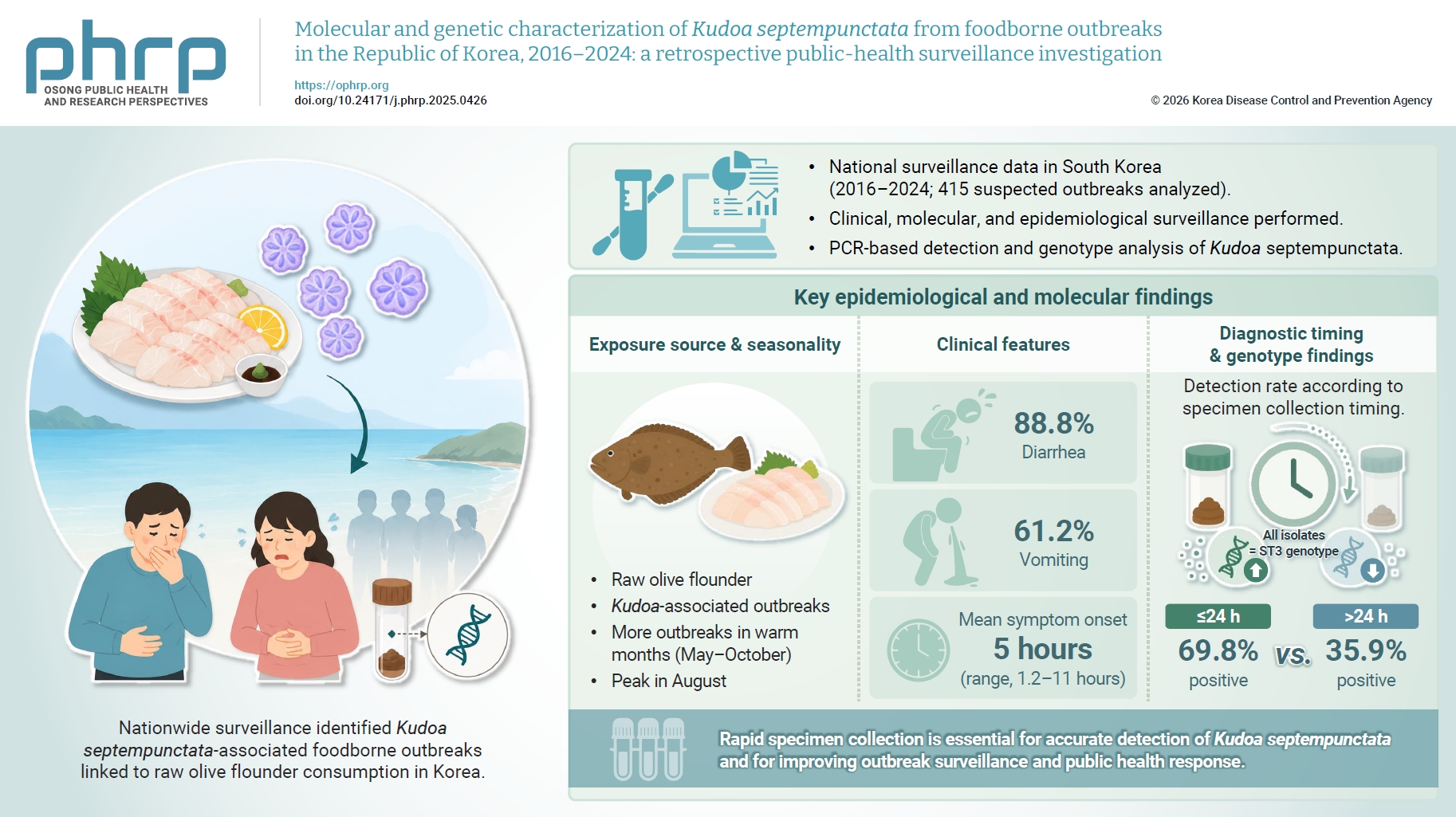
Objectives Kudoa septempunctata is a marine myxosporean parasite implicated in seafood-borne acute gastroenteritis, predominantly associated with the consumption of raw olive flounder. This study aimed to characterize the molecular and genetic features of K. septempunctata-associated with foodborne outbreaks in the Republic of Korea from 2016 to 2024. Methods: We reviewed 415 suspected foodborne outbreaks reported through national surveillance between 2016 and 2024. Among these, 37 outbreaks with complete clinical, epidemiological, and laboratory data from 2020 to 2024—including K. septempunctata testing and genotyping—were analyzed in detail. Results: Diarrhea (88.8%) and vomiting (61.2%) were the most common symptoms. The detection rate of K. septempunctata was significantly higher in specimens collected ≤24 hours after raw fish consumption (69.8%) than in those collected > 24 hours after consumption (35.9%). Outbreak occurrence was higher during warmer months (May–October) than during other periods, although this difference was not statistically significant. All sequences obtained from patient specimens belonged to sequence type 3 (ST3) of K. septempunctata. Conclusion: Since 2020, the proportion of reported outbreaks associated with Kudoa has increased, indicating its continued public health relevance. The timing of specimen collection is a key determinant of K. septempunctata detection, as diagnostic yield declines significantly when specimens are collected more than 24 hours after exposure. These findings highlight the need for standardized rapid investigation protocols and an integrated surveillance system linking clinical data with seafood supply-chain information.
Objectives The aim of this study was to compare the rate of parasitism and intestinal parasitism profiles of children who live in relatively proximal communities across the 5 municipalities of the Barranquilla metropolitan area, Colombia.
Methods In total, 986 fecal samples from children aged 1 to 10 were analyzed using a direct method (physiological saline and lugol) and the zinc sulfate flotation technique. A comparative analysis of the parasitism profiles between sampling locations (7 schools and 3 health centers providing growth and development services) was conducted using principal component analysis (PCA). The presence of Taenia solium antibodies was evaluated by the enzyme-linked immunosorbent assay method in 269 serum samples from the same group of children.
Results The overall prevalence of intestinal parasitism was 57.6% (range, 42.1%–77.6%) across the sampling areas. The prevalence of helminthiasis was between 4.1% and 23.7%, and that of intestinal protozoa was between 38.2% and 73.5%. PCA showed that the parasite profiles of each sampling location shared no common characteristics. A total of 3.0% of the serum samples were positive for T. solium antibodies.
Conclusion The intestinal parasitism profiles between relatively proximal sampling locations with similar geographic conditions were vastly different, indicating the need to study each small ecological niche on a localized scale to develop more cost-effective interventions for controlling intestinal parasitism.
Citations
Citations to this article as recorded by
Prevalence of soil-transmitted helminths infection and associated risk factors among residents of Jigjiga town, Somali region, Eastern Ethiopia Abdlmenur Alewi Sedo, Ahmed Zeynudin, Tariku Belay, Mekdes Mekonen Belay, Ahmed Mohammed Ibrahim, Mohamed Omar Osman, Ramadan Budul Yusuf, Abdifatah Abdulahi, Alqeer Aliyo Ali PLOS ONE.2025; 20(1): e0317829. CrossRef
The burden of intestinal parasitic infections in Antioquia, Colombia: Impact in childhood growth development and nutritional status Carolina Hernández-Castro, Sonia del Pilar Agudelo-López, Angélica Patricia Medina-Lozano, Diego López-García, Luis Alfonso García-Tuberquia, Jorge Humberto Botero-Garcés, María Cenelia Orozco-Peláez, Manuela Bolaños-Muñoz, Daniel Antonio Bejarano-Villafa Acta Tropica.2024; 251: 107119. CrossRef
Prevalencia y diversidad de parásitos intestinales zoonóticos en perros domésticos en un área urbano en el Caribe colombiano Luz Adriana Sarmiento-Rubiano, Yina Garcia Toscano, Julieannie Paola Ruiz, Lucena Delgado Soraca, Alfonso Bettin Martínez, Jimmy Becerra Enríquez Revista Mexicana de Ciencias Pecuarias.2024; 15(4): 848. CrossRef
An update on the distribution of Blastocystis subtypes in the Americas Paula Jiménez, Marina Muñoz, Juan David Ramírez Heliyon.2022; 8(12): e12592. CrossRef
Frecuencia de parasitosis intestinal en escuelas primarias en Veracruz, México Vanessa Oceguera-Segovia, Gabriel Obed Martínez-Rodríguez, Janet Michelle Villafuerte-Ordaz, Xóchitl Magnolia Alanís-Reyes, Angel Alberto Puig-Lagunes Revista Mexicana de Pediatría.2022; 89(4): 146. CrossRef
María de la Luz Galván-Ramírez, Ana Luisa Madriz-Elisondo, Cynthia Guadalupe Temores Ramírez, Jorge de Jesús Romero Rameño, Dania Araceli de la O Carrasco, Marco Antonio Cardona López
Osong Public Health Res Perspect 2019;10(1):39-48. Published online February 28, 2019
<sec>
<title>Objectives</title>
<p>To determine the prevalence and risk factors associated with intestinal parasites in the population of San Juan Cosala, Jalisco, Mexico.</p></sec>
<sec>
<title>Methods</title>
<p>A total of 277 samples from 104 participants were analysed using direct smear, flotation, formaldehyde/ethyl acetate, and modified Kinyoun’s acid-fast stain methods. The Graham method was applied only for samples from children under 12 years of age for the diagnosis of<italic> Enterobius vermicularis.</italic></p></sec>
<sec>
<title>Results</title>
<p>The prevalence of parasite infections in the study population was 77.9% including:<italic> Entamoeba histolytica/E. dispar/E. moshkovskii/E. bangladeshi</italic> (37.5%),<italic> Giardia intestinalis</italic> (11.5%);<italic> commensals: Endolimax nana</italic> (44.2%),<italic> Entamoeba coli</italic> (27.9%),<italic> Chilomastix mesnili</italic> (6.7%) and<italic> Iodamoeba bütschlii</italic>, (2.9%); emerging intestinal protozoans:<italic> Blastocystis</italic> spp. (49%),<italic> Cryptosporidium</italic> spp. (7.7%) and <italic>Cyclospora cayetanensis</italic> (2.9%); and helminths:<italic> Enterobius vermicularis</italic> (18.3%) and <italic>Ascaris lumbricoides</italic> (5.8%). The results also showed that 58.64% of the studied population presented polyparasitism. A significant association was found between protozoan infections and housewives, and houses that were not built with concrete ceilings, brick walls and cement floors (<italic>p</italic> < 0.05).</p></sec>
<sec>
<title>Conclusion</title>
<p>Polyparasitism was observed in over half the study population. The most prevalent parasite was <italic>Blastocystis</italic> spp, whilst the prevalence of helminths was less than that of protozoans. The risk factors for infection to intestinal parasites were being a housewife and not having solid brick, cement and concrete materials for house construction.</p></sec>
Citations
Citations to this article as recorded by
Prevalence of Cyclospora cayetanensis in Diarrheal Patients in Eastern India Ajanta Ghosal, Sanjib Kumar Sardar, Koushik Das, Tapas Haldar, Akash Prasad, Seiki Kobayashi, Yumiko Saito-Nakano, Shanta Dutta, Tomoyoshi Nozaki, Sandipan Ganguly Japanese Journal of Infectious Diseases.2026; 79(4): 129. CrossRef
Increasing food safety and sustainability: consumer acceptance toward cold plasma-treated red berries Ilaria Russo, Francesco Bimbo, Alessandra Barlaam, Rosaria Viscecchia, Annunziata Giangaspero, Biagia De Devitiis Food Quality and Preference.2026; 141: 105895. CrossRef
High prevalence and territorial heterogeneity of intestinal parasite detection in Ecuador: A large registry-based cross-sectional study using routine stool examinations Esteban Ortiz-Prado, Sebastián Cadena, Mónica Duran, Xavier Larrea, Norma Páez, Viviana Sarlabous, Mayra Sánchez, Patricio Toledo, Hugo Vergara, Jorge Vasconez-Gonzalez, Juan S. Izquierdo-Condoy International Journal of Infectious Diseases.2026; 171: 109026. CrossRef
Comparative Analysis of Intestinal Parasitic Infections and Risk Factors Affected by the Pandemic Among Primary Schoolchildren in the Provinces of Manzini and Lubombo, Kingdom of Eswatini: A Follow‐Up Study in 2019 and 2022 Ai-Wen Yin, Mathobela Mbongiseni, Ting-Wu Chuang, Chia-Mei Chou, Chia-Kwung Fan, Priya Gusain Journal of Tropical Medicine.2025;[Epub] CrossRef
Aspects of Genetic Diversity, Host Specificity and Public Health Significance of Single‐Celled Intestinal Parasites Commonly Observed in Humans and Mostly Referred to as ‘Non‐Pathogenic’ Christen Rune Stensvold APMIS.2025;[Epub] CrossRef
Bienestar animal: experiencias desde un módulo de producción para la enseñanza universitaria Esli Castro-Díaz, Astrid Rodríguez-Lozano, Ronnie Arieta-Román, José Armando Sánchez-Salcedo Revista Biológico Agropecuaria Tuxpan.2025; 13(1): 15. CrossRef
Enterobius vermicularis Infection in a Child Population with Evidence of Vulvovaginitis and Bacterial Coinfection in Girls in Oaxaca, México Jaime Vargas-Arzola, Aristeo Segura-Salvador, Luis Alberto Hernández-Osorio, Nancy G. Santos-Hernández, Dolores G. Vidal-López, Adriana Moreno-Rodríguez, José A. De Fuentes-Vicente, Ranjan Kumar Mohapatra Advances in Public Health.2024;[Epub] CrossRef
Intestinal parasite infections associated with sociodemographic and seasonal factors in the Western Amazon Gustavo Henrique Sinhorin, Ana Carolina Gomes Carneiro, Beatrice Emeli Silva Farias, Patrícia de Almeida, Antônio Ralph Medeiros-Sousa, Leonardo Augusto Kohara Melchior, Andreia Fernandes Brilhante Parasitology Research.2023; 122(2): 419. CrossRef
Prevalence of Enterobius vermicularis among children in Iran: A comprehensive systematic review and meta-analysis Elnaz Moussavi, Mohammad Houssaini, Nader Salari, Mahvan Hemmati, Ahmad Abdullahi, Ali Asghar Khaleghi, Shamarina Shohaimi, Masoud Mohammadi Parasite Epidemiology and Control.2023; 22: e00315. CrossRef
Improved household flooring is associated with lower odds of enteric and parasitic infections in low- and middle-income countries: A systematic review and meta-analysis Hugo Legge, Rachel L. Pullan, Benn Sartorius, Srinivasa Rao Mutheneni PLOS Global Public Health.2023; 3(12): e0002631. CrossRef
Enterobiasis among Yemeni children: a cross-sectional study Abdulelah H. Al-Adhroey, Yahya A. Al-Ansi, Mohammed A. Al-Kholani, Abdulrahman H. Amer, Marwan M. Al-Khyat, Fadia H. Al Hubaishi, Radhwan H. Aziz, Ebrahim S. Al-Khateeb, Souad A. Al-Gabri, Tawfik M. Al-Gabri Journal of Parasitic Diseases.2022; 46(3): 722. CrossRef
Prevalence of human cryptosporidiosis in the Americas: systematic review and meta-analysis Higor Wilson Jann, Mauro Jorge Cabral-Castro, João Victor Barreto Costa, Alba Cristina Miranda de Barros Alencar, José Mauro Peralta, Regina Helena Saramago Peralta Revista do Instituto de Medicina Tropical de São P.2022;[Epub] CrossRef
Frecuencia de parasitosis intestinal en escuelas primarias en Veracruz, México Vanessa Oceguera-Segovia, Gabriel Obed Martínez-Rodríguez, Janet Michelle Villafuerte-Ordaz, Xóchitl Magnolia Alanís-Reyes, Angel Alberto Puig-Lagunes Revista Mexicana de Pediatría.2022; 89(4): 146. CrossRef
Intestinal protozoa and helminths in ulcerative colitis and the influence of anti-parasitic therapy on the course of the disease Abdurakhim Toychiev, Behzod Navruzov, Dinora Pazylova, Nikolay Davis, Najiya Badalova, Svetlana Osipova Acta Tropica.2021; 213: 105755. CrossRef
Contamination of fresh produce sold on the Italian market with Cyclospora cayetanensis and Echinococcus multilocularis Alessandra Barlaam, Tamirat T. Temesgen, Kristoffer R. Tysnes, Laura Rinaldi, Nicola Ferrari, Anna R. Sannella, Giovanni Normanno, Simone M. Cacciò, Lucy J. Robertson, Annunziata Giangaspero Food Microbiology.2021; 98: 103792. CrossRef
The role of environmental factors in the realization of the epidemic process on ascariasis Anton A. Martsev Hygiene and sanitation.2021; 100(3): 218. CrossRef
Epidemiology of Intestinal Parasites in Pediatric Patients: Example of Ordu Province Emine YURDAKUL ERTÜRK, Ülkü KARAMAN, Yeliz KAŞKO ARICI, Cemil ÇOLAK, Gamze YOLALAN, Şermin TOP Online Türk Sağlık Bilimleri Dergisi.2021; 6(3): 391. CrossRef
Molecular genotyping of Blastocystis spp. in wild mammals from Mexico Fernando Martinez-Hernandez, Jose Alejandro Martinez-Ibarra, Eduardo Lopez-Escamilla, Claudia Villanueva-Garcia, Claudia Irais Muñoz-Garcia, Emilio Rendon-Franco, Pablo Maravilla, Guiehdani Villalobos Parasitology Research.2020; 119(1): 97. CrossRef
The association between the lack of safe drinking water and sanitation facilities with intestinal Entamoeba spp infection risk: A systematic review and meta-analysis Hamid Atabati, Hamid Kassiri, Ehsan Shamloo, Mitra Akbari, Ali Atamaleki, Fatemeh Sahlabadi, Nguyen Thi Thuy Linh, Ali Rostami, Yadolah Fakhri, Amin Mousavi Khaneghah, Chia Kwung Fan PLOS ONE.2020; 15(11): e0237102. CrossRef
Cyclospora cayetanensis and Cyclosporiasis: An Update Sonia Almeria, Hediye N. Cinar, Jitender P. Dubey Microorganisms.2019; 7(9): 317. CrossRef
<sec>
<title>Objectives</title>
<p><italic>Leishmania</italic> parasites are the causative agents of leishmaniasis. The Visceral leishmaniasis (VL) form of the disease is fatal if not treated in most cases. This study examined the epidemiological aspects of VL in two southwest counties of Iran.</p></sec>
<sec>
<title>Methods</title>
<p>This was a retrospective study of hospitalized patients with a laboratory confirmation of VL from Larestan and Ghiro-Karzin Counties.</p></sec>
<sec>
<title>Results</title>
<p>For Larestan county, a decline in the incidence of VL has been observed from 2004 to 2015. Significantly more males (<italic>n</italic> = 14) than females (<italic>n</italic> = 6) were infected with VL in this county (<italic>p</italic> < 0.05), >95% of cases in children under 5 years of age. In Ghiro-Karzin county, the results were similar to a decline in VL infection from 2004 to 2015, and slightly more males (<italic>n</italic> = 14) than females (<italic>n</italic> = 11). Similarly, the majority of the patients infected with VL were children under 5 years old (88%).</p></sec>
<sec>
<title>Conclusion</title>
<p>The results from this study indicate that although the incidence of VL infection has reduced over time, VL was more prevalent in boys under 5 years old, suggesting that more attention to controlling the parasite and its vector are required.</p></sec>
Citations
Citations to this article as recorded by
Knowledge, Attitudes, and Practices of Schoolchildren About Cutaneous Leishmaniasis in Dehloran City, Ilam Province, Southwest of Iran Reza Jorvand, Rahmat Chateripour, Morteza Akbari, Rahman Panahi, Mohammad Saaid Dayer Journal of Community Health.2026; 51(1): 95. CrossRef
Efficacy and safety of single-dose liposomal amphotericin B in patients with visceral leishmaniasis in Bangladesh: a real-life experience Md. Rezaul Ekram, Mohammad Robed Amin, Mohammad Jahid Hasan, Md. Abdullah Saeed Khan, Rajib Nath, Pranab Kumar Mallik, Alex Lister, Monjur Rahman Journal of Parasitic Diseases.2021; 45(4): 903. CrossRef
<sec><title>Objectives</title><p>Schoolchildren in developing countries are at greater risk of intestinal parasitic infections. This study aimed to estimate the prevalence and assess the risk factors of intestinal parasite infection among schoolchildren in rural areas of Peru.</p></sec><sec><title>Methods</title><p>A volunteer team from the Korea International Cooperation Agency (KOICA) conducted a campaign for parasite eradication called “Chao parasitos” at five schools in the peripheral highland regions of Huanuco in October 2013. The study collected questionnaires and stool samples from children of participating schools. <italic>Entamoeba coli</italic>, <italic>Iodamoeba buschii</italic>, and <italic>Chilomastix mesnil</italic> were classified as nonpathogenic parasites.</p></sec><sec><title>Results</title><p>The overall prevalence of intestinal parasite infection in the students was 100% (185/185). Among them, 25.9% (48/185) were infected only with nonpathogenic parasites whereas 74.1% (137/185) were infected with at least one pathogenic parasite. <italic>Ascaris lumbricoides</italic> was the most commonly detected (37.3%, 69/185), followed by <italic>Giardia lamblia</italic> (15.1%, 28/185) and <italic>I. buschii</italic> (11.9%, 22/185). Among lifestyle practices associated with parasitic infection, the rate of washing hands before meals was significantly lower in the students with pathogenic parasites compared to those with nonpathogenic parasites (77.4%, 106/137 vs. 93.8%, 45/48, <italic>p</italic> = 0.025).</p></sec><sec><title>Conclusion</title><p>The prevalence of intestinal parasite was 100%. Both personal hygiene and water supply facilities are required to eradicate parasite infection in rural areas of Peru.</p></sec>
Citations
Citations to this article as recorded by
Development and Validation of a Computer Vision-Based Artificial Intelligence System (FenoParasite) for the Microscopic Detection of Ascaris lumbricoides and Giardia lamblia in Stool Samples Miguel Hueda-Zavaleta, Exequiel Federico Espeche, Francisco Zea Gamboa, Mady Canelu Ramos Rojas, Enrique Lanchipa Valencia, Juan Carlos Gómez de la Torre Pretell Tropical Medicine and Infectious Disease.2026; 11(9): 246. CrossRef
Parameter Estimation and Forecasting Strategies for Cholera Dynamics: Insights from the 1991–1997 Peruvian Epidemic Hamed Karami, Gerardo Chowell, Oscar J. Mujica, Alexandra Smirnova Mathematics.2025; 13(10): 1692. CrossRef
Ecoepidemiology and zoonotic risk of intestinal parasites in humans and domestic dogs in marginalized coastal communities of Ecuador Roberto Coello-Peralta, Rommel Lenin Vinueza, Betty Judith Pazmiño Gómez, Renato León, Marco Faytong-Haro, Carmen Yancha Moreta, Gilma Esperanza Guerrero Lapo, Manuel González González, Aldo Rubén Andrada, Mariela Alderete, Pedro Cedeño-Reyes, María de Lo Scientific Reports.2025;[Epub] CrossRef
Impacto de enfermedades infecciosas parasitarias en niños: Estudio en una comunidad indígena en Ecuador Nicole Celina Gamboa Camacho, Gloria Del Valle Peña Rosas, Dick Alejandro Castro Demera Más Vita.2024; 6(4): 08. CrossRef
Intestinal parasitic infection among rural schoolchildren in Taiz, Yemen: School-based assessment of the prevalence and associated risk factors T. Alharazi Helminthologia.2022; 59(3): 233. CrossRef
Systematic Review Of Risk Factor Of Intestinal Parasite Infection Nur Afidah Novitasari, Mohammad Zainal Fatah Media Gizi Kesmas.2021; 10(1): 165. CrossRef
Prevalence of Intestinal Parasitic Infections among Children in Europe over the Last Five Years Maria Kantzanou, Maria A. Karalexi, Georgia Vrioni, Athanasios Tsakris Tropical Medicine and Infectious Disease.2021; 6(3): 160. CrossRef
Prevalence of Intestinal Parasitic Infections and Associated Risk Factors among the First-Cycle Primary Schoolchildren in Sasiga District, Southwest Ethiopia Baye Sitotaw, Wakgari Shiferaw Journal of Parasitology Research.2020; 2020: 1. CrossRef
Relative Frequency of Blastocystis Subtypes 1, 2, and 3 in Urban and Periurban Human Populations of Arequipa, Peru Kasandra Ascuña-Durand, Renzo S. Salazar-Sánchez, Ricardo Castillo-Neyra, Jorge Ballón-Echegaray Tropical Medicine and Infectious Disease.2020; 5(4): 178. CrossRef
Enteroparasitosis in patients attended by the health public service: epidemiology and spatial distribution Andressa Barros Ibiapina, Janaína Soares Leal, Pedro Ricardo Alves de Santana, Marcelo Ribeiro Mesquita, Tito Lívio da Cunha Lopes, Débora Cavalcante Braz Scientia Medica.2020; 30(1): e34764. CrossRef
Prevalence of intestinal parasitic infections and associated risk factors among Jawi primary school children, Jawi town, north-west Ethiopia Baye Sitotaw, Haileyesus Mekuriaw, Destaw Damtie BMC Infectious Diseases.2019;[Epub] CrossRef
Anti-parasitic activity of polyether ionophores Michał Antoszczak, Dietmar Steverding, Adam Huczyński European Journal of Medicinal Chemistry.2019; 166: 32. CrossRef
Intestinal parasitic infections and associated factors in children of three rural schools in Colombia. A cross-sectional study Paula C. Hernández, Liliana Morales, Jacqueline Chaparro-Olaya, Diana Sarmiento, Juan Felipe Jaramillo, Gustavo A. Ordoñez, Fabian Cortés, Lizeth K. Sánchez, Michael E. Grigg PLOS ONE.2019; 14(7): e0218681. CrossRef
Objectives
The prevalence of <i>Clonorchis sinensis</i> infection was investigated among residents of the five major river basins, that is, Hangang, Nakdonggang, Seomjingang, Yeongsangang, and Geumgang River basins in Korea. Methods
From January to December 2007, a total of 31,268 stool samples were collected from 29 localities and examined by the formalin-ether sedimentation technique. Results
Intestinal parasite eggs and/or protozoan cysts were detected from 2957 (9.5%) inhabitants. Number of residents harbouring helminth eggs in the faeces was 2542 (8.1%) for <i>C. sinensis</i>, 255 (0.8%) for <i>Heterophyes</i> spp., 36 (0.1%) for <i>Echinostoma</i> spp., 30 (0.1%) for <i>Trichuris trichiura</i>, 8 (0.03%) for <i>Ascaris lumbricoides</i>, 7 (0.02%) for <i>Gymnophalloide seoi</i>, and 50 (0.02%) for <i>Trichostrongylus orientalis</i>. Number of residents harbouring protozoan cysts in the faeces was 133 (1.3%) for <i>Entamoeba</i> spp. and 50 (0.2%) for <i>Giardia lamblia.</i> The positive rates of <i>C. sinensis</i> in Nakdonggang, Seomjingang, Yeongsangang, Geumgang, and Hangang River basins were 12.2%, 9.5%, 3.3%, 3.0%, and 1.0%, respectively. The egg positive rate of <i>C. sinensis</i> was higher in male (10.6%) than in female (6.1%), and the age group of 50s had the highest positive rate (10.4%). Conclusion
The result of this study revealed little decrease in positive rate of <i>C. sinensis</i> compared with the result of southern endemic areas of Korea in 2006.
Citations
Citations to this article as recorded by
Global Burden of Trichostrongylus Infections in Humans: A Systematic Review and Meta-Analysis Jurairat Jongthawin, Kinley Wangdi, Aongart Mahittikorn, Frederick Ramirez Masangkay, Manas Kotepui Medicina.2026; 62(2): 408. CrossRef
Infection characteristics of Metagonimus species (Digenea: Heterophyidae) metacercariae in fish from major rivers of Korea Woon-Mok Sohn Parasites, Hosts and Diseases.2024; 62(1): 1. CrossRef
Global prevalence of 4 neglected foodborne trematodes targeted for control by WHO: A scoping review to highlight the gaps Rachel Tidman, Kaushi S. T. Kanankege, Mathieu Bangert, Bernadette Abela-Ridder, Paul R. Torgerson PLOS Neglected Tropical Diseases.2023; 17(3): e0011073. CrossRef
Infection Characteristics of Clonorchis sinensis Metacercariae in Fish from Republic of Korea Woon-Mok Sohn The Korean Journal of Parasitology.2022; 60(2): 79. CrossRef
High Endemicity with Clonorchis sinensis Metacercariae in Fish from Yongjeon-cheon (Stream) in Cheongsong-gun, Gyeongsangbuk-do, Korea Woon-Mok Sohn, Byoung-Kuk Na, Shin-Hyeong Cho, Hee Il Lee, Myoung-Ro Lee, Jung-Won Ju, Gou Ok Kim The Korean Journal of Parasitology.2021; 59(1): 97. CrossRef
Survey of Zoonotic Trematode Metacercariae in Fish from Water Systems of Geum-gang (River) in Republic of Korea Woon-Mok Sohn, Byoung-Kuk Na, Shin-Hyeong Cho, Cheon-Hyeon Kim, Min-Ah Hwang, Kyeong-Woo No, Jai-Dong Kim The Korean Journal of Parasitology.2021; 59(1): 23. CrossRef
Risk Factors for Clonorchis sinensis Infection in Residents of Binyang, Guangxi: A Cross-Sectional and Logistic Analysis Study Meng Xu, Yanyan Jiang, Jianhai Yin, Shengkui Cao, Yujuan Shen, Jianping Cao Frontiers in Public Health.2021;[Epub] CrossRef
Prevalence and Infection Intensity of Zoonotic Trematode Metacercariae in Fish from Soyang-cheon (Stream), in Wanju-gun, Jeollabuk-do, Korea Woon-Mok Sohn, Byoung-Kuk Na, Shin-Hyeong Cho, Jung-Won Ju, Cheon-Hyeon Kim, Min-Ah Hwang, Kyeong-Woo No, Jong-Ho Park The Korean Journal of Parasitology.2021; 59(3): 265. CrossRef
Survey of Zoonotic Trematode Metacercariae in Fish from Irrigation Canal of Togyo-jeosuji (Reservoir) in Cheorwon-gun, Gangwon-do, Republic of Korea Woon-Mok Sohn, Byoung-Kuk Na, Shin-Hyeong Cho, Hee Il Lee, Jung-Won Ju, Myoung-Ro Lee, Eun-Joo Lim, Sung Yong Son, Eunmi Ko, Jaeseok Choi The Korean Journal of Parasitology.2021; 59(4): 427. CrossRef
Endemicity of Zoonotic Trematode Metacercariae in Fish from Deokcheon-gang (River) in Sancheong-gun, Gyeongsangnam-do, Republic of Korea Woon-Mok Sohn, Byoung-Kuk Na, Shin-Hyeong Cho, Hee Il Lee, Jung-Won Ju, Myoung-Ro Lee, Jeong-Gil Park, Jihee Ahn The Korean Journal of Parasitology.2021; 59(5): 523. CrossRef
Prevalence of Clonorchis sinensis infection in fish in South‐East Asia: A systematic review and meta‐analysis Ying Zhang, Qing‐Long Gong, Qing‐Bo Lv, Yang‐Yuan Qiu, Yan‐Chun Wang, Hong‐Yu Qiu, Xin‐Rui Guo, Jun‐Feng Gao, Qiao‐Cheng Chang, Chun‐Ren Wang Journal of Fish Diseases.2020; 43(11): 1409. CrossRef
Infection Status with Clonorchis sinensis Metacercariae in Fish from Yangcheon (Stream) in Sancheong-gun, Gyeongsangnam-do, Korea Woon-Mok Sohn, Byoung-Kuk Na, Shin-Hyeong Cho, Jung-Won Ju The Korean Journal of Parasitology.2019; 57(2): 145. CrossRef
Prevalence, Species Distribution, and Related Factors of Fish-Borne Trematode Infection in Ninh Binh Province, Vietnam Anh Kieu Thi Tran, Hoa Thuy Doan, Anh Ngoc Do, Van Thi Nguyen, Su Xuan Hoang, Huong Thu Thi Le, Hoa Thi Hoang, Nam Hoang Le, Quyen Bao Thi Le, Tran-Anh Le BioMed Research International.2019; 2019: 1. CrossRef
Infection Status with Digenetic Trematode Metacercariae in Fishes from Coastal Lakes in Gangwon-do, Republic of Korea Woon-Mok Sohn, Byoung-Kuk Na, Shin-Hyeong Cho, Soon-Won Lee The Korean Journal of Parasitology.2019; 57(6): 681. CrossRef
Recombinant adenylate kinase 3 from liver fluke Clonorchis sinensis for histochemical analysis and serodiagnosis of clonorchiasis Soon Bin Kwon, Paul Kim, Hae Sun Woo, Tae Yun Kim, Ju Yeong Kim, Hye Min Lee, Yun Soo Jang, Eun-Min Kim, Tai-Soon Yong, Baik Lin Seong Parasitology.2018; 145(12): 1531. CrossRef
Prevalence and Intensity of Clonorchis sinensis Metacercariae in Freshwater Fish from Wicheon Stream in Gunwi-gun, Gyeongsangbuk-do, Korea
Woon-Mok Sohn, Byoung-Kuk Na, Shin-Hyeong Cho, Jung-Won Ju, Dong-Chul Son The Korean Journal of Parasitology.2018; 56(1): 41. CrossRef
Epidemiological and Clinical Parameters Features of Patients with Clonorchiasis in the Geum River Basin, Republic of Korea Hee-Eun Shin, Myoung-Ro Lee, Jung-Won Ju, Byong-Suk Jeong, Mi-Yeoun Park, Keoung-Sook Lee, Shin-Hyeong Cho Interdisciplinary Perspectives on Infectious Disea.2017; 2017: 1. CrossRef
A new method for estimating the prevalence of clonorchiasis in Korea Jin-Young Jeong, Jin Yong Lee, Byung-Suk Chung, Younghyun Choi, Allison Baer Alley, Hyun Joo Kim Medicine.2017; 96(13): e6536. CrossRef
Prevalence of Clonorchis sinensis Infection among Residents along 5 Major Rivers in the Republic of Korea Young-Il Jeong, Hee-Eun Shin, Sang-Eun Lee, Hyeng-Il Cheun, Jung-Won Ju, Jung-Yeon Kim, Mi Yeoun Park, Shin-Hyeong Cho The Korean Journal of Parasitology.2016; 54(2): 215. CrossRef
Trematode Metacercariae in Freshwater Fish from Water Systems of Hantangang and Imjingang in Republic of Korea Woon-Mok Sohn, Byoung-Kuk Na, Shin-Hyeong Cho, Soon-Won Lee, Seung-Bong Choi, Won-Seok Seok The Korean Journal of Parasitology.2015; 53(3): 289. CrossRef
Prevalence and Risk Factors of Clonorchiasis among Residents of Riverside Areas in Muju-gun, Jeollabuk-do, Korea Do-Soon Park, Sung-Jin Na, Shin Hyeong Cho, Kyung Ja June, Young-Chae Cho, Young-Ha Lee The Korean Journal of Parasitology.2014; 52(4): 391. CrossRef
Prevalence and Risk Factors of Clonorchiasis among the Populations Served by Primary Healthcare Posts along Five Major Rivers in South Korea Kyung Ja June, Shin Hyeong Cho, Won Ja Lee, Chunmi Kim, Kyung-Soon Park Osong Public Health and Research Perspectives.2013; 4(1): 21. CrossRef



 First
 Prev


