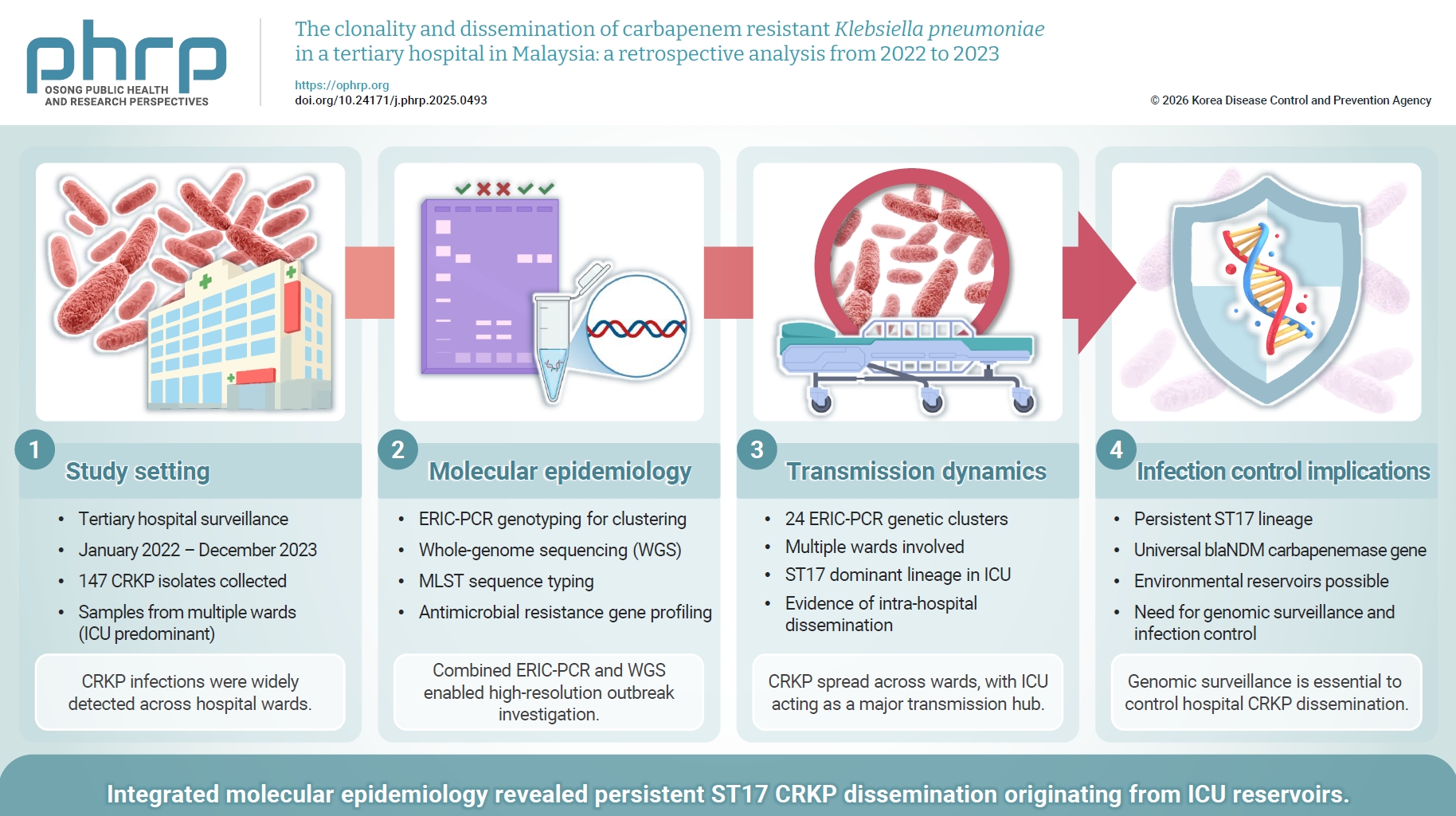
Objectives Cases of nosocomial carbapenem-resistant Klebsiella pneumoniae (CRKP) have been increasing steadily since the 1990s. In this study, we sought to assess CRKP clonal diversity and patterns of dissemination at Hospital Canselor Tuanku Muhriz (HCTM), a tertiary university hospital located in Kuala Lumpur, Malaysia. Methods: From January 2022 to December 2023, all CRKP isolates from HCTM were included in the investigation. Associated patient demographic data and clinical histories were retrieved from hospital records. Antibiotic susceptibility data for the collected isolates were obtained from the HCTM diagnostic laboratory. Molecular typing was performed using enterobacterial repetitive intergenic consensus polymerase chain reaction (ERIC-PCR) to identify genetic clusters. Based on ERIC-PCR clustering results and epidemiological investigations, selected CRKP isolates were subjected to whole-genome sequencing (WGS) to validate clonal relatedness, identify antimicrobial resistance genes, and establish phylogenomic relationships. Results: During the study period, a total of 147 CRKP isolates were recovered from various wards across HCTM. All isolates exhibited resistance to imipenem, meropenem, or ertapenem, with 124 isolates confirmed as carbapenemase producers. ERIC-PCR identified 24 genetic clusters disseminated across 23 wards within HCTM. Twelve CRKP isolates were selected for WGS based on integrated epidemiological investigation and ERIC-PCR genotyping; sequence typing revealed ST17 as the dominant circulating CRKP lineage in the intensive care unit, ward 6E, and possibly across the hospital. The carbapenemase gene bla_NDM was detected in all WGS-analyzed CRKP isolates. Conclusion: Integrating epidemiological investigation, phenotypic testing, molecular typing, and WGS is essential to understand resistance dynamics, map transmission, and guide hospital infection prevention strategies.
Objectives Tuberculosis (TB) and drug-resistant TB (DR-TB) are national health burdens in Vietnam. In this study, we investigated the prevalence of rifampicin (RIF) and/or isoniazid (isonicotinic acid hydrazide, INH) resistance in patients with suspected TB, and applied appropriate techniques to help rapidly target DR-TB. Methods: In total, 1,547 clinical specimens were collected and cultured using the BACTEC MGIT system (Becton Dickinson and Co.). A resazurin microtiter assay (REMA) was used to determine the proportions of RIF and/or INH resistance. A real-time polymerase chain reaction panel with TaqMan probes was employed to identify the mutations of rpoB and katG associated with DR-TB in clinical isolates. Genotyping of the identified mutations was also performed. Results: A total of 468 Mycobacterium tuberculosis isolates were identified using the REMA. Of these isolates, 106 (22.6%) were found to be resistant to 1 or both antibiotics. Of the resistant isolates, 74 isolates (69.8%) were resistant to isoniazid (INH) only, while 1 isolate (0.94%) was resistant to RIF only. Notably, 31 isolates (29.24%) were resistant to both antibiotics. Of the 41 phenotypically INH-resistant isolates, 19 (46.3%) had the Ser315Thr mutation. There were 8 different rpoB mutations in 22 (68.8%) of the RIF-resistant isolates. The most frequently detected mutations were at codons 531 (37.5%), 526 (18.8%), and 516 (6.3%). Conclusion: To help prevent new cases of DR-TB in Vietnam, it is crucial to gain a comprehensive understanding of the genotypic DR-TB isolates.
Citations
Citations to this article as recorded by
Identification of Potent Molecule for Rifampicin‐Resistant Mycobacterium tuberculosis using Natural Compounds by Structure‐Based Analysis Madhana Priya N, Magesh R ChemistrySelect.2026;[Epub] CrossRef
Clinical Evaluation of a Tandem qPCR-CRISPR Assay for Multidrug-Resistant or Rifampicin-Resistant Tuberculosis: A Prospective Diagnostic Accuracy Study Ying Wang, Zhe Song, Jianfeng Zeng, Yajuan Dong, Houming Liu, Jian Zeng, Xuhui Liu, Liang Fu, Xuelin Li, Shuihua Lu, Zhen Huang, Xiao-Yong Fan Microorganisms.2026; 14(8): 1750. CrossRef
Objectives Real-time polymerase chain reaction is currently used as a confirmatory test for coronavirus disease 2019 (COVID-19). The test results are interpreted as positive, negative, or inconclusive, and are used only for a qualitative classification of patients. However, the test results can be quantitated using threshold count (Ct) values to determine the amount of virus present in the sample. Therefore, this study investigated the diagnostic usefulness of Ct results through various quantitative analyzes, along with an analysis of clinical and epidemiological characteristics.
Methods Clinical and epidemiological data from 4,642 COVID-19 patients in April 2021 were analyzed, including the Ct values of the RNA-dependent RNA polymerase (RdRp), envelope (E), and nucleocapsid (N) genes. Clinical and epidemiological data (sex, age, underlying diseases, and early symptoms) were collected through a structured questionnaire. A correlation analysis was used to examine the relationships between variables.
Results All 3 genes showed statistically significant relationships with symptoms and severity levels. The Ct values of the RdRp gene decreased as the severity of the patients increased. Moreover, statistical significance was observed for the presence of underlying diseases and dyspnea.
Conclusion Ct values were found to be related to patients’ clinical and epidemiological characteristics. In particular, since these factors are closely related to symptoms and severity, Ct values can be used as primary data for predicting patients’ disease prognosis despite the limitations of this method. Conducting follow-up studies to validate this approach might enable using the data from this study to establish policies for preventing COVID-19 infection and spread.
Citations
Citations to this article as recorded by
Age, sex and seasonal differences in COVID-19 viral load: a Lebanese cross-sectional study Elie Charro, Karolina Jaalouk, Fatima Kourani, Youmna Mrad, Fadi Fakih, Chadi Fakih BMC Infectious Diseases.2025;[Epub] CrossRef
Objectives Voluntary testing (VT) plays a crucial role in the prevention and control of infectious diseases. The present study investigated the perceptions and utilization of VT services for coronavirus disease 2019 (COVID-19) among the inhabitants of Saudi Arabia. Methods: In total, 3,510 adult participants from all provinces of Saudi Arabia were recruited via a national online survey. Results: Of the 3,510 participants, 88.9% were aware of the testing services available to them and of those, more than half (59.5%) had used the VT services and 96.1% were satisfied with the services. Contact with a positive COVID-19 case was the top reason for accessing VT, while a lack of awareness about the availability of VT services was the top perceived limiting factor. A history of chronic health conditions, anxiety and/or depression, and previous symptoms suggestive of COVID-19 were found to be predictors of the utilization of VT services (odds ratio [OR] 1.55, 95% confidence interval [CI] 1.22−1.96; OR 1.48, 95% CI 1.16−1.88; and OR 3.31, 95% CI 2.77−3.95), respectively. Conclusion: The awareness of voluntary COVID-19 testing services was satisfactory among the Saudi Arabian population, but can be improved. Sociodemographic and health history predictors of the utilization of VT services were identified.
<sec>
<title>Objectives</title>
<p>The emergence of resistant bacteria is being increasingly reported around the world, potentially threatening millions of lives. Amongst resistant bacteria, methicillin-resistant <italic>Staphylococcus aureus</italic> (MRSA) is the most challenging to treat. This is due to emergent MRSA strains and less effective traditional antibiotic therapies to Staphylococcal infections. The use of bacteriophages (phages) against MRSA is a new, potential alternate therapy. In this study, morphology, genetic and protein structure of lytic phages against MRSA have been analysed.</p></sec>
<sec>
<title>Methods</title>
<p>Isolation of livestock and sewage bacteriophages were performed using 0.4 μm membrane filters. Plaque assays were used to determine phage quantification by double layer agar method. Pure plaques were then amplified for further characterization. Sulfate-polyacrylamide gel electrophoresis and random amplification of polymorphic DNA were run for protein evaluation, and genotyping respectively. Transmission electron microscope was also used to detect the structure and taxonomic classification of phage visually.</p></sec>
<sec>
<title>Results</title>
<p>Head and tail morphology of bacteriophages against MRSA were identified by transmission electron microscopy and assigned to the <italic>Siphoviridae</italic> family and the <italic>Caudovirales</italic> order.</p></sec>
<sec>
<title>Conclusion</title>
<p>Bacteriophages are the most abundant microorganism on Earth and coexist with the bacterial population. They can destroy bacterial cells successfully and effectively. They cannot enter mammalian cells which saves the eukaryotic cells from lytic phage activity. In conclusion, phage therapy may have many potential applications in microbiology and human medicine with no side effect on eukaryotic cells.</p></sec>
Citations
Citations to this article as recorded by
Efficacy of bacteriophage against multidrug resistant Staphylococcus spp. isolates Sayad Mahmud Koli, Raquiba Sultana, Md Nahian, Shahariar Ahmed Kabbo, Farjana Rahman, Md Sharifull Islam, Mrityunjoy Acharjee Continence Reports.2026; 19: 100126. CrossRef
Bacteriophage Challenge Drives Genomic and Proteomic Remodeling and Alters Antibiotic Resistance in a Methicillin-Resistant Staphylococcus aureus Otília Vágó, Krisztián Laczi, László Orosz, Georgina Horváth, Károly Péter Sárvári, Diána Szabó, Regina Csordás, Zoltán Szabó, Caleb Ardizzone, Titanilla Szögi, Katalin Burián, Dezső Péter Virok Antibiotics.2026; 15(8): 800. CrossRef
Interaction Between Staphylococcus aureus and Microbiota: Invasion or Commensalism Ahmad Nasser, Shiva Jahanbakhshi Current Pharmaceutical Biotechnology.2026; 27(7): 864. CrossRef
A novel Kayvirus species phage RuSa1 removes biofilm and lyses multiple clinical strains of methicillin resistant Staphylococcus aureus Kokkarambath Vannadil Suchithra, Asif Hameed, Punchappady Devasya Rekha, Paul Stothard, Ananthapadmanabha Bhagwath Arun Scientific Reports.2025;[Epub] CrossRef
Bacteriophage D2SVT exhibits potent antimicrobial and antibiofilm activity against carbapenem-resistant Acinetobacter baumannii
Mukta Kulshrestha, Vishvanath Tiwari Journal of Applied Microbiology.2025;[Epub] CrossRef
Role of methicillin-resistant Staphylococcus aureus in cutaneous infections: Current treatments and therapeutic approaches for future advancement Adviti Thomas, Nour Almsallaty, Tamim Chalati, Joshua Boateng, Asma Buanz, Ana Maria Totea International Journal of Pharmaceutics.2025; 684: 126030. CrossRef
Characterization of a Vibrio parahaemolyticus-targeting lytic bacteriophage SSJ01 and its application in artificial seawater Jungu Kang, Yoonjee Chang Food Science and Biotechnology.2024; 33(6): 1505. CrossRef
Isolation and encapsulation of bacteriophage with chitosan nanoparticles for biocontrol of multidrug-resistant methicillin-resistant Staphylococcus aureus isolated from broiler poultry farms Mona M. Elsayed, Rasha M. Elkenany, Ayman Y. EL-Khateeb, Nehal M. Nabil, Maram M. Tawakol, Heba M. Hassan Scientific Reports.2024;[Epub] CrossRef
Immunomodulation in Non-traditional Therapies for Methicillin-resistant Staphylococcus aureus (MRSA) Management Suthi Subbarayudu, S. Karthick Raja Namasivayam, Jesu Arockiaraj Current Microbiology.2024;[Epub] CrossRef
Prevention and Modern Strategies for Managing Methicillin-Resistant Staphylococcal Infections in Prosthetic Joint Infections (PJIs) Karolina Kraus, Paweł Mikziński, Jarosław Widelski, Emil Paluch Antibiotics.2024; 13(12): 1151. CrossRef
P1 Bacteriophage-Enabled Delivery of CRISPR-Cas9 Antimicrobial Activity Against Shigella flexneri Yang W. Huan, Vincenzo Torraca, Russell Brown, Jidapha Fa-arun, Sydney L. Miles, Diego A. Oyarzún, Serge Mostowy, Baojun Wang ACS Synthetic Biology.2023; 12(3): 709. CrossRef
Staphylococcus aureus Dormancy: Waiting for Insurgency Ahmad Nasser, Shiva Jahanbakhshi, Mohammad Mehdi Soltan Dallal, Maryam Banar, Azin Sattari-Maraji, Taher Azimi Current Pharmaceutical Biotechnology.2023; 24(15): 1898. CrossRef
Recent advance on nanoparticles or nanomaterials with anti-multidrug resistant bacteria and anti-bacterial biofilm properties: A systematic review Farhad Moradi, Arshin Ghaedi, Zahra Fooladfar, Aida Bazrgar Heliyon.2023; 9(11): e22105. CrossRef
Isolation and characterization of lytic bacteriophages from sewage at an egyptian tertiary care hospital against methicillin-resistant Staphylococcus aureus clinical isolates Safia Samir, Amira El-Far, Hend Okasha, Rania Mahdy, Fatima Samir, Sami Nasr Saudi Journal of Biological Sciences.2022; 29(5): 3097. CrossRef
Staphylococcus aureus: Biofilm Formation and Strategies Against it Ahmad Nasser , Mohammad Mehdi Soltan Dallal, Shiva Jahanbakhshi, Taher Azimi, Leila Nikouei Current Pharmaceutical Biotechnology.2022; 23(5): 664. CrossRef
An Anti-MRSA Phage From Raw Fish Rinse: Stability Evaluation and Production Optimization Israa M. Abd-Allah, Ghadir S. El-Housseiny, Mohammad Y. Alshahrani, Samar S. El-Masry, Khaled M. Aboshanab, Nadia A. Hassouna Frontiers in Cellular and Infection Microbiology.2022;[Epub] CrossRef
Molecular mechanisms of Shigella effector proteins: a common pathogen among diarrheic pediatric population Ahmad Nasser, Mehrdad Mosadegh, Taher Azimi, Aref Shariati Molecular and Cellular Pediatrics.2022;[Epub] CrossRef
A Metal-Containing NP Approach to Treat Methicillin-Resistant Staphylococcus aureus (MRSA): Prospects and Challenges Wendy Wai Yeng Yeo, Sathiya Maran, Amanda Shen-Yee Kong, Wan-Hee Cheng, Swee-Hua Erin Lim, Jiun-Yan Loh, Kok-Song Lai Materials.2022; 15(17): 5802. CrossRef
Electrochemical Biosensors for Pathogen Detection: An Updated Review Morteza Banakar, Masoud Hamidi, Zohaib Khurshid, Muhammad Sohail Zafar, Janak Sapkota, Reza Azizian, Dinesh Rokaya Biosensors.2022; 12(11): 927. CrossRef
Isolation of a lytic bacteriophage for Helicobacter pylori Sara Khosravi, Razieh Amini, Mohammad Reza Arabestani, Seyed Saman Talebi, Farid Azizi Jalilian Gene Reports.2021; 23: 101107. CrossRef
Bacteriophage Therapy for Critical and High-Priority Antibiotic-Resistant Bacteria and Phage Cocktail-Antibiotic Formulation Perspective Gursneh Kaur, Ritika Agarwal, Rakesh Kumar Sharma Food and Environmental Virology.2021; 13(4): 433. CrossRef
A comprehensive review of bacterial osteomyelitis with emphasis on Staphylococcus aureus Ahmad Nasser, Taher Azimi, Soheila Ostadmohammadi, Samaneh Ostadmohammadi Microbial Pathogenesis.2020; 148: 104431. CrossRef
Characterization of the Three New Kayviruses and Their Lytic Activity Against Multidrug-Resistant Staphylococcus aureus Natalia Łubowska, Bartłomiej Grygorcewicz, Katarzyna Kosznik-Kwaśnicka, Agata Zauszkiewicz-Pawlak, Alicja Węgrzyn, Barbara Dołęgowska, Lidia Piechowicz Microorganisms.2019; 7(10): 471. CrossRef
<sec><title>Objectives</title><p>Brucellosis is a major zoonotic disease that poses a significant public health threat worldwide. The classical bacteriological detection process used to identify <italic>Brucella</italic> spp. is difficult and time-consuming. This study aimed to develop a novel molecular assay for detecting brucellosis.</p></sec><sec><title>Methods</title><p>All complete sequences of chromosome 1 with 2.1-Mbp lengths were compared among all available <italic>Brucella</italic> sequences. A unique repeat sequence (URS) locus on chromosome 1 could differentiate <italic>Brucella abortus</italic> from <italic>Brucella melitensis</italic>. A primer set was designed to flank the unique locus. A total of 136 lymph nodes and blood samples were evaluated and classified by the URS-polymerase chain reaction (PCR) method in 2013–2014.</p></sec><sec><title>Results</title><p>Biochemical tests and bacteriophage typing as the golden standard indicated that all <italic>Brucella</italic> spp. isolates were <italic>B. melitensis</italic> biovar 1 and <italic>B. abortus</italic> biovar 3. The PCR results were the same as the bacteriological method for detecting <italic>Brucella</italic> spp. The sensitivity and specificity of the URS-PCR method make it suitable for detecting <italic>B. abortus</italic> and <italic>B. melitensis</italic>.</p></sec><sec><title>Conclusion</title><p>Quick detection of <italic>B. abortus</italic> and <italic>B. melitensis</italic> can provide the most effective strategies for control of these bacteria. The advantage of this method over other presented methods is that both <italic>B. abortus</italic> and <italic>B. melitensis</italic> are detectable in a single test tube. Furthermore, this method covered 100% of all <italic>B. melitensis</italic> and <italic>B. abortus</italic> biotypes. The development of this URS-PCR method is the first step toward the development of a novel kit for the molecular identification of <italic>B. abortus</italic> and <italic>B. melitensis</italic>.</p></sec>
Citations
Citations to this article as recorded by
The clinical manifestations and laboratory test results of Brucella melitensis and Brucella abortus in acute brucellosis patients Kun Li, Dawei Cheng, Xihong Sun, Huijie Zhang, Bing Zhang, Tao Zheng, Xun Zhou, Wenguo Jiang, Bilal Tursun, Hai Jiang Journal of Infection and Public Health.2026; 19(2): 103031. CrossRef
CRISPR technology for diagnosis and treatment of human brucellosis Cia-Hin Lau, Xiaojun Li, Qing-Le Liang, Rui Guo, Xiangyang Ren, Zhenna Xu, Yanqiu Zhu, Ying Lai, Guoqing Liu, Yumei Huang, Weidong Wu, Haibao Zhu, Jinhui Chen, Xianpeng Zhang Journal of Microbiological Methods.2026; 240: 107339. CrossRef
Brucella, Coxiella, and Theileria Species DNA in Haemaphysalis qinghaiensis Ticks Collected from Goats and Sheep in Qinghai Province, Northwest China Kun Li, Xuxin Yang, Jianling Wang, Shengyu Li, Xu Zhao, Shengjun Cai, Leyu Wu, Guoqiang An, Hongyan Zhao, Dongri Piao, Qingqing Xu, Yu Fan, Jiquan Li, Hai Jiang Tropical Medicine and Infectious Disease.2026; 11(1): 17. CrossRef
Molecular and serological investigation of Brucella species in kennel and farm dogs in Iran Baharak Akhtardanesh, Elham Mohammadi, Soheil Sadr, Asma Askari, Zeinab Manzari Tavakoli, Rozhin Ahmadi, Shakiba Nazemian, Hossein Rashidi, Morteza Aghamiri, Mehdi Golchin, Masoud Imani Acta Tropica.2025; 262: 107521. CrossRef
Investigating the Rate of Contamination of Milk and Traditional Dairy Products with Brucella Bacteria by PCR Method, Mamasani District, Fars Province, South of Iran M Kalantari, N Askarpour, K Azizi, M Yousefi, M Amin, M Vahedi, A Keshavarz Armaghane Danesh.2024; 29(2): 231. CrossRef
Rapid detection of Brucella cells using a gold nanoparticle-based aptasensor via a simple colorimetric method Azam Ahangari, Pezhman Mahmoodi, Mohammad Ali Zolfigol, Abdolmajid Mohammadzadeh, Mojtaba Salouti BMC Veterinary Research.2024;[Epub] CrossRef
Development of a simplified and cost-effective sample preparation method for genotyping of human papillomavirus by next-generation sequencing Rungrat Jitvaropas, Ukrit Thongpoom, Vorthon Sawaswong, Kritsada Khongnomnan, Witthaya Poomipak, Kesmanee Praianantathavorn, Pornjarim Nilyanimit, Yong Poovorawan, Sunchai Payungporn Archives of Virology.2023;[Epub] CrossRef
Survey of Zoonotic Bacterial Pathogens in Native Foxes in Central Chile: First Record of Brucella canis Exposure Nicolás Galarce, Sebastián de la Fuente, Beatriz Escobar, Phillip Dettleff, Pedro Abalos, Juan Carlos Hormazábal, Roberto Flores, Nicole Sallaberry-Pincheira, Víctor Martínez Animals.2021; 11(7): 1980. CrossRef
Development and validation of immunoassay for whole cell detection of Brucella abortus and Brucella melitensis Richa Hans, Pranjal Kumar Yadav, Pushpendra Kumar Sharma, Mannan Boopathi, Duraipandian Thavaselvam Scientific Reports.2020;[Epub] CrossRef
Laboratory Diagnostic Procedures for Human Brucellosis: An Overview of Existing Approaches Afshar Etemadi, Rezvan Moniri, Heinrich Neubauer, Yasaman Dasteh Goli, Saeed Alamian Jundishapur Journal of Microbiology.2019;[Epub] CrossRef
Comparison of PCR-RFLP and PFGE for determining the clonality of Brucella isolates from human and livestock specimens Nasrin Bahmani, Reza Mirnejad, Mohammad Reza Arabestani, Parviz Mohajerie, Seyed Hamid Hashemi, Manoochehr Karami, Mohammad Yousef Alikhani Saudi Journal of Biological Sciences.2019; 26(2): 256. CrossRef
Designing an immunosensor for detection of
Brucella abortus
based on coloured silica nanoparticles
Arash Shams, Bahareh Rahimian Zarif, Mojtaba Salouti, Reza Shapouri, Sako Mirzaii Artificial Cells, Nanomedicine, and Biotechnology.2019; 47(1): 2562. CrossRef
Identification of Brucella genus and eight Brucella species by Luminex bead-based suspension array Tina S. Lusk Pfefer, Ruth Timme, Julie A. Kase Food Microbiology.2018; 70: 113. CrossRef
Objectives
Production of carbapenemase, especially <i>Klebsiella pneumoniae</i> carbapenemases (KPC), is one of the antibiotic resistance mechanisms of Enterobacteriaceae such as <i>Klebsiella oxytoca</i>. This study aimed to investigate and identify KPC-producing <i>K. oxytoca</i> isolates using molecular and phenotypic methods. Methods
A total of 75 isolates of <i>K. oxytoca</i> were isolated from various clinical samples, and were verified as <i>K. oxytoca</i> after performing standard microbiological tests and using a polymerase chain reaction (PCR) method. An antibiotic susceptibility test was performed using a disc diffusion method according to the Clinical and Laboratory Standards Institute guidelines. CHROMagar KPC chromogenic culture media was used to examine and confirm the production of the carbapenemase enzyme in <i>K. oxytoca</i> isolates; in addition, PCR was used to evaluate the presence of <i>bla</i><sub>KPC</sub> gene in <i>K. oxytoca</i> strains. Results
Of a total of 75 <i>K. oxytoca</i> isolates, one multidrug resistant strain was isolated from the urine of a hospitalized woman. This strain was examined to assess its ability to produce carbapenemase enzyme; it produced a colony with a blue metallic color on the CHROMagar KPC chromogenic culture media. In addition, the <i>bla</i><sub>KPC</sub> gene was confirmed by PCR. After sequencing, it was confirmed and deposited in GenBank. Conclusion
To date, many cases of KPC-producing Enterobacteriaceae, in particular <i>K. pneumoniae</i>, have been reported in different countries; there are also some reports on the identification of KPC-producing <i>K. oxytoca</i>. Therefore, to prevent the outbreak of nosocomial infections, the early detection, control, and prevention of the spread of these strains are of great importance.
Citations
Citations to this article as recorded by
Antibiotic Resistance and Virulence Mechanisms in Klebsiella pneumoniae: Understanding for Better Interventions Assefa Asnakew Abebe, Alemayehu Godana Birhanu, Tesfaye Sisay Tessema Bacteria.2026; 5(1): 9. CrossRef
Molecular Typing and Occurrence of Extended-Spectrum Beta-Lactamases (ESBLs) Genes among Klebsiella oxytoca Isolated from Selected Hospitals in Khorramabad, Iran Gholamreza Goudarzi, Pegah Shakib, Khatereh Anbari, Tabasom Zavari The Open Microbiology Journal.2026;[Epub] CrossRef
Klebsiella oxytoca Complex: Update on Taxonomy, Antimicrobial Resistance, and Virulence Jing Yang, Haiyan Long, Ya Hu, Yu Feng, Alan McNally, Zhiyong Zong Clinical Microbiology Reviews.2022;[Epub] CrossRef
Development and comparison of immunochromatographic strips with four nanomaterial labels: Colloidal gold, new colloidal gold, multi-branched gold nanoflowers and Luminol-reduced Au nanoparticles for visual detection of Vibrio parahaemolyticus in seafood Meijiao Wu, Youxue Wu, Cheng Liu, Yachen Tian, Shuiqin Fang, Hao Yang, Bin Li, Qing Liu Aquaculture.2021; 539: 736563. CrossRef
Variation in Accessory Genes Within the Klebsiella oxytoca Species Complex Delineates Monophyletic Members and Simplifies Coherent Genotyping Amar Cosic, Eva Leitner, Christian Petternel, Herbert Galler, Franz F. Reinthaler, Kathrin A. Herzog-Obereder, Elisabeth Tatscher, Sandra Raffl, Gebhard Feierl, Christoph Högenauer, Ellen L. Zechner, Sabine Kienesberger Frontiers in Microbiology.2021;[Epub] CrossRef
Multidrug-Resistant Bacteria and Alternative Methods to Control Them: An Overview Roberto Vivas, Ana Andréa Teixeira Barbosa, Silvio Santana Dolabela, Sona Jain Microbial Drug Resistance.2019; 25(6): 890. CrossRef
Molecular typing of cytotoxin-producing Klebsiella oxytoca isolates by 16S-23S internal transcribed spacer PCR M.M. Soltan Dallal, M. Validi, M. Douraghi, B. Bakhshi New Microbes and New Infections.2019; 30: 100545. CrossRef
Determination of antibiotic resistance and minimum inhibitory concentration of meropenem and imipenem growth in Klebsiella strains isolated from urinary tract infection in Shahrekord educational hospitals Farshad Kakian, Behnam Zamzad, Abolfazl Gholipour, Kiarash Zamanzad Journal of Shahrekord University of Medical Scienc.2019; 21(2): 80. CrossRef
Evaluation the cytotoxic effect of cytotoxin-producing Klebsiella oxytoca isolates on the HEp-2 cell line by MTT assay Mohammad Mehdi Soltan-Dallal, Majid Validi, Masoumeh Douraghi, Jalil Fallah-Mehrabadi, Leila Lormohammadi Microbial Pathogenesis.2017; 113: 416. CrossRef
Outbreak by Hypermucoviscous Klebsiella pneumoniae ST11 Isolates with Carbapenem Resistance in a Tertiary Hospital in China Lingling Zhan, Shanshan Wang, Yinjuan Guo, Ye Jin, Jingjing Duan, Zhihao Hao, Jingnan Lv, Xiuqin Qi, Longhua Hu, Liang Chen, Barry N. Kreiswirth, Rong Zhang, Jingye Pan, Liangxing Wang, Fangyou Yu Frontiers in Cellular and Infection Microbiology.2017;[Epub] CrossRef
Objectives
<i>Escherichia coli</i> is regarded as the most important etiological agent of urinary tract infections. Fluoroquinolones are routinely used in the treatment of these infections; however, in recent years, a growing rate of resistance to these drugs has been reported globally. The aims of this study were to detect plasmid-mediated <i>qnrA</i>, <i>qnrB</i>, and <i>qnrS</i> genes among the quinolone-nonsusceptible <i>E. coli</i> isolates and to investigate their clonal relatedness in Qazvin and Zanjan Provinces, Iran. Methods
A total of 200 clinical isolates of <i>E. coli</i> were collected from hospitalized patients. The bacterial isolates were identified through standard laboratory protocols and further confirmed using API 20E test strips. Antimicrobial susceptibility was determined by the standard disk diffusion method. Polymerase chain reaction (PCR) and sequencing were used for detecting <i>qnrA</i>, <i>qnrB</i>, and <i>qnrS</i> genes and the clonal relatedness of <i>qnr</i>-positive isolates was evaluated by enterobacterial repetitive intergenic consensus-PCR (ERIC-PCR) method. Results
In total, 136 (68%) isolates were nonsusceptible to quinolone compounds, among which 45 (33.1%) and 71 (52.2%) isolates showed high- and low-level quinolone resistance, respectively. Of the 136 isolates, four (2.9%) isolates were positive for the <i>qnrS1</i> gene. The results from ERIC-PCR revealed that two (50%) cases of <i>qnr</i>-positive isolates were related genetically. Conclusion
Our study results were indicative of the presence of low frequency of <i>qnr</i> genes among the clinical isolates of <i>E. coli</i> in Qazvin and Zanjan Provinces, which emphasizes the need for establishing tactful policies associated with infection-control measures in our hospital settings.
Citations
Citations to this article as recorded by
Antibiotic resistance genes in
Escherichia coli
– literature review
Ádám Kerek, István Román, Ábel Szabó, Dóra Kovács, Gábor Kardos, László Kovács, Ákos Jerzsele Critical Reviews in Microbiology.2026; 52(1): 1. CrossRef
Molecular insights into antimicrobial resistance in human bacterial pathogens: mechanisms, resistance genes, and translational diagnostic applications Nazmul Hossen, Maria Teresa Mascellino Frontiers in Microbiology.2026;[Epub] CrossRef
A Sustainable Combined Approach to Control the Microbial Bioburden in the School Environment Maria D’Accolti, Irene Soffritti, Eleonora Mazziga, Francesca Bini, Matteo Bisi, Antonella Volta, Sante Mazzacane, Elisabetta Caselli Microorganisms.2025; 13(4): 791. CrossRef
Biofilm Formation and Antibiotic Resistance Genes of Escherichia coli From Poultry Farms and Clinical Samples Arina Sasoon, Farhad Nikkhahi, Amir Javadi, Samira Sabzi, Mohadeseh Ostovari Deilamani, Niloofar Kiaheyrati, Amin Karampour, Amir Peymani, Fatemeh Fardsanei Veterinary Medicine and Science.2025;[Epub] CrossRef
Molecular Mechanisms of Antibiotic Resistance in Uropathogenic Escherichia coli: A Narrative Review Nakjun Choi, Dong Uk Kim, Eun-Jin Lee Urogenital Tract Infection.2025; 20(2): 96. CrossRef
Uncovering hidden threats: prevalence, antibiotic resistance and virulence gene profiles of Escherichia coli strains isolated from Testudines and their aquatic habitats Lungile N. Mlangeni, Tsepo Ramatla, Cormac Price, Oriel Thekisoe, Che Weldon Molecular Biology Reports.2025;[Epub] CrossRef
Characterization of plasmid-mediated quinolone resistant genes among uropathogenic Escherichia coli isolates in Bushehr, south of Iran Matin Aref, Javad Fathi, Parisa Ghazanfari, Yalda Malekzadegan, Behdokht Jamali BMC Research Notes.2025;[Epub] CrossRef
Polluted surface water is a repository of antibiotic-resistant
Escherichia coli
harbouring Plasmid-Mediated Quinolone Resistance (PMQR) determinants
Abimbola Olumide Adekanmbi, Victoria Oluwanifemi Odunfa, Olabisi Comfort Akinlabi, Adedolapo Victoria Olaposi, Oreoluwa Samuel Adebowale, Zaccheaus Oluwaseun Faniran, Omowunmi Abosede Banjo International Journal of Environmental Studies.2024; 81(2): 629. CrossRef
Phylogenetic analysis, biofilm formation, antimicrobial resistance and relationship between these characteristics in Uropathogenic Escherichia coli Talieh Mostaghimi, Abazar Pournajaf, Ali Bijani, Mohsen Mohammadi, Mehdi Rajabnia, Mehrdad Halaji Molecular Biology Reports.2024;[Epub] CrossRef
A review of the mechanisms that confer antibiotic resistance in pathotypes of E. coli Sina Nasrollahian, Jay P. Graham, Mehrdad Halaji Frontiers in Cellular and Infection Microbiology.2024;[Epub] CrossRef
Navigating fluoroquinolone resistance in Gram-negative bacteria: a comprehensive evaluation Linda Kherroubi, Joanna Bacon, Khondaker Miraz Rahman JAC-Antimicrobial Resistance.2024;[Epub] CrossRef
Panel of primers for evaluation of antibiotic resistance genes with real time detection of results A. S. Mokhov, A. D. Klimova, D. V. Azarov, A. E. Goncharov Russian Journal for Personalized Medicine.2023; 3(1): 72. CrossRef
Antimicrobial resistance in bacteria isolated from peridomestic Rattus species: A scoping literature review Theethawat Uea-Anuwong, Kaylee A. Byers, Lloyd Christian Wahl, Omid Nekouei, Yrjo Tapio Grohn, Ioannis Magouras One Health.2023; 16: 100522. CrossRef
Prevalence and mechanisms of ciprofloxacin resistance in Escherichia coli isolated from hospitalized patients, healthy carriers, and wastewaters in Iran Zohreh Neyestani, Farzad Khademi, Roghayeh Teimourpour, Mojtaba Amani, Mohsen Arzanlou BMC Microbiology.2023;[Epub] CrossRef
Quinolone resistance and biofilm formation capability of uropathogenic Escherichia coli isolates from an Iranian inpatients’ population Elham Rastegar, Yalda Malekzadegan, Reza Khashei, Nahal Hadi Molecular Biology Reports.2023; 50(10): 8073. CrossRef
Antibiotic-resistant Escherichia coli Undergoes a Change in mcr-1 and qnr-S Expression after being Exposed to Gamma Irradiation Ahmed G. Merdash, Gamal M. El-Sherbiny, Ahmed O. El-Gendy, Ahmed F. Azmy, Hussein M. El-Kabbany, Maged S. Ahmad Journal of Pure and Applied Microbiology.2023; 17(4): 2620. CrossRef
Frequency of Plasmid-Located Quinolone Resistance Genes in Clinical Isolates of Klebsiella pneumoniae in Northern Iran Leila Asadpour, Mohammad Moradi Bazghaleh Medical Laboratory Journal.2023; 17(3): 32. CrossRef
Effect of ciprofloxacin and
in vitro
gut conditions on biofilm of
Escherichia coli
isolated from clinical and environmental sources
Vankadari Aditya, Akshatha Kotian, Sreya Saikrishnan, Anusha Rohit, Divyashree Mithoor, Indrani Karunasagar, Vijaya Kumar Deekshit Journal of Applied Microbiology.2022; 132(2): 964. CrossRef
Detection of qnrA, qnrB, and qnrS genes in Klebsiella pneumoniae and Escherichia coli isolates from leukemia patients Mahdane Roshani, Alireza Goodarzi, Ali Hashemi, Farhad Afrasiabi, Hossein Goudarzi, Mohammadreza Arabestani Reviews in Medical Microbiology.2022; 33(1): 14. CrossRef
Decentralized systems for the treatment of antimicrobial compounds released from hospital aquatic wastes Manisha Sharma, Ankush Yadav, Kashyap Kumar Dubey, Joshua Tipple, Diganta Bhusan Das Science of The Total Environment.2022; 840: 156569. CrossRef
Presence and Transfer of Antimicrobial Resistance Determinants in
Escherichia coli
in Pigs, Pork, and Humans in Thailand and Lao PDR Border Provinces
Chanika Pungpian, Nuananong Sinwat, Sunpetch Angkititrakul, Rangsiya Prathan, Rungtip Chuanchuen Microbial Drug Resistance.2021; 27(4): 571. CrossRef
Symptoms, risk factors, diagnosis and treatment of urinary tract infections Rajanbir Kaur, Rajinder Kaur Postgraduate Medical Journal.2021; 97(1154): 803. CrossRef
Quinolone resistance (qnrA) gene in isolates of Escherichia coli collected from the Al-Hillah River in Babylon Province, Iraq Hawraa Mohammed Al-Rafyai, Mourouge Saadi Alwash, Noor Salman Al-Khafaji Pharmacia.2021; 68(1): 1. CrossRef
Hypervirulent and hypermucoviscous extended-spectrum β-lactamase-producing
Klebsiella pneumoniae
and
Klebsiella variicola
in Chile
F. Morales-León, A. Opazo-Capurro, C. Caro, N. Lincopan, A. Cardenas-Arias, F. Esposito, V. Illesca, M. L. Rioseco, M. Domínguez-Yévenes, C. A. Lima, H. Bello-Toledo, Gerardo González-Rocha Virulence.2021; 12(1): 35. CrossRef
Surgical Antibiotic Prophylaxis in an Era of Antibiotic Resistance: Common Resistant Bacteria and Wider Considerations for Practice Bradley D Menz, Esmita Charani, David L Gordon, Andrew JM Leather, S Ramani Moonesinghe, Cameron J Phillips Infection and Drug Resistance.2021; Volume 14: 5235. CrossRef
High prevalence of plasmid-mediated quinolone resistance (PMQR) among E. coli from aquatic environments in Bangladesh Mohammed Badrul Amin, Sumita Rani Saha, Md Rayhanul Islam, S. M. Arefeen Haider, Muhammed Iqbal Hossain, A. S. M. Homaun Kabir Chowdhury, Emily K. Rousham, Mohammad Aminul Islam, Abdelazeem Mohamed Algammal PLOS ONE.2021; 16(12): e0261970. CrossRef
Development of quinolone resistance and prevalence of different virulence genes among
Shigella flexneri
and
Shigella dysenteriae
in environmental water samples
B. Roy, S.K. Tousif Ahamed, B. Bandyopadhyay, N. Giri Letters in Applied Microbiology.2020; 71(1): 86. CrossRef
Synergistic Activity of Fluoroquinolones Combining with Artesunate Against Multidrug-Resistant
Escherichia coli
SiMin Wei, YueFei Yang, Wei Tian, MingJiang Liu, ShaoJie Yin, JinGui Li Microbial Drug Resistance.2020; 26(1): 81. CrossRef
Plasmid-Mediated Quinolone Resistance in Pseudomonas aeruginosa Isolated from Burn Patients in Tehran, Iran Azam Molapour, Amir Peymani, Parvaneh Saffarain, Narges Habibollah-Pourzereshki, Pooya Rashvand Infectious Disorders - Drug Targets .2020; 20(1): 49. CrossRef
Plasmidic Fluoroquinolone Resistance Genes in Fluoroquinolone-Resistant and/or Extended Spectrum Beta-Lactamase-Producing
Escherichia coli
Strains Isolated from Pediatric and Adult Patients Diagnosed with Urinary Tract Melisa Akgoz, Irem Şenoymak, Asuman Begum Ates, Cem Celik, Betul Keskin, Busra Betul Ozmen Capin, Zeynep Ceren Karahan Microbial Drug Resistance.2020; 26(11): 1334. CrossRef
Characterization of Plasmid‐Mediated Quinolone Resistance and Serogroup Distributions of Uropathogenic Escherichia coli among Iranian Kidney Transplant Patients Amin Sadeghi, Mehrdad Halaji, Amirhossein Fayyazi, Seyed Asghar Havaei, Yun Peng Chao BioMed Research International.2020;[Epub] CrossRef
Antimicrobial resistance in fecal Escherichia coli isolated from poultry chicks in northern Iran Zohreh Pourhossein, Leila Asadpour, Hadi Habibollahi, Seyedeh Tooba Shafighi Gene Reports.2020; 21: 100926. CrossRef
Determination of antibiotic resistance genes and virulence factors in Escherichia coli isolated from Turkish patients with urinary tract infection Azer Özad Düzgün, Funda Okumuş, Ayşegül Saral, Ayşegül Çopur Çiçek, Sedanur Cinemre Revista da Sociedade Brasileira de Medicina Tropic.2019;[Epub] CrossRef
The emergence of antimicrobial resistance in environmental strains of the Bacteroides fragilis group Sebastian Niestępski, Monika Harnisz, Ewa Korzeniewska, Ma. Guadalupe Aguilera-Arreola, Araceli Contreras-Rodríguez, Zofia Filipkowska, Adriana Osińska Environment International.2019; 124: 408. CrossRef
Evaluation of Quinolone Resistance in Escherichia coli Isolates Recovered from Urine and Feces of Patients with Acute or Recurrent Urinary Tract Infection Hossein Norouzian, Nader Shahrokhi, Shahram Sabeti, Saeid Bouzari, Mohammad Pooya Journal of Medical Microbiology and Infectious Dis.2019; 7(4): 120. CrossRef
Plasmid-mediated quinolones resistance in clinically important bacteria M. Omidvar Panah, M. Najafi, A. Peymani The Journal of Qazvin University of Medical Scien.2018; 22(2): 90. CrossRef
Detection of Plasmid-Mediated qnr Genes Among the Clinical Quinolone-Resistant Escherichia coli Strains Isolated in Tehran, Iran Reza Ranjbar, Sajjad S. Tolon, Mehrdad Sami, Reza Golmohammadi The Open Microbiology Journal.2018; 12(1): 248. CrossRef
Characterization of Escherichia coli strains isolated from raw vegetables Pavel Pleva, Magda Janalíková, Silvie Pavlíčková, Martin Lecomte, Tanguy Godillon, Ivan Holko Potravinarstvo Slovak Journal of Food Sciences.2018; 12(1): 304. CrossRef
Objectives
Ebola and Marburg viruses (EBOVs and MARVs, respectively) are causative agents of severe hemorrhagic fever with high mortality rates in humans and nonhuman primates. In 2014, there was a major Ebola outbreak in various countries in West Africa, including Guinea, Liberia, Republic of Sierra Leone, and Nigeria. EBOV and MARV are clinically difficult to diagnose and distinguish from other African epidemic diseases. Therefore, in this study, we aimed to develop a method for rapid identification of the virus to prevent the spread of infection. Methods
We established a conventional one-step reverse transcription-polymerase chain reaction (RT-PCR) assay for these pathogens based on the Superscript Reverse Transcriptase-Platinum <i>Taq</i> polymerase enzyme mixture. All assays were thoroughly optimized using <i>in vitro</i>-transcribed RNA. Results
We designed seven primer sets of nucleocapsid protein (NP) genes based on sequences from seven filoviruses, including five EBOVs and two MARVs. To evaluate the sensitivity of the RT-PCR assay for each filovirus, 10-fold serial dilutions of synthetic viral RNA transcripts of EBOV or MARV NP genes were used to assess detection limits of viral RNA copies. The potential for these primers to cross react with other filoviruses was also examined. The results showed that the primers were specific for individual genotype detection in the examined filoviruses. Conclusion
The assay established in this study may facilitate rapid, reliable laboratory diagnosis in suspected cases of Ebola and Marburg hemorrhagic fevers.
Citations
Citations to this article as recorded by
Marburg Virus Disease – A Mini-Review Sandip Chakraborty, Deepak Chandran, Ranjan K. Mohapatra, Mahmoud Alagawany, Mohd Iqbal Yatoo, Md. Aminul Islam, Anil K. Sharma, Kuldeep Dhama Journal of Experimental Biology and Agricultural S.2022; 10(4): 689. CrossRef
Marburgviruses: An Update Caterina M Miraglia Laboratory Medicine.2019; 50(1): 16. CrossRef
Ebola virus Shamimul Hasan, Syed Ansar Ahmad, Rahnuma Masood, Shazina Saeed Journal of Family Medicine and Primary Care.2019; 8(7): 2189. CrossRef
Fast and Parallel Detection of Four Ebola Virus Species on a Microfluidic-Chip-Based Portable Reverse Transcription Loop-Mediated Isothermal Amplification System Xue Lin, Xiangyu Jin, Bin Xu, Ruliang Wang, Rongxin Fu, Ya Su, Kai Jiang, Han Yang, Ying Lu, Yong Guo, Guoliang Huang Micromachines.2019; 10(11): 777. CrossRef
The current landscape of nucleic acid tests for filovirus detection David J. Clark, John Tyson, Andrew D. Sails, Sanjeev Krishna, Henry M. Staines Journal of Clinical Virology.2018; 103: 27. CrossRef
Objectives
This study aimed to evaluate the specificity, sensitivity, cost, and turn-around time of three methods of gene polymorphism analysis and to study the relationship between IL28B rs12979860 and SVR rate to pegIFN-α/RVB therapy among patients with chronic hepatitis C. Methods
A total of 100 samples from chronic hepatitis C patients were analyzed in parallel using the three methods: direct sequencing, real-time polymerase chain reaction (PCR), amplification refractory mutation system (ARMS)-PCR. Results
The different profiles for IL28B rs12979860 alleles (CC, CT, and TT) obtained with PCR-RFLP, ARMS-PCR, and direct sequencing were consistent among the three methods. Prevalence of rs12979860 genotypes CC, CT and TT in HCV genotype 1a was 10(19.6%), 35(68.6%), and six (11.8%), respectively, and in HCV genotype 31, it was 13(26.5%), 31(63.3%), and five (10.2%), respectively. No significant difference was seen between rs12979860 genotype and HCV genotype (<i>p</i> = 0.710). Conclusion
Screening by ARMS – PCR SNOP detection represents the most efficient and reliable method to determine HCV polymorphisms in routine clinical practice.
Citations
Citations to this article as recorded by
Multiplex Snapshot Minisequencing for the Detection of Common PAH Gene Mutations in Iranian Patients with Phenylketonuria Pegah Namdar Aligoodarzi, Golale Rostami, Seyed Reza Kazemi Nezhad, Mohammad Hamid Iranian Biomedical Journal.2023; 27(1): 46. CrossRef
Expression of
TRIM56
Gene in SARS-CoV-2 Variants and its Relationship with Progression of COVID-19
Rezvan Tavakoli, Pooneh Rahimi, Mojtaba Hamidi-Fard, Sana Eybpoosh, Delaram Doroud, Iraj Ahmadi, Enayat Anvari, Mohammadreza Aghasadeghi, Abolfazl Fateh Future Virology.2023; 18(9): 563. CrossRef
Performance of the tetra-primer PCR technique compared to PCR-RFLP in the search for rs12979860 (C/T) and rs8099917 (T/G) single nucleotide polymorphisms (SNPs) in the IFNL4 gene Ellen Hochleitner Souza Kindermann, Karoline Rodrigues Campos, Adele Caterino-de-Araujo Revista do Instituto Adolfo Lutz.2023; 82: 1. CrossRef
Glioblastoma as a Novel Drug Repositioning Target: Updated State Hamed Hosseinalizadeh, Ammar Ebrahimi, Ahmad Tavakoli, Seyed Hamidreza Monavari Anti-Cancer Agents in Medicinal Chemistry.2023; 23(11): 1253. CrossRef
Prevalence of Human Cytomegalovirus Infection in Iranian Prostate Cancer Patients Ehsan Alborzi, Ahmad Tavakoli, Seyed Jalal Kiani, Saied Ghorbani, Davod Javanmard, Milad Sabaei, Maryam Fatemipour, Seyed Hamidreza Monavari Iranian Journal of Medical Microbiology.2023; 17(4): 379. CrossRef
Performance of the tetra-primer PCR technique compared to PCR-RFLP in the search for rs12979860 (C/T) and rs8099917 (T/G) single nucleotide polymorphisms (SNPs) in the IFNL4 gene Ellen Hochleitner Souza Kindermann, Karoline Rodrigues Campos, Adele Caterino-de-Araujo Revista do Instituto Adolfo Lutz.2023; 82: 1. CrossRef
MicroRNAs Profiling in HIV, HCV, and HIV/HCV Co-Infected Patients Mohsen Moghoofei, Sohrab Najafipour, Shayan Mostafaei , Ahmad Tavakoli , Farah Bokharaei-Salim , Saied Ghorbani, Davod Javanmard, Hadi Ghaffari , Seyed Hamidreza Monavari Current HIV Research.2021; 19(1): 27. CrossRef
Occult hepatitis C virus infection in hemophilia patients and its correlation with interferon lambda 3 and 4 polymorphisms Amir Hossein Nafari, Ahmad Ayadi, Zahra Noormohamadi, Fatemeh Sakhaee, Farzam Vaziri, Seyed Davar Siadat, Abolfazl Fateh Infection, Genetics and Evolution.2020; 79: 104144. CrossRef
Polymerase Chain Reaction Assay Using the Restriction Fragment Length Polymorphism Technique in the Detection of Prosthetic Joint Infections: A Multi-Centered Study Ataollah Moshirabadi, Mohammad Razi, Peyman Arasteh, Mohammad Mahdi Sarzaeem, Saman Ghaffari, Saied Aminiafshar, Kami Hosseinian Khosroshahy, Fatemeh Maryam Sheikholeslami The Journal of Arthroplasty.2019; 34(2): 359. CrossRef
One-Step ARMS-PCR for the Detection of SNPs—Using the Example of the PADI4 Gene Sabrina Ehnert, Caren Linnemann, Bianca Braun, Josephine Botsch, Karolin Leibiger, Philipp Hemmann, Andreas K. Nussler Methods and Protocols.2019; 2(3): 63. CrossRef
Epstein–Barr Virus and Risk of Breast Cancer: A Systematic Review and Meta-Analysis Mohammad Farahmand, Seyed Hamidreza Monavari, Zabihollah Shoja, Hadi Ghaffari, Mehdi Tavakoli, Ahmad Tavakoli Future Oncology.2019; 15(24): 2873. CrossRef
Modeling suggests that microliter volumes of contaminated blood caused an outbreak of hepatitis C during computerized tomography Eyal Shteyer, Louis Shekhtman, Tal Zinger, Sheri Harari, Inna Gafanovich, Dana Wolf, Hefziba Ivgi, Rima Barsuk, Ilana Dery, Daniela Armoni, Mila Rivkin, Rahul Pipalia, Michal Cohen Eliav, Yizhak Skorochod, Gabriel S. Breuer, Ran Tur-kaspa, Yonit Weil Wien PLOS ONE.2019; 14(1): e0210173. CrossRef
Correlation of CD81 and SCARB1 polymorphisms on virological responses in Iranian patients with chronic hepatitis C virus genotype 1 Milad Nafari, Shiva Irani, Farzam Vaziri, Safoora Gharibzadeh, Fatemeh Sakhaee, Mohammad Khazeni, Naser Kalhor, Fatemeh Rahimi Jamnani, Seyed Davar Siadat, Abolfazl Fateh Infection, Genetics and Evolution.2018; 62: 296. CrossRef
First detection of human hepegivirus-1 (HHpgV-1) in Iranian patients with hemophilia Yazdan Bijvand, Mohammad Reza Aghasadeghi, Fatemeh Sakhaee, Parviz Pakzad, Farzam Vaziri, Alireza Azizi Saraji, Fatemeh Rahimi Jamnani, Seyed Davar Siadat, Abolfazl Fateh Scientific Reports.2018;[Epub] CrossRef
Evaluation of TRIM5 and TRIM22 polymorphisms on treatment responses in Iranian patients with chronic hepatitis C virus infection Setareh Mobasheri, Nazanin Irani, Abbas Akhavan Sepahi, Fatemeh Sakhaee, Fatemeh Rahimi Jamnani, Farzam Vaziri, Seyed Davar Siadat, Abolfazl Fateh Gene.2018; 676: 95. CrossRef
Data Mining and Machine Learning Algorithms Using IL28B Genotype and Biochemical Markers Best Predicted Advanced Liver Fibrosis in Chronic Hepatitis C Hend Ibrahim Shousha, Abubakr Hussein Awad, Dalia Abdelhamid Omran, Mayada Mohamed Elnegouly, Mahasen Mabrouk Japanese Journal of Infectious Diseases.2018; 71(1): 51. CrossRef
IL28B rs12980275 and HLA rs4273729 genotypes as a powerful predictor factor for rapid, early, and sustained virologic response in patients with chronic hepatitis C Parvaneh Sedighimehr, Shiva Irani, Fatemeh Sakhaee, Farzam Vaziri, Mohammadreza Aghasadeghi, Seyed Mehdi Sadat, Fatemeh Rahimi Jamnani, Abolfazl Fateh, Seyed Davar Siadat Archives of Virology.2017; 162(1): 181. CrossRef
Comparison of Direct Sequencing, Real-Time PCR-High Resolution Melt (PCR-HRM) and PCR-Restriction Fragment Length Polymorphism (PCR-RFLP) Analysis for Genotyping of Common Thiopurine Intolerant Variant Alleles NUDT15 c.415C>T and TPMT c.719A>G (TPMT*3C) Wai-Ying Fong, Chi-Chun Ho, Wing-Tat Poon Diagnostics.2017; 7(2): 27. CrossRef
Effect of IL15 rs10833 and SCARB1 rs10846744 on virologic responses in chronic hepatitis C patients treated with pegylated interferon-α and ribavirin Sahar Sadeghi, Mehdi Davari, Esmaeil Asli, Safoora Gharibzadeh, Farzam Vaziri, Fatemeh Rahimi Jamnani, Abolfazl Fateh, Seyed Davar Siadat Gene.2017; 630: 28. CrossRef
High platelet count and high probability of CALR detection in myeloproliferative neoplasms Reza Shirzad, Zari Tahan-nejad, Javad Mohamadi-asl, Mohammad Seghatoleslami, Ahmad Ahmadzadeh, Amal Saki Malehi, Najmaldin Saki Comparative Clinical Pathology.2017; 26(1): 25. CrossRef
A comparative study of various methods for detection ofIL28Brs12979860 in chronic hepatitis C Seyed Hamidreza Monavari, Roohollah Fateh, Farzam Vaziri, Fatemeh Rahimi Jamnani, Enayat Anvari, Farzin Sadeghi, Parviz Afrough, Ava Behrouzi, Fatemeh Sakhaee, Sepideh Meidaninikjeh, Hamidreza Mollaie, Alireza Hadizadeh Tasbiti, Shamsi Yari, Maryam Sadegh Scandinavian Journal of Clinical and Laboratory In.2017; 77(4): 247. CrossRef
EGFR rs11506105 and IFNL3 SNPs but not rs8099917 are strongly associated with treatment responses in Iranian patients with chronic hepatitis C M Asnavandi, M Zargar, F Vaziri, F R Jamnani, S Gharibzadeh, A Fateh, S D Siadat Genes & Immunity.2017; 18(3): 144. CrossRef
Genetic Variation in Interleukin-28B and Response to Peg-IFNα-2a/RBV Combination Therapy in Patients with Hepatitis C Virus Infection Farah Bokharaei-Salim, Mostafa Salehi-Vaziri, Farzin Sadeghi, Khadijeh Khanaliha, Maryam Esghaei, Seyed Hamidreza Monavari, Seyed Moayed Alavian, Shahin Fakhim, Hossein Keyvani Jundishapur Journal of Microbiology.2016;[Epub] CrossRef
Objectives
This study was carried out in order to understand the behavior of dengue viruses through the entomological and laboratory surveillance of outbreaks. The aim of the study was to provide additional research to support current knowledge of epidemiological, clinical, and laboratory diagnosis of dengue virus and ultimately to use this information to forecast dengue as well as to justify intervention measures. Methods
Data on the presence of <i>Aedes</i> larvae in human dwellings during the entomological surveillance in Cuddalore, Nagapattinam, and Tirunelveli dengue outbreaks were taken to compute indices, namely the House Index (HI), Container index (CI), and the Breteau Index (BI). Standard procedures were followed for nonstructural Protein 1 (NS1) and immunoglobulin M enzyme linked immunosorbent assay for the confirmation of dengue. Serovar confirmation was made in the Kottayam field station of the Vector Control Research Center, Puducherry. Results
Larval indices HI < 2–3% and BI < 20 contributed to halting the outbreak. Incubation of the dengue viruses in humans was detected at 15 days, NS1 was identified as a tool for the early diagnosis of dengue cases and its presence indicated the need to implement all available interventions. It was also discovered that it is helpful to search for hidden habitats of <i>Aedes</i> when dengue cases have not been reduced even after the sustainable management of the larval indices, HI < 5% and BI < 20. Based on the observed incidences of stopping dengue outbreaks, it was learnt that neighborhood areas of the outbreak villages, around 400 m, should have permissible larval indices < 5% HI and BI < 20. Heterogeneous serovars that led to dengue hemorrhagic fever and Dengue Shock Syndrome (DSS) were identified using reverse transcription polymerase chain reaction and reconfirmed in the field as DEN-1 and DEN-3 viruses and were circulating in Tirunelveli during the outbreak. Conclusion
The behaviors of dengue viruses experienced in experimental, clinical, epidemiological, entomological, and laboratory surveillance did not deviate from observations in the field during dengue outbreaks in the Cuddalore, Nagapattinam, and Tirunelveli districts of Tamil Nadu, India.
Citations
Citations to this article as recorded by
A systematic review of published literature on mosquito control action thresholds across the world Vindhya S. Aryaprema, Madeline R. Steck, Steven T. Peper, Rui-de Xue, Whitney A. Qualls, Olaf Horstick PLOS Neglected Tropical Diseases.2023; 17(3): e0011173. CrossRef
Application of Nanomaterials in the Field of New Energy Environment and Economic Benefit Analysis Shuai Xu, Haoying An, Jiahai Dai, Haichang Zhang Advances in Materials Science and Engineering.2022; 2022: 1. CrossRef
A study on stegomyia indices in dengue control: a fuzzy approach Sayani Adak, Soovoojeet Jana Soft Computing.2021; 25(1): 699. CrossRef
Epidemiology and challenges of dengue surveillance in the WHO South-East Asia Region Tsheten Tsheten, Darren J Gray, Archie C A Clements, Kinley Wangdi Transactions of The Royal Society of Tropical Medi.2021; 115(6): 583. CrossRef
Assessing the interplay between dengue incidence and weather in Jakarta via a clustering integrated multiple regression model Muhammad Fakhruddin, Prama Setia Putra, Karunia Putra Wijaya, Ardhasena Sopaheluwakan, Ratna Satyaningsih, Kurnia Endah Komalasari, Mamenun, Sumiati, Sapto Wahyu Indratno, Nuning Nuraini, Thomas Götz, Edy Soewono Ecological Complexity.2019; 39: 100768. CrossRef
Emergence of Dengue Virus 4 as the Predominant Serotype during the Outbreak of 2017 in South India P.Ferdinamarie Sharmila, K. Vanathy, Barathidasan Rajamani, Venkatesh Kaliaperumal, Rahul Dhodapkar Indian Journal of Medical Microbiology.2019; 37(3): 393. CrossRef
Objectives
A fast and accurate diagnosis is necessary to control and eliminate tuberculosis (TB). In Korea, TB continues to be a serious public health problem. In this study, diagnostic tests on clinical samples from patients suspected to have TB were performed and the sensitivity and specificity of the various techniques were compared. The main objective of the study was to compare various diagnostic tests and evaluate their sensitivity and specificity for detecting tuberculosis. Methods
From January 2013 to December 2013, 170,240 clinical samples from patients suspected to have TB were tested with smear microscopy, acid-fast bacilli culture, and real-time polymerase chain reaction (PCR). The test results were compared and data were analyzed. Results
A total of 8216 cultures tested positive for TB (positive detection rate, 4.8%). The contamination rate in the culture was 0.6% and the isolation rate of nontuberculous mycobacteria was 1.0%. The sensitivity and specificity of smear microscopy were 56.8% and 99.6%, respectively. The concordance rate between the solid and liquid cultures was 92.8%. <i>Mycobacterium</i> isolates were not detected in 0.4% of the cases in the liquid culture, whereas no <i>Mycobacterium</i> isolates were detected in 6.8% of the cases in the solid culture. The sensitivity and specificity of real-time PCR for the solid culture were 97.2% and 72.4%, respectively, whereas the corresponding data for the liquid culture were 93.5% and 97.2%. Conclusion
The study results can be used to improve existing TB diagnosis procedure as well as for comparing the effectiveness of the assay tests used for detecting <i>Mycobacterium tuberculosis</i> isolates.
Citations
Citations to this article as recorded by
The Imperative Role of Xpert® Mycobacterium Tuberculosis Complex/Resistance to Rifampin (MTB/RIF) in Rapid Diagnosis of Pulmonary and Extrapulmonary Tuberculosis Santhiya Ramachandran, Pajanivel R Cureus.2024;[Epub] CrossRef
The Xpert® MTB/RIF diagnostic test for pulmonary and extrapulmonary tuberculosis in immunocompetent and immunocompromised patients: Benefits and experiences over 2 years in different clinical contexts Ana Paula de Oliveira Tomaz, Sonia Mara Raboni, Gislene Maria Botão Kussen, Keite da Silva Nogueira, Clea Elisa Lopes Ribeiro, Libera Maria Dalla Costa, Padmapriya P. Banada PLOS ONE.2021; 16(3): e0247185. CrossRef
Comparative performance of the laboratory assays used by a Diagnostic Laboratory Hub for opportunistic infections in people living with HIV Narda Medina, Ana Alastruey-Izquierdo, Danicela Mercado, Oscar Bonilla, Juan C. Pérez, Luis Aguirre, Blanca Samayoa, Eduardo Arathoon, David W. Denning, Juan Luis Rodriguez-Tudela AIDS.2020; 34(11): 1625. CrossRef
Multiplex PCR is a Rapid, Simple and Cheap Method for Direct Diagnosis of M. tuberculosis from Sputum Samples Tarig M.S. Alnour, Faisel Abuduhier , Mohammed Khatatneh , Fahad Albalawi , Khalid Alfifi , Bernard Silvala Infectious Disorders - Drug Targets .2020; 20(4): 495. CrossRef
Naked eye detection of the Mycobacterium tuberculosis complex by recombinase polymerase amplification—SYBR green I assays Nuntita Singpanomchai, Yukihiro Akeda, Kazunori Tomono, Aki Tamaru, Pitak Santanirand, Panan Ratthawongjirakul Journal of Clinical Laboratory Analysis.2019;[Epub] CrossRef
Retropharyngeal SOL: An unusual presentation of a multifaceted entity Poojan Agarwal, Manju Kaushal, Shruti Dogra, Ankur Gupta, Nishi Sharma CytoJournal.2018; 15: 12. CrossRef
Rapid Detection of Rifampicin- and Isoniazid-Resistant Mycobacterium tuberculosis using TaqMan Allelic Discrimination Davood Darban-Sarokhalil, Mohammad J. Nasiri, Abbas A.I. Fooladi, Parvin Heidarieh, Mohammad M. Feizabadi Osong Public Health and Research Perspectives.2016; 7(2): 127. CrossRef
A Retrospective Analysis on the Use of Algorithm for the Diagnosis of Mycobacterium Tuberculosis Huseyin Guducuoglu, Abdullah Bektas, Siddik Keskin, Cennet Ragbetli Medical Science and Discovery.2016; 3(7): 275. CrossRef
Port site infection in laparoscopic surgery: A review of its management Prakash K Sasmal World Journal of Clinical Cases.2015; 3(10): 864. CrossRef
In December 2011, a 42-year-old male farmer was admitted to a hospital in Sanandaj (Western Iran) with fever and anemia in order to check whether he suffered from some infectious diseases. During the first 3 days after admission, the patient gradually developed progressive oliguria, fever, abdominal pain in the right upper quadrant, leukocytosis with toxic granulation, petechiae and ecchymosis, oral bleeding, and vomiting. The sonographic findings revealed splenomegaly and an increase in the thickness of the gall bladder wall. In order to manage the patient and taking into consideration the most probable differential diagnoses, diagnostic tests were performed on two blood samples collected from him, and real-time polymerase chain reaction for human cytomegalovirus was positive.
Objectives
The resistance of <i>Streptococcus pneumoniae</i> to the recently available antibiotic treatment has been a growing problem. The aim of the study was to determine the quinolone-resistant strains and detect the presence of mutations in the quinolone resistance-determining regions of the <i>gyrA</i>, <i>parE</i>, and <i>parC</i> genes. Methods
In this study, for the first time in Iran, the polymerase chain reaction–restriction fragment length polymorphism (PCR-RFLP) method was used to investigate the presence of mutations at quinolone resistance-determining regions of topoisomerase IV and DNA gyrase on 82 <i>S. pneumoniae</i> strains, among them 45 clinical samples were from patients and 37 from healthy carriers (control group). Results
In clinical samples, 34 (75.56%) strains contained mutations in the <i>parC</i> gene, 31 (68.89%) carried mutations in the <i>gyrA</i> gene, and 14 (31.11%) had <i>parE</i> gene mutations. Antibiotic susceptibility test was performed using the CLSI (Clinical and Laboratory Standards Institute) criteria on three different generations of quinolone family, with nalidixic acid (82.22%) showing the highest resistance and levofloxacin (42.22%) the least resistance. Conclusion
Results indicated that there is a significant correlation between quinolone resistance development and mutations in the <i>parE</i> gene as well as in the <i>parC</i> and <i>gyrA</i> genes.
Citations
Citations to this article as recorded by
Effects of simulated food processing stresses on antibiotic resistance in Salmonella Typhimurium Yun Li, Yufan Wu, Keer Xia, Kai Zheng, Lu Sun, Jiwei Liang, Yi Hong, Zhuosi Li, Yue Ma, Xiaojie Qin, Qingli Dong, Xiang Wang Food Research International.2026; 226: 118179. CrossRef
Molecular mechanisms of fluoroquinolone resistance in Streptococcus
pneumoniae isolates from Iran Aram Sharifi, Amin Tarinjoo, Samira Dahaghin, Ali Ahmadi Infection Epidemiology and Microbiology.2026; 12(1): 15. CrossRef
Treatment of Adult Patients with Acute Bacterial Rhinosinusitis: Official Practice Guideline of the Infectious Diseases and Tropical Medicine Research Center Advisory Committee Soheil Roshanzamiri, Amirali Jahanshahi, Davood Yadegarinia, Masoud Mardani, Shervin Shokohi, Amir Rajabi, Nima Dehghan, Pooya Vahedi, Mohammad Hossein Ramezani, Ilad Alavi Darazam Archives of Clinical Infectious Diseases.2025;[Epub] CrossRef
A Review of the Impact of Streptococcal Infections and Antimicrobial Resistance on Human Health Raina Gergova, Vasil Boyanov, Adile Muhtarova, Alexandra Alexandrova Antibiotics.2024; 13(4): 360. CrossRef
DNA-based detection of pork content in food Muflihah, Ari Hardianto, Pintaka Kusumaningtyas, Sulistyo Prabowo, Yeni Wahyuni Hartati Heliyon.2023; 9(3): e14418. CrossRef
Mutant selection window of four quinolone antibiotics against clinical isolates of Streptococcus pneumoniae, Haemophilus influenzae and Moraxella catarrhalis Hajime Nakai, Takumi Sato, Takashi Uno, Emiko Furukawa, Masato Kawamura, Hiroshi Takahashi, Akira Watanabe, Shigeru Fujimura Journal of Infection and Chemotherapy.2018; 24(2): 83. CrossRef
Objectives
Chikungunya (CHIK) has been classified as a communicable disease group IV in South Korea since late 2010. Based on this, we investigated the extent of imported cases of CHIK in dengue-suspected individuals returning from dengue-endemic regions. Methods
A total of 486 dengue-suspected serum samples were screened for CHIK by enzyme-linked immunosorbent assay (ELISA) and reverse transcription-polymerase chain reaction (RT-PCR) analysis. Further RT-PCR-positive samples were used for the viral culture, and CHIK was subsequently confirmed by sequence analysis of the culture samples. Results
Five out of 107 dengue-positive samples were found to be positive for CHIK and 15 out of 379 dengue-negative samples were found to be positive for CHIK by immunoglobulin M ELISA. Further, a CHIK virus was isolated from one of the two RT-PCR-positive sera by cell culture and confirmed by sequence analysis. Conclusion
The present study documents the first evidence of travel-associated CHIK infection in South Korea. Considering the intense international traffic between countries, our finding emphasizes the urgent need for active patient and vector surveillance for timely response to reduce the introduction of CHIK in Korea.
Citations
Citations to this article as recorded by
Global molecular and serological evidence of dengue and chikungunya infection: a systematic review and meta-analysis of 158,608 tested participants Mohammed Alissa, Abdullah Alghamdi, Suad A. Alghamdi, Ghadah S. Abusalim, Abdulkarim S. Binshaya, Ghfren S. Aloraini, Tawfiq N. Juraybi, Meshari A. Alsuwat Reviews on Environmental Health.2026; 41(3): 388. CrossRef
Metabarcoding for the Monitoring of the Microbiome and Parasitome of Medically Important Mosquito Species in Two Urban and Semi-urban Areas of South Korea Xavier Chavarria, Jun Ho Choi, Singeun Oh, Myungjun Kim, Dongjun Kang, In-Yong Lee, Yun Soo Jang, Myung-hee Yi, Tai-Soon Yong, Ju Yeong Kim Current Microbiology.2025;[Epub] CrossRef
Amplicon-based MinION Sequencing, Genomic Characterization, and Zoonotic Potential of Patient-derived Chikungunya Virus Imported from Thailand, Republic of Korea Seonghyeon Lee, Seung Soon Lee, Bohyeon Kim, Haryo Seno Pangestu, Augustine Natasha, Jae Hwan Byun, Jieun Park, Sara Puspareni Prayitno, Woan Lee, Yeonsu Oh, Kyu Sung Shin, Won-Keun Kim Journal of Bacteriology and Virology.2025; 55(2): 120. CrossRef
Global prevalence of dengue and chikungunya coinfection: A systematic review and meta-analysis of 43,341 participants Ahmad Adebayo Irekeola, E.A. R Engku Nur Syafirah, Md Asiful Islam, Rafidah Hanim Shueb Acta Tropica.2022; 231: 106408. CrossRef
Current Status and a Perspective of Mosquito-Borne Diseases in the Republic of Korea Jae Hyoung Im, Tong-Soo Kim, Moon-Hyun Chung, Ji Hyeon Baek, Hea Yoon Kwon, Jin-Soo Lee Vector-Borne and Zoonotic Diseases.2021; 21(2): 69. CrossRef
Implications of a travel connectivity-based approach for infectious disease transmission risks in Oceania Angela Cadavid Restrepo, Luis Furuya-Kanamori, Helen Mayfield, Eric Nilles, Colleen L Lau BMJ Open.2021; 11(8): e046206. CrossRef
Development of a neutralization assay based on the pseudotyped chikungunya virus of a Korean isolate Woo-Chang Chung, Kwang Yeon Hwang, Suk-Jo Kang, Jae-Ouk Kim, Moon Jung Song Journal of Microbiology.2020; 58(1): 46. CrossRef
Chikungunya virus infection in Indonesia: a systematic review and evolutionary analysis Harapan Harapan, Alice Michie, Mudatsir Mudatsir, Roy Nusa, Benediktus Yohan, Abram Luther Wagner, R. Tedjo Sasmono, Allison Imrie BMC Infectious Diseases.2019;[Epub] CrossRef
Global prevalence and distribution of coinfection of malaria, dengue and chikungunya: a systematic review Nasir Salam, Shoeb Mustafa, Abdul Hafiz, Anis Ahmad Chaudhary, Farah Deeba, Shama Parveen BMC Public Health.2018;[Epub] CrossRef
Chikungunya Virus Infection after Traveling to Surinam, South America Hoe-Soo Jang, Jong-Hun Chung, Joa Kim, Sun Ae Han, Na-Ra Yun, Dong-Min Kim The Korean Journal of Medicine.2016; 90(3): 262. CrossRef
Molecular epidemiology, evolution and phylogeny of Chikungunya virus: An updating review Alessandra Lo Presti, Eleonora Cella, Silvia Angeletti, Massimo Ciccozzi Infection, Genetics and Evolution.2016; 41: 270. CrossRef
The First Imported Case Infected with Chikungunya Virus in Korea Jeong-Hwan Hwang, Chang-Seop Lee Infection & Chemotherapy.2015; 47(1): 55. CrossRef
Zika virus in Brazil and the danger of infestation by Aedes (Stegomyia) mosquitoes Carlos Brisola Marcondes, Maria de Fátima Freire de Melo Ximenes Revista da Sociedade Brasileira de Medicina Tropic.2015; 49(1): 4. CrossRef
Objectives
To date, no indigenous dengue virus (DENV) transmissions have been reported in Korea. However, imported dengue infections have been diagnosed in travelers returning from endemic areas. This study presents the first virological evidence of travel-associated DENV importation into South Korea. Methods
From January 2004 to June 2006, a total of 278 serum samples from 245 patients with suspected dengue fever were tested using the Panbio Dengue Duo IgM/IgG Rapid Strip Test. We selected 11 of the early symptomatic-phase sera that were negative for IgM and retrospectively studied them by virus isolation and reverse transcription-polymerase chain reaction. Results
All 11 serum samples were found to be DENV positive by reverse transcription-polymerase chain reaction and viruses were successfully isolated from seven of the 11 serum samples. All the isolates were identified as DENV serotype-1. Conclusion
We successfully isolated seven DENV serotype-1 strains for the first time in South Korea from imported infections. Considering that the vector mosquito, <i>Aedes albopictus</i>, already exists in South Korea, we propose that a vector surveillance program for dengue is urgently needed.
Citations
Citations to this article as recorded by
Integrating RT-RPA/CRISPR system for the end-point visual detection of Mayaro virus Christine Ardelle Marquez, Gna Ahn, Woo-Ri Shin, Eung Je Lee, Chan-Hee Lee, Hye-Kwon Kim, Yang-Hoon Kim, Ji-Young Ahn Molecular & Cellular Toxicology.2026; 22(1): 93. CrossRef
Serotypic and genotypic profile of dengue virus outbreaks in India between 2011 and 2017 Ashvini Kumar Yadav, Divya Namdeo, Prashant Khare, Shashwati Nema, Abhijit Pakhare, Rashmi Chowdhary, Debasis Biswas Journal of Vector Borne Diseases.2025; 62(2): 135. CrossRef
Genotypic persistence of dengue virus in the Philippines Ma. Jowina Galarion, Brian Schwem, Coleen Pangilinan, Angelo dela Tonga, Joy Ann Petronio-Santos, Erlinda delos Reyes, Raul Destura Infection, Genetics and Evolution.2019; 69: 134. CrossRef
Neutralization of Acidic Intracellular Vesicles by Niclosamide Inhibits Multiple Steps of the Dengue Virus Life Cycle In Vitro Eunhye Jung, Sangwoo Nam, Hyeryeon Oh, Sangmi Jun, Hyun-Joo Ro, Baek Kim, Meehyein Kim, Yun Young Go Scientific Reports.2019;[Epub] CrossRef
Seroprevalence of Dengue Virus Antibody in Korea Ji Hyen Lee, Han Wool Kim, Kyung-Hyo Kim Pediatric Infection & Vaccine.2018; 25(3): 132. CrossRef
Circulating Genotypes of Dengue-1 Virus in South West India, 2014–2015 Shetty Pooja, Sasidharanpillai Sabeena, Bhaskar Revti, Ramachandran Sanjay, Aithal Anjali, Kumar Rajendra, Sushama Aswathyraj, Dsouza Giselle, Maity Hindol, Govindakarnavar Arunkumar Japanese Journal of Infectious Diseases.2017; 70(6): 663. CrossRef
WITHDRAWN: A disease around the corner Hae-Wol Cho, Chaeshin Chu Osong Public Health and Research Perspectives.2016;[Epub] CrossRef
A Disease Around the Corner Hae-Wol Cho, Chaeshin Chu Osong Public Health and Research Perspectives.2016; 7(1): 1. CrossRef
Prevalence of Neutralizing Antibodies to Japanese Encephalitis Virus among High-Risk Age Groups in South Korea, 2010 Eun Ju Lee, Go-Woon Cha, Young Ran Ju, Myung Guk Han, Won-Ja Lee, Young Eui Jeong, Nagendra R Hegde PLOS ONE.2016; 11(1): e0147841. CrossRef
Laboratory-acquired dengue virus infection by needlestick injury: a case report, South Korea, 2014 Changhwan Lee, Eun Jung Jang, Donghyok Kwon, Heun Choi, Jung Wan Park, Geun-Ryang Bae Annals of Occupational and Environmental Medicine.2016;[Epub] CrossRef
A Pan-Dengue Virus Reverse Transcription-Insulated Isothermal PCR Assay Intended for Point-of-Need Diagnosis of Dengue Virus Infection by Use of the POCKIT Nucleic Acid Analyzer Yun Young Go, R. P. V. Jayanthe Rajapakse, Senanayake A. M. Kularatne, Pei-Yu Alison Lee, Keun Bon Ku, Sangwoo Nam, Pin-Hsing Chou, Yun-Long Tsai, Yu-Lun Liu, Hsiao-Fen Grace Chang, Hwa-Tang Thomas Wang, Udeni B. R. Balasuriya, M. J. Loeffelholz Journal of Clinical Microbiology.2016; 54(6): 1528. CrossRef
Comparison of the Epidemiological Aspects of Imported Dengue Cases between Korea and Japan, 2006–2010 Young Eui Jeong, Won-Chang Lee, Jung Eun Cho, Myung-Guk Han, Won-Ja Lee Osong Public Health and Research Perspectives.2016; 7(1): 71. CrossRef
Complete Genome Sequences of Three Clinical Isolates of Dengue Virus Serotype 1 from South Korean Travelers Yun Young Go, Eunhye Jung, Young Eui Jeong, Udeni B. R. Balasuriya Genome Announcements.2015;[Epub] CrossRef
Comparison of Four Serological Tests for Detecting Antibodies to Japanese Encephalitis Virus after Vaccination in Children Go Woon Cha, Jung Eun Cho, Young Ran Ju, Young-Jin Hong, Myung Guk Han, Won-Ja Lee, Eui Yul Choi, Young Eui Jeong Osong Public Health and Research Perspectives.2014; 5(5): 286. CrossRef
Dengue virus type 1 clade replacement in recurring homotypic outbreaks Boon-Teong Teoh, Sing-Sin Sam, Kim-Kee Tan, Jefree Johari, Meng-Hooi Shu, Mohammed Bashar Danlami, Juraina Abd-Jamil, NorAziyah MatRahim, Nor Muhammad Mahadi, Sazaly AbuBakar BMC Evolutionary Biology.2013;[Epub] CrossRef
Travel-Associated Chikungunya Cases in South Korea during 2009–2010 Go Woon Cha, Jung Eun Cho, Eun Ju Lee, Young Ran Ju, Myung Guk Han, Chan Park, Young Eui Jeong Osong Public Health and Research Perspectives.2013; 4(3): 170. CrossRef
The Road Less Traveled Chaeshin Chu Osong Public Health and Research Perspectives.2011; 2(1): 1. CrossRef




 First
 Prev


