Objectives Cervical cancer remains a major public health challenge in India despite advances in prevention through human papillomavirus (HPV) vaccination and screening. Although national estimates indicate gradual declines, marked regional disparities persist, and coronavirus disease 2019–related disruptions may have affected recent disease trajectories. This study assessed long-term trends, post-pandemic deviations, and progress toward World Health Organization (WHO) elimination targets in South India.
Methods This population-based observational analysis used Global Burden of Disease Study 2023 estimates for women aged 30–69 years in South India from 1990 to 2023. Pre-pandemic trends and counterfactual projections were evaluated, and age-standardized incidence rates (ASRs) were descriptively compared with the WHO elimination threshold of ≤4 cases per 100,000 woman-years.
Results Age-standardized cervical cancer incidence and mortality declined until the early 2010s but remained above national and global rates. Thereafter, declines stagnated and reversed. In 2023, incidence ranged from 26.1 per 100,000 women in Kerala to 65.8 in Telangana; all states exceeded the WHO threshold based on these ASRs. Observed rates exceeded counterfactual projections, but uncertainty envelopes included zero for every location and outcome. Thus, the findings are consistent with possible post-pandemic disruption to cervical cancer services rather than statistically demonstrated excess burden, and this ecological comparison cannot establish causality. Disability-adjusted life-year rates were highest among women aged 50–69 years.
Conclusion South India appears to have experienced a recent loss of momentum in cervical cancer control. Strengthening HPV vaccination coverage, expanding screening, and improving the resilience of cancer prevention services are essential for accelerating progress toward elimination targets.
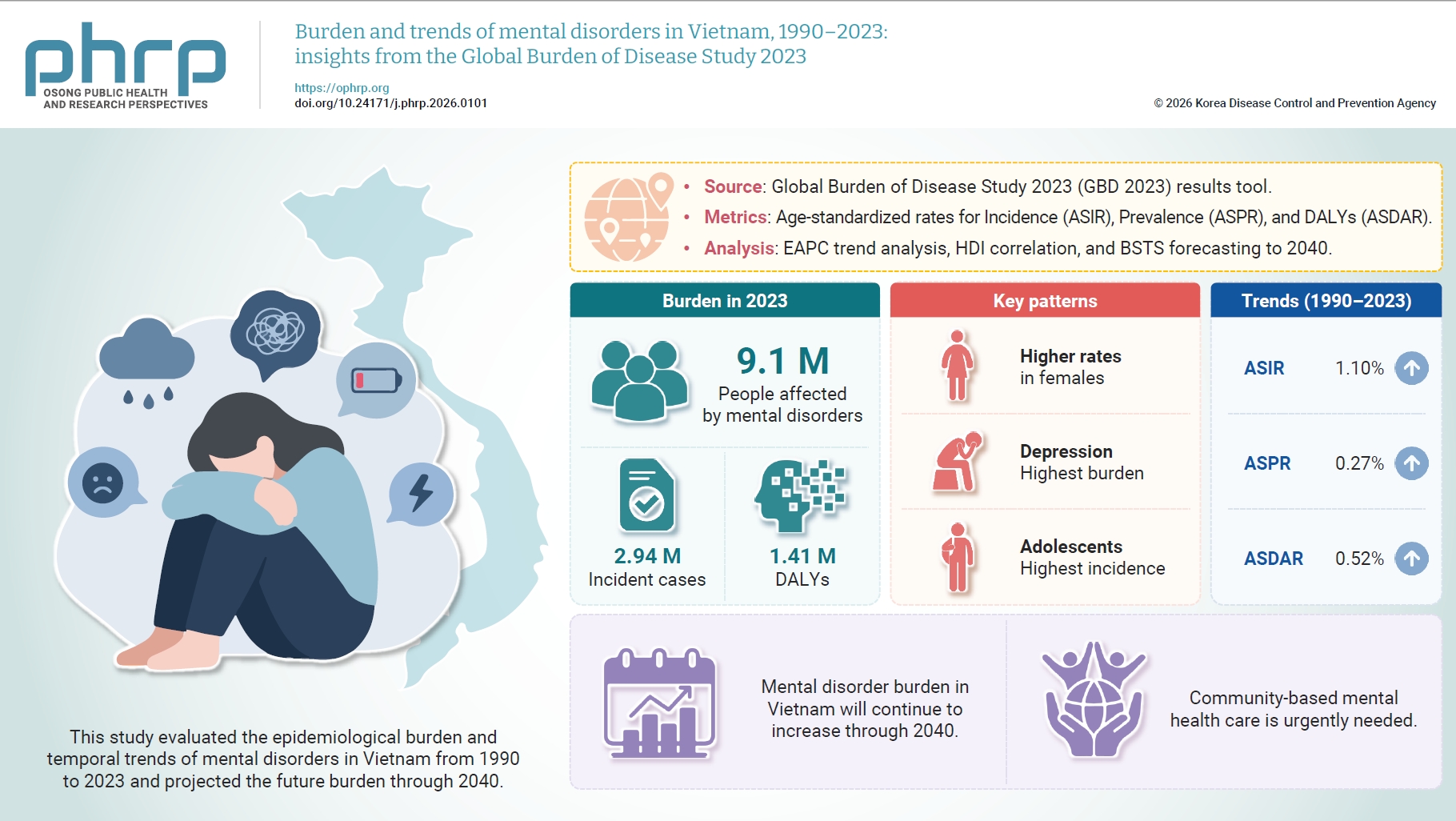
Objectives This study evaluated the epidemiological burden and temporal trends of mental disorders in Vietnam from 1990 to 2023 and projected the future burden through 2040. Methods: Global Burden of Disease Study 2023 data were used to analyze the age-standardized prevalence rate (ASPR), age-standardized incidence rate (ASIR), and age-standardized disability-adjusted life-year rate (ASDAR) by age, sex, and diagnostic subtype. Temporal trends were quantified using the estimated annual percentage change (EAPC), and Pearson correlation analysis examined associations with Vietnam’s human development index (HDI). Bayesian structural time series (BSTS) models were used to forecast the burden through 2040. Results: In 2023, approximately 9.1 million individuals in Vietnam had mental disorders, with 2.94 million annual incident cases and 1.41 million disability-adjusted life-years. Depressive disorders ranked highest across all metrics, and females consistently had higher agestandardized rates than males. Age-standardized rates increased significantly from 1990 to 2023: ASIR, 1.10% EAPC (95% confidence interval [CI], 0.87%–1.33%); ASPR, 0.27% EAPC (95% CI, 0.21%–0.33%); and ASDAR, 0.52% EAPC (95% CI, 0.46%–0.58%). Mental disorder burden was strongly positively correlated with HDI (r =0.773–0.909, all p<0.001). BSTS models projected continued increases through 2040 (ASPR, 9,003.75; ASIR, 3,307.11; ASDAR, 1,408.05 per 100,000 population). Conclusion: Mental disorders constitute an escalating public health challenge in Vietnam, with the burden increasing steadily over 3 decades and projected to continue rising through 2040. Reorientation toward an integrated, community-based care model, alongside targeted workforce expansion and systematic integration of mental health services into primary care, is essential to mitigate this growing burden.
<sec>
<title>Objectives</title>
<p>Cardiovascular disease (CVD) has a substantial financial impact on healthcare systems in the US. This study aimed to examine the impact of CVD on health insurance coverage and health service use under economic stress as indicated by the Great Recession in the US (December 2007–June 2009).</p></sec>
<sec>
<title>Methods</title>
<p>Data of 26,483 adults aged ≥ 20 years from the 2003–2012 National Health and Nutrition Examination Survey were analyzed. There were 9,479 adults assigned to the group “before the Great Recession” (2003–2006), 5,674 adults assigned to “during the Great Recession” (2007–2008), and 11,330 adults assigned to “after the Great Recession” (2009–2012).</p></sec>
<sec>
<title>Results</title>
<p>Patients with CVD from low-income families were more likely to have health insurance during the recession (OR:1.57, 95% CI: 1.01,2.45). Those participants without CVD, who were from low-income families or < 65 years, were more likely to use the emergency room rather than primary care facilities to gain access to routine healthcare (<italic>p</italic> < 0.05). Patients with CVD from high-income families were also more likely to use the emergency room (<italic>p</italic> < 0.05). Patients with CVD but not those without CVD, who reported a high family income or were ≥ 65 years old, were less likely to use mental health services during the recession than before the recession.</p></sec>
<sec>
<title>Conclusion</title>
<p>Effective strategies need to be developed to promote primary care use among the general adult American population. In addition, use of mental health services among patients with CVD needs to be improved when financial stress occurs.</p></sec>
<sec>
<title>Objectives</title>
<p>Hand, Foot and Mouth disease (HFMD) is a highly contagious viral disease that affects young children and frequently causes epidemics. A vaccine is available in China (enterovirus 71) and, the Republic of Korea took the first step to develop a new vaccine. New vaccine development requires that disease burden is calculated in advance so the financial cost, morbidity and mortality can be measured.</p></sec>
<sec>
<title>Methods</title>
<p>Data from National Sentinel Surveillance and health insurance systems of 1 million claimants were used. Direct medical and non-medical costs, indirect (caregiving and premature death) costs, cases and related deaths were summarized.</p></sec>
<sec>
<title>Results</title>
<p>From 2010 to 2014, there were an estimated 3,605 to 9,271 cases of HFMD, with 1 to 3 deaths. The estimated socioeconomic disease burden ranged from 80.5 to 164.2 million USD and was similar to that of hepatitis A (93.6–103.8 million USD). Among each costs, costs of caregiving consisted of highest proportion mainly due to hiring caregivers (50% – 60%) or opportunity costs from day off (62% – 69%).</p></sec>
<sec>
<title>Conclusion</title>
<p>Considering the social impact of HFMD, the estimated socioeconomic disease burden is not high and government policies need to focus on reducing the loss of work in caregivers.</p></sec>
Citations
Citations to this article as recorded by
How urbanization shapes the effectiveness of school closures on hand, foot, and mouth disease Yazhen Zhang, Juan Zhang, Xuefeng Zhang, Hui Jin International Journal of Infectious Diseases.2025; 154: 107845. CrossRef
Progress in research and development of preventive vaccines for children in China XuYang Zheng, Ge Jin Frontiers in Pediatrics.2024;[Epub] CrossRef
The Hand, Foot, and Mouth Disease Sentinel Surveillance System in South Korea: Retrospective Evaluation Study Bryan Inho Kim, Chiara Achangwa, Seonghui Cho, Jisoo Ahn, Jisu Won, Hyunkyung Do, Dayeong Lee, Bohye Yoon, Joohee Kim, Sukhyun Ryu JMIR Public Health and Surveillance.2024; 10: e59446. CrossRef
Association of public health and social measures on the hand-foot-mouth epidemic in South Korea Sukhyun Ryu, Changhee Han, Sheikh Taslim Ali, Chiara Achangwa, Bingyi Yang, Sen Pei Journal of Infection and Public Health.2023; 16(6): 859. CrossRef
Dynamical analysis for a reaction-diffusion HFMD model with nonsmooth saturation treatment function Lei Shi, Hongyong Zhao, Daiyong Wu Communications in Nonlinear Science and Numerical .2021; 95: 105593. CrossRef
A stage structure HFMD model with temperature-dependent latent period Hongyong Zhao, Lei Shi, Jing Wang, Kai Wang Applied Mathematical Modelling.2021; 93: 745. CrossRef
A reaction-diffusion HFMD model with nonsmooth treatment function Lei Shi, Hongyong Zhao, Daiyong Wu Advances in Difference Equations.2021;[Epub] CrossRef
Development and comparison of forecast models of hand-foot-mouth disease with meteorological factors Tao Fu, Ting Chen, Zhen-Bin Dong, Shu-Ying Luo, Ziping Miao, Xiu-Ping Song, Ru-Ting Huang, Ji-Min Sun Scientific Reports.2019;[Epub] CrossRef
Application of a combined model with seasonal autoregressive integrated moving average and support vector regression in forecasting hand-foot-mouth disease incidence in Wuhan, China Jiao-Jiao Zou, Gao-Feng Jiang, Xiao-Xu Xie, Juan Huang, Xiao-Bing Yang Medicine.2019; 98(6): e14195. CrossRef



 First
 Prev


