Objectives This study developed deep neural network (DNN) models capable of accurately classifying major adverse cardiac events (MACE) in patients with acute myocardial infarction (AMI) after hospital discharge, across 3 follow-up intervals: 1, 6, and 12 months. Methods: DNN models were constructed to predict post-discharge MACE across 4 categories. Multiple traditional machine learning models were implemented as controls to benchmark the performance of our DNN approach. All models were evaluated based on their ability to predict MACE occurrence during the specified follow-up periods. Results: The DNN models demonstrated superior predictive performance over conventional machine learning methods, achieving high accuracies of 0.922, 0.884, and 0.913 for the 1-month, 6-month, and 12-month follow-up periods, respectively. Conclusion: The high accuracy of our DNN models highlights their practical advantages for AMI diagnosis and guidance of follow-up treatment. These models can serve as valuable decision support tools, enabling clinicians to optimize the overall management of AMI patients and potentially enhance their hospitalization experience.
Citations
Citations to this article as recorded by
Artificial intelligence and biohealth: the Republic of Korea’s emerging priorities in health care R&D Jong-Koo Lee Osong Public Health and Research Perspectives.2025; 16(4): 309. CrossRef
Objectives Public health workers have been at the forefront of treating patients with coronavirus disease 2019 (COVID-19) and managing the pandemic. The redeployment of this workforce has limited or interrupted other public health services, including testing for human immunodeficiency virus (HIV). This study aims to examine the impact of COVID-19 on HIV testing and diagnosis in the Republic of Korea from 2016 to 2021, comparing data before and after the onset of COVID-19.
Methods Annual HIV testing data were collected from each institution through direct communication or from open-source databases. The annual number of new HIV cases was obtained from the official report of the Korea Disease Control and Prevention Agency. Data on healthcare visits for HIV diagnosis or treatment were extracted from the open-source database of the National Insurance Health Service of Korea. Interrupted time series regression was conducted, stratified by institution type.
Results In 2020, HIV tests, diagnoses, and visits decreased. Notably, public health centers experienced a substantial reduction in 2020−2021 compared to previous years. The annual percentage change in HIV tests was −53.0%, while for HIV diagnoses, it was −31.6%. The decrease in visits for HIV was also most pronounced for public facilities: −33.3% in 2020 and −45.6% in 2021 relative to 2019.
Conclusion The numbers of tests, diagnoses, and healthcare visits for HIV at public health centers in the Republic of Korea substantially decreased in 2020 and 2021. The impacts of these changes on the early diagnosis and treatment of HIV necessitate further monitoring.
Citations
Citations to this article as recorded by
Multidimensional Trends and AI-Based Forecasts of HIV Incidence in Korea, 1985–2024 Seungho Baek, Haneol Cho, Chansoo Kim, Yeonju Kim Journal of Epidemiology and Global Health.2026;[Epub] CrossRef
Trends in HIV testing and Seroprevalence among key populations at public health centers in South Korea, 2011–2023: a nationwide analysis Jin-Sook Wang, Eun Ji Kim, Gayeong Kim, Seolhui Kim, Heui Man Kim, Na Rae Jo, Tae-Young Heo, Myung-Guk Han BMC Public Health.2025;[Epub] CrossRef
Epidemiological Characteristics of HIV-Infected Individuals by the Registration for Special Exempted Calculation: A Nationwide Cohort Study Yunsu Choi, Kyoung Hwan Ahn, Soo Min Kim, Bo Youl Choi, Jungsoon Choi, Jung Ho Kim, Shin-Woo Kim, Youn Jeong Kim, Yoon Hee Jun, Bo Young Park Infection & Chemotherapy.2024; 56(4): 510. CrossRef
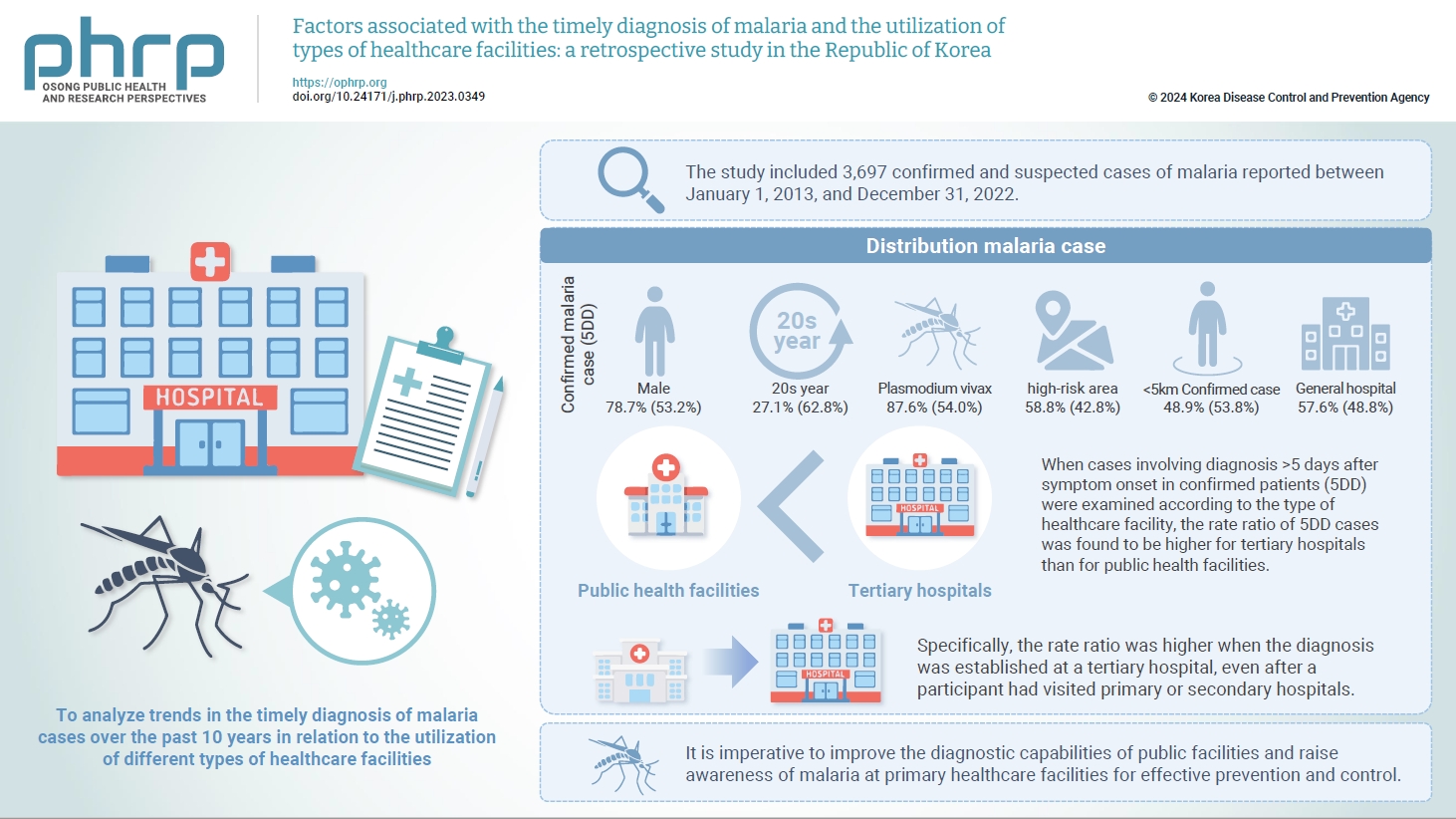
Objectives This study aimed to analyze trends in the timely diagnosis of malaria cases over the past 10 years in relation to the utilization of different types of healthcare facilities. Methods: The study included 3,697 confirmed and suspected cases of malaria reported between January 1, 2013, and December 31, 2022, in the national integrative disease and healthcare management system. Some cases lacking a case report or with information missing from the case report were excluded from the analysis. A generalized linear model with a Poisson distribution was constructed to estimate risk ratios and 95% confidence intervals adjusted for other variables, such as distance. Results: When cases involving diagnosis >5 days after symptom onset in confirmed patients (5DD) were examined according to the type of healthcare facility, the risk ratio of 5DD cases was found to be higher for tertiary hospitals than for public health facilities. Specifically, the risk ratio was higher when the diagnosis was established at a tertiary hospital, even after a participant had visited primary or secondary hospitals. In an analysis adjusted for the distance to each participant’s healthcare facility, the results did not differ substantially from the results of the crude analysis. Conclusion: It is imperative to improve the diagnostic capabilities of public facilities and raise awareness of malaria at primary healthcare facilities for effective prevention and control.
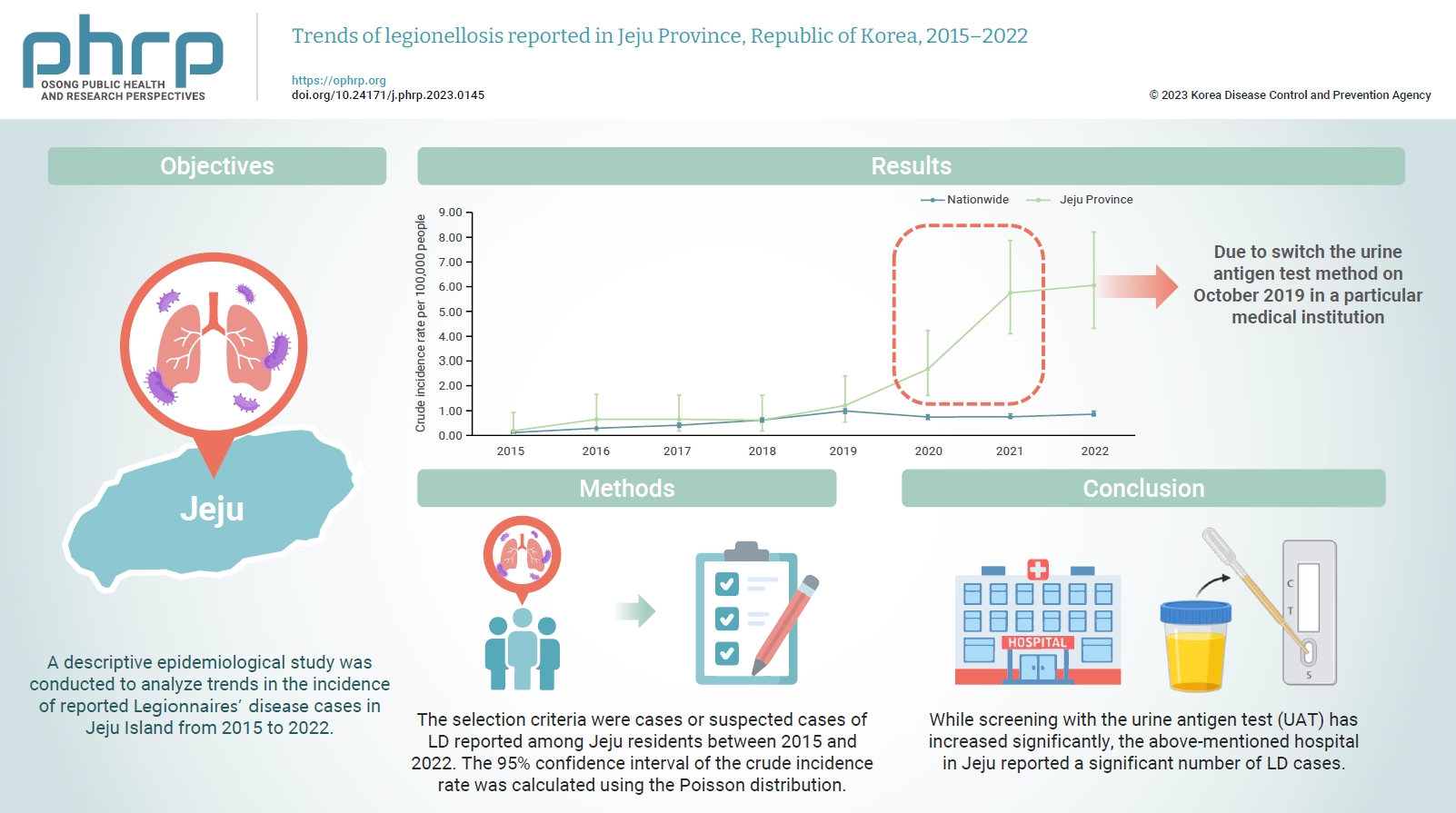
Objectives The number of reported cases of Legionnaires’ disease (LD) in the Republic of Korea surged nationally in 2016; however, in 2022, this number was higher in Jeju Province than the previous national peak. A descriptive epidemiological study was conducted to analyze trends in the incidence of reported LD cases in Jeju Island from 2015 to 2022.
Methods The data for this study were obtained from case reports submitted to the Korea Disease Control and Prevention Agency through its Disease and Health Integrated Management System. The selection criteria were cases or suspected cases of LD reported among Jeju residents between 2015 and 2022. The 95% confidence interval of the crude incidence rate was calculated using the Poisson distribution.
Results Since 2020, the incidence rate of LD in Jeju has risen sharply, showing a statistically significant difference from the national incidence rate. A particular medical institution in Jeju reported a significant number of LD cases. Screening with the urine antigen test (UAT) also increased significantly.
Conclusion Our findings indicate that the rapid increase in cases of LD in Jeju Province since 2020 was due to the characteristics of medical-care use among Jeju residents, which were focused on a specific medical institution. According to their clinical practice guidelines, this medical institution conducted UATs to screen patients suspected of pneumonia.
Objectives We investigated the impact of the coronavirus disease 2019 (COVID-19) pandemic on tuberculosis (TB) management in the Republic of Korea (ROK).
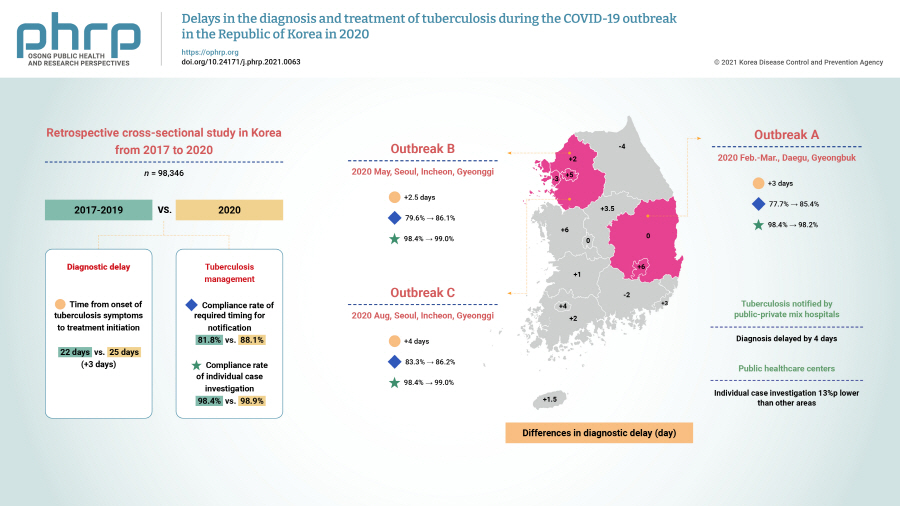
Methods This retrospective cross-sectional study used nationwide ROK TB notification data (98,346 cases) from 2017 to 2020. The median time from the onset of TB symptoms to treatment initiation and the compliance rates with the required timing for notification and individual case investigations were measured and compared across periods and regions affected by the COVID-19 epidemic.
Results TB diagnosis during the COVID-19 pandemic was delayed. The median time to TB treatment initiation (25 days) in 2020 increased by 3 days compared to that of the previous 3 years (22 days) (p<0.0001). In the outbreak in Seoul, Incheon, and Gyeonggi province during August, the time to TB diagnosis was 4 days longer than in the previous 3 years (p=0.0303). In the outbreak in Daegu and Gyeongbuk province from February to March 2020, the compliance rate with the required timing for individual case investigations was 2.2%p points lower than in other areas in 2020 (p=0.0148). For public health centers, the rate was 13%p lower than in other areas (80.3% vs. 93.3%, p=0.0003).
Conclusion TB diagnoses during the COVID-19 pandemic in the ROK were delayed nationwide, especially for patients notified by public-private mix TB control hospitals. TB individual case investigations were delayed in regional COVID-19 outbreak areas (Daegu and Gyeongbuk province), especially in public health centers. Developing strategies to address this issue will be helpful for sustainable TB management during future outbreaks.
Citations
Citations to this article as recorded by
Risk Factors Associated With Tuberculosis Diagnostic Delay in the Jiangsu Province, China (2011-2021): Spatiotemporal Database Analysis Study Yifan Tang, Cheng Chen, Mingming Chen, Kai Wang, Sifan Wang, Yi Lin, Qiao Liu, Chengxiu Ling, Tenglong Li, Limei Zhu JMIR Public Health and Surveillance.2026; 12: e80052. CrossRef
Exploring the impact of the COVID-19 pandemic on the social determinants of tuberculosis in Addis Ababa, Ethiopia: a qualitative study Yeshewas Abaynew, Ahmed Ali, Girma Taye Discover Social Science and Health.2025;[Epub] CrossRef
Trends in epidemiological characteristics of pulmonary tuberculosis among children and youth in Chinese mainland from 2019 to 2024: analysis of national surveillance data Eryong Liu, Yun Wang, Fang Yuan, Xichao Ou, Tao Li, Qinglin Meng, Yanlin Zhao BMC Public Health.2025;[Epub] CrossRef
Managing Pulmonary Injury in Older Adults with Tuberculosis: The Role of Nursing Interventions Qin Zhang, Jing Guo, Haiying Lei, Qingfen Zhang Journal of Multidisciplinary Healthcare.2025; Volume 18: 7511. CrossRef
A Review of the Impact of Patent Medicine Vendors in Driving Community Tuberculosis Case Finding in the COVID-19 Pandemic in Nigeria Arinze Emmanuel Ajogwu, Onwubiko Iheanyichukwu Samuel, Nnanyelugo Longinus Ochike, Uzoma Chidinma Ajegbo, Chinedu Paschal Maduka Matrix Science Medica.2024; 8(2): 33. CrossRef
Tuberculosis: Republic of Korea, 2021 Jinsoo Min, Hyung Woo Kim, Ju Sang Kim Tuberculosis and Respiratory Diseases.2023; 86(1): 67. CrossRef
Prevalence and associated factors of diabetes mellitus among patients with tuberculosis in South Korea from 2011 to 2018: a nationwide cohort study Dawoon Jeong, Jeongha Mok, Doosoo Jeon, Hee-Yeon Kang, Hee Jin Kim, Hee-Sun Kim, Jeong Mi Seo, Hongjo Choi, Young Ae Kang BMJ Open.2023; 13(3): e069642. CrossRef
Increased Healthcare Delays in Tuberculosis Patients During the First Wave of COVID-19 Pandemic in Korea: A Nationwide Cross-Sectional Study Jinsoo Min, Yousang Ko, Hyung Woo Kim, Hyeon-Kyoung Koo, Jee Youn Oh, Yun-Jeong Jeong, Hyeon Hui Kang, Kwang Joo Park, Yong Il Hwang, Jin Woo Kim, Joong Hyun Ahn, Yangjin Jegal, Ji Young Kang, Sung-Soon Lee, Jae Seuk Park, Ju Sang Kim Journal of Korean Medical Science.2022;[Epub] CrossRef
Time trend prediction and spatial–temporal analysis of multidrug-resistant tuberculosis in Guizhou Province, China, during 2014–2020 Wang Yun, Chen Huijuan, Liao Long, Lu Xiaolong, Zhang Aihua BMC Infectious Diseases.2022;[Epub] CrossRef
Real-world association of adherence with outcomes and economic burden in patients with tuberculosis from South Korea claims data Sun-Hong Kwon, Jin Hyun Nam, Hye-Lin Kim, Hae-Young Park, Jin-Won Kwon Frontiers in Pharmacology.2022;[Epub] CrossRef
The Impact of the COVID-19 Pandemic on Tuberculosis Case Notification and Treatment Outcomes in Eswatini Hloniphile Victory Masina, I-Feng Lin, Li-Yin Chien International Journal of Public Health.2022;[Epub] CrossRef
Trends in incidences of newly notified tuberculosis in Jeju Province, Korea, 2017-2021 Jinhee Kim, Nam-Hun Kang, Jong-Myon Bae Journal of Medicine and Life Science.2022; 19(3): 103. CrossRef
<sec><title>Objectives</title><p>Understanding factors affecting advanced stage at diagnosis is vital to improve cancer outcomes and overall survival. We investigated the factors affecting later-stage cancer diagnosis.</p></sec><sec><title>Methods</title><p>Patients completed self-reported questionnaires. We collected cancer stage data from medical records review. Logistic regression analyses were performed to identify factors associated with later stage cancer at diagnosis by gender.</p></sec><sec><title>Results</title><p>In total, 1,870 cancer patients were included in the study; 55.8% were men, 31.1% had more than one comorbid condition, and 63.5% had disabilities. About half of the patients were smokers, and drank alcohol, and 58.0% were diagnosed at an advanced stage. By cancer type, lung and liver cancers (both genders), prostate (men), colorectal, cervical, and thyroid cancer (women) were more likely to be diagnosed at a later stage. After controlling for socioeconomic factors, comorbidity (odds ratio [OR], 1.48 in men) and disability (OR, 1.64 in men and 1.52 in women) remained significantly associated with late-stage diagnosis.</p></sec><sec><title>Conclusion</title><p>In this nationwide study, using combined information from patients and medical records, we found that male patients with comorbidities or disabilities, and female patients with disabilities were more likely to have advanced stage cancer at diagnosis. Targeted approaches by cancer type and health conditions are recommended.</p></sec>
Citations
Citations to this article as recorded by
Social Determinants of Health Coding Among Hospital Visits Made by Adults With Cancer Malcolm Su, Samar Bhat, Michael D. Dang, Deborah Freeland, Benjamin Johnson, Jessica I. Billig, Navid Sadeghi, Arthur S. Hong JCO Oncology Practice.2026;[Epub] CrossRef
Exploring the association between air pollution and the incidence of liver cancers Xin Wu, Xin Zhang, Xiaopeng Yu, Hongyuan Liang, Shaoshan Tang, Yao Wang Ecotoxicology and Environmental Safety.2025; 290: 117437. CrossRef
Association Between Metabolic Dysfunction-Associated Steatotic Liver Disease and Thyroid Cancer Sang Yi Moon, Minkook Son, Jung-Hwan Cho, Hye In Kim, Ji Min Han, Ji Cheol Bae, Sunghwan Suh Thyroid®.2025; 35(1): 79. CrossRef
Visual Impairment and Cancer Risk: A Nationwide Cohort Study of Adult Swedish Men and Women Leda Pistiolis, Henrik Litsne, Roger Olofsson Bagge, Kristian F. Axelsson Cancers.2025; 18(1): 147. CrossRef
Factors associated with late diagnosis of cervical cancer at two national referral hospitals, Kenya 2017: A case control study Valerian Mwenda, Martin Mwangi, Gladwell Gathecha, Joseph Kibachio, Robert Too, Zeinab Gura, Marleen Temmerman Gynecologic Oncology Reports.2024; 52: 101355. CrossRef
“I Thought It Was Better to Be Safe Than Sorry”: Factors Influencing Parental Decisions on HPV and Other Adolescent Vaccinations for Students with Intellectual Disability and/or Autism in New South Wales, Australia Allison Carter, Christiane Klinner, Alexandra Young, Iva Strnadová, Horas Wong, Cassandra Vujovich-Dunn, Christy E. Newman, Cristyn Davies, S. Rachel Skinner, Margie Danchin, Sarah Hynes, Rebecca Guy Vaccines.2024; 12(8): 922. CrossRef
Obstacles dans le dépistage du cancer du sein chez les personnes ayant un handicap Sylvia Mazellier, Rajeev Ramanah, Catherine Guldenfels, Carole Mathelin Bulletin du Cancer.2022; 109(2): 185. CrossRef
Cancer Disparities Experienced by People with Disabilities Rosemary B. Hughes, Susan Robinson-Whelen, Carly Knudson International Journal of Environmental Research an.2022; 19(15): 9187. CrossRef
Prognostic factors and survival analysis of Hurthle cell carcinoma: A population-based study Bailey M. Humphreys, Kelvin O. Memeh, Alex Funkhouser, Tanaz M. Vaghaiwalla Surgery.2022; 172(5): 1379. CrossRef
Disparities in the Diagnosis and Treatment of Bile Duct Cancer in People with Disabilities: A National Cohort Study in South Korea Seon Mee Park, So Young Kim, Kyoung Eun Yeob, Dong Wook Shin, Joung-Ho Han, Jong Heon Park, Jong Hyock Park International Journal of Environmental Research an.2022; 19(24): 16625. CrossRef
Impact of comorbidity assessment methods to predict non-cancer mortality risk in cancer patients: a retrospective observational study using the National Health Insurance Service claims-based data in Korea Sanghee Lee, Yoon Jung Chang, Hyunsoon Cho BMC Medical Research Methodology.2021;[Epub] CrossRef
Disparities in the Diagnosis, Treatment, and Survival Rate of Cervical Cancer among Women with and without Disabilities Jin Young Choi, Kyoung Eun Yeob, Seung Hwa Hong, So Young Kim, Eun-Hwan Jeong, Dong Wook Shin, Jong Heon Park, Gil-won Kang, Hak Soon Kim, Jong Hyock Park, Ichiro Kawachi Cancer Control.2021;[Epub] CrossRef
Gynecologic Care in Women With Down Syndrome Anna J. B. Smith, Jeremy Applebaum, Edward J. Tanner, George T. Capone Obstetrics & Gynecology.2020; 136(3): 518. CrossRef
Objectives
To date, no indigenous dengue virus (DENV) transmissions have been reported in Korea. However, imported dengue infections have been diagnosed in travelers returning from endemic areas. This study presents the first virological evidence of travel-associated DENV importation into South Korea. Methods
From January 2004 to June 2006, a total of 278 serum samples from 245 patients with suspected dengue fever were tested using the Panbio Dengue Duo IgM/IgG Rapid Strip Test. We selected 11 of the early symptomatic-phase sera that were negative for IgM and retrospectively studied them by virus isolation and reverse transcription-polymerase chain reaction. Results
All 11 serum samples were found to be DENV positive by reverse transcription-polymerase chain reaction and viruses were successfully isolated from seven of the 11 serum samples. All the isolates were identified as DENV serotype-1. Conclusion
We successfully isolated seven DENV serotype-1 strains for the first time in South Korea from imported infections. Considering that the vector mosquito, <i>Aedes albopictus</i>, already exists in South Korea, we propose that a vector surveillance program for dengue is urgently needed.
Citations
Citations to this article as recorded by
Integrating RT-RPA/CRISPR system for the end-point visual detection of Mayaro virus Christine Ardelle Marquez, Gna Ahn, Woo-Ri Shin, Eung Je Lee, Chan-Hee Lee, Hye-Kwon Kim, Yang-Hoon Kim, Ji-Young Ahn Molecular & Cellular Toxicology.2026; 22(1): 93. CrossRef
Serotypic and genotypic profile of dengue virus outbreaks in India between 2011 and 2017 Ashvini Kumar Yadav, Divya Namdeo, Prashant Khare, Shashwati Nema, Abhijit Pakhare, Rashmi Chowdhary, Debasis Biswas Journal of Vector Borne Diseases.2025; 62(2): 135. CrossRef
Genotypic persistence of dengue virus in the Philippines Ma. Jowina Galarion, Brian Schwem, Coleen Pangilinan, Angelo dela Tonga, Joy Ann Petronio-Santos, Erlinda delos Reyes, Raul Destura Infection, Genetics and Evolution.2019; 69: 134. CrossRef
Neutralization of Acidic Intracellular Vesicles by Niclosamide Inhibits Multiple Steps of the Dengue Virus Life Cycle In Vitro Eunhye Jung, Sangwoo Nam, Hyeryeon Oh, Sangmi Jun, Hyun-Joo Ro, Baek Kim, Meehyein Kim, Yun Young Go Scientific Reports.2019;[Epub] CrossRef
Seroprevalence of Dengue Virus Antibody in Korea Ji Hyen Lee, Han Wool Kim, Kyung-Hyo Kim Pediatric Infection & Vaccine.2018; 25(3): 132. CrossRef
Circulating Genotypes of Dengue-1 Virus in South West India, 2014–2015 Shetty Pooja, Sasidharanpillai Sabeena, Bhaskar Revti, Ramachandran Sanjay, Aithal Anjali, Kumar Rajendra, Sushama Aswathyraj, Dsouza Giselle, Maity Hindol, Govindakarnavar Arunkumar Japanese Journal of Infectious Diseases.2017; 70(6): 663. CrossRef
WITHDRAWN: A disease around the corner Hae-Wol Cho, Chaeshin Chu Osong Public Health and Research Perspectives.2016;[Epub] CrossRef
A Disease Around the Corner Hae-Wol Cho, Chaeshin Chu Osong Public Health and Research Perspectives.2016; 7(1): 1. CrossRef
Prevalence of Neutralizing Antibodies to Japanese Encephalitis Virus among High-Risk Age Groups in South Korea, 2010 Eun Ju Lee, Go-Woon Cha, Young Ran Ju, Myung Guk Han, Won-Ja Lee, Young Eui Jeong, Nagendra R Hegde PLOS ONE.2016; 11(1): e0147841. CrossRef
Laboratory-acquired dengue virus infection by needlestick injury: a case report, South Korea, 2014 Changhwan Lee, Eun Jung Jang, Donghyok Kwon, Heun Choi, Jung Wan Park, Geun-Ryang Bae Annals of Occupational and Environmental Medicine.2016;[Epub] CrossRef
A Pan-Dengue Virus Reverse Transcription-Insulated Isothermal PCR Assay Intended for Point-of-Need Diagnosis of Dengue Virus Infection by Use of the POCKIT Nucleic Acid Analyzer Yun Young Go, R. P. V. Jayanthe Rajapakse, Senanayake A. M. Kularatne, Pei-Yu Alison Lee, Keun Bon Ku, Sangwoo Nam, Pin-Hsing Chou, Yun-Long Tsai, Yu-Lun Liu, Hsiao-Fen Grace Chang, Hwa-Tang Thomas Wang, Udeni B. R. Balasuriya, M. J. Loeffelholz Journal of Clinical Microbiology.2016; 54(6): 1528. CrossRef
Comparison of the Epidemiological Aspects of Imported Dengue Cases between Korea and Japan, 2006–2010 Young Eui Jeong, Won-Chang Lee, Jung Eun Cho, Myung-Guk Han, Won-Ja Lee Osong Public Health and Research Perspectives.2016; 7(1): 71. CrossRef
Complete Genome Sequences of Three Clinical Isolates of Dengue Virus Serotype 1 from South Korean Travelers Yun Young Go, Eunhye Jung, Young Eui Jeong, Udeni B. R. Balasuriya Genome Announcements.2015;[Epub] CrossRef
Comparison of Four Serological Tests for Detecting Antibodies to Japanese Encephalitis Virus after Vaccination in Children Go Woon Cha, Jung Eun Cho, Young Ran Ju, Young-Jin Hong, Myung Guk Han, Won-Ja Lee, Eui Yul Choi, Young Eui Jeong Osong Public Health and Research Perspectives.2014; 5(5): 286. CrossRef
Dengue virus type 1 clade replacement in recurring homotypic outbreaks Boon-Teong Teoh, Sing-Sin Sam, Kim-Kee Tan, Jefree Johari, Meng-Hooi Shu, Mohammed Bashar Danlami, Juraina Abd-Jamil, NorAziyah MatRahim, Nor Muhammad Mahadi, Sazaly AbuBakar BMC Evolutionary Biology.2013;[Epub] CrossRef
Travel-Associated Chikungunya Cases in South Korea during 2009–2010 Go Woon Cha, Jung Eun Cho, Eun Ju Lee, Young Ran Ju, Myung Guk Han, Chan Park, Young Eui Jeong Osong Public Health and Research Perspectives.2013; 4(3): 170. CrossRef
The Road Less Traveled Chaeshin Chu Osong Public Health and Research Perspectives.2011; 2(1): 1. CrossRef



 First
 Prev


