

Search
- Page Path
- HOME > Search
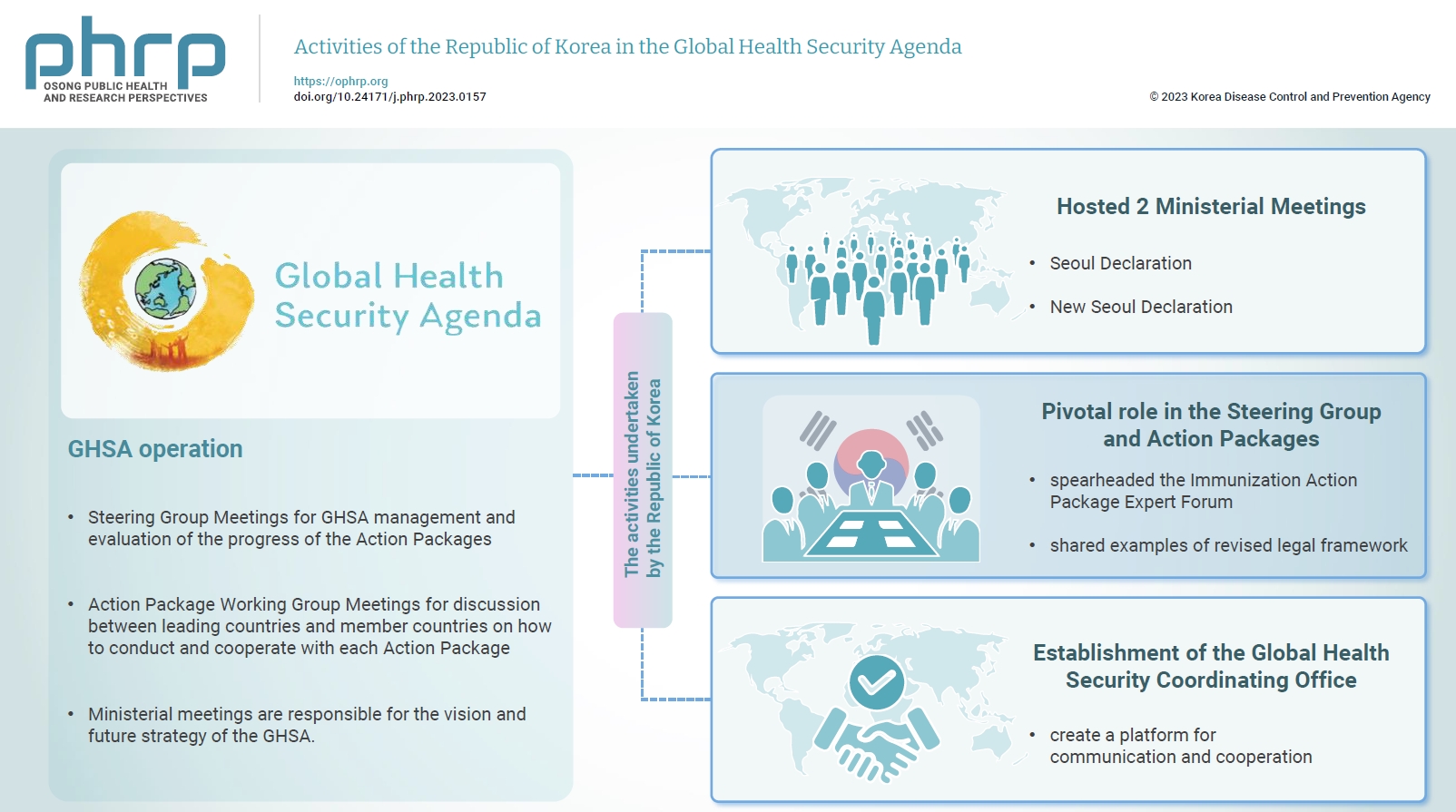
- Activities of the Republic of Korea in the Global Health Security Agenda
- Gang Lip Kim, Sookhyun Lee, So Yoon Kim
- Osong Public Health Res Perspect. 2024;15(1):90-93. Published online February 19, 2024
- DOI: https://doi.org/10.24171/j.phrp.2023.0157
- 578 View
- 138 Download
- Epidemiological characteristics of carbapenemase-producing Enterobacteriaceae outbreaks in the Republic of Korea between 2017 and 2022
- Hyoseon Jeong, Junghee Hyun, Yeon-Kyeng Lee
- Osong Public Health Res Perspect. 2023;14(4):312-320. Published online August 21, 2023
- DOI: https://doi.org/10.24171/j.phrp.2023.0069
- 1,087 View
- 144 Download
- 2 Crossref
-
 Graphical Abstract
 Abstract
 PDF
PDF 
- Objectives
We aimed to describe the epidemiological characteristics of carbapenemase-producing Enterobacteriaceae (CPE) outbreaks in healthcare settings in the Republic of Korea between 2017 and 2022.
Methods
Under the national notifiable disease surveillance system, we obtained annual descriptive statistics regarding the isolated species, carbapenemase genotype, healthcare facility type, outbreak location and duration, and number of patients affected and recommended interventions. We used epidemiological investigation reports on CPE outbreaks reported to Korea Disease Control and Prevention Agency from June 2017 to September 2022.
Results
Among the 168 reports analyzed, Klebsiella pneumoniae (85.1%) was the most frequently reported species, while K. pneumoniae carbapenemase (KPC, 82.7%) was the most common carbapenemase genotype. Both categories increased from 2017 to 2022 (p<0.01). General hospitals had the highest proportion (54.8%), while tertiary general hospitals demonstrated a decreasing trend (p<0.01). The largest proportion of outbreaks occurred exclusively in intensive care units (ICUs, 44.0%), and the frequency of concurrent outbreaks in ICUs and general wards increased over time (p<0.01). The median outbreak duration rose from 43.5 days before the coronavirus disease 2019 (COVID-19) pandemic (2017–2019) to 79.5 days during the pandemic (2020–2022) (p=0.01), and the median number of patients associated with each outbreak increased from 5.0 to 6.0 (p=0.03). Frequently recommended interventions included employee education (38.1%), and 3 or more measures were proposed for 45.2% of outbreaks.
Conclusion
In the Republic of Korea, CPE outbreaks have been consistently dominated by K. pneumoniae and KPC. The size of these outbreaks increased during the COVID-19 pandemic. Our findings highlight the need for continuing efforts to control CPE outbreaks using a multimodal approach, while considering their epidemiology. -
Citations
Citations to this article as recorded by
- Comparison of clinical outcomes of patients with serial negative surveillance cultures according to a subsequent polymerase chain reaction test for carbapenemase-producing Enterobacterales
H. Seo, S. Kim, Y.W. Lee, H.S. Oh, H-S. Kim, Y.K. Kim
Journal of Hospital Infection.2024; 146: 93. CrossRef - Identifying Contact Time Required for Secondary Transmission of Clostridioides difficile Infections by Using Real-Time Locating System
Min Hyung Kim, Jaewoong Kim, Heejin Ra, Sooyeon Jeong, Yoon Soo Park, Dongju Won, Hyukmin Lee, Heejung Kim
Emerging Infectious Diseases.2024;[Epub] CrossRef
- Comparison of clinical outcomes of patients with serial negative surveillance cultures according to a subsequent polymerase chain reaction test for carbapenemase-producing Enterobacterales
- Estimating the number of severe COVID-19 cases and COVID-19-related deaths averted by a nationwide vaccination campaign in Republic of Korea
- Ji Hae Hwang, Ju Hee Lee, Eun Jung Jang, Ryu Kyung Kim, Kil Hun Lee, Seon Kyeong Park, Sang Eun Lee, Chungman Chae, Sangwon Lee, Young Joon Park
- Osong Public Health Res Perspect. 2023;14(3):164-172. Published online June 22, 2023
- DOI: https://doi.org/10.24171/j.phrp.2023.0096
- 1,723 View
- 116 Download
- 1 Web of Science
- 1 Crossref
-
Graphical Abstract
Abstract
PDF
- Objectives
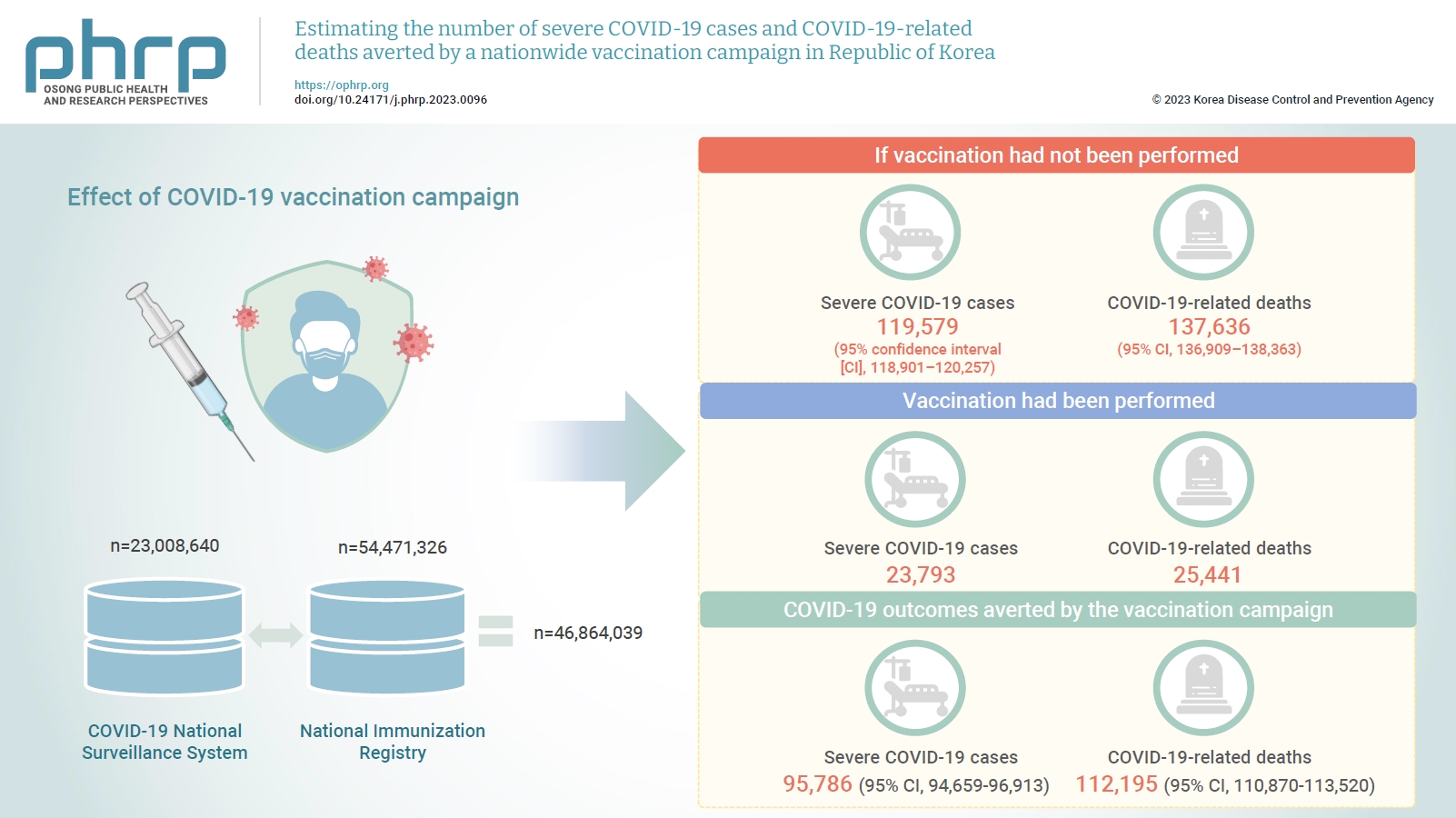
The Korea Disease Control and Prevention Agency promotes vaccination by regularly providing information on its benefits for reducing the severity of coronavirus disease 2019 (COVID-19). This study aimed to analyze the number of averted severe COVID-19 cases and COVID-19-related deaths by age group and quantify the impact of Republic of Korea’s nationwide vaccination campaign.
Methods
We analyzed an integrated database from the beginning of the vaccination campaign on February 26, 2021 to October 15, 2022. We estimated the cumulative number of severe cases and COVID-19-related deaths over time by comparing observed and estimated cases among unvaccinated and vaccinated groups using statistical modeling. We compared daily age-adjusted rates of severe cases and deaths in the unvaccinated group to those in the vaccinated group and calculated the susceptible population and proportion of vaccinated people by age.
Results
There were 23,793 severe cases and 25,441 deaths related to COVID-19. We estimated that 119,579 (95% confidence interval [CI], 118,901–120,257) severe COVID-19 cases and 137,636 (95% CI, 136,909–138,363) COVID-19-related deaths would have occurred if vaccination had not been performed. Therefore, 95,786 (95% CI, 94,659–96,913) severe cases and 112,195 (95% CI, 110,870–113,520) deaths were prevented as a result of the vaccination campaign.
Conclusion
We found that, if the nationwide COVID-19 vaccination campaign had not been implemented, the number of severe cases and deaths would have been at least 4 times higher. These findings suggest that Republic of Korea’s nationwide vaccination campaign reduced the number of severe cases and COVID-19 deaths. -
Citations
Citations to this article as recorded by- Comparative Effectiveness of COVID-19 Bivalent Versus Monovalent mRNA Vaccines in the Early Stage of Bivalent Vaccination in Korea: October 2022 to January 2023
Ryu Kyung Kim, Young June Choe, Eun Jung Jang, Chungman Chae, Ji Hae Hwang, Kil Hun Lee, Ji Ae Shim, Geun-Yong Kwon, Jae Young Lee, Young-Joon Park, Sang Won Lee, Donghyok Kwon
Journal of Korean Medical Science.2023;[Epub] CrossRef
- Comparative Effectiveness of COVID-19 Bivalent Versus Monovalent mRNA Vaccines in the Early Stage of Bivalent Vaccination in Korea: October 2022 to January 2023
- Risk factors for deaths associated with COVID-19 according to the cause of death classification in Republic of Korea
- Na-Young Kim, Seong-Sun Kim, Hyun Ju Lee, Dong Hwi Kim, Boyeong Ryu, Eunjeong Shin, Donghyok Kwon
- Osong Public Health Res Perspect. 2023;14(2):89-99. Published online April 18, 2023
- DOI: https://doi.org/10.24171/j.phrp.2022.0312
- 1,440 View
- 93 Download
-
Graphical Abstract
Abstract
PDF

- Objectives
This study aimed to classify coronavirus disease 2019 (COVID-19)-related deaths according to whether COVID-19 was listed as the cause of death, and to investigate the differences in demographic characteristics and risk factors for COVID-19 death classifications.
Methods
A total of 5,625 deaths in South Korea among patients with confirmed COVID-19 from January 20, 2020 to December 31, 2021 were selected. Excluding false reports and unnatural deaths, 5,597 deaths were analyzed. Based on death report data, deaths were classified according to whether the cause of death was listed as COVID-19 (CD) or not (NCD). The epidemiological characteristics and causes of deaths were investigated using descriptive, univariate, and multivariate statistical analyses. Odds ratios (ORs) and 95% confidence intervals (CIs) were calculated to analyze the risk factors.
Results
The case fatality ratio was 0.89% and increased with age. Additionally, 96.4% of the subjects had an underlying disease, and 53.4% died in winter. The proportion of NCDs was 9.3%, of whom 19.1% died at home and 39.0% were confirmed to have COVID-19 after death. Malignant neoplasms (102/416 vs. 637/4,442; OR, 1.71; 95% CI, 1.36−2.16; p<0.001) were significantly associated with NCD.
Conclusion
This is the first study to analyze risk factors by cause of death using COVID-19 death report data in South Korea. These results are expected to be used as evidence for establishing a death monitoring system that can collect timely information in a new infectious disease pandemic.
- Estimated impact of the national hepatitis B immunization program on acute viral hepatitis B among adolescents in Republic of Korea
- Chungman Chae, Sangwoo Tak
- Osong Public Health Res Perspect. 2023;14(2):138-145. Published online March 24, 2023
- DOI: https://doi.org/10.24171/j.phrp.2022.0321
- 1,527 View
- 62 Download
-
Graphical Abstract
Abstract
PDF
- Objectives
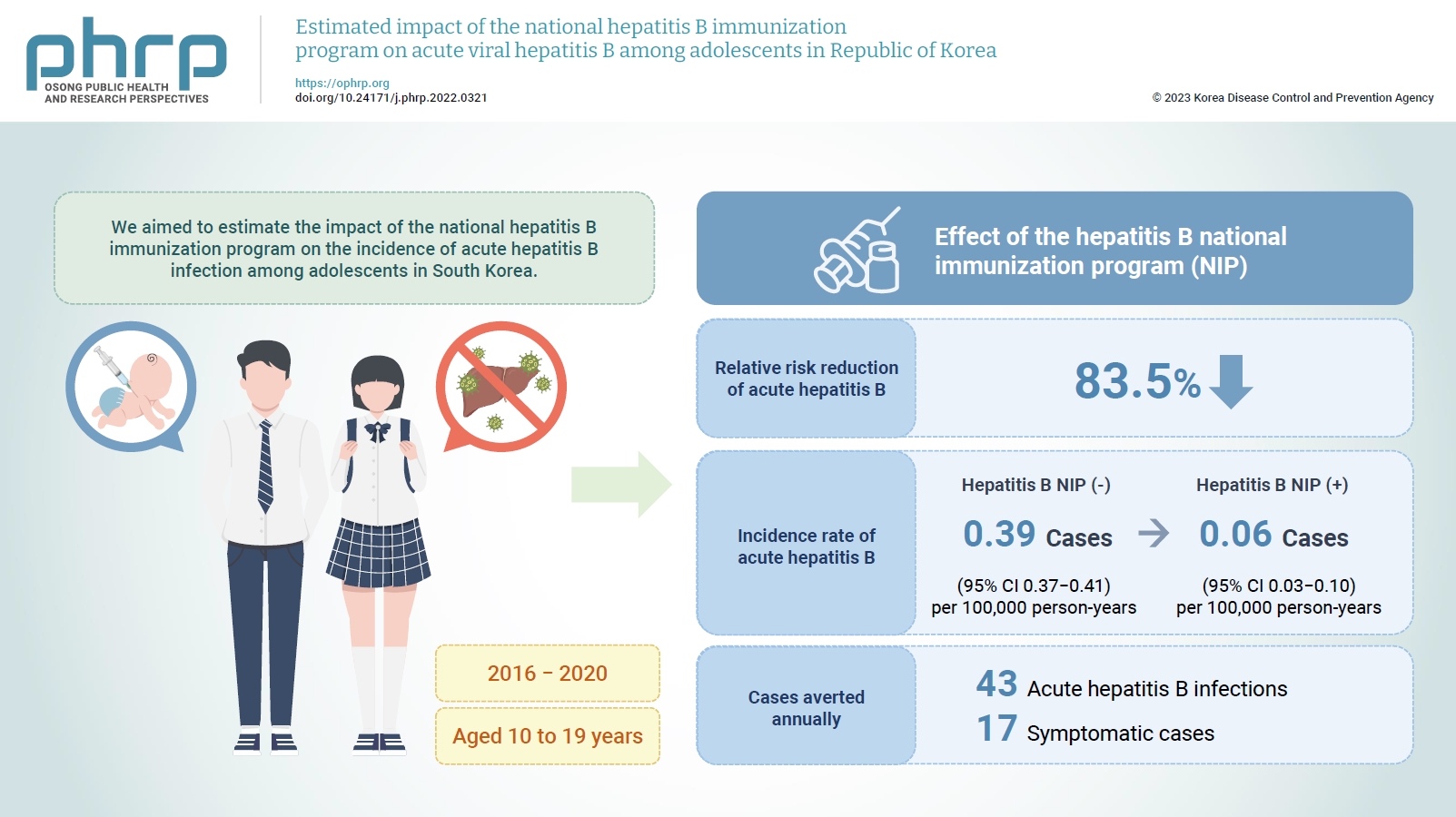
We aimed to estimate the impact of the national hepatitis B immunization program on the incidence of acute hepatitis B infection among adolescents in South Korea.
Methods
We estimated the counterfactual incidence rate of reported acute hepatitis B among adolescents from 2016 to 2020 compared to the assumption that the national hepatitis B immunization program for children had not been implemented since 1995. The impact of the national hepatitis B immunization program for adolescents was measured by estimating the absolute risk reduction and averted acute hepatitis B infections among adolescents from 2016 to 2020 attributed to the national immunization program.
Results
The relative risk reduction of acute hepatitis B among adolescents was estimated to be 83.5% after implementing the national hepatitis B immunization program. The incidence rate of reported acute hepatitis B infections among adolescents decreased from 0.39 to 0.06 per 100,000 person-years, and 43 acute hepatitis B infections, including 17 symptomatic cases, were averted annually from 2016 to 2020 by the national hepatitis B immunization program.
Conclusion
The national hepatitis B immunization program for children was effective in preventing acute hepatitis B infection among adolescents in South Korea.
- Investigation of SARS-CoV-2 lineages and mutations circulating in a university-affiliated hospital in South Korea analyzed using Oxford Nanopore MinION sequencing
- Hyaekang Kim, Sung Hee Chung, Hyun Soo Kim, Han-Sung Kim, Wonkeun Song, Ki Ho Hong, Jae-Seok Kim
- Osong Public Health Res Perspect. 2022;13(5):360-369. Published online October 11, 2022
- DOI: https://doi.org/10.24171/j.phrp.2022.0183
- 3,077 View
- 76 Download
- 2 Web of Science
- 2 Crossref
-
Abstract
PDF
 Supplementary Material
 - Objectives
Despite the introduction of vaccines, treatments, and massive diagnostic testing, the evolution of severe acute respiratory syndrome coronavirus 2 (SARS-CoV-2) has continued to overcome barriers that had slowed its previous spread. As the virus evolves towards increasing fitness, it is critical to continue monitoring the occurrence of new mutations that could evade human efforts to control them. Methods: We performed whole-genome sequencing using Oxford Nanopore MinION sequencing on 58 SARS-CoV-2 isolates collected during the ongoing coronavirus disease 2019 pandemic at a tertiary hospital in South Korea and tracked the emergence of mutations responsible for massive spikes in South Korea. Results: The differences among lineages were more pronounced in the spike gene, especially in the receptor-binding domain (RBD), than in other genes. Those RBD mutations could compromise neutralization by antibodies elicited by vaccination or previous infections. We also reported multiple incidences of Omicron variants carrying mutations that could impair the diagnostic sensitivity of reverse transcription-polymerase chain reaction-based testing. Conclusion: These results provide an understanding of the temporal changes of variants and mutations that have been circulating in South Korea and their potential impacts on antigenicity, therapeutics, and diagnostic escape of the virus. We also showed that the utilization of the nanopore sequencing platform and the ARTIC workf low can provide convenient and accurate SARS-CoV-2 genomic surveillance even at a single hospital. -
Citations
Citations to this article as recorded by- Understanding large scale sequencing datasets through changes to protein folding
David Shorthouse, Harris Lister, Gemma S Freeman, Benjamin A Hall
Briefings in Functional Genomics.2024;[Epub] CrossRef - Molecular epidemiology of SARS‐CoV‐2 in Mongolia, first experience with nanopore sequencing in lower‐ and middle‐income countries setting
Munkhtuya Erendereg, Suvd Tumurbaatar, Otgonjargal Byambaa, Gerelmaa Enebish, Natsagdorj Burged, Tungalag Khurelsukh, Nomin‐Erdene Baatar, Badmaarag Munkhjin, Jargaltulga Ulziijargal, Anuujin Gantumur, Oyunbaatar Altanbayar, Ochbadrakh Batjargal, Delgermu
Immunity, Inflammation and Disease.2023;[Epub] CrossRef
- Understanding large scale sequencing datasets through changes to protein folding
- Genomic Surveillance of SARS-CoV-2: Distribution of Clades in the Republic of Korea in 2020
- Ae Kyung Park, Il-Hwan Kim, Junyoung Kim, Jeong-Min Kim, Heui Man Kim, Chae young Lee, Myung-Guk Han, Gi-Eun Rhie, Donghyok Kwon, Jeong-Gu Nam, Young-Joon Park, Jin Gwack, Nam-Joo Lee, SangHee Woo, Jin Sun No, Jaehee Lee, Jeemin Ha, JeeEun Rhee, Cheon-Kwon Yoo, Eun-Jin Kim
- Osong Public Health Res Perspect. 2021;12(1):37-43. Published online February 23, 2021
- DOI: https://doi.org/10.24171/j.phrp.2021.12.1.06
- 9,153 View
- 223 Download
- 21 Web of Science
- 22 Crossref
-
Abstract
PDF
Since a novel beta-coronavirus, severe acute respiratory syndrome coronavirus 2 (SARS-CoV-2) was first reported in December 2019, there has been a rapid global spread of the virus. Genomic surveillance was conducted on samples isolated from infected individuals to monitor the spread of genetic variants of SARS-CoV-2 in Korea. The Korea Disease Control and Prevention Agency performed whole genome sequencing of SARS-CoV-2 in Korea for 1 year (January 2020 to January 2021). A total of 2,488 SARS-CoV-2 cases were sequenced (including 648 cases from abroad). Initially, the prevalent clades of SARS-CoV-2 were the S and V clades, however, by March 2020, GH clade was the most dominant. Only international travelers were identified as having G or GR clades, and since the first variant 501Y.V1 was identified (from a traveler from the United Kingdom on December 22nd, 2020), a total of 27 variants of 501Y.V1, 501Y.V2, and 484K.V2 have been classified (as of January 25th, 2021). The results in this study indicated that quarantining of travelers entering Korea successfully prevented dissemination of the SARS-CoV-2 variants in Korea.
-
Citations
Citations to this article as recorded by- Increased viral load in patients infected with severe acute respiratory syndrome coronavirus 2 Omicron variant in the Republic of Korea
Jeong-Min Kim, Dongju Kim, Nam-Joo Lee, Sang Hee Woo, Jaehee Lee, Hyeokjin Lee, Ae Kyung Park, Jeong-Ah Kim, Chae Young Lee, Il-Hwan Kim, Cheon Kwon Yoo, Eun-Jin Kim
Osong Public Health and Research Perspectives.2023; 14(4): 272. CrossRef - Rapid Emergence of the Omicron Variant of Severe Acute Respiratory Syndrome Coronavirus 2 in Korea
Ae Kyung Park, Il-Hwan Kim, Chae Young Lee, Jeong-Ah Kim, Hyeokjin Lee, Heui Man Kim, Nam-Joo Lee, SangHee Woo, Jaehee Lee, JeeEun Rhee, Cheon-Kwon Yoo, Eun-Jin Kim
Annals of Laboratory Medicine.2023; 43(2): 211. CrossRef - A Seroprevalence Study on Residents in a Senior Care Facility with Breakthrough SARS-CoV-2 Omicron Infection
Heui Man Kim, Eun Ju Lee, Sang Won O, Yong Jun Choi, Hyeokjin Lee, Sae Jin Oh, Jeong-Min Kim, Ae Kyung Park, Jeong-Ah Kim, Chae young Lee, Jong Mu Kim, Hanul Park, Young Joon Park, Jeong-Hee Yu, Eun-Young Kim, Hwa-Pyeong Ko, Eun-Jin Kim
Viral Immunology.2023; 36(3): 203. CrossRef - COVID-19 Cases and Deaths among Healthcare Personnel with the Progression of the Pandemic in Korea from March 2020 to February 2022
Yeonju Kim, Sung-Chan Yang, Jinhwa Jang, Shin Young Park, Seong Sun Kim, Chansoo Kim, Donghyok Kwon, Sang-Won Lee
Tropical Medicine and Infectious Disease.2023; 8(6): 308. CrossRef - The COVID-19 pandemic and healthcare utilization in Iran: evidence from an interrupted time series analysis
Monireh Mahmoodpour-Azari, Satar Rezaei, Nasim Badiee, Mohammad Hajizadeh, Ali Mohammadi, Ali Kazemi-Karyani, Shahin Soltani, Mehdi Khezeli
Osong Public Health and Research Perspectives.2023; 14(3): 180. CrossRef - Online Phylogenetics with matOptimize Produces Equivalent Trees and is Dramatically More Efficient for Large SARS-CoV-2 Phylogenies than de novo and Maximum-Likelihood Implementations
Alexander M Kramer, Bryan Thornlow, Cheng Ye, Nicola De Maio, Jakob McBroome, Angie S Hinrichs, Robert Lanfear, Yatish Turakhia, Russell Corbett-Detig, Olivier Gascuel
Systematic Biology.2023; 72(5): 1039. CrossRef - Genomic epidemiology of SARS-CoV-2 variants in South Korea between January 2020 and February 2023
Il-Hwan Kim, Jin Sun No, Jeong-Ah Kim, Ae Kyung Park, HyeokJin Lee, Jeong-Min Kim, Nam-Joo Lee, Chi-Kyeong Kim, Chae Young Lee, SangHee Woo, Jaehee Lee, JeeEun Rhee, Eun-Jin Kim
Virology.2023; 587: 109869. CrossRef - Genomic evidence of SARS‐CoV‐2 reinfection in the Republic of Korea
Ae Kyung Park, Jee Eun Rhee, Il‐Hwan Kim, Heui Man Kim, Hyeokjin Lee, Jeong‐Ah Kim, Chae Young Lee, Nam‐Joo Lee, SangHee Woo, Jaehee Lee, Jin Sun No, Gi‐Eun Rhie, Seong Jin Wang, Sang‐Eun Lee, Young Joon Park, Gemma Park, Jung Yeon Kim, Jin Gwack, Cheon‐K
Journal of Medical Virology.2022; 94(4): 1717. CrossRef - SARS-CoV-2 B.1.619 and B.1.620 Lineages, South Korea, 2021
Ae Kyung Park, Il-Hwan Kim, Heui Man Kim, Hyeokjin Lee, Nam-Joo Lee, Jeong-Ah Kim, SangHee Woo, Chae young Lee, Jaehee Lee, Sae Jin Oh, JeeEun Rhee, Cheon-Kwon Yoo, Eun-Jin Kim
Emerging Infectious Diseases.2022; 28(2): 415. CrossRef - Humoral and Cellular Responses to COVID-19 Vaccines in SARS-CoV-2 Infection-Naïve and -Recovered Korean Individuals
Ji-Young Hwang, Yunhwa Kim, Kyung-Min Lee, Eun-Jeong Jang, Chang-Hoon Woo, Chang-Ui Hong, Seok-Tae Choi, Sivilay Xayaheuang, Jong-Geol Jang, June-Hong Ahn, Hosun Park
Vaccines.2022; 10(2): 332. CrossRef - Increase in Viral Load in Patients With SARS-CoV-2 Delta Variant Infection in the Republic of Korea
Jeong-Min Kim, Jee Eun Rhee, Myeongsu Yoo, Heui Man Kim, Nam-Joo Lee, Sang Hee Woo, Hye-Jun Jo, Donghyok Kwon, Sangwon Lee, Cheon Kwon Yoo, Eun-Jin Kim
Frontiers in Microbiology.2022;[Epub] CrossRef - Molecular Dynamics Studies on the Structural Stability Prediction of SARS-CoV-2 Variants Including Multiple Mutants
Kwang-Eun Choi, Jeong-Min Kim, Jee Eun Rhee, Ae Kyung Park, Eun-Jin Kim, Cheon Kwon Yoo, Nam Sook Kang
International Journal of Molecular Sciences.2022; 23(9): 4956. CrossRef - SARS-CoV-2 shedding dynamics and transmission in immunosuppressed patients
Jee-Soo Lee, Ki Wook Yun, Hyeonju Jeong, Boram Kim, Man Jin Kim, Jae Hyeon Park, Ho Seob Shin, Hyeon Sae Oh, Hobin Sung, Myung Gi Song, Sung Im Cho, So Yeon Kim, Chang Kyung Kang, Pyoeng Gyun Choe, Wan Beom Park, Nam Joong Kim, Myoung-Don Oh, Eun Hwa Choi
Virulence.2022; 13(1): 1242. CrossRef - Immunological and Pathological Peculiarity of Severe Acute Respiratory Syndrome Coronavirus 2 Beta Variant
Sunhee Lee, Gun Young Yoon, Su Jin Lee, Young-Chan Kwon, Hyun Woo Moon, Yu-Jin Kim, Haesoo Kim, Wooseong Lee, Gi Uk Jeong, Chonsaeng Kim, Kyun-Do Kim, Seong-Jun Kim, Dae-Gyun Ahn, Miguel Angel Martinez
Microbiology Spectrum.2022;[Epub] CrossRef - Clinical scoring system to predict viable viral shedding in patients with COVID-19
Sung Woon Kang, Heedo Park, Ji Yeun Kim, Sunghee Park, So Yun Lim, Sohyun Lee, Joon-Yong Bae, Jeonghun Kim, Seongman Bae, Jiwon Jung, Min Jae Kim, Yong Pil Chong, Sang-Oh Lee, Sang-Ho Choi, Yang Soo Kim, Sung-Cheol Yun, Man-Seong Park, Sung-Han Kim
Journal of Clinical Virology.2022; 157: 105319. CrossRef - Model-informed COVID-19 exit strategy with projections of SARS-CoV-2 infections generated by variants in the Republic of Korea
Sung-mok Jung, Kyungmin Huh, Munkhzul Radnaabaatar, Jaehun Jung
BMC Public Health.2022;[Epub] CrossRef - Comparative analysis of mutational hotspots in the spike protein of SARS-CoV-2 isolates from different geographic origins
Sanghoo Lee, Mi-Kyeong Lee, Hyeongkyun Na, Jinwoo Ahn, Gayeon Hong, Youngkee Lee, Jimyeong Park, Yejin Kim, Yun-Tae Kim, Chang-Ki Kim, Hwan-Sub Lim, Kyoung-Ryul Lee
Gene Reports.2021; 23: 101100. CrossRef - Review of Current COVID-19 Diagnostics and Opportunities for Further Development
Yan Mardian, Herman Kosasih, Muhammad Karyana, Aaron Neal, Chuen-Yen Lau
Frontiers in Medicine.2021;[Epub] CrossRef - Locally harvested Covid-19 convalescent plasma could probably help combat the geographically determined SARS-CoV-2 viral variants
Manish Raturi, Anuradha Kusum, Mansi Kala, Garima Mittal, Anita Sharma, Naveen Bansal
Transfusion Clinique et Biologique.2021; 28(3): 300. CrossRef - Molecular Dynamics Studies on the Structural Characteristics for the Stability Prediction of SARS-CoV-2
Kwang-Eun Choi, Jeong-Min Kim, JeeEun Rhee, Ae Kyung Park, Eun-Jin Kim, Nam Sook Kang
International Journal of Molecular Sciences.2021; 22(16): 8714. CrossRef - Management following the first confirmed case of SARS-CoV-2 in a domestic cat associated with a massive outbreak in South Korea
Taewon Han, Boyeong Ryu, Suyeon Lee, Yugyeong Song, Yoongje Jeong, Ilhwan Kim, Jeongmin Kim, Eunjin Kim, Wonjun Lee, Hyunju Lee, Haekyoung Hwang
One Health.2021; 13: 100328. CrossRef - Genomic epidemiology reveals the reduction of the introduction and spread of SARS-CoV-2 after implementing control strategies in Republic of Korea, 2020
Jung-Hoon Kwon, Jeong-Min Kim, Dong-hun Lee, Ae Kyung Park, Il-Hwan Kim, Da-Won Kim, Ji-Yun Kim, Noori Lim, Kyeong-Yeon Cho, Heui Man Kim, Nam-Joo Lee, SangHee Woo, Chae Young Lee, Jin Sun No, Junyoung Kim, JeeEun Rhee, Myung-Guk Han, Gi-Eun Rhie, Cheon K
Virus Evolution.2021;[Epub] CrossRef
- Increased viral load in patients infected with severe acute respiratory syndrome coronavirus 2 Omicron variant in the Republic of Korea
- Detection of Novel Coronavirus on the Surface of Environmental Materials Contaminated by COVID-19 Patients in the Republic of Korea
- Sang-Eun Lee, Deog-Yong Lee, Wook-Gyo Lee, ByeongHak Kang, Yoon Suk Jang, Boyeong Ryu, SeungJae Lee, Hyunjung Bahk, Eungyu Lee
- Osong Public Health Res Perspect. 2020;11(3):128-132. Published online May 8, 2020
- DOI: https://doi.org/10.24171/j.phrp.2020.11.3.03
- 8,848 View
- 281 Download
- 45 Web of Science
- 22 Crossref
-
Abstract
PDF
This study aimed to determine the presence of SARS-CoV-2 on surfaces frequently touched by COVID-19 patients, and assess the scope of contamination and transmissibility in facilities where the outbreaks occurred. In the course of this epidemiological investigation, a total of 80 environmental specimens were collected from 6 hospitals (68 specimens) and 2 “mass facilities” (6 specimens from a rehabilitation center and 6 specimens from an apartment building complex). Specific reverse transcriptase-polymerase chain reaction targeting of RNA-dependent RNA polymerase, and envelope genes, were used to identify the presence of this novel coronavirus. The 68 specimens from 6 hospitals (A, B, C, D, E, and G), where prior disinfection/cleaning had been performed before environmental sampling, tested negative for SARS-CoV-2. However, 2 out of 12 specimens (16.7%) from 2 “mass facilities” (F and H), where prior disinfection/cleaning had not taken place, were positive for SARS-CoV-2 RNA polymerase, and envelope genes. These results suggest that prompt disinfection and cleaning of potentially contaminated surfaces is an effective infection control measure. By inactivating SARS-CoV-2 with disinfection/cleaning the infectivity and transmission of the virus is blocked. This investigation of environmental sampling may help in the understanding of risk assessment of the COVID-19 outbreak in “mass facilities” and provide guidance in using effective disinfectants on contaminated surfaces.
-
Citations
Citations to this article as recorded by- Assessing the impact of architectural and behavioral interventions for controlling indoor COVID-19 infection risk: An agent-based approach
Anxiao Zhang, Qi Zhen, Chi Zheng, Jing Li, Yue Zheng, Yiming Du, Qiong Huang, Qi Zhang
Journal of Building Engineering.2023; 74: 106807. CrossRef - Advancements in COVID-19 Testing: An In-depth Overview
Rajesh Kumar, Seetha Harilal, Abdullah G. Al-Sehemi, Mehboobali Pannipara, Githa Elizabeth Mathew, Bijo Mathew
Current Pharmaceutical Biotechnology.2023; 24(9): 1122. CrossRef - Coronavirus disease 2019 (COVID-19) research agenda for healthcare epidemiology
Lona Mody, Ibukunoluwa C. Akinboyo, Hilary M. Babcock, Werner E. Bischoff, Vincent Chi-Chung Cheng, Kathleen Chiotos, Kimberly C. Claeys, K. C. Coffey, Daniel J. Diekema, Curtis J. Donskey, Katherine D. Ellingson, Heather M. Gilmartin, Shruti K. Gohil, An
Infection Control & Hospital Epidemiology.2022; 43(2): 156. CrossRef - SARS-CoV-2 on Surfaces and HVAC Filters in Dormitory Rooms
Jin Pan, Seth A. Hawks, Aaron J. Prussin, Nisha K. Duggal, Linsey C. Marr
Environmental Science & Technology Letters.2022; 9(1): 71. CrossRef - COVID-19 Cluster Linked to Aerosol Transmission of SARS-CoV-2 via Floor Drains
Taewon Han, Heedo Park, Yungje Jeong, Jungmin Lee, Eungyeong Shon, Man-Seong Park, Minki Sung
The Journal of Infectious Diseases.2022; 225(9): 1554. CrossRef - Environmental Contamination with SARS-CoV-2 in Hospital COVID Department: Antigen Test, Real-Time RT-PCR and Virus Isolation
Urška Rozman, Lea Knez, Goran Novak, Jernej Golob, Anita Pulko, Mojca Cimerman, Matjaž Ocepek, Urška Kuhar, Sonja Šostar Turk
COVID.2022; 2(8): 1050. CrossRef - Using Environmental Sampling to Enable Zoonotic Pandemic Preparedness
Avirup Sanyal, Sanskriti Agarwal, Uma Ramakrishnan, Kritika M. Garg, Balaji Chattopadhyay
Journal of the Indian Institute of Science.2022; 102(2): 711. CrossRef - Anforderungen an die Hygiene bei der Reinigung und Desinfektion von Flächen
Bundesgesundheitsblatt - Gesundheitsforschung - Ge.2022; 65(10): 1074. CrossRef - SARS-CoV-2 pandemic: a review of molecular diagnostic tools including sample collection and commercial response with associated advantages and limitations
Harikrishnan Jayamohan, Christopher J. Lambert, Himanshu J. Sant, Alexander Jafek, Dhruv Patel, Haidong Feng, Michael Beeman, Tawsif Mahmood, Ugochukwu Nze, Bruce K. Gale
Analytical and Bioanalytical Chemistry.2021; 413(1): 49. CrossRef - Contamination of inert surfaces by SARS-CoV-2: Persistence, stability and infectivity. A review
Montse Marquès, José L. Domingo
Environmental Research.2021; 193: 110559. CrossRef - A Systematic Review of Surface Contamination, Stability, and Disinfection Data on SARS-CoV-2 (Through July 10, 2020)
Noah Bedrosian, Elizabeth Mitchell, Elsa Rohm, Miguel Rothe, Christine Kelly, Gabrielle String, Daniele Lantagne
Environmental Science & Technology.2021; 55(7): 4162. CrossRef - Transmission of Severe Acute Respiratory Syndrome Coronavirus 2 via Contaminated Surfaces: What Is to Be Done?
Craig S Conover
Clinical Infectious Diseases.2021; 72(11): 2062. CrossRef - Investigation of SARS CoV-2 virus in environmental surface
Abdollah Dargahi, Farhad Jeddi, Mehdi Vosoughi, Chiman Karami, Aidin Hadisi, S. Ahamad Mokhtari, Hasan Ghobadi, Morteza Alighadri, Somayeh Biparva Haghighi, Hadi Sadeghi
Environmental Research.2021; 195: 110765. CrossRef - Ist die Desinfektion öffentlicher Flächen zur Prävention von SARS-CoV-2 – infektionen sinnvoll?
Günter Kampf, Lutz Jatzwauk
Das Gesundheitswesen.2021; 83(03): 180. CrossRef - SARS-CoV-2 Detection Rates from Surface Samples Do Not Implicate Public Surfaces as Relevant Sources for Transmission
Günter Kampf, Stephanie Pfaender, Emanuel Goldman, Eike Steinmann
Hygiene.2021; 1(1): 24. CrossRef - The SARS-CoV-2 (COVID-19) pandemic in hospital: An insight into environmental surfaces contamination, disinfectants’ efficiency, and estimation of plastic waste production
Faezeh seif, Zahra Noorimotlagh, Seyyed Abbas Mirzaee, Mojtaba Kalantar, Barat Barati, Mahdi Emamian Fard, Nozar Kalantar Fard
Environmental Research.2021; 202: 111809. CrossRef - Prevalence of SARS-CoV-2 RNA on inanimate surfaces: a systematic review and meta-analysis
Simone Belluco, Marzia Mancin, Filippo Marzoli, Alessio Bortolami, Eva Mazzetto, Alessandra Pezzuto, Michela Favretti, Calogero Terregino, Francesco Bonfante, Roberto Piro
European Journal of Epidemiology.2021; 36(7): 685. CrossRef - Management following the first confirmed case of SARS-CoV-2 in a domestic cat associated with a massive outbreak in South Korea
Taewon Han, Boyeong Ryu, Suyeon Lee, Yugyeong Song, Yoongje Jeong, Ilhwan Kim, Jeongmin Kim, Eunjin Kim, Wonjun Lee, Hyunju Lee, Haekyoung Hwang
One Health.2021; 13: 100328. CrossRef - Non-Respiratory Droplet Transmission of COVID-19 in the Isolation Ward of a Secondary Hospital in Oman
Zayid K. Al Mayahi, Nawal Al Kindi, Nasser Al Shaqsi, Noaman Al Hattali, Azza Al Hattali, Khalid Salim, Mark Beatty
Infectious Diseases in Clinical Practice.2021; 29(6): e371. CrossRef - Effectiveness of antiviral metal and metal oxide thin-film coatings against human coronavirus 229E
Louis-Vincent Delumeau, Hatameh Asgarimoghaddam, Tamiru Alkie, Alexander James Bryan Jones, Samantha Lum, Kissan Mistry, Marc G. Aucoin, Stephanie DeWitte-Orr, Kevin P. Musselman
APL Materials.2021;[Epub] CrossRef - Rapid Review of SARS-CoV-1 and SARS-CoV-2 Viability, Susceptibility to Treatment, and the Disinfection and Reuse of PPE, Particularly Filtering Facepiece Respirators
José G. B. Derraik, William A. Anderson, Elizabeth A. Connelly, Yvonne C. Anderson
International Journal of Environmental Research an.2020; 17(17): 6117. CrossRef - Potential sources, modes of transmission and effectiveness of prevention measures against SARS-CoV-2
G. Kampf, Y. Brüggemann, H.E.J. Kaba, J. Steinmann, S. Pfaender, S. Scheithauer, E. Steinmann
Journal of Hospital Infection.2020; 106(4): 678. CrossRef
- Assessing the impact of architectural and behavioral interventions for controlling indoor COVID-19 infection risk: An agent-based approach
- Army Soldiers’ Knowledge of, Attitude Towards, and Preventive Behavior Towards Tuberculosis in Korea
- Yun Choi, Geum Hee Jeong
- Osong Public Health Res Perspect. 2018;9(5):269-277. Published online October 31, 2018
- DOI: https://doi.org/10.24171/j.phrp.2018.9.5.09
- 6,346 View
- 150 Download
- 6 Crossref
-
Abstract
PDF
Objectives The aim of this study was to gather information about Korean Army soldiers’ attitude towards tuberculosis to enable the development of an informed educational program and potential intervention plans.
Methods There were 500 male soldiers serving in the Korean Army who responded to questionnaires regarding knowledge of, attitudes towards, and preventive behavior towards tuberculosis. The questionnaires were collected between September 10 until October 1, 2014. Participants’ characteristic that influenced differences in knowledge, attitudes, and preventive behavior towards tuberculosis were compared by
t test. Variables that influenced preventive behavior were identified by multiple regression analysis.Results The mean scores assessing knowledge of, attitude, and preventive behavior towards tuberculosis were 11.64 (± 4.03) out of 20 points, 3.21 (± 0.38) out of 4 points, and 2.88 (± 0.42) out of 4 points, respectively. Non-smokers were more knowledgeable about tuberculosis than smokers. Participants who had family or friends with tuberculosis had better knowledge and a more productive attitude to tuberculosis. Participants who were educated or obtained information about tuberculosis, received better scores in all areas of knowledge, attitude and preventive behavior compared to other participants. Non-smoking, family or friends who have had tuberculosis, obtaining information about tuberculosis, and positive attitudes towards treatment and preventive education had an explanatory power of 24.6% with regard to preventive behavior against tuberculosis.
Conclusion More relatable, systemized education should be provided regularly to improve soldiers’ knowledge of, attitudes towards, and prevention against tuberculosis in the Republic of Korea Army.
-
Citations
Citations to this article as recorded by- Tingkat Pengetahuan Keluarga Tinggal Serumah Tentang Pencegahan Penularan Pasien Tuberkulosis Paru
Komang Yuliani, I Dewa Agung Ketut Sudarsana
Journal Nursing Research Publication Media (NURSEP.2023; 2(1): 47. CrossRef - Knowledge, Attitudes, and Preventative Behavior Toward Tuberculosis in University Students in Indonesia
Irma Melyani Puspitasari, Rano Kurnia Sinuraya, Arini Nurhaqiqi Aminudin, Rika Rahmi Kamilah
Infection and Drug Resistance.2022; Volume 15: 4721. CrossRef - The Relationship between Health Literacy and Preventive Behaviors of Soldiers
Javad Azimzadeh, Maryam Nezamzadeh, Fatemeh Kalroozi, Seyyed Amir Hossein Pishgooie
Military Caring Sciences.2021; 8(2): 109. CrossRef - Factors Affecting Preventive Behavior related to Tuberculosis among University Students in Korea: Focused on Knowledge, Attitude and Optimistic Bias related to Tuberculosis
Myung Soon Kwon, Yun Choi
Journal of Korean Academy of Fundamentals of Nursi.2020; 27(3): 236. CrossRef - Assessment of knowledge, attitude and practice on tuberculosis among teacher trainees of Samtse College of Education, Bhutan
Thinley Dorji, Tandin Tshering, Kinley Wangdi, Ritesh G. Menezes
PLOS ONE.2020; 15(11): e0241923. CrossRef - The Infectivity of Pulmonary Tuberculosis in Korean Army Units: Evidence from Outbreak Investigations
Chang-gyo Yoon, Dong Yoon Kang, Jaehun Jung, Soo Yon Oh, Jin Beom Lee, Mi-Hyun Kim, Younsuk Seo, Hee-Jin Kim
Tuberculosis and Respiratory Diseases.2019; 82(4): 298. CrossRef
- Tingkat Pengetahuan Keluarga Tinggal Serumah Tentang Pencegahan Penularan Pasien Tuberkulosis Paru
- Estimating the Incidence of Cases and Deaths Resulting from Hand, Foot and Mouth Disease and Its Related Socioeconomic Disease Burden in Republic of Korea (2010 – 2014)
- Donghee Seo
- Osong Public Health Res Perspect. 2018;9(3):112-117. Published online June 30, 2018
- DOI: https://doi.org/10.24171/j.phrp.2018.9.3.05
- 4,398 View
- 60 Download
- 6 Crossref
-
Abstract
PDF
Objectives Hand, Foot and Mouth disease (HFMD) is a highly contagious viral disease that affects young children and frequently causes epidemics. A vaccine is available in China (enterovirus 71) and, the Republic of Korea took the first step to develop a new vaccine. New vaccine development requires that disease burden is calculated in advance so the financial cost, morbidity and mortality can be measured.
Methods Data from National Sentinel Surveillance and health insurance systems of 1 million claimants were used. Direct medical and non-medical costs, indirect (caregiving and premature death) costs, cases and related deaths were summarized.
Results From 2010 to 2014, there were an estimated 3,605 to 9,271 cases of HFMD, with 1 to 3 deaths. The estimated socioeconomic disease burden ranged from 80.5 to 164.2 million USD and was similar to that of hepatitis A (93.6–103.8 million USD). Among each costs, costs of caregiving consisted of highest proportion mainly due to hiring caregivers (50% – 60%) or opportunity costs from day off (62% – 69%).
Conclusion Considering the social impact of HFMD, the estimated socioeconomic disease burden is not high and government policies need to focus on reducing the loss of work in caregivers.
-
Citations
Citations to this article as recorded by- Association of public health and social measures on the hand-foot-mouth epidemic in South Korea
Sukhyun Ryu, Changhee Han, Sheikh Taslim Ali, Chiara Achangwa, Bingyi Yang, Sen Pei
Journal of Infection and Public Health.2023; 16(6): 859. CrossRef - Dynamical analysis for a reaction-diffusion HFMD model with nonsmooth saturation treatment function
Lei Shi, Hongyong Zhao, Daiyong Wu
Communications in Nonlinear Science and Numerical .2021; 95: 105593. CrossRef - A stage structure HFMD model with temperature-dependent latent period
Hongyong Zhao, Lei Shi, Jing Wang, Kai Wang
Applied Mathematical Modelling.2021; 93: 745. CrossRef - A reaction-diffusion HFMD model with nonsmooth treatment function
Lei Shi, Hongyong Zhao, Daiyong Wu
Advances in Difference Equations.2021;[Epub] CrossRef - Development and comparison of forecast models of hand-foot-mouth disease with meteorological factors
Tao Fu, Ting Chen, Zhen-Bin Dong, Shu-Ying Luo, Ziping Miao, Xiu-Ping Song, Ru-Ting Huang, Ji-Min Sun
Scientific Reports.2019;[Epub] CrossRef - Application of a combined model with seasonal autoregressive integrated moving average and support vector regression in forecasting hand-foot-mouth disease incidence in Wuhan, China
Jiao-Jiao Zou, Gao-Feng Jiang, Xiao-Xu Xie, Juan Huang, Xiao-Bing Yang
Medicine.2019; 98(6): e14195. CrossRef
- Association of public health and social measures on the hand-foot-mouth epidemic in South Korea
- A Retrospective Mid- and Long-term Follow-up Study on the Changes in Hematologic Parameters in the Highly Exposed Residents of the Hebei Spirit Oil Spill in Taean, South Korea
- Young-Hyun Choi, Jee-Young Hong, Moo-Sik Lee
- Osong Public Health Res Perspect. 2017;8(5):358-366. Published online October 31, 2017
- DOI: https://doi.org/10.24171/j.phrp.2017.8.5.10
- 4,371 View
- 29 Download
- 7 Crossref
-
Abstract
PDF
Objectives This study aimed to analyze changes in hematologic parameters in the residents of the areas highly contaminated by the Hebei Spirit Oil Spill in 2007 and those who participated in the clean-up activities.
Methods According to demographic characteristics, health status and behavior, and level of exposure to oil, we compared the hematologic results in 2009 and 2012 among 701 residents. The hematologic parameters were composed of white blood cell (WBC) count, and levels of hemoglobin, hematocrit (Hct), aspartate aminotransferase (AST), alanine aminotransferase (ALT), glucose, glycosylated hemoglobin (HbA1c), blood urea nitrogen (BUN), creatinine (Cr), total cholesterol (T-chol), high-density lipoprotein (HDL), and triglyceride (TG).
Results Paired
t -test revealed that the WBC count and levels of Hct, AST, ALT, glucose, and HbA1c significantly increased, whereas the BUN, Cr, HDL, and TG levels significantly decreased. Multiple linear regression modelling showed a relationship between the level of exposure to oil and temporal changes in Hct, glucose, HbA1c, and BUN levels.Conclusion Our results suggest a relationship between level of exposure to oil and changes in hematologic parameters over 3 years. Further studies should be conducted to determine the impact of oil spill on health such as the occurrence of diseases.
-
Citations
Citations to this article as recorded by- Single and mixed effects of multiple volatile organic compounds exposure on hematological parameters in the U.S. adult population
Yan Zhuang, Laifu Li, Yanqi Zhang, Xuna Liu, Beibei Zeng, Boxu Zhu, Fei Dai
Chemosphere.2024; 355: 141825. CrossRef - Latent Trajectories of Haematological, Hepatic, and Renal Profiles after Oil Spill Exposure: A Longitudinal Analysis
Benjamin Atta Owusu, Apiradee Lim, Nitinun Pongsiri, Chanthip Intawong, Sunthorn Rheanpumikankit, Saijit Suksri, Thammasin Ingviya
International Journal of Environmental Research an.2023; 20(4): 2871. CrossRef - Haematological, renal, and hepatic function changes among Rayong oil spill clean-up workers: a longitudinal study
Benjamin Atta Owusu, Apiradee Lim, Chanthip Intawong, Sunthorn Rheanpumikankit, Saijit Suksri, Thammasin Ingviya
International Archives of Occupational and Environ.2022; 95(7): 1481. CrossRef - Association between BTEX (benzene, toluene, ethylbenzene and xylene) concentration in ambient air with hematological and spirometric indices: a population-based study
Hosna Moradkhani, Mostafa Leili, Jalal Puralajal, Ashraf Mazaheri Tehrani, Ayat Hossein Panahi, Mohammd Taghi Samadi, Sara Beheshtifar
Human and Ecological Risk Assessment: An Internati.2022; 28(5-6): 490. CrossRef - Combine effect of exposure to petrol, kerosene and diesel fumes: On hepatic oxidative stress and haematological function in rats
Solomon E Owumi, Bidemi N Oladimeji, Tobiloba C Elebiyo, Uche O Arunsi
Toxicology and Industrial Health.2021; 37(6): 336. CrossRef - Associations between blood volatile organic compounds, and changes in hematologic and biochemical profiles, in a population-based study
Sabit Cakmak, Christie Cole, Chris Hebbern, Julie Andrade, Robert Dales
Environment International.2020; 145: 106121. CrossRef - Developing Large-Scale Research in Response to an Oil Spill Disaster: a Case Study
Richard K. Kwok, Aubrey K. Miller, Kaitlyn B. Gam, Matthew D. Curry, Steven K. Ramsey, Aaron Blair, Lawrence S. Engel, Dale P. Sandler
Current Environmental Health Reports.2019; 6(3): 174. CrossRef
- Single and mixed effects of multiple volatile organic compounds exposure on hematological parameters in the U.S. adult population
- H5N8 Highly Pathogenic Avian Influenza in the Republic of Korea: Epidemiology During the First Wave, from January Through July 2014
- Hachung Yoon, Oun-Kyong Moon, Wooseog Jeong, Jida Choi, Young-Myong Kang, Hyo-Young Ahn, Jee-Hye Kim, Dae-Sung Yoo, Young-Jin Kwon, Woo-Seok Chang, Myeong-Soo Kim, Do-Soon Kim, Yong-Sang Kim, Yi-Seok Joo
- Osong Public Health Res Perspect. 2015;6(2):106-111. Published online April 30, 2015
- DOI: https://doi.org/10.1016/j.phrp.2015.01.005
- 3,002 View
- 25 Download
- 13 Crossref
-
Abstract
PDF
- Objectives
This study describes the outbreaks of H5N8 highly pathogenic avian influenza (HPAI) in Korea during the first wave, from January 16, 2014 through July 25, 2014. Its purpose is to provide a better understanding of the epidemiology of H5N8 HPAI.
Methods
Information on the outbreak farms and HPAI positive wild birds was provided by the Animal and Plant Quarantine Agency. The epidemiological investigation sheets for the outbreak farms were examined.
Results
During the 7-month outbreak period (January–July 2014), H5N8 HPAI was confirmed in 212 poultry farms, 38 specimens from wild birds (stools, birds found dead or captured). Ducks were the most frequently infected poultry species (159 outbreak farms, 75.0%), and poultry in 67 (31.6%) outbreak farms was asymptomatic.
Conclusion
As in the previous four H5N1 epidemics of HPAI that occurred in Korea, this epidemic of H5N8 proved to be associated with migratory birds. Poultry farms in Korea can hardly be free from the risk of HPAI introduced via migratory birds. The best way to overcome this geographical factor is to reinforce biosecurity to prevent exposure of farms, related people, and poultry to the pathogen. -
Citations
Citations to this article as recorded by- The global prevalence of highly pathogenic avian influenza A (H5N8) infection in birds: A systematic review and meta-analysis
Xue-Yao Yang, Qing-Long Gong, Yan-Jin Li, Emad Beshir Ata, Man-Jie Hu, Yong-Yang Sun, Zhi-Yang Xue, Ying-Shi Yang, Xue-Pan Sun, Chun-Wei Shi, Gui-Lian Yang, Hai-Bin Huang, Yan-Long Jiang, Jian-Zhong Wang, Xin Cao, Nan Wang, Yan Zeng, Wen-Tao Yang, Chun-Fe
Microbial Pathogenesis.2023; 176: 106001. CrossRef - Impact of inland waters on highly pathogenic avian influenza outbreaks in neighboring poultry farms in South Korea
Saleem Ahmad, Kyeyoung Koh, Daesung Yoo, Gukhyun Suh, Jaeil Lee, Chang-Min Lee
Journal of Veterinary Science.2022;[Epub] CrossRef - Emergence of a Novel Reassortant H5N3 Avian Influenza Virus in Korean Mallard Ducks in 2018
Seon-Ju Yeo, Vui Thi Hoang, Tuan Bao Duong, Ngoc Minh Nguyen, Hien Thi Tuong, Mudsser Azam, Haan Woo Sung, Hyun Park
Intervirology.2022; 65(1): 1. CrossRef - Wild birds as reservoirs for diverse and abundant gamma- and deltacoronaviruses
Michelle Wille, Edward C Holmes
FEMS Microbiology Reviews.2020; 44(5): 631. CrossRef - Virus–virus interactions and host ecology are associated with RNA virome structure in wild birds
Michelle Wille, John‐Sebastian Eden, Mang Shi, Marcel Klaassen, Aeron C. Hurt, Edward C. Holmes
Molecular Ecology.2018; 27(24): 5263. CrossRef - Development of Clade-Specific and Broadly Reactive Live Attenuated Influenza Virus Vaccines against Rapidly Evolving H5 Subtype Viruses
Kobporn Boonnak, Yumiko Matsuoka, Weijia Wang, Amorsolo L. Suguitan, Zhongying Chen, Myeisha Paskel, Mariana Baz, Ian Moore, Hong Jin, Kanta Subbarao, Douglas S. Lyles
Journal of Virology.2017;[Epub] CrossRef - Multidimensional analysis model for highly pathogenic avian influenza using data cube and data mining techniques
Zhenshun Xu, Jonguk Lee, Daihee Park, Yongwha Chung
Biosystems Engineering.2017; 157: 109. CrossRef - Five distinct reassortants of H5N6 highly pathogenic avian influenza A viruses affected Japan during the winter of 2016–2017
Nobuhiro Takemae, Ryota Tsunekuni, Kirill Sharshov, Taichiro Tanikawa, Yuko Uchida, Hiroshi Ito, Kosuke Soda, Tatsufumi Usui, Ivan Sobolev, Alexander Shestopalov, Tsuyoshi Yamaguchi, Junki Mine, Toshihiro Ito, Takehiko Saito
Virology.2017; 512: 8. CrossRef - Complete analysis of the H5 hemagglutinin and N8 neuraminidase phylogenetic trees reveals that the H5N8 subtype has been produced by multiple reassortment events
Andrew R. Dalby
F1000Research.2016; 5: 2463. CrossRef - Phylogenetic and biological characterization of three K1203 (H5N8)-like avian influenza A virus reassortants in China in 2014
Juan Li, Min Gu, Dong Liu, Benqi Liu, Kaijun Jiang, Lei Zhong, Kaituo Liu, Wenqi Sun, Jiao Hu, Xiaoquan Wang, Shunlin Hu, Xiaowen Liu, Xiufan Liu
Archives of Virology.2016; 161(2): 289. CrossRef - Experimental infection of SPF and Korean native chickens with highly pathogenic avian influenza virus (H5N8)
Eun-Kyoung Lee, Byung-Min Song, Hyun-Mi Kang, Sang-Hee Woo, Gyeong-Beom Heo, Suk Chan Jung, Yong Ho Park, Youn-Jeong Lee, Jae-Hong Kim
Poultry Science.2016; 95(5): 1015. CrossRef - Wild waterfowl migration and domestic duck density shape the epidemiology of highly pathogenic H5N8 influenza in the Republic of Korea
Sarah C. Hill, Youn-Jeong Lee, Byung-Min Song, Hyun-Mi Kang, Eun-Kyoung Lee, Amanda Hanna, Marius Gilbert, Ian H. Brown, Oliver G. Pybus
Infection, Genetics and Evolution.2015; 34: 267. CrossRef - Intracontinental and intercontinental dissemination of Asian H5 highly pathogenic avian influenza virus (clade 2.3.4.4) in the winter of 2014–2015
Takehiko Saito, Taichiro Tanikawa, Yuko Uchida, Nobuhiro Takemae, Katsushi Kanehira, Ryota Tsunekuni
Reviews in Medical Virology.2015; 25(6): 388. CrossRef
- The global prevalence of highly pathogenic avian influenza A (H5N8) infection in birds: A systematic review and meta-analysis
- Assessment of Intensive Vaccination and Antiviral Treatment in 2009 Influenza Pandemic in Korea
- Chaeshin Chu, Sunmi Lee
- Osong Public Health Res Perspect. 2015;6(1):47-51. Published online February 28, 2015
- DOI: https://doi.org/10.1016/j.phrp.2014.11.007
- 2,709 View
- 17 Download
- 2 Crossref
-
Abstract
PDF
- Objectives
We characterized and assessed public health measures, including intensive vaccination and antiviral treatment, implemented during the 2009 influenza pandemic in the Republic of Korea.
Methods
A mathematical model for the 2009 influenza pandemic is formulated. The transmission rate, the vaccination rate, the antiviral treatment rate, and the hospitalized rate are estimated using the least-squares method for the 2009 data of the incidence curves of the infected, vaccinated, treated, and hospitalized.
Results
The cumulative number of infected cases has reduced significantly following the implementation of the intensive vaccination and antiviral treatment. In particular, the intensive vaccination was the most critical factor that prevented severe outbreak.
Conclusion
We have found that the total infected proportion would increase by approximately six times under the half of vaccination rates. -
Citations
Citations to this article as recorded by- Modeling influenza transmission dynamics with media coverage data of the 2009 H1N1 outbreak in Korea
Yunhwan Kim, Ana Vivas Barber, Sunmi Lee, Roberto Barrio
PLOS ONE.2020; 15(6): e0232580. CrossRef - Doing Mathematics with Aftermath of Pandemic Influenza 2009
Hae-Wol Cho, Chaeshin Chu
Osong Public Health and Research Perspectives.2015; 6(1): 1. CrossRef
- Modeling influenza transmission dynamics with media coverage data of the 2009 H1N1 outbreak in Korea
- Assessment of the Intensive Countermeasures in the 2009 Pandemic Influenza in Korea
- Jin Hyuk Choi, Yunhwan Kim, Seoyun Choe, Sunmi Lee
- Osong Public Health Res Perspect. 2014;5(2):101-107. Published online April 30, 2014
- DOI: https://doi.org/10.1016/j.phrp.2014.03.003
- 2,638 View
- 18 Download
-
Abstract
PDF
- Objectives
It is critical to implement effective multiple countermeasures to mitigate or retain the spread of pandemic influenza. We propose a mathematical pandemic influenza model to assess the effectiveness of multiple countermeasures implemented in 2009.
Methods
Age-specific parameters, including the transmission rate, the proportion of asymptomatic individuals, the vaccination rate, the social distancing rate, and the antiviral treatment rate are estimated using the least-square method calibrated to the incidence data.
Results
The multiple interventions (intensive vaccination, social distancing, antivrial treatment) were successfully implemented resulting in the dramatic reduction in the total number of incidence.
Conclusion
The model output is sensitive to age-specific parameters and this leads to the fact that a more elaborate age group model should be developed and extensive further studies must be followed.
- Prevalence of Tick-Borne Encephalitis Virus in Ixodid Ticks Collected from the Republic of Korea During 2011–2012
- Seok-Min Yun, Bong Gu Song, WooYoung Choi, Won Il Park, Sung Yun Kim, Jong Yul Roh, Jungsang Ryou, Young Ran Ju, Chan Park, E-Hyun Shin
- Osong Public Health Res Perspect. 2012;3(4):213-221. Published online December 31, 2012
- DOI: https://doi.org/10.1016/j.phrp.2012.10.004
- 3,469 View
- 27 Download
- 28 Crossref
-
Abstract
PDF
- Objectives
In this study, we demonstrated that TBEV-infected ticks have been distributed in the ROK, combined with our previous results. These results suggest that TBEV may exist in the ROK, and H. longicornis, H. flava, and I. nipponensis may be potential vectors of TBEV. In addition, these results emphasize the need for further epidemiological research of TBEV.
Methods
We examined for the presence of RNA of TBEV by reverse transcriptase-nested polymerase chain reaction (RT-nested PCR) using ixodid ticks captured in 25 localities of 10 provinces. Ticks were collected by the flagging and dragging method or using sentinel BG traps at forests, grass thickets, and grassland. A total of 13,053 ticks belonging to two genera and four species were collected and pooled (1292 pools), according to collection site, species of tick, and developmental stage.
Results
Among 1292 pools, the envelope (E) protein gene of TBEV was detected using RT-nested PCR in 10 pools (3 pools of the 1,331 adult ticks and 7 pools of the 11,169 nymph ticks) collected from Gangwon-do province, Jeonrabuk-do province, and Jeju Island. The minimum infection rates for TBEV of Haemaphysalis longicornis, Haemaphysalis flava, and Ixodes nipponensis were 0.06%, 0.17%, and 2.38%, respectively. Phylogenetic analysis based on the partial E protein gene was performed to identify relationships between the TBEV strains. This showed that 10 Korean strains clustered with the Western subtype.
Conclusion
In this study, we investigated the prevalence of tick-borne encephalitis virus (TBEV) in ixodid ticks from various regions of the Republic of Korea (ROK) during 2011–2012 to identify whether TBEV is circulating and to determine the endemic regions of TBEV. -
Citations
Citations to this article as recorded by- TBE in South Korea
Joon Young Song
Tick-borne encephalitis - The Book.2023;[Epub] CrossRef - Molecular detection and phylogenetic analysis of tick‐borne encephalitis virus in ticks in northeastern China
Xiaohui Li, Hongwei Ji, Di Wang, Lihe Che, Li Zhang, Liang Li, Qing Yin, Quan Liu, Feng Wei, Zedong Wang
Journal of Medical Virology.2022; 94(2): 507. CrossRef - TBE in South Korea
Song Joon Young
Tick-borne encephalitis - The Book.2022;[Epub] CrossRef - Genomic Determinants Potentially Associated with Clinical Manifestations of Human-Pathogenic Tick-Borne Flaviviruses
Artem N. Bondaryuk, Nina V. Kulakova, Ulyana V. Potapova, Olga I. Belykh, Anzhelika V. Yudinceva, Yurij S. Bukin
International Journal of Molecular Sciences.2022; 23(21): 13404. CrossRef - TBE in South Korea
Song Joon Young
Tick-borne encephalitis - The Book.2021;[Epub] CrossRef - Hard Ticks as Vectors Tested Negative for Severe Fever with Thrombocytopenia Syndrome in Ganghwa-do, Korea during 2019-2020
Kyoung Jin, Yeon-Ja Koh, Seong Kyu Ahn, Joonghee Cho, Junghwan Lim, Jaeyong Song, Jinyoung Lee, Young Woo Gong, Mun Ju Kwon, Hyung Wook Kwon, Young Yil Bahk, Tong-Soo Kim
The Korean Journal of Parasitology.2021; 59(3): 281. CrossRef - Nationwide Temporal and Geographical Distribution of Tick Populations and Phylogenetic Analysis of Severe Fever with Thrombocytopenia Syndrome Virus in Ticks in Korea, 2020
Min-Goo Seo, Byung-Eon Noh, Hak Seon Lee, Tae-Kyu Kim, Bong-Goo Song, Hee Il Lee
Microorganisms.2021; 9(8): 1630. CrossRef - Seroepidemiologic survey of emerging vector-borne infections in South Korean forest/field workers
Ji Yun Noh, Joon Young Song, Joon Yong Bae, Man-Seong Park, Jin Gu Yoon, Hee Jin Cheong, Woo Joo Kim, Nam-Hyuk Cho
PLOS Neglected Tropical Diseases.2021; 15(8): e0009687. CrossRef - European subtype of tick-borne encephalitis virus. Literature review
Yu. S. Savinova
Acta Biomedica Scientifica.2021; 6(4): 100. CrossRef - Tick-Borne Encephalitis Virus: An Emerging Ancient Zoonosis?
Andrei A. Deviatkin, Ivan S. Kholodilov, Yulia A. Vakulenko, Galina G. Karganova, Alexander N. Lukashev
Viruses.2020; 12(2): 247. CrossRef - Characterization of tick-borne encephalitis virus isolated from a tick in central Hokkaido in 2017
Yuji Takahashi, Shintaro Kobayashi, Mariko Ishizuka, Minato Hirano, Memi Muto, Shoko Nishiyama, Hiroaki Kariwa, Kentaro Yoshii
Journal of General Virology.2020; 101(5): 497. CrossRef - A history of the introduction, establishment, dispersal and management ofHaemaphysalis longicornisNeumann, 1901 (Ixodida: Ixodidae) in New Zealand
Allen C. G. Heath
New Zealand Journal of Zoology.2020; 47(4): 241. CrossRef - Four Year Surveillance of the Vector Hard Ticks for SFTS, Ganghwa-do, Republic of Korea
Myung-Deok Kim-Jeon, Seung Jegal, Hojong Jun, Haneul Jung, Seo Hye Park, Seong Kyu Ahn, Jinyoung Lee, Young Woo Gong, Kwangsig Joo, Mun Ju Kwon, Jong Yul Roh, Wook-Gyo Lee, Young Yil Bahk, Tong-Soo Kim
The Korean Journal of Parasitology.2019; 57(6): 691. CrossRef - TBE in South Korea
Joon Young Song
Tick-borne encephalitis - The Book.2019;[Epub] CrossRef - Ixodid ticks and tick-borne encephalitis virus prevalence in the South Asian part of Russia (Republic of Tuva)
Ivan Kholodilov, Oxana Belova, Ludmila Burenkova, Yuri Korotkov, Lidiya Romanova, Lola Morozova, Vitalii Kudriavtsev, Larissa Gmyl, Ilmira Belyaletdinova, Alexander Chumakov, Natalia Chumakova, Oyumaa Dargyn, Nina Galatsevich, Anatoly Gmyl, Mikhail Mikhai
Ticks and Tick-borne Diseases.2019; 10(5): 959. CrossRef - Current Status of Tick-Borne Diseases in South Korea
Jae Hyoung Im, JiHyeon Baek, Areum Durey, Hea Yoon Kwon, Moon-Hyun Chung, Jin-Soo Lee
Vector-Borne and Zoonotic Diseases.2019; 19(4): 225. CrossRef - Molecular characterization of Haemaphysalis longicornis-borne rickettsiae, Republic of Korea and China
Ju Jiang, Huijuan An, John S. Lee, Monica L. O’Guinn, Heung-Chul Kim, Sung-Tae Chong, Yanmin Zhang, Dan Song, Roxanne G. Burrus, Yuzhou Bao, Terry A. Klein, Allen L. Richards
Ticks and Tick-borne Diseases.2018; 9(6): 1606. CrossRef - Molecular detection of Rickettsia species in ticks collected from the southwestern provinces of the Republic of Korea
Yoontae Noh, Yeong Seon Lee, Heung-Chul Kim, Sung-Tae Chong, Terry A. Klein, Ju Jiang, Allen L. Richards, Hae Kyeong Lee, Su Yeon Kim
Parasites & Vectors.2017;[Epub] CrossRef - Necessity of a Surveillance System for Tick-borne Encephalitis
Seok-Ju Yoo, Ji-Hyuk Park
Osong Public Health and Research Perspectives.2017; 8(2): 155. CrossRef - Tick-borne encephalitis in Japan, Republic of Korea and China
Kentaro Yoshii, Joon Young Song, Seong-Beom Park, Junfeng Yang, Heinz-Josef Schmitt
Emerging Microbes & Infections.2017; 6(1): 1. CrossRef - Molecular detection of severe fever with thrombocytopenia syndrome and tick-borne encephalitis viruses in ixodid ticks collected from vegetation, Republic of Korea, 2014
Seok-Min Yun, Ye-Ji Lee, WooYoung Choi, Heung-Chul Kim, Sung-Tae Chong, Kyu-Sik Chang, Jordan M. Coburn, Terry A. Klein, Won-Ja Lee
Ticks and Tick-borne Diseases.2016; 7(5): 970. CrossRef - The characterization of TBEV of European subtype circulating in Siberia, Russia
I. V. Kozlova, T. V. Demina, S. E. Tkachev, Yu. S. Savinova, E. K. Doroshchenko, O. V. Lisak, Yu. P. Dzhioev, O. V. Suntsova, M. M. Verkhozina, A. I. Paramonov, N. V. Tikunova, V. I. Zlobin, D. . Ruzek
Epidemiology and Vaccine Prevention.2016; 15(6): 30. CrossRef - Detection of SFTS Virus inIxodes nipponensisandAmblyomma testudinarium(Ixodida: Ixodidae) Collected From Reptiles in the Republic of Korea
Jae-Hwa Suh, Heung-Chul Kim, Seok-Min Yun, Jae-Won Lim, Jin-Han Kim, Sung-Tae Chong, Dae-Ho Kim, Hyun-Tae Kim, Hyun Kim, Terry A. Klein, Jaree L. Johnson, Won-Ja Lee
Journal of Medical Entomology.2016; 53(3): 584. CrossRef - Epidemiological Features and Clinical Manifestations of Lyme Borreliosis in Korea during the Period 2005^|^ndash;2012
Shinje Moon, Yeongseon Hong, Kyu-Jam Hwang, Suyeon Kim, Jihye Eom, Donghyok Kwon, Ji-Hyuk Park, Seung-Ki Youn, Aeree Sohn
Japanese Journal of Infectious Diseases.2015; 68(1): 1. CrossRef - Characteristics and Factors Associated with Death among Patients Hospitalized for Severe Fever with Thrombocytopenia Syndrome, South Korea, 2013
Jaeseung Shin, Donghyok Kwon, Seung-Ki Youn, Ji-Hyuk Park
Emerging Infectious Diseases.2015; 21(10): 1704. CrossRef - Review: Sentinels of tick-borne encephalitis risk
Maren Imhoff, Peter Hagedorn, Yesica Schulze, Wiebke Hellenbrand, Martin Pfeffer, Matthias Niedrig
Ticks and Tick-borne Diseases.2015; 6(5): 592. CrossRef - Louping ill virus (LIV) in the Far East
Galina N. Leonova, Ilya G. Kondratov, Olga S. Maystrovskaya, Ikuo Takashima, Sergei I. Belikov
Archives of Virology.2015; 160(3): 663. CrossRef - Prevalence of severe fever with thrombocytopenia syndrome virus in Haemaphysalis longicornis ticks in South Korea
Sun-Whan Park, Bong Gu Song, E-Hyun Shin, Seok-Min Yun, Myung-Guk Han, Mi Yeoun Park, Chan Park, Jungsang Ryou
Ticks and Tick-borne Diseases.2014; 5(6): 975. CrossRef
- TBE in South Korea
 First
First Prev
Prev


