Hazlienor Mohd Hatta, Kamarul Imran Musa, Suhaily Mohd Hairon, Nik Mohd Hafiz Mohd Fuzi, Normaizura Mokhter, Norfaizah Sulaiman, Amutha Ayasamy, Rohani Ismail, Rohaidah Hashim, Jason Wei Jian Ng
Received March 25, 2026 Accepted August 9, 2026 Published online October 13, 2026
Objectives Nontyphoidal Salmonella (NTS) is a major cause of foodborne illness in Malaysia. Time-series modeling can characterize temporal patterns, although structural disruptions, nonlinear dynamics, and regional variability may affect model performance. This study aimed to characterize NTS seasonality in Malaysia, assess temporal stability, and explore model-based approaches for surveillance.
Methods Monthly laboratory-confirmed human NTS cases from national laboratory surveillance databases for 2018–2024 were analyzed using time-series models, including autoregressive integrated moving-average (ARIMA) models with Fourier terms and an exploratory hybrid ARIMA–long short-term memory (LSTM) model. Interrupted time-series analysis was used to assess structural stability. Anomalies were identified using 95% prediction intervals, and stratified modeling assessed regional heterogeneity.
Results NTS cases showed recurring annual seasonal patterns of moderate strength, with temporal variation over the study period. A significant decline occurred in March 2020 (β=−62.24 cases, p=0.001), followed by gradual recovery (β=2.71 cases/month, p<0.001), suggesting a marked coronavirus disease 2019 pandemic-related disruption and a subsequent positive post-intervention trend. The ARIMA(0,1,1)–Fourier (K=1) model outperformed conventional ARIMA, benchmark, and exponential smoothing models (root mean squared error, 42.9 vs. 51.37–108.79). The hybrid ARIMA–LSTM model provided modest additional improvement, particularly during high-case periods. Model-based anomaly detection identified deviations from expected patterns that coincided with documented outbreak-associated months. Regional heterogeneity in temporal dynamics suggested the need for surveillance strategies tailored to local epidemiological patterns.
Conclusion Parsimonious models captured most temporal patterns in NTS cases, with only modest gains from more complex approaches. Context-specific modeling strategies, model-based anomaly detection, and tiered surveillance frameworks may support more proactive NTS surveillance in Malaysia.
Objectives This study assessed the economic value of 2 major initiatives within the national infectious disease response system of the Korea Disease Control and Prevention Agency (KDCA): the Training Programs for Public Health Workforce (TPPHW) and the Infectious Disease Information System (IDIS). Methods: We developed a structured estimation model to quantify the economic benefits of pandemic preparedness investments and applied it to the KDCA’s TPPHW and IDIS. The model incorporated parameters elicited from 29 senior officials into a cost-benefit analysis (CBA) framework, from which we calculated the net present value (NPV) and benefit-cost ratio (BCR) over a 10-year period, with sensitivity analyses. Results: Both initiatives yielded positive net benefits under baseline assumptions, although the margin was substantially greater for workforce training than for the information system. At the assumed discount rate of 4.5%, the CBA yielded a BCR of 2.120 and an NPV of 27.2 billion Korean won (KRW) for TPPHW. For IDIS, the corresponding values were a BCR of 1.071 and an NPV of 2.7 billion KRW. Sensitivity analysis showed that workforce training remained economically justified across all scenarios, whereas the information system remained viable only under more favorable assumptions. Conclusion: This study contributes to the literature by systematically applying CBA to infectious disease preparedness in the Republic of Korea. The findings support continued investment in skilled workforce training and integrated information infrastructure for future pandemic preparedness. The study is limited by its reliance on expert-elicited parameters and its focus on monetary benefits, excluding health outcomes such as disability-adjusted life years and quality-of-life improvements.
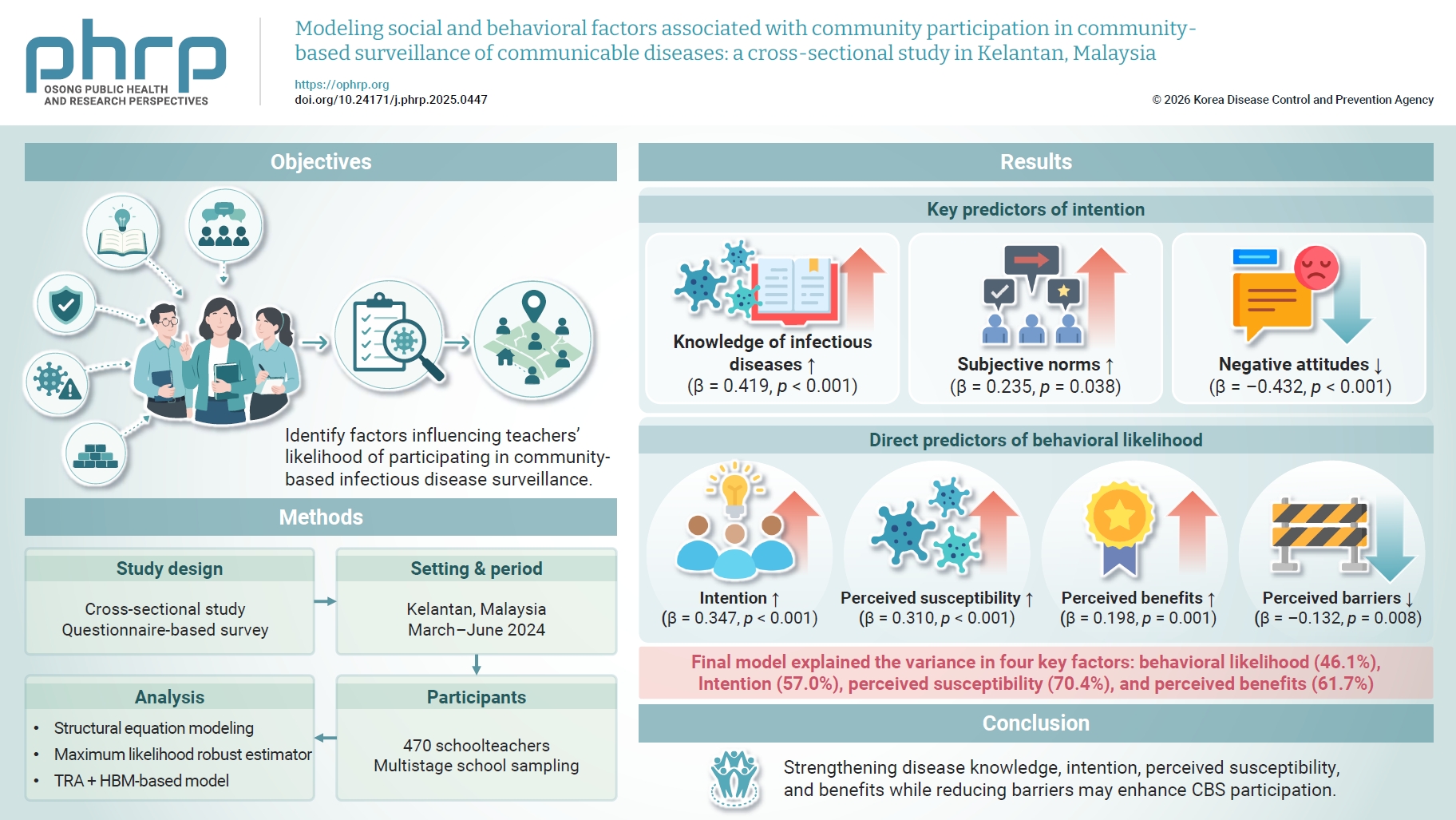
Objectives This study examined the social and behavioral factors influencing community leaders’ participation in community-based surveillance (CBS) of infectious diseases. We hypothesized that knowledge, attitudes, and perceptions significantly predict the behavioral likelihood of engaging in CBS activities. Methods: A cross-sectional study was conducted among 470 schoolteachers in Kelantan, Malaysia, from March to June 2024. Participants were selected using multistage sampling, with random selection of schools followed by convenience sampling of teachers. Data were collected using the validated KAP-CBS-ID questionnaire, which was based on the Theory of Reasoned Action and Health Belief Model. Structural equation modeling was used to analyze relationships among the study variables with the maximum likelihood robust estimator. Results: The final model demonstrated good fit (comparative fit index, 0.921; standardized root mean square residual, 0.071; root mean square error of approximation, 0.040 [90% confidence interval, 0.036–0.044]). Ten significant path relationships were identified, explaining 46.1% of the variance in behavioral likelihood. Knowledge of infectious diseases (β=0.419, p<0.001), subjective norms (β=0.235, p=0.038), and negative attitudes (β=–0.432, p<0.001) significantly influenced intention. Behavioral likelihood was directly predicted by intention (β =0.347, p<0.001), perceived susceptibility (β=0.310, p<0.001), perceived benefits (β=0.198, p=0.001), and perceived barriers (β=–0.132, p=0.008). Self-efficacy showed significant indirect effects through perceived benefits (β=0.785, p<0.001) and perceived susceptibility (β=0.765, p<0.001). Conclusion: Knowledge and psychosocial factors significantly inf luence community engagement in CBS of infectious diseases. Public health interventions should address these interconnected determinants to strengthen early disease detection and reporting systems.
Objectives This study aimed to examine the temporal dynamics of dengue cases in Malaysia from 2022 to 2024 using seasonal-trend decomposition and time-series modeling. Methods: Weekly dengue case counts from the national registry were analyzed across all states using seasonal-trend decomposition using LOESS (STL) to separate trend, seasonal, and irregular components. Autoregressive integrated moving average (ARIMA) and seasonal ARIMA (SARIMA) models were fitted to validate temporal structures, with model selection based on the Akaike information criterion (AIC), corrected AIC, and Bayesian information criterion. Diagnostic checks, including residual analysis and Ljung-Box testing, were performed to ensure model adequacy. Results: Dengue incidence showed marked heterogeneity across states. STL decomposition indicated that long-term trends contributed more strongly to case dynamics than seasonality in most states, although seasonal influences were significant in the states of Kedah and Kelantan. Seasonal peak timing varied between states, highlighting differences in epidemic cycles. ARIMA and SARIMA modeling confirmed that no single temporal structure could adequately represent all states; while some series were well fitted by simple ARIMA models, others required seasonal adjustments. Residual diagnostics demonstrated that the selected models were statistically adequate. Conclusion: Dengue dynamics in Malaysia are shaped by both trend and seasonal components, with considerable variation across states. Combining STL decomposition with ARIMA/SARIMA modeling strengthens the evidence base for state-specific forecasting and proactive vector control. Tailoring surveillance systems and interventions to local temporal patterns
Objectives
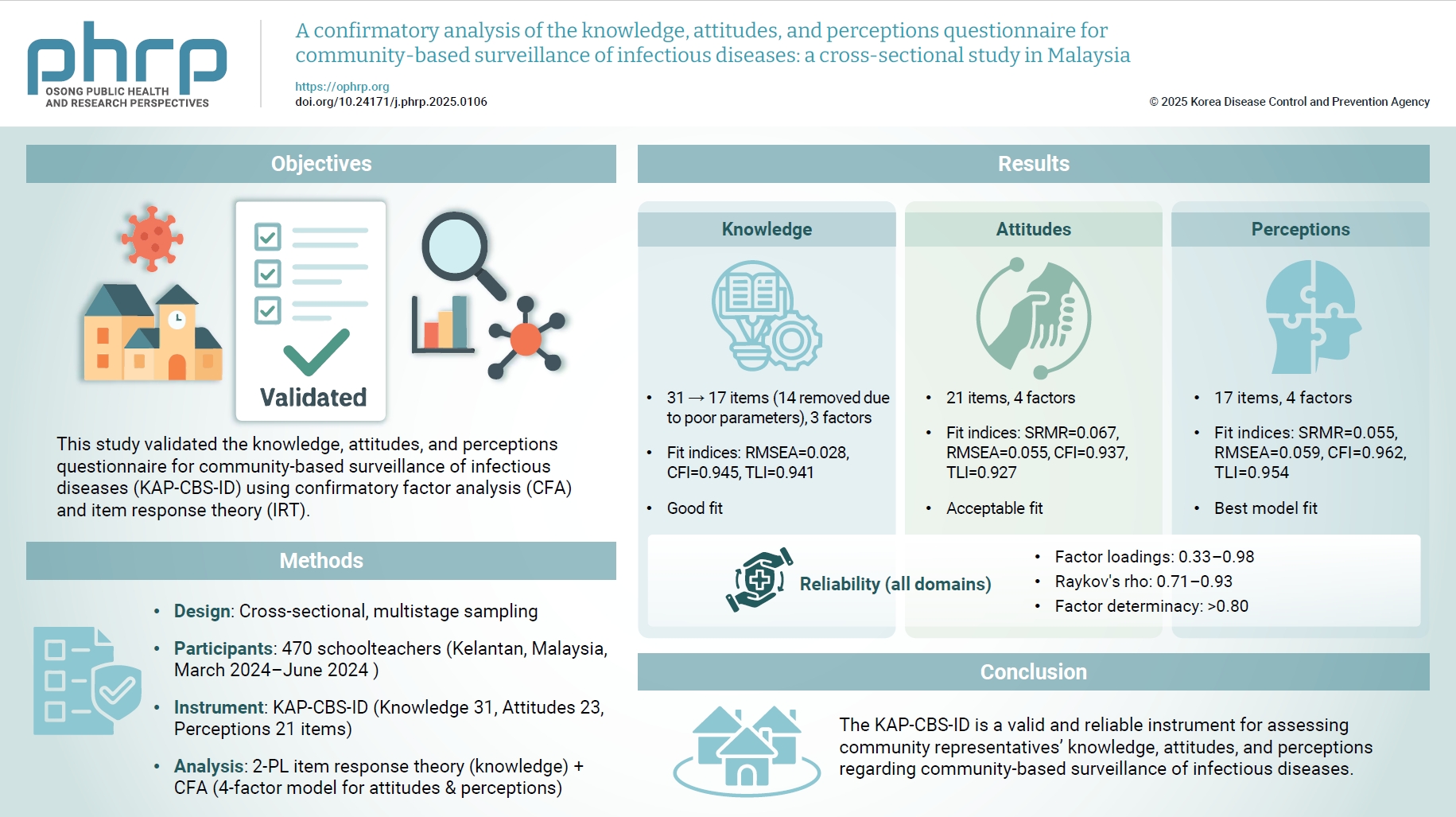
This study aimed to validate the psychometric properties of the recently developed knowledge, attitudes, and perceptions questionnaire for community-based surveillance of infectious diseases (KAP-CBS-ID questionnaire), using confirmatory factor analysis (CFA) and item response theory (IRT).
Methods
A cross-sectional study using multistage sampling recruited 470 schoolteachers from Kelantan, Malaysia. The self-administered KAP-CBS-ID questionnaire consists of 3 domains: knowledge (31 items), attitudes (23 items), and perceptions (21-items). Two-parameter logistic (2-PL) IRT analysis and CFA were performed to validate the knowledge section. For attitudes and perceptions sections, CFA proceeded using a 4-factor model to evaluate both model fit and construct validity.
Results
Two-PL IRT analysis of the knowledge section resulted in elimination of 14 items due to inadequate discrimination or difficulty parameters. The 3-factor CFA model demonstrated good fit indices for knowledge (root mean square error of approximation [RMSEA], 0.028; comparative fit index [CFI], 0.945; Tucker-Lewis index [TLI], 0.941) without any modifications. The attitudes section required re-specification, ultimately yielding 21 items across 4 factors with acceptable fit indices (standardized root mean square residual [SRMR], 0.067; RMSEA, 0.055; CFI, 0.937; TLI, 0.927). Similarly, the perceptions section was refined to 17 items across 4 factors, showing good model fit (SRMR, 0.055; RMSEA, 0.059; CFI, 0.962; TLI, 0.954). Factor loadings ranged from 0.33 to 0.98, while Raykov’s rho reliability estimates ranged from 0.71 to 0.93. Factor determinacy exceeded 80% for all factors.
Conclusion
The KAP-CBS-ID is a valid and reliable instrument for assessing community representatives’ knowledge, attitudes, and perceptions regarding community-based surveillance of infectious diseases.
Citations
Citations to this article as recorded by
Modeling social and behavioral factors associated with community participation in community-based surveillance of communicable diseases: a cross-sectional study in Kelantan, Malaysia Ahmed Azeez Hasan, Anis Kausar Ghazali, Norsa’adah Bachok, Najib Majdi Yaacob, Suhaily Mohd Hairon, Nur Amira Mohd Nadir, Fatimah Muhd Shukri Osong Public Health and Research Perspectives.2026; 17(3): 229. CrossRef
Objectives The study aimed to analyze the core capacities to implement World Health Organization International Health Regulations (IHR) in 6 countries: Indonesia, Cambodia, Vietnam, the Dominican Republic, Ghana, and the Republic of Korea. Methods: Secondary data from relevant databases and reports, including the electronic State Party Self-Assessment Annual Reporting mechanism and global health security index, were used to assess health security in these countries. Descriptive statistics summarized the basic features of the scores, and a strengths, weaknesses, opportunities, and threats (SWOT) analysis was subsequently performed to identify factors affecting health security scores while highlighting key similarities and differences between countries. Results: Early warning and event management emerged as the primary strength in most countries. Common opportunities included international commitments and immunization programs. In contrast, many countries shared weaknesses related to the policy, legal, and normative frameworks for IHR implementation, as well as challenges in human resources, chemical event management, and radiation emergency preparedness. Recurring threats involved issues such as biosafety, biosecurity, dual-use research and the culture of responsible science, infection control practices, coordination between public health and security authorities, laboratory supply chain vulnerabilities, and communication with healthcare workers during public health emergencies. Conclusion: In order to counter future global health threats, countries should prioritize enhancing surveillance capacity (early warning and event management) as well as the immunization indicator (vaccination rates for human and animal diseases, including the national vaccine delivery system).
Citations
Citations to this article as recorded by
Has the COVID-19 pandemic enhanced the capacity of rural public health emergency management? Evidence from Jiangsu Province of China Ming Cao, Yajing Zhang Frontiers in Public Health.2026;[Epub] CrossRef
Building systems for preparedness: Global scoping studies on institutional governance and National Public Health Agencies Sileshi Demelash Sasie, Fantu Mamo Aragaw, Tigist Ali Gebeyehu, Sintayehu Abdella Shikur, Lensa Fekadu, Neima Zeynu Ali, Zenebech Mamo Argaw, Julia Robinson PLOS Global Public Health.2026; 6(2): e0005427. CrossRef
Strengthening CBRN Preparedness through Military Medical Capabilities and Multisectoral Collaboration Moonsoo Yoon IGEE Proceedings.2026; 3(2): 89. CrossRef
Objectives The prevalence of hepatitis B in the Republic of Korea has declined, yet the disease burden persists. After various changes in targets and methods, the national hepatitis B surveillance system now exclusively monitors acute cases. We aimed to assess the alignment of this system with its intended purpose and to recommend improvements supporting the national strategic plan for viral hepatitis management.
Methods This study assessed acute hepatitis B cases reported to the Korean Disease Control and Prevention Agency’s mandatory surveillance system over a 10-year period (2013–2022). It evaluated 5 factors from the Centers for Disease Control and Prevention’s Updated Guidelines for Evaluating Public Health Surveillance Systems: simplicity, positive predictive value, data quality, timeliness, and usefulness.
Results The nonspecific nature of acute hepatitis B symptoms, along with the complexity of diagnostic criteria, indicated a high potential for misreporting. The surveillance system demonstrated a high positive predictive value (94.4%), with data quality and timeliness also rated high. However, data following the onset of the coronavirus disease 2019 pandemic indicate the need for improvement. Moreover, given the relative importance of specific characteristics of chronic infectious diseases, only limited interventions are implementable through the current surveillance system.
Conclusion The evaluation of the Republic of Korea’s acute hepatitis B surveillance system revealed high positive predictive value, data quality, and timeliness. However, improvements can be made in the misreporting of chronic cases and the system’s usefulness. More accurate reflection of the characteristics of acute hepatitis B cases is essential for better management of viral hepatitis.
Citations
Citations to this article as recorded by
International Infectious Disease Surveillance Systems and Implications for Korea: Case of Bacterial Gastroenteritis Minsol Jo, Yerin Heo, Dong-Sook Kim, Inmyung Song Journal of Health Informatics and Statistics.2026; 51(1): 1. CrossRef
The burden of chronic hepatitis B and C in 2022 and progress towards elimination: a global report Fuqiang Cui, Diana Faini, Devin Razavi-Shearer, Homie Razavi, Casimir Manzengo Mingiedi, Monica Alonso Gonzalez, Ahmed Sabry Alaama, Antons Mozalevskis, Polin Chan, Kiyohiko Izumi, Mohamed Amine Ghrabi, Meg Doherty, Lesi Olufunmilayo, Niklas Luhmann, Cath The Lancet Gastroenterology & Hepatology.2026; 11(6): 509. CrossRef
HepPlus: Protocol for a prospective multicenter observational study of a web-based platform to support Hepatitis B and C management in Thailand Pitchaya Chairuengjitjaras, Ketsarapohn Sudchit, Nattapat Boonsiripiyachok, Pisit Tangkijvanich Sage Open Chronic Disease.2026;[Epub] CrossRef
Identifying Gaps and Challenges in Acute Hepatitis B Surveillance in the Country of Georgia: Comprehensive Surveillance System Evaluation Lika Karichashvili, Ketevan Galdavadze, Khatuna Zakhashvili, Maia Tsereteli, Ekaterine Ruadze, Sophia Surguladze, Pawel Stefanoff JMIR Public Health and Surveillance.2025; 11: e72888. CrossRef
From Paper to Digital: Performance and Challenges of the Electronic Hepatitis B Surveillance System in Ninh Binh, Northern Vietnam (2017–2022) Hien T. Nguyen, Thai Q. Pham, Duc M. Hoang, Quang D. Tran, Giang T. Chu, Thuong T. Nguyen, Nam H. Le, Huyen T. Nguyen, Khanh C. Nguyen, Florian Vogt Tropical Medicine and Infectious Disease.2024; 9(12): 299. CrossRef
Effects of SARS-CoV-2 Spike S1 Subunit on the Interplay Between Hepatitis B and Hepatocellular Carcinoma Related Molecular Processes in Human Liver Giovanni Colonna Livers.2024; 5(1): 1. CrossRef
Tae Jung Kim, Hak Seung Lee, Seong-Eun Kim, Jinju Park, Jun Yup Kim, Jiyoon Lee, Ji Eun Song, Jin-Hyuk Hong, Joongyub Lee, Joong-Hwa Chung, Hyeon Chang Kim, Dong-Ho Shin, Hae-Young Lee, Bum Joon Kim, Woo-Keun Seo, Jong-Moo Park, Soo Joo Lee, Keun-Hwa Jung, Sun U. Kwon, Yun-Chul Hong, Hyo-Soo Kim, Hyun-Jae Kang, Juneyoung Lee, Hee-Joon Bae
Osong Public Health Res Perspect 2024;15(1):18-32. Published online January 31, 2024
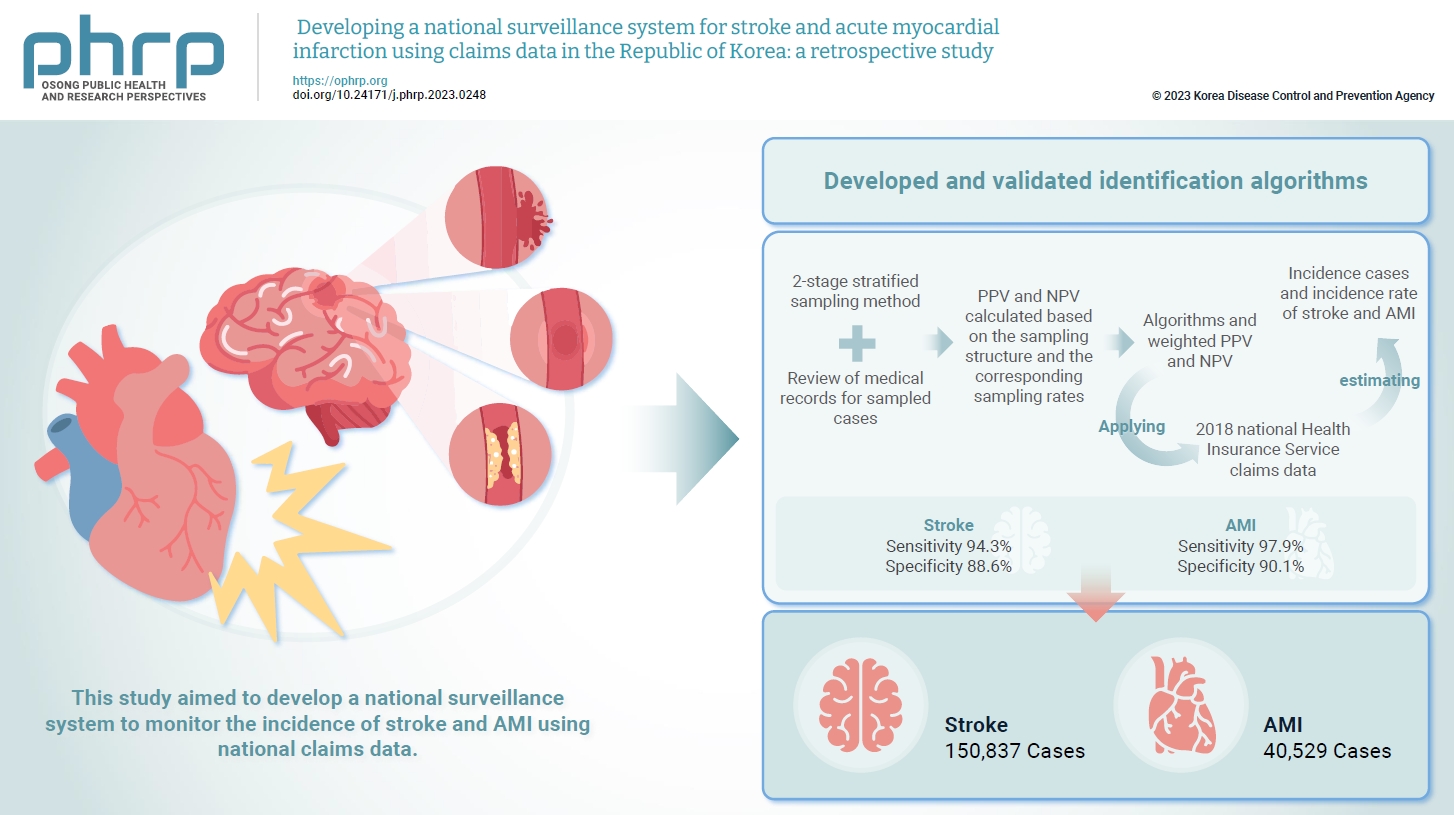
Objectives Limited information is available concerning the epidemiology of stroke and acute myocardial infarction (AMI) in the Republic of Korea. This study aimed to develop a national surveillance system to monitor the incidence of stroke and AMI using national claims data. Methods: We developed and validated identification algorithms for stroke and AMI using claims data. This validation involved a 2-stage stratified sampling method with a review of medical records for sampled cases. The weighted positive predictive value (PPV) and negative predictive value (NPV) were calculated based on the sampling structure and the corresponding sampling rates. Incident cases and the incidence rates of stroke and AMI in the Republic of Korea were estimated by applying the algorithms and weighted PPV and NPV to the 2018 National Health Insurance Service claims data. Results: In total, 2,200 cases (1,086 stroke cases and 1,114 AMI cases) were sampled from the 2018 claims database. The sensitivity and specificity of the algorithms were 94.3% and 88.6% for stroke and 97.9% and 90.1% for AMI, respectively. The estimated number of cases, including recurrent events, was 150,837 for stroke and 40,529 for AMI in 2018. The age- and sex-standardized incidence rate for stroke and AMI was 180.2 and 46.1 cases per 100,000 person-years, respectively, in 2018. Conclusion: This study demonstrates the feasibility of developing a national surveillance system based on claims data and identification algorithms for stroke and AMI to monitor their incidence rates.
Citations
Citations to this article as recorded by
Effect of a ≥50% Reduction in Low-Density Lipoprotein Cholesterol From Baseline in Patients With Ischemic Stroke Minyoul Baik, Jimin Jeon, Joonsang Yoo, Jinkwon Kim Neurology.2026;[Epub] CrossRef
Objectives We aimed to describe the epidemiological characteristics of carbapenemase-producing Enterobacteriaceae (CPE) outbreaks in healthcare settings in the Republic of Korea between 2017 and 2022.
Methods Under the national notifiable disease surveillance system, we obtained annual descriptive statistics regarding the isolated species, carbapenemase genotype, healthcare facility type, outbreak location and duration, and number of patients affected and recommended interventions. We used epidemiological investigation reports on CPE outbreaks reported to Korea Disease Control and Prevention Agency from June 2017 to September 2022.
Results Among the 168 reports analyzed, Klebsiella pneumoniae (85.1%) was the most frequently reported species, while K. pneumoniae carbapenemase (KPC, 82.7%) was the most common carbapenemase genotype. Both categories increased from 2017 to 2022 (p<0.01). General hospitals had the highest proportion (54.8%), while tertiary general hospitals demonstrated a decreasing trend (p<0.01). The largest proportion of outbreaks occurred exclusively in intensive care units (ICUs, 44.0%), and the frequency of concurrent outbreaks in ICUs and general wards increased over time (p<0.01). The median outbreak duration rose from 43.5 days before the coronavirus disease 2019 (COVID-19) pandemic (2017–2019) to 79.5 days during the pandemic (2020–2022) (p=0.01), and the median number of patients associated with each outbreak increased from 5.0 to 6.0 (p=0.03). Frequently recommended interventions included employee education (38.1%), and 3 or more measures were proposed for 45.2% of outbreaks.
Conclusion In the Republic of Korea, CPE outbreaks have been consistently dominated by K. pneumoniae and KPC. The size of these outbreaks increased during the COVID-19 pandemic. Our findings highlight the need for continuing efforts to control CPE outbreaks using a multimodal approach, while considering their epidemiology.
Citations
Citations to this article as recorded by
Microbiological and clinical impact of aminoglycosides on KPC-producing Klebsiella pneumoniae bacteraemia with aminoglycoside-modifying enzymes Jae Eun Seong, Sang Min Ahn, Min Han, Yong Seop Lee, Jung Ah Lee, Jae Hoon Kim, Jung Ho Kim, Jin Young Ahn, Su Jin Jeong, Nam Su Ku, Joon Sup Yeom, Hyukmin Lee, Jun Yong Choi Diagnostic Microbiology and Infectious Disease.2026; 114(1): 117111. CrossRef
Early prediction of colonization by carbapenemase-producing enterobacterales at ICU admission using machine learning Ji Hun Kim, Eunmi Yang, Yun Woo Lee, Han-Sung Kim, Hyeonji Seo Scientific Reports.2026;[Epub] CrossRef
Multidrug-resistant organism co-colonization in patients with discordant direct stool Xpert Carba-R and culture-based carbapenemase-producing Enterobacterales surveillance results Cheon-Hoo Jun, Si-Ho Kim, Hyoung Tae Kim, Yu Mi Wi Journal of Infection and Public Health.2026; 19(5): 103188. CrossRef
Comparison of clinical outcomes of patients with serial negative surveillance cultures according to a subsequent polymerase chain reaction test for carbapenemase-producing Enterobacterales H. Seo, S. Kim, Y.W. Lee, H.S. Oh, H-S. Kim, Y.K. Kim Journal of Hospital Infection.2024; 146: 93. CrossRef
Identifying Contact Time Required for Secondary Transmission ofClostridioides difficileInfections by Using Real-Time Locating System Min Hyung Kim, Jaewoong Kim, Heejin Ra, Sooyeon Jeong, Yoon Soo Park, Dongju Won, Hyukmin Lee, Heejung Kim Emerging Infectious Diseases.2024;[Epub] CrossRef
Antimicrobial activity of ceftazidime-avibactam against KPC-2-producing Enterobacterales: a cross-combination and dose-escalation titration study with relebactam and vaborbactam Min Seo Kang, Jin Yang Baek, Jae-Hoon Ko, Sun Young Cho, Keon Young Lee, Young Ho Lee, Jinyoung Yang, Tae Yeul Kim, Hee Jae Huh, Nam Yong Lee, Kyungmin Huh, Cheol-In Kang, Doo Ryeon Chung, Kyong Ran Peck, Bobby G. Warren Microbiology Spectrum.2024;[Epub] CrossRef
Performance comparison of BD Phoenix CPO detect panel with Cepheid Xpert Carba-R assay for the detection of carbapenemase-producing Klebsiella pneumoniae isolates Nazmiye Ülkü Tüzemen, Uğur Önal, Osman Merdan, Bekir Akca, Beyza Ener, Halis Akalın, Cüneyt Özakın BMC Microbiology.2024;[Epub] CrossRef
Objectives We conducted a comparative analysis of the differences in the incidence of 8 acute respiratory viruses and the changes in their patterns before and during the coronavirus disease 2019 (COVID-19) pandemic. Methods: Three sentinel surveillance systems of the Korea Disease Control and Prevention Agency and data from the Health Insurance Review and Assessment Service were analyzed. The average numbers of reported cases and the related hospital admissions and outpatient data were compared between April 2018–2019 and 2020–2021. Changes in the disease burden and medical expenditures between these 2 time periods were evaluated. Results: During the COVID-19 pandemic, the number of reported cases of all acute respiratory viral infections, except for human bocavirus, decreased significantly. Data from the Health Insurance Review and Assessment Service also showed decreases in the actual amount of medical service usage and a marked reduction in medical expenditures. Conclusion: Non-pharmacological interventions in response to COVID-19 showed preventive effects on the transmission of other respiratory viruses, as well as COVID-19. Although COVID-19 had a tremendous impact on society as a whole, with high social costs, there were also positive effects, such as a reduction in the incidence of acute respiratory viral infections.
Citations
Citations to this article as recorded by
Performance Evaluation of a Respiratory Virus Multiplex Real-Time PCR Panel Including SARS-CoV-2 and Its Clinical Utility in the Post-Pandemic Period Sunggyun Park Keimyung Medical Journal.2025; 44(1): 30. CrossRef
Machine learning forecasts for seasonal epidemic peaks: Lessons learnt from an atypical respiratory syncytial virus season Roger A. Morbey, Daniel Todkill, Conall Watson, Alex J. Elliot, André Ricardo Ribas Freitas PLOS ONE.2023; 18(9): e0291932. CrossRef
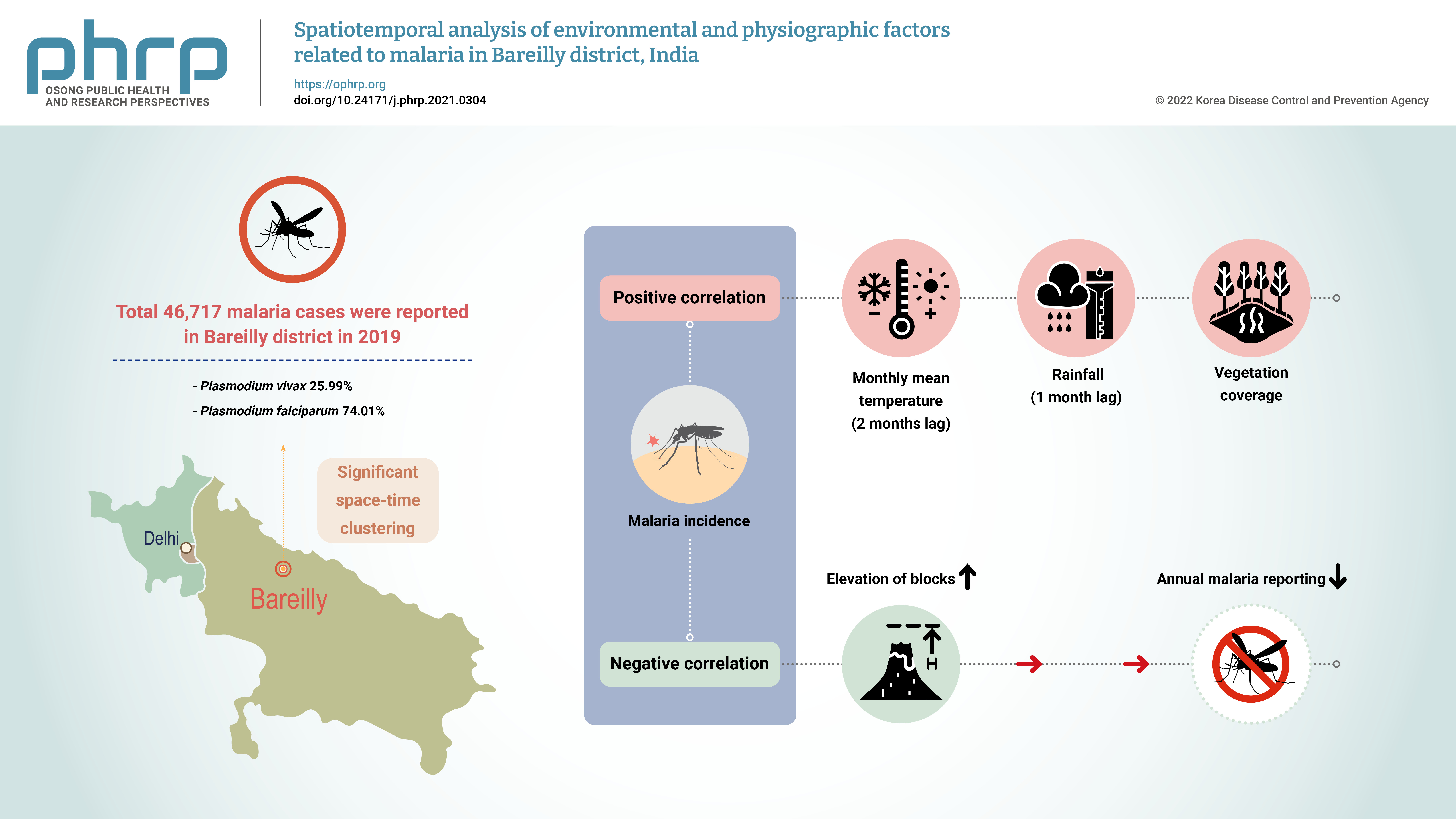
Objectives The aim of this study was to explore the spatiotemporal clustering of reported malaria cases and to study the effects of various environmental and physiographic factors on malaria incidence in Bareilly district, Uttar Pradesh, India. Methods: Malaria surveillance data were collected from the state health department and cleaned into an analyzable format. These data were analyzed along with meteorological, physiographic, and 2019 population data, which were obtained from the Indian Meteorological Department, National Aeronautics and Space Administration web portal, the Bhuvan platform of the Indian Space Research Organization, and the 2011 Census of India. Results: In total, 46,717 malaria cases were reported in Bareilly district in 2019, of which 25.99% were Plasmodium vivax cases and 74.01% were P. falciparum cases. The reported malaria cases in the district showed clustering, with significant spatial autocorrelation (Moran’s I value=0.63), and space-time clustering (p<0.01). A significant positive correlation was found between monthly malaria incidence and the monthly mean temperature (with a lag of 1−2 months) and rainfall (with a lag of 1 month). A significant negative correlation was detected between the elevation of blocks (i.e., intermediate-level administrative districts) and annual malaria reporting. Conclusion: The presence of space-time clustering of malaria cases and its correlation with meteorological and physiographic factors indicate that routine spatial analysis of the surveillance data could help control and manage malaria outbreaks in the district.
Citations
Citations to this article as recorded by
Revisiting the impacts of geographical aspects on public health in the tropical-Asian countries: a review Arif Ashari, Muhamad Ervin, Grace Helena Amaranthois Kapisan, Muhammad Asrori Indra Wardoyo, Raisya Arzety Olivia, Bagus Tegar Sakti Prakosa Reviews on Environmental Health.2026; 41(2): 307. CrossRef
Spatial Analysis of Malaria in Bangladesh: Insights from Bayesian Disease Mapping Models Ummehani Mimi, Md. Rezaul Karim, Sultana Begum, Khadiza Akter Eme, Denekew Bitew Belay PLOS One.2026; 21(8): e0353483. CrossRef
Association between temperature and malaria (1959-2019): a systematic review and meta-analysis Yogesh Murugan, Vaibhavkumar Shrivastav Archives of Public Health.2025;[Epub] CrossRef
Digital health: trends, opportunities and challenges in medical devices, pharma and bio-technology Naresh Kasoju, N. S. Remya, Renjith Sasi, S. Sujesh, Biju Soman, C. Kesavadas, C. V. Muraleedharan, P. R. Harikrishna Varma, Sanjay Behari CSI Transactions on ICT.2023; 11(1): 11. CrossRef
<sec>
<title>Objectives</title>
<p>Pathogenic <italic>Vibrio</italic> species are widely distributed in warm estuarine and coastal environments, and can infect humans through the consumption of raw or mishandled contaminated seafood and seawater. For this reason, the distribution of these bacteria in South Korea was investigated.</p></sec>
<sec>
<title>Methods</title>
<p>Seawater samples were collected from 145 coastal area points in the aquatic environment in which <italic>Vibrio</italic> species live. Environmental data (i.e., water temperature, salinity, turbidity, and atmospheric temperature) was collected which may help predict the distribution of the species (data not shown). Seawater samples were filtered, and incubated overnight in alkaline peptone water, at 37°C. Using species-specific polymerase chain reaction methods, screening tests were performed for the <italic>hlyA, ctxA, vvhA</italic>, and <italic>tlh</italic> genes. Clones of pathogenic <italic>Vibrio</italic> species were isolated using 3 selective plating media.</p></sec>
<sec>
<title>Results</title>
<p>In 2017, total seawater isolation rates for <italic>Vibrio vulnificus</italic>, <italic>Vibrio cholerae</italic> (non-pathogenic, non-O1, non-O139 serogroups), and <italic>Vibrio parahaemolyticus</italic> were 15.82%, 13.18%, 65.80%, respectively. However, in 2018 isolation rates for each were 21.81%, 19.40%, and 70.05%, respectively.</p></sec>
<sec>
<title>Conclusion</title>
<p>The isolation rates of pathogenic <italic>Vibrio</italic> species positively correlated with the temperature of seawater and atmosphere, but negatively correlated with salinity and turbidity. From 2017 to 2018, the most frequent seawater-isolated <italic>Vibrio</italic> species were <italic>V. parahaemolyticus</italic> (68.10 %), <italic>V. vulnificus</italic> (16.54%), and non-toxigenic <italic>V. cholerae</italic> (19.58%). Comprehensive monitoring, prevention, and control efforts are needed to protect the public from pathogenic <italic>Vibrio</italic> species.</p></sec>
Citations
Citations to this article as recorded by
Anti-biofilm activity and mechanism of fumaric acid against Vibrio parahaemolyticus and its application in food systems Wenxiu Zhu, Meihan Zhang, Zixuan Wang, Ziye Wang, Yao Liu, Huanhuan Liu, Jian Guo, Ting Pan, Ningbo Qin, Xiaodong Xia Food Bioscience.2026; 80: 108852. CrossRef
Optoelectronic sensor arrays for monitoring the main water quality parameters in aquaculture systems Adolfo Blasco, Inés González, Miriam Benitez, Pablo Gaviña, Pedro Amorós, José V. Ros-Lis Microchemical Journal.2026; 225: 118025. CrossRef
Geochemical factors associated with seasonal shifts in the abalone gut microbiota across urchin-barren habitats Jae-Won Jo, Joon-Young Park, Jin-Jae Lee, Min-Jung Lee, Bong-Soo Kim Frontiers in Microbiology.2026;[Epub] CrossRef
Metabarcoding detection of Vibrio species in black-tailed gulls reveals seabirds as overlooked sentinels of coastal zoonotic risk in South Korea Singeun Oh, Dewi Arinta, Buyanbadrakh Burenbaatar, Jun Ho Choi, Leon Kim, Du-Yeol Choi, Dongjun Kang, Arwa Shatta, Myung-hee Yi, Yoon Hee Cho, In-Yong Lee, Ju Yeong Kim Environmental Research.2026; 306: 125145. CrossRef
Culture-enriched metagenomics enables genome-resolved detection of low abundance ESKAPE and Vibrio pathogens in coastal habitats Jia Yee Ho, Dalong Hu, Deborah Yebon Kang, Clarence Bo Wen Sim, Winona Wijaya, Yann Felix Boucher Water Research X.2026; 32: 100599. CrossRef
Design of a multi-epitope vaccine (vme-VAC/MST-1) against cholera and vibriosis based on reverse vaccinology and immunoinformatics approaches Pedro Henrique Marques, Thais Cristina Vilela Rodrigues, Eduardo Horta Santos, Lucas Bleicher, Flavia Figueira Aburjaile, Flaviano S. Martins, Carlo Jose Freire Oliveira, Vasco Azevedo, Sandeep Tiwari, Siomar Soares Journal of Biomolecular Structure and Dynamics.2025; 43(4): 1788. CrossRef
Forecasting Foodborne Disease Risk Caused by Vibrio parahaemolyticus Using a SARIMAX Model Incorporating Sea Surface Environmental and Climate Factors: Implications for Seafood Safety in Zhejiang, China Rong Ma, Ting Liu, Lei Fang, Jiang Chen, Shenjun Yao, Hui Lei, Yu Song Foods.2025; 14(10): 1800. CrossRef
Vibrio cholerae in Water Environments: A Systematic Review and Meta‐Analysis Aaron Awere‐Duodu, Onyansaniba K. Ntim, Eric S. Donkor Environmental Microbiology Reports.2025;[Epub] CrossRef
Vibrio spp. in aquatic ecosystems of the coastal zone of Colombia Maria J. Calvo-Saad, Silvia Y. Narváez-Florez, Tania Córdoba-Meza, Angeline Montaño, Paula Díaz, Patricia Escandón, Yussely Tatiana Cobos-Leon, Lizeth Paola Sánchez, Lizbeth Janet Vivas- Aguas, Magdalena Wiesner Regional Studies in Marine Science.2025; 91: 104515. CrossRef
Occurrence, environmental correlates, and risk assessment of Vibrio parahaemolyticus in Caspian sea coastal waters Mohammad Ahmadi, Ali Esrafili, Hamidreza Pazoki-Toroudi, Fazel Gorjipour, Roshanak Rezaei Kalantary Scientific Reports.2025;[Epub] CrossRef
Bacterial biocontrol of vibriosis in shrimp: A review Esti Harpeni, Alim Isnansetyo, Indah Istiqomah, Murwantoko Aquaculture International.2024; 32(5): 5801. CrossRef
Genetic Analysis of Clinical and Environmental Vibrio vulnificus Isolates from Jeollanam-do, South Korea Hae Young Na, Yeon Hee Yoon, Won Kim, Hyung Woo Lim, Eunbyeul Go, Hyeon Ji Kim, Hye Lin Yang, Sook Park Journal of Bacteriology and Virology.2024; 54(4): 379. CrossRef
Nested Spatial and Temporal Modeling of Environmental Conditions Associated With Genetic Markers of Vibrio parahaemolyticus in Washington State Pacific Oysters Brendan Fries, Benjamin J. K. Davis, Anne E. Corrigan, Angelo DePaola, Frank C. Curriero Frontiers in Microbiology.2022;[Epub] CrossRef
Spatial and temporal effects of fish feed on antibiotic resistance in coastal aquaculture farms Shahbaz Raza, Sangki Choi, Minjeong Lee, Jingyeong Shin, Heejong Son, Jinhua Wang, Young Mo Kim Environmental Research.2022; 212: 113177. CrossRef
An Assay Combining Droplet Digital PCR With Propidium Monoazide Treatment for the Accurate Detection of Live Cells of Vibrio vulnificus in Plasma Samples Ling Hu, Yidong Fu, Shun Zhang, Zhilei Pan, Jiang Xia, Peng Zhu, Jing Guo Frontiers in Microbiology.2022;[Epub] CrossRef
Seasonal variation, virulence gene and antibiotic resistance of Vibrio in a semi-enclosed bay with mariculture (Dongshan Bay, Southern China) Qiancheng Gao, Xiaowan Ma, Zhichao Wang, Haisheng Chen, Yu Luo, Bi Wu, Shanni Qi, Miaozhen Lin, Jing Tian, Ying Qiao, Hans-Peter Grossart, Wei Xu, Lixing Huang Marine Pollution Bulletin.2022; 184: 114112. CrossRef
Molecular Epidemiology of Antimicrobial Resistance and Virulence Profiles of Escherichia coli, Salmonella spp., and Vibrio spp. Isolated from Coastal Seawater for Aquaculture Saharuetai Jeamsripong, Varangkana Thaotumpitak, Saran Anuntawirun, Nawaphorn Roongrojmongkhon, Edward R. Atwill, Woranich Hinthong Antibiotics.2022; 11(12): 1688. CrossRef
Meteorological and Water Quality Factors Associated with Microbial Diversity in Coastal Water from Intensified Oyster Production Areas of Thailand Saharuetai Jeamsripong, Varangkana Thaotumpitak, Saran Anuntawirun, Nawaphorn Roongrojmongkhon, Edward R. Atwill Water.2022; 14(23): 3838. CrossRef
Predictive models for the effect of environmental factors on the abundance of Vibrio parahaemolyticus in oyster farms in Taiwan using extreme gradient boosting Nodali Ndraha, Hsin-I Hsiao, Yi-Zeng Hsieh, Abani K. Pradhan Food Control.2021; 130: 108353. CrossRef
Prevalence, detection of virulence genes and antimicrobial susceptibility of pathogen Vibrio species isolated from different types of seafood samples at “La Nueva Viga” market in Mexico City Ana Karen Álvarez-Contreras, Elsa Irma Quiñones-Ramírez, Carlos Vázquez-Salinas Antonie van Leeuwenhoek.2021; 114(9): 1417. CrossRef
<p>Since 2011, the Republic of Korea (ROK) and United States (U.S.) have been collaborating to conduct inter- and intra-governmental exercises to jointly respond to biological events in Korea. These exercises highlight U.S. interest in increasing its global biosurveillance capability and the ROK’s interest in improving cooperation among ministries to respond to crises. With Able Response (AR) exercises, the ROK and U.S. have improved coordination among US and ROK government and defense agencies responding to potential bio-threats and identified additional areas on which to apply refinements in policies and practices. In 2014, the AR exercise employed a Biosurveillance Portal (BSP) to facilitate more effective communication among participating agencies and countries including Australia. In the present paper, we seek to provide a comprehensive assessment of the AR 2014 (AR14) exercise and make recommendations for future improvements. Incorporating a more realistic response in future scenarios by integrating a tactical response episode in the exercise is recommended.</p>
Citations
Citations to this article as recorded by
Artificial intelligence in public health: the potential of epidemic early warning systems Chandini Raina MacIntyre, Xin Chen, Mohana Kunasekaran, Ashley Quigley, Samsung Lim, Haley Stone, Hye-young Paik, Lina Yao, David Heslop, Wenzhao Wei, Ines Sarmiento, Deepti Gurdasani Journal of International Medical Research.2023;[Epub] CrossRef
Whole of government and whole of society approaches: call for further research to improve population health and health equity Flaminia Ortenzi, Robert Marten, Nicole B Valentine, Aku Kwamie, Kumanan Rasanathan BMJ Global Health.2022; 7(7): e009972. CrossRef
Biodefence research two decades on: worth the investment? Carrie M Long, Andrea Marzi The Lancet Infectious Diseases.2021; 21(8): e222. CrossRef
Objectives
Completeness and timeliness are key attributes of accurate disease surveillance. This study aimed to evaluate the completeness and timeliness of tuberculosis (TB) notification in the Republic of Korea, by comparing notification data from the Korean National Tuberculosis Surveillance System and reimbursement data from the National Health Insurance. Methods
We evaluated reimbursement data from 103,075 cases (2012–2014) and surveillance data from 215,055 cases (2011–2015); cases were matched using Resident Registration Numbers. Completeness was evaluated using notifications that were reported within 365 days of the corresponding insurance claim. Timeliness was evaluated using the delay between starting TB treatment and the corresponding notification. Multivariate logistic regression analysis was used to analyze factors that affected completeness (e.g., sex, age, institution type, and nationality). Results
The completeness values were 90.0% in 2012 (33,094/36,775), 93.0% in 2013 (31,445/33,803), and 94.0% in 2014 (30,537/32,497). The rates of notification within 7 days of the corresponding claim were 81.6% in 2012 (27,323/33,489), 79.8% in 2013 (25,469/31,905), and 80.4% in 2014 (24,891/30,978). Increases over time were observed in the sex-, age-, institution type-, and nationality-specific analyses. Multivariate analyses revealed that completeness was affected by institution type [hospitals: odds ratio (OR) = 1.82, <i>p</i> < 0.001; general hospitals: OR = 4.18, <i>p</i> < 0.001] and nationality (native Korean status: OR = 1.48, <i>p</i> < 0.001). Conclusion
Notification completeness exhibited a 4.0% increase during 2012–2014 in Korea, and institution type and nationality significantly affected the completeness of TB notifications.
Citations
Citations to this article as recorded by
Suicide risk in people with tuberculosis in Republic of Korea: a nationwide cohort, 2012–2021 Chiwook Chung, Seung Won Lee, Dawoon Jeong, Hongjo Choi, Hojoon Sohn, Young Ae Kang Infectious Diseases of Poverty.2026;[Epub] CrossRef
Comparison of Patients Who Were Not Evaluated and Lost to Follow-Up with Multidrug/Rifampin-Resistant Tuberculosis in South Korea Hongjo Choi, Jeongha Mok, Young Ae Kang, Dawoon Jeong, Hee-Yeon Kang, Hee Jin Kim, Hee-Sun Kim, Doosoo Jeon Yonsei Medical Journal.2025; 66(1): 16. CrossRef
Nationwide coverage of molecular drug susceptibility testing in patients with pulmonary multidrug/rifampicin-resistant tuberculosis in South Korea: a retrospective cohort study (2015–2021) Jeongha Mok, Dawoon Jeong, Hojoon Sohn, Saerom Kim, Seung Won Lee, Young Ae Kang BMJ Open Respiratory Research.2025; 12(1): e003307. CrossRef
Impact of Mass Screening Using Chest X-Ray on Mortality Reduction and Treatment Adherence Among Pulmonary Tuberculosis Patients Ji Yoon Baek, Sayada Zartasha Kazmi, Hyunmin Lee, Yerin Hwang, So Jin Park, Myung-Hee Shin, Jayoun Lee, Hongjo Choi, Aesun Shin Journal of Korean Medical Science.2024;[Epub] CrossRef
Comparative risk of serious infections and tuberculosis in Korean patients with inflammatory bowel disease treated with non-anti-TNF biologics or anti-TNF-α agents: a nationwide population-based cohort study Min Jee Kim, Ye-Jee Kim, Daehyun Jeong, Seonok Kim, Seokchan Hong, Sang Hyoung Park, Kyung-Wook Jo Therapeutic Advances in Gastroenterology.2024;[Epub] CrossRef
Nationwide Treatment Outcomes of Patients With Multidrug/Rifampin-Resistant Tuberculosis in Korea, 2011–2017: A Retrospective Cohort Study (Korean TB-POST) Hongjo Choi, Jeongha Mok, Young Ae Kang, Dawoon Jeong, Hee-Yeon Kang, Hee Jin Kim, Hee-Sun Kim, Doosoo Jeon Journal of Korean Medical Science.2023;[Epub] CrossRef
Retreatment after loss to follow-up reduces mortality in patients with multidrug/rifampicin-resistant tuberculosis Hongjo Choi, Jeongha Mok, Young Ae Kang, Dawoon Jeong, Hee-Yeon Kang, Hee Jin Kim, Hee-Sun Kim, Doosoo Jeon ERJ Open Research.2023; 9(4): 00135-2023. CrossRef
Cohort Profile: Korean Tuberculosis and Post-Tuberculosis Cohort Constructed by Linking the Korean National Tuberculosis Surveillance System and National Health Information Database Dawoon Jeong, Hee-Yeon Kang, Jinsun Kim, Hyewon Lee, Bit-Na Yoo, Hee-Sun Kim, Hongjo Choi Journal of Preventive Medicine and Public Health.2022; 55(3): 253. CrossRef
Hidden loss to follow-up among tuberculosis patients managed by public–private mix institutions in South Korea Hyung Woo Kim, Sohee Park, Jinsoo Min, Jiyu Sun, Ah Young Shin, Jick Hwan Ha, Jae Seuk Park, Sung-Soon Lee, Marc Lipman, Ibrahim Abubakar, Helen R. Stagg, Ju Sang Kim Scientific Reports.2022;[Epub] CrossRef
Assessing the Quality of Reporting to China’s National TB Surveillance Systems Tao Li, Lijia Yang, Sarah E. Smith-Jeffcoat, Alice Wang, Hui Guo, Wei Chen, Xin Du, Hui Zhang International Journal of Environmental Research an.2021; 18(5): 2264. CrossRef
Quality and Utility of Information Captured by Surveillance Systems Relevant to Antimicrobial Resistance (AMR): A Systematic Review Mustafa Al-Haboubi, Rebecca E. Glover, Elizabeth Eastmure, Mark Petticrew, Nick Black, Nicholas Mays Antibiotics.2021; 10(4): 431. CrossRef
Risk of tuberculosis in patients with cancer treated with immune checkpoint inhibitors: a nationwide observational study Seongman Bae, Ye-Jee Kim, Min-ju Kim, Jwa Hoon Kim, Sung-Cheol Yun, Jiwon Jung, Min Jae Kim, Yong Pil Chong, Sung-Han Kim, Sang-Ho Choi, Yang Soo Kim, Sang-Oh Lee Journal for ImmunoTherapy of Cancer.2021; 9(9): e002960. CrossRef
Underreporting of patients diagnosed with tuberculosis in the Region of Southern Denmark Frederik D. Thrane, Peter H. Andersen, Isik S. Johansen, Inge K. Holden Scandinavian Journal of Public Health.2020; 48(8): 870. CrossRef
Effects of particulate air pollution on tuberculosis development in seven major cities of Korea from 2010 to 2016: methodological considerations involving long-term exposure and time lag Honghyok Kim, Sarah Yu, Hongjo Choi Epidemiology and Health.2020; 42: e2020012. CrossRef
Latent tuberculosis infection screening and treatment in congregate settings (TB FREE COREA): protocol for a prospective observational study in Korea Jinsoo Min, Hyung Woo Kim, Helen R Stagg, Marc Lipman, Molebogeng X Rangaka, Jun-Pyo Myong, Hyeon Woo Yim, Jeong Uk Lim, Yunhee Lee, Hyeon-Kyoung Koo, Sung-Soon Lee, Jae Seuk Park, Kyung Sook Cho, Ju Sang Kim BMJ Open.2020; 10(2): e034098. CrossRef
Tuberculosis Surveillance and Monitoring under the National Public-Private Mix Tuberculosis Control Project in South Korea 2016–2017 Jinsoo Min, Hyung Woo Kim, Yousang Ko, Jee Youn Oh, Ji Young Kang, Joosun Lee, Young Joon Park, Sung-Soon Lee, Jae Seuk Park, Ju Sang Kim Tuberculosis and Respiratory Diseases.2020; 83(3): 218. CrossRef
Prediction of treatment failure and compliance in patients with tuberculosis Hyeon-Kyoung Koo, Jinsoo Min, Hyung Woo Kim, Joosun Lee, Ju Sang Kim, Jae Seuk Park, Sung-Soon Lee BMC Infectious Diseases.2020;[Epub] CrossRef
Impact of COVID-19 Pandemic on the National PPM Tuberculosis Control Project in Korea: the Korean PPM Monitoring Database between July 2019 and June 2020 Jinsoo Min, Hyung Woo Kim, Hyeon-Kyoung Koo, Yousang Ko, Jee Youn Oh, Jaetae Kim, Jiyeon Yang, Yunhyung Kwon, Young-Joon Park, Ji Young Kang, Sung-Soon Lee, Jae Seuk Park, Ju Sang Kim Journal of Korean Medical Science.2020;[Epub] CrossRef
Clinical profiles of early and tuberculosis-related mortality in South Korea between 2015 and 2017: a cross-sectional study Jinsoo Min, Ju Sang Kim, Hyung Woo Kim, Ah Young Shin, Hyeon-Kyoung Koo, Sung-Soon Lee, Yang-Ki Kim, Kyeong-Cheol Shin, Jung Hyun Chang, Gayoung Chun, Joosun Lee, Mi Sun Park, Jae Seuk Park BMC Infectious Diseases.2019;[Epub] CrossRef
Treatment outcomes and factors affecting treatment outcomes of new patients with tuberculosis in Busan, South Korea: a retrospective study of a citywide registry, 2014–2015 Jeongha Mok, Daeseong An, Seoungjin Kim, Miyoung Lee, Changhoon Kim, Hyunjin Son BMC Infectious Diseases.2018;[Epub] CrossRef
Tuberculosis prevention and care in Korea: Evolution of policy and practice Unyeong Go, Misun Park, Un-Na Kim, Sodam Lee, Sunmi Han, Joosun Lee, Jiyeon Yang, Jieun Kim, Shinyoung Park, Youngman Kim, Hyosoon Yoo, Jeongok Cha, Wonseo Park, Haeyoung Kang, Hwon Kim, Guri Park, Minjung Kim, Ok Park, Hyunjin Son, Enhi Cho, Kyoungin Na, Journal of Clinical Tuberculosis and Other Mycobac.2018; 11: 28. CrossRef
The relationship between multiple chronic diseases and depressive symptoms among middle-aged and elderly populations: results of a 2009 korean community health survey of 156,747 participants JooYeon Seo, BoYoul Choi, Shinah Kim, HyeYoung Lee, DongHoon Oh BMC Public Health.2017;[Epub] CrossRef
Vitamin D Deficiency among Adults with History of Pulmonary Tuberculosis in Korea Based on a Nationwide Survey Mi Joo, Mi Han, Sun Park, Hwan Shin International Journal of Environmental Research an.2017; 14(4): 399. CrossRef
Tuberculosis Control in the Republic of Korea Cho, Kyung Sook Health and Social Welfare Review.2017; 37(4): 179. CrossRef
Objectives
The aim of this study was to characterize the pathogens responsible for causing diarrhea according to season, region of isolation, patient age, and sex as well as to provide useful data for the prevention of diarrheal disease. Methods
Stool specimens from 14,886 patients with diarrhea were collected to identify pathogenic bacteria from January 2014 to December 2014 in Korea. A total of 3,526 pathogenic bacteria were isolated and analyzed according to season, region of isolation, and the age and sex of the patient. Results
The breakdown of the isolated pathogenic bacteria were as follows: <i>Salmonella</i> spp. 476 (13.5%), pathogenic <i>Escherichia coli</i> 777 (22.0%), <i>Vibrio parahaemolyticus</i> 26 (0.74%), <i>Shigella</i> spp. 13 (0.37%), <i>Campylobacter</i> spp. 215 (6.10%), <i>Clostridium perfringens</i> 508 (14.4%), <i>Staphylococcus aureus</i> 1,144 (32.4%), <i>Bacillus cereus</i> 356 (10.1%), <i>Listeria monocytogenes</i> 1 (0.03%), and <i>Yersinia enterocolitica</i> 10 (0.3%). The isolation rate trend showed the highest ratio in the summer season from June to September for most of the pathogenic bacteria except the Gram-positive bacteria. The isolation rate of most of the pathogenic bacteria by patient age showed highest ratio in the 0–19 year age range. For isolation rate by region, 56.2% were isolated from cities and 43.8% were isolated from provinces. Conclusion
Hygiene education should be addressed for diarrheal disease-susceptible groups, such as those younger than 10 years, aged 10–19 years, and older than 70 years, and monitoring for the pathogens is still required. In addition, an efficient laboratory surveillance system for infection control should be continued.
Citations
Citations to this article as recorded by
A nationwide spatiotemporal forecasting model for bacterial gastroenteritis surveillance in South Korea Seungwon Oh, Yerin Heo, Yong Chan Kim, Seong-u Im, Dong-Sook Kim Journal of Infection and Public Health.2026; 19(10): 103357. CrossRef
A quantitative risk assessment of Bacillus cereus in tofu treated with carbon quantum dots derived from tangerine peels Yeon Ho Kim, Seul Bin Baik, Hye Kim, Seockmo Ku Food Research International.2026; 245: 120705. CrossRef
Antimicrobial Resistance Profiles and Molecular Characteristics of Salmonella enterica Serovar Agona Isolated from Food-Producing Animals During 2010–2020 in South Korea Hyun-Ju Song, Sekendar Ali, Bo-Youn Moon, Hee Young Kang, Eun Jeong Noh, Tae-Sun Kim, Su-Jeong Kim, Ji-In Kim, Yun Jin Lee, Soon-Seek Yoon, Suk-Kyung Lim Foodborne Pathogens and Disease.2025; 22(3): 210. CrossRef
Antimicrobial Susceptibility Patterns and Genetic Diversity of Campylobacter spp. Isolates from Patients with Diarrhea in South Korea So Yeon Kim, Dongheui An, Hyemi Jeong, Jonghyun Kim Microorganisms.2024; 12(1): 94. CrossRef
Comparative evaluation of two molecular multiplex syndromic panels with acute gastroenteritis Kuenyoul Park, Bo-Moon Shin Diagnostic Microbiology and Infectious Disease.2024; 109(1): 116211. CrossRef
An Outbreak of Campylobacter Jejuni Involving Healthcare Workers Detected by COVID-19 Healthcare Worker Symptom Surveillance Hye Jin Shi, Jae Baek Lee, Shinhee Hong, Joong Sik Eom, Yoonseon Park Korean Journal of Healthcare-Associated Infection .2023; 28(1): 172. CrossRef
Plant-derived nanoparticles as alternative therapy against Diarrheal pathogens in the era of antimicrobial resistance: A review Tesleem Olatunde Abolarinwa, Daniel Jesuwenu Ajose, Bukola Opeyemi Oluwarinde, Justine Fri, Kotsoana Peter Montso, Omolola Esther Fayemi, Adeyemi Oladapo Aremu, Collins Njie Ateba Frontiers in Microbiology.2022;[Epub] CrossRef
Prevalence, co-infection and seasonality of fecal enteropathogens from diarrheic cats in the Republic of Korea (2016–2019): a retrospective study Ye-In Oh, Kyoung-Won Seo, Do-Hyung Kim, Doo-Sung Cheon BMC Veterinary Research.2021;[Epub] CrossRef
Genotyping and antimicrobial susceptibility of Clostridium perfringens isolated from dromedary camels, pastures and herders Mahmoud Fayez, Ibrahim Elsohaby, Theeb Al-Marri, Kamal Zidan, Ali Aldoweriej, Elham El-Sergany, Ahmed Elmoslemany Comparative Immunology, Microbiology and Infectiou.2020; 70: 101460. CrossRef
Comparative Analysis of Aerotolerance, Antibiotic Resistance, and Virulence Gene Prevalence in Campylobacter jejuni Isolates from Retail Raw Chicken and Duck Meat in South Korea Jinshil Kim, Hyeeun Park, Junhyung Kim, Jong Hyun Kim, Jae In Jung, Seongbeom Cho, Sangryeol Ryu, Byeonghwa Jeon Microorganisms.2019; 7(10): 433. CrossRef
Guideline for the Antibiotic Use in Acute Gastroenteritis Youn Jeong Kim, Ki-Ho Park, Dong-Ah Park, Joonhong Park, Byoung Wook Bang, Seung Soon Lee, Eun Jung Lee, Hyo-Jin Lee, Sung Kwan Hong, Yang Ree Kim Infection & Chemotherapy.2019; 51(2): 217. CrossRef
Winning the War against Multi-Drug Resistant Diarrhoeagenic Bacteria Chizoba Mercy Enemchukwu, Angus Nnamdi Oli, Ebere Innocent Okoye, Nonye Treasure Ujam, Emmanuel O. Osazuwa, George Ogonna Emechebe, Kenneth Nchekwube Okeke, Christian Chukwuemeka Ifezulike, Obiora Shedrack Ejiofor, Jude Nnaemeka Okoyeh Microorganisms.2019; 7(7): 197. CrossRef
Molecular Characterization of Enterotoxigenic Escherichia coli in Foodborne Outbreak Sang-Hun Park, Hyun-Jung Seung, Hyo-Won Jeong, So-Yun Park, Ji-Hun Jung, Young-Hee Jin, Sung-Hee Han, Hee-Soon Kim, Jin-Seok Kim, Joo-Hyun Park, Ye-Ji Gong, Chae Kyu Hong, Jib-Ho Lee, Il-Young Kim, Kweon Jung Journal of Bacteriology and Virology.2018; 48(4): 113. CrossRef
Epidemiology of Listeria monocytogenes prevalence in foods, animals and human origin from Iran: a systematic review and meta-analysis Reza Ranjbar, Mehrdad Halaji BMC Public Health.2018;[Epub] CrossRef
The Epidemiological Influence of Climatic Factors on Shigellosis Incidence Rates in Korea Yeong-Jun Song, Hae-Kwan Cheong, Myung Ki, Ji-Yeon Shin, Seung-sik Hwang, Mira Park, Moran Ki, Jiseun Lim International Journal of Environmental Research an.2018; 15(10): 2209. CrossRef
Molecular characterization and antimicrobial resistance profile of Clostridium perfringens type A isolates from humans, animals, fish and their environment Jay Prakash Yadav, Suresh Chandra Das, Pankaj Dhaka, Deepthi Vijay, Manesh Kumar, Asish Kumar Mukhopadhyay, Goutam Chowdhury, Pranav Chauhan, Rahul Singh, Kuldeep Dhama, Satya Veer Singh Malik, Ashok Kumar Anaerobe.2017; 47: 120. CrossRef
Molecular characterization of antimicrobial resistant non-typhoidal Salmonella from poultry industries in Korea Jin Eui Kim, Young ju Lee Irish Veterinary Journal.2017;[Epub] CrossRef
Objectives
Food- and water-borne disease outbreaks (FBDOs) are an important public health problem worldwide. This study investigated the trends in FBDOs in Korea and established emerging causal pathogens and causal vehicles. Methods
We analyzed FBDOs in Korea by year, location, causal pathogens, and causal vehicles from 2007 to 2012. Information was collected from the FBDOs database in the Korean Centers for Disease Control and Prevention. Results
During 2007–2012, a total of 1794 FBDOs and 48,897 patients were reported. After 2007, FBDOs and patient numbers steadily decreased over the next 2 years and then plateaued until 2011. However, in 2012, FBDOs increased slightly accompanied by a large increase in the number of affected patients. Our results highlight the emergence of norovirus and pathogenic <i>Escherichia coli</i> other than enterohemorrhagic <i>E. coli</i> (EHEC) in schools in 2012. We found that pickled vegetables is an emerging causal vehicle responsible for this problem. Conclusion
On the basis of this study we recommend intensified inspections of pickled vegetable manufacturers and the strengthening of laboratory surveillance of relevant pathogens.
Citations
Citations to this article as recorded by
Exploring Foodborne Disease Outbreaks in Iran (2000-2023): Trends, Pathogens, and the Impact of Animal-Origin Foods Zahra Qadiry, Mohammadreza Mohammadian, Mohammadreza Rezaeigolestani Journal of Human Environment and Health Promotion.2025; 11(4): 201. CrossRef
Measures for preventing norovirus outbreaks on campus in economically underdeveloped areas and countries: evidence from rural areas in Western China Huali Xiong, Fengxun Ma, Dayi Tang, Daiqiang Liu Frontiers in Public Health.2024;[Epub] CrossRef
Phage biocontrol of zoonotic food-borne pathogen Vibrio parahaemolyticus for seafood safety Jung Hyen Lee, Minjin Oh, Byoung Sik Kim Food Control.2023; 144: 109334. CrossRef
Vibrio-infecting bacteriophages and their potential to control biofilm Ana Cevallos-Urena, Jeong Yeon Kim, Byoung Sik Kim Food Science and Biotechnology.2023; 32(12): 1719. CrossRef
Antibiotic Resistance Profiles of Bacteria Isolated from Hotspot Environments in Bahir Dar City, Northwestern Ethiopia Kindu Geta, Mulugeta Kibret Journal of Multidisciplinary Healthcare.2022; Volume 15: 1403. CrossRef
Inhibitory Effects of Crude Fucoidan Extract from Hizikia fusiformis against Norovirus Causing Foodborne Disease Hyojin Kim, Mi Sook Chung Korean Journal of Food and Cookery Science.2018; 34(5): 519. CrossRef
High level of drug resistance by gram-negative bacteria from selected sewage polluted urban rivers in Addis Ababa, Ethiopia Teshome Belachew, Amete Mihret, Tesfaye Legesse, Yihenew Million, Kassu Desta BMC Research Notes.2018;[Epub] CrossRef
Inhibitory Effects of Allium chinense and Its Dimethyl Disulfide against Murine Norovirus as a Surrogate for Foodborne Virus Mi Sook Chung Korean Journal of Food and Cookery Science.2018; 34(2): 222. CrossRef
Inactivation of norovirus surrogates by kimchi fermentation in the presence of black raspberry Garam Bae, Jeongwon Kim, Hyojin Kim, Jong Hyeon Seok, Dan Bi Lee, Kyung Hyun Kim, Mi Sook Chung Food Control.2018; 91: 390. CrossRef
Metagenomic Sequencing for Surveillance of Food- and Waterborne Viral Diseases David F. Nieuwenhuijse, Marion P. G. Koopmans Frontiers in Microbiology.2017;[Epub] CrossRef
Prevalence, antimicrobial resistance and multiple-locus variable-number tandem-repeat analysis profiles of diarrheagenic Escherichia coli isolated from different retail foods Lili Wang, Hiromi Nakamura, Eriko Kage-Nakadai, Yukiko Hara-Kudo, Yoshikazu Nishikawa International Journal of Food Microbiology.2017; 249: 44. CrossRef
Complete genome sequence ofVibrio parahaemolyticusFORC_023 isolated from raw fish storage water Han Young Chung, Eun Jung Na, Kyu-Ho Lee, Sangryeol Ryu, Hyunjin Yoon, Ju-Hoon Lee, Hyeun Bum Kim, Heebal Kim, Sang Ho Choi, Bong-Soo Kim, David Rasko Pathogens and Disease.2016; 74(4): ftw032. CrossRef
An outbreak of norovirus infection associated with fermented oyster consumption in South Korea, 2013 H. G. CHO, S. G. LEE, M. Y. LEE, E. S. HUR, J. S. LEE, P. H. PARK, Y. B. PARK, M. H. YOON, S. Y. PAIK Epidemiology and Infection.2016; 144(13): 2759. CrossRef
Molecular epidemiology of norovirus in South Korea Sung-Geun Lee, Han-Gil Cho, Soon-Young Paik BMB Reports .2015; 48(2): 61. CrossRef
Three Gastroenteritis Outbreaks in South Korea Caused by the Consumption of Kimchi Tainted by Norovirus GI.4 Ji-Hyuk Park, Sunyoung Jung, Jaeseung Shin, Jeong Su Lee, In Sun Joo, Deog-Yong Lee Foodborne Pathogens and Disease.2015; 12(3): 221. CrossRef
Environmental monitoring of bacterial contamination and antibiotic resistance patterns of the fecal coliforms isolated from Cauvery River, a major drinking water source in Karnataka, India Sinosh Skariyachan, Arpitha Badarinath Mahajanakatti, Nisha Jayaprakash Grandhi, Akshatha Prasanna, Ballari Sen, Narasimha Sharma, Kiran S Vasist, Rajeswari Narayanappa Environmental Monitoring and Assessment.2015;[Epub] CrossRef
Detection of viable murine norovirus using the plaque assay and propidium-monoazide-combined real-time reverse transcription-polymerase chain reaction Minhwa Lee, Dong Joo Seo, Jina Seo, Hyejin Oh, Su Been Jeon, Sang-Do Ha, Jinjong Myoung, In-Soo Choi, Changsun Choi Journal of Virological Methods.2015; 221: 57. CrossRef
Emergence of Norovirus GII.4 variants in acute gastroenteritis outbreaks in South Korea between 2006 and 2013 Han-Gil Cho, Po-Hyun Park, Sung-Geun Lee, Ju-Eun Kim, Kyung-A Kim, Hyeun-Kyong Lee, Eun-Mi Park, Myong-Ki Park, Sun-Young Jung, Deog-Yong Lee, Mi-hye Yoon, Jong-Bok Lee, Soon-Young Paik Journal of Clinical Virology.2015; 72: 11. CrossRef
Objectives
To study the significance of entomological surveillance, the house index (HI), container index (CI), and Breteau index (BI) were determined to estimate the degree of a major dengue outbreak in Tirunelveli, Tamil Nadu, India (Latitude: 8°42′N; Longitude: 77°42′E) in May 2012. Methods
The HI, CI, and BI were determined in a primary health center (PHC) in the village of Maruthamputhur (Pappakudi taluk, Tirunelveli) by carrying out an antilarval (AL) work that involved door-to-door search for immature stages of <i>Aedes</i> spp. mosquitoes by trained field workers and volunteers. The work of field workers was evaluated by a junior and senior entomologist the following day. Results
Before the AL work, the reported numbers of fever cases from Week 1 to 5 in Maruthamputhur were 211, 394, 244, 222, and 144 with two deaths. By contrast, after the AL work, these numbers were considerably reduced and there was no fever-related death (the HI was reduced from 48.2% to 1.6%, the CI from 28.6% to 0.4%, and the BI from 48.2 to 1.6). Conclusion
Because no specific medicine and vaccines are available to treat dengue fever and dengue hemorrhagic fever, entomological surveillance and its significance can be used to halt the outbreak of dengue as shown in this study.
Citations
Citations to this article as recorded by
Myco-Fabrication of Redox-Active CuO Nanoparticles for Potential Biomedical and Environmental Applications Saud Alqahtani, Taha Alqahtani, Yahya l Asiri, Kumarappan Chidambaram, Muthulakshmi Balamurugan, Sudha Kesavarthini Palaniswami, Ananth Sivapunniyam, Harina Veeramani Journal of Pharmaceutical Innovation.2026;[Epub] CrossRef
Insecticide resistance status and bar-coding of dengue vectors in three districts of Tamil Nadu, India Rajalakshmi Anbalagan, P K Srivastava, Kalpana Baruah, Jayalakshmi Krishnan Journal of Vector Borne Diseases.2025; 62(1): 51. CrossRef
Assessment of larval and pupal indices of dengue mosquito vectors in a North-Eastern state of Tripura, India Siraj Ahmed Khan, Smita Bordoloi, Anisha Shah, Subrata Baidya Journal of Vector Borne Diseases.2024; 61(1): 101. CrossRef
Acarological Risk of Infection with Borrelia burgdorferi, the Lyme Disease Agent, in Staten Island, New York City Liyang Zhou, Leonid Tsynman, Kamesan Kanapathipillai, Zahir Shah, Waheed Bajwa Arthropoda.2024; 2(3): 181. CrossRef
Morphological and molecular characterization of Aedes aegypti variant collected from Tamil Nadu, India Nirmal P Kumar, M Kalimuthu, M Senthil Kumar, R Govindrajan, A Venkatesh, R Paramasivan, Ashwani Kumar, Bhavna Gupta Journal of Vector Borne Diseases.2022; 59(1): 22. CrossRef
Larval survey and spatial epidemiological analysis of vector Aedes aegypti to study the risk of dengue outbreak in India A. Sajeli Begum, Swati Alok, Samrun Nessa GeoJournal.2021; 86(1): 81. CrossRef
Estimating the annual dengue force of infection from the age of reporting primary infections across urban centres in endemic countries Joseph R. Biggs, Ava Kristy Sy, Katharine Sherratt, Oliver J. Brady, Adam J. Kucharski, Sebastian Funk, Mary Anne Joy Reyes, Mary Ann Quinones, William Jones-Warner, Ferchito L. Avelino, Nemia L. Sucaldito, Amado O. Tandoc, Eva Cutiongco-de la Paz, Maria BMC Medicine.2021;[Epub] CrossRef
Comparison of INAR(1)-Poisson model and Markov prediction model in forecasting the number of DHF patients in west java Indonesia Atina Ahdika, Novyan Lusiyana Journal of Physics: Conference Series.2017; 814: 012002. CrossRef
Identification of Aedes albopictus
larval index thresholds in the transmission of dengue in Guangzhou, China Lei Luo, Xiaoning Li, Xincai Xiao, Ya Xu, Miaoling Huang, Zhicong Yang Journal of Vector Ecology.2015; 40(2): 240. CrossRef
Prion diseases, also called transmissible spongiform encephalopathies (TSEs), lead to neurological dysfunction in animals and are fatal. Infectious prion proteins are causative agents of many mammalian TSEs, including scrapie (in sheep), chronic wasting disease (in deer and elk), bovine spongiform encephalopathy (BSE; in cattle), and Creutzfeldt–Jakob disease (CJD; in humans). BSE, better known as mad cow disease, is among the many recently discovered zoonotic diseases. BSE cases were first reported in the United Kingdom in 1986. Variant CJD (vCJD) is a disease that was first detected in 1996, which affects humans and is linked to the BSE epidemic in cattle. vCJD is presumed to be caused by consumption of contaminated meat and other food products derived from affected cattle. The BSE epidemic peaked in 1992 and decreased thereafter; this decline is continuing sharply owing to intensive surveillance and screening programs in the Western world. However, there are still new outbreaks and/or progression of prion diseases, including atypical BSE, and iatrogenic CJD and vCJD via organ transplantation and blood transfusion. This paper summarizes studies on prions, particularly on prion molecular mechanisms, BSE, vCJD, and diagnostic procedures. Risk perception and communication policies of the European Union for the prevention of prion diseases are also addressed to provide recommendations for appropriate government policies in Korea.
Citations
Citations to this article as recorded by
Feasibility and scalability of insect-based feed in livestock production: influencing factors and opportunities Wilfred Oluwasegun Alegbeleye, Oluwadara Alegbeleye, Adama Ndour, Oluwaseun Ojelade, Oluwafemi Bamidele Daramola, Nathaneal Akinsafe Bamidele, Abiodun Oluwole Akinde, Ioannis Savvaidis Agriculture & Food Security.2026;[Epub] CrossRef
Therapeutic strategies in prion disease: current evidence, translational challenges, and emerging directions Yixin Zhu, Barry M. Bradford, Neil A. Mabbott Frontiers in Neuroscience.2026;[Epub] CrossRef
CRISPR/Cas9-editing of PRNP in Alpine goats Aurélie Allais-Bonnet, Christophe Richard, Marjolaine André, Valérie Gelin, Marie-Christine Deloche, Aurore Lamadon, Gwendoline Morin, Béatrice Mandon-Pépin, Eugénie Canon, Dominique Thépot, Johann Laubier, Katayoun Moazami-Goudarzi, Ludivine Laffont, Oli Veterinary Research.2025;[Epub] CrossRef
New Food Ingredients: The Challenge of Potential New Pathogens and Spoilage Issues Michael Leonidas Chikindas, Donald W. Schaffner, Svetoslav Dimitrov Todorov Molecular Nutrition & Food Research.2025;[Epub] CrossRef
Fatal Familial Insomnia: A Brief Overview of a Human Prion Disease Courtney N. Molleker, Eric T. Gillock Transactions of the Kansas Academy of Science.2025; 128(1-2): 125. CrossRef
Single nucleotide polymorphisms (SNPs) in the open reading frame (ORF) of prion protein gene (PRNP) in Nigerian livestock species Adeniyi C. Adeola, Semiu F. Bello, Abdussamad M. Abdussamad, Rahamon A. M. Adedokun, Sunday C. Olaogun, Nasiru Abdullahi, Akanbi I. Mark, Anyebe B. Onoja, Oscar J. Sanke, Godwin F. Mangbon, Jebi Ibrahim, Philip M. Dawuda, Adebowale E. Salako, Samia Kdidi, BMC Genomics.2024;[Epub] CrossRef
Evaluating the inter-species transmission risk of amyloid beta peptide aggregates via ingestion Joshua Raine, Nicholas Tolwinski, Jan Gruber, Ajay S. Mathuru Alzheimer's Research & Therapy.2024;[Epub] CrossRef
Morzeddhu: A Unique Example of a Traditional and Sustainable Typical Dish from Catanzaro Stefano Alcaro, Roberta Rocca, Maria Grazia Rotundo, Francesco Bianco, Luigi Scordamaglia Foods.2024; 13(12): 1810. CrossRef
Responsible innovation: Mitigating the food safety aspects of cultured meat production Louise Manning Journal of Food Science.2024; 89(8): 4638. CrossRef
Countering Zoonotic Diseases: Current Scenario and Advances in Diagnostics, Monitoring, Prophylaxis and Therapeutic Strategies Saurabh Gupta, Rasanpreet Kaur, Jagdip Singh Sohal, Shoor Vir Singh, Kaushik Das, Manish Kumar Sharma, Jitendra Singh, Shalini Sharma, Kuldeep Dhama Archives of Medical Research.2024; 55(6): 103037. CrossRef
Scrapie-associated polymorphisms of the prion protein gene (PRNP) in Nigerian native goats Adeniyi C. Adeola, Semiu F. Bello, Abdussamad M. Abdussamad, Akanbi I. Mark, Oscar J. Sanke, Anyebe B. Onoja, Lotanna M. Nneji, Nasiru Abdullahi, Sunday C. Olaogun, Lawal D. Rogo, Godwin F. Mangbon, Shamsudeen L. Pedro, Manasseh P. Hiinan, Muhammad M. Muk Gene.2023; 855: 147121. CrossRef
Infections and immunity: associations with obesity and related metabolic disorders Amitabha Ray, Melissa J. L. Bonorden, Rajashree Pandit, Katai J. Nkhata, Anupam Bishayee Journal of Pathology and Translational Medicine.2023; 57(1): 28. CrossRef
The concept of one health applied to the problem of zoonotic diseases Mohamed N. F. Shaheen Reviews in Medical Virology.2022;[Epub] CrossRef
Exploring the prospects of the fifth quarter in the 21st century Philip O. Soladoye, Manuel Juárez, Mario Estévez, Yu Fu, Carlos Álvarez Comprehensive Reviews in Food Science and Food Saf.2022; 21(2): 1439. CrossRef
Gene-Edited Cell Models to Study Chronic Wasting Disease Simrika Thapa, Cristobal Marrero Winkens, Waqas Tahir, Maria I. Arifin, Sabine Gilch, Hermann M. Schatzl Viruses.2022; 14(3): 609. CrossRef
Optimization Based Modeling for the Food Supply Chain's Resilience to Outbreaks Emma Moynihan, Charalampos Avraam, Sauleh Siddiqui, Roni Neff Frontiers in Sustainable Food Systems.2022;[Epub] CrossRef
Eco-Friendly Alternative Disposal through the Pyrolysis Process of Meat and Bone Meal Anca Maria Zaharioiu, Claudia Şandru, Eusebiu Ilarian Ionete, Florian Marin, Roxana Elena Ionete, Amalia Soare, Marius Constantinescu, Felicia Bucura, Violeta-Carolina Niculescu Materials.2022; 15(19): 6593. CrossRef
Safety of Alternative Proteins: Technological, Environmental and Regulatory Aspects of Cultured Meat, Plant-Based Meat, Insect Protein and Single-Cell Protein Joshua Hadi, Gale Brightwell Foods.2021; 10(6): 1226. CrossRef
“It’s important to know about this” - risk communication and the impacts of chronic wasting disease on indigenous food systems in Western Canada Brenda Parlee, Kevin Ahkimnachie, Hannah Cunningham, Magdalena Jordan, Ellen Goddard Environmental Science & Policy.2021; 123: 190. CrossRef
The Great Masquerade: Donor-derived Infections with Uncommon Central Nervous System Pathogens Amy Spallone, Marion Hemmersbach-Miller OBM Transplantation.2021; 05(02): 1. CrossRef
PMCA Applications for Prion Detection in Peripheral Tissues of Patients with Variant Creutzfeldt-Jakob Disease Giorgio Giaccone, Fabio Moda Biomolecules.2020; 10(3): 405. CrossRef
Riesgos y complicaciones clínicas asociadas con los injertos de origen bovino Ángel Emmanuel Rodríguez, Hessam Nowzari Revista de la Asociación Dental Mexicana.2020; 77(2): 108. CrossRef
Comparative proteomic analysis of mitochondrial proteins from maize CMS‐C sterile, maintainer and restorer anthers Huaisheng Zhang, Bin Wang, Bing Li, Yanan Lin, Huili Yang, Dong Ding, Yadong Xue, Jihua Tang The Plant Genome.2020;[Epub] CrossRef
The Causal Relationship between Eating Animals and Viral Epidemics Bhaskara L. Reddy, Milton H., Jr. Saier Microbial Physiology.2020; 30(1-6): 2. CrossRef
Problems with precaution: the transfusion medicine experience Kumanan Wilson, Katherine M. Atkinson, Dean A. Fergusson, Adalsteinn Brown, Alan Forster, Malia S. Q. Murphy, Alan T. Tinmouth, Jennifer Keelan Journal of Risk Research.2019; 22(2): 137. CrossRef
Valuing the investigation of Prion diseases in Ethiopia Teferedegn EY, Tesfaye D, Un C International Journal of Agricultural Science and .2019; : 001. CrossRef
Neuroradiology of human prion diseases, diagnosis and differential diagnosis Simona Gaudino, Emma Gangemi, Raffaella Colantonio, Annibale Botto, Emanuela Ruberto, Rosalinda Calandrelli, Matia Martucci, Maria Gabriella Vita, Carlo Masullo, Alfonso Cerase, Cesare Colosimo La radiologia medica.2017; 122(5): 369. CrossRef
The Risk of Prion Infection through Bovine Grafting Materials Yeoungsug Kim, Angel Emmanuel Rodriguez, Hessam Nowzari Clinical Implant Dentistry and Related Research.2016; 18(6): 1095. CrossRef
Review: Laboratory diagnosis and surveillance of Creutzfeldt-Jakob disease Jeongmin Lee, Jae Wook Hyeon, Su Yeon Kim, Kyu-Jam Hwang, Young Ran Ju, Chongsuk Ryou Journal of Medical Virology.2015; 87(1): 175. CrossRef
Avaliação epidemiológica dos óbitos por doenças priônicas no Brasil sob o enfoque da biossegurança Camila Abdalla de Oliveira Cardoso, Marli Brito Moreira de Albuquerque Navarro, Bernardo Elias Correa Soares, Telma Abdalla de Oliveira Cardoso Cadernos Saúde Coletiva.2015; 23(1): 2. CrossRef
Molecular cloning and sequence analysis of prion protein gene in Xiji donkey in China Zhuming Zhang, Renli Wang, Lihua Xu, Fangzhong Yuan, Xiangmei Zhou, Lifeng Yang, Xiaomin Yin, Binrui Xu, Deming Zhao Gene.2013; 529(2): 345. CrossRef
Objectives
Nosocomial outbreaks involve only a small number of cases and limited baseline data. The present study proposes a method to detect the nosocomial outbreaks caused by rare pathogens, exploiting score prediction interval of a Poisson distribution. Methods
The proposed method was applied to three empirical datasets of nosocomial outbreaks in Japan: outbreaks of (1) multidrug-resistant <i>Acinetobacter baumannii</i> (<i>n</i> = 46) from 2009 to 2010, (2) multidrug-resistant <i>Pseudomonas aerginosa</i> (<i>n</i> = 18) from 2009 to 2010, and (3) <i>Serratia marcescens</i> (<i>n</i> = 226) from 1999 to 2000. Results
The proposed method successfully detected all three outbreaks during the first 2 months. Both the model-based and empirically derived threshold values indicated that the nosocomial outbreak of rare infectious disease may be declared upon diagnosis of index case(s), although the sensitivity and specificity were highly variable. Conclusion
The findings support the practical notion that, upon diagnosis of index patient(s), one should immediately start the outbreak investigation of nosocomial outbreak caused by a rare pathogen. The proposed score prediction interval can permit easy computation of outbreak threshold in hospital settings among healthcare experts.
Citations
Citations to this article as recorded by
Towards data-driven refinement of an automated cluster alert system: assessing the concordance of epidemiological expert assessment and genotyping Darius Ferenc Ruether, Marco Paul, Sandra Jendrossek, Nicholas Jakob Böhm, Brar Piening, Friederike Maechler, Anna Weber, Selin Saydan, Luis Alberto Peña Diaz, Michael Behnke, Christine Geffers, Seven Johannes Sam Aghdassi Infection Control & Hospital Epidemiology.2026; : 1. CrossRef
Lean back and wait for the alarm? Testing an automated alarm system for nosocomial outbreaks to provide support for infection control professionals Christin Schröder, Luis Alberto Peña Diaz, Anna Maria Rohde, Brar Piening, Seven Johannes Sam Aghdassi, Georg Pilarski, Norbert Thoma, Petra Gastmeier, Rasmus Leistner, Michael Behnke, Surbhi Leekha PLOS ONE.2020; 15(1): e0227955. CrossRef
Time series non-Gaussian Bayesian bivariate model applied to data on HMPV and RSV: a case of Dadaab in Kenya Raymond Nyoka, Thomas N. O. Achia, Jimmy Omony, Samuel M. Musili, Anthony Gichangi, Henry Mwambi BMC Public Health.2019;[Epub] CrossRef
Neural Network-Based Uncertainty Quantification: A Survey of Methodologies and Applications H. M. Dipu Kabir, Abbas Khosravi, Mohammad Anwar Hosen, Saeid Nahavandi IEEE Access.2018; 6: 36218. CrossRef
Automated detection of hospital outbreaks: A systematic review of methods Brice Leclère, David L. Buckeridge, Pierre-Yves Boëlle, Pascal Astagneau, Didier Lepelletier, Andre Scherag PLOS ONE.2017; 12(4): e0176438. CrossRef
Journal Publishing: Never Ending Saga Hae-Wol Cho, Chaeshin Chu Osong Public Health and Research Perspectives.2014; 5(1): 1. CrossRef
Roll the Dice Hae-Wol Cho, Chaeshin Chu Osong Public Health and Research Perspectives.2014; 5(5): 243. CrossRef
Summing Up Again Hae-Wol Cho, Chaeshin Chu Osong Public Health and Research Perspectives.2014; 5(4): 177. CrossRef
Sample Size Considerations for One-to-One Animal Transmission Studies of the Influenza A Viruses Hiroshi Nishiura, Hui-Ling Yen, Benjamin J. Cowling, Maciej F. Boni PLoS ONE.2013; 8(1): e55358. CrossRef
Objective
Prediction of influenza incidence among outpatients from an influenza surveillance system is important for public influenza strategy. Methods
We developed two influenza prediction models through influenza surveillance data of the Korea Centers for Disease Control and Prevention (each year, each province and metropolitan city; total reported patients with influenza-like illness stratified by age) for 6 years from 2005 to 2010 and disease-specific data (influenza code J09-J11, monthly number of influenza patients, total number of outpatients and hospital visits) from the Health Insurance Review and Assessment service. Results
Incidence of influenza in each area, year, and month was estimated from our prediction models, which were validated by simulation processes. For example, in November 2009, Seoul and Joenbuk, the final number of influenza patients calculated by prediction models A and B underestimated actual reported cases by 64 and 833 patients, respectively, in Seoul and 6 and 9 patients, respectively, in Joenbuk. R-square demonstrated that prediction model A was more suitable than model B for estimating the number of influenza patients. Conclusion
Our prediction models from the influenza surveillance system could estimate the nationwide incidence of influenza. This prediction will provide important basic data for national quarantine activities and distributing medical resources in future pandemics.
Citations
Citations to this article as recorded by
Statistical Machine and Deep Learning Methods for Forecasting of Covid-19 Mamta Juneja, Sumindar Kaur Saini, Harleen Kaur, Prashant Jindal Wireless Personal Communications.2024; 138(1): 497. CrossRef
Assessment of Intensive Vaccination and Antiviral Treatment in 2009 Influenza Pandemic in Korea Chaeshin Chu, Sunmi Lee Osong Public Health and Research Perspectives.2015; 6(1): 47. CrossRef
Doing Mathematics with Aftermath of Pandemic Influenza 2009 Hae-Wol Cho, Chaeshin Chu Osong Public Health and Research Perspectives.2015; 6(1): 1. CrossRef
Antiviral treatment of influenza in South Korea Young June Choe, Hyunju Lee, Hoan Jong Lee, Eun Hwa Choi Expert Review of Anti-infective Therapy.2015; 13(6): 741. CrossRef
Years of Epidemics (2009–2011): Pandemic Influenza and Foot-and-Mouth Disease Epidemic in Korea Hae-Wol Cho, Chaeshin Chu Osong Public Health and Research Perspectives.2013; 4(3): 125. CrossRef
How to Manage a Public Health Crisis and Bioterrorism in Korea Hae-Wol Cho, Chaeshin Chu Osong Public Health and Research Perspectives.2013; 4(5): 223. CrossRef
Was the Mass Vaccination Effective During the Influenza Pandemic 2009–2010 in Korea? Hae-Wol Cho, Chaeshin Chu Osong Public Health and Research Perspectives.2013; 4(4): 177. CrossRef
A Tale of Two Fields: Mathematical and Statistical Modeling of Infectious Diseases Hae-Wol Cho, Chaeshin Chu Osong Public Health and Research Perspectives.2011; 2(2): 73. CrossRef
Objectives
The aim of this study was to review the epidemiologic data of rubella and congenital rubella syndrome (CRS) supplied by surveillance systems from 2001 to 2009 and to propose measures to improve the quality of the surveillance system in the Republic of Korea. Methods
The epidemiological data for rubella and CRS cases reported to the Korea Centers for Disease Control and Prevention from 2001 to 2009 were retrospectively reviewed, and insurance reimbursement data from the Korea National Health Insurance Review Agency were collected for comparison. Results
The number of yearly reported rubella cases to the Korea Centers for Disease Control and Prevention from 2001 to 2009 was 128, 24, 8, 24, 15, 12, 35, 30, and 36, respectively. The occurrence of rubella shifted to a slightly higher age group during the 9-year period, i.e. from 0–9 years to 10–19 years. Among the 309 reported rubella cases, three were confirmed cases of CRS. In addition, according to data sourced from Health Insurance Review Agency, 24, 19, 19, 9, and 5 CRS cases were reported for medical insurance reimbursement from 2005 to 2009, respectively. Conclusion
According to available surveillance data, the reported cases of rubella and CRS were not high, but a more detailed surveillance with emphasis on susceptible women of childbearing age is necessary for better monitoring and control of rubella and CRS in the Republic of Korea.
Citations
Citations to this article as recorded by
Unveiling the Hidden Burden of TORCH Infections in HIV Patients: A Residual Serum Seroepidemiological Study in a Korean Metropolitan City Hye Jin Shi, Myung-Deok Kim-Jeon, Jung-Hee Kim, Kyung-Ae Kim, Yoonseon Park, Juyeong Lee, Shin Hee Hong, Jaeyong Song, Meyong Hee Kim, Munju Kwon, Joong Sik Eom Infection & Chemotherapy.2025; 57(4): 578. CrossRef
Rubella seroepidemiology among Korean women: Two decades after a combined vaccination strategy Seung-Ah Choe, Young June Choe, Jin Young Paek International Journal of Infectious Diseases.2020; 94: 25. CrossRef
Laboratory confirmation of congenital rubella syndrome in South Korea in 2017: A genomic epidemiological investigation Jin-Sook Wang, Hye Min Lee, Su Jin Kim, Jun-Sub Kim, Chun Kang, Chae won Jung, Hye kyung In, Dong Hee Seo, Dong Han Lee, Yoon-Seok Chung Vaccine.2020; 38(44): 6868. CrossRef
TORCH (toxoplasmosis, rubella, cytomegalovirus, and herpes simplex virus) screening of small for gestational age and intrauterine growth restricted neonates: efficacy study in a single institute in Korea Mi Hae Chung, Chan Ok Shin, Juyoung Lee Korean Journal of Pediatrics.2018; 61(4): 114. CrossRef
Does Rubella Cause Autism: A 2015 Reappraisal? Jill Hutton Frontiers in Human Neuroscience.2016;[Epub] CrossRef
Immunogenicity and safety of a tetravalent measles-mumps-rubella-varicella vaccine: an open-labeled, randomized trial in healthy Korean children Sung-Ho Cha, Seon-Hee Shin, Taek-jin Lee, Chang Hwi Kim, Michael Povey, Hwang Min Kim, Ouzama Nicholson Clinical and Experimental Vaccine Research.2014; 3(1): 91. CrossRef