
Skip to contents Skip to Global Navigation Menu
  • KDCA
  • Contact us
  • E-Submission

PHRP : Osong Public Health and Research Perspectives

OPEN ACCESS. pISSN: 2210-9099. eISSN: 2233-6052

Page Path

18
results for

"drug resistance"

Article category

Keywords

Publication year

Authors

Funded articles

"drug resistance"

Original Articles

Environmental emergence and dissemination of clinically relevant multidrug-resistant bacteria and resistance genes in sewage and aquatic ecosystems
Smita Atara, Komal Antaliya, Nilam Vaghamshi, Ashaka Vansia, Anjana Ghelani, Rajesh Patel, Pravin Dudhagara
Received February 19, 2026  Accepted May 28, 2026  Published online July 23, 2026  
DOI: https://doi.org/10.24171/j.phrp.2026.0186    [Epub ahead of print]
Objectives
This study characterized multidrug-resistant (MDR) bacteria in sewage, river, and marine ecosystems in South Gujarat, India.
Methods
Water samples were collected from 25 hospital drainage, sewage treatment/pumping, Tapi River, and coastal marine sites at multiple time points. From 270 screened colonies, 166 morphologically and biochemically distinct nonduplicate isolates were retained. Antimicrobial susceptibility was assessed, and isolates were classified as MDR, extensively drug-resistant (XDR), or pan-drug-resistant (PDR). Biofilm formation, metabolic activity, extracellular polymeric substance protein, heavy metal tolerance, extended-spectrum β-lactamase production, carbapenemase production, and metallo-β-lactamase activity were assessed phenotypically. Tapi River estuary water was used for taxonomic profiling and antibiotic resistance gene (ARG) detection.
Results
The 166 isolates comprised 45 bacterial species, with clinically significant Gram-negative pathogens predominating, including Pseudomonas aeruginosa (n=24, 14.5%), Ochrobactrum intermedium (n=16, 9.6%), Stenotrophomonas maltophilia (n=15, 9.0%), and Escherichia coli (n=12, 7.2%). MDR phenotypes were detected in 80.1% of isolates; 18.1% were XDR, and 1.8% were PDR, with PDR isolates confined to river water samples. Biofilm formation was observed in 86.1% (n=143) of isolates, including 28.3% (n=47) strong, 24.7% (n=41) moderate, and 32.5% (n=54) weak producers. Extended-spectrum β-lactamase production was confirmed in 13.4% of Gram-negative isolates, and carbapenemase activity was detected in 11 isolates. Zinc and copper tolerance were significantly higher in XDR than in MDR isolates (p<0.05). Metagenomics identified efflux pumps as the dominant ARG class (36.2%), followed by target-site mutations (21.3%) and β-lactamases (14.9%), and detected blaCTX-M-15, blaTEM-207, gyrA, and parC.
Conclusion
These interconnected aquatic systems represent important reservoirs for community-level antimicrobial resistance transmission.
  • 1,030 View
  • 53 Download
Genetic profiling of the tolC component of the acrAB-TolC efflux pump in clinical Klebsiella pneumoniae isolates: a cross-sectional study in Pontianak, Indonesia
Mardhia Mardhia, Delima Fajar Liana, Sari Eka Pratiwi, Mahyarudin Mahyarudin, Risa Agustina
Osong Public Health Res Perspect 2026;17(3):254-261.
Published online April 20, 2026
DOI: https://doi.org/10.24171/j.phrp.2025.0573
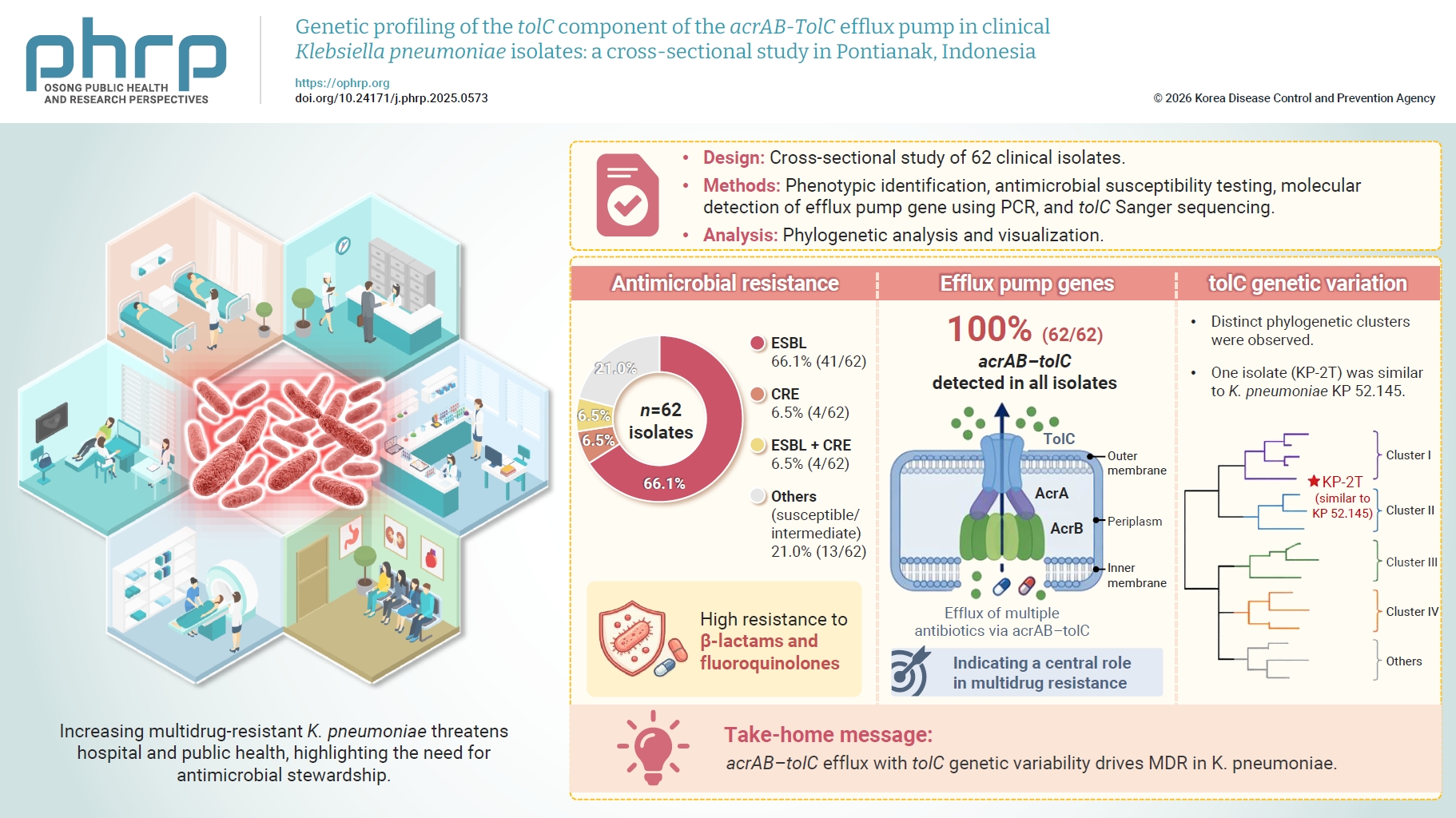
Genetic profiling of the tolC component of the acrAB-TolC efflux pump in clinical Klebsiella pneumoniae isolates: a cross-sectional study in Pontianak, Indonesia
Objectives
Klebsiella pneumoniae is a leading cause of hospital-acquired infections. Its increasing prevalence poses substantial challenges to both hospital and public health systems due to the emergence of multidrug-resistant strains. Understanding the epidemiology of K. pneumoniae and its antimicrobial resistance characteristics may support antimicrobial stewardship and infection control programs. A cross-sectional study was conducted from June to November 2025. Methods: A total of 62 isolates underwent phenotypic identification and antimicrobial susceptibility testing using the BD Phoenix system (Becton Dickinson), followed by molecular detection of K. pneumoniae and efflux pump genes. Sanger sequencing was performed on isolates positive for the tolC gene. Results: Among the isolates, 66.1% were classified as extended-spectrum β-lactamase (ESBL) producers, 6.5% as carbapenem-resistant Enterobacterales (CRE), and 6.5% as both ESBL and CRE producers. Most clinical isolates were resistant to ampicillin, cefazolin, ceftazidime, ceftriaxone, ciprofloxacin, and cefepime. The acrAB and tolC genes were detected in all 62 isolates. One isolate showed a genetic profile similar to that of the K. pneumoniae KP 52.145 strain. Conclusion: This study demonstrated a high prevalence of antibiotic resistance among K. pneumoniae isolates and confirmed the presence of efflux pump genes, including tolC, with observable genetic variability. Further investigation of tolC gene evolution is essential, as these genes play critical roles in antibiotic resistance mechanisms.
  • 2,588 View
  • 48 Download

Review Article

Applying biotechnology to overcome cancer drug resistance and improve public health outcomes
Franklin Akwasi Adjei, Bernard Kwame Frempong, Augustine Afriyie
Osong Public Health Res Perspect 2026;17(1):4-16.
Published online February 4, 2026
DOI: https://doi.org/10.24171/j.phrp.2025.0336
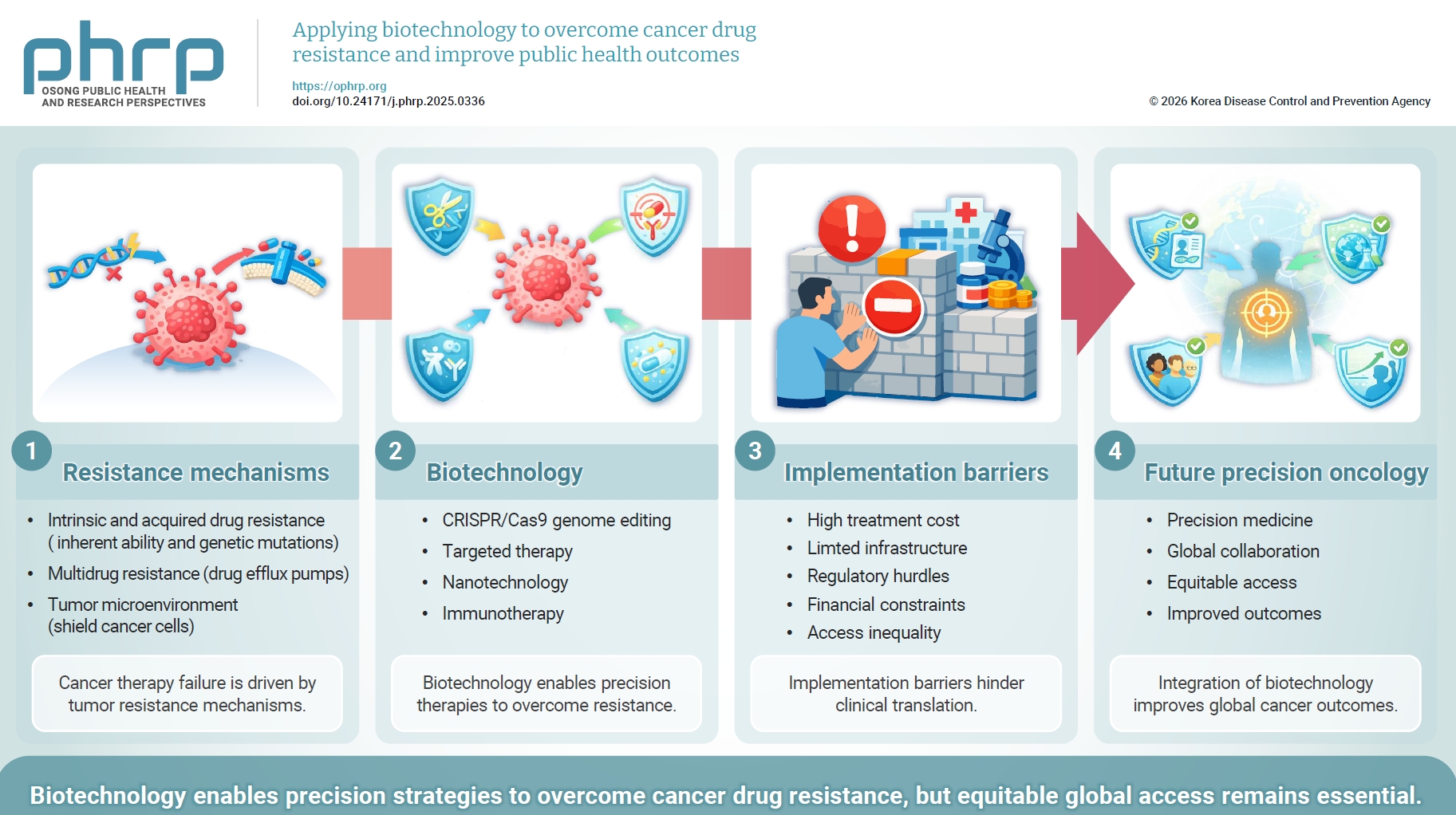
Applying biotechnology to overcome cancer drug resistance and improve public health outcomes
This review examines how biotechnology advances (CRISPR/Cas9, next-generation targeted therapies, nanotechnology-based drug delivery, and immunotherapies) can be applied to address cancer drug resistance worldwide. It also considers the economic burden of resistance, inequities in access to biotechnology solutions, and ethical concerns surrounding rapid innovation, particularly in low-resource settings. A narrative review synthesized evidence from basic science studies, clinical trials, translational research, and policy analyses. Evidence was prioritized for 2015–2025 publications. The synthesis highlights resistance biology and evaluates how precision medicine, biomarker-guided treatment, and high-throughput drug screening can inform individualized regimens and rational combinations. Breakthroughs in gene editing, targeted inhibitors, nanocarriers, and immune engineering can counter key resistance mechanisms, including resistance-conferring mutations, altered drug transport, immune evasion, and tumor microenvironment–mediated protection. Despite progress, implementation barriers remain substantial: high drug and development costs, limited molecular diagnostics and manufacturing capacity, and regulatory and governance challenges that can delay adoption and widen disparities, particularly in low- and middle-income countries. Integrating biotechnology innovations within precision medicine frameworks may improve treatment selection and patient outcomes. Maximizing public health impact requires affordability and financing strategies, robust ethical oversight, timely regulatory pathways, and coordinated global collaboration to ensure access to effective therapies across health systems worldwide.
  • 3,316 View
  • 108 Download

Original Articles

Prevalence, multidrug resistance, and biofilm formation of Vibrio parahaemolyticus isolated from fish mariculture environments in Cat Ba Island, Vietnam
Kim Cuc Thi Nguyen, Phuc Hung Truong, Hoa Truong Thi, Xuan Tuy Ho, Phu Van Nguyen
Osong Public Health Res Perspect 2024;15(1):56-67.
Published online February 19, 2024
DOI: https://doi.org/10.24171/j.phrp.2023.0181
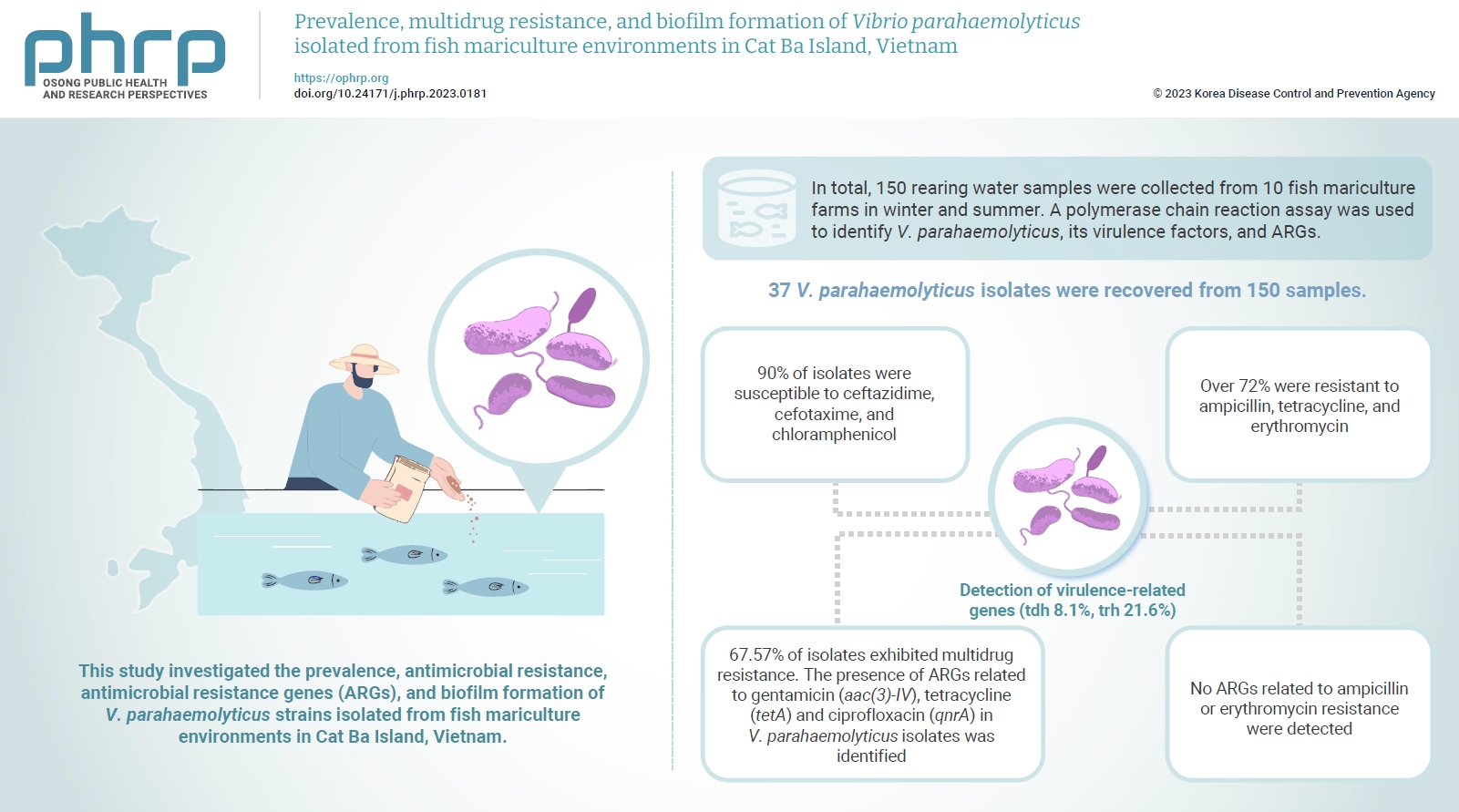
Prevalence, multidrug resistance, and biofilm formation of Vibrio parahaemolyticus isolated from fish mariculture environments in Cat Ba Island, Vietnam
Objectives
Vibrio parahaemolyticus is a major foodborne pathogen in aquatic animals and a threat to human health worldwide. This study investigated the prevalence, antimicrobial resistance, antimicrobial resistance genes (ARGs), and biofilm formation of V. parahaemolyticus strains isolated from fish mariculture environments in Cat Ba Island, Vietnam. Methods: In total, 150 rearing water samples were collected from 10 fish mariculture farms in winter and summer. A polymerase chain reaction assay was used to identify V. parahaemolyticus, its virulence factors, and ARGs. The antimicrobial resistance patterns and biofilm formation ability of V. parahaemolyticus strains were investigated using the disk diffusion test and a microtiter plate-based crystal violet method, respectively. Results: Thirty-seven V. parahaemolyticus isolates were recovered from 150 samples. The frequencies of the tdh and trh genes among V. parahaemolyticus isolates were 8.1% and 21.6%, respectively. More than 90% of isolates were susceptible to ceftazidime, cefotaxime, and chloramphenicol, but over 72% were resistant to ampicillin, tetracycline, and erythromycin. Furthermore, 67.57% of isolates exhibited multidrug resistance. The presence of ARGs related to gentamicin (aac(3)-IV), tetracycline (tetA) and ciprofloxacin (qnrA) in V. parahaemolyticus isolates was identified. Conversely, no ARGs related to ampicillin or erythromycin resistance were detected. Biofilm formation capacity was detected in significantly more multidrug-resistant isolates (64.9%) than non-multidrug-resistant isolates (18.9%). Conclusion: Mariculture environments are a potential source of antibiotic-resistant V. parahaemolyticus and a hotspot for virulence genes and ARGs diffusing to aquatic environments. Thus, the prevention of antibiotic-resistant foodborne vibriosis in aquatic animals and humans requires continuous monitoring.

Citations

Citations to this article as recorded by  Crossref logo
  • The synthetic peptide GATR-3 shows significant antibacterial and biofilm-inhibition activity against shellfish- and oyster-associated bacteria Vibrio vulnificus and Vibrio parahaemolyticus
    Sabrina Hsin-Yin Tsai, Brett A. Froelich, Monique L. van Hoek
    Comparative Immunology Reports.2026; 10: 200266.     CrossRef
  • Antimicrobial resistance in shrimp aquaculture: Pathways, ecosystem risks, and policy responses
    Lovely Akter, Neaz A. Hasan, Moshiur Rahman, Nasrullah Forajy, Mohammad Mahfujul Haque
    Environmental Challenges.2026; 22: 101401.     CrossRef
  • Influence of environmental parameters on total and pathogenic Vibrio parahaemolyticus isolated from mussels and clams
    Görkem Cengiz, Özlem Küplülü
    Microbial Pathogenesis.2026; 213: 108352.     CrossRef
  • Phenotypic and genomic characterization of Vibrio parahaemolyticus isolated from Pacific white shrimp (Litopenaeus vannamei) at wet markets and online retail channels
    Xiaoyu Wang, Jiayi Zhang, Yongheng Zhu, Jun Wang, Tian Ding, Xinyu Liao, Juhee Ahn
    Food Science and Biotechnology.2026; 35(5): 1319.     CrossRef
  • The role of cortisol as a physiological stress indicator in fish contamination by Vibrio parahaemolyticus and its implications for human health
    Rzgar Farooq Rashid
    Italian Journal of Food Safety.2026;[Epub]     CrossRef
  • Assessment of Antibiotic Susceptibility and Biofilm Formation in Bacteria Isolated from White-Leg Shrimp in Traditional Markets, Can Tho City, Vietnam
    Hau Huu Tran, Nhi Thao Huynh, Nam Van Be Tran, Thanh Uyen Le, Tam Ngoc Thanh Huynh
    World's Veterinary Journal.2026; 16(1): 259.     CrossRef
  • New insights into the resistome-mobilome–biofilm relationship in Vibrio parahaemolyticus
    Antoine Régnier, Virginie Chesnais, Cecile Dumaire, Cecile Berdous, Romain Briandet, Sabine Debuiche, Virgile Guéneau, Graziella Midelet, Mélanie Gay, Thomas Brauge
    Food Microbiology.2026; 140: 105162.     CrossRef
  • Molecular Epidemiology, Antibiotic Susceptibility, and Virulence Profiling of Vibrio parahaemolyticus Isolated from Aquatic Foods in Shenzhen, China
    Fei Zha, Rui Luo, Longfei Hu, Weipeng Chen, Chun-Xu Xue
    Foodborne Pathogens and Disease.2026;[Epub]     CrossRef
  • Interface-dependent V. parahaemolyticus biofilm under varying temperatures, media, and oxygen conditions: implications for seafood safety
    Hansani Nilupama Kumari Senarath Pathirana, Steve Flint, Jon Palmer
    Food Research International.2026; 242: 120008.     CrossRef
  • Molecular epidemiology of multidrug-resistant, biofilm-producing Vibrio parahaemolyticus from a brackish water aquaculture-estuarine interface
    S.J. Abisha Juliet Mary, M. Petchimuthu, S. Deepika, G. Ferolin Jessina, S. Balasundari
    Environmental Pollution.2026; 409: 128990.     CrossRef
  • The Conjugative Megaplasmid pMD9A Mediates Transferring Antibiotic Resistance Genes
    Yahan Cao, Ling-jia Zhu, TianQi Wang, Wenchao Yu
    Microbial Drug Resistance.2026;[Epub]     CrossRef
  • Optimization of immune priming interval using Imuno-FS Plus enhances the efficacy of oral formalin-killed Vibrio parahaemolyticus vaccine in Pacific white shrimp (Litopenaeus vannamei)
    Annisa Widya Ananda, Sri Nuryati, Dinamella Wahjuningrum, Munti Yuhana, Ardana Kurniaji
    Comparative Immunology Reports.2026; 11: 200316.     CrossRef
  • Exploring the antibiofilm efficacy of pyrimidines against Vibrio parahaemolyticus, mechanisms and their potential food processing applications
    Olajide Sunday Faleye, Jin-Hyung Lee, Jintae Lee
    LWT.2025; 215: 117229.     CrossRef
  • The role of sea fish meat in the transmission of Vibrio parahaemolyticus to humans: An in-depth analysis of seasonal and species-specific variations
    Maged A. Al-Garadi, Dhary Alewy Almashhadany, Rasha N. Aziz, Dheyazan M. Ali Al-Qabili, Ohoud S. Alhumaidan, Hanouf Alnuwaysir, Al-Hammadi Mohammed Ali, Essam Sayed, A. M. Alabsi
    Veterinary World.2025; : 348.     CrossRef
  • Multidrug Resistance, Biofilm-Forming Ability, and Molecular Characterization of Vibrio Species Isolated from Foods in Thailand
    Watcharapong Mitsuwan, Ratchadaporn Boripun, Phirabhat Saengsawang, Sutsiree Intongead, Sumaree Boonplu, Rawiwan Chanpakdee, Yukio Morita, Sumalee Boonmar, Napapat Rojanakun, Natnicha Suksriroj, Chollathip Ruekaewma, Titima Tenitsara
    Antibiotics.2025; 14(3): 235.     CrossRef
  • Antimicrobial resistance of zoonotic bacteria isolated from shrimp aquaculture environments in Selangor, Malaysia
    S. Devadas, Z. Zakaria, M. Shariff, S. Bhassu, M. Karim, I. Natrah
    Aquaculture.2025; 604: 742480.     CrossRef
  • Characterization of Virulence Genotypes and Prevalence of Vibrio parahaemolyticus from Fish Samples Collected from Thoothukudi Fish Landing Centres, India
    Selvamathi Veerabhadran Ragul, Fathiraja Parthiban, Rajendran Shalini, Sivasankar Panchavarnam, Thandapani Muthulakshmi, Mohamed Mansoor, Stephen Jerusha, Selvam Krishnakumar
    Thalassas: An International Journal of Marine Scie.2025;[Epub]     CrossRef
  • Persistent Threats: A Comprehensive Review of Biofilm Formation, Control, and Economic Implications in Food Processing Environments
    Alexandra Ban-Cucerzan, Kálmán Imre, Adriana Morar, Adela Marcu, Ionela Hotea, Sebastian-Alexandru Popa, Răzvan-Tudor Pătrînjan, Iulia-Maria Bucur, Cristina Gașpar, Ana-Maria Plotuna, Sergiu-Constantin Ban
    Microorganisms.2025; 13(8): 1805.     CrossRef
  • Southeast‑Asian landscape of antimicrobial resistance research (2014–2024): A bibliometric analysis
    Alex S. Borromeo, Allan M. Manaloto, Ronilo P. Antonio
    Journal of Global Antimicrobial Resistance.2025; 45: 125.     CrossRef
  • A New Strategy: Antibiotic Circumstances for Rational Drug use Against Clinical Aeromonas hydrophila And Bacterial Properties of This Bacteria on Different Agars
    Nurdan Filik, Fethi Filik, Ayşegül Kubilay
    Acta Aquatica Turcica.2024; 20(4): 312.     CrossRef
  • Passive immunoprophylaxis with Ccombodies against Vibrio parahaemolyticus in Pacific white shrimp (Penaeus vannamei)
    Wanna Sirimanapong, Prawporn Thaijongrak, Chiranan Sudpraseart, Dennis Berbulla Bela-ong, Abigail Joy D. Rodelas-Angelia, Mark Rickard N. Angelia, Seungbeom Hong, Jaesung Kim, Kim D. Thompson, Tae Sung Jung
    Fish & Shellfish Immunology.2024; 154: 109973.     CrossRef
  • Isolation of H2S-generating Bacterium (Desulfovibrio sp.) and Vibrio parahaemolyticus From Aquatic Farming and In Vitro Evaluation of the Ability of Bacteriophages as Biocontrol
    Truong Thi Bich Van, Nguyen Thi Loan Anh, Nguyen Huu Tri , Chau Thanh Tuan
    Jurnal Ilmiah Perikanan dan Kelautan.2024; 17(1): 167.     CrossRef
  • 9,471 View
  • 225 Download
  • 19 Web of Science
  • Crossref
Drug resistance and the genotypic characteristics of rpoB and katG in rifampicin- and/or isoniazid-resistant Mycobacterium tuberculosis isolates in central Vietnam
Thi Binh Nguyen Nguyen, Thi Kieu Diem Nguyen, Van Hue Trương, Thi Tuyet Ngoc Tran, van Bao Thang Phan, Thi Tuyen Nguyen, Hoang Bach Nguyen, Viet Quynh Tram Ngo, Van Tuan Mai, Paola Molicotti
Osong Public Health Res Perspect 2023;14(5):347-355.
Published online October 18, 2023
DOI: https://doi.org/10.24171/j.phrp.2023.0124
Drug resistance and the genotypic characteristics of rpoB and katG in rifampicin- and/or isoniazid-resistant Mycobacterium tuberculosis isolates in central Vietnam
Objectives
Tuberculosis (TB) and drug-resistant TB (DR-TB) are national health burdens in Vietnam. In this study, we investigated the prevalence of rifampicin (RIF) and/or isoniazid (isonicotinic acid hydrazide, INH) resistance in patients with suspected TB, and applied appropriate techniques to help rapidly target DR-TB. Methods: In total, 1,547 clinical specimens were collected and cultured using the BACTEC MGIT system (Becton Dickinson and Co.). A resazurin microtiter assay (REMA) was used to determine the proportions of RIF and/or INH resistance. A real-time polymerase chain reaction panel with TaqMan probes was employed to identify the mutations of rpoB and katG associated with DR-TB in clinical isolates. Genotyping of the identified mutations was also performed. Results: A total of 468 Mycobacterium tuberculosis isolates were identified using the REMA. Of these isolates, 106 (22.6%) were found to be resistant to 1 or both antibiotics. Of the resistant isolates, 74 isolates (69.8%) were resistant to isoniazid (INH) only, while 1 isolate (0.94%) was resistant to RIF only. Notably, 31 isolates (29.24%) were resistant to both antibiotics. Of the 41 phenotypically INH-resistant isolates, 19 (46.3%) had the Ser315Thr mutation. There were 8 different rpoB mutations in 22 (68.8%) of the RIF-resistant isolates. The most frequently detected mutations were at codons 531 (37.5%), 526 (18.8%), and 516 (6.3%). Conclusion: To help prevent new cases of DR-TB in Vietnam, it is crucial to gain a comprehensive understanding of the genotypic DR-TB isolates.

Citations

Citations to this article as recorded by  Crossref logo
  • Identification of Potent Molecule for Rifampicin‐Resistant Mycobacterium tuberculosis using Natural Compounds by Structure‐Based Analysis
    Madhana Priya N, Magesh R
    ChemistrySelect.2026;[Epub]     CrossRef
  • Clinical Evaluation of a Tandem qPCR-CRISPR Assay for Multidrug-Resistant or Rifampicin-Resistant Tuberculosis: A Prospective Diagnostic Accuracy Study
    Ying Wang, Zhe Song, Jianfeng Zeng, Yajuan Dong, Houming Liu, Jian Zeng, Xuhui Liu, Liang Fu, Xuelin Li, Shuihua Lu, Zhen Huang, Xiao-Yong Fan
    Microorganisms.2026; 14(8): 1750.     CrossRef
  • 6,585 View
  • 163 Download
  • 2 Web of Science
  • Crossref

Review Article

Strategies to combat Gram-negative bacterial resistance to conventional antibacterial drugs: a review
Priyanka Bhowmik, Barkha Modi, Parijat Roy, Antarika Chowdhury
Osong Public Health Res Perspect 2023;14(5):333-346.
Published online October 18, 2023
DOI: https://doi.org/10.24171/j.phrp.2022.0323
Strategies to combat Gram-negative bacterial resistance to conventional antibacterial drugs: a review
The emergence of antimicrobial resistance raises the fear of untreatable diseases. Antimicrobial resistance is a multifaceted and dynamic phenomenon that is the cumulative result of different factors. While Gram-positive pathogens, such as methicillin-resistant Staphylococcus aureus and Clostridium difficile, were previously the most concerning issues in the field of public health, Gram-negative pathogens are now of prime importance. The World Health Organization’s priority list of pathogens mostly includes multidrug-resistant Gram-negative organisms particularly carbapenem-resistant Enterobacterales, carbapenem-resistant Pseudomonas aeruginosa, and extensively drug-resistant Acinetobacter baumannii. The spread of Gram-negative bacterial resistance is a global issue, involving a variety of mechanisms. Several strategies have been proposed to control resistant Gram-negative bacteria, such as the development of antimicrobial auxiliary agents and research into chemical compounds with new modes of action. Another emerging trend is the development of naturally derived antibacterial compounds that aim for targets novel areas, including engineered bacteriophages, probiotics, metal-based antibacterial agents, odilorhabdins, quorum sensing inhibitors, and microbiome-modifying agents. This review focuses on the current status of alternative treatment regimens against multidrug-resistant Gram-negative bacteria, aiming to provide a snapshot of the situation and some information on the broader context.

Citations

Citations to this article as recorded by  Crossref logo
  • Progress in Characterization of Lipopolysaccharides and Lipid A by Mass Spectrometry
    Amanda Helms, Jennifer S. Brodbelt
    Mass Spectrometry Reviews.2026; 45(5): 929.     CrossRef
  • Effect of MgO/P2O5 ratio on the structure and antibacterial property of Ag2O doped zinc phosphate glass
    Jeongho Cho, Bongki Ryu, Jaeyeop Chung
    Journal of the Korean Ceramic Society.2026; 63(3): 440.     CrossRef
  • Antimicrobial effect and safety of 228 nm far-UVC light-emitting diodes
    Honoka Fujikawa, Yuki Shimizu, Mane Nishimura, Tomohiro Fujii, Yu Okada, Keisuke Kawasaki, Kenji Watanabe, Yoichi Mizukami, Jun Nishikawa
    Journal of Photochemistry and Photobiology B: Biol.2026; 278: 113410.     CrossRef
  • Role of novel β-lactam antibiotics in the treatment of bacterial pneumonia
    Susanna Esposito, Nicola Principi
    Expert Opinion on Pharmacotherapy.2026; 27(5): 423.     CrossRef
  • Ten Year Review of Wound Culture Results and Antimicrobial Resistance Patterns in a Burn Center
    Gabrielle Bierlein-De La Rosa, Patrick Ten Eyck, Colette Galet, Shady Al Hayek
    Journal of Surgical Research.2026; 322: 35.     CrossRef
  • RAGE in Neutrophils: A Sensor for Pathogen-Associated Structures and Beyond
    Ekaterina A. Golenkina, Sofia V. Navarnova, Galina M. Viryasova, Svetlana I. Galkina, Tatjana V. Gaponova, Yulia M. Romanova, Galina F. Sud’ina
    Biomedicines.2026; 14(5): 1128.     CrossRef
  • Thermal degradation kinetics and multifunctional properties of gelatin/carrageenan films incorporating eugenol-loaded Pickering emulsions for active packaging applications
    Khadijah Husna Abd Hamid, Theja Sree Pothula Ganesh Kumar, Nasratun Masngut, Mohd Hafiz Arzmi, Nurul Aini Mohd Azman
    Journal of Food Measurement and Characterization.2026; 20(7): 13843.     CrossRef
  • Synthesis and biological evaluation of novel carbazole derivatives as broad-spectrum antibacterial agents to fight antimicrobial resistance (AMR)
    Maria Grazia Martina, Francesca Barbieri, Sacha Michèle Idriss Cancade, Gioele Benocci, Alida Chittolina, Matteo Longo, Lisa Giannessi, Sara Rossi, Sandra Gemma, Giuseppe Campiani, Jean-Denis Docquier, Marco Radi
    European Journal of Pharmaceutical Sciences.2026; 224: 107595.     CrossRef
  • A synergistic bio–electro–topological strategy based on an MXene/silk fibroin hydrogel and electrical stimulation for diabetic wound healing
    Wenli Du, Yuanyuan Xu, Yuecheng Peng, Zhiyu Chen, Zihan Yao, Junjie Wang, Xuefeng Hu, Jieyu Zhang, Yunbing Wang
    Materials Horizons.2026; 13(16): 8223.     CrossRef
  • Outer membrane as a drug target for the treatment of GNB infections
    Urjoshi Chattoraj, Ayesha Fatima, Deepanshi Saxena, Sidharth Chopra
    Drug Discovery Today.2026; 31(5): 104768.     CrossRef
  • Collateral sensitivity-harnessing microbial vulnerabilities as a solution to antimicrobial resistance
    Rishav Jana, Priyanka Bhowmik
    Molecular Biology Reports.2026;[Epub]     CrossRef
  • Isolation, derivatization, and anti-microbial evaluation of secondary metabolites from Garcinia dryobalanoides
    Nur Fazlin Zafirah Zaine, Nor Hisam Zamakshshari, Ainaa Nadiah Abd Halim, Vivien Jong Yi Mian, Ngieng Ngui Sing
    Natural Product Research.2025; 39(22): 6383.     CrossRef
  • Bioactive Potential and Chemical Composition of Vitex agnus-castus L. Leaf Extracts Collected in Algeria: A Combined In Vitro and In Silico Approach
    Amina Bramki, Ghozlane Barboucha, Ouided Benslama, Anna Andolfi, Fatima Zohra Makhlouf, Maria Smati, Djamila Benouchenne, Mohamed Moussaoui, Chawki Bensouici, Alessio Cimmino, Jesús G. Zorrilla, Maria Michela Salvatore, Marco Masi
    Molecules.2025; 30(3): 749.     CrossRef
  • Viability and Surface Morphology of Human Erythrocytes upon Interaction with Chitosan Derivatives
    Evgeniya A. Bezrodnykh, Marina G. Holyavka, Tatyana N. Belyaeva, Svetlana M. Pankova, Valery G. Artyukhov, Yurij A. Antonov, Boris B. Berezin, Inesa V. Blagodatskikh, Vladimir E. Tikhonov
    ACS Applied Bio Materials.2025; 8(3): 1909.     CrossRef
  • Effect of Mutations on the Evolution of Extended Spectrum β-lactamases (ESBL)
    Anirudha Dutta, Antarika Chowdhury, Parijat Roy, Priyanka Bhowmik
    The Protein Journal.2025; 44(5): 501.     CrossRef
  • Membrane-targeting antibacterial isoniazid schiff base against S. aureus and biofilms
    Yaguang Liu, Lianzhi Hu, Binbin Liu, Zheng Qu
    Frontiers in Chemistry.2025;[Epub]     CrossRef
  • Rapidez diagnóstica na detecção de carbapenemases como estratégia de políticas públicas no controle e prevenção de infecção hospitalar
    Ana Beatriz Nascimento Costa, Ana Carolina Cavalcante Tiburcio, Akemi Oshiro Guirelli, Andréia Moreira dos Santos Carmo, Vilma Dos Santos Menezes Gaiotto Daros, Ivana Barros de Campos, Jaqueline Maria Gerbase, Maria Edvania Ferreira Teodoro, Murilo Carlos
    BEPA. Boletim Epidemiológico Paulista .2025; 22: 81.     CrossRef
  • Resistance of Gram-negative bacteria to aztreonam-avibactam: An evaluation of data from in vitro studies
    Matthew E. Falagas, Laura T. Romanos, Dimitrios S. Kontogiannis, Charalampos Filippou
    International Journal of Antimicrobial Agents.2025; 66(6): 107624.     CrossRef
  • Facile Phyto fabrication of Mg interconnected ZrO2 nanocomposites for effective decontamination of infected water bodies
    M. Pushpa, S. Mageswari, S. Na Shereenaa, S. Surendhiran
    Journal of the Indian Chemical Society.2025; 102(11): 102193.     CrossRef
  • Antibiotic Resistance: A Genetic and Physiological Perspective
    Rania G. Elbaiomy, Ahmed H. El‐Sappah, Rong Guo, Xiaoling Luo, Shiyuan Deng, Meifang Du, Xiaohong Jian, Mohammed Bakeer, Zaixin Li, Zhi Zhang
    MedComm.2025;[Epub]     CrossRef
  • Interactive effects of environment on antimicrobial activity of extracts of the termite Macrotermes subhyalinus (Blattodea: Termitidae)
    Miriam Awuor Oluoch, Benson Odhiambo Onyango, Peter Bulli, Ellen Klinger
    Journal of Insect Science.2025;[Epub]     CrossRef
  • Plasmon-enhanced photocatalysis and antimicrobial activity of Ag/LaVO4:Eu3+ nanoparticle gel for wound healing
    V.K. Klochkov, O.O. Sedyh, G.V. Grygorova, N.O. Karpenko, P.O. Maksimchuk, S.B. Pavlov, T.P. Osolodchenko, S.L. Yefimova
    Functional Materials.2025; 32(4): 663.     CrossRef
  • Efficacy of new generation biosorbents for the sustainable treatment of antibiotic residues and antibiotic resistance genes from polluted waste effluent
    Barkha Madhogaria, Sangeeta Banerjee, Atreyee Kundu, Prasanta Dhak
    Infectious Medicine.2024; 3(1): 100092.     CrossRef
  • Evaluation of Plant-Based Silver Nanoparticles for Antioxidant Activity and Promising Wound-Healing Applications
    Maria Qubtia, Shazia Akram Ghumman, Sobia Noreen, Huma Hameed, Shazia Noureen, Rizwana Kausar, Ali Irfan, Pervaiz Akhtar Shah, Hafsa Afzal, Misbah Hameed, Mohammad Raish, Maria Rana, Ajaz Ahmad, Katarzyna Kotwica-Mojzych, Yousef A. Bin Jardan
    ACS Omega.2024; 9(10): 12146.     CrossRef
  • Progress and potentialities in wood extractives-based materials for active food packaging applications
    Eliana I. Fernández Sosa, Nanci Ehman, Fernando E. Felissia, M. Guadalupe Chaves, M. Cristina Area
    Food Bioscience.2024; 60: 104489.     CrossRef
  • A comprehensive investigation of the anion inhibition profile of a β-carbonic anhydrase from Acinetobacter baumannii for crafting innovative antimicrobial treatments
    Viviana De Luca, Simone Giovannuzzi, Claudiu T. Supuran, Clemente Capasso
    Journal of Enzyme Inhibition and Medicinal Chemist.2024;[Epub]     CrossRef
  • 15,923 View
  • 492 Download
  • 26 Web of Science
  • Crossref

Short Communication

Epidemiological characteristics of carbapenemase-producing Enterobacteriaceae outbreaks in the Republic of Korea between 2017 and 2022
Hyoseon Jeong, Junghee Hyun, Yeon-Kyeng Lee
Osong Public Health Res Perspect 2023;14(4):312-320.
Published online August 21, 2023
DOI: https://doi.org/10.24171/j.phrp.2023.0069
Epidemiological characteristics of carbapenemase-producing Enterobacteriaceae outbreaks in the Republic of Korea between 2017 and 2022
Objectives
We aimed to describe the epidemiological characteristics of carbapenemase-producing Enterobacteriaceae (CPE) outbreaks in healthcare settings in the Republic of Korea between 2017 and 2022.
Methods
Under the national notifiable disease surveillance system, we obtained annual descriptive statistics regarding the isolated species, carbapenemase genotype, healthcare facility type, outbreak location and duration, and number of patients affected and recommended interventions. We used epidemiological investigation reports on CPE outbreaks reported to Korea Disease Control and Prevention Agency from June 2017 to September 2022.
Results
Among the 168 reports analyzed, Klebsiella pneumoniae (85.1%) was the most frequently reported species, while K. pneumoniae carbapenemase (KPC, 82.7%) was the most common carbapenemase genotype. Both categories increased from 2017 to 2022 (p<0.01). General hospitals had the highest proportion (54.8%), while tertiary general hospitals demonstrated a decreasing trend (p<0.01). The largest proportion of outbreaks occurred exclusively in intensive care units (ICUs, 44.0%), and the frequency of concurrent outbreaks in ICUs and general wards increased over time (p<0.01). The median outbreak duration rose from 43.5 days before the coronavirus disease 2019 (COVID-19) pandemic (2017–2019) to 79.5 days during the pandemic (2020–2022) (p=0.01), and the median number of patients associated with each outbreak increased from 5.0 to 6.0 (p=0.03). Frequently recommended interventions included employee education (38.1%), and 3 or more measures were proposed for 45.2% of outbreaks.
Conclusion
In the Republic of Korea, CPE outbreaks have been consistently dominated by K. pneumoniae and KPC. The size of these outbreaks increased during the COVID-19 pandemic. Our findings highlight the need for continuing efforts to control CPE outbreaks using a multimodal approach, while considering their epidemiology.

Citations

Citations to this article as recorded by  Crossref logo
  • Microbiological and clinical impact of aminoglycosides on KPC-producing Klebsiella pneumoniae bacteraemia with aminoglycoside-modifying enzymes
    Jae Eun Seong, Sang Min Ahn, Min Han, Yong Seop Lee, Jung Ah Lee, Jae Hoon Kim, Jung Ho Kim, Jin Young Ahn, Su Jin Jeong, Nam Su Ku, Joon Sup Yeom, Hyukmin Lee, Jun Yong Choi
    Diagnostic Microbiology and Infectious Disease.2026; 114(1): 117111.     CrossRef
  • Early prediction of colonization by carbapenemase-producing enterobacterales at ICU admission using machine learning
    Ji Hun Kim, Eunmi Yang, Yun Woo Lee, Han-Sung Kim, Hyeonji Seo
    Scientific Reports.2026;[Epub]     CrossRef
  • Multidrug-resistant organism co-colonization in patients with discordant direct stool Xpert Carba-R and culture-based carbapenemase-producing Enterobacterales surveillance results
    Cheon-Hoo Jun, Si-Ho Kim, Hyoung Tae Kim, Yu Mi Wi
    Journal of Infection and Public Health.2026; 19(5): 103188.     CrossRef
  • Comparison of clinical outcomes of patients with serial negative surveillance cultures according to a subsequent polymerase chain reaction test for carbapenemase-producing Enterobacterales
    H. Seo, S. Kim, Y.W. Lee, H.S. Oh, H-S. Kim, Y.K. Kim
    Journal of Hospital Infection.2024; 146: 93.     CrossRef
  • Identifying Contact Time Required for Secondary Transmission ofClostridioides difficileInfections by Using Real-Time Locating System
    Min Hyung Kim, Jaewoong Kim, Heejin Ra, Sooyeon Jeong, Yoon Soo Park, Dongju Won, Hyukmin Lee, Heejung Kim
    Emerging Infectious Diseases.2024;[Epub]     CrossRef
  • Antimicrobial activity of ceftazidime-avibactam against KPC-2-producing Enterobacterales: a cross-combination and dose-escalation titration study with relebactam and vaborbactam
    Min Seo Kang, Jin Yang Baek, Jae-Hoon Ko, Sun Young Cho, Keon Young Lee, Young Ho Lee, Jinyoung Yang, Tae Yeul Kim, Hee Jae Huh, Nam Yong Lee, Kyungmin Huh, Cheol-In Kang, Doo Ryeon Chung, Kyong Ran Peck, Bobby G. Warren
    Microbiology Spectrum.2024;[Epub]     CrossRef
  • Performance comparison of BD Phoenix CPO detect panel with Cepheid Xpert Carba-R assay for the detection of carbapenemase-producing Klebsiella pneumoniae isolates
    Nazmiye Ülkü Tüzemen, Uğur Önal, Osman Merdan, Bekir Akca, Beyza Ener, Halis Akalın, Cüneyt Özakın
    BMC Microbiology.2024;[Epub]     CrossRef
  • 6,359 View
  • 233 Download
  • 6 Web of Science
  • Crossref

Review Article

Carbapenem resistance in critically important human pathogens isolated from companion animals: a systematic literature review
Angie Alexandra Rincón-Real, Martha Cecilia Suárez-Alfonso
Osong Public Health Res Perspect 2022;13(6):407-423.
Published online December 16, 2022
DOI: https://doi.org/10.24171/j.phrp.2022.0033
This study aimed to describe the presence and geographical distribution of Gram-negativebacteria considered critical on the priority list of antibiotic-resistant pathogens publishedby the World Health Organization, including carbapenem-resistant Enterobacteriaceae,carbapenem-resistant Acinetobacter spp., and carbapenem-resistant Pseudomonas aeruginosa.A systematic review of original studies published in 5 databases between 2010 and 2021 wasconducted, including genotypically confirmed carbapenem-resistant isolates obtained fromcanines, felines, and their settings. Fifty-one articles met the search criteria. Carbapenemresistant isolates were found in domestic canines and felines, pet food, and on veterinarymedical and household surfaces. The review found that the so-called “big five”—that is, the5 major carbapenemases identified worldwide in Enterobacterales (New Delhi metallo-βlactamase, active-on-imipenem, Verona integron-encoded metallo-β-lactamase, Klebsiellapneumoniae carbapenemase, and oxacillin [OXA]-48-like)—and the 3 most importantcarbapenemases from Acinetobacter spp. (OXA-23-like, OXA-40-like, and OXA-58-like) hadbeen detected in 8 species in the Enterobacteriaceae family and 5 species of glucose nonfermenting bacilli on 5 continents. Two publications used molecular analysis to confirmcarbapenem-resistant bacteria transmission between owners and dogs. Isolating criticallyimportant human carbapenem-resistant Gram-negative bacteria from domestic canines andfelines highlights the importance of including these animal species in surveillance programsand antimicrobial resistance containment plans as part of the One Health approach.

Citations

Citations to this article as recorded by  Crossref logo
  • Reducing carbapenemase-producing Gram-negative bacilli in high-risk veterinary hospital units through targeted infection prevention and control
    Chavin Leelapsawas, Chutirat Torsahakul, Nicole Sirisopit Mehl, Krishaporn Kradangnga, Parinya Sroithongkham, Rusmin Indra, Parnkaew Wannamala, Luksika Keerativitayanant, Rungtip Chuanchuen, Pattrarat Chanchaithong
    Research in Veterinary Science.2026; 204: 106120.     CrossRef
  • Monitoring antimicrobial resistance trends and emerging carbapenemases in Enterobacterales causing companion animal infections: a four-year study
    Laura Fernandes, Joana Moreira da Silva, Juliana Menezes, Cátia Marques, Cátia Caneiras, Constança Pomba
    Veterinary Microbiology.2026; 316: 110987.     CrossRef
  • Clinical audit on antimicrobial stewardship effectiveness in reducing antimicrobial‐resistant bacterial colonisation in hospitalised horses
    Karen Mazzola, Aliai Lanci, Silvia Piva, Viviana Schisa, Jole Mariella, Raffaele Scarpellini, Francesca Freccero, Erica De Carolis, Fabio Tumietto, Carolina Castagnetti
    Equine Veterinary Journal.2026;[Epub]     CrossRef
  • Beyond companionship: Current practices and future perspectives in antimicrobial resistance surveillance among companion animals
    Raffaele Scarpellini, Silvia Piva
    Research in Veterinary Science.2026; 209: 106275.     CrossRef
  • Epidemiology and characterization of carbapenemase gene alleles expressed by Enterobacterales recovered from Nairobi river surface water and local input sources in Nairobi, Kenya
    Rael J. Too, Briton M. Kavulavu, George C. Gitao, Lilly C. Bebora, Dixie F. Mollenkopf, Samuel Kariuki, Thomas E. Wittum
    Total Environment Microbiology.2026; 2(3): 100094.     CrossRef
  • Multilevel surveillance of antimicrobial resistance in Escherichia coli and Klebsiella pneumoniae from companion animals: Evidence from a Veterinary University Hospital before and after EU Regulation 2022/1255
    R. Scarpellini, M. Giunti, F. Dondi, C. Agnoli, L. Pisoni, S. Del Magno, A. Foglia, I. Magagnoli, E. Esposito, E. Mondo, F. Tumietto, S. Piva
    Veterinary Microbiology.2026; 319: 111081.     CrossRef
  • Survey-based risk factors and genomic characterization of oral and oropharyngeal Enterobacterales carriage in humans and companion animals: a One Health study
    W. Cooper Brookshire, K. Taylor Hellmann, D. Ashley Robinson, Keun Seok Seo
    Frontiers in Veterinary Science.2026;[Epub]     CrossRef
  • NDM-5-plasmid diversity in multiple international high-risk Escherichia coli clones associated with canine and feline extraintestinal infections
    Pattrarat Chanchaithong, Parinya Sroithongkham, Chavin Leelapsawas, Komkiew Pinpimai, Jitrapa Yindee, Alexandra Collaud, Vincent Perreten
    Veterinary Microbiology.2025; 301: 110338.     CrossRef
  • Staphylococcal skin infection isolates from dogs without recent antibiotic exposure are 100% susceptible to clindamycin
    W. Cooper Brookshire, Larry D. Ballard, Vernon C. Langston, Joo Youn Park, Keun-Seok Seo
    Frontiers in Veterinary Science.2025;[Epub]     CrossRef
  • The European Union summary report on antimicrobial resistance in zoonotic and indicator bacteria from humans, animals and food in 2022–2023

    EFSA Journal.2025;[Epub]     CrossRef
  • Zoonotic potential of uropathogenic Escherichia coli lineages from companion animals
    Nicolas Jousserand, Frédéric Auvray, Camille Chagneau, Laurent Cavalié, Christelle Maurey, Amandine Drut, Rachel Lavoué, Eric Oswald
    Veterinary Research.2025;[Epub]     CrossRef
  • Genomic analyses of Escherichia coli ST410 harbouring the blaOXA-181 carbapenemase gene from companion animals and humans in Switzerland
    Yvonne Spahr, Patrice Nordmann, Javier E Fernandez, Laurent Poirel, Andrea Endimiani, Vincent Perreten
    Journal of Applied Microbiology.2025;[Epub]     CrossRef
  • WGS-based characterization of trans-sectoral OXA-48-producing Escherichia coli in Switzerland
    Valentina Donà, Patrice Nordmann, Javier E. Fernandez, Laurent Poirel, Jacqueline Findlay, Simone Schuller, Sonja Kittl, Helene Rohrbach, Andrea Endimiani, Vincent Perreten
    One Health Advances.2025;[Epub]     CrossRef
  • Analysis of the Concordance Between the Use of Phenotypic Screening Tests with the β-Lactamase Gene Profile in Selected Gram-Negative Bacteria
    Patrycja Głowacka, Izabela Marczuk, Patrycja Wójcicka, Monika Ogórkiewicz, Marta Ciesielska, Dorota Żakowska, Paweł Rutyna, Anna Koszczyńska, Marta Łączyńska, Natalia Podsiadły, Emilia Paziewska, Beata Cieśluk-Olchowska
    Antibiotics.2025; 14(12): 1275.     CrossRef
  • First report of a blaNDM-5-carrying Escherichia coli sequence type 12 isolated from a dog with pyometra in Japan
    Kazuki Harada, Tadashi Miyamoto, Michiyo Sugiyama, Tetsuo Asai
    Journal of Infection and Chemotherapy.2024; 30(9): 938.     CrossRef
  • The European Union summary report on antimicrobial resistance in zoonotic and indicator bacteria from humans, animals and food in 2021–2022

    EFSA Journal.2024;[Epub]     CrossRef
  • Epidemiological analysis and prevention strategies in response to a shigellosis cluster outbreak: a retrospective case series in an alternative school in the Republic of Korea, 2023
    Yeongseo Ahn, Sunmi Jin, Gemma Park, Hye Young Lee, Hyungyong Lee, Eunkyung Shin, Junyoung Kim, Jaeil Yoo, Yuna Kim
    Osong Public Health and Research Perspectives.2024; 15(1): 68.     CrossRef
  • Carbapenem Resistance in Animal-Environment-Food from Africa: A Systematic Review, Recommendations and Perspectives
    Komla Dossouvi, Ayawovi Selom Ametepe
    Infection and Drug Resistance.2024; Volume 17: 1699.     CrossRef
  • Identification of blaOXA-23 gene in resistant Pseudomonas aeruginosa strains isolated from cows and humans in Basra province, Iraq
    Alyaa Sabti Jasim, Abeer Laily Mohammed, Wameedh Hashim Abbas, Hanaa Khaleel Ibraheim, Hasanain A.J. Gharban
    Veterinary World.2024; : 1629.     CrossRef
  • The European Union Summary Report on Antimicrobial Resistance in zoonotic and indicator bacteria from humans, animals and food in 2020/2021

    EFSA Journal.2023;[Epub]     CrossRef
  • Resistome-based surveillance identifies ESKAPE pathogens as the predominant gram-negative organisms circulating in veterinary hospitals
    Flavia Zendri, Cajsa M. Isgren, Jane Devaney, Vanessa Schmidt, Rachel Rankin, Dorina Timofte
    Frontiers in Microbiology.2023;[Epub]     CrossRef
  • Unveiling the emergence of multidrug-resistant pathogens in exotic pets from France: a comprehensive study (2017-2019)
    Sandro Cardoso, Aurélie Le Loc’h, Inês Marques, Anabela Almeida, Sérgio Sousa, Maria José Saavedra, Sofia Anastácio, Eduarda Silveira
    One Health & Implementation Research.2023; 3(4): 161.     CrossRef
  • 12,800 View
  • 261 Download
  • 22 Web of Science
  • Crossref

Original Article

Objectives
This study aimed to identify the epidemiological characteristics of patients with carbapenem-resistant Enterobacteriaceae and Acinetobacter baumannii (CRE/ CRAB) isolates in a tertiary referral hospital in Korea. Methods: We collected and analyzed data from 528 adults admitted to a tertiary referral hospital from August 1, 2018 to February 29, 2020. The CRE/CRAB isolates were confirmed as being present at the time of patients’ admission or acquired during hospitalization based on their medical records. The t-test, chi-square test, or Fisher exact test and stepwise multiple logistic regression were performed. Results: While the proportion of community-acquired CRE/CRAB was low (6%), 20% of CRE/ CRAB isolates were identified in patients at the time of hospitalization. The risk of CRAB isolation was positively associated with mechanical ventilator use (odds ratio [OR], 3.52; 95% confidence interval [CI], 1.96−6.33) and total parenteral nutrition use (OR, 3.64; 95% CI, 1.87−7.08). Conclusion: Over 20% of CRE/CRAB isolates in a tertiary referral hospital in Korea were found at the time of patients’ admission. Furthermore, patients with mechanical ventilation and/or total parenteral nutrition tended to acquire CRAB more frequently. Thus, active surveillance for CRE/CRAB at the time of hospitalization is strongly required, particularly for patients who are expected to require mechanical ventilation or total parenteral nutrition.

Citations

Citations to this article as recorded by  Crossref logo
  • Disease burden of carbapenem-resistant Enterobacterales infections in Korea
    C.M. Lee, J. Jung, E. Lee, S. Lee, S.Y. Cho, P.G. Choe, R. Lee, Y.K. Kim, H.J. Choi, J-H. Kim, C-J. Kim, Y.G. Kwak, K-H. Park, Y.S. Kim, S. Cheon, S.Y. Park, H.B. Kim, N.S. Ku, J. Ahn, K-H. Song, E.S. Kim, S.M. Moon, S.J. Choi
    Journal of Hospital Infection.2026; 172: 89.     CrossRef
  • Epidemiological analysis and prevention strategies in response to a shigellosis cluster outbreak: a retrospective case series in an alternative school in the Republic of Korea, 2023
    Yeongseo Ahn, Sunmi Jin, Gemma Park, Hye Young Lee, Hyungyong Lee, Eunkyung Shin, Junyoung Kim, Jaeil Yoo, Yuna Kim
    Osong Public Health and Research Perspectives.2024; 15(1): 68.     CrossRef
  • External validation of the ICU-CARB score to predict carbapenem-resistant gram-negative bacteria carriage in critically ill patients upon ICU admission: a multicenter analysis
    Tong Wu, Xiaoli Wang, Ziyun Shen, Zhongwei Zhang, Yuhao Liu, Rong Fang, Qian Wang, Sheng Wang, Quanhong Zhou, Hongping Qu, Yunqi Dai, Ruoming Tan
    Antimicrobial Resistance & Infection Control.2024;[Epub]     CrossRef
  • Geographical mapping and temporal trends of Acinetobacter baumannii carbapenem resistance: A comprehensive meta-analysis
    Masoumeh Beig, Elnaz Parvizi, Tahereh Navidifar, Narjes Bostanghadiri, Maryam Mofid, Narges Golab, Mohammad Sholeh, Mullika Traidej Chomnawang
    PLOS ONE.2024; 19(12): e0311124.     CrossRef
  • Epidemiology and Risk Factors of Carbapenemase-Producing Enterobacteriaceae Acquisition and Colonization at a Korean Hospital over 1 Year
    Hye-Jin Kim, Jung-Hee Hyun, Hyo-Seon Jeong, Yeon-Kyeng Lee
    Antibiotics.2023; 12(4): 759.     CrossRef
  • 7,263 View
  • 105 Download
  • 5 Web of Science
  • Crossref

Review Article

Yersinia pestis antibiotic resistance: a systematic review
Chen Lei, Suresh Kumar
Osong Public Health Res Perspect 2022;13(1):24-36.
Published online February 18, 2022
DOI: https://doi.org/10.24171/j.phrp.2021.0288
Yersinia pestis, the cause of plague and a potential biological weapon, has always been a threatening pathogen. Some strains of Y. pestis have varying degrees of antibiotic resistance. Thus, this systematic review was conducted to alert clinicians to this pathogen’s potential antimicrobial resistance. A review of the literature was conducted for experimental reports and systematic reviews on the topics of plague, Y. pestis, and antibiotic resistance. From 1995 to 2021, 7 Y. pestis isolates with 4 antibiotic resistance mechanisms were reported. In Y. pestis 17/95, 16/95, and 2180H, resistance was mediated by transferable plasmids. Each plasmid contained resistance genes encoded within specific transposons. Strain 17/95 presented multiple drug resistance, since plasmid 1202 contained 10 resistance determinants. Strains 16/95 and 2180H showed single antibiotic resistance because both additional plasmids in these strains carried only 1 antimicrobial determinant. Strains 12/87, S19960127, 56/13, and 59/13 exhibited streptomycin resistance due to an rpsl gene mutation, a novel mechanism that was discovered recently. Y. pestis can acquire antibiotic resistance in nature not only via conjugative transfer of antimicrobial-resistant plasmids from other bacteria, but also by gene point mutations. Global surveillance should be strengthened to identify antibiotic-resistant Y. pestis strains by whole-genome sequencing and drug susceptibility testing.

Citations

Citations to this article as recorded by  Crossref logo
  • Advances in Microbial Diagnostics: Machine Learning and Nanotechnology for Zoonotic Disease Control
    Narges Lotfalizadeh, Cinzia Santucciu, Valentina Chisu, Helia Sepahvand, Abbas Rahdar, Razieh Behzadmehr, Octavio Luiz Franco, Guettari Moez, Luiz Fernando Romanholo Ferreira
    WIREs Nanomedicine and Nanobiotechnology.2026;[Epub]     CrossRef
  • Anti-infective compounds for Yersinia
    Kumar D Gahlot, Matthew S Francis, Jyoti M Gurung
    Sustainable Microbiology.2026;[Epub]     CrossRef
  • Protective outcomes of high-affinity monoclonal antibodies against drug-resistant plague strains
    Wenxuan Peng, Hailian Wu, Li Zhang, Binyang Zheng, Qi Zhang, Wenyuan Xin, Xiaoyan Yang, Kaiye Ying, Ru Ma, Hongxing Pan, Qingwen Zhang, Haisheng Wu
    Frontiers in Immunology.2026;[Epub]     CrossRef
  • Current progress in developing mRNA-lipid nanoparticle vaccines against human bacterial pathogens
    Brody Pullinger, Nichaela Harbison-Price, Ismail Sebina, Jack Na, Gabrielle T. Belz, Mark J. Walker, Jorge Cervantes, Michael Paul Gantier, Zachary R. Stromberg
    Clinical Microbiology Reviews.2026;[Epub]     CrossRef
  • In Vitro Selection of Antibodies Targeting Yersinia pestis Membrane Lipids Using Nanodisc-Based Antigen Presentation
    Madeline R. Bolding, Sarah C. Mozden, Olivia R. Pimentel, Makaela M. Montoya, Jessica Z. Kubicek-Sutherland, Nileena Velappan
    Pathogens.2026; 15(6): 651.     CrossRef
  • A field-deployable high-resolution SNP genotyping platform for rapid surveillance of Yersinia pestis
    Ying Liu, Qiuying Huang, Yarong Wu, Jiahao Zheng, Mingzhu Xu, Liu Guo, Fang Liu, Mengnan Cui, Yan Guo, Xiujuan Zuo, Jianyun Li, Xin Wang, Huaiqi Jing, Ruifu Yang, Yujun Cui, Qingge Li
    Virulence.2026;[Epub]     CrossRef
  • Live attenuated vaccines alone or in combination with an adenovirus-based vaccine protect mice lacking IFN-γ against pneumonic plague
    Emily K. Hendrix, Jian Sha, Paul B. Kilgore, Blake H. Neil, Atul K. Verma, Heidi Spratt, Ashok K. Chopra
    Science Translational Medicine.2026;[Epub]     CrossRef
  • Combination of live-attenuated and adenovirus-based vaccines provides immediate and durable protection against Yersinia pestis in mice
    Emily K. Hendrix, Jian Sha, Paul B. Kilgore, Blake H. Neil, Atul K. Verma, Edwin B. Rodriguez, Ashok K. Chopra
    Molecular Therapy Nucleic Acids.2026; 37(4): 103104.     CrossRef
  • Live Plague Vaccine Development: Past, Present, and Future
    Andrey P. Anisimov, Anastasia S. Vagaiskaya, Alexandra S. Trunyakova, Svetlana V. Dentovskaya
    Vaccines.2025; 13(1): 66.     CrossRef
  • Plague and tularemia surveillance in hormozgan province, Southern Iran
    Hossein Ahangari Cohan, Saber Esmaeili, Ahmad Mahmoudi, Ahmad Ghasemi, Amir Hesam Nemati, Mohammad Mehdi Gooya, Abdoljabbar Zakeri, Ehsan Mostafavi
    BMC Veterinary Research.2025;[Epub]     CrossRef
  • Nanolipoprotein particle (NLP) vaccine confers protection against Yersinia pestis aerosol challenge in a BALB/c mouse model
    Sergei S. Biryukov, Amy Rasley, Michael L. Davies, Christopher P. Klimko, Jennifer L. Dankmeyer, Melissa Hunter, Nathaniel O. Rill, Jennifer L. Shoe, Jeremy Miller, Yuli Talyansky, Barbara Sullinger, Matheo Herrera, Daniel Huang, Leslie Bautista, Lucy Pep
    Frontiers in Immunology.2025;[Epub]     CrossRef
  • New Frontiers for Old Medications: Repurposing Approved Drugs Against Gram-Negative Bacterial Infections
    Ronit Aloni-Grinstein, Emanuelle Mamroud, Yoav Gal
    Microorganisms.2025; 13(9): 2115.     CrossRef
  • Antibiotic Susceptibility Screening and Search for Resistance Genes in Yersinia pestis Clinical Isolates from Plague Outbreaks in Natural Foci of Kazakhstan (1926–2003)
    Zyat Abdel, Zauresh Zhumadilova, Raikhan Mussagalieva, Aigul Abdirassilova, Altyn Rysbekova, Svetlana Issaeva, Bolatbek Baitursyn, Beck Abdeliyev, Dinmukhammed Otebay, Ardak Jumagaziyeva, Bauyrzhan Toizhanov, Nurbol Shakiyev
    Microbial Drug Resistance.2025; 31(9): 287.     CrossRef
  • Molecular Tracing and Comparative Genomics Analysis of Yersinia pestis Strains Isolated from Wild Rodents in Yunnan Province in 2022
    Rong Yang, Fengyi Yang, Shanshan Dong, Haiyan Peng, Liyuan Shi, Peng Wang
    Pathogens.2025; 14(12): 1212.     CrossRef
  • Seek and you shall find: Yersinia enterocolitica in Ireland’s drinking water
    James Powell, Maureen Daly, Nuala H. O’Connell, Colum P. Dunne
    Irish Journal of Medical Science (1971 -).2024; 193(4): 1885.     CrossRef
  • A novel sORF gene mutant strain of Yersinia pestis vaccine EV76 offers enhanced safety and improved protection against plague
    Xiao Guo, Youquan Xin, Zehui Tong, Shiyang Cao, Yuan Zhang, Gengshan Wu, Hongyan Chen, Tong Wang, Yajun Song, Qingwen Zhang, Ruifu Yang, Zongmin Du, Gregory P. Priebe
    PLOS Pathogens.2024; 20(3): e1012129.     CrossRef
  • Interaction between Yersinia pestis Ail Outer Membrane Protein and the C-Terminal Domain of Human Vitronectin
    Laurine Vasseur, Florent Barbault, Antonio Monari
    The Journal of Physical Chemistry B.2024; 128(16): 3929.     CrossRef
  • Integrated Computational Analysis of Physicochemical Features, Biological Properties, Kinase Target Prediction and Biotransformation Pathways in Drug Discovery
    Mohamed Sabri Bensaad, Dhiya Eddine Bensaad, Mohamed Amine Kahoul, Dania S. Waggas, Roua S. Baty, Rokayya Sami, Hamsa Jameel Banjer, Siraj B. Alharthi, Ruqaiah I. Bedaiwi, Zeyad M. Alharbi, Mohammad A. Alanazi, Nouf H. Alsubhi, Ashwaq M. Al-Nazawi, Nada A
    International Journal of Pharmacology.2024; 20(5): 748.     CrossRef
  • Emerging Microorganisms and Infectious Diseases: One Health Approach for Health Shared Vision
    Maria Vittoria Ristori, Valerio Guarrasi, Paolo Soda, Nicola Petrosillo, Fiorella Gurrieri, Umile Giuseppe Longo, Massimo Ciccozzi, Elisabetta Riva, Silvia Angeletti
    Genes.2024; 15(7): 908.     CrossRef
  • Screening of promising molecules against potential drug targets in Yersinia pestis by integrative pan and subtractive genomics, docking and simulation approach
    Lei Chen, Lihu Zhang, Yanping Li, Liang Qiao, Suresh Kumar
    Archives of Microbiology.2024;[Epub]     CrossRef
  • Plasmonic-Enhanced Colorimetric Lateral Flow Immunoassays Using Bimetallic Silver-Coated Gold Nanostars
    Supriya Atta, Yuanhao Zhao, Sebastian Sanchez, Deven Seedial, Jasmine Pramila Devadhasan, Alexander Jarrett Summers, Marcellene A. Gates-Hollingsworth, Kathryn J Pflughoeft, Jian Gu, Douglas C. Montgomery, David P. AuCoin, Frederic Zenhausern, Tuan Vo-Din
    ACS Applied Materials & Interfaces.2024; 16(40): 54907.     CrossRef
  • Madagascar’s Plague: One Health Research Aims to Slow Its Spread
    Wendee Nicole
    Environmental Health Perspectives.2024;[Epub]     CrossRef
  • The Protective Effect of IL-17A in Pneumonic Plague Can Be Compensated by Effective Vaccines and Immunization Strategies in Mice
    Emily K. Hendrix, Jian Sha, Paul B. Kilgore, Blake H. Neil, Atul K. Verma, Ashok K. Chopra
    Vaccines.2024; 12(12): 1361.     CrossRef
  • Development of Effective Medical Countermeasures Against the Main Biowarfare Agents: The Importance of Antibodies
    Arnaud Avril, Sophie Guillier, Christine Rasetti-Escargueil
    Microorganisms.2024; 12(12): 2622.     CrossRef
  • Rapid Induction of Protective Immunity against Pneumonic Plague by Yersinia pestis Polymeric F1 and LcrV Antigens
    Moshe Aftalion, Avital Tidhar, Yaron Vagima, David Gur, Ayelet Zauberman, Tzvi Holtzman, Arik Makovitzki, Theodor Chitlaru, Emanuelle Mamroud, Yinon Levy
    Vaccines.2023; 11(3): 581.     CrossRef
  • Antibiotic resistance in Neisseria gonorrhoeae: broad-spectrum drug target identification using subtractive genomics
    Umairah Natasya Mohd Omeershffudin, Suresh Kumar
    Genomics & Informatics.2023; 21(1): e5.     CrossRef
  • Polyclonal Antibodies Derived from Transchromosomic Bovines Vaccinated with the Recombinant F1-V Vaccine Increase Bacterial Opsonization In Vitro and Protect Mice from Pneumonic Plague
    Sergei S. Biryukov, Hua Wu, Jennifer L. Dankmeyer, Nathaniel O. Rill, Christopher P. Klimko, Kristi A. Egland, Jennifer L. Shoe, Melissa Hunter, David P. Fetterer, Ju Qiu, Michael L. Davies, Christoph L. Bausch, Eddie J. Sullivan, Thomas Luke, Christopher
    Antibodies.2023; 12(2): 33.     CrossRef
  • New Bacteriophages with Podoviridal Morphotypes Active against Yersinia pestis: Characterization and Application Potential
    Tamar Suladze, Ekaterine Jaiani, Marina Darsavelidze, Maia Elizbarashvili, Olivier Gorge, Ia Kusradze, Tamar Kokashvili, Nino Lashkhi, George Tsertsvadze, Nino Janelidze, Svetlana Chubinidze, Marina Grdzelidze, Shota Tsanava, Eric Valade, Marina Tediashvi
    Viruses.2023; 15(7): 1484.     CrossRef
  • Characterization of Mu-Like Yersinia Phages Exhibiting Temperature Dependent Infection
    Biao Meng, Zhizhen Qi, Xiang Li, Hong Peng, Shanzheng Bi, Xiao Wei, Yan Li, Qi Zhang, Xiaoqing Xu, Haihong Zhao, Xiaoyan Yang, Changjun Wang, Xiangna Zhao, Olaya Rendueles
    Microbiology Spectrum.2023;[Epub]     CrossRef
  • Ancient Yersinia pestis genomes lack the virulence-associated Ypf Φ prophage present in modern pandemic strains
    Joanna H. Bonczarowska, Julian Susat, Ben Krause-Kyora, Dorthe Dangvard Pedersen, Jesper Boldsen, Lars Agersnap Larsen, Lone Seeberg, Almut Nebel, Daniel Unterweger
    Proceedings of the Royal Society B: Biological Sci.2023;[Epub]     CrossRef
  • A situation analysis of the current plague outbreak in the Demographic Republic of Congo and counteracting strategies – Correspondence
    Ranjit Sah, Abdullah Reda, Rachana Mehta, Ranjan K. Mohapatra, Kuldeep Dhama
    International Journal of Surgery.2022; 105: 106885.     CrossRef
  • Antimicrobial resistance in Klebsiella pneumoniae: identification of bacterial DNA adenine methyltransferase as a novel drug target from hypothetical proteins using subtractive genomics
    Umairah Natasya Mohd Omeershffudin, Suresh Kumar
    Genomics & Informatics.2022; 20(4): e47.     CrossRef
  • 25,508 View
  • 474 Download
  • 30 Web of Science
  • Crossref
Original Articles
Prevalence of plasmid-mediated AmpC β-lactamases among uropathogenic Escherichia coli isolates in southwestern Iran
Nabi Jomehzadeh, Khadijeh Ahmadi, Zahra Rahmani
Osong Public Health Res Perspect 2021;12(6):390-395.
Published online December 1, 2021
DOI: https://doi.org/10.24171/j.phrp.2021.0272
Objectives
This study was undertaken to evaluate AmpC β-lactamase-producing Escherichia coli urine isolates and to characterize the frequency of plasmid-mediated AmpC (pAmpC)-encoding genes.
Methods
Antimicrobial susceptibility tests were performed using the disk diffusion technique. AmpC β-lactamase production was assessed with a phenotypic inhibitor-based method. The presence of 6 pAmpC-encoding cluster genes was detected by multiplex polymerase chain reaction (PCR).
Results
The proportion of antibiotic resistance of E. coli isolates ranged from 7.4% to 90.5%, and more than half (51.6%) of the total isolates were multidrug-resistant (MDR). Among the 95 E. coli isolates, 60 (63.2%) were found to be cefoxitin-resistant, but only 14 (14.7%) isolates were confirmed as AmpC β-lactamase-producers. In the PCR assay, pAmpC-encoding genes were found in 15 (15.8%) isolates, and blaDHA was the most prevalent type. However, blaFOX, blaMOX, and blaACC genes were not detected in the isolates.
Conclusion
Our findings contributed valuable information concerning antibiotic resistance, confirmatory phenotypic testing for AmpC production, and pAmpC β-lactamase gene content in E. coli isolates in southwestern Iran. The level of MDR recorded in AmpC-producing strains of this study was worrying; therefore, implementing strong infection control approaches to reduce the MDR burden is recommended.

Citations

Citations to this article as recorded by  Crossref logo
  • Prevalence and Molecular Characterization of β-Lactamase and Quinolone Resistance Genes in Imipenem-Non-Susceptible Uropathogenic Escherichia coli (UPEC) Isolates
    Anfal Kara, Chiara Massaro, Naouel Boussoualim, Meriem Elkolli, Rosa Alduina
    Frontiers in Bioscience-Landmark.2026;[Epub]     CrossRef
  • Resistance gene profiling of beta-lactamase and carbapenemase in gram-negative blood isolates: A tertiary care hospital
    Daniel Beshah, Tesfaye Sisay Tessema, Gurja Belay Woldemichael, Esmael Besufikad Belachew, Dawit Hailu Alemayehu, Abebech Tesfaye, Dessalegn Abeje Tefera, Solomon Gizaw Derese, Tizazu Zenebe Zelelie, Abera Admasie, Tamrat Abebe, Adey Feleke Desta, Nabi Jo
    PLOS One.2026; 21(3): e0344856.     CrossRef
  • Genotypic Diversity and Multidrug Resistance Profiles of AmpC-Producing Escherichia coli and Klebsiella pneumoniae in Abakaliki, Nigeria
    Henrietta Uzoeto, Ismaila Danjuma Mohammed , Ugonna Cassandra Aniokete, Ikemesit Udeme Peter
    Journal of Drug Delivery and Therapeutics.2026; 16(4): 137.     CrossRef
  • Phenotypic ESBL and AmpC in community-acquired urinary tract infections in Babylon, Iraq: Empirical therapy mismatch and clinical outcomes
    Yasameen Riyadh Saeed Al-Azzawi, Thanaa Abdulmahdi Mokif, Fakhri Alajeel, Tahreer Hadi Saleh
    Ukrainian Journal of Nephrology and Dialysis.2026; (3(91)): 45.     CrossRef
  • Prevalence and characteristics of ST131-O16 and ST131-O25b clones among extended-spectrum β-lactamase-producing Escherichia coli isolates causing bloodstream infection in Iran
    Mohammad Taha Ebrahimi, Shahnaz Halimi, Maryam Yavari-Bafghi, Reza Beigverdi, Hossein Ali Rahdar, Mohammad Emaneini, Fereshteh Jabalameli
    Molecular Biology Reports.2025;[Epub]     CrossRef
  • Mapping Antimicrobial Resistance in Escherichia coli and Klebsiella pneumoniae from Complicated Urinary Tract Infections in Oman: Phenotypic and Genotypic Insights
    Nawal AL Shizawi, Zaaima AL Jabri, Fatima Khan, Hiba Sami, Turkiya AL Siyabi, Zakariya AL Muharrmi, Srinivasa Rao Sirasanagandla, Meher Rizvi
    Diagnostics.2025; 15(9): 1062.     CrossRef
  • Nitrofurantoin resistance mechanisms in uropathogenic Escherichia coli isolates from Iran
    Shayesteh Novin, Seyedeh Elham Rezatofighi, Mohammad Roayaei Ardakani
    Annals of Clinical Microbiology and Antimicrobials.2025;[Epub]     CrossRef
  • Comparative analysis of virulence genes, biofilm production, and antibiotic resistance in Escherichia coli from dogs and humans using rep-PCR
    Rasa Zarin, Jalal Shayegh, Somayyeh Hosseinzadeh
    BMC Veterinary Research.2025;[Epub]     CrossRef
  • A review of the mechanisms that confer antibiotic resistance in pathotypes of E. coli
    Sina Nasrollahian, Jay P. Graham, Mehrdad Halaji
    Frontiers in Cellular and Infection Microbiology.2024;[Epub]     CrossRef
  • Association Between Uropathogenic Escherichia coli Virulence Genes and Severity of Infection and Resistance to Antibiotics
    Sofía Alejandra Fonseca-Martínez, Ruth Aralí Martínez-Vega, Ana Elvira Farfán-García, Clara Isabel González Rugeles, Libeth Yajaira Criado-Guerrero
    Infection and Drug Resistance.2023; Volume 16: 3707.     CrossRef
  • Extended-spectrum β-lactamases producing Enterobacteriaceae (ESBL-PE) prevalence in Nepal: A systematic review and meta-analysis
    Christina Khadka, Manita Shyaula, Gopiram Syangtan, Shrijana Bista, Reshma Tuladhar, Anjana Singh, Dev Raj Joshi, Lok R. Pokhrel, Prabin Dawadi
    Science of The Total Environment.2023; 901: 166164.     CrossRef
  • Prevalence of Extended-Spectrum β-Lactamase-Resistant Genes in Escherichia coli Isolates from Central China during 2016–2019
    Zui Wang, Qin Lu, Xiaohui Mao, Li Li, Junfeng Dou, Qigai He, Huabin Shao, Qingping Luo
    Animals.2022; 12(22): 3191.     CrossRef
  • Molecular detection and characterization of Shigella spp. harboring extended-spectrum β-lactamase genes in children with diarrhea in northwest Iran
    Sahar Sabour, Amir Teimourpour, Jafar Mohammadshahi, Hadi Peeridogaheh, Roghayeh Teimourpour, Taher Azimi, Zahra Hosseinali
    Molecular and Cellular Pediatrics.2022;[Epub]     CrossRef
  • Plasmid-mediated AmpC β-Lactamase Gene Analysis in Klebsiella Pneumoniae Clinical Isolates
    Nabi Jomehzadeh, Khadijeh Ahmadi, Hasti Shaabaninejad, Gholamali Eslami
    Biomedical and Biotechnology Research Journal (BBR.2022; 6(4): 582.     CrossRef
  • 10,139 View
  • 146 Download
  • 12 Web of Science
  • Crossref
<sec> <title>Objectives</title> <p>Infectious diarrhea is one of the most common causes of pediatric death worldwide and enteropathogenic <italic>Escherichia coli</italic> (EPEC) is one of the main causes. There are 2 subgroups of EPEC, typical and atypical, based on the presence or absence of bundle forming pili (bfp), of which atypical EPEC is considered less virulent, but not less pathogenic. Antimicrobial resistance towards atypical EPEC among children is growing and is considered a major problem. In this study the pattern of antibiotic resistance in clinical isolates was determined.</p></sec> <sec> <title>Methods</title> <p>Using 130 isolates, antibiotic resistance patterns and phenotypes were assessed, and genotypic profiles of extended spectrum β-lactamase (ESBL) production using disc diffusion and PCR was carried out. Phylogenetic groups were analyzed using quadruplex PCR.</p></sec> <sec> <title>Results</title> <p>There were 65 <italic>E. coli</italic> isolates identified as atypical EPEC by PCR, among which the highest antibiotic resistance was towards ampicillin, followed by trimethoprim-sulfamethoxazole, and tetracycline. Multidrug resistance was detected in 44.6% of atypical EPEC isolates. Around 33% of isolates were determined to be extended spectrum β-lactamase producers, and in 90% of isolates, genes responsible for ESBL production could be detected. Moreover, the majority of atypical EPEC strains belonged to Group E, followed by Groups B1, B2 and C.</p></sec> <sec> <title>Conclusion</title> <p>High rates of multidrug resistance and ESBL production among atypical EPEC isolates warrant periodical surveillance studies to select effective antibiotic treatment for patients. It is considered a critical step to manage antibiotic resistance by avoiding unnecessary prescriptions for antibiotics.</p></sec>

Citations

Citations to this article as recorded by  Crossref logo
  • Characteristics of antibiotic resistance of Escherichia coli strains in people suffering from gastroenteritis in the Republic of Guinea
    Balde Ramatoulaye, Alekseevna Kaftyreva Lidia, Alexandrovna Makarova Maria, Nikolaevna Matveeva Zoya, Evgenievich Polev Dmitry, Timurovna Saitova Alina, Kaba Lancei, Songomo Mountaga, Yéro Boiro Mamadou, Sahar Traore Mohamed
    African Journal of Microbiology Research.2025; 19(2): 11.     CrossRef
  • Drug Resistance and Molecular Typing Characteristics of Diarrheagenic Escherichia coli in Patients with Diarrhea in Chifeng, China
    Chunru Wei, Yanbo Bai, Lingxian Li, Huying Li, Peng Peng, Yunyao Zhao, Xiujun Sun, Huixia Yu
    Microbial Drug Resistance.2025; 31(6): 169.     CrossRef
  • A Comprehensive Review of the Role of Virulence Factors in Enteropathogenic Escherichia coli-Induced Intestinal Injury
    Owais M Ahmad , Seeme Rukh, Samuel Dos Santos Pereira, Ankita Saran, Vijay I Chandran, Alina Muneeb, Waldyr M Banderas Echeverry, Muyiwa Shoyoye , Damilare M Akintunde, Damilola Hassan, Zoya Morani, Lalain Masood
    Cureus.2025;[Epub]     CrossRef
  • Isolation, Enrichment and Analysis of Aerobic, Anaerobic, Pathogen-Free and Non-Resistant Cellulose-Degrading Microbial Populations from Methanogenic Bioreactor
    Lyudmila Dimitrova, Yana Ilieva, Dilnora Gouliamova, Vesselin Kussovski, Venelin Hubenov, Yordan Georgiev, Tsveta Bratanova, Mila Kaleva, Maya M. Zaharieva, Hristo Najdenski
    Genes.2025; 16(5): 551.     CrossRef
  • Genotypic and Technological Characterization of Lactic Acid Bacteria and Coagulase-Negative Staphylococci Isolated from Sucuk: A Preliminary Screening of Potential Starter Cultures
    Mükerrem Kaya, Bilge Sayın, Kübra Çinar Topçu, Mehmet Karadayı, Aybike Kamiloğlu, Medine Güllüce, Güzin Kaban
    Foods.2025; 14(20): 3495.     CrossRef
  • Antibacterial Efficacy of Feline-Derived Lactic Acid Bacteria against Enteropathogenic Escherichia coli: A Comprehensive In Vitro Analysis
    Weiwei Wang, Hao Dong, Qianqian Chen, Xiaohan Chang, Longjiao Wang, Chengyi Miao, Shuxing Chen, Lishui Chen, Ran Wang, Shaoyang Ge, Wei Xiong
    Fermentation.2024; 10(10): 514.     CrossRef
  • Phenotypic and molecular characterization of enteropathogenic Escherichia coli and Salmonella spp. causing childhood diarrhoea in Awka, South-Eastern Nigeria
    Ifeanyi Emmanuel Nwike, Malachy Chigozie Ugwu, Peter Chika Ejikeugwu, Nonye Treasure Ujam, Ifeanyichukwu Romanus Iroha, Charles Okechukwu Esimone
    Bulletin of the National Research Centre.2023;[Epub]     CrossRef
  • Antimicrobial Resistance and Biofilm Formation of Escherichia coli Isolated from Pig Farms and Surroundings in Bulgaria
    Mila D. Kaleva, Yana Ilieva, Maya Margaritova Zaharieva, Lyudmila Dimitrova, Tanya Chan Kim, Iva Tsvetkova, Yordan Georgiev, Petya Orozova, Krasimir Nedev, Hristo Najdenski
    Microorganisms.2023; 11(8): 1909.     CrossRef
  • Isolation and Molecular Characterization of Proteus mirabilis Bacteria from Poultry Meat in the Iraqi Market and a Study of their Resistance to some Antibiotics
    Ammar H. Hamed, Ahmed I. Alnazzal
    IOP Conference Series: Earth and Environmental Sci.2023; 1262(6): 062019.     CrossRef
  • Virulence and phylogenetic analysis of enteric pathogenic Escherichia coli isolated from children with diarrhoea in South Africa
    Ntando W. Alfinete, John Y. Bolukaoto, Lee Heine, Natasha Potgieter, Tobias G. Barnard
    International Journal of Infectious Diseases.2022; 114: 226.     CrossRef
  • Prevalence of extended-spectrum β-lactamases, AmpC, and carbapenemases in Proteus mirabilis clinical isolates
    Mona Shaaban, Soha Lotfy Elshaer, Ola A. Abd El-Rahman
    BMC Microbiology.2022;[Epub]     CrossRef
  • Enteropathogenic Escherichia coli—A Summary of the Literature
    Anca Delia Mare, Cristina Nicoleta Ciurea, Adrian Man, Bianca Tudor, Valeriu Moldovan, Luminița Decean, Felicia Toma
    Gastroenterology Insights.2021; 12(1): 28.     CrossRef
  • Prevalence of Antibiotic-Resistant Escherichia coli Isolated from Swine Faeces and Lagoons in Bulgaria
    Lyudmila Dimitrova, Mila Kaleva, Maya M. Zaharieva, Christina Stoykova, Iva Tsvetkova, Maya Angelovska, Yana Ilieva, Vesselin Kussovski, Sevda Naydenska, Hristo Najdenski
    Antibiotics.2021; 10(8): 940.     CrossRef
  • 13,158 View
  • 152 Download
  • 9 Web of Science
  • Crossref
Analysis of Resistance to Macrolide–Lincosamide–Streptogramin B Among mecA-Positive Staphylococcus Aureus Isolates
Mahmoud Khodabandeh, Mohsen Mohammadi, Mohammad Reza Abdolsalehi, Azadeh Alvandimanesh, Mehrdad Gholami, Meysam Hasannejad Bibalan, Abazar Pournajaf, Ramin Kafshgari, Ramazan Rajabnia
Osong Public Health Res Perspect 2019;10(1):25-31.
Published online February 28, 2019
DOI: https://doi.org/10.24171/j.phrp.2019.10.1.06
<sec> <title>Objectives</title> <p>Genetic determinants conferring resistance to macrolide, lincosamide, and streptogramin B (MLS<sub>B</sub>) via ribosomal modification such as, <italic>erm</italic>, <italic>msrA/B</italic> and <italic>ereA/B</italic> genes are distributed in bacteria. The main goals of this work were to evaluate the dissemination of MLS<sub>B</sub> resistance phenotypes and genotypes in methicillin-resistant <italic>Staphylococcus aureus</italic> (MRSA) isolates collected from clinical samples.</p></sec> <sec> <title>Methods</title> <p>A total of 106 MRSA isolates were studied. Isolates were recovered from 3 hospitals in Tehran between May 2016 to July 2017. The prevalence of MLS<sub>B</sub>-resistant strains were determined by D-test, and then M-PCR was performed to identify genes encoding resistance to macrolides, lincosamides, and streptogramins in the tested isolates.</p></sec> <sec> <title>Results</title> <p>The frequency of constitutive resistance MLS<sub>B</sub>, inducible resistance MLS<sub>B</sub> and MS<sub>B</sub> resistance were 56.2%, 22.9%, and 16.6%, respectively. Of 11 isolates with the inducible resistance MLS<sub>B</sub> phenotype, <italic>ermC</italic>, <italic>ermB</italic>, <italic>ermA</italic> and <italic>ereA</italic> were positive in 81.8%, 63.6%, 54.5% and 18.2% of these isolates, respectively. In isolates with the constitutive resistance MLS<sub>B</sub> phenotype, the prevalence of <italic>ermA</italic>, <italic>ermB</italic>, <italic>ermC</italic>, <italic>msrA</italic>, <italic>msrB</italic>, <italic>ereA</italic> and <italic>ereB</italic> were 25.9%, 18.5%, 44.4%, 0.0%, 0.0%, 11.1% and 0.0%, respectively.</p></sec> <sec> <title>Conclusion</title> <p>Clindamycin is commonly administered in severe MRSA infections depending upon the antimicrobial susceptibility findings. This study showed that the D-test should be used as an obligatory method in routine disk diffusion assay to detect inducible clindamycin resistance in MRSA so that effective antibiotic treatment can be provided.</p></sec>

Citations

Citations to this article as recorded by  Crossref logo
  • Antimicrobial Susceptibility Patterns and Biofilm Formation of Staphylococcus aureus Strains Isolated from Pediatric Patients with Atopic Dermatitis
    Carolina Romo-González, Alejandra Aquino-Andrade, Abril Pérez-Carranza, Diana Chaparro-Camacho, Andrea Becerril-Osnaya, Maria Teresa García-Romero
    Microorganisms.2026; 14(2): 311.     CrossRef
  • Ten‐Year Epidemiology and Antimicrobial Susceptibility of Pediatric Staphylococcal Scalded Skin Syndrome: A Retrospective Study From a Tertiary Referral Center
    Mahsa Soti Khiabani, Sanaz Mohamadaghayi Talari, Mahmoud Khodabandeh
    Pediatric Dermatology.2026; 43(5): 1120.     CrossRef
  • Clinical and Epidemiological Landscape of Antimicrobial Resistance and Virulence in Streptococcus Species
    Telma de Sousa, Catarina Silva, José Eduardo Pereira, Gilberto Igrejas, Patricia Poeta
    Antibiotics.2026; 15(8): 751.     CrossRef
  • Coagulase‐Negative Staphylococci (CoNS): An Emerging Threat, Antimicrobial Resistance, and Health Concern
    Anushri Keshri, Shivani Choudhary, Anil Kumar, Indu Singh, Haritima Singh, Divakar Sharma, Arun Kumar, Sushma Verma, Arun Ratn, Shweta Negi
    International Journal of Microbiology.2026;[Epub]     CrossRef
  • Antimicrobials profiling, biofilm formation, and clonal lineage of methicillin-resistant Staphylococcus aureus isolated from cockroaches
    Yasin Saberi, Mehrdad Halaji, Mohsen Karami, Jalal Jafarzadeh, Kasra Javadi, Hoda Shirafkan, Abazar Pournajaf
    Heliyon.2025; 11(1): e41698.     CrossRef
  • Discovery of anti-methicillin-resistant Staphylococcus aureus inhibitors by targeting thymidylate kinase (TMPK) via multi-step virtual screening, molecular simulations, and free energy calculations
    Talal Alshammari, Abdulrahman Alshammari, Metab Alharbi, Abdullah F. Alasmari, Abdullah S. Alhamed, Norah A. Albekairi, Alanoud Talal Aljasham, Amal F. Alshammary
    Journal of Infection and Public Health.2025; 18(10): 102884.     CrossRef
  • Prevalence of Extended-spectrum β-Lactamase-Producing Genes among MRSA Isolates from Clinical Samples in Baghdad City
    Ali Yaseen Jasim, Jaleel Samanje, Qahtan Adnan Rasheed
    Medical Journal of Babylon.2025; 22(2): 473.     CrossRef
  • Utilization of machine learning to predict antibiotic resistant event outcomes in acute myeloid leukemia patients undergoing induction chemotherapy
    Stephanie McMahon, Samantha Franklin, Jessica Galloway-Peña
    Frontiers in Cellular and Infection Microbiology.2025;[Epub]     CrossRef
  • Burden of Streptococcus pyogenes and emm12 Type in Severe Otitis Media Among Children
    Alexandra S. Alexandrova, Adile A. Muhtarova, Vasil S. Boyanov, Raina T. Gergova
    Microbiology Research.2025; 16(8): 181.     CrossRef
  • Macrolide-Resistant Mycoplasma pneumoniae Infection Successfully Treated With Doxycycline and Immunomodulators in a Pediatric Patient: A Case Report
    Mekdes M Wollel, Muluneh A Yimer, Kathy Yimer
    Cureus.2025;[Epub]     CrossRef
  • Inducible Clindamycin Resistance in Staphylococcus aureus Isolates in Kermanshah, Iran
    Zahra Jahanbakhshi, Jamileh Nowroozi, Zahra Kahrarian, Azin Tariniya Gilani, Mohadeseh Ahmadvand, Nasrollah Sohrabi
    Journal of Clinical Research in Paramedical Scienc.2024;[Epub]     CrossRef
  • Antimicrobial Resistance and the Prevalence of the Panton-Valentine Leukocidin Gene among Clinical Isolates of Staphylococcus aureus in Lithuania
    Agnė Kirkliauskienė, Jonas Kriščiūnas, Jolanta Miciulevičienė, Daiva Radzišauskienė, Tomas Kačergius, Maksim Bratchikov, Lina Kaplerienė
    Polish Journal of Microbiology.2024; 73(1): 21.     CrossRef
  • Phylogenetic Analysis and Comparative Genomics of Brucella abortus and Brucella melitensis Strains in Egypt
    Alyaa Elrashedy, Mohamed Nayel, Akram Salama, Ahmed Zaghawa, Nader R. Abdelsalam, Mohamed E. Hasan
    Journal of Molecular Evolution.2024; 92(3): 338.     CrossRef
  • Inducible clindamycin-resistant and biofilm formation in the Staphylococcus aureus isolated from healthcare worker’s anterior nasal carriage
    Mahdi Dadashi Firouzjaei, Mehrdad Halaji, Sajad Yaghoubi, Peyman Hendizadeh, Maryam Salehi, Mohsen Mohammadi, Abazar Pournajaf
    BMC Research Notes.2024;[Epub]     CrossRef
  • Exposure to doxycycline increases risk of carrying a broad range of enteric antimicrobial resistance determinants in an elderly cohort
    Lucy Carpenter, Sophie Miller, Erin Flynn, Jocelyn M. Choo, Josephine Collins, Andrew P. Shoubridge, David Gordon, David J. Lynn, Craig Whitehead, Lex E.X. Leong, Kerry L. Ivey, Steve L. Wesselingh, Maria C. Inacio, Maria Crotty, Lito E. Papanicolas, Stev
    Journal of Infection.2024; 89(4): 106243.     CrossRef
  • The perfluorooctanoic acid accumulation and release from pipelines promoted growth of bacterial communities and opportunistic pathogens with different antibiotic resistance genes in drinking water
    Haibo Wang, Xiangkai Tao, Hong Yin, Xueci Xing, Baoyou Shi
    Journal of Hazardous Materials.2024; 478: 135600.     CrossRef
  • Characterization of oxacillin-resistant Staphylococcus lugdunensis isolated from sterile body fluids in a medical center in Taiwan: A 12-year longitudinal epidemiological study
    Shih-Cheng Chang, Jazon Harl Hidrosollo, Lee-Chung Lin, Yu-Hsiang Ou, Cheng-Yen Kao, Jang-Jih Lu
    Journal of Microbiology, Immunology and Infection.2023; 56(2): 292.     CrossRef
  • A new insight into the potential drivers of antibiotic resistance gene enrichment in the collembolan gut association with antibiotic and non-antibiotic agents
    Yi-Fei Wang, Tian-Gui Cai, Zhe-Lun Liu, Hui-Ling Cui, Dong Zhu, Min Qiao
    Journal of Hazardous Materials.2023; 451: 131133.     CrossRef
  • Phenotypic and Genotypic Characterization of Macrolide-Lincosamide-Streptogramin Resistance in Staphylococcus aureus Isolates from Bovine and Human
    Ozgul Gulaydin, Kemal Gurturk, Ismail Hakki Ekin, Ziya Ilhan, Cigdem Arabaci
    Acta Veterinaria.2023; 73(1): 102.     CrossRef
  • Encapsulated peracetic acid as a valid broad-spectrum antimicrobial alternative, leading to beneficial microbiota compositional changes and enhanced performance in broiler chickens
    Salvatore Galgano, Leah Conway, Nikki Dalby, Adrian Fellows, Jos G. M. Houdijk
    Journal of Animal Science and Biotechnology.2023;[Epub]     CrossRef
  • Metagenomic investigation reveals bacteriophage-mediated horizontal transfer of antibiotic resistance genes in microbial communities of an organic agricultural ecosystem
    Yujie Zhang, Ai Kitazumi, Yen-Te Liao, Benildo G. de los Reyes, Vivian C. H. Wu, Thomas G. Denes
    Microbiology Spectrum.2023;[Epub]     CrossRef
  • New update on molecular diversity of clinical Staphylococcus aureus isolates in Iran: antimicrobial resistance, adhesion and virulence factors, biofilm formation and SCCmec typing
    Mahtab Tabandeh, Hami Kaboosi, Mojtaba Taghizadeh Armaki, Abazar Pournajaf, Fatemeh Peyravii Ghadikolaii
    Molecular Biology Reports.2022; 49(4): 3099.     CrossRef
  • Inducible Clindamycin-Resistant Staphylococcus aureus Strains in Africa: A Systematic Review
    Muluneh Assefa, Faham Khamesipour
    International Journal of Microbiology.2022; 2022: 1.     CrossRef
  • Genetic Diversity and Virulence Profile of Methicillin and Inducible Clindamycin-Resistant Staphylococcus aureus Isolates in Western Algeria
    Zahoua Mentfakh Laceb, Seydina M. Diene, Rym Lalaoui, Mabrouk Kihal, Fella Hamaidi Chergui, Jean-Marc Rolain, Linda Hadjadj
    Antibiotics.2022; 11(7): 971.     CrossRef
  • Characteristics of antibiotic resistance gene distribution in rainfall runoff and combined sewer overflow
    Xin-rong Pan, Lei Chen, Li-ping Zhang, Jian-e Zuo
    Environmental Science and Pollution Research.2022; 30(11): 30766.     CrossRef
  • Staphylococcus aureus from Subclinical Cases of Mastitis in Dairy Cattle in Poland, What Are They Hiding? Antibiotic Resistance and Virulence Profile
    Edyta Kaczorek-Łukowska, Joanna Małaczewska, Patrycja Sowińska, Marta Szymańska, Ewelina Agnieszka Wójcik, Andrzej Krzysztof Siwicki
    Pathogens.2022; 11(12): 1404.     CrossRef
  • Surveillance of osteoarticular infections caused by Staphylococcus aureus in a paediatric hospital in Mexico City
    Nancy Evelyn Aguilar-Gómez, Jocelin Merida-Vieyra, Oscar Daniel Isunza-Alonso, María Gabriela Morales-Pirela, Oscar Colín-Martínez, Enrique Josué Juárez-Benítez, Silvestre García de la Puente, Alejandra Aquino-Andrade
    Frontiers in Cellular and Infection Microbiology.2022;[Epub]     CrossRef
  • Molecular typing, biofilm formation, and analysis of adhesion factors in Staphylococcus aureus strains isolated from urinary tract infections
    Masoumeh Navidinia, Anis Mohammadi, Reza Arjmand, Masoud Dadashi, Mehdi Goudarzi
    Gene Reports.2021; 22: 101008.     CrossRef
  • Molecular characterization of invasive Staphylococcus aureus strains isolated from patients with diabetes in Iran: USA300 emerges as the major type
    Zahra Tayebi, Maryam Fazeli, Ali Hashemi, Saeed Abdi, Masoud Dadashi, Mohammad Javad Nasiri, Mehdi Goudarzi
    Infection, Genetics and Evolution.2021; 87: 104679.     CrossRef
  • Predominance of PVL-negative community-associated methicillin-resistant Staphylococcus aureus sequence type 8 in newly diagnosed HIV-infected adults, Tanzania
    Joel Manyahi, Sabrina J. Moyo, Said Aboud, Nina Langeland, Bjørn Blomberg
    European Journal of Clinical Microbiology & Infect.2021; 40(7): 1477.     CrossRef
  • Molecular characterization of Staphylococcus aureus strains isolated from hospitalized patients based on coagulase gene polymorphism analysis: High frequency of vancomycin-intermediate S. aureus and the emergence of coagulase type II in Iran
    Malihe Soltani, Bahareh Hajikhani, Samira Zamani, Mehrdad Haghighi, Ali Hashemi, Mohammad Javad Nasiri, Masoud Dadashi, Behzad Pourhossein, Mehdi Goudarzi
    Gene Reports.2021; 23: 101078.     CrossRef
  • Inducible clindamycin resistance among clinical Staphylococcus aureus strains in Iran: A contemporaneous systematic review and meta-analysis
    Mojtaba Memariani, Hamed Memariani, Hamideh Moravvej
    Gene Reports.2021; 23: 101104.     CrossRef
  • Association of Macrolide Resistance Genotypes and Synergistic Antibiotic Combinations for Combating Macrolide-Resistant MRSA Recovered from Hospitalized Patients
    Amr S. Bishr, Salma M. Abdelaziz, Ibrahim S. Yahia, Mahmoud A. Yassien, Nadia A. Hassouna, Khaled M. Aboshanab
    Biology.2021; 10(7): 624.     CrossRef
  • Relationship between MLSB resistance and the prevalent virulence genotypes among Bulgarian Staphylococcus aureus isolates
    Virna-Maria Tsitou, Ivan Mitov, Raina Gergova
    Acta Microbiologica et Immunologica Hungarica.2021; 68(1): 55.     CrossRef
  • Occurrence, Antibiotic Resistance, Virulence Factors, and Genetic Diversity of Bacillus spp. from Public Hospital Environments in South Africa
    Zamile N. Mbhele, Christiana O. Shobo, Daniel G. Amoako, Oliver T. Zishiri, Linda A. Bester
    Microbial Drug Resistance.2021; 27(12): 1692.     CrossRef
  • Bacterial Antibiotic Resistance: The Most Critical Pathogens
    Giuseppe Mancuso, Angelina Midiri, Elisabetta Gerace, Carmelo Biondo
    Pathogens.2021; 10(10): 1310.     CrossRef
  • Mechanisms of Resistance to Macrolide Antibiotics among Staphylococcus aureus
    Maria Miklasińska-Majdanik
    Antibiotics.2021; 10(11): 1406.     CrossRef
  • Genetic Characterization of Methicillin-Resistant Staphylococcus aureus Isolates from Human Bloodstream Infections: Detection of MLSB Resistance
    Vanessa Silva, Sara Hermenegildo, Catarina Ferreira, Célia M. Manaia, Rosa Capita, Carlos Alonso-Calleja, Isabel Carvalho, José Eduardo Pereira, Luis Maltez, José L. Capelo, Gilberto Igrejas, Patrícia Poeta
    Antibiotics.2020; 9(7): 375.     CrossRef
  • Genetic analysis of methicillin‐susceptible Staphylococcus aureus clinical isolates: High prevalence of multidrug‐resistant ST239 with strong biofilm‐production ability
    Hossein Goudarzi, Mehdi Goudarzi, Fattaneh Sabzehali, Maryam Fazeli, Alireza Salimi Chirani
    Journal of Clinical Laboratory Analysis.2020;[Epub]     CrossRef
  • Emergence and spread of coagulase type III and staphylococcal cassette chromosome mec type IV among mupirocin-resistant Staphylococcus aureus isolated from wound infections
    Mirmohammad Miri, Maryam Fazeli, Anahita Amirpour, Mohammad Javad Nasiri, Ramin Pouriran, Mehdi Goudarzi
    Gene Reports.2020; 21: 100858.     CrossRef
  • Resistance profile to antimicrobials agents in methicillin-resistant Staphylococcus aureus isolated from hospitals in South Brazil between 2014-2019
    Adriana Medianeira Rossato, Muriel Primon-Barros, Lisiane da Luz Rocha, Keli Cristine Reiter, Cícero Armídio Gomes Dias, Pedro Alves d’Azevedo
    Revista da Sociedade Brasileira de Medicina Tropic.2020;[Epub]     CrossRef
  • High prevalence of panton-valentine leukocidin in methicillin-resistant Staphylococcus aureus in a tertiary care hospital in Peshawar, Pakistan

    International Journal of Biosciences (IJB).2019; : 332.     CrossRef
  • 12,893 View
  • 232 Download
  • Crossref
High Prevalence of Class 1 to 3 Integrons Among Multidrug-Resistant Diarrheagenic Escherichia coli in Southwest of Iran
Mohammad Kargar, Zahra Mohammadalipour, Abbas Doosti, Shahrokh Lorzadeh, Alireza Japoni-Nejad
Osong Public Health Res Perspect 2014;5(4):193-198.
Published online August 31, 2014
DOI: https://doi.org/10.1016/j.phrp.2014.06.003
Objectives
Horizontal transfer of integrons is one of the important factors that can contribute to the occurrence of multidrug-resistant (MDR) bacteria. This study aimed to determine the prevalence of integrons among MDR <i>Escherichia coli</i> strains isolated from stool specimens and investigate the associations between the existence of integrons and MDR properties in the southwest of Iran.
Methods
There were 164 <i>E. coli</i> strains isolated from January 2012 to June 2012. Fecal specimens identified as <i>E. coli</i> by the conventional methods. Subsequently the antibiotic resistance was assessed using Clinical and Laboratory Standard Institute criteria. The presence of class 1–3 integrons and embedded gene cassettes was verified using specific primers by multiplex polymerase chain reaction assay.
Results
Among a total of 164 studied samples, 69 (42.07%) isolates were multidrug resistant. Class 1 and class 2 integrons were present in 78.26% and 76.81% MDR isolates, respectively. For the first time in Iran, class 3 integron was observed in 26.09% MDR isolates. Significant correlations were identified between: class 1 integron and resistance to amikacin, gentamicin, chloramphenicol, ampicillin, tetracycline, nalidixic acid, and co-trimoxazole; class 2 integron and resistance to aminoglycosides, co-trimoxazole, cefalexin, ampicillin, and chloramphenicol; and class 3 integron and resistance to gentamicin, kanamycin, and streptomycin.
Conclusion
Our results indicate that integrons are common among MDR isolates and they can be used as a marker for the identification of MDR isolates. Therefore, due to the possibility of a widespread outbreak of MDR isolates, molecular surveillance and sequencing of the integrons in other parts of the country is recommended.

Citations

Citations to this article as recorded by  Crossref logo
  • High prevalence of class 1 integron, biofilm formation, and antimicrobial resistance profiles of Escherichia coli isolated from cattle, water, and soil in Bangladesh
    Md. Niamul Shahadat, Abu Bakkar Siddique, Shihab Ahmed, Md Hafizur Rahman
    BMC Microbiology.2026;[Epub]     CrossRef
  • A One Health Perspective on Proteus mirabilis: The Interaction of Virulence and Antimicrobial Resistance Across Human and Animal Reservoirs
    Ibtisam Faeq Hasona, Amal Awad, Gamal Younis, Wafaa Farouk Mohamed
    Microorganisms.2026; 14(2): 444.     CrossRef
  • Genes and physiological strategies in bacterial antibiotic resistance
    Muhammad Shahid Nadeem, Rabia Rasool, Muhammad Afzal, Inam Ullah, Bibi Nazia Murtaza, Rabeea Mustafa Ali Daoub, Kamel Chaieb, Sami I. Alzarea, Imran Kazmi, Ghulam Md Ashraf
    Frontiers in Microbiology.2026;[Epub]     CrossRef
  • Genomic characterization of a mobile-element-associated resistance island in trimethoprim-sulfamethoxazole-resistant Stenotrophomonas maltophilia isolates sharing the same PFGE genotype
    Gülşah Altan, Erva Rakıcı, Devrim Dündar, Osman Birol Özgümüş
    Frontiers in Cellular and Infection Microbiology.2026;[Epub]     CrossRef
  • Unravelling AMR dynamics in the rumenofaecobiome: Insights, challenges and implications for One Health
    Ziming Wu, Mustasim Famous, Theano Stoikidou, Freya E.S. Bowden, Gama Dominic, Sharon A. Huws, Fernanda Godoy-Santos, Linda B. Oyama
    International Journal of Antimicrobial Agents.2025; 66(1): 107494.     CrossRef
  • Detection of Integrons in Escherichia coli Associated With Urinary Tract Infections in Riyadh, Saudi Arabia
    Enshad Alzaidi, Maryam Alshammari, Manal AlKhulaifi, Bader Alrashidi, Abdulkarim Alhetheel, Reem Aljaaidi, Dunia Al Farraj, Dorota Formanowicz
    International Journal of Microbiology.2025;[Epub]     CrossRef
  • Occurrence of Virulence and Antibiotic Resistance in Pseudomonas aeruginosa Isolated from the Environmental Water from Tamaulipas, Mexico
    Jessica I. Licea-Herrera, Abraham Guerrero, Paulina Guel, Virgilio Bocanegra-García, Gildardo Rivera, Ana Verónica Martínez-Vázquez
    Antibiotics.2025; 14(12): 1278.     CrossRef
  • Characterization of Antibiotic Resistance and Prevalence of Diarrheagenic E. coli Strains Isolated from Stool Samples in a Hospital Setting in Mali
    Aminata Maiga, Lassina Doumbia, NFaly Tounkara, Tidiani Sinayoko, Rabiatou Sanogo, Ibrahim Keita, Ami Diakite, Moussa Diawara, Oumar Agaly Dicko, Famakan Dembele, Mohamed Ag Baraika, Yacouba Cissoko, Drissa Kone, Aldiouma Guindo, Ibrahim Izetiegouma Maiga
    Advances in Bioscience and Biotechnology.2025; 16(12): 517.     CrossRef
  • Occurrence of β-Lactamase Enzyme Genes and Integrons in Antibiotic Resistant Escherichia coli Isolates from Pregnant Women with Asymptomatic Bacteriuria in Nairobi, Kenya
    Adelaide Ogutu Ayoyi, Gideon Kikuvi, Christine Bii, Samuel Kariuki
    Open Journal of Medical Microbiology.2025; 15(04): 252.     CrossRef
  • Municipal wastewater treatment plant showing a potential reservoir for clinically relevant MDR bacterial strains co-occurrence of ESBL genes and integron-integrase genes
    Kuldeep Soni, David Kothamasi, Ram Chandra
    Journal of Environmental Management.2024; 351: 119938.     CrossRef
  • Ciprofloxacin and Imipenem Resistance in Bathing Waters—Preliminary Studies of Great Rudnickie Lake
    Natalia Jendrzejewska, Ewa Karwowska
    Applied Sciences.2024; 14(14): 6238.     CrossRef
  • Integrons in the Age of Antibiotic Resistance: Evolution, Mechanisms, and Environmental Implications: A Review
    Niyaz Ali, Izhar Ali, Ahmad Ud Din, Kashif Akhtar, Bing He, Ronghui Wen
    Microorganisms.2024; 12(12): 2579.     CrossRef
  • Agricultural Soil as a Reservoir of Pseudomonas aeruginosa with Potential Risk to Public Health
    Jessica I. Licea-Herrera, Abraham Guerrero, Maribel Mireles-Martínez, Yuridia Rodríguez-González, Guadalupe Aguilera-Arreola, Araceli Contreras-Rodríguez, Susana Fernandez-Davila, Rocío Requena-Castro, Gildardo Rivera, Virgilio Bocanegra-García, Ana Verón
    Microorganisms.2024; 12(11): 2181.     CrossRef
  • Prevalence of Class I Integrons among Multidrug-resistant Gram-negative Bacterial Isolates from Tertiary Care Hospital, South India
    Kruthika Perumal, Priyamvadha Ramadorai, Priyadarshini Shanmugam, Lavanya Mohanam
    Journal of Pure and Applied Microbiology.2024; 18(4): 2758.     CrossRef
  • Detection of virulence factor genes, antibiotic resistance genes and biofilm formation in clinical Gram-negative bacteria and first report from Türkiye of K.oxytoca carrying both blaOXA-23 and blaOXA-51 genes
    Azer Özad Düzgün, Gamze Yüksel
    Biologia.2023; 78(8): 2245.     CrossRef
  • Antimicrobial Resistance in Romania: Updates on Gram-Negative ESCAPE Pathogens in the Clinical, Veterinary, and Aquatic Sectors
    Ilda Czobor Barbu, Irina Gheorghe-Barbu, Georgiana Alexandra Grigore, Corneliu Ovidiu Vrancianu, Mariana Carmen Chifiriuc
    International Journal of Molecular Sciences.2023; 24(9): 7892.     CrossRef
  • Extended-Spectrum β-Lactamase-Producing Escherichia coli Isolated from Food-Producing Animals in Tamaulipas, Mexico
    Antonio Mandujano, Diana Verónica Cortés-Espinosa, José Vásquez-Villanueva, Paulina Guel, Gildardo Rivera, Karina Juárez-Rendón, Wendy Lizeth Cruz-Pulido, Guadalupe Aguilera-Arreola, Abraham Guerrero, Virgilio Bocanegra-García, Ana Verónica Martínez-Vázqu
    Antibiotics.2023; 12(6): 1010.     CrossRef
  • Antimicrobial susceptibility and integrons detection among extended-spectrum β-lactamase producing Enterobacteriaceae isolates in patients with urinary tract infection
    Karzan Taha Abubaker, Khanda Abdulateef Anwar
    PeerJ.2023; 11: e15429.     CrossRef
  • Brucella abortus antigen omp25 vaccines: Development and targeting based on Lactococcus lactis
    Somaye Tirbakhsh Gouran, Abbas Doosti, Mohammad Saeid Jami
    Veterinary Medicine and Science.2023; 9(4): 1908.     CrossRef
  • Integrons in the development of antimicrobial resistance: critical review and perspectives
    Basharat Ahmad Bhat, Rakeeb Ahmad Mir, Hafsa Qadri, Rohan Dhiman, Abdullah Almilaibary, Mustfa Alkhanani, Manzoor Ahmad Mir
    Frontiers in Microbiology.2023;[Epub]     CrossRef
  • Tracing the Evolutionary Pathways of Serogroup O78 Avian Pathogenic Escherichia coli
    Eun-Jin Ha, Seung-Min Hong, Seung-Ji Kim, Sun-Min Ahn, Ho-Won Kim, Kang-Seuk Choi, Hyuk-Joon Kwon
    Antibiotics.2023; 12(12): 1714.     CrossRef
  • Molecular Detection of Integrons, Colistin and β-lactamase Resistant Genes in Salmonella enterica Serovars Enteritidis and Typhimurium Isolated from Chickens and Rats Inhabiting Poultry Farms
    Tsepo Ramatla, Kealeboga Mileng, Rendani Ndou, Nthabiseng Mphuti, Michelo Syakalima, Kgaugelo E. Lekota, Oriel M.M. Thekisoe
    Microorganisms.2022; 10(2): 313.     CrossRef
  • Prevalence of the Integrons and ESBL Genes in Multidrug-Resistant Strains of Escherichia coli Isolated from Urinary Tract Infections, Ardabil, Iran
    Soheyla Barzegar, Mohsen Arzanlou, Amir Teimourpour, Majid Esmaelizad, Mehdi Yousefipour, Jafar MohammadShahi, Roghayeh Teimourpour
    Iranian Journal of Medical Microbiology.2022; 16(1): 56.     CrossRef
  • Migration of antibiotic resistance genes and evolution of flora structure in the Xenopus tropicalis intestinal tract with combined exposure to roxithromycin and oxytetracycline
    Xiaojun Lin, Yanbin Xu, Ruiqi Han, Wenshi Luo, Li Zheng
    Science of The Total Environment.2022; 820: 153176.     CrossRef
  • Investigation of class 1 integrons and biofilm formation in multi-drug resistance uropathogenic Escherichia coli isolated from patients with urinary tract infection in Shohadaye Qom hospital, Iran
    Ahmad Khorshidi, NadiaMohammad Zadeh, Azad Khaledi, GholamAbbas Moosavi, Ali Shakerimoghaddam, Azade Matinpur
    International Archives of Health Sciences.2022; 9(1): 47.     CrossRef
  • Prevalence and characterisation of antimicrobial resistance genes and class 1 and 2 integrons in multiresistant Escherichia coli isolated from poultry production
    Przemysław Racewicz, Michał Majewski, Hanna Biesiada, Sebastian Nowaczewski, Jarosław Wilczyński, Danuta Wystalska, Magdalena Kubiak, Marcin Pszczoła, Zofia E. Madeja
    Scientific Reports.2022;[Epub]     CrossRef
  • Prevalence of integrons in multidrug-resistant Escherichia coli isolates from waters and vegetables in Nsukka and Enugu, Southeast Nigeria
    Chinyere B. Chigor, Ini-Abasi I. Ibangha, Nkechinyere O. Nweze, Valentino C. Onuora, Chizoba A. Ozochi, Yinka Titilawo, Matthew C. Enebe, Tatyana N. Chernikova, Peter N. Golyshin, Vincent N. Chigor
    Environmental Science and Pollution Research.2022; 29(40): 60945.     CrossRef
  • Antimicrobial resistance and genetic diversity of Staphylococcus aureus collected from livestock, poultry and humans
    Sangeeta Rao, Lyndsey Linke, Roberta Magnuson, Linzy Jauch, Doreene R. Hyatt
    One Health.2022; 15: 100407.     CrossRef
  • The Emergence of Carbapenem-Resistant Gram-Negative Bacteria in Mizoram, Northeast India
    Vanlalruati S. C. Ralte, Archana Loganathan, Prasanth Manohar, Christine Vanlalbiakdiki Sailo, Zothan Sanga, Lalremruata Ralte, John Zothanzama, Sebastian Leptihn, Ramesh Nachimuthu, Nachimuthu Senthil Kumar
    Microbiology Research.2022; 13(3): 342.     CrossRef
  • Common Etiological Agents in Adult Patients with Gastroenteritis from Central Iran
    Elnaz Abbasi, Alex van Belkum, Ehsanollah Ghaznavi-Rad
    Microbial Drug Resistance.2022; 28(11): 1043.     CrossRef
  • Antibiotic Resistance in Proteus mirabilis: Mechanism, Status, and Public Health Significance
    Ebtehal Alqurashi, Khaled Elbanna, Iqbal Ahmad, Hussein H. Abulreesh
    Journal of Pure and Applied Microbiology.2022; 16(3): 1550.     CrossRef
  • Antibiotic Susceptibility Profiles and Resistance Mechanisms to β-Lactams and Polymyxins of Escherichia coli from Broilers Raised under Intensive and Extensive Production Systems
    Mariana Ferreira, Célia Leão, Lurdes Clemente, Teresa Albuquerque, Ana Amaro
    Microorganisms.2022; 10(10): 2044.     CrossRef
  • Antimicrobial Resistance, Integron Carriage, and Fluoroquinolone Resistance Genes in Acinetobacte baumannii Isolates
    Parastoo Ashouri, Jafar Mohammadshahi, Vajihe Sadat Nikbin, Hadi Peeridogaheh, Behnam Mohammadi-Ghalehbin, Soheila Refahi, Amir Teimourpour, Majid Esmaelizad, Hafez Mirzaneghad, Roghayeh Teimourpour
    Archives of Clinical Infectious Diseases.2022;[Epub]     CrossRef
  • Multidrug resistance-encoding gene in Citrobacter freundii isolated from healthy laying chicken in Blitar District, Indonesia
    Adiana Mutamsari Witaningrum, Freshinta Jellia Wibisono, Dian Ayu Permatasari, Mustofa Helmi Effendi, Emmanuel Nnabuike Ugbo
    International Journal of One Health.2022; : 161.     CrossRef
  • Evaluation of Retail Meat as a Source of ESBL Escherichia coli in Tamaulipas, Mexico
    Ana Verónica Martínez-Vázquez, Antonio Mandujano, Eduardo Cruz-Gonzalez, Abraham Guerrero, Jose Vazquez, Wendy Lizeth Cruz-Pulido, Gildardo Rivera, Virgilio Bocanegra-García
    Antibiotics.2022; 11(12): 1795.     CrossRef
  • Characterization of Integrons and Quinolone Resistance in Clinical Escherichia coli Isolates in Mansoura City, Egypt
    Shaymaa H. Abdel-Rhman, Rehab M. Elbargisy, Dina E. Rizk, Ahmed Majeed Al-Shammari
    International Journal of Microbiology.2021; 2021: 1.     CrossRef
  • Prevalence and Characterization of ESBL/AmpC Producing Escherichia coli from Fresh Meat in Portugal
    Lurdes Clemente, Célia Leão, Laura Moura, Teresa Albuquerque, Ana Amaro
    Antibiotics.2021; 10(11): 1333.     CrossRef
  • Association of phylogenetic distribution and presence of integrons with multidrug resistance in Escherichia coli clinical isolates from children with diarrhoea
    Yesmi Patricia Ahumada-Santos, María Elena Báez-Flores, Sylvia Páz Díaz-Camacho, Magdalena de Jesús Uribe-Beltrán, Carlos Alberto Eslava-Campos, Jesús Ricardo Parra-Unda, Francisco Delgado-Vargas
    Journal of Infection and Public Health.2020; 13(5): 767.     CrossRef
  • Class 1 Integrons in Clinical Multi Drug Resistance E. coli, Sana’a Hospitals, Yemen
    Mukhtar A. Al-Hammadi, Hassan A. Al-Shamahy, Abdulaziz Q. Ali, Mahfoudh A.M. Abdulghani, Hassan Pyar, Ibrahim AL-Suboal
    Pakistan Journal of Biological Sciences.2020; 23(3): 231.     CrossRef
  • Occurrence, Phenotypic and Molecular Characterization of Extended-Spectrum- and AmpC- β-Lactamase Producing Enterobacteriaceae Isolated From Selected Commercial Spinach Supply Chains in South Africa
    Loandi Richter, Erika M. du Plessis, Stacey Duvenage, Lise Korsten
    Frontiers in Microbiology.2020;[Epub]     CrossRef
  • Staphylococcus aureus biofilms: Structures, antibiotic resistance, inhibition, and vaccines
    Raziey Parastan, Mohammad Kargar, Kavous Solhjoo, Farshid Kafilzadeh
    Gene Reports.2020; 20: 100739.     CrossRef
  • Dissemination of antibiotic resistance genes (ARGs) via integrons in Escherichia coli: A risk to human health
    Shaqiu Zhang, Muhammad Abbas, Mujeeb Ur Rehman, Yahui Huang, Rui Zhou, Siyue Gong, Hong Yang, Shuling Chen, Mingshu Wang, Anchun Cheng
    Environmental Pollution.2020; 266: 115260.     CrossRef
  • Multi-Drug-Resistant Diarrheagenic Escherichia coli Pathotypes in Pediatric Patients with Gastroenteritis from Central Iran


    Elnaz Abbasi, Mahdieh mondanizadeh, Alex van Belkum, Ehsanollah Ghaznavi-Rad
    Infection and Drug Resistance.2020; Volume 13: 1387.     CrossRef
  • The Relationship of Class I Integron Gene Cassettes and the Multidrug-Resistance in Extended -Spectrum β-Lactamase Producing Isolates of Escherichia coli
    Alisha Akya, Roya Chegene Lorestani, Mosayeb Rostamian, Azam Elahi, Shokofe Baakhshii, Minoo Aliabadi, Keyghobad Ghadiri
    Archives of Pediatric Infectious Diseases.2019;[Epub]     CrossRef
  • Integrons in Enterobacteriaceae : diversity, distribution and epidemiology
    Megha Kaushik, Sanjay Kumar, Rajeev Kumar Kapoor, Jugsharan Singh Virdi, Pooja Gulati
    International Journal of Antimicrobial Agents.2018; 51(2): 167.     CrossRef
  • Molecular analysis of Shiga toxin-producing Escherichia coli O157:H7 and non-O157 strains isolated from calves
    Maryam Kohansal, Ali Ghanbari Asad
    Onderstepoort Journal of Veterinary Research.2018;[Epub]     CrossRef
  • Prevalence of Integrons and Insertion Sequences in ESBL-Producing E. coli Isolated from Different Sources in Navarra, Spain
    Lara Pérez-Etayo, Melibea Berzosa, David González, Ana Isabel Vitas
    International Journal of Environmental Research an.2018; 15(10): 2308.     CrossRef
  • Frequency of antimicrobial resistance and integron gene cassettes in Escherichia coli isolated from giant pandas (Ailuropoda melanoleuca) in China
    Wencheng Zou, Caiwu Li, Xin Yang, Yongxiang Wang, Guangyang Cheng, Jinxin Zeng, Xiuzhong Zhang, Yanpeng Chen, Run Cai, Qianru Huang, Lan Feng, Hongning Wang, Desheng Li, Guiquan Zhang, Yanxi Chen, Zhizhong Zhang, Heming Zhang
    Microbial Pathogenesis.2018; 116: 173.     CrossRef
  • Colistin-Resistant Klebsiella pneumoniae: Prevalence of Integrons and Synergistic Out Turn for Colistin-Meropenem
    Prasanth Manohar, Thamaraiselvan Shanthini, Pandey Ekta, Mahesan J B, Kodiveri Muthukaliannan Gothandam, Bulent Bozdogan, Nachimuthu Ramesh
    Archives of Clinical Infectious Diseases.2018;[Epub]     CrossRef
  • Evaluation of integrons classes 1–3 in extended spectrum beta-lactamases and multi drug resistant Escherichia coli isolates in the North of Iran
    Shahla Asgharzadeh Kangachar, Ali Mojtahedi
    Gene Reports.2018; 12: 299.     CrossRef
  • Association of Glycerol Kinase Gene with Class 3 Integrons: A Novel Cassette Array within Escherichia coli
    Rajkumari Elizabeth, Debadatta Dhar Chanda, Atanu Chakravarty, Deepjyoti Paul, Shiela Chetri, Deepshikha Bhowmik, Jayalaxmi Wangkheimayum, Amitabha Bhattacharjee
    Indian Journal of Medical Microbiology.2018; 36(1): 104.     CrossRef
  • Emergence of class 1 to 3 integrons among members of Enterobacteriaceae in Egypt
    Dina E. Rizk, Areej M. El-Mahdy
    Microbial Pathogenesis.2017; 112: 50.     CrossRef
  • Detection of Class I and II integrons for the assessment of antibiotic and multidrug resistance amongEscherichia coliisolates from agricultural irrigation waters in Bulacan, Philippines
    Cielo Emar M. Paraoan, Windell L. Rivera, Pierangeli G. Vital
    Journal of Environmental Science and Health, Part .2017; 52(5): 306.     CrossRef
  • Distribution of Integrons and Phylogenetic Groups among Enteropathogenic Escherichia coli Isolates from Children <5 Years of Age in Delhi, India
    Taru Singh, Shukla Das, V. G. Ramachandran, Sayim Wani, Dheeraj Shah, Khan A. Maroof, Aditi Sharma
    Frontiers in Microbiology.2017;[Epub]     CrossRef
  • The distribution of carbapenem- and colistin-resistance in Gram-negative bacteria from the Tamil Nadu region in India
    Prasanth Manohar, Thamaraiselvan Shanthini, Ramankannan Ayyanar, Bulent Bozdogan, Aruni Wilson, Ashok J. Tamhankar, Ramesh Nachimuthu, Bruno S. Lopes
    Journal of Medical Microbiology .2017; 66(7): 874.     CrossRef
  • Multidrug-Resistant Escherichia coli Strains Isolated from Patients Are Associated with Class 1 and 2 Integrons
    Hamid Lavakhamseh, Parviz Mohajeri, Samaneh Rouhi, Pegah Shakib, Rashid Ramazanzadeh, Afshin Rasani, Majid Mansouri
    Chemotherapy.2016; 61(2): 72.     CrossRef
  • Variability in gene cassette patterns of class 1 and 2 integrons associated with multi drug resistance patterns in Staphylococcus aureus clinical isolates in Tehran-Iran
    Mahdi Mostafa, Seyed Davar Siadat, Fereshteh Shahcheraghi, Farzam Vaziri, Alireza Japoni-Nejad, Jalil Vand Yousefi, Bahareh Rajaei, Elnaz Harifi Mood, Nayyereh Ebrahim zadeh, Arfa Moshiri, Seyed Alireza Seyed Siamdoust, Mohamad Rahbar
    BMC Microbiology.2015;[Epub]     CrossRef
  • 6,941 View
  • 48 Download
  • Crossref
In Vitro Antibacterial Efficacy of 21 Indian Timber-Yielding Plants Against Multidrug-Resistant Bacteria Causing Urinary Tract Infection
Monali P. Mishra, Rabindra N. Padhy
Osong Public Health Res Perspect 2013;4(6):347-357.
Published online December 31, 2013
DOI: https://doi.org/10.1016/j.phrp.2013.10.007
Objectives
To screen methanolic leaf extracts of 21 timber-yielding plants for antibacterial activity against nine species of uropathogenic bacteria isolated from clinical samples of a hospital (<i>Enterococcus faecalis, Staphylococcus aureus</i>, <i>Acinetobacter baumannii, Citrobacter freundii, Enterobacter aerogenes, Escherichia coli, Klebsiella pneumoniae, Proteus mirabilis,</i> and <i>Pseudomonas aeruginosa</i>).
Methods
Bacterial strains were subjected to antibiotic sensitivity tests by the Kirby–Bauer's disc diffusion method. The antibacterial potentiality of leaf extracts was monitored by the agar-well diffusion method with multidrug-resistant (MDR) strains of nine uropathogens.
Results
Two Gram-positive isolates, <i>E. faecalis</i> and <i>S. aureus</i>, were resistant to 14 of the 18 antibiotics used. Gram-negative isolates <i>A. baumannii</i>, <i>C. freundii</i>, <i>E. aerogenes</i>, <i>E. coli</i>, <i>K. pneumoniae</i>, <i>P. mirabilis</i>, and <i>P. aeruginosa</i> were resistant to 10, 12, 9, 11, 11, 10, and 11 antibiotics, respectively, of the 14 antibiotics used. Methanolic leaf extracts of <i>Anogeissus acuminata</i> had the maximum zone of inhibition size—29 mm against <i>S. aureus</i> and 28 mm against <i>E. faecalis</i> and <i>P. aeruginosa. Cassia tora</i> had 29 mm as the zone of inhibition size for <i>E. faecalis, E. aerogenes</i>, and <i>P. aeruginosa</i>. Based on the minimum inhibitory concentration and minimum bactericidal concentration values, the most effective 10 plants against uropathogens could be arranged in decreasing order as follows: <i>C. tora</i> > <i>A. acuminata</i> > <i>Schleichera oleosa</i> > <i>Pterocarpus santalinus</i> > <i>Eugenia jambolana</i> > <i>Bridelia retusa</i> > <i>Mimusops elengi</i> > <i>Stereospermum kunthianum</i> > <i>Tectona grandis</i> > <i>Anthocephalus cadamba.</i> The following eight plants had moderate control capacity: <i>Artocarpus heterophyllus</i>, <i>Azadirachta indica</i>, <i>Dalbergia latifolia</i>, <i>Eucalyptus citriodora</i>, <i>Gmelina arborea</i>, <i>Pongamia pinnata</i>, <i>Pterocarpus marsupium</i>, and <i>Shorea robusta</i>. <i>E. coli</i>, followed by <i>A. baumannii</i>, <i>C. freundii</i>, <i>E. aerogenes</i>, <i>P. mirabilis</i>, and <i>P. aeruginosa</i> were controlled by higher amounts/levels of leaf extracts. Phytochemicals of all plants were qualitatively estimated.
Conclusions
A majority of timber-yielding plants studied had <i>in vitro</i> control capacity against MDR uropathogenic bacteria.

Citations

Citations to this article as recorded by  Crossref logo
  • Comprehensive review on ethnobotany, phytochemistry, and pharmacology of Terminalia phillyreifolia , a traditional medicinal plant
    Hoang-Vinh-Truong Phan, Ngoc-Han Pham, Huong-Thi-Thu Le, Toan-Em Quach-Van, Huynh Nguyen Khanh Tran, Thi-Minh-Suong Huynh, Tien-Dung Le, Van-Kieu Nguyen
    Natural Product Research.2026; : 1.     CrossRef
  • Assessment of Depth of Penetration of Alstonia scholaris and Ficus racemosa for Endodontic Therapy - An In vitro Study
    Mythri Padaru, Raksha Bhat, Preethesh Shetty
    Research Journal of Pharmacy and Technology.2026; 19(6): 2744.     CrossRef
  • Can the extracts of an endangered tree/plant (red sandalwood) be an alternative and adjunctive therapy for human ovarian cancer treatment?
    Somashekara Rajashekara, Koladevi Mohankumar Kavya, Girish Sai Sindhushree
    Microchemical Journal.2026; 229: 119422.     CrossRef
  • Schleichera oleosa (Kusum) leaf extract mediated green synthesis of bimetallic Ag-Fe nanoparticles: in-vitro evaluation of antimicrobial and antioxidant activities
    Divyanshu Singh, Dimpi Gupta, Ankit Tiwari, Jai Naik, Farheen Quraishi, Rajat Pratap Singh, Sunil Kumar Singh, Ashish Kumar Singh
    Discover Applied Sciences.2025;[Epub]     CrossRef
  • Prospects for the use of plant extracts for the treatment of wounds infected with poly-resistant pathogens
    V.M. Holubnycha, I.V. Chorna, T.V. Derevianko
    Experimental and Clinical Medicine.2025; 4(94): 35.     CrossRef
  • Diabetes Warriors from Heart Wood: Unveiling Dalbergin and Isoliquiritigenin from Dalbergia latifolia as Potential Antidiabetic Agents in-vitro and in-vivo
    Srinivas Sutrapu, Rashmi Saxena Pal, Navneet Khurana, Harish Vancha, Sharfuddin Mohd, Krishna Mohan Chinnala, Bimlesh Kumar, Govindaiah Pilli
    Cell Biochemistry and Biophysics.2024; 82(2): 1309.     CrossRef
  • Ethnopharmacological survey of medicinal plants used by the Nyambo and Haya people of Kyerwa district in northwestern Tanzania to treat urinary tract infections
    Judith Costantine, Rogers Mwakalukwa, Deborah Runyoro, Godfrey Sambayi, Cleopatra Justine, Meshack Lugoba
    Clinical Traditional Medicine and Pharmacology.2024; 5(4): 200177.     CrossRef
  • Chemical constituents, pharmacological activities, and uses of common ayurvedic medicinal plants: a future source of new drugs
    Parul Kaushik, Priyanka Ahlawat, Kuldeep Singh, Raman Singh
    Advances in Traditional Medicine.2023; 23(3): 673.     CrossRef
  • Antibacterial activity of Libyan Juniperus phoenicea L. leaves extracts against common nosocomial pathogens
    Aml O. Alhadad, Galal S. Salem, Suliman M. Hussein, Sarah M. Elshareef
    Journal of Experimental Biology and Agricultural S.2023; 11(2): 371.     CrossRef
  • The Ethnopharmacology, Phytochemistry and Bioactivities of the Corymbia Genus (Myrtaceae)
    Matthew J. Perry, Phurpa Wangchuk
    Plants.2023; 12(21): 3686.     CrossRef
  • Gas Chromatography-Mass Spectroscopic, high performance liquid chromatographic and In-silico characterization of antimicrobial and antioxidant constituents of Rhus longipes(Engl)
    Adedoyin Adetutu Olasunkanmi, Olumide Samuel Fadahunsi, Peter Ifeoluwa Adegbola
    Arabian Journal of Chemistry.2022; 15(2): 103601.     CrossRef
  • Evaluation of the sensory attributes of pepper soup beef hides and determination of the preservative potential of the spices used for its preparation
    T.C.L. Maguipa, P.D. Mbougueng, H.M. Womeni
    Journal of Agriculture and Food Research.2022; 8: 100293.     CrossRef
  • Flourensia retinophylla: An outstanding plant from northern Mexico with antibacterial activity
    D. Jasso de Rodríguez, M.C. Victorino-Jasso, N.E. Rocha-Guzmán, M.R. Moreno-Jiménez, L. Díaz-Jiménez, R. Rodríguez-García, J.Á. Villarreal-Quintanilla, F.M. Peña-Ramos, D.A. Carrillo-Lomelí, Z.A. Genisheva, M.L. Flores-López
    Industrial Crops and Products.2022; 185: 115120.     CrossRef
  • Antibacterial Screening, Biochemometric and Bioautographic Evaluation of the Non-Volatile Bioactive Components of Three Indigenous South African Salvia Species
    Margaux Lim Ah Tock, Sandra Combrinck, Guy Kamatou, Weiyang Chen, Sandy Van Vuuren, Alvaro Viljoen
    Antibiotics.2022; 11(7): 901.     CrossRef
  • Computational in Silico Modelling of Phytochemicals as a Potential Cure
    Rachita Kurmi, Kavya N R, Jennath Sherin A, Silpa T S
    International Journal of Scientific Research in Sc.2021; : 42.     CrossRef
  • Hepatoprotective effects of Cassiae Semen on mice with non-alcoholic fatty liver disease based on gut microbiota
    Hanyan Luo, Hongwei Wu, Lixia Wang, Shuiming Xiao, Yaqi Lu, Cong Liu, Xiankuo Yu, Xiao Zhang, Zhuju Wang, Liying Tang
    Communications Biology.2021;[Epub]     CrossRef
  • Phytochemical screening, anthocyanins and antimicrobial activities in some berries fruits
    Amina A. Aly, Hoda G. M. Ali, Noha E. R. Eliwa
    Journal of Food Measurement and Characterization.2019; 13(2): 911.     CrossRef
  • Antimicrobial activity of select edible plants from Odisha, India against food-borne pathogens
    Sujogya Kumar Panda, Yugal Kishore Mohanta, Laxmipriya Padhi, Walter Luyten
    LWT.2019; 113: 108246.     CrossRef
  • Extracts ofTectona grandisandVernonia amygdalinahave anti-Toxoplasmaand pro-inflammatory propertiesin vitro
    Mlatovi Dégbé, Françoise Debierre-Grockiego, Amivi Tété-Bénissan, Héloïse Débare, Kodjo Aklikokou, Isabelle Dimier-Poisson, Messanvi Gbeassor
    Parasite.2018; 25: 11.     CrossRef
  • Psacalium paucicapitatum has in vitro antibacterial activity
    D. Jasso de Rodríguez, L.C. García-Hernández, N.E. Rocha-Guzmán, M.R. Moreno-Jiménez, R. Rodríguez-García, M.L.V. Díaz-Jiménez, A. Sáenz-Galindo, J.A. Villarreal-Quintanilla, F.M. Peña-Ramos, M.L. Flores-López, D.A. Carrillo-Lomelí
    Industrial Crops and Products.2017; 107: 489.     CrossRef
  • Qualitative Phytochemical Analysis, Antimicrobial Activity and Cytotoxic Effect of Moringa concanensis Nimmo Leaves
    Ramaswamy Malathi, Solaimuthu Chandrasek
    Research Journal of Medicinal Plants.2017; 11(3): 93.     CrossRef
  • In vitro antibacterial activity of crude extracts of 9 selected medicinal plants against UTI causing MDR bacteria
    Monali P. Mishra, Sibanarayan Rath, Shasank S. Swain, Goutam Ghosh, Debajyoti Das, Rabindra N. Padhy
    Journal of King Saud University - Science.2017; 29(1): 84.     CrossRef
  • Phytochemical investigation and antimicrobial assessment of Bellis sylvestris leaves
    Monica Scognamiglio, Elisabetta Buommino, Lorena Coretti, Vittoria Graziani, Rosita Russo, Pina Caputo, Giovanna Donnarumma, Brigida D⿿Abrosca, Antonio Fiorentino
    Phytochemistry Letters.2016; 17: 6.     CrossRef
  • The genus Anogeissus: A review on ethnopharmacology, phytochemistry and pharmacology
    Deeksha Singh, Uttam Singh Baghel, Anshoo Gautam, Dheeraj Singh Baghel, Divya Yadav, Jai Malik, Rakesh Yadav
    Journal of Ethnopharmacology.2016; 194: 30.     CrossRef
  • Antibacterial activity of five Peruvian medicinal plants against Pseudomonas aeruginosa
    Gabriela Ulloa-Urizar, Miguel Angel Aguilar-Luis, María del Carmen De Lama-Odría, José Camarena-Lizarzaburu, Juana del Valle Mendoza
    Asian Pacific Journal of Tropical Biomedicine.2015; 5(11): 928.     CrossRef
  • In vitro antibacterial efficacy of plants used by an Indian aboriginal tribe against pathogenic bacteria isolated from clinical samples
    Shasank S. Swain, Rabindra N. Padhy
    Journal of Taibah University Medical Sciences.2015; 10(4): 379.     CrossRef
  • Monitoring in vitro antibacterial efficacy of 26 Indian spices against multidrug resistant urinary tract infecting bacteria
    Sibanarayan Rath, Rabindra N. Padhy
    Integrative Medicine Research.2014; 3(3): 133.     CrossRef
  • 7,104 View
  • 43 Download
  • Crossref
Comparison of Antimicrobial Resistance in Escherichia coli Strains Isolated From Healthy Poultry and Swine Farm Workers Using Antibiotics in Korea
Seung-Hak Cho, Yeong-Sik Lim, Yeon-Ho Kang
Osong Public Health Res Perspect 2012;3(3):151-155.
Published online June 30, 2012
DOI: https://doi.org/10.1016/j.phrp.2012.07.002
Objectives
The aim of this study is to compare the antibiotic resistance of <i>Escherichia coli</i> isolates from faecal samples of workers who often use antibiotics.
Methods
A total of 163<i>E coli</i> strains isolated from faecal samples of livestock workers (poultry and swine farm workers) and restaurant workers in the same regions as a control group were analyzed by agar disc diffusion to determine their susceptibility patterns to 16 antimicrobial agents.
Results
Most of the tested isolates showed high antimicrobial resistance to ampicillin and tetracycline. The isolates showed higher resistance to cephalothin than other antibiotics among the cephems. Among the aminoglycosides, the resistance to gentamicin and tobramycin occurred at higher frequencies compared with resistance to amikacin and netilmicin. Our data indicated that faecal <i>E coli</i> isolates of livestock workers showed higher antibiotic resistances than nonlivestock workers (restaurant workers), especially cephalothin, gentamicin, and tobramycin (<i>p</i> < 0.05). Moreover, the rates of the livestock workers in the association of multidrug resistance were also higher than the rates of the restaurant workers.
Conclusion
This study implies that usage of antibiotics may contribute to the prevalence of antibiotic resistance in commensal <i>E coli</i> strains of humans.

Citations

Citations to this article as recorded by  Crossref logo
  • Aptamer-based biosensors for tobramycin
    Jizhao Zhang, Qiang Zhao
    Analytical Methods.2025; 17(27): 5605.     CrossRef
  • Comparison of Antimicrobial Resistance in Escherichia coli Strains Isolated From Swine, Poultry, and Farm Workers in the Respective Livestock Farming Units in Greece
    Magdalini K Christodoulou
    Cureus.2023;[Epub]     CrossRef
  • Risk Factors Associated with the Carriage of Pathogenic Escherichia coli in Healthy Commercial Meat Chickens in Queensland, Australia †
    Leena Awawdeh, Rachel Forrest, Conny Turni, Rowland Cobbold, Joerg Henning, Justine Gibson
    Poultry.2022; 1(2): 94.     CrossRef
  • Characteristics and nutrient function of intestinal bacterial communities in black soldier fly (Hermetia illucens L.) larvae in livestock manure conversion
    Yue Ao, Chongrui Yang, Shengchen Wang, Qingyi Hu, Li Yi, Jibin Zhang, Ziniu Yu, Minmin Cai, Chan Yu
    Microbial Biotechnology.2021; 14(3): 886.     CrossRef
  • Insects, Rodents, and Pets as Reservoirs, Vectors, and Sentinels of Antimicrobial Resistance
    Willis Gwenzi, Nhamo Chaukura, Norah Muisa-Zikali, Charles Teta, Tendai Musvuugwa, Piotr Rzymski, Akebe Luther King Abia
    Antibiotics.2021; 10(1): 68.     CrossRef
  • Phenotypic and genotypic antimicrobial resistance patterns of Escherichia coli and Klebsiella isolated from dairy farm milk, farm slurry and water in Punjab, India
    Prateek Jindal, Jasbir Bedi, Randhir Singh, Rabinder Aulakh, Jatinder Gill
    Environmental Science and Pollution Research.2021; 28(22): 28556.     CrossRef
  • Analysis of drug sensitivity of Escherichia Coli O157H7
    Minzi Xu, Zhenyu Liu, Yanbo Song, Runan Zhao, Zheng Yang, Huijin Zhao, Xiaobing Sun, Yaning Gu, Huifei Yang
    Biomedical Microdevices.2021;[Epub]     CrossRef
  • One Health of Peripheries: Biopolitics, Social Determination, and Field of Praxis
    Oswaldo Santos Baquero
    Frontiers in Public Health.2021;[Epub]     CrossRef
  • Antimicrobial resistance in fecal Escherichia coli isolated from poultry chicks in northern Iran
    Zohreh Pourhossein, Leila Asadpour, Hadi Habibollahi, Seyedeh Tooba Shafighi
    Gene Reports.2020; 21: 100926.     CrossRef
  • Prevalence of Multidrug Resistant Escherichia Coli In Suspected Cases of Urinary Tract Infection Among Patients Attending Ahmadu Bello University Medical Center, Zaria
    Shitu, S., Gambo, B. A., Musa, M. O., Abubakar, A. A., Attahiru, M.
    UMYU Journal of Microbiology Research (UJMR).2020; 5(2): 123.     CrossRef
  • Prevalence and risk factors for multi-drug resistant Escherichia coli among poultry workers in the Federal Capital Territory, Abuja, Nigeria
    Mabel Kamweli Aworh, Jacob Kwaga, Emmanuel Okolocha, Nwando Mba, Siddhartha Thakur, Grzegorz Woźniakowski
    PLOS ONE.2019; 14(11): e0225379.     CrossRef
  • High genomic diversity of multi-drug resistant wastewater Escherichia coli
    Norhan Mahfouz, Serena Caucci, Eric Achatz, Torsten Semmler, Sebastian Guenther, Thomas U. Berendonk, Michael Schroeder
    Scientific Reports.2018;[Epub]     CrossRef
  • Characterization of Escherichia coli Isolated from Day-old Chicken Fluff in Taiwanese Hatcheries
    Shengnan Zhao, Chia-Lan Wang, Shao-Kuang Chang, Yi-Lun Tsai, Chung-Hsi Chou
    Avian Diseases.2018; 63(1): 9.     CrossRef
  • Changes in antimicrobial resistance patterns and dominance of extended spectrum β-lactamase genes among faecal Escherichia coli isolates from broilers and workers during two rearing periods
    Fatemeh Doregiraee, Masoud Alebouyeh, Bahar Nayeri Fasaei, Saeed Charkhkar, Elahe Tajeddin, Mohammad Reza Zali
    Italian Journal of Animal Science.2018; 17(3): 815.     CrossRef
  • Oxytetracycline reduces the diversity of tetracycline-resistance genes in the Galleria mellonella gut microbiome
    Katarzyna Ignasiak, Anthony Maxwell
    BMC Microbiology.2018;[Epub]     CrossRef
  • Antimicrobial Resistance and the Presence of Virulence Genes in Escherichia coli Strains Isolated from Ruditapes philippinarum in Gomso Bay, Korea
    Tae-Ok Kim, In-Seon Eom, Kwang-Ho Park, Kwon-Sam Park
    Korean Journal of Fisheries and Aquatic Sciences.2016; 49(6): 800.     CrossRef
  • High prevalence of cross-resistance to fluoroquinolone and cotrimoxazole in tetracycline-resistant Escherichia coli human clinical isolates
    Eric Batard, Mathilde Lefebvre, Guillaume Ghislain Aubin, Nathalie Caroff, Stéphane Corvec
    Journal of Chemotherapy.2016; 28(6): 510.     CrossRef
  • Soil‐borne reservoirs of antibiotic‐resistant bacteria are established following therapeutic treatment of dairy calves
    Jinxin Liu, Zhe Zhao, Lisa Orfe, Murugan Subbiah, Douglas R. Call
    Environmental Microbiology.2016; 18(2): 557.     CrossRef
  • Antibiotic Resistance in Airborne Bacteria Near Conventional and Organic Beef Cattle Farms in California, USA
    Helen M. Sancheza, Cristina Echeverria, Vanessa Thulsiraj, Amy Zimmer-Faust, Ariel Flores, Madeleine Laitz, Gregory Healy, Shaily Mahendra, Suzanne E. Paulson, Yifang Zhu, Jennifer A. Jay
    Water, Air, & Soil Pollution.2016;[Epub]     CrossRef
  • Transport of Antibiotic Resistance Plasmids in Porous Media
    Chaoqi Chen, Jing Li, Stephanie L. DeVries, Pengfei Zhang, Xiqing Li
    Vadose Zone Journal.2015; 14(3): 1.     CrossRef
  • Possibility of CTX-M-14 Gene Transfer from Shigella sonnei to a Commensal Escherichia coli Strain of the Gastroenteritis Microbiome
    Seung-Hak Cho, Soon Young Han, Yeon-Ho Kang
    Osong Public Health and Research Perspectives.2014; 5(3): 156.     CrossRef
  • A survey of the frequency of aminoglycoside antibiotic-resistant genotypes and phenotypes inEscherichia coliin broilers with septicaemia in Hebei, China
    F.Y. Zhang, S.Y. Huo, Y.R. Li, R. Xie, X.J. Wu, L.G. Chen, Y.H. Gao
    British Poultry Science.2014; 55(3): 305.     CrossRef
  • Prevalence of Antimicrobial Resistance in Escherichia coli Strains Isolated from Fishery Workers
    Hyun-Ho Shin, Seung-Hak Cho
    Osong Public Health and Research Perspectives.2013; 4(2): 72.     CrossRef
  • 6,121 View
  • 36 Download
  • Crossref
The Emergence of Oseltamivir-Resistant Seasonal Influenza A (H1N1) Virus in Korea During the 2008-2009 Season
Woo-Young Choi, Inseok Yang, Sujin Kim, Namjoo Lee, Meehwa Kwon, Joo-Yeon Lee, Chun Kang
Osong Public Health Res Perspect 2011;2(3):178-185.
Published online December 31, 2011
DOI: https://doi.org/10.1016/j.phrp.2011.11.042
Objectives
To monitor antiviral drug resistance among seasonal influenza viruses isolated in Korea during the 2008-2009 influenza season, we examined influenza isolates collected through Korea Influenza Surveillance Scheme for antiviral drug susceptibility.
Methods
For genetic analysis of antiviral drug resistance, the matrix (M2) and neuraminidase (NA) genes of each isolate were amplified by reverse transcription-polymerase chain reaction and followed by nucleotide sequencing. For phylogenetic analyses, the sequences of hemagglutinin (HA) and NA genes of each isolate were aligned using multiple alignment program. For phenotypic analysis of antiviral drug resistance, drug susceptibilities against M2 inhibitor (amantadine) and NA inhibitors (oseltavimir and zanamivir) were determined by virus yield reduction assay and fluorometric NA inhibition assay, respectively.
Results
In Korea, the resistant influenza viruses against oseltamivir were first detected in sealsonal influenza A(H1N1) viruses on Week 48 of 2008. Since then, the number of oseltamivir-resistant A(H1N1) viruses was continuously increased and had reached the highest peak on Week 52 of 2008. 533 (99.8%) of 534 A(H1N1) viruses were resistant to oseltamivir and all of them harbored the H275Y mutation in the NA gene during the 2008-2009 season. The oseltamivir resistance identified by sequencing was confirmed by NA inhibition assay. Genetic analysis based on HA gene of the resistant A(H1N1) viruses revealed that the viruses were identified as A/Brisbane/10/2007-like strain which was vaccine strain for the 2008-2009 season.
Conclusions
The oseltamivir-resistant A(H1N1) viruses were first emerged in Europe in November 2007 and then circulated globally. One year later, the oseltamivir-resistant A(H1N1) viruses were first detected in Korea in November 2008 and continued circulating until the Week 7 of 2009 during the 2008-2009 season. Considering the pandemic preparedness, it should be continued to monitor the emergence and the characterization of antiviral drug resistant influenza viruses.

Citations

Citations to this article as recorded by  Crossref logo
  • Pharmacokinetics and safety of a novel influenza treatment (baloxavir marboxil) in Korean subjects compared with Japanese subjects
    Yun Kim, Sangwon Lee, Yohan Kim, In‐Jin Jang, SeungHwan Lee
    Clinical and Translational Science.2022; 15(2): 422.     CrossRef
  • 2018–2019 antiviral drug sensitivity of the influenza virus strains isolated from various regions of Kazakhstan
    T. I. Glebova, N. G. Klivleyeva, G. V. Lukmanova, N. T. Saktaganov, A. M. Baimukhametova
    Russian Journal of Infection and Immunity.2021; 11(6): 1159.     CrossRef
  • Assessment of Intensive Vaccination and Antiviral Treatment in 2009 Influenza Pandemic in Korea
    Chaeshin Chu, Sunmi Lee
    Osong Public Health and Research Perspectives.2015; 6(1): 47.     CrossRef
  • Doing Mathematics with Aftermath of Pandemic Influenza 2009
    Hae-Wol Cho, Chaeshin Chu
    Osong Public Health and Research Perspectives.2015; 6(1): 1.     CrossRef
  • Antiviral treatment of influenza in South Korea
    Young June Choe, Hyunju Lee, Hoan Jong Lee, Eun Hwa Choi
    Expert Review of Anti-infective Therapy.2015; 13(6): 741.     CrossRef
  • Synthesis and anti-influenza virus activity of 4-oxo- or thioxo-4,5-dihydrofuro[3,4-c]pyridin-3(1H)-ones
    Ye Jin Jang, Raghavendra Achary, Hye Won Lee, Hyo Jin Lee, Chong-Kyo Lee, Soo Bong Han, Young-Sik Jung, Nam Sook Kang, Pilho Kim, Meehyein Kim
    Antiviral Research.2014; 107: 66.     CrossRef
  • Was the Mass Vaccination Effective During the Influenza Pandemic 2009–2010 in Korea?
    Hae-Wol Cho, Chaeshin Chu
    Osong Public Health and Research Perspectives.2013; 4(4): 177.     CrossRef
  • How to Manage a Public Health Crisis and Bioterrorism in Korea
    Hae-Wol Cho, Chaeshin Chu
    Osong Public Health and Research Perspectives.2013; 4(5): 223.     CrossRef
  • Generation and Characterization of Recombinant Influenza A(H1N1) Viruses Resistant to Neuraminidase Inhibitors
    WooYoung Choi, Jin-Young Shin, Hwan-Eui Jeong, Mi-Jin Jeong, Su-Jin Kim, Joo-Yeon Lee, Chun Kang
    Osong Public Health and Research Perspectives.2013; 4(6): 323.     CrossRef
  • Occurrence and characterization of oseltamivir-resistant influenza virus in children between 2007-2008 and 2008-2009 seasons
    Seoung Geun Kim, Yoon Ha Hwang, Yung Hae Shin, Sung Won Kim, Woo Sik Jung, Sung Mi Kim, Jae Min Oh, Na Young Lee, Mun Ju Kim, Kyung Soon Cho, Yeon Gyeong Park, Sang Kee Min, Chang Kyu Lee, Jun Sub Kim, Chun Kang, Joo Yeon Lee, Man Kyu Huh, Chang Hoon Kim
    Korean Journal of Pediatrics.2013; 56(4): 165.     CrossRef
  • 5,541 View
  • 30 Download
  • Crossref
Prevalence of Antibiotic Resistance in Escherichia coli Fecal Isolates From Healthy Persons and Patients With Diarrhea
Seung-Hak Cho, Yeong-Sik Lim, Mi-Sun Park, Seong-Han Kim, Yeon-Ho Kang
Osong Public Health Res Perspect 2011;2(1):41-45.
Published online June 30, 2011
DOI: https://doi.org/10.1016/j.phrp.2011.05.003
Objectives
This study aimed to investigate the prevalence of antibiotic resistance in fecal <i>Escherichia coli</i> isolates from healthy persons and patients with diarrhea.
Methods
<i>E. coli</i> isolates (<i>n</i> = 428) were obtained from fecal samples of apparently healthy volunteers and hospitalized patients with diarrhea. Susceptibility patterns of isolates to 16 antimicrobial agents were determined by agar disc diffusion.
Results
Most <i>E. coli</i> isolates exhibited less than 10% resistance against imipenem, cefotetan, aztreonam, cefepime, cefoxitin, amikacin and netilamicin, although greater than 65% were resistant to ampicillin and tetracycline. No significant difference in resistance rates for all tested antibiotics was found between isolates from the healthy-and diarrheal-patient groups, including for multi-drug resistance (<i>p</i> = 0.22). The highest number of resistant antibiotics was 12 antibiotics. No significant differences in antibiotic resistance were found among the sex and age strata for isolates from healthy individuals. However, antibiotic resistance rates to cefoxitin, cefotaxime, amikacin, and netilamicin were significantly higher in the isolates of men than those of women (<i>p</i> < 0.05) in isolates from patients with diarrhea. Furthermore, isolates from patients with diarrhea older than 40-years of age showed higher resistance to cefepime and aztreonam (<i>p</i> < 0.05).
Conclusion
High resistance to the antibiotics most frequently prescribed for diarrhea was found in isolates from patients with diarrhea and apparently healthy individuals without any significant difference.

Citations

Citations to this article as recorded by  Crossref logo
  • Characterization and antimicrobial susceptibility of Escherichia coli isolated from healthy farm animals in Tunisia
    Salma Bessalah, John Morris Fairbrother, Imed Salhi, Ghyslaine Vanier, Touhami Khorchani, Mabrouk-Mouldi Seddik, Mohamed Hammadi
    Animal Biotechnology.2021; 32(6): 748.     CrossRef
  • Research note: Occurrence ofmcr-encoded colistin resistance inEscherichia colifrom pigs and pig farm workers in Vietnam
    Son Thi Thanh Dang, Duong Thi Quy Truong, John Elmerdahl Olsen, Nhat Thi Tran, Giang Thi Huong Truong, Hue Thi Kim Vu, Anders Dalsgaard
    FEMS Microbes.2021;[Epub]     CrossRef
  • Multidrug-resistant bacteria as intestinal colonizers and evolution of intestinal colonization in healthy university students in Portugal
    Raquel Mota, Marisa Pinto, Josman Palmeira, Daniela Gonçalves, Helena Ferreira
    Access Microbiology .2021;[Epub]     CrossRef
  • Influence of Environmental and Anthropogenic Factors on Microbial Ecology and Sanitary Threat in the Final Stretch of the Brda River
    Łukasz Kubera, Marta Małecka-Adamowicz, Emilia Jankowiak, Ewa Dembowska, Piotr Perliński, Karolina Hejze
    Water.2019; 11(5): 922.     CrossRef
  • Comparison of Commensal Escherichia coli Isolates from Adults and Young Children in Lubuskie Province, Poland: Virulence Potential, Phylogeny and Antimicrobial Resistance
    Ewa Bok, Justyna Mazurek, Andrzej Myc, Michał Stosik, Magdalena Wojciech, Katarzyna Baldy-Chudzik
    International Journal of Environmental Research an.2018; 15(4): 617.     CrossRef
  • PHENOTYPIC DETECTION OF AMPC β-LACTAMASE ENZYME IN GRAM-NEGATIVE BACILLI
    Khanda Anoar, Sherko Omer, Bayan Majid, Hero Rahim, Shno Muhammed
    JOURNAL OF SULAIMANI MEDICAL COLLEGE.2018; 8(2): 57.     CrossRef
  • Antimicrobial resistance profiles and molecular characterization of Escherichia coli strains isolated from healthy adults in Ho Chi Minh City, Vietnam
    Phuong Hoai HOANG, Sharda Prasad AWASTHI, Phuc DO NGUYEN, Ngan Ly Hoang NGUYEN, Dao Thi Anh NGUYEN, Ninh Hoang LE, Chinh VAN DANG, Atsushi HINENOYA, Shinji YAMASAKI
    Journal of Veterinary Medical Science.2017; 79(3): 479.     CrossRef
  • Characterization of enteropathogenicEscherichia coliof clinical origin from the pediatric population in Pakistan
    Mahwish Younas, Fariha Siddiqui, Zobia Noreen, Syeda Sadia Bokhari, Oscar G. Gomez-Duarte, Brendan W. Wren, Habib Bokhari
    Transactions of The Royal Society of Tropical Medi.2016; 110(7): 414.     CrossRef
  • Possibility of CTX-M-14 Gene Transfer from Shigella sonnei to a Commensal Escherichia coli Strain of the Gastroenteritis Microbiome
    Seung-Hak Cho, Soon Young Han, Yeon-Ho Kang
    Osong Public Health and Research Perspectives.2014; 5(3): 156.     CrossRef
  • Prevalence of Antimicrobial Resistance in Escherichia coli Strains Isolated from Fishery Workers
    Hyun-Ho Shin, Seung-Hak Cho
    Osong Public Health and Research Perspectives.2013; 4(2): 72.     CrossRef
  • The Road Less Traveled
    Chaeshin Chu
    Osong Public Health and Research Perspectives.2011; 2(1): 1.     CrossRef
  • 6,261 View
  • 38 Download
  • Crossref
Page of 1