Skip to contents Skip to Global Navigation Menu
  • KDCA
  • Contact us
  • E-Submission

PHRP : Osong Public Health and Research Perspectives

OPEN ACCESS. pISSN: 2210-9099. eISSN: 2233-6052

Page Path

31
results for

"factors"

Article category

Keywords

Publication year

Authors

Funded articles

"factors"

Original Articles

Age- and sex-specific patterns in the prevalence of metabolic syndrome components in the Republic of Korea, 2014–2023: a repeated cross-sectional study of national health screening statistics
Yu-Mi Jang, Woo-Hyeon Son
Received February 22, 2026  Accepted August 3, 2026  Published online September 23, 2026  
DOI: https://doi.org/10.24171/j.phrp.2026.0195    [Epub ahead of print]
Objectives
This study described 10-year trends in the prevalence of 5 metabolic syndrome (MetS) components and examined age- and sex-specific patterns in the Republic of Korea using aggregated national health screening statistics from 2014 to 2023.
Methods
This repeated cross-sectional study used publicly available aggregated data from the National Health Screening Statistical Yearbook of the National Health Insurance Service. Annual prevalence estimates were summarized overall and by age group and sex. Linear regression descriptively summarized temporal trends. Because of a marked reduction in examinees in 2018 and a discontinuity around the 2018–2019 transition, sensitivity analyses excluding 2018 were performed.
Results
From 2014 to 2023, the prevalence of abdominal obesity increased from 21.0% to 25.5%, hyperglycemia from 34.7% to 40.1%, and hypertension from 42.3% to 45.1%. Hypertriglyceridemia and low high-density lipoprotein (HDL) cholesterol appeared to decrease over the same period but showed a marked discontinuity between 2018 and 2019. Prevalence generally increased across older age groups, particularly for hypertension and hyperglycemia. Men had a higher prevalence of 4 MetS components, whereas women had a higher prevalence of low HDL cholesterol.
Conclusion
MetS components showed heterogeneous temporal, age-specific, and sex-specific patterns in Korean national health screening statistics. Increases in abdominal obesity and hyperglycemia support the need for earlier age- and sex-tailored cardiometabolic prevention, whereas apparent declines in lipid-related indicators should be interpreted cautiously due to the 2018–2019 discontinuity. Because this study used aggregated repeated cross-sectional data, individual-level longitudinal studies are needed to clarify cardiometabolic risk trends in the Republic of Korea.
  • 701 View
  • 8 Download
Child health problems and social determinants as predictors of postpartum depression: a cross-sectional study using 2023 Indonesia Health Survey data
Objectives
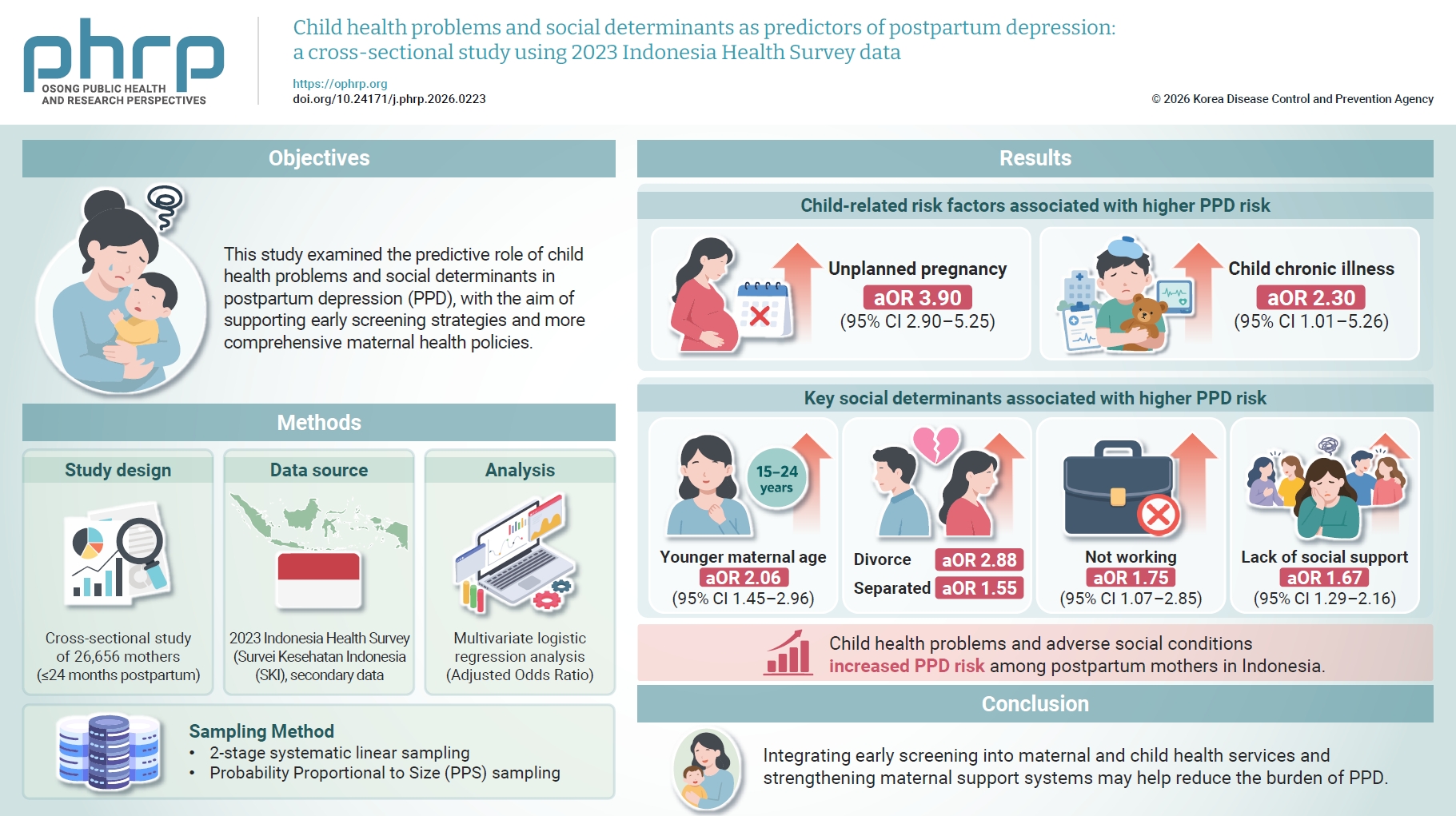
This study examined the predictive role of child health problems and social determinants in postpartum depression (PPD), with the aim of supporting early screening strategies and more comprehensive maternal health policies. Methods: This cross-sectional study used secondary data from the 2023 Indonesia Health Survey, conducted by the Indonesian Ministry of Health. The analysis included 26,656 postpartum women aged at least 15 years who had given birth within the previous 24 months. PPD was assessed using the Mini International Neuropsychiatric Interview. Multiple logistic regression was used to analyze the data. Results: Child health problems were among the strongest factors associated with PPD in Indonesia. Having had an unplanned pregnancy was associated with higher odds of PPD (adjusted odds ratio [aOR], 3.90; 95% confidence interval [CI], 2.90–5.25; p < 0.001), as was having a child with chronic illness (aOR, 2.30; 95% CI, 1.01–5.26; p= 0.048). Social risk factors, including younger maternal age, divorce or separation from a partner, unemployment, and lack of social support, were also associated with PPD in Indonesia. Conclusion: Child health problems and adverse social conditions were significantly associated with postpartum mental health in Indonesia. Integrating early screening into maternal and child health services and strengthening maternal support systems may help reduce the burden of PPD.
  • 2,080 View
  • 101 Download
Epidemiological trends and regional risk factors for scrub typhus in Busan, Republic of Korea: 2019–2023
Keoungsuk Kim, Hyeokjin Lee, Seungah Park, Gey Ok Lee, Sang-Eun Lee
Osong Public Health Res Perspect 2026;17(3):242-253.
Published online May 11, 2026
DOI: https://doi.org/10.24171/j.phrp.2026.0085
Epidemiological trends and regional risk factors for scrub typhus in Busan, Republic of Korea: 2019–2023
Objectives
Scrub typhus, an acute disease caused by Orientia tsutsugamushi and transmitted by larval chigger mites, is a representative autumn febrile illness in the Republic of Korea. We examined epidemiological characteristics underlying spatial heterogeneity in Busan Metropolitan City to inform region-specific prevention and control policies. Methods: We analyzed 1,645 confirmed and suspected scrub typhus cases reported in Busan from 2019 to 2023. Crude incidence rates and age-standardized incidence rates (ASIRs) per 100,000 population were calculated using the 2021 mid-year population. The chi-square test assessed associations between disease occurrence and exposure activities within the preceding 30 days. Correlation analyses examined the relationships of ASIR with environmental indicators, including per capita urban forest area, and epidemiological indicators, including prior infectious disease education. Results: The overall mean ASIR in Busan was 8.35 per 100,000 population, below the national average. However, incidence was higher in peri-urban districts, including Gijang-gun (26.12/100,000) and Gangseo-gu (15.02/100,000), than in central urban districts such as Junggu (2.20/100,000). Higher incidence was observed among women and older adults (≥60 years). ASIR correlated strongly with per capita urban forest area (r=0.92; 95% confidence interval, 0.79–0.97; p<0.001). Regional differences were significant for agriculture/forestry, gardening, and general outdoor activities (p<0.001). Districts with higher incidence also displayed higher rates of infectious disease education, although this may reflect reverse causation. Conclusion: In Busan, scrub typhus incidence was concentrated in peri-urban districts. These findings support region-specific prevention strategies, evaluation of infectious disease education, enhanced mite surveillance, and practical protective measures during fieldwork.
  • 1,725 View
  • 54 Download

Review Article

Evidence for a perinatal origin of childhood obesity: a systematic review and meta-analysis of risk and protective factors
Andi Rispah Sulistianingsih, Nurjazuli Nurjazuli, Martha Irene Kartasurya, Syamsulhuda Budi Musthofa, Jauhari Oka Reuwpassa
Osong Public Health Res Perspect 2026;17(2):114-135.
Published online March 27, 2026
DOI: https://doi.org/10.24171/j.phrp.2025.0351
Evidence for a perinatal origin of childhood obesity: a systematic review and meta-analysis of risk and protective factors
Objectives
This systematic review aimed to identify perinatal risk factors associated with obesity in children aged ≤5 years.
Methods
This studyfollowed the Preferred Reporting Items for Systematic Reviews and Meta-Analyses guidelines. Medline (via PubMed), Embase, and Cochrane CENTRAL were searched from inception, without language or date restrictions. In addition, gray literature sources, including LILACS and CNKI, were screened for comprehensive evidence synthesis. Meta-analyses were conducted to estimate pooled risk ratios. Study quality was independently assessed by 2 reviewers using the Joanna Briggs Institute critical appraisal tool.
Results
A total of 24,643 articles were screened, and 39 cohort studies were included in the final analysis. Sample sizes ranged from 169 to 333,353 participants. Meta-analysis results indicated that high gestational weight gain (adjusted risk ratio [aRR], 1.46; 95% confidence interval [CI], 1.17–1.82), history of cesarean section (aRR, 1.25; 95% CI, 1.17–1.33), macrosomia (aRR, 1.88; 95% CI, 1.55–2.27), antibiotic use (aRR, 1.31; 95% CI, 1.14–1.51), pre-pregnancy obesity (aRR, 1.82; 95% CI, 1.21–2.73), and female sex (aRR, 1.46; 95% CI, 1.32–1.61) were associated with an increased risk of obesity in children aged ≤5 years. Exclusive breastfeeding (aRR, 0.74; 95% CI, 0.64–0.85) was identified as a protective factor..
Conclusion
Perinatal factors and pre-pregnancy obesity played important roles in increasing the risk of obesity in children aged ≤5 years. Breastfeeding was associated with a protective effect against childhood obesity. Therefore, obesity prevention efforts should begin during pregnancy, and maintaining appropriate maternal weight before conception is equally essential.

Citations

Citations to this article as recorded by  Crossref logo
  • Multi-class urinary antibiotic exposure, dietary sources, and childhood overweight and obesity risk through lipid metabolic disruption: evidence from multicenter cohorts in China
    Xinli Song, Jieyu Liu, Li Chen, Yi Zhang, Ruolin Wang, Jianuo Jiang, Lan Zhang, Yanle Xiong, Jingyang Su, Ziqi Dong, Yang Qin, Dengcheng Zhang, Zhenting Lu, Zhiying Song, Jinghong Liang, Jun Ma, Yanhui Dong
    Environmental Pollution.2026; 408: 128907.     CrossRef
  • 2,706 View
  • 104 Download
  • 1 Web of Science
  • Crossref

Original Articles

Scrub typhus in the era of climate change: exploring lagged and cumulative effects of meteorological factors in the Republic of Korea, 2001–2024, a nationwide time-series study
Objectives
Scrub typhus, caused by Orientia tsutsugamushi, is a climate-sensitive vector-borne disease with high incidence in the Republic of Korea. This study examined long-term epidemiological trends and changing meteorological influences in the context of climate change.
Methods
A retrospective time-series study was conducted using national surveillance data on 149,289 scrub typhus cases (2001–2024) across 4 surveillance phases. Temporal trends in age-standardized incidence rates were evaluated using Joinpoint regression. Associations between monthly meteorological variables and incidence were assessed with Spearman correlation analysis and time-series regression analysis using distributed lag non-linear models.
Results
The national incidence increased until 2017 and has decreased since 2018, whereas the AAPC rebound to 4.32% during phase IV (2019–2024). The proportion of female cases decreased, while that of adults ≥70 years increased significantly. In phase IV, the average annual percent change increased in central and urban regions. The lag effect of meteorological factors lengthened from 4 to 6 months, with mean temperature (Tmean) and relative humidity (RH) representing the primary predictors. Phase III (2013–2018) displayed the highest cumulative relative risk (RR) for Tmean at 25.2 °C (RR, 5.86; 95% confidence interval [CI], 2.56–13.42), whereas in phase IV, only moderate RH (58%) remained significantly associated with incidence (RR, 1.68; 95% CI, 1.29–2.20).
Conclusion
Over the past 2 decades, the influence of meteorological factors on scrub typhus has shifted, with recent years marked by greater uncertainty under increasing climate variability and instability. For timely risk prediction and targeted prevention, adaptive surveillance systems that integrate dynamic climate indicators—capturing the intensity, frequency, and variability of extreme weather events—are needed.

Citations

Citations to this article as recorded by  Crossref logo
  • A Review of Domestic Research and Response Trends Regarding the Environmental and Health Impacts of Climate Change
    Young Sun Kwon, Junsuk Kang
    Journal of Environmental Health Sciences.2026; 52(1): 7.     CrossRef
  • Non-linear effects and lag patterns of eco-environmental factors on scrub typhus: a spatiotemporal analysis in Yunnan, China, 2015–2022
    Xiangnan Jing, Yuewei Ling, Ruonan Jing, Fuying Guo, Feifei Yin, Dongsheng Huang, Lijie Zhang, Xiangyu Yan, Tiejun Shui
    Parasites & Vectors.2026;[Epub]     CrossRef
  • 3,491 View
  • 145 Download
  • 1 Web of Science
  • Crossref
Factors influencing adherence to anti-tuberculosis treatment in Morocco: a cross-sectional study from the Béni Mellal-Khénifra region
Mohamed Dellal, Sanae Batoui, Youness Aassem, Khalid Habbari
Osong Public Health Res Perspect 2025;16(5):476-485.
Published online September 19, 2025
DOI: https://doi.org/10.24171/j.phrp.2025.0153
Factors influencing adherence to anti-tuberculosis treatment in Morocco: a cross-sectional study from the Béni Mellal-Khénifra region
Objectives
Adherence to anti-tuberculosis treatment is essential for achieving successful outcomes and preventing the emergence of drug-resistant strains. This study aimed to evaluate adherence levels and identify factors associated with non-adherence among tuberculosis patients in the Béni Mellal-Khénifra region of Morocco. We hypothesized that sociodemographic, clinical, and behavioral factors influence adherence.
Methods
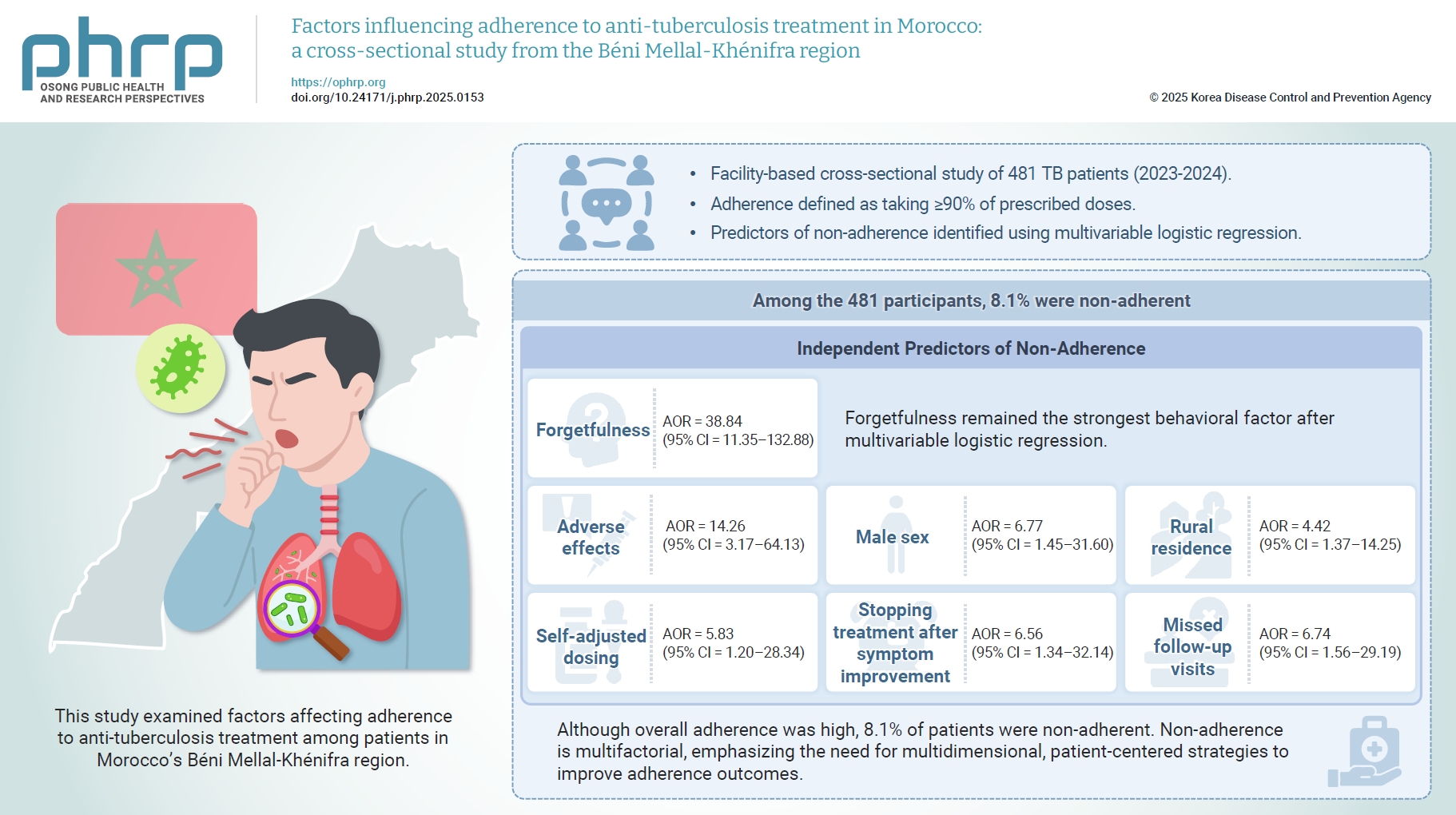
A facility-based cross-sectional study was conducted from January 2023 to December 2024 in 2 Tuberculosis and Respiratory Disease Diagnostic Centers in the Béni Mellal-Khénifra region. A total of 481 patients who had been on treatment for at least 2 months were recruited using convenience sampling. Data were collected through structured, pre-tested questionnaires administered in face-to-face interviews and verified against treatment cards and medical records. Adherence was defined as taking ≥90% of prescribed doses. Multivariable logistic regression was used to identify independent predictors of non-adherence.
Results
Among the 481 participants, 8.1% were non-adherent. Significant predictors of non-adherence included forgetfulness (adjusted odds ratio [AOR], 38.84; 95% confidence interval [CI], 11.35–132.88), adverse effects (AOR, 14.26; 95% CI, 3.17–64.13), male sex (AOR, 6.77; 95% CI, 1.45–31.60), rural residence (AOR, 4.42; 95% CI, 1.37–14.25), self-adjusted dosing (AOR, 5.83; 95% CI, 1.20–28.34), stopping treatment after symptom improvement (AOR, 6.56; 95% CI, 1.34–32.14), and missed follow-up visits (AOR, 6.74; 95% CI, 1.56–29.19).
Conclusion
Although overall adherence was high, 8.1% of patients were non-adherent. Strategies to improve adherence should focus on addressing forgetfulness, managing side effects, enhancing access in rural areas, and reinforcing patient education and follow-up systems to improve treatment outcomes in this and similar settings.

Citations

Citations to this article as recorded by  Crossref logo
  • Longitudinal Observation by Optical Coherence Tomography in Patients Treated with Ethambutol: A Systematic Review and Meta-Analysis
    Rui Luo, Jin Ma, Yong Zhong
    Journal of Clinical Medicine.2026; 15(3): 1230.     CrossRef
  • Non-Adherence to Anti-Tuberculosis Treatment and Its Determinants Among Tuberculosis Patients in Tanzania
    Meshack Morice, Bernadetha Hugho Kimario, Indo Ndaigeze, Damas Dismas Nyabenda
    Journal of Community Health.2026; 51(4): 648.     CrossRef
  • 1,774 View
  • 98 Download
  • 2 Web of Science
  • Crossref
Identifying risk factors for COVID-19 cluster infections in schools in the Republic of Korea: a case-control study
Jihyun Choi, Seongju Choi, Baigu Lee, Young-Joon Park, Sang Eun Lee
Osong Public Health Res Perspect 2024;15(4):375-382.
Published online July 11, 2024
DOI: https://doi.org/10.24171/j.phrp.2023.0351
Identifying risk factors for COVID-19 cluster infections in schools in the Republic of Korea: a case-control study
Objectives
No study has yet analyzed risk factors to determine whether students with confirmed coronavirus disease 2019 (COVID-19) infections may affect students at neighboring schools. Therefore, this study aimed to determine risk factors for COVID-19 transmission among schools within a community in the Republic of Korea.
Methods
An epidemiological investigation was conducted among 696 students and school staff members at 3 schools where COVID-19 clusters began on October 15, 2021. Interviews, visit history surveys, a facility risk assessment, and closed-circuit television were used to identify risk factors. The statistical significance of risk factors was also evaluated.
Results
We confirmed 129 cases (18.5%) among the individuals exposed to COVID-19 at the 3 schools, many of whom had a history of visiting the same multi-use facilities. The odds ratio of having visited multi-use facilities such as karaoke rooms was 1.90 (95% confidence interval, 1.03–3.50); the number of visits to a karaoke room and the visit durations were significantly higher among confirmed cases than non-confirmed cases (p=0.02 and p=0.03, respectively).
Conclusion
Having a history of visiting karaoke rooms often and spending a long time there were risk factors for COVID-19 infection and inter-school transmission. Thus, it is necessary to investigate the status of multi-use facilities frequently visited by adolescents and consider incorporating them into the scope of school quarantine to prevent infectious diseases at schools in a community.
  • 5,122 View
  • 88 Download
Household secondary attack rates and risk factors during periods of SARS-CoV-2 Delta and Omicron variant predominance in the Republic of Korea
Jin Lee, Mijeong Ko, Seontae Kim, Dosang Lim, Gemma Park, Sang-Eun Lee
Osong Public Health Res Perspect 2023;14(4):263-271.
Published online August 11, 2023
DOI: https://doi.org/10.24171/j.phrp.2023.0133
Household secondary attack rates and risk factors during periods of SARS-CoV-2 Delta and Omicron variant predominance in the Republic of Korea
Objectives
The household secondary attack rate (SAR) of severe acute respiratory syndrome coronavirus 2 (SARS-CoV-2) is an important indicator for community transmission. This study aimed to characterize transmission by comparing household SARs and identifying risk factors during the periods of Delta and Omicron variant predominance in Republic of Korea.
Methods
We defined the period of Delta variant predominance (Delta period) as July 25, 2021 to January 15, 2022, and the period of Omicron variant predominance (Omicron period) as February 7 to September 3, 2022. The number of index cases included was 214,229 for the Delta period and 5,521,393 for the Omicron period. To identify the household SARs and risk factors for each period, logistic regression was performed to determine the adjusted odds ratio (aOR).
Results
The SAR was 35.2% for the Delta period and 43.1% for the Omicron period. The aOR of infection was higher in 2 groups, those aged 0 to 18 years and ≥75 years, compared to those aged 19 to 49 years. Unvaccinated individuals (vs. vaccinated individuals) and individuals experiencing initial infection (vs. individuals experiencing a second or third infection) had an increased risk of infection with SARS-CoV-2.
Conclusion
This study analyzed the household SARs and risk factors. We hope that the results can help develop age-specific immunization plans and responses to reduce the SAR in preparation for emerging infectious diseases or potential new variants of SARS-CoV-2.

Citations

Citations to this article as recorded by  Crossref logo
  • Current Impact of COVID-19 in Long-Term Care Facilities in the United States: A Systematic Literature Review
    Stefan Gravenstein, Catherine E. Cooke, Daniel Verdi, Mark J. Fedele, Sohini Ganguli, Stephan Martin, Florin Draica
    The Senior Care Pharmacist.2026; 41(5): 167.     CrossRef
  • Lower Levels of Household Transmission of SARS-CoV-2 Omicron Variant of Concern vs Wild Type: An Interplay Between Transmissibility and Immune Status
    Angelique M A M Winkel, Eva Kozanli, Mildred E Haverkort, Sjoerd M Euser, Judith G C Sluiter-Post, Rob Mariman, Afke Vogelzang, Jordy de Bakker, Coen R Lap, Marianne A van Houten, Dirk Eggink, Steven F L van Lelyveld
    The Journal of Infectious Diseases.2025; 231(3): 653.     CrossRef
  • Impact of disease severity, age, sex, comorbidity, and vaccination on secondary attack rates of SARS-CoV-2: a global systematic review and meta-analysis
    Dewan Md. Sumsuzzman, Yang Ye, Zhen Wang, Abhishek Pandey, Joanne M. Langley, Alison P. Galvani, Seyed M. Moghadas
    BMC Infectious Diseases.2025;[Epub]     CrossRef
  • SARS-CoV-2 secondary attack rates and risks for transmission among agricultural workers and their households in Guatemala, 2022-2023
    Joseph Daniel Carreon, Molly M. Lamb, Anna N. Chard, Diva M. Calvimontes, Chelsea Iwamoto, Neudy Rojop, Jose Monzon, Ian D. Plumb, Edgar Barrios, Julio del Cid-Villatoro, Kareen Arias, Melissa Gomez, Claudia Maribel Paiz Reyes, Maria Renee Lopez, May Chu,
    IJID Regions.2025; 16: 100676.     CrossRef
  • 8,429 View
  • 176 Download
  • 4 Web of Science
  • Crossref
Risk factors for transmission in a COVID-19 cluster infection in a high school in the Republic of Korea
Jin-Hwan Jeon, Su Jin Kang, Se-Jin Jeong, Hyeon-Cheol Jang, Young-Joon Park, Sang-Eun Lee
Osong Public Health Res Perspect 2023;14(4):252-262.
Published online July 27, 2023
DOI: https://doi.org/10.24171/j.phrp.2023.0125
Risk factors for transmission in a COVID-19 cluster infection in a high school in the Republic of Korea
Objectives
This study aimed to examine the scale, characteristics, risk factors, and modes of transmission in a coronavirus disease 2019 (COVID-19) outbreak at a high school in Seoul, Republic of Korea.
Methods
An epidemiological survey was conducted of 1,118 confirmed cases and close contacts from a COVID-19 outbreak at an educational facility starting on May 31, 2021. In-depth interviews, online questionnaires, flow evaluations, and CCTV analyses were used to devise infection prevention measures. Behavioral and spatial risk factors were identified, and statistical significance was tested.
Results
Among 3rd-year students, there were 33 confirmed COVID-19 cases (9.6%). Students who used a study room in the annex building showed a statistically significant 4.3-fold elevation in their relative risk for infection compared to those who did not use the study room. Moreover, CCTV facial recognition analysis confirmed that 17.8% of 3rd-year students did not wear masks and had the lowest percentage of mask-wearers by grade. The air epidemiological survey conducted in the study room in the annex, which met the 3 criteria for a closed space, confirmed that there was only 10% natural ventilation due to the poor ventilation system.
Conclusion
To prevent and manage the spread of COVID-19 in educational facilities, advance measures that consider the size, operation, and resources of each school are crucial. In addition, various survey methodologies should be used in future studies to quickly analyze a wider range of data that can inform an evidence-based quarantine response.

Citations

Citations to this article as recorded by  Crossref logo
  • Detection of a cluster of Omicron's BA.4 sublineage in Northern Senegal and identification of the first XAS recombinant variant in Senegal
    Martin Faye, Modeste Name Faye, Babacar Ndiaye, Moussa Moïse Diagne, Safietou Sankhe, Ndeye Marième Top, Amadou Diallo, Cheikh Loucoubar, Ndongo Dia, Amadou Alpha Sall, Ousmane Faye
    Virus Research.2024; 339: 199259.     CrossRef
  • 7,983 View
  • 237 Download
  • 1 Web of Science
  • Crossref
Risk factors associated with death due to severe fever with thrombocytopenia syndrome in hospitalized Korean patients (2018–2022)
Jia Kim, Hyo-jeong Hong, Ji-hye Hwang, Na-Ri Shin, Kyungwon Hwang
Osong Public Health Res Perspect 2023;14(3):151-163.
Published online June 8, 2023
DOI: https://doi.org/10.24171/j.phrp.2023.0048
Risk factors associated with death due to severe fever with thrombocytopenia syndrome in hospitalized Korean patients (2018–2022)
Objectives
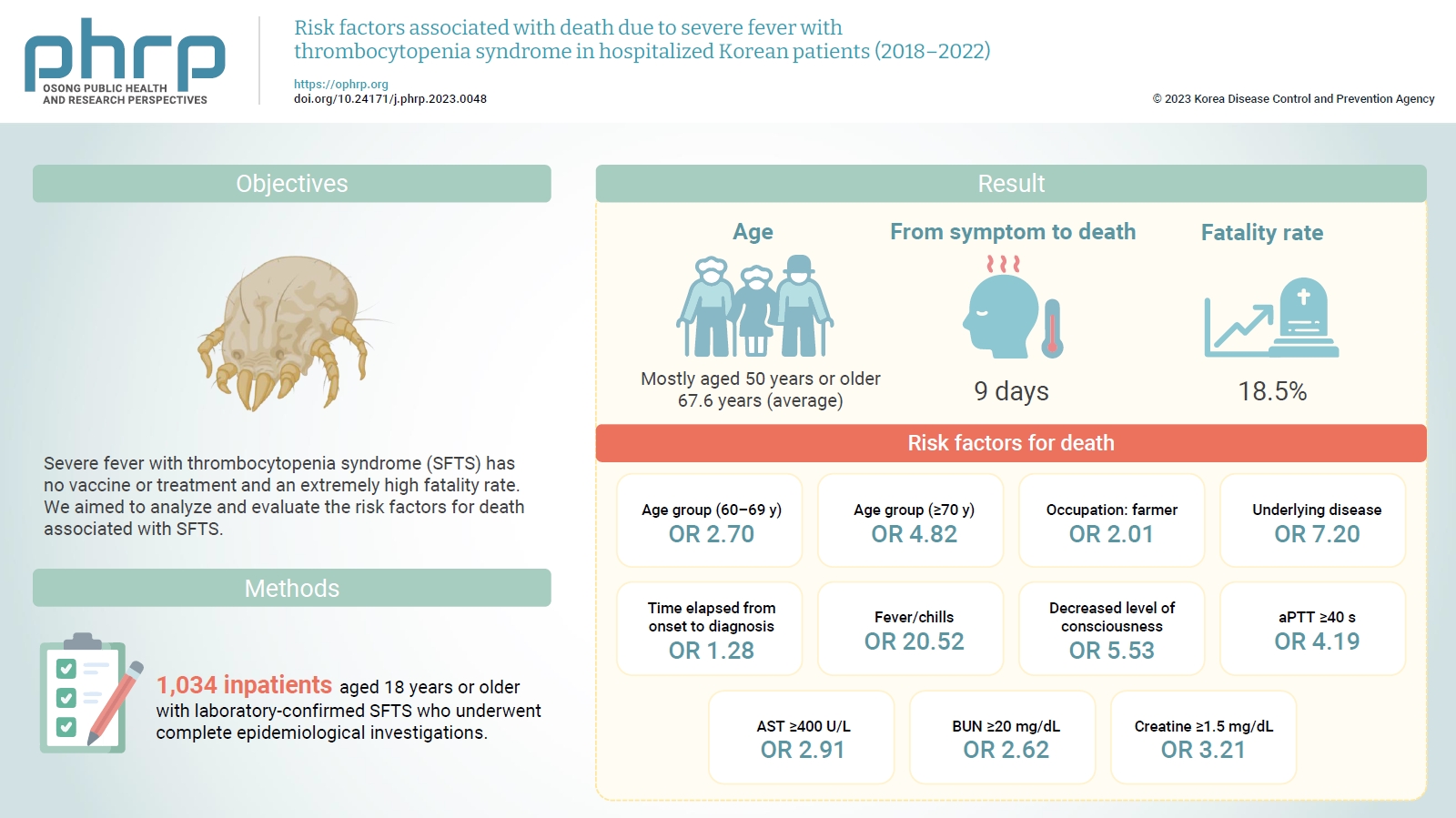
Severe fever with thrombocytopenia syndrome (SFTS) has no vaccine or treatment and an extremely high fatality rate. We aimed to analyze and evaluate the risk factors for death associated with SFTS.
Methods
Among reports from 2018 to 2022, we compared and analyzed 1,034 inpatients aged 18 years or older with laboratory-confirmed SFTS who underwent complete epidemiological investigations.
Results
Most of the inpatients with SFTS were aged 50 years or older (average age, 67.6 years). The median time from symptom onset to death was 9 days, and the average case fatality rate was 18.5%. Risk factors for death included age of 70 years or older (odds ratio [OR], 4.82); agriculture-related occupation (OR, 2.01); underlying disease (OR, 7.20); delayed diagnosis (OR, 1.28 per day); decreased level of consciousness (OR, 5.53); fever/chills (OR, 20.52); prolonged activated partial thromboplastin time (OR, 4.19); and elevated levels of aspartate aminotransferase (OR, 2.91), blood urea nitrogen (OR, 2.62), and creatine (OR, 3.21).
Conclusion
The risk factors for death in patients with SFTS were old age; agriculture-related occupation; underlying disease; delayed clinical suspicion; fever/chills; decreased level of consciousness; and elevated activated partial thromboplastin time, aspartate aminotransferase, blood urea nitrogen, and creatine levels.

Citations

Citations to this article as recorded by  Crossref logo
  • Seroprevalence and Epidemiological Characteristics of Severe Fever with Thrombocytopenia Syndrome in Patients with Chronic Diseases in Korea
    Jongyoun Yi, Ahreum Kim, Maeng Seok Noh, Changhoon Kim, Hyun Jin Son, Mee Kyung Ko, Kye-Hyung Kim
    Viruses.2026; 18(2): 217.     CrossRef
  • Overwintering Ticks as a Reservoir for Severe Fever With Thrombocytopenia Syndrome Virus in the Republic of Korea
    Hyunyoung Yoon, Hee Il Lee, Seong Yoon Kim
    Entomological Research.2026;[Epub]     CrossRef
  • Ecological signature on the epidemiological dynamics of severe fever with thrombocytopenia syndrome
    Zhe Lou, Jing Lu, Shuyi Liang, Wei Zhao, Ling Huang, Haowei Wang, Xiang Li, Jianli Hu, Ruiyun Li, Bo Zhang
    PLOS Neglected Tropical Diseases.2026; 20(6): e0014408.     CrossRef
  • Clinical Predictors of Mortality in Severe Fever with Thrombocytopenia Syndrome: An Updated Systematic Review and Meta-Analysis
    Ke-Xin Wang, Guo-Mei Xia, Yu-Han Liu, Shuai-Ru Jiao, Yu-Feng Gao, Sheng-Qun Deng
    Pathogens.2026; 15(7): 767.     CrossRef
  • Commentary on “Low Thoracic Muscle Mass: A Novel Indicator of Poor Prognosis in Patients With Severe Fever With Thrombocytopenia Syndrome”
    Mohammad Barary, Mostafa Javanian, Mohammad Golparvar Azizi, Mehran Shokri, Soheil Ebrahimpour
    Immunity, Inflammation and Disease.2026;[Epub]     CrossRef
  • Identification of early prognostic biomarkers in Severe Fever with Thrombocytopenia Syndrome using machine learning algorithms
    Jie Zhu, Jianmei Zhou, Chunhui Tao, Guomei Xia, Bingyan Liu, Xiaowei Zheng, Xu Li, Zhenhua Zhang
    Annals of Medicine.2025;[Epub]     CrossRef
  • The immunogenicity and protection efficacy evaluation of mRNA vaccine candidate for severe fever with thrombocytopenia syndrome in mice
    Da-Eun Jeong, Jack Yoon, Baek Kim, Jun-Gu Kang, Abdallah M. Samy
    PLOS Neglected Tropical Diseases.2025; 19(4): e0012999.     CrossRef
  • Retrospective Analysis of Severe Fever With Thrombocytopenia Syndrome and Construction of a Nomogram Prediction Model for Mortality Risk Factors
    Gang Chen, Yuchen Du, Xiuchang Ma, Yaowen Liang, Apeng Chen, Jie Wei, Jinhuan Wu, Wenxian Qian, Shuqin Xie, Yi Yan, Zheng Hu, Yishan Zheng, Man Tian, Changhua Yi
    Open Forum Infectious Diseases.2025;[Epub]     CrossRef
  • Deciphering the evolutionary landscape of severe fever with thrombocytopenia syndrome virus across East Asia
    Dongbin Park, Kwan Woo Kim, Young-Il Kim, Mark Anthony B Casel, Hyunwoo Jang, Woohyun Kwon, Kanghee Kim, Se-Mi Kim, Monford Paul Abishek N, Eun-Ha Kim, Hobin Jang, Suhee Hwang, Seok-Min Yun, Joo-Yeon Lee, Hye Won Jeong, Su-Jin Park, Young Ki Choi
    Virus Evolution.2024;[Epub]     CrossRef
  • Acute kidney injury as a prognostic marker in severe fever with thrombocytopenia syndrome
    Jin Mi Lee, Hae Lee Kim, Myoung-nam Lim, Changhyup Kim, Yeon Ju La, Yong Duk Jeon, Won Sup Oh, Seongmin Son, Sunhwa Lee, Hyunjeong Baek, Daniel Duck-Jin Hwang, Ji In Park
    Scientific Reports.2024;[Epub]     CrossRef
  • Double-Stranded RNA-Based Method for Diagnosing Severe Fever with Thrombocytopenia
    Jung Wan Park, Jaemin Jeon, Yoosik Kim, Min Hyok Jeon
    Journal of Clinical Medicine.2024; 14(1): 105.     CrossRef
  • 7,185 View
  • 254 Download
  • 10 Web of Science
  • Crossref
Risk factors for deaths associated with COVID-19 according to the cause of death classification in Republic of Korea
Na-Young Kim, Seong-Sun Kim, Hyun Ju Lee, Dong Hwi Kim, Boyeong Ryu, Eunjeong Shin, Donghyok Kwon
Osong Public Health Res Perspect 2023;14(2):89-99.
Published online April 18, 2023
DOI: https://doi.org/10.24171/j.phrp.2022.0312
Risk factors for deaths associated with COVID-19 according to the cause of death classification in Republic of Korea
Objectives
This study aimed to classify coronavirus disease 2019 (COVID-19)-related deaths according to whether COVID-19 was listed as the cause of death, and to investigate the differences in demographic characteristics and risk factors for COVID-19 death classifications.
Methods
A total of 5,625 deaths in South Korea among patients with confirmed COVID-19 from January 20, 2020 to December 31, 2021 were selected. Excluding false reports and unnatural deaths, 5,597 deaths were analyzed. Based on death report data, deaths were classified according to whether the cause of death was listed as COVID-19 (CD) or not (NCD). The epidemiological characteristics and causes of deaths were investigated using descriptive, univariate, and multivariate statistical analyses. Odds ratios (ORs) and 95% confidence intervals (CIs) were calculated to analyze the risk factors.
Results
The case fatality ratio was 0.89% and increased with age. Additionally, 96.4% of the subjects had an underlying disease, and 53.4% died in winter. The proportion of NCDs was 9.3%, of whom 19.1% died at home and 39.0% were confirmed to have COVID-19 after death. Malignant neoplasms (102/416 vs. 637/4,442; OR, 1.71; 95% CI, 1.36−2.16; p<0.001) were significantly associated with NCD.
Conclusion
This is the first study to analyze risk factors by cause of death using COVID-19 death report data in South Korea. These results are expected to be used as evidence for establishing a death monitoring system that can collect timely information in a new infectious disease pandemic.

Citations

Citations to this article as recorded by  Crossref logo
  • A Meta-Analysis of the Association between Apolipoprotein E Polymorphisms and SARS-COV-2 Risk/Severity in the Korean Population
    T.-Th.-D. Nguyen, M. Zayed, D.-I. Choi, Ch.-S. Lee, B.-H. Jeong
    Russian Journal of Genetics.2025; 61(8): 997.     CrossRef
  • 6,624 View
  • 125 Download
  • 1 Web of Science
  • Crossref
Analysis of risk factors affecting suicidal ideation in South Korea by life cycle stage
Ji-Young Hwang, Il-Su Park
Osong Public Health Res Perspect 2021;12(5):314-323.
Published online October 26, 2021
DOI: https://doi.org/10.24171/j.phrp.2021.0208
Objectives
This study analyzed risk factors for suicidal ideation in South Koreans from a life cycle perspective.
Methods
A secondary analysis was conducted of data collected in 2015 as part of the 6th Korea National Health and Nutrition Examination Survey (KNHANES). The participants comprised 5,935 individuals aged 12 years or older. The statistical analysis reflected the complex sampling design of the KNHANES, and the Rao-Scott chi-square test and multiple logistic regression analysis were performed.
Results
The prevalence of suicidal ideation was 5.7% in adolescents, 3.7% in young adults, 5.4% in middle-aged adults, and 7.0% in older adults. Depression and stress were risk factors in every stage of the life cycle. In those aged 12 to 19 years, activity restrictions were significantly associated with suicidal ideation. Education and subjective health status were risk factors in adults aged 20 to 39 years, and education, activity restrictions, and quality of life were the major risk factors in those aged 40 to 64 years. For adults 65 years of age or older, the risk of suicidal ideation was higher among those with inappropriate sleep time.
Conclusion
The risk factors for suicidal ideation were found to be different across stages of the life cycle. This suggests a need for individualized suicide prevention plans and specific government policies that reflect the characteristics of each life cycle stage.

Citations

Citations to this article as recorded by  Crossref logo
  • Suicidality risk of cancer caregivers: a systematic review and meta-analysis of observational studies
    Xia-Yin Zhu, Lu-Yi Hu, Min-Ya Jin, Tao-Hsin Tung
    Annals of Medicine.2026;[Epub]     CrossRef
  • Factors associated with suicidal ideation among unmarried Korean women in their twenties: a cross-sectional study
    Myeong-Hui Choe
    BMC Women's Health.2026;[Epub]     CrossRef
  • Association of Weight-Loss Medication Use and Weight Change with Depression and Suicidal Ideation and Behaviors
    Dasol Kim, Ki Young Son
    Korean Journal of Family Practice.2026; 16(2): 120.     CrossRef
  • Factors Associated with Suicidal Ideation Among Middle-Aged Korean Adults: A Cross-Sectional Analysis of the 2022–2023 Korea National Health and Nutrition Examination Survey
    Jung-Ha Son, Chul-Gyu Kim, Ji-Su Hong, Yun-Hee Oh, Ji-Yeon Choi
    Healthcare.2026; 14(20): 3426.     CrossRef
  • National Trends and Directions for Suicide Prevention Research in South Korea: A Narrative Review
    Ah Rah Lee, Je Young Hannah Sun, Myungjae Baik, Peter Jongho Na, Sang Min Lee, Jong-Woo Paik
    Psychiatry Investigation.2025; 22(6): 603.     CrossRef
  • Exploring Drug Use and Healthcare Utilization Among Adult Suicide Attempters: A Decision Tree Approach Using National Survey Data
    Bohyun Choi, Dajung Ryu, Mihyeon Seong, Sohyune Sok, Yufang Guo
    Journal of Nursing Management.2025;[Epub]     CrossRef
  • Association between long working hours and the development of suicidal ideation among female workers: An 8-year population-based study using the Korean Longitudinal Survey of Women & Family (2012–2020)
    Seong-Uk Baek, Yu-Min Lee, Jin-Ha Yoon
    Psychiatry Research.2024; 333: 115731.     CrossRef
  • Prevalence and incidence of suicide, suicidal ideation and self-harm in caregivers of cancer patients: A systematic review and meta-analysis
    Chen Ee Low, Sean Loke, Sounak Rana, Ben Sim, Cyrus Su Hui Ho
    General Hospital Psychiatry.2024; 90: 35.     CrossRef
  • Psychological resilience and suicidality in the general population: A cross-sectional study based on data from the National Mental Health Survey of Korea 2021
    Seung-Hoon Lee, Junhyung Kim, Changsu Han
    Journal of Affective Disorders.2024; 363: 15.     CrossRef
  • Risk factors of passive suicidal ideation among outpatients in traditional medicine clinics: The case of Korean medicine in South Korea
    Ilsu Park, Tae-Hyeon Lee, Chan-Young Kwon
    Heliyon.2024; 10(17): e37181.     CrossRef
  • Development of a Clinical Guideline for Suicide Prevention in Psychiatric Patients Based on the ADAPTE Methodology
    Jeong Hun Yang, Jieun Yoo, Dae Hun Kang, C. Hyung Keun Park, Sang Jin Rhee, Min Ji Kim, Sang Yeol Lee, Se-Hoon Shim, Jung-Joon Moon, Seong-Jin Cho, Shin Gyeom Kim, Min-Hyuk Kim, Jinhee Lee, Won Sub Kang, Weon-Young Lee, Yong Min Ahn
    Psychiatry Investigation.2024; 21(10): 1149.     CrossRef
  • Hwa-byung (anger syndrome) as a risk factor for suicidal ideation in MZ generation: a survey study in South Korea
    Chan-Young Kwon
    Frontiers in Psychology.2024;[Epub]     CrossRef
  • Alcohol Consumption and Quality of Life in Middle-aged Men
    Jeong-Sook Lee
    International Journal of High Risk Behaviors and A.2023;[Epub]     CrossRef
  • Factors Related to Suicidal Ideation by Gender and Age Group in Korean Adults
    Eun Young Kim, Yong Whi Jeong, Jihye Lim, Dae Ryong Kang
    Journal of Korean Medical Science.2023;[Epub]     CrossRef
  • Association between Sleep Duration and Symptoms of Depression Aged between 18 and 49: The Korea National Health and Nutrition Examination Survey (KNHANES Ⅶ) from 2016 to 2018
    Sung-Yong Choi, Ji-Eun Han, Jiae Choi, Minjung Park, Soo-Hyun Sung, Angela Dong-Min Sung
    Healthcare.2022; 10(11): 2324.     CrossRef
  • 11,412 View
  • 200 Download
  • 12 Web of Science
  • Crossref

Review Article

<p>This review compared coronavirus disease 2019 (COVID-19) laboratory findings, comorbidities, and clinical outcomes in patients from the general population versus medical staff to aid diagnosis of COVID-19 in a more timely, efficient, and accurate way. Electronic databases were searched up to 23<sup>rd</sup> March, 2020. The initial search yielded 6,527 studies. Following screening, 24 studies were included [18 studies (11,564 cases) of confirmed COVID-19 cases in the general public, and 6 studies (394 cases) in medical staff] in this review. Significant differences were observed in white blood cell counts (<italic>p</italic> < 0.001), lymphocyte counts (<italic>p</italic> < 0.001), platelet counts (<italic>p</italic> = 0.04), procalcitonin levels (<italic>p</italic> < 0.001), lactate dehydrogenase levels (<italic>p</italic> < 0.001), and creatinine levels (<italic>p</italic> = 0.03) when comparing infected medical staff with the general public. The mortality rate was higher in the general population than in medical staff (8% versus 2%). This review showed that during the early stages of COVID-19, laboratory findings alone may not be significant predictors of infection and may just accompany increasing C-reactive protein levels, erythrocyte sedimentation rates, and lactate dehydrogenase levels. In the symptomatic stage, the lymphocyte and platelet counts tended to decrease. Elevated D-dimer fibrin degradation product was associated with poor prognosis.</p>

Citations

Citations to this article as recorded by  Crossref logo
  • Quality indicators for appropriate inpatient antibiotic use: results from two national surveys in Italy, 2016–2022
    C. Vicentini, A. Russotto, R. Bussolino, M. Castagnotto, C. Gastaldo, S. Bazzolo, D. Gamba, S. Corcione, F.G. De Rosa, F. D'Ancona, C.M. Zotti
    Journal of Hospital Infection.2025; 160: 34.     CrossRef
  • Efficacy and limitations of SARS-CoV-2 vaccines - A systematic review
    Muhammad Azeem, Patrizia Cancemi, Farwa Mukhtar, Sefora Marino, Emanuela Peri, Giulia Di Prima, Viviana De Caro
    Life Sciences.2025; 371: 123610.     CrossRef
  • A comprehensive review of recent advances in research on COVID in communication studies
    Barbara Cyrek, Jenna Peltonen
    Discover Public Health.2024;[Epub]     CrossRef
  • microRNA-185 Inhibits SARS-CoV-2 Infection through the Modulation of the Host’s Lipid Microenvironment
    Nadine Ahmed, Magen E. Francis, Noreen Ahmed, Alyson A. Kelvin, John Paul Pezacki
    Viruses.2023; 15(9): 1921.     CrossRef
  • Protective action of natural and induced immunization against the occurrence of delta or alpha variants of SARS-CoV-2 infection: a test-negative case-control study
    Giovanni Corrao, Matteo Franchi, Federico Rea, Danilo Cereda, Antonio Barone, Catia Rosanna Borriello, Petra Giulia Della Valle, Michele Ercolanoni, Ida Fortino, Jose Jara, Olivia Leoni, Francesco Mazziotta, Elisabetta Pierini, Giuseppe Preziosi, Marcello
    BMC Medicine.2022;[Epub]     CrossRef
  • Balancing Benefits and Harms of COVID-19 Vaccines: Lessons from the Ongoing Mass Vaccination Campaign in Lombardy, Italy
    Giovanni Corrao, Federico Rea, Matteo Franchi, Danilo Cereda, Antonio Barone, Catia Rosanna Borriello, Giulia Petra Della Valle, Michele Ercolanoni, Jose Jara, Giuseppe Preziosi, Manuel Maffeo, Francesco Mazziotta, Elisabetta Pierini, Francesco Lecis, Pie
    Vaccines.2022; 10(4): 623.     CrossRef
  • Vulnerability Predictors of Post-Vaccine SARS-CoV-2 Infection and Disease—Empirical Evidence from a Large Population-Based Italian Platform
    Giovanni Corrao, Matteo Franchi, Danilo Cereda, Francesco Bortolan, Olivia Leoni, Catia Rosanna Borriello, Petra Giulia Della Valle, Marcello Tirani, Giovanni Pavesi, Antonio Barone, Michele Ercolanoni, Jose Jara, Massimo Galli, Guido Bertolaso
    Vaccines.2022; 10(6): 845.     CrossRef
  • Factors associated with severe or fatal clinical manifestations of SARS‐CoV‐2 infection after receiving the third dose of vaccine
    Giovanni Corrao, Matteo Franchi, Danilo Cereda, Francesco Bortolan, Olivia Leoni, Jose Jara, Giuseppina Valenti, Giovanni Pavesi
    Journal of Internal Medicine.2022; 292(5): 829.     CrossRef
  • Role of multiresolution vulnerability indices in COVID-19 spread in India: a Bayesian model-based analysis
    Rupam Bhattacharyya, Anik Burman, Kalpana Singh, Sayantan Banerjee, Subha Maity, Arnab Auddy, Sarit Kumar Rout, Supriya Lahoti, Rajmohan Panda, Veerabhadran Baladandayuthapani
    BMJ Open.2022; 12(11): e056292.     CrossRef
  • A novel multi-omics-based highly accurate prediction of symptoms, comorbid conditions, and possible long-term complications of COVID-19
    Debmalya Barh, Sandeep Tiwari, Bruno Silva Andrade, Marianna E Weener, Aristóteles Góes-Neto, Vasco Azevedo, Preetam Ghosh, Kenneth Blum, Nirmal Kumar Ganguly
    Molecular Omics.2021; 17(2): 317.     CrossRef
  • Clinical and laboratory factors associated with coronavirus disease 2019 (Covid‐19): A systematic review and meta‐analysis
    Le Huu Nhat Minh, Ali Ahmed‐Fouad Abozaid, Nam Xuan Ha, Loc Le Quang, Abdelrahman Gamil Gad, Ranjit Tiwari, Tran Nhat‐Le, Dinh Kim Quyen, Balqees AL‐Manaseer, Nguyen Dang Kien, Nguyen Lam Vuong, Ahmad Helmy Zayan, Le Huu Hanh Nhi, Kadek Agus Surya Dila, J
    Reviews in Medical Virology.2021;[Epub]     CrossRef
  • Epidemiologic and Clinic Characteristics of the First Wave of the COVID-19 Pandemic in Hospitalized Patients from Galați County
    Mihaela-Camelia Vasile, Anca-Adriana Arbune, Gabriela Lupasteanu, Constantin-Marinel Vlase, George-Cosmin Popovici, Manuela Arbune
    Journal of Clinical Medicine.2021; 10(18): 4210.     CrossRef
  • Human Amniotic Fluid for the Treatment of Hospitalized, Symptomatic, and Laboratory-verified SARS-CoV-2 Patients
    Mojgan Barati, Fakher Rahim
    The Open Biology Journal.2021; 9(1): 36.     CrossRef
  • Stratification of the risk of developing severe or lethal Covid-19 using a new score from a large Italian population: a population-based cohort study
    Giovanni Corrao, Federico Rea, Flavia Carle, Salvatore Scondotto, Alessandra Allotta, Vito Lepore, Antonio D'Ettorre, Cinzia Tanzarella, Patrizia Vittori, Sabrina Abena, Marica Iommi, Liana Spazzafumo, Michele Ercolanoni, Roberto Blaco, Simona Carbone, Cr
    BMJ Open.2021; 11(11): e053281.     CrossRef
  • 14,307 View
  • 174 Download
  • 14 Web of Science
  • Crossref

Original Articles

Risk Factors in Early Life for Preschool Children in Korea that are Associated with Being Overweight or Obese
Jin Suk Ra, Hyun Jung Yun
Osong Public Health Res Perspect 2020;11(1):15-26.
Published online February 28, 2020
DOI: https://doi.org/10.24171/j.phrp.2020.11.1.04
<sec> <title>Objectives</title> <p>The present study addressed the risk factors in early life for Korean preschool children that are associated with being overweight or obese.</p></sec> <sec> <title>Methods</title> <p>A descriptive cross-sectional design was used to conduct this study, which included 507 mothers with preschool children aged 3–5 years, who attended daycare centers. Data were acquired via a self-administered questionnaire completed by the mothers. Of the 650 questionnaires that were distributed, 507 (78%) were completed and sent back. Multivariate logistic regression analyses were used to identify risk factors in early life, which may contribute to being overweight or obese in preschool children.</p></sec> <sec> <title>Results</title> <p>Fifty-eight (11.4%) preschool children were overweight and 41 (8.1%) were obese. Multivariate logistic regression analysis with adjustment for covariates, revealed a significant association with the introduction of solid foods before 4 months of age [adjusted odds ratio (aOR) = 9.49, <italic>p</italic> = 0.029] and a nonresponsive feeding style (aOR = 2.80, <italic>p</italic> = 0.043) with being overweight or obese in preschool children.</p></sec> <sec> <title>Conclusion</title> <p>The findings of this study highlighted the need for parenting education programs on feeding practices to increase their understanding of hunger and satiety cues in infants, and appropriate timing for the introduction of solid foods.</p></sec>

Citations

Citations to this article as recorded by  Crossref logo
  • Trajectory of Obesity and the Impact of Eating Behaviors on Obesity in Preschool Children: A Nationwide Population-Based Cohort Study in Korea
    Kyeong Hun Lee, Baek Seung Kim, Gitae Seo, Hyeon-Jong Yang, Kyunghoon Kim, Eun-Ae Yang
    Children.2024; 11(11): 1297.     CrossRef
  • Systematic review and meta‐analysis of breastfeeding and later overweight or obesity expands on previous study for World Health Organization
    Bernardo Lessa Horta, Nigel Rollins, Mariane S. Dias, Valquiria Garcez, Rafael Pérez‐Escamilla
    Acta Paediatrica.2023; 112(1): 34.     CrossRef
  • 11,984 View
  • 184 Download
  • 2 Web of Science
  • Crossref
Enteroparasitism and Risk Factors Associated with Clinical Manifestations in Children and Adults of Jalisco State in Western Mexico
María de la Luz Galván-Ramírez, Ana Luisa Madriz-Elisondo, Cynthia Guadalupe Temores Ramírez, Jorge de Jesús Romero Rameño, Dania Araceli de la O Carrasco, Marco Antonio Cardona López
Osong Public Health Res Perspect 2019;10(1):39-48.
Published online February 28, 2019
DOI: https://doi.org/10.24171/j.phrp.2019.10.1.08
<sec> <title>Objectives</title> <p>To determine the prevalence and risk factors associated with intestinal parasites in the population of San Juan Cosala, Jalisco, Mexico.</p></sec> <sec> <title>Methods</title> <p>A total of 277 samples from 104 participants were analysed using direct smear, flotation, formaldehyde/ethyl acetate, and modified Kinyoun’s acid-fast stain methods. The Graham method was applied only for samples from children under 12 years of age for the diagnosis of<italic> Enterobius vermicularis.</italic></p></sec> <sec> <title>Results</title> <p>The prevalence of parasite infections in the study population was 77.9% including:<italic> Entamoeba histolytica/E. dispar/E. moshkovskii/E. bangladeshi</italic> (37.5%),<italic> Giardia intestinalis</italic> (11.5%);<italic> commensals: Endolimax nana</italic> (44.2%),<italic> Entamoeba coli</italic> (27.9%),<italic> Chilomastix mesnili</italic> (6.7%) and<italic> Iodamoeba bütschlii</italic>, (2.9%); emerging intestinal protozoans:<italic> Blastocystis</italic> spp. (49%),<italic> Cryptosporidium</italic> spp. (7.7%) and <italic>Cyclospora cayetanensis</italic> (2.9%); and helminths:<italic> Enterobius vermicularis</italic> (18.3%) and <italic>Ascaris lumbricoides</italic> (5.8%). The results also showed that 58.64% of the studied population presented polyparasitism. A significant association was found between protozoan infections and housewives, and houses that were not built with concrete ceilings, brick walls and cement floors (<italic>p</italic> < 0.05).</p></sec> <sec> <title>Conclusion</title> <p>Polyparasitism was observed in over half the study population. The most prevalent parasite was <italic>Blastocystis</italic> spp, whilst the prevalence of helminths was less than that of protozoans. The risk factors for infection to intestinal parasites were being a housewife and not having solid brick, cement and concrete materials for house construction.</p></sec>

Citations

Citations to this article as recorded by  Crossref logo
  • Prevalence of Cyclospora cayetanensis in Diarrheal Patients in Eastern India
    Ajanta Ghosal, Sanjib Kumar Sardar, Koushik Das, Tapas Haldar, Akash Prasad, Seiki Kobayashi, Yumiko Saito-Nakano, Shanta Dutta, Tomoyoshi Nozaki, Sandipan Ganguly
    Japanese Journal of Infectious Diseases.2026; 79(4): 129.     CrossRef
  • Increasing food safety and sustainability: consumer acceptance toward cold plasma-treated red berries
    Ilaria Russo, Francesco Bimbo, Alessandra Barlaam, Rosaria Viscecchia, Annunziata Giangaspero, Biagia De Devitiis
    Food Quality and Preference.2026; 141: 105895.     CrossRef
  • High prevalence and territorial heterogeneity of intestinal parasite detection in Ecuador: A large registry-based cross-sectional study using routine stool examinations
    Esteban Ortiz-Prado, Sebastián Cadena, Mónica Duran, Xavier Larrea, Norma Páez, Viviana Sarlabous, Mayra Sánchez, Patricio Toledo, Hugo Vergara, Jorge Vasconez-Gonzalez, Juan S. Izquierdo-Condoy
    International Journal of Infectious Diseases.2026; 171: 109026.     CrossRef
  • Comparative Analysis of Intestinal Parasitic Infections and Risk Factors Affected by the Pandemic Among Primary Schoolchildren in the Provinces of Manzini and Lubombo, Kingdom of Eswatini: A Follow‐Up Study in 2019 and 2022
    Ai-Wen Yin, Mathobela Mbongiseni, Ting-Wu Chuang, Chia-Mei Chou, Chia-Kwung Fan, Priya Gusain
    Journal of Tropical Medicine.2025;[Epub]     CrossRef
  • Aspects of Genetic Diversity, Host Specificity and Public Health Significance of Single‐Celled Intestinal Parasites Commonly Observed in Humans and Mostly Referred to as ‘Non‐Pathogenic’
    Christen Rune Stensvold
    APMIS.2025;[Epub]     CrossRef
  • Bienestar animal: experiencias desde un módulo de producción para la enseñanza universitaria
    Esli Castro-Díaz, Astrid Rodríguez-Lozano, Ronnie Arieta-Román, José Armando Sánchez-Salcedo
    Revista Biológico Agropecuaria Tuxpan.2025; 13(1): 15.     CrossRef
  • Enterobius vermicularis Infection in a Child Population with Evidence of Vulvovaginitis and Bacterial Coinfection in Girls in Oaxaca, México
    Jaime Vargas-Arzola, Aristeo Segura-Salvador, Luis Alberto Hernández-Osorio, Nancy G. Santos-Hernández, Dolores G. Vidal-López, Adriana Moreno-Rodríguez, José A. De Fuentes-Vicente, Ranjan Kumar Mohapatra
    Advances in Public Health.2024;[Epub]     CrossRef
  • Intestinal parasite infections associated with sociodemographic and seasonal factors in the Western Amazon
    Gustavo Henrique Sinhorin, Ana Carolina Gomes Carneiro, Beatrice Emeli Silva Farias, Patrícia de Almeida, Antônio Ralph Medeiros-Sousa, Leonardo Augusto Kohara Melchior, Andreia Fernandes Brilhante
    Parasitology Research.2023; 122(2): 419.     CrossRef
  • Prevalence of Enterobius vermicularis among children in Iran: A comprehensive systematic review and meta-analysis
    Elnaz Moussavi, Mohammad Houssaini, Nader Salari, Mahvan Hemmati, Ahmad Abdullahi, Ali Asghar Khaleghi, Shamarina Shohaimi, Masoud Mohammadi
    Parasite Epidemiology and Control.2023; 22: e00315.     CrossRef
  • Improved household flooring is associated with lower odds of enteric and parasitic infections in low- and middle-income countries: A systematic review and meta-analysis
    Hugo Legge, Rachel L. Pullan, Benn Sartorius, Srinivasa Rao Mutheneni
    PLOS Global Public Health.2023; 3(12): e0002631.     CrossRef
  • Enterobiasis among Yemeni children: a cross-sectional study
    Abdulelah H. Al-Adhroey, Yahya A. Al-Ansi, Mohammed A. Al-Kholani, Abdulrahman H. Amer, Marwan M. Al-Khyat, Fadia H. Al Hubaishi, Radhwan H. Aziz, Ebrahim S. Al-Khateeb, Souad A. Al-Gabri, Tawfik M. Al-Gabri
    Journal of Parasitic Diseases.2022; 46(3): 722.     CrossRef
  • Prevalence of human cryptosporidiosis in the Americas: systematic review and meta-analysis
    Higor Wilson Jann, Mauro Jorge Cabral-Castro, João Victor Barreto Costa, Alba Cristina Miranda de Barros Alencar, José Mauro Peralta, Regina Helena Saramago Peralta
    Revista do Instituto de Medicina Tropical de São P.2022;[Epub]     CrossRef
  • Frecuencia de parasitosis intestinal en escuelas primarias en Veracruz, México
    Vanessa Oceguera-Segovia, Gabriel Obed Martínez-Rodríguez, Janet Michelle Villafuerte-Ordaz, Xóchitl Magnolia Alanís-Reyes, Angel Alberto Puig-Lagunes
    Revista Mexicana de Pediatría.2022; 89(4): 146.     CrossRef
  • Intestinal protozoa and helminths in ulcerative colitis and the influence of anti-parasitic therapy on the course of the disease
    Abdurakhim Toychiev, Behzod Navruzov, Dinora Pazylova, Nikolay Davis, Najiya Badalova, Svetlana Osipova
    Acta Tropica.2021; 213: 105755.     CrossRef
  • Contamination of fresh produce sold on the Italian market with Cyclospora cayetanensis and Echinococcus multilocularis
    Alessandra Barlaam, Tamirat T. Temesgen, Kristoffer R. Tysnes, Laura Rinaldi, Nicola Ferrari, Anna R. Sannella, Giovanni Normanno, Simone M. Cacciò, Lucy J. Robertson, Annunziata Giangaspero
    Food Microbiology.2021; 98: 103792.     CrossRef
  • The role of environmental factors in the realization of the epidemic process on ascariasis
    Anton A. Martsev
    Hygiene and sanitation.2021; 100(3): 218.     CrossRef
  • Epidemiology of Intestinal Parasites in Pediatric Patients: Example of Ordu Province
    Emine YURDAKUL ERTÜRK, Ülkü KARAMAN, Yeliz KAŞKO ARICI, Cemil ÇOLAK, Gamze YOLALAN, Şermin TOP
    Online Türk Sağlık Bilimleri Dergisi.2021; 6(3): 391.     CrossRef
  • Molecular genotyping of Blastocystis spp. in wild mammals from Mexico
    Fernando Martinez-Hernandez, Jose Alejandro Martinez-Ibarra, Eduardo Lopez-Escamilla, Claudia Villanueva-Garcia, Claudia Irais Muñoz-Garcia, Emilio Rendon-Franco, Pablo Maravilla, Guiehdani Villalobos
    Parasitology Research.2020; 119(1): 97.     CrossRef
  • The association between the lack of safe drinking water and sanitation facilities with intestinal Entamoeba spp infection risk: A systematic review and meta-analysis
    Hamid Atabati, Hamid Kassiri, Ehsan Shamloo, Mitra Akbari, Ali Atamaleki, Fatemeh Sahlabadi, Nguyen Thi Thuy Linh, Ali Rostami, Yadolah Fakhri, Amin Mousavi Khaneghah, Chia Kwung Fan
    PLOS ONE.2020; 15(11): e0237102.     CrossRef
  • Cyclospora cayetanensis and Cyclosporiasis: An Update
    Sonia Almeria, Hediye N. Cinar, Jitender P. Dubey
    Microorganisms.2019; 7(9): 317.     CrossRef
  • 14,171 View
  • 174 Download
  • Crossref
Intra-Oral Factors Influencing Halitosis in Young Women
Ho Sun Shon, Kyoung Ok Kim, Jae Kwan Jung, Eun Jong Cha, Su Ok Lee, Kyung Ah Kim
Osong Public Health Res Perspect 2018;9(6):340-347.
Published online December 31, 2018
DOI: https://doi.org/10.24171/j.phrp.2018.9.6.08
<sec> <title>Objectives</title> <p>The aim of this research was to determine intra-oral factors that affect halitosis in young women.</p></sec> <sec> <title>Methods</title> <p>This study was performed between March 2014 to May 2014, and included 35 women in their 20s with good oral health. Correlation and logistic regression analyses were performed to investigate the change in halitosis immediately, and 1 hour after scaling.</p></sec> <sec> <title>Results</title> <p>In both oral gas (OG) and extraoral gas (EG) groups, halitosis was reduced after scaling compared to before scaling. The logistic regression analysis of oral state factors in OG showed that as oral fluid [odds ratio (OR) = 0.792, <italic>p</italic> = 0.045] and dental plaque (OR = 0.940, <italic>p</italic> = 0.016) decreased by 1 unit, the OR in the OG group decreased (> 50). In addition, as glucose levels in the oral cavity (OR = 1.245, <italic>p</italic> = 0.075) and tongue coating index (OR = 2.912, <italic>p</italic> = 0.064) increased by 1 unit, the OR in the OG group increased (> 50). Furthermore, in the EG group, as oral fluid (OR = 0.66, <italic>p</italic> = 0.01) and dental plaque (OR = 0.95, <italic>p</italic> = 0.04) decreased, the OR in the EG group decreased (> 50) significantly.</p></sec> <sec> <title>Conclusion</title> <p>To control halitosis, it is necessary to increase oral fluid and decrease the amount of tongue plaque. Furthermore, maintaining a healthy oral environment, aided by regular scaling and removal of dental plaque, may significantly control halitosis.</p></sec>

Citations

Citations to this article as recorded by  Crossref logo
  • Prevalence and associated factors of self‐reported halitosis among institutionalized adolescents: Cross‐sectional study
    Francisco Wilker Mustafa Gomes Muniz, Laura Barreto Moreno, Taciane Menezes da Silviera, Cassiano Kuchenbecker Rösing, Paulo Roberto Grafitti Colussi
    International Journal of Dental Hygiene.2023; 21(2): 409.     CrossRef
  • Validation of the Romanian Version of the Halitosis Associated Life-Quality Test (HALT) in a Cross-Sectional Study among Young Adults
    Raluca Briceag, Aureliana Caraiane, Gheorghe Raftu, Melania Lavinia Bratu, Roxana Buzatu, Liana Dehelean, Mariana Bondrescu, Felix Bratosin, Bogdan Andrei Bumbu
    Healthcare.2023; 11(19): 2660.     CrossRef
  • Role of Probiotics in Halitosis of Oral Origin: A Systematic Review and Meta-Analysis of Randomized Clinical Studies
    Nansi López-Valverde, Antonio López-Valverde, Bruno Macedo de Sousa, Cinthia Rodríguez, Ana Suárez, Juan Manuel Aragoneses
    Frontiers in Nutrition.2022;[Epub]     CrossRef
  • Microbiota in intra-oral halitosis – characteristics, effects of antibacterial mouth rinse treatment
    D. S. Vikina, I. N. Antonova, V. V. Tec, T. E. Lazareva
    Parodontologiya.2020; 25(1): 4.     CrossRef
  • 13,806 View
  • 62 Download
  • Crossref
Association between Beta-lactam Antibiotic Resistance and Virulence Factors in AmpC Producing Clinical Strains of P. aeruginosa
Sanaz Dehbashi, Hamed Tahmasebi, Mohammad Reza Arabestani
Osong Public Health Res Perspect 2018;9(6):325-333.
Published online December 31, 2018
DOI: https://doi.org/10.24171/j.phrp.2018.9.6.06
<sec> <title>Objectives</title> <p>The purpose of this study was to determine the presence of <italic>IMP</italic> and <italic>OXA</italic> genes in clinical strains of <italic>Pseudomonas aeruginosa</italic> (<italic>P. aeruginosa</italic>) that are carriers of the <italic>ampC</italic> gene.</p></sec> <sec> <title>Methods</title> <p>In this study, 105 clinical isolates of <italic>P. aeruginosa</italic> were collected. Antibiotic resistance patterns were determined using the disk diffusion method. The strains carrying AmpC enzymes were characterized by a combination disk method. Multiplex-PCR was used to identify resistance and virulence genes, chi-square test was used to determine the relationship between variables.</p></sec> <sec> <title>Results</title> <p>Among 105 isolates of <italic>P. aeruginosa</italic>, the highest antibiotic resistance was to cefotaxime and aztreonam, and the least resistance was to colictin and ceftazidime. There were 49 isolates (46.66%) that showed an AmpC phenotype. In addition, the frequencies of the resistance genes were; <italic>OXA48</italic> gene 85.2%, <italic>OXA199, 139</italic> 3.8%, <italic>OXA23</italic> 3.8%, <italic>OXA2</italic> 66.6%, <italic>OXA10</italic> 3.8%, <italic>OXA51</italic> 85.2% and <italic>OXA58</italic> 3.8%. The <italic>IMP27</italic> gene was detected in 9 isolates (8.57%) and the <italic>IMP3.34</italic> was detected in 11 isolates (10.47%). Other genes detected included; <italic>lasR</italic> (17.1%), <italic>lasB</italic> (18%) and <italic>lasA</italic> (26.6%). There was a significant relationship between virulence factors and the <italic>OX</italic> and <italic>IMP</italic> genes (<italic>p</italic> ≤ 0.05).</p></sec> <sec> <title>Conclusion</title> <p>The relationship between antibiotic resistance and virulence factors observed in this study could play an important role in outbreaks associated with <italic>P. aeruginosa</italic> infections.</p></sec>

Citations

Citations to this article as recorded by  Crossref logo
  • Box-Behnken optimized copper oxide nanoparticles from Thymus vulgaris potentiate efficacy against multidrug-resistant bacterial pathogens and exhibit anticancer activity
    Samah H. Abu-Hussien, Akebe Luther King, Muhammad A. Khan
    Bioresources and Bioprocessing.2026;[Epub]     CrossRef
  • Pseudomonas aeruginosa in bloodstream and central nervous system infections in children: virulence, resistance, and clinical aspects
    Zulfirya Z. Sadeeva, Anna V. Lazareva, Ksenia A. Romanova, Ekaterina A. Samoylova, Rustam N. Heydarov, Vladimir M. Mikhailovich
    Reviews and Research in Medical Microbiology.2026;[Epub]     CrossRef
  • Exogenous plastic stress: polypropylene-induced phenotypic alterations and oxidative stress adaptation in Pseudomonas aeruginosa
    Wenjing Zhang, Runcheng Zhou, Jingwei Pan, Zhiteng Lin, Xumei Yi, Kecan Chen, Xin Chen
    Antonie van Leeuwenhoek.2025;[Epub]     CrossRef
  • Disinfectant-induced bacterial resistance and antibiotic cross-resistance—mechanisms and clinical relevance
    Łucja Justyna Walczak, Magdalena Kwiatkowska, Bartosz Twarowski, Maria Kubacka, Julia Paluch, Mariola Herbet
    Clinical and Experimental Medicine.2025;[Epub]     CrossRef
  • Prevalence -lactam resistant Pseudomonas aeruginosa strains isolated from chronic supportive otitis media infections: A single center survey in Eastern India
    Shakti Rath, Debidatta Singhsamanta, Debasmita Dubey, Saumya Ranjan Das
    IP International Journal of Medical Microbiology a.2024; 10(3): 258.     CrossRef
  • Prevalence of colistin resistance in clinical isolates of Pseudomonas aeruginosa: a systematic review and meta-analysis
    Negar Narimisa, Abbasali Keshtkar, Leila Dadgar-Zankbar, Narjess Bostanghadiri, Yasaman Rouein Far, Soheila Shahroodian, Abed Zahedi Bialvaei, Shabnam Razavi
    Frontiers in Microbiology.2024;[Epub]     CrossRef
  • Comparative bacteriome and antibiotic resistome analysis of water and sediment of the Ganga River of India
    Ankita Srivastava, Digvijay Verma
    World Journal of Microbiology and Biotechnology.2023;[Epub]     CrossRef
  • Prevalence of different virulence factors and their association with antimicrobial resistance among Pseudomonas aeruginosa clinical isolates from Egypt
    Eva A. Edward, Marwa R. El Shehawy, Alaa Abouelfetouh, Elsayed Aboulmagd
    BMC Microbiology.2023;[Epub]     CrossRef
  • Molecular epidemiology and collaboration of siderophore-based iron acquisition with surface adhesion in hypervirulent Pseudomonas aeruginosa isolates from wound infections
    Hamed Tahmasebi, Sanaz Dehbashi, Mona Nasaj, Mohammad Reza Arabestani
    Scientific Reports.2022;[Epub]     CrossRef
  • Decoding Genetic Features and Antimicrobial Susceptibility of Pseudomonas aeruginosa Strains Isolated from Bloodstream Infections
    Tomasz Bogiel, Dagmara Depka, Mateusz Rzepka, Agnieszka Mikucka
    International Journal of Molecular Sciences.2022; 23(16): 9208.     CrossRef
  • Prevalence of the Genes Associated with Biofilm and Toxins Synthesis amongst the Pseudomonas aeruginosa Clinical Strains
    Tomasz Bogiel, Dagmara Depka, Mateusz Rzepka, Joanna Kwiecińska-Piróg, Eugenia Gospodarek-Komkowska
    Antibiotics.2021; 10(3): 241.     CrossRef
  • A Comprehensive Study of the Relationship between the Production of β-Lactamase Enzymes and Iron/Siderophore Uptake Regulatory Genes in Clinical Isolates of Acinetobacter baumannii
    Mahyar Porbaran, Hamed Tahmasebi, MohammadReza Arabestani, Joseph Falkinham
    International Journal of Microbiology.2021; 2021: 1.     CrossRef
  • Regulation of virulence and β-lactamase gene expression in Staphylococcus aureus isolates: cooperation of two-component systems in bloodstream superbugs
    Sanaz Dehbashi, Hamed Tahmasebi, Behrouz Zeyni, Mohammad Reza Arabestani
    BMC Microbiology.2021;[Epub]     CrossRef
  • New approach to identify colistin‐resistant Pseudomonas aeruginosa by high‐resolution melting curve analysis assay
    H. Tahmasebi, S. Dehbashi, M.R. Arabestani
    Letters in Applied Microbiology.2020; 70(4): 290.     CrossRef
  • Resistant Pseudomonas aeruginosa carrying virulence genes in hospitalized patients with urinary tract infection from Sanandaj, west of Iran
    Safoura Derakhshan, Aslan Hosseinzadeh
    Gene Reports.2020; 20: 100675.     CrossRef
  • Prevalence and molecular typing of Metallo-β-lactamase-producing Pseudomonas aeruginosa with adhesion factors: A descriptive analysis of burn wounds isolates from Iran
    Hamed Tahmasebi, Sanaz Dehbashi, Mohammad Yousef Alikhani, Mahyar Porbaran, Mohammad Reza Arabestani
    Gene Reports.2020; 21: 100853.     CrossRef
  • Co-harboring of mcr-1 and β-lactamase genes in Pseudomonas aeruginosa by high-resolution melting curve analysis (HRMA): Molecular typing of superbug strains in bloodstream infections (BSI)
    Hamed Tahmasebi, Sanaz Dehbashi, Mohammad Reza Arabestani
    Infection, Genetics and Evolution.2020; 85: 104518.     CrossRef
  • Relationship between Biofilm Regulating Operons and Various Β-Lactamase Enzymes: Analysis of the Clinical Features of Infections caused by Non-Fermentative Gram-Negative Bacilli (Nfgnb) from Iran
    Mahyar Porbaran, Reza Habibipour
    Journal of Pure and Applied Microbiology.2020; 14(3): 1723.     CrossRef
  • Carbapenem-Resistant Pseudomonas aeruginosa Strains-Distribution of the Essential Enzymatic Virulence Factors Genes
    Tomasz Bogiel, Małgorzata Prażyńska, Joanna Kwiecińska-Piróg, Agnieszka Mikucka, Eugenia Gospodarek-Komkowska
    Antibiotics.2020; 10(1): 8.     CrossRef
  • Biofilm Formation and β-lactamase Enzymes: A Synergism Activity in Acinetobacter baumannii Isolated from Wound Infection
    Mahyar Porbaran, Reza Habibipour
    Journal of Advances in Medical and Biomedical Rese.2019; 27(125): 34.     CrossRef
  • 27,685 View
  • 162 Download
  • Crossref
Relationships between Virulence Factors and Antimicrobial Resistance among Escherichia coli Isolated from Urinary Tract Infections and Commensal Isolates in Tehran, Iran
Mohammad Reza Asadi Karam, Mehri Habibi, Saeid Bouzari
Osong Public Health Res Perspect 2018;9(5):217-224.
Published online October 31, 2018
DOI: https://doi.org/10.24171/j.phrp.2018.9.5.02
<sec> <title>Objectives</title> <p>Uropathogenic <italic>Escherichia coli</italic> (UPEC) are the major cause of urinary tract infections (UTIs). Here, we determined whether sensitivity to antibiotics was related to the prevalence of iron scavenging genes, or to biofilm and hemolysis formation.</p></sec> <sec> <title>Methods</title> <p>A total of 110 UPEC and 30 <italic>E coli</italic> isolates were collected from the urine of UTI patients and feces of healthy individuals without UTI, respectively. The presence of iron receptor genes and phenotypic properties were evaluated by polymerase chain reaction and phenotypic methods, respectively. Susceptibility to routine antibiotics was evaluated using the disc diffusion method.</p></sec> <sec> <title>Results</title> <p>The prevalence of iron scavenging genes ranged from 21.8% (<italic>ireA</italic>) to 84.5% (<italic>chuA</italic>) in the UPEC. Resistance to ceftazidime and cefotaxime was significantly correlated with the presence of <italic>fyuA</italic> and <italic>iutA</italic> iron genes. Biofilm production was significantly associated with the prevalence of <italic>fyuA</italic> and <italic>hma</italic> iron genes. A higher degree of antibiotic resistance was exhibited by isolates that produced biofilms than by their non-biofilm producing counterparts.</p></sec> <sec> <title>Conclusion</title> <p>Our study clearly indicates that biofilm production is associated with antibiotic resistance, and that iron receptors and hemolysin production also contribute to reduced antibiotic sensitivity. These results further our understanding of the role that these virulence factors play during UPEC pathogenesis, which in turn may be valuable for the development of novel treatment strategies against UTIs.</p></sec>

Citations

Citations to this article as recorded by  Crossref logo
  • Chronic uropathogenic Escherichia coli infections in adolescence: in vitro analysis of clinical isolates, multidrug resistance, and in vivo hippocampal cognitive impacts
    Hoora Afshar Naderi, Farimah Beheshti, Ahad Ali Harati Asl, Vida Hojati, Omid Azizi
    Naunyn-Schmiedeberg's Archives of Pharmacology.2026; 399(6): 8327.     CrossRef
  • Detection of the iroN virulence gene in multidrug-resistant Escherichia coli isolated from quails in traditional markets of Surabaya, Indonesia
    Maria Oliva Keytimu, Ummi Rahayu, Freshinta Jellia Wibisono, Mustofa Helmi Effendi, John Yew Huat Tang, Mariana Febrilianti Resilinda Putri, Aswin Rafif Khairullah, Saifur Rehman, Wasito Wasito, Riza Zainuddin Ahmad, Bima Putra Pratama, Irfan Alias Kendek
    Veterinary World.2026; : 920.     CrossRef
  • Genomic and Phenotypic Insights into Multidrug-Resistant Escherichia coli ST131 from Urinary Tract Infections: A Clinical and Molecular Investigation
    Faryal Tallat, Fareesa Khan, Ihtisham Ul Haq, Shabir Ahmad, Nasir Ali
    Microbial Drug Resistance.2026;[Epub]     CrossRef
  • Escherichia coli: An arduous voyage from commensal to Antibiotic-resistance
    Shiela Chetri
    Microbial Pathogenesis.2025; 198: 107173.     CrossRef
  • Third‐Generation Cephalosporin‐Resistant Uropathogenic Escherichia coli From Community‐ and Hospital‐Acquired Infections Show High Level of Antibiotic Resistance and Specific Virulence Traits
    Amina Bougouizi, Astri Dwyanti Tagueha, Daniela Scribano, Zohra Chekroud, Zahrat el Imen Lamraoui, Lucia Nencioni, Cecilia Ambrosi, Hamza Rahab, Divakar Sharma
    Canadian Journal of Infectious Diseases and Medica.2025;[Epub]     CrossRef
  • Comparative evaluation of biofilm-forming capacity in uropathogenic and commensal Escherichia coli
    Rashmi P. Mahale, Anuradha K, Adeline Princy, Yogeesh D. Maheshwarappa, Mahadevaiah Neelambike Sumana
    Frontiers in Cellular and Infection Microbiology.2025;[Epub]     CrossRef
  • Insights into the phylogenetic profile and virulence-associated genes of multidrug-resistant uropathogenic Escherichia coli in North of Iran
    Raheleh Sheikhi, Sara Darvishvand, Mohammad Shenagari, Ali Monfared, Masoud Khosravi, Mojgan Sigarchi, Elham Ramezanzade, Mohammad-kazem Lebadi, Yalda Haghdar-Saheli, Pegah Aghajanzadeh, Ali Movassaghi
    IJID Regions.2025; 16: 100711.     CrossRef
  • Assessment of Antimicrobial Resistance and Virulence of Biofilm-Forming Uropathogenic Escherichia coli from Rio de Janeiro
    Maria Clara F. Oliveira, Anna Luiza B. Canellas, Lidiane C. Berbert, Alexander M. Cardoso, Vitoria A. Silva, Samantha S. T. Garutti, Débora Hosana F. Rangel, Rubens Clayton S. Dias, Jamila Alessandra Perini, Claudia R. V. M. Souza, Thiago P. G. Chagas, Ma
    Antibiotics.2025; 14(9): 869.     CrossRef
  • Comparative Analysis of ESBL Phenotypes and Antimicrobial Resistance in Escherichia coli Associated with Urinary Tract Infections and in Commensal Strains
    Denyss Guilcazo, Lazaro López, Diana Calderón, Katherine Vasquez, Cristina Chávez, Lance B. Price, Jay P. Graham, Joseph Eisenberg, Gabriel Trueba
    Microbial Drug Resistance.2025; 31(11): 380.     CrossRef
  • Nitrofurantoin resistance mechanisms in uropathogenic Escherichia coli isolates from Iran
    Shayesteh Novin, Seyedeh Elham Rezatofighi, Mohammad Roayaei Ardakani
    Annals of Clinical Microbiology and Antimicrobials.2025;[Epub]     CrossRef
  • Correlation between antimicrobial resistance, biofilm formation, and virulence determinants in uropathogenic Escherichia coli from Egyptian hospital
    Sara A. Alshaikh, Tarek El-banna, Fatma Sonbol, Mahmoud H. Farghali
    Annals of Clinical Microbiology and Antimicrobials.2024;[Epub]     CrossRef
  • Multidrug resistance in pathogenic Escherichia coli isolates from urinary tract infections in dogs, Spain
    Ana Abad-Fau, Eloisa Sevilla, Ainara Oro, Inmaculada Martín-Burriel, Bernardino Moreno, Mariano Morales, Rosa Bolea
    Frontiers in Veterinary Science.2024;[Epub]     CrossRef
  • Resistant Escherichia coli isolated from wild mammals from two rescue and rehabilitation centers in Costa Rica: characterization and public health relevance
    Rita Fernandes, Raquel Abreu, Isa Serrano, Roger Such, Encarnación Garcia-Vila, Sandy Quirós, Eva Cunha, Luís Tavares, Manuela Oliveira
    Scientific Reports.2024;[Epub]     CrossRef
  • Progress toward a vaccine for extraintestinal pathogenic E. coli (ExPEC) II: efficacy of a toxin-autotransporter dual antigen approach
    Yikun Xing, Justin R. Clark, James D. Chang, Jacob J. Zulk, Dylan M. Chirman, Felipe-Andres Piedra, Ellen E. Vaughan, Haroldo J. Hernandez Santos, Kathryn A. Patras, Anthony W. Maresso, Kimberly A. Kline
    Infection and Immunity.2024;[Epub]     CrossRef
  • Escherichia coli isolated from pyometra and cystitis in the same animal exhibit a wide phenotypic similarity
    Camila Azevedo Moni, Maria Eduarda Dias, Cassiane Elisabete Lopes, Franciele Maboni Siqueira
    Journal of Applied Microbiology.2024;[Epub]     CrossRef
  • Molecular Evaluation of Aminoglycoside Resistance and Biofilm Formation Potential in Escherichia coli Isolates Collected from Hospitalized Patients
    Sousan Akrami, Saeed Khoshnood, Maryam Koupaei, Effat Abbasi Montazeri, Hossein Meghdadi, Morteza Saki, Moloudsadat Motahar, Sara Masihzadeh, Sara Daneshfar, Marjan Abdi, Zahra Farshadzadeh
    Jundishapur Journal of Microbiology.2024;[Epub]     CrossRef
  • Detection and Molecular Characterization of Escherichia coli from Wastewater Environments in Two University Campuses in Nigeria
    Olubunmi Marvelous Emurotu, Chukwudi Anyanwu, Cornelius Arome Omatola, Ruth Foluke Aminu, Joseph Oyiguh Abraham, Gilbert Karngong Nfor, Sunday Ocholi Samson, S’fiso Thuthukani Gumbi
    Frontiers in Bioscience-Elite.2024;[Epub]     CrossRef
  • Uropathogenic Escherichia coli (UPEC)-Associated Urinary Tract Infections: The Molecular Basis for Challenges to Effective Treatment
    Shane Whelan, Brigid Lucey, Karen Finn
    Microorganisms.2023; 11(9): 2169.     CrossRef
  • Susceptibility and Virulence of Enterobacteriaceae Isolated from Urinary Tract Infections in Benin
    Funkè F. Assouma, Haziz Sina, Tomabu Adjobimey, Agossou Damien Pacôme Noumavo, Akim Socohou, Bawa Boya, Ange D. Dossou, Lauriane Akpovo, Basile Boni Saka Konmy, Jacques F. Mavoungou, Adolphe Adjanohoun, Lamine Baba-Moussa
    Microorganisms.2023; 11(1): 213.     CrossRef
  • Association Between Uropathogenic Escherichia coli Virulence Genes and Severity of Infection and Resistance to Antibiotics
    Sofía Alejandra Fonseca-Martínez, Ruth Aralí Martínez-Vega, Ana Elvira Farfán-García, Clara Isabel González Rugeles, Libeth Yajaira Criado-Guerrero
    Infection and Drug Resistance.2023; Volume 16: 3707.     CrossRef
  • Incidence of biofilms among the multidrug resistant E. coli, isolated from urinary tract infections in the Nilgiris district, South India
    A. P. Cardiliya, M. J. N. Chandrasekar, M. J. Nanjan
    Brazilian Journal of Microbiology.2023; 54(3): 1809.     CrossRef
  • Correlation of biofilm formation, virulence factors, and phylogenetic groups among Escherichia coli strains causing urinary tract infection: A global systematic review and meta-analysis
    Hossein Karballaei Mirzahosseini, Farhad Najmeddin, Atabak Najafi, Arezoo Ahmadi, Hamidreza Sharifnia, Azad Khaledi, Mojtaba Mojtahedzadeh
    Journal of Research in Medical Sciences.2023;[Epub]     CrossRef
  • Diabetic Foot Osteomyelitis Caused by Co-Infection with Methicillin-Resistant Staphylococcus aureus and Multidrug-Resistant Extended-Spectrum ß-Lactamase-Producing Escherichia coli: A Case Report
    Shiori Kitaya, Chieko Miura, Ayano Suzuki, Yoshimichi Imai, Koichi Tokuda, Hajime Kanamori
    Applied Microbiology.2023; 3(3): 1046.     CrossRef
  • Fluoroquinolone resistance determinants in carbapenem-resistant Escherichia coli isolated from urine clinical samples in Thailand
    Parichart Boueroy, Peechanika Chopjitt, Rujirat Hatrongjit, Masatomo Morita, Yo Sugawara, Yukihiro Akeda, Tetsuya Iida, Shigeyuki Hamada, Anusak Kerdsin
    PeerJ.2023; 11: e16401.     CrossRef
  • Characterization of virulence determinants and phylogenetic background of multiple and extensively drug resistant Escherichia coli isolated from different clinical sources in Egypt
    Rana El-baz, Heba Shehta Said, Eman Salama Abdelmegeed, Rasha Barwa
    Applied Microbiology and Biotechnology.2022; 106(3): 1279.     CrossRef
  • A global systematic review and meta-analysis on correlation between biofilm producers and non-biofilm producers with antibiotic resistance in Uropathogenic Escherichia coli
    Mitra Garousi, Sina Monazami Tabar, Hosein Mirazi, Parnia Asgari, Paniz Sabeghi, Astireh Salehi, Azad Khaledi, Mohammad Ghenaat Pisheh Sanani, Hossein Karballaei Mirzahosseini
    Microbial Pathogenesis.2022; 164: 105412.     CrossRef
  • Virulence factors, antimicrobial resistance and the relationship between these characteristics in uropathogenic Escherichia coli
    Farzaneh Firoozeh, Mohammad Zibaei, Farzad Badmasti, Azad Khaledi
    Gene Reports.2022; 27: 101622.     CrossRef
  • Association between Virulence Factors and Antimicrobial Resistance of Klebsiella pneumoniae Clinical Isolates from North Kerala
    Ramya Kumaran, R.V. Geetha, Sabitha Baby
    Journal of Pure and Applied Microbiology.2022; 16(2): 867.     CrossRef
  • Characterization of virulence factors and antibiotic resistance pattern of uropathogenic Escherichia coli strains in a tertiary care center
    Naveen Kumar M, Sevitha Bhat, Archana Bhat K, Vishwas Saralaya, Shalini Shenoy Mulki
    F1000Research.2022; 11: 1163.     CrossRef
  • Antibiotic Resistance, Biofilm Formation and Sub-Inhibitory Hydrogen Peroxide Stimulation in Uropathogenic Escherichia coli
    Prabin Dawadi, Santosh Khanal, Tista Prasai Joshi, Sudeep KC, Reshma Tuladhar, Bijaya Laxmi Maharjan, Anjani Darai, Dev Raj Joshi
    Microbiology Insights.2022;[Epub]     CrossRef
  • Characterization of virulence factors and antibiotic resistance pattern of uropathogenic Escherichia coli strains in a tertiary care center
    Naveen Kumar M, Sevitha Bhat, Archana Bhat K, Vishwas Saralaya, Shalini Shenoy Mulki
    F1000Research.2022; 11: 1163.     CrossRef
  • Insects, Rodents, and Pets as Reservoirs, Vectors, and Sentinels of Antimicrobial Resistance
    Willis Gwenzi, Nhamo Chaukura, Norah Muisa-Zikali, Charles Teta, Tendai Musvuugwa, Piotr Rzymski, Akebe Luther King Abia
    Antibiotics.2021; 10(1): 68.     CrossRef
  • Virulence genes and phylogenetic groups of uropathogenic Escherichia coli isolates from patients with urinary tract infection and uninfected control subjects: a case-control study
    Seyedeh Elham Rezatofighi, Mahsa Mirzarazi, Mansour Salehi
    BMC Infectious Diseases.2021;[Epub]     CrossRef
  • Virulence characterization and clonal analysis of uropathogenic Escherichia coli metallo-beta-lactamase-producing isolates
    Fatemeh Zangane Matin, Seyedeh Elham Rezatofighi, Mohammad Roayaei Ardakani, Mohammad Reza Akhoond, Fahimeh Mahmoodi
    Annals of Clinical Microbiology and Antimicrobials.2021;[Epub]     CrossRef
  • Antimicrobial Susceptibility and Detection of Virulence-Associated Genes in Escherichia coli Strains Isolated from Commercial Broilers
    Tímea Kocúreková, Lívia Karahutová, Dobroslava Bujňáková
    Antibiotics.2021; 10(11): 1303.     CrossRef
  • Evaluation of Biofilm Formation and Virulence Genes and Association with Antibiotic Resistance Patterns of Uropathogenic Escherichia coli Strains in Southwestern Iran
    Mostafa Boroumand, Asghar Sharifi, Mohammad Amin Ghatei, Mohsen Sadrinasab
    Jundishapur Journal of Microbiology.2021;[Epub]     CrossRef
  • Differences of virulence factors, and antimicrobial susceptibility according to phylogenetic group in uropathogenic Escherichia coli strains isolated from Korean patients
    Miri Hyun, Ji Yeon Lee, Hyun ah Kim
    Annals of Clinical Microbiology and Antimicrobials.2021;[Epub]     CrossRef
  • Changes in Bacterial Spectrum and Resistance Patterns Over Time in the Urine of Patients with Neurogenic Lower Urinary Tract Dysfunction Due to Spinal Cord Injury
    Jürgen Pannek, Carmen Kurmann, Jörg Krebs, Valentin Habermacher, Jens Wöllner
    Urologia Internationalis.2021; 105(5-6): 483.     CrossRef
  • A systematic review and meta-analysis of antibiotic resistance patterns, and the correlation between biofilm formation with virulence factors in uropathogenic E. coli isolated from urinary tract infections
    Fei Zhao, Huanxin Yang, Dezhong Bi, Azad Khaledi, Mingqi Qiao
    Microbial Pathogenesis.2020; 144: 104196.     CrossRef
  • A survey for phylogenetic relationship; presence of virulence genes and antibiotic resistance patterns of avian pathogenic and uropathogenic Escherichia coli isolated from poultry and humans in Yazd, Iran
    Mansoureh Bakhshi, Hengameh Zandi, Mehdi Fatahi Bafghi, Akram Astani, Vahid Reza Ranjbar, Mahmood Vakili
    Gene Reports.2020; 20: 100725.     CrossRef
  • Biofilm formation, antimicrobial susceptibility and virulence genes of Uropathogenic Escherichia coli isolated from clinical isolates in Uganda
    Paul Katongole, Fatuma Nalubega, Najjuka Christine Florence, Benon Asiimwe, Irene Andia
    BMC Infectious Diseases.2020;[Epub]     CrossRef
  • Relationship between Virulence and Resistance among Gram-Negative Bacteria
    Virginio Cepas, Sara M. Soto
    Antibiotics.2020; 9(10): 719.     CrossRef
  • Virulence factors of uropathogenic Escherichia coli (UPEC) and correlation with antimicrobial resistance
    Chhaya Shah, Ratna Baral, Bijay Bartaula, Lok Bahadur Shrestha
    BMC Microbiology.2019;[Epub]     CrossRef
  • 13,070 View
  • 200 Download
  • Crossref
Cardiovascular Disease Risk Factors and Obesity Levels in Korean Adults: Results from the Korea National Health and Nutrition Examination Survey, 2007–2015
Kwanjun Park, Sunmi Lim, Yoonhyung Park, Woong Ju, Yoonhee Shin, Hansol Yeom
Osong Public Health Res Perspect 2018;9(4):150-159.
Published online August 31, 2018
DOI: https://doi.org/10.24171/j.phrp.2018.9.4.03
<sec> <title>Objectives</title> <p>The increase in the obesity rate in adult males in Korea is higher than countries in the Organization for Economic Co-operation and Development and other Asian countries. We examined the trends and prevalence of major risk factors for cardiovascular disease by evaluating the weight status amongst adults from 2007 to 2015.</p></sec> <sec> <title>Methods</title> <p>The study included 37,402 adults, who participated in the Korea National Health and Nutrition Examination Survey. The prevalence trends of cardiovascular disease risk factors were estimated for each body mass index group.</p></sec> <sec> <title>Results</title> <p>From 2007 to 2015, significant increases in the prevalence of hypertension, diabetes, and hypercholesterolemia were observed in normal weight adults (0.03 percentage point (%p), 0.06%p, and 0.13%p, respectively). Amongst the overweight and obese adults, a significant increase in the prevalence of hypercholesterolemia was observed, During this period, the prevalence of smoking decreased amongst obese adults and no significant changes in drinking habits and physical activity were noted across all body mass index groups.</p></sec> <sec> <title>Conclusion</title> <p>The prevalence of obesity in Korean adults is increasing, and it is necessary to implement interventions to prevent further weight gain and obesity-associated cardiovascular disease.</p></sec>

Citations

Citations to this article as recorded by  Crossref logo
  • Metabolic traits in obesity and normal BMI in industrialised countries: a multi-country analysis of national population-based studies

    The Lancet.2026; 408(10552): 325.     CrossRef
  • The effect of a nutrition program based on the Health Behavior Interaction Model on primary school students’ nutritional attitudes and behaviors
    Ayşe Burcu Başçı, Oya Nuran Emiroğlu, Bilge Kalanlar
    Journal of Public Health.2025; 33(6): 1237.     CrossRef
  • Epidemiological trends and burden of gallbladder and biliary tract cancer in Belt and Road Initiative countries: A comprehensive analysis from the Global Burden of Disease 2021 database
    Hao Wu, Qian-Qian Feng, Jian-Hui Li, Hai-Yang Xie, Shi-Gui Yang, Shu-Sen Zheng
    Hepatobiliary & Pancreatic Diseases International.2025; 24(6): 666.     CrossRef
  • Influence of Varied Dietary Cholesterol Levels on Lipid Metabolism in Hamsters
    Chung-Hsiung Huang, Hung-Sheng Hsu, Meng-Tsan Chiang
    Nutrients.2024; 16(15): 2472.     CrossRef
  • Prevalence of cardiovascular risk factors in middle-aged Lithuanian women in different body mass index and waist circumference groups
    Egidija Rinkūnienė, Emilija Petrulionytė, Vilma Dženkevičiūtė, Žaneta Petrulionienė, Augustė Senulytė, Roma Puronaitė, Aleksandras Laucevičius
    Primary Care Diabetes.2023; 17(1): 27.     CrossRef
  • Thirty-six Year Trends in Mortality from Diseases of Circulatory System in Korea
    Jongmin Baek, Hokyou Lee, Hyeok-Hee Lee, Ji Eun Heo, So Mi Jemma Cho, Hyeon Chang Kim
    Korean Circulation Journal.2021; 51(4): 320.     CrossRef
  • The identification of established modifiable mid-life risk factors for cardiovascular disease which contribute to cognitive decline: Korean Longitudinal Study of Aging (KLoSA)
    Yebeen Ysabelle Boo, Otto-Emil Jutila, Meghan A. Cupp, Logan Manikam, Sung-Il Cho
    Aging Clinical and Experimental Research.2021; 33(9): 2573.     CrossRef
  • A Healthy Diet Rich in Calcium and Vitamin C Is Inversely Associated with Metabolic Syndrome Risk in Korean Adults from the KNHANES 2013–2017
    Sunmin Park, Kyungjin Kim, Byung-Kook Lee, Jaeouk Ahn
    Nutrients.2021; 13(4): 1312.     CrossRef
  • Classification and Prediction on the Effects of Nutritional Intake on Overweight/Obesity, Dyslipidemia, Hypertension and Type 2 Diabetes Mellitus Using Deep Learning Model: 4–7th Korea National Health and Nutrition Examination Survey
    Hyerim Kim, Dong Hoon Lim, Yoona Kim
    International Journal of Environmental Research an.2021; 18(11): 5597.     CrossRef
  • Trends in cardiovascular disease risk factors by BMI category among adults in England, 2003‐2018
    Shaun Scholes, Linda Ng Fat, Jennifer S. Mindell
    Obesity.2021; 29(8): 1347.     CrossRef
  • Precision Medicine and Cardiovascular Health: Insights from Mendelian Randomization Analyses
    Wes Spiller, Keum Ji Jung, Ji-Young Lee, Sun Ha Jee
    Korean Circulation Journal.2020; 50(2): 91.     CrossRef
  • Association of the Healthy Eating Index with Estimated Cardiovascular Age in Adults from the KNHANES 2013–2017
    Sunmin Park, Kyungjin Kim, Byung-Kook Lee, Jaeouk Ahn
    Nutrients.2020; 12(10): 2912.     CrossRef
  • 11,506 View
  • 60 Download
  • Crossref

Meeting Report

The 2nd Meeting of National Control Laboratories for Vaccines and Biologicals in the Western Pacific
Hokyung Oh, Jinho Shin, Chung Keel Lee, Masaki Ochiai, Kiyoko Nojima, Chang Kweng Lim, Sanj Raut, Irene Lisovsky, Stella Williams, Ki Young Yoo, Dong-Yeop Shin, Manabu Ato, Qiang Ye, Kiwon Han, Chulhyun Lee, Naery Lee, Ji Young Hong, Kikyung Jung, Pham Van Hung, Jayoung Jeong
Osong Public Health Res Perspect 2018;9(3):133-139.
Published online June 30, 2018
DOI: https://doi.org/10.24171/j.phrp.2018.9.3.10
<p>The Second Meeting of the National Control Laboratories for Vaccines and Biologicals in the Western Pacific, was jointly organized by the National Institute of Food and Drug Safety Evaluation of the Ministry of Food and Drug Safety in the Republic of Korea, and by the World Health Organization Regional Office for the Western Pacific.</p> <p>In the National Lot Release Systems session countries including Canada, China, Japan, Malaysia, Vietnam, and the Republic of Korea, all shared information on their current Lot Release Systems, including current practices and developments in risk-based official lot release of vaccines.</p> <p>In the session on Quality Control of Blood Products, experts from the National Institute for Biological Standards and Control shared quality control and research results for; blood coagulation factor VIII products, and the measurement of procoagulant activity in immunoglobulin products. Representatives from Japan proposed a regional collaborative study to test aggregated immunoglobulin free from complement activity. A cell-based Japanese encephalitis vaccine potency assay was proposed by representatives from Korea and they also called for voluntary participation of other National Control Laboratories in a collaborative study, on the first Korean <italic>Gloydius</italic> anti-venom standard. Participants agreed in general to continue communicating, and coordinate presentation of the study results.</p>

Citations

Citations to this article as recorded by  Crossref logo
  • A collaborative study to establish the second national standard for hepatitis B immunoglobulin in Korea
    Chan Woong Choi, Su Kyoung Seong, Ki Won Han, Hyun Jeong Kim, Kyung Hee Sohn, Sun Bo Shim, Yun Su Bang, JungHwan Cho, In Soo Shin
    Biologicals.2023; 82: 101679.     CrossRef
  • Report on the seventh meeting of national control laboratories for vaccines and biologicals of the WHO Western Pacific and South-East Asia member states
    Sun Bo Shim, Chan Woong Choi, Jin Ho Shin, Jong Won Kim, Silke Schepelmann, Jae Ho Jung, Harish Chander, Ratih Pujilestari, Madoka Kuramitsu, Masaki Ochiai, Nee Yuan Qi, Geraldine N. Dimapilis, Luu Thi Dung, Hyung Sil Moon, In Soo Shin
    Biologicals.2023; 84: 101712.     CrossRef
  • 8,053 View
  • 138 Download
  • Crossref
Original Articles
Age-differentiated Risk Factors of Suicidal Ideation among Young and Middle-aged Korean Adults
Ahra Jo, Minho Jeon, Heeyoung Oh
Osong Public Health Res Perspect 2017;8(3):201-210.
Published online June 30, 2017
DOI: https://doi.org/10.24171/j.phrp.2017.8.3.07
<sec><title>Objectives</title><p>This study aimed to determine the prevalence of suicidal ideation among young and middle-aged adults, and explore the risk factors that affect suicidal ideation.</p></sec><sec><title>Methods</title><p>A descriptive study design was used for secondary data analysis. A total sample of 5,214 was drawn from two waves (2012–2013) of the 7th Korea Health Panel (KHP) survey. The KHP data were collected by a well-trained interviewer using the face-to-face method during home visits as well as self-report method. Descriptive statistics of frequency, percentage, chi-square test, and logistic regression analysis were performed using SPSS 22.0.</p></sec><sec><title>Results</title><p>The prevalence of suicidal ideation in young and middle-aged adults was 4.4% and 5.6%, respectively. For young adults, suicidal ideation risk was higher among those with low income or heavy drinking habits. In middle-aged adults, low income, poor perceived health status, negative perception of peer-compared health status, and negative social perspective were the major risk factors.</p></sec><sec><title>Conclusion</title><p>There is considerable risk of suicidal ideation in adulthood. Opportunities for increased income, avoidance of heavy drinking, and the construction of positive subjective health status and social perspective should be considered in suicide prevention interventions for Korean young and middle-aged adults.</p></sec>

Citations

Citations to this article as recorded by  Crossref logo
  • Socioeconomic Inequalities in the Continuum of Suicidal Ideation
    Minjae Choi, Yeaseul Yoon, Yo Han Lee, Hyun-Hee Heo, Myung Ki
    Crisis.2026; 47(3): 129.     CrossRef
  • Psychosocial risk factors of youth suicide in the Western Pacific: a scoping review
    Mohammad Izzat Morshidi, Peter K. H. Chew, Lidia Suárez
    Social Psychiatry and Psychiatric Epidemiology.2024; 59(2): 201.     CrossRef
  • Hospitalizations for Suicidal Events: Reiteration Risk—The Experience in the Veneto Region, Italy
    Silvia Cocchio, Giulia Tremolada, Nicola Cogo, Claudia Cozzolino, Mario Saia, Michele Tonon, Francesca Russo, Patrizia Furlan, Marco Fonzo, Vincenzo Baldo
    Psychiatry International.2024; 5(3): 434.     CrossRef
  • Predictors of Suicidal Behavior in Young Adults: An Analysis of Korea National Health and Nutrition Examination Survey Data Using Propensity Score Matching
    Young Hwa Lee, Seon Young Hwang
    Journal of Korean Academy of psychiatric and Menta.2024; 33(4): 413.     CrossRef
  • Spatial and temporal trends and risk factors for intentional carbon monoxide poisoning hospitalizations in England between 2002 and 2016
    Aina Roca-Barceló, Helen Crabbe, Rebecca Close, Helena Fahie, Giovanni S. Leonardi, Frédéric B. Piel
    Journal of Affective Disorders.2023; 329: 168.     CrossRef
  • Impact of COVID-19 pandemic on intensive care admissions and mortality due to self-poisoning: A retrospective comparative study from a tertiary care hospital
    Aneela Α. Kidwai, Komal Fareed, Jamal Ara, Mahnoor Khalil, Shaista Ahmed, Syeda Urooj Riaz, Yumna Ahmed
    Public Health and Toxicology.2023; 3(3): 1.     CrossRef
  • Spectrum and predictors of suicidal risk among incarcerated youth in a correctional facility in Kaduna, Northern Nigeria
    Marufah Dupe Lasisi, Folorunsho Tajudeen Nuhu, Femi Adebayo, Edwin Ehi Eseigbe, Taiwo Lateef Sheikh
    Vulnerable Children and Youth Studies.2022; 17(2): 147.     CrossRef
  • Alcohol use and its association with suicide attempt, suicidal thoughts and non-suicidal self-harm in two successive, nationally representative English household samples
    Sarah Ledden, Paul Moran, David Osborn, Alexandra Pitman
    BJPsych Open.2022;[Epub]     CrossRef
  • Associations between Suicidal Ideation and Relatives’ Physical and Mental Health among Community Residents: Differences between Family Members and Lineal Consanguinity
    Caifeng Li, Zhen Wei, Yifan Wang, Long Sun
    International Journal of Environmental Research an.2022; 19(23): 15997.     CrossRef
  • Factors affecting suicidal ideation among premenopausal and postmenopausal women
    Go‐Un Kim, Hae Kyoung Son, Mi‐Young Kim
    Journal of Psychiatric and Mental Health Nursing.2021; 28(3): 356.     CrossRef
  • Depression and suicidal ideation among HIV seropositive patients attending the special treatment clinic of the University of Calabar Teaching Hospital, Calabar, Nigeria
    Elvis Mbu Bisong, Chidi John Okafor, Agam Ebaji Ayuk, Udeme Essien Asibong, Henry Ohem Okpa
    Calabar Journal of Health Sciences.2021; 4: 64.     CrossRef
  • The role of ageing in the wish to be dead: disentangling age, period and cohort effects in suicide ideation in European population
    M. Cabello, L. A. Rico-Uribe, J. C. Martinez-Ávila, A. Sánchez-Niubò, F. F. Caballero, G. Borges, B. Mellor-Marsá, J. M. Haro, M. Prina, S. Koskinen, J. L. Ayuso-Mateos
    Epidemiology and Psychiatric Sciences.2021;[Epub]     CrossRef
  • Association Between Suicide Risk and Comorbidity of Mood Disorder and Alcohol Use Disorder: Using Common Data Model in Psychiatry
    Yong Hyuk Cho, Eunyoung Lee, Eun Sil Her, Gyubeom Hwang, Ki-Young Lim, Jai Sung Noh, Yunmi Shin, Chang Hyung Hong, Hyun Woong Roh, Dongyun Lee, Heirim Lee, Doyeop Kim, Rae Woong Park, Bumhee Park, Sang Joon Son
    Journal of Korean Neuropsychiatric Association.2021; 60(3): 232.     CrossRef
  • Analysis of risk factors affecting suicidal ideation in South Korea by life cycle stage
    Ji-Young Hwang, Il-Su Park
    Osong Public Health and Research Perspectives.2021; 12(5): 314.     CrossRef
  • Association of chronic diseases and lifestyle factors with suicidal ideation among adults aged 18–69 years in Eswatini: evidence from a population-based survey
    Mfundi President Sebenele Motsa, Hung-Yi Chiou, Yi-Hua Chen
    BMC Public Health.2021;[Epub]     CrossRef
  • Cross-national prevalence and factors associated with suicide ideation and attempts in older and young-and-middle age people
    Maria Cabello, Marta Miret, José Luis Ayuso-Mateos, Felix Feliz Caballero, Somnath Chatterji, Beata Tobiasz-Adamczyk, Josep Maria Haro, Seppo Koskinen, Matilde Leonardi, Guilherme Borges
    Aging & Mental Health.2020; 24(9): 1533.     CrossRef
  • Characteristics, causality, and suicidal behavior: a qualitative study of family members with suicide history in Wonogiri, Indonesia
    Susana Nurtanti, Sri Handayani, Nita Yunianti Ratnasari, Putri Halimu Husna, Tantut Susanto
    Frontiers of Nursing.2020; 7(2): 169.     CrossRef
  • Risk Factors for Suicidal Ideation among Middle Class Korean: Focusing on Psychosocial Comparison - An Analysis of a Nationwide Survey of the 8th Korea Health Panel Data
    Ahra Jo, Bora Kang, Youngju Seo, Eunha Gil, Heeyoung Oh
    Journal of Korean Academy of Community Health Nurs.2018; 29(1): 1.     CrossRef
  • The Function of Personality in Suicidal Ideation from the Perspective of the Interpersonal-Psychological Theory of Suicide
    Marc Baertschi, Alessandra Costanza, Alessandra Canuto, Kerstin Weber
    International Journal of Environmental Research an.2018; 15(4): 636.     CrossRef
  • To Be or Not to Be
    Hae-Wol Cho, Chaeshin Chu
    Osong Public Health and Research Perspectives.2017; 8(3): 157.     CrossRef
  • 8,844 View
  • 67 Download
  • Crossref
Low Levels of Extensively Drug-resistant Tuberculosis among Multidrug Resistant Tuberculosis Isolates and Their Relationship to Risk Factors: Surveillance in Tehran, Iran; 2006 to 2014
Alireza Hadizadeh Tasbiti, Shamsi Yari, Mostafa Ghanei, Mohammad Ali Shokrgozar, Abolfazl Fateh, Ahmadreza Bahrmand
Osong Public Health Res Perspect 2017;8(2):116-123.
Published online April 30, 2017
DOI: https://doi.org/10.24171/j.phrp.2017.8.2.03
<sec><title>Objectives</title><p>Extensively drug-resistant tuberculosis (XDR-TB) is more expensive and difficult to treat than multidrug-resistant tuberculosis (MDR-TB), and outcomes for patients are much worse; therefore, it is important that clinicians understand the magnitude and distribution of XDR-TB. We conducted a retrospective study to compare the estimated incidence of and risk factors for M/XDR-TB with those of susceptible TB controls.</p></sec><sec><title>Methods</title><p>Sputum culture and drug susceptibility testing (DST) were performed in patients with known or suspected TB. Strains that were identified as MDR were subjected to DST for second-line drugs using the proportion method.</p></sec><sec><title>Results</title><p>Among 1,442 TB patients (mean age, 46.48 ± 21.24 years) who were culture-positive for <italic>Mycobacterium tuberculosis</italic>, 1,126 (78.1%) yielded isolates that were resistant to at least one first-line drug; there were 33 isolates (2.3%) of MDR-TB, of which three (0.2%) were classified as XDR-TB. Ofloxacin resistance was found in 10 (0.7%) isolates. Women were 15% more likely than men to yield M/XDR-TB isolates, but this difference was not significant. In a multivariate analysis comparing susceptible TB with X/MDR-TB, only one variable—the number of previous treatment regimens—was associated with MDR (odds ratio, 1.06; 95% confidence interval, 1.14–21.2).</p></sec><sec><title>Conclusion</title><p>The burden of M/XDR-TB cases is not sizeable in Iran. Nonetheless, strategies must be implemented to identify and cure patients with pre-XDR-TB before they develop XDR-TB. Our results provide a greater understanding of the evolution and spread of M/XDR-TB in an environment where drug-resistant TB has a low incidence.</p></sec>

Citations

Citations to this article as recorded by  Crossref logo
  • Characterization of Second-Line Drug-resistance Mutations in Multidrug-resistant Mycobacterium tuberculosis Isolates of Andhra Pradesh, India
    Venkata Giri Prasad Polu, Basireddy Sreekanth Reddy, Kota Neela Mani Kanta, Mithun Roy, Benson Wesly Buraga, Kannan Natarajan, Bojjireddy Venkata Subba Reddy, Suneel Reddy Alla, Kogila Sreeja Vamsi, Mugudalabetta Shiva Kumar, Uday Sankar Allam
    Journal of Pure and Applied Microbiology.2025; 19(4): 2974.     CrossRef
  • Prevalence and Temporal Trends of Multidrug-resistant Tuberculosis in Iran from 1981 to 2023: A Systematic Review and Meta-analysis
    Saman Ayoubi, Parissa Farnia, Poopak Farnia, Jalaledin Ghanavi, Ali Akbar Velayati
    The International Journal of Mycobacteriology.2024; 13(3): 320.     CrossRef
  • Global prevalence of drug-resistant tuberculosis: a systematic review and meta-analysis
    Nader Salari, Amir Hossein Kanjoori, Amin Hosseinian-Far, Razie Hasheminezhad, Kamran Mansouri, Masoud Mohammadi
    Infectious Diseases of Poverty.2023;[Epub]     CrossRef
  • Pre-extensively drug-resistant tuberculosis among pulmonary multidrug-resistant tuberculosis patients in Eastern Nigeria
    Ndubuisi O. Nwachukwu, Amara E. Ulasi, Christopher U. Okoronkwo, Valentine N. Unegbu
    Lung India.2023; 40(6): 492.     CrossRef
  • Mycobacterium tuberculosis PPE7 Enhances Intracellular Survival of Mycobacterium smegmatis and Manipulates Host Cell Cytokine Secretion Through Nuclear Factor Kappa B and Mitogen-Activated Protein Kinase Signaling
    Jing Suo, Xinyan Wang, Rongchuan Zhao, Pengjiao Ma, Liang Ge, Tao Luo
    Journal of Interferon & Cytokine Research.2022; 42(10): 525.     CrossRef
  • The burden of pre-extensively and extensively drug-resistant tuberculosis among MDR-TB patients in the Amhara region, Ethiopia
    Agumas Shibabaw, Baye Gelaw, Wondwossen Gebreyes, Richard Robinson, Shu-Hua Wang, Belay Tessema, Shampa Anupurba
    PLOS ONE.2020; 15(2): e0229040.     CrossRef
  • Spoligotype and Drug Susceptibility Profiles of Mycobacterium tuberculosis Complex Isolates in Golestan Province, North Iran


    Noormohamad Mansoori, Farzam Vaziri, Sirus Amini, Sharareh Khanipour, Shahin Pourazar Dizaji, Masoumeh Douraghi
    Infection and Drug Resistance.2020; Volume 13: 2073.     CrossRef
  • A comparative study of phenotypic and genotypic first- and second-line drug resistance testing of Mycobacterium tuberculosis
    Fatemeh Sakhaee, Morteza Ghazanfari, Nayereh Ebrahimzadeh, Farzam Vaziri, Fatemeh Rahimi Jamnani, Mehdi Davari, Safoora Gharibzadeh, Fatemeh Hemati Mandjin, Abolfazl Fateh, Seyed Davar Siadat
    Biologicals.2017; 49: 33.     CrossRef
  • 7,509 View
  • 43 Download
  • Crossref
<sec><title>Objectives</title><p>This was a comparative study between Australia and Korea that investigated whether and to what extent factors related to self-rated good health (SRGH) differ by gender among age groups.</p></sec><sec><title>Methods</title><p>This study was a secondary analysis of data that were collected in nationally representative, cross-sectional, and population-based surveys. We analyzed Australian and Korean participants > 20 years of age using 2011 data from the Australian National Nutritional Physical Activity Survey (n = 9,276) and the Korean National Health and Nutritional Examination Survey (n = 5,915). Analyses were based on multiple logistic regression after controlling for covariates.</p></sec><sec><title>Results</title><p>Factors associated with SRGH and the extent of their influence differed by gender among age groups within each nation. Australian SRGH was associated with more factors than Korean SRGH, except in participants > 65 years old. Many differences among adults aged 20–44 years were observed, particularly with regard to the influence of socioeconomic factors. Living with a spouse only influenced SRGH in men 20–44 years old in both countries, negatively for Korean men and positively for Australian men. In this same age group, SRGH was positively influenced by employment and attainment of a higher education level in Australian men but not among Korean men; among women, income, but not education, affected SRGH in Korea, whereas in Australia, women were more influenced by education than by income. Lack of chronic disease had a strong influence on SRGH in both countries and was influential in all Australians and Koreans except those ≥ 65 years old.</p></sec><sec><title>Conclusion</title><p>Broad features of society should be considered when discussing health and differences in associated factors and their influences. For focused public health interventions of population groups, it is also necessary to consider gender and age groups within social environments.</p></sec>

Citations

Citations to this article as recorded by  Crossref logo
  • Factors and age-related drivers that influence self-rated bad health in police officers: A cross-sectional study
    Hyo Young Lee, Hyuk Im, Kyu-Min Kim
    Preventive Medicine Reports.2024; 42: 102748.     CrossRef
  • The effects of medication adherence and health literacy on health‐related quality of life in older people with hypertension
    Nam Hee Park, Mi Sook Song, So Young Shin, Ji‐hye Jeong, Hyo Young Lee
    International Journal of Older People Nursing.2018;[Epub]     CrossRef
  • 7,947 View
  • 35 Download
  • Crossref
Intake Trends of Red Meat, Alcohol, and Fruits and Vegetables as Cancer-Related Dietary Factors from 1998 to 2009
Min Kyung Park, Hee Young Paik, Yeonsook Lee
Osong Public Health Res Perspect 2016;7(3):180-189.
Published online June 30, 2016
DOI: https://doi.org/10.1016/j.phrp.2016.04.005
Objectives
Cancer is the leading cause of death worldwide, and cancer incidence and mortality have been increasing steadily in South Korea. This study aimed to examine the change in consumption of three cancer-related dietary factors—red meat, alcohol, and fruits/vegetables, and to evaluate consumption of these dietary factors among Koreans according to the criteria from the recommendations of the World Cancer Research Fund/American Institute of Cancer Research.
Methods
Consumption of red meat, alcoholic beverages, and fruits and vegetables was calculated from the 24-hour recall data of 36,486 individuals older than 20 years who were selected from the Korea National Health and Nutrition Examination Survey 1998–2009. The intake adequacy of these three factors was evaluated by the recommended criteria of the World Cancer Research Fund/American Institute of Cancer Research report.
Results
The mean red meat intake in the men in their 20s increased sharply (from 91.6 g to 111.3 g, <i>p</i> < 0.05). The mean alcohol intake increased continuously in men (from 10.3 g to 20.0 g, <i>p</i> < 0.05) and women (from 1.5 g to 3.5 g, <i>p</i> < 0.05). The mean fruit/vegetable intake decreased in the 21–29–year age group (from 349.4 g to 306.7 g in men; from 393.3 g to 292.5 g in women; <i>p</i> < 0.05). The percentage of individuals who did not meet the intake criteria for the three cancer-related dietary factors was especially high, and the percentage increased over 10 years in those in their 20s (<i>p</i> < 0.05).
Conclusion
We confirmed that intakes of red meat, alcoholic drink, and fruits and vegetables have moved toward a negative direction in both men and women in their 20s.

Citations

Citations to this article as recorded by  Crossref logo
  • Structure-activity relationship analysis of mono-methylated quercetins by comprehensive MS/MS analysis and anti-proliferative efficacy in human colorectal cancer cells
    Sanghee Han, Yong Weon Yi, Hail Kim, Min Young Lee, Hyunjin Choi, Yeon-Sun Seong, In Jin Ha, Seok-Geun Lee
    Biomedicine & Pharmacotherapy.2025; 184: 117930.     CrossRef
  • Food neophobia amongst young Korean adults in their 20s: Its association with preference, acceptance, and perceived intake of fruits and vegetables
    So-Young Kim, Meeyoung Kim
    International Journal of Gastronomy and Food Scien.2024; 35: 100875.     CrossRef
  • Association between processed red meat intake and cardiovascular risk factors in patients with type 2 diabetes: a cross-sectional study from China
    Fan Zhang, Yongfei Chai, Jiajia Ren, Xiaoyu Xu, Cuiqi Jing, Haimeng Zhang, Yuhong Jiang, Hong Xie
    Frontiers in Nutrition.2024;[Epub]     CrossRef
  • Associations of cooking practices and healthy eating habits among young Korean adults in their 20s
    So-Young Kim, Ji Yu Choi
    International Journal of Gastronomy and Food Scien.2023; 31: 100644.     CrossRef
  • Lifestyle and Sociodemographic and Economic Characteristics of Patients with Lung Cancer in Morocco
    Imane Harkati, Mohamed Kamal Hilali, Nezha Oumghar, Mouna Khouchani, Mohamed Loukid
    Canadian Respiratory Journal.2020; 2020: 1.     CrossRef
  • The potential problem of picky eating: a pilot study among university students of food and nutrition
    So-young Kim, EunJu Lee
    British Food Journal.2020; 122(9): 2841.     CrossRef
  • Effects of processed red meat consumption on the risk of type 2 diabetes and cardiovascular diseases among Korean adults: the Korean Genome and Epidemiology Study
    Jakyung Son, Yujin Lee, Kyong Park
    European Journal of Nutrition.2019; 58(6): 2477.     CrossRef
  • Dietary patterns related to exposure to persistent organic pollutants based on the Ewha Birth and Growth Cohort
    Hye Ah Lee, Hyo Jeong Hwang, Se Young Oh, Eun Hee Ha, Hyesook Park
    Environmental Pollution.2018; 243: 189.     CrossRef
  • Diet-Related Risk Factors for Incident Hypertension During an 11-Year Follow-Up: The Korean Genome Epidemiology Study
    Hye Ah Lee, Hyesook Park
    Nutrients.2018; 10(8): 1077.     CrossRef
  • Dietary Factors and Female Breast Cancer Risk: A Prospective Cohort Study
    Ji Kim, Jeonghee Lee, So-Youn Jung, Jeongseon Kim
    Nutrients.2017; 9(12): 1331.     CrossRef
  • Associations between high-risk alcohol consumption and sarcopenia among postmenopausal women
    Yu-Jin Kwon, Hyoung-Ji Lim, Yong-Jae Lee, Hye-Sun Lee, John A. Linton, Jae Woo Lee, Hee-Taik Kang
    Menopause.2017; 24(9): 1022.     CrossRef
  • 6,694 View
  • 28 Download
  • Crossref
Accuracy of Self-reported Hypertension, Diabetes, and Hypercholesterolemia: Analysis of a Representative Sample of Korean Older Adults
Heeran Chun, Il-Ho Kim, Kyung-Duk Min
Osong Public Health Res Perspect 2016;7(2):108-115.
Published online April 30, 2016
DOI: https://doi.org/10.1016/j.phrp.2015.12.002
Objectives
This study will assess the accuracy of self-reported hypertension, diabetes, and hypercholesterolemia among Korean older adults.
Methods
Using data from the fourth Korean National Health Examination and Nutrition Survey (KNHANES IV, 2007–2009), we selected 7,270 individuals aged 50 years and older who participated in both a health examination and a health interview survey. Self-reported prevalence of hypertension (HTN), diabetes mellitus (DM), and hypercholesterolemia was compared with measured data (arterial systolic/diastolic blood pressure, fasting glucose, and total cholesterol).
Results
An agreement between self-reported and measured data was only moderate for hypercholesterolemia (κ, 0.48), even though it was high for HTN (κ, 0.72) and DM (κ, 0. 82). Sensitivity was low in hypercholesterolemia (46.7%), but high in HTN and DM (73% and 79.3%, respectively). Multiple analysis shows that predictors for sensitivity differed by disease. People with less education were more likely to exhibit lower sensitivity to HTN and hypercholesterolemia, and people living in rural areas were less sensitive to DM and hypercholesterolemia.
Conclusion
Caution is needed in interpreting the results of community studies using self-reported data on chronic diseases, especially hypercholesterolemia, among adults aged 50 years and older.

Citations

Citations to this article as recorded by  Crossref logo
  • Noncommunicable Diseases and their Risk Factors in Hitherto Understudied Senior Adults of Afghanistan: A Public Health Concern
    Khwaja Mir Islam Saeed, Mir Salamuddin Hakim, Sharif Ahmad Habib Ahmadzai, Ahmad Farshid Muhammadi
    South Asian Journal of Geriatric Medicine, Surgery.2026; 1(1): 4.     CrossRef
  • Validation of Self-Reported Disease History in Korea: A National Health Insurance Cohort Study
    Yeon Woo Oh, Eun-Cheol Park
    Journal of Korean Medical Science.2026;[Epub]     CrossRef
  • Prevalence and Associated Risk Factors for Hypercholesterolemia and Hypertension in Morocco
    Houria Lahmam, Hicham El Berri, Slimane Mehdad, Naima Saeid, Bouchra Mekkaoui, Kaoutar Benjeddou, Khalid El Kari, Samir Mounach, Latifa Belakhel, Benaissa Attarassi, Hassan Aguenaou, Nabila Auajjar
    Palestinian Medical and Pharmaceutical Journal.2026; 11(3): 249.     CrossRef
  • Blood Trihalomethane Concentrations and Gestational Diabetes Mellitus: A Nationwide Cross-Sectional Study
    Zhi-min Deng, Juan He, Wen-zhu Li, Fang-fang Dai, Meng-yang Dai, Xing Li, Jie Pi, Tai-lang Yin
    Current Medical Science.2026; 46(3): 815.     CrossRef
  • Socioeconomic inequality in hypertension and its determinants in people over 60 years in Fasa, southern Iran: a Blinder-Oaxaca decomposition
    Reza Tabrizi, Reza Pakzad, Maryam Akbari, Azizallah Dehghan, Mozhan Abdollahi, Sina Bazmi, Sina Kardeh, Yaser Sarikhani
    BMC Public Health.2025;[Epub]     CrossRef
  • Dental Checkups and All-cause Mortality in Older Adults Aged ≥75 Years: A Large Retrospective Cohort Study
    Naoko Otsuki, Tomoaki Mameno, Yuya Kanie, Maki Shinzawa, Kazunori Ikebe, Ryohei Yamamoto, Lewis A Lipsitz
    The Journals of Gerontology, Series A: Biological .2025;[Epub]     CrossRef
  • The impact of using self-report versus objective measures of cardiometabolic conditions in epidemiologic research: a case study from India using data from the longitudinal aging study in India
    Emma Nichols, Peifeng Hu, David E. Bloom, Jinkook Lee, T. V. Sekher
    Frontiers in Epidemiology.2025;[Epub]     CrossRef
  • National trends in the prevalence of hypertension and diabetes stratified by sleep duration in South Korea, 2009–2022: A nationwide cross-sectional study: Trends and association of sleep duration in hypertension and diabetes
    Jinyoung Jeong, Hyunjee Kim, Jaeyu Park, Hyeon Jin Kim, Hyesu Jo, Sooji Lee, Kyeongmin Lee, Seoyoung Park, Yesol Yim, Ho Geol Woo, Yejun Son, Soeun Kim, Sang Youl Rhee, Dong Keon Yon
    Medicine.2025; 104(47): e46042.     CrossRef
  • Validation of the self-reported diagnosis of diabetes mellitus, hypercholesterolemia, and hypertension in Iran; STEPS 2016
    Mohsen Merati, Farnam Mohebi, Ehsan Alipour, Masoud Masinaei, Atefe Pooyan, Parinaz Mehdipour, Bahram Mohajer, Hamidreza Komaki, Maryam Mobarakabadi, Farshad Farzadfar
    Journal of Diabetes & Metabolic Disorders.2024; 23(1): 745.     CrossRef
  • Factors associated with poor adherence to medication in patients with diabetes and hypertension in Peru: findings from a pooled analysis of six years of population-based surveys
    Pablo M. Calderon-Ramirez, Edson Huamani-Merma, Mayu Gabriel Mirano-Ortiz-de-Orue, Daniel Fernandez-Guzman, Carlos J. Toro-Huamanchumo
    Public Health.2024; 231: 108.     CrossRef
  • An Examination of the Agreement between Self-reported Diabetes and Paraclinical Tests, Medical Records, and Clinical Examinations: Insights from the Shahedieh Cohort Study, Yazd, Iran
    Farzan Madadizadeh, Mahdieh Momayyezi, Hossein Fallahzadeh
    Journal of Caring Sciences.2024; 13(2): 97.     CrossRef
  • Accuracy of self‐reported treated hypertension in the women's health initiative: Comparisons with medication inventories
    Michael J. LaMonte, Grace M. Milton, Connor R. Miller, Kathleen M. Hovey, Ahmed Soliman, Amy E. Millen, Jean Wactawski‐Wende
    The Journal of Clinical Hypertension.2024; 26(10): 1171.     CrossRef
  • Social engagement and allostatic load mediate between adverse childhood experiences and multimorbidity in mid to late adulthood: the Canadian Longitudinal Study on Aging
    Leslie Atkinson, Divya Joshi, Parminder Raina, Lauren E. Griffith, Harriet MacMillan, Andrea Gonzalez
    Psychological Medicine.2023; 53(4): 1437.     CrossRef
  • Validity of self‐reported hypertension and related factors in the adult population: Preliminary results from the cohort in the west of Iran
    Negar Piri, Yousef Moradi, Reza Ghanei Gheshlagh, Mahsa Abdullahi, Eghbal Fattahi, Farhad Moradpour
    The Journal of Clinical Hypertension.2023; 25(2): 146.     CrossRef
  • Concordance of self-reporting of diabetes compared with medical records: A comparative study using polyclinic data in Singapore
    Khai Wei Tan, Jeremy Kaiwei Lew, Poay Sian Sabrina Lee, Sin Kee Ong, Hui Li Koh, Doris Yee Ling Young, Eng Sing Lee
    Annals of the Academy of Medicine, Singapore.2023; 52(2): 62.     CrossRef
  • Using random-forest multiple imputation to address bias of self-reported anthropometric measures, hypertension and hypercholesterolemia in the Belgian health interview survey
    Ingrid Pelgrims, Brecht Devleesschauwer, Stefanie Vandevijvere, Eva M. De Clercq, Stijn Vansteelandt, Vanessa Gorasso, Johan Van der Heyden
    BMC Medical Research Methodology.2023;[Epub]     CrossRef
  • Comparing Risk Assessment Between Payers and Providers: Inconsistent Agreement in Medical Comorbidity Records for Patients Undergoing Total Joint Arthroplasty
    John R. Hobbs, Justin A. Magnuson, Erik Woelber, Kalpak Sarangdhar, P. Maxwell Courtney, Chad A. Krueger
    The Journal of Arthroplasty.2023; 38(10): 2105.     CrossRef
  • Validade do autorrelato de hipertensão arterial em trabalhadores
    Rafael Cavalcante Mota, Janaína Santos de Siqueira, Rita de Cássia Pereira Fernandes
    Cadernos Saúde Coletiva.2023;[Epub]     CrossRef
  • Validity of self-reported hypertension and associated factors among Vietnamese adults: a cross-sectional study
    Hoang Thi Hai Van, Dang Thi Huong, Tran Ngoc Anh
    Blood Pressure.2023;[Epub]     CrossRef
  • Vascular risk factors and stroke risk across the life span: A population-representative study of half a million people
    Raed A Joundi, Scott B Patten, Jeanne VA Williams, Eric E Smith
    International Journal of Stroke.2022; 17(9): 1021.     CrossRef
  • Comparing self-reported and measured hypertension and hypercholesterolaemia at standard and more stringent diagnostic thresholds: the cross-sectional 2010–2015 Busselton Healthy Ageing study
    Angela J Burvill, Kevin Murray, Matthew W Knuiman, Joseph Hung
    Clinical Hypertension.2022;[Epub]     CrossRef
  • Socio-demographic correlates of diabetes self-reporting validity: a study on the adult Kurdish population
    Farhad Moradpour, Negar Piri, Hojat Dehghanbanadaki, Ghobad Moradi, Mahdiyeh Fotouk-Kiai, Yousef Moradi
    BMC Endocrine Disorders.2022;[Epub]     CrossRef
  • Socioeconomic Inequalities in the Prevalence of Diabetes in Argentina: A Repeated Cross-Sectional Study in Urban Women and Men
    Carlos Rojas-Roque, Akram Hernández-Vásquez, Diego Azañedo, Guido Bendezu-Quispe
    International Journal of Environmental Research an.2022; 19(15): 8888.     CrossRef
  • The Associations between Depression, Acculturation, and Cardiovascular Health among African Immigrants in the United States
    Nwakaego A. Nmezi, Ruth-Alma Turkson-Ocran, Carolyn M. Tucker, Yvonne Commodore-Mensah
    International Journal of Environmental Research an.2022; 19(11): 6658.     CrossRef
  • Validity of self‐reported hypertension in India: Evidence from nationally representative survey of adult population over 45 years
    Mrigesh Bhatia, Priyanka Dixit, Manish Kumar, Laxmi Kant Dwivedi
    The Journal of Clinical Hypertension.2022; 24(11): 1506.     CrossRef
  • Determinants of self-reported hypertension among women in South Africa: evidence from the population-based survey
    Peter Austin Morton Ntenda, Walaa Mamdouh Reyad El-Meidany, Fentanesh Nibret Tiruneh, Mfundi President Sebenele Motsa, Joyce Nyirongo, Gowokani Chijere Chirwa, Arnold Kapachika, Owen Nkoka
    Clinical Hypertension.2022;[Epub]     CrossRef
  • The difference between hypertension determined by self-report versus examination in the adult population of the USA: Continuous NHANES 1999–2016
    Leanna Delhey, Catherine Shoults, Kemmian Johnson, Mohammed Orloff, Mohammed F Faramawi, Robert Delongchamp
    Journal of Public Health.2021; 43(2): 316.     CrossRef
  • Bi-directional association between allergic rhinitis and diabetes mellitus from the national representative data of South Korea
    Tae Kyung Lee, Ye Jin Jeon, Sun Jae Jung
    Scientific Reports.2021;[Epub]     CrossRef
  • Cut-off points of anthropometric markers associated with hypertension and diabetes in Peru: Demographic and Health Survey 2018
    Akram Hernández-Vásquez, Diego Azañedo, Rodrigo Vargas-Fernández, Juan Pablo Aparco, Raul Martín Chaparro, Marilina Santero
    Public Health Nutrition.2021; 24(4): 611.     CrossRef
  • Examining elevated blood pressure and the effects of diabetes self-management education on blood pressure among a sample of Marshallese with type 2 diabetes in Arkansas
    Pearl A. McElfish, Christopher R. Long, Zoran Bursac, Aaron J. Scott, Harish E. Chatrathi, Ka‘imi A. Sinclair, Nirav Nagarsheth, Mikaila Calcagni, Jay Patolia, Marie-Rachelle Narcisse, Solveig A. Cunningham
    PLOS ONE.2021; 16(4): e0250489.     CrossRef
  • Self-Reported Modifiable Risk Factors of Cardiovascular Disease among Older Adults in Malaysia: A Cross-Sectional Study of Prevalence and Clustering
    Ying Ying Chan, Norhafizah Sahril, Muhammad Solihin Rezali, Lim Kuang Kuay, Azli Baharudin, Mohamad Aznuddin Abd Razak, Mohd Shaiful Azlan Kassim, Muhammad Fadhli Mohd Yusoff, Mohd Azahadi Omar, Noor Ani Ahmad
    International Journal of Environmental Research an.2021; 18(15): 7941.     CrossRef
  • Usefulness of Relative Handgrip Strength as a Simple Indicator of Cardiovascular Risk in Middle-Aged Koreans
    Won Bin Kim, Jun-Bean Park, Yong-Jin Kim
    The American Journal of the Medical Sciences.2021; 362(5): 486.     CrossRef
  • Agreement Between Self-Reported Information and Administrative Data on Comorbidities, Imaging and Treatment in Denmark – A Validation Study of 38,745 Patients with Knee or Hip Osteoarthritis
    Halit Selçuk, Ewa M Roos, Dorte T Grønne, Martin T Ernst, Søren T Skou
    Clinical Epidemiology.2021; Volume 13: 779.     CrossRef
  • Validity of self-reported diabetes varies with sociodemographic charecteristics: Example from Iran
    Mehdi Moradinazar, Yahya Pasdar, Farid Najafi, Ebrahim Shakiba, Behrooz Hamzeh, Mehnoosh Samadi, Maryam Mirzaei, Annette J. Dobson
    Clinical Epidemiology and Global Health.2020; 8(1): 70.     CrossRef
  • Dietary patterns and cardiovascular disease in Greek adults: The Hellenic National Nutrition and Health Survey (HNNHS)
    Dimitra Karageorgou, Emmanouella Magriplis, Ioanna Bakogianni, Anastasia V. Mitsopoulou, Ioannis Dimakopoulos, Renata Micha, George Michas, Triantafyllia Ntouroupi, Sophia M. Tsaniklidou, Konstantina Argyri, Michail Chourdakis, Demosthenes B. Panagiotakos
    Nutrition, Metabolism and Cardiovascular Diseases.2020; 30(2): 201.     CrossRef
  • Accuracy of self‐reported hypertension: Effect of age, gender, and history of alcohol dependence
    Jeannette L. Wellman, Brian Holmes, Shirley Y. Hill
    The Journal of Clinical Hypertension.2020; 22(5): 842.     CrossRef
  • Spatial Epidemiology of Diabetes and Tuberculosis in India
    Daniel J Corsi
    JAMA Network Open.2020; 3(5): e203892.     CrossRef
  • Credibility of self-reported health parameters in elderly population
    Roi Amster, Iris Reychav, Roger McHaney, Lin Zhu, Joseph Azuri
    Primary Health Care Research & Development.2020;[Epub]     CrossRef
  • What are the illnesses associated with frailty in community-dwelling older adults: the Korean Frailty and Aging Cohort Study
    Sunyoung Kim, Hee-Won Jung, Chang Won Won
    The Korean Journal of Internal Medicine.2020; 35(4): 1004.     CrossRef
  • The Demographic Representativeness and Health Outcomes of Digital Health Station Users: Longitudinal Study
    Leah Flitcroft, Won Sun Chen, Denny Meyer
    Journal of Medical Internet Research.2020; 22(6): e14977.     CrossRef
  • Self‐reported diabetes, hypertension and hypercholesterolemia among older persons in Malaysia
    Nur Liana Ab Majid, Wan Shakira Rodzlan Hasani, Halizah Mat Rifin, Tania Gayle Robert Lourdes, Miaw Yn Jane Ling, Thamil Arasu Saminanthan, Hasimah Ismail, Ahzairin Ahmad, Muhammad Fadhli Mohd Yusoff
    Geriatrics & Gerontology International.2020; 20(S2): 79.     CrossRef
  • Association between number of medications used and nutritional markers among elderly persons with chronic diseases: National Health Survey (2013)
    Isabel Cristina Bento, Mary Anne Nascimento Souza, Sérgio Viana Peixoto
    Revista Brasileira de Geriatria e Gerontologia.2019;[Epub]     CrossRef
  • Prevalence, determinants and association of unawareness of diabetes, hypertension and hypercholesterolemia with poor disease control in a multi-ethnic Asian population without cardiovascular disease
    Ryan E. K. Man, Alvin Hong Wei Gan, Eva K. Fenwick, Alfred Tau Liang Gan, Preeti Gupta, Charumathi Sabanayagam, Nicholas Tan, Kah Hie Wong, Tien Yin Wong, Ching-Yu Cheng, Ecosse L. Lamoureux
    Population Health Metrics.2019;[Epub]     CrossRef
  • Differential self-report error by socioeconomic status in hypertension and hypercholesterolemia: INSEF 2015 study
    Irina Kislaya, Hanna Tolonen, Ana Paula Rodrigues, Marta Barreto, Ana Paula Gil, Vânia Gaio, Sónia Namorado, Ana João Santos, Carlos Matias Dias, Baltazar Nunes
    European Journal of Public Health.2019; 29(2): 273.     CrossRef
  • Validity of Self-reported Hypertension and Factors Related to Discordance Between Self-reported and Objectively Measured Hypertension: Evidence From a Cohort Study in Iran
    Farid Najafi, Yahya Pasdar, Ebrahim Shakiba, Behrooz Hamzeh, Mitra Darbandi, Mehdi Moradinazar, Jafar Navabi, Bita Anvari, Mohammad Reza Saidi, Shahrzad Bazargan-Hejazi
    Journal of Preventive Medicine and Public Health.2019; 52(2): 131.     CrossRef
  • Public health monitoring of hypertension, diabetes and elevated cholesterol: comparison of different data sources
    Laura Paalanen, Päivikki Koponen, Tiina Laatikainen, Hanna Tolonen
    European Journal of Public Health.2018; 28(4): 754.     CrossRef
  • Low potassium and high sodium intakes: a double health threat to Cape Verdeans
    Daniela Alves, Zélia Santos, Miguel Amado, Isabel Craveiro, António Pedro Delgado, Artur Correia, Luzia Gonçalves
    BMC Public Health.2018;[Epub]     CrossRef
  • Diet-Related Risk Factors for Incident Hypertension During an 11-Year Follow-Up: The Korean Genome Epidemiology Study
    Hye Ah Lee, Hyesook Park
    Nutrients.2018; 10(8): 1077.     CrossRef
  • Evaluation of the association between the number of natural teeth and anemia among Korean adults using nationally representative data
    Kyungdo Han, Jun‐Beom Park
    Journal of Periodontology.2018; 89(10): 1184.     CrossRef
  • Diabetes Fact Sheet in Korea, 2016: An Appraisal of Current Status
    Jong Chul Won, Jae Hyuk Lee, Jae Hyeon Kim, Eun Seok Kang, Kyu Chang Won, Dae Jung Kim, Moon-Kyu Lee
    Diabetes & Metabolism Journal.2018; 42(5): 415.     CrossRef
  • Accuracy of self-reported hypertension
    Vivian S.S. Gonçalves, Keitty R.C. Andrade, Kenia M.B. Carvalho, Marcus T. Silva, Mauricio G. Pereira, Tais F. Galvao
    Journal of Hypertension.2018; 36(5): 970.     CrossRef
  • Trends in Determinants of Hypercholesterolemia among Chinese Adults between 2002 and 2012: Results from the National Nutrition Survey
    Peng-kun Song, Hong Li, Qing-qing Man, Shan-shan Jia, Li-xiang Li, Jian Zhang
    Nutrients.2017; 9(3): 279.     CrossRef
  • High Level Physical Activity and Prevalence of Cardiovascular Disease Using the Korea National Health and Nutrition Examination Survey Data, 2007-2013
    Kyounghoon Park, Byung-Joo Park
    Journal of Preventive Medicine and Public Health.2017; 50(5): 320.     CrossRef
  • Association between underweight and tooth loss among Korean adults
    In-Seok Song, Kyungdo Han, Jae-Jun Ryu, Jun-Beom Park
    Scientific Reports.2017;[Epub]     CrossRef
  • Potential use of telephone-based survey for non-communicable disease surveillance in Sri Lanka
    H. M. M. Herath, N. P. Weerasinghe, T. P. Weerarathna, A. Hemantha, A. Amarathunga
    BMC Public Health.2017;[Epub]     CrossRef
  • Level of Agreement and Factors Associated With Discrepancies Between Nationwide Medical History Questionnaires and Hospital Claims Data
    Yeon-Yong Kim, Jong Heon Park, Hee-Jin Kang, Eun Joo Lee, Seongjun Ha, Soon-Ae Shin
    Journal of Preventive Medicine and Public Health.2017; 50(5): 294.     CrossRef
  • Evaluation of Self-assessment in Cardiovascular Diseases Among Korean Older Population
    Hae-Wol Cho, Chaeshin Chu
    Osong Public Health and Research Perspectives.2016; 7(2): 75.     CrossRef
  • 6,921 View
  • 42 Download
  • Crossref
Composition of Metabolic Syndrome Among Korean Adults in a Lifestyle Modification Intervention
Nan-He Yoon, Seunghyun Yoo, Hyekyeong Kim
Osong Public Health Res Perspect 2014;5(6):370-377.
Published online December 31, 2014
DOI: https://doi.org/10.1016/j.phrp.2014.10.005
Objectives
The aim of this study was to examine the composition of metabolic syndrome (MetS) components among middle-aged and older Koreans.
Methods
A total of 263 participants (age 40 + years) in a lifestyle modification intervention program who met the MetS definition of National Cholesterol Education Program (NCEP) – Adult Treatment Panel (ATP) III criteria were included in the study. The frequent patterns and clustering of MetS components were investigated. Clustering of changes in individual components, through a lifestyle modification intervention, was also identified. All characteristics were stratified by and compared between sexes.
Results
Approximately 80% of the participants had three of five MetS risk factors at baseline. The prevalence of each risk differed by sex. MetS composition patterns that do not include low high-density lipoprotein (HDL) cholesterol were more noticeable in men because of the low prevalence of low HDL cholesterol. In women, with higher prevalence of low HDL cholesterol, more patterns that include low HDL cholesterol were observed. The most common combination was “elevated blood pressure + abdominal obesity + impaired fasting glucose” in both sexes. Clustering of MetS risks was also found with most of the frequent combinations of MetS components. Through the lifestyle intervention, the greatest change was observed in HDL cholesterol among men and blood pressure among women. Triglycerides and HDL cholesterol were likely to be improved with blood pressure in men and abdominal obesity in women.
Conclusion
Differences in the prevalent patterns of MetS compositions were observed prior to and after the intervention, along with during-intervention changes. It is recommended that intervention strategies and guidelines for MetS management consider the MetS composition patterns for effectiveness.

Citations

Citations to this article as recorded by  Crossref logo
  • Temporal Sequence of Metabolic Syndrome Components: Abdominal Obesity as the Primary Driver of Progression in a Korean Prospective Cohort Study
    Hoon Seok Kim, Jaeeun Yoo
    Medicina.2025; 61(8): 1498.     CrossRef
  • Development and Evaluation of a Blended Self-Management Program for Metabolic Syndrome in Patients With Rheumatic Diseases
    BoAe Im, HyunSoo Oh, SooHyun Kim, HyeSun Jeong, WhaSook Seo
    Health Education & Behavior.2024; 51(4): 625.     CrossRef
  • Gender Differences of Health Behaviors in the Risk of Metabolic Syndrome for Middle-Aged Adults: A National Cross-Sectional Study in South Korea
    Jaehee Yoon, Jeewuan Kim, Heesook Son
    International Journal of Environmental Research an.2021; 18(7): 3699.     CrossRef
  • Evaluation of the physical activity level, nutrition quality, and depression in patients with metabolic syndrome
    İsmet Kazaz, Ender Angin, Seray Kabaran, Gözde İyigün, Berkiye Kirmizigil, Mehtap Malkoç
    Medicine.2018; 97(18): e0485.     CrossRef
  • Effects of prolonged exercise versus multiple short exercise sessions on risk for metabolic syndrome and the atherogenic index in middle-aged obese women: a randomised controlled trial
    JinWook Chung, KwangJun Kim, Jeeyoung Hong, Hyoun-Joong Kong
    BMC Women's Health.2017;[Epub]     CrossRef
  • Health related behavior patterns and associated factors among marriage immigrant women using latent class analysis
    Wonsup Cho, Seunghyun Yoo, Hyekyeong Kim
    Korean Journal of Health Education and Promotion.2015; 32(5): 17.     CrossRef
  • Depression among Korean Adults with Type 2 Diabetes Mellitus: Ansan-Community-Based Epidemiological Study
    Chan Young Park, So Young Kim, Jong Won Gil, Min Hee Park, Jong-Hyock Park, Yeonjung Kim
    Osong Public Health and Research Perspectives.2015; 6(4): 224.     CrossRef
  • 5,884 View
  • 42 Download
  • Crossref
Evidence Gap on the Prevalence of Non-conventional Risk Factors for Type 2 Diabetes in Iran
Abdolreza Shaghaghi, Ali Ahmadi
Osong Public Health Res Perspect 2014;5(5):292-297.
Published online October 31, 2014
DOI: https://doi.org/10.1016/j.phrp.2014.08.002
Objectives
Robust scientific evidence exists about the role of non-conventional risk factors in type 2 diabetes worldwide. The current epidemiological pattern of the disease in Iran suggests a precipitating role for these non-conventional risk factors. This review was performed to examine the research evidence suggesting a higher prevalence of non-conventional type 2 diabetes risk factors in Iran.
Methods
MeSH keywords were applied to search several databases, including PUBMED, MEDLINE, AMED, EMBASE, Iran DOC, and the Scientific Information Database without a time limit from inception to September 2011. The quality of the non-interventional and population-based studies on Iranians included in these databases was assessed by the authors and any disagreement was resolved with consensus.
Results
The literature search yielded 1847 publications, of which 62 were included in this study after eliminating non-relevant and overlapping papers. No study was found that verified a higher prevalence of the non-conventional type 2 diabetes risk factors in the Iranian population.
Conclusion
The identified evidence gap about the role of prominent non-conventional risk factors of type 2 diabetes in the Iranian population could be a major caveat in the application of an evidence-based approach to endorse or reject existing hypothesis about these risk factors. Studies on the prevalence of non-conventional biomarkers of type 2 diabetes among Iranians could be a promising area of research.

Citations

Citations to this article as recorded by  Crossref logo
  • Application of Pender’s health promotion model for type 2 diabetes treatment adherence: protocol for a mixed methods study in southern Iran
    Nahid Shahabi, Zahra Hosseini, Teamur Aghamolaei, Amin Ghanbarnejad, Ahmad Behzad
    Trials.2022;[Epub]     CrossRef
  • Prevalence and determinants of diabetes and prediabetes in southwestern Iran: the Khuzestan comprehensive health study (KCHS)
    Sanam Hariri, Zahra Rahimi, Nahid Hashemi-Madani, Seyyed Ali Mard, Farnaz Hashemi, Zahra Mohammadi, Leila Danehchin, Farhad Abolnezhadian, Aliasghar Valipour, Yousef Paridar, Mohammad Mahdi Mir-Nasseri, Alireza Khajavi, Sahar Masoudi, Saba Alvand, Bahman
    BMC Endocrine Disorders.2021;[Epub]     CrossRef
  • Association of modified Nordic diet with cardiovascular risk factors among type 2 diabetes patients: a cross-sectional study
    Elnaz Daneshzad, Shaghayegh Emami, Manije Darooghegi Mofrad, Sahar Saraf-Bank, Pamela J. Surkan, Leila Azadbakht
    Journal of Cardiovascular and Thoracic Research.2018; 10(3): 153.     CrossRef
  • 5,699 View
  • 31 Download
  • Crossref
Prevalence and Risk Factors of Clonorchiasis among the Populations Served by Primary Healthcare Posts along Five Major Rivers in South Korea
Kyung Ja June, Shin Hyeong Cho, Won Ja Lee, Chunmi Kim, Kyung-Soon Park
Osong Public Health Res Perspect 2013;4(1):21-26.
Published online February 28, 2013
DOI: https://doi.org/10.1016/j.phrp.2012.12.002
Objectives
Clonorchiasis is an infectious disease caused by the Chinese liver fluke <i>Clonorchis sinensis</i>. In this study, we investigated the prevalence and risk factors of clonorchiasis among the populations served by primary healthcare posts along five major rivers in South Korea.
Methods
Forty primary healthcare posts that are located less than 5 km from one of the five rivers were selected from 26 counties. For the purpose of the survey, community health practitioners selected the nearest villages from the riversides in their own catchment area. From January to May 2009, a total of 2788 stool samples were collected and examined using the formalin–ether sedimentation technique. Village inhabitants were also interviewed by means of questionnaires in order to obtain information on potential risk factors.
Results
The prevalence rates of clonorchiasis at various river basins were as follows: Seomjin River, 21.3%; Nakdong River, 13.5%; Geum River, 9.2%; Han River, 7.6%; and Yeongsan River, 4.9%. The total number of people infected with <i>C. sinensis</i> was 329 (11.3%). By gender, 14.3% of males and 7.6% of females were infected. In case of both males and females, the prevalence rate was highest in those in their 40s. Consumption of raw freshwater fish was confirmed as a risk factor based on a logistic regression analysis.
Conclusion
The present findings suggest that clonorchiasis is still highly prevalent among the inhabitants of riverside areas in southern Korea, and, accordingly, it is necessary to implement a systematic control program in the endemic areas.

Citations

Citations to this article as recorded by  Crossref logo
  • Assessing trends in clonorchiasis incidence via prescription data analysis in South Korea
    Taeksang Lee, Jun Hyun Lee, Hanna Jin, Yun Kyung Lee, Hyun Beom Song
    BMC Public Health.2025;[Epub]     CrossRef
  • Infection characteristics of Metagonimus species (Digenea: Heterophyidae) metacercariae in fish from major rivers of Korea
    Woon-Mok Sohn
    Parasites, Hosts and Diseases.2024; 62(1): 1.     CrossRef
  • Risk factors for Clonorchis sinensis infections and control measures reinforced with focused interviews
    Soon-Ok Lee, Fuhong Dai, Eun Joo Park, Yun Pyo Hong, Fu-Shi Quan, Jin-Ho Song, Sung-Jong Hong
    Parasitology Research.2024;[Epub]     CrossRef
  • The spatial-temporal risk profiling of Clonorchis sinensis infection over 50 years implies the effectiveness of control programs in South Korea: a geostatistical modeling study
    Hai-Yan Xiao, Jong-Yil Chai, Yue-Yi Fang, Ying-Si Lai
    The Lancet Regional Health - Western Pacific.2023; 33: 100697.     CrossRef
  • Global prevalence of 4 neglected foodborne trematodes targeted for control by WHO: A scoping review to highlight the gaps
    Rachel Tidman, Kaushi S. T. Kanankege, Mathieu Bangert, Bernadette Abela-Ridder, Paul R. Torgerson
    PLOS Neglected Tropical Diseases.2023; 17(3): e0011073.     CrossRef
  • Infection Characteristics of Clonorchis sinensis Metacercariae in Fish from Republic of Korea
    Woon-Mok Sohn
    The Korean Journal of Parasitology.2022; 60(2): 79.     CrossRef
  • Survey of Zoonotic Trematode Metacercariae in Fish from Water Systems of Geum-gang (River) in Republic of Korea
    Woon-Mok Sohn, Byoung-Kuk Na, Shin-Hyeong Cho, Cheon-Hyeon Kim, Min-Ah Hwang, Kyeong-Woo No, Jai-Dong Kim
    The Korean Journal of Parasitology.2021; 59(1): 23.     CrossRef
  • Risk Factors for Clonorchis sinensis Infection in Residents of Binyang, Guangxi: A Cross-Sectional and Logistic Analysis Study
    Meng Xu, Yanyan Jiang, Jianhai Yin, Shengkui Cao, Yujuan Shen, Jianping Cao
    Frontiers in Public Health.2021;[Epub]     CrossRef
  • High Endemicity with Clonorchis sinensis Metacercariae in Fish from Yongjeon-cheon (Stream) in Cheongsong-gun, Gyeongsangbuk-do, Korea
    Woon-Mok Sohn, Byoung-Kuk Na, Shin-Hyeong Cho, Hee Il Lee, Myoung-Ro Lee, Jung-Won Ju, Gou Ok Kim
    The Korean Journal of Parasitology.2021; 59(1): 97.     CrossRef
  • Prevalence and Infection Intensity of Zoonotic Trematode Metacercariae in Fish from Soyang-cheon (Stream), in Wanju-gun, Jeollabuk-do, Korea
    Woon-Mok Sohn, Byoung-Kuk Na, Shin-Hyeong Cho, Jung-Won Ju, Cheon-Hyeon Kim, Min-Ah Hwang, Kyeong-Woo No, Jong-Ho Park
    The Korean Journal of Parasitology.2021; 59(3): 265.     CrossRef
  • Survey of Zoonotic Trematode Metacercariae in Fish from Irrigation Canal of Togyo-jeosuji (Reservoir) in Cheorwon-gun, Gangwon-do, Republic of Korea
    Woon-Mok Sohn, Byoung-Kuk Na, Shin-Hyeong Cho, Hee Il Lee, Jung-Won Ju, Myoung-Ro Lee, Eun-Joo Lim, Sung Yong Son, Eunmi Ko, Jaeseok Choi
    The Korean Journal of Parasitology.2021; 59(4): 427.     CrossRef
  • Endemicity of Zoonotic Trematode Metacercariae in Fish from Deokcheon-gang (River) in Sancheong-gun, Gyeongsangnam-do, Republic of Korea
    Woon-Mok Sohn, Byoung-Kuk Na, Shin-Hyeong Cho, Hee Il Lee, Jung-Won Ju, Myoung-Ro Lee, Jeong-Gil Park, Jihee Ahn
    The Korean Journal of Parasitology.2021; 59(5): 523.     CrossRef
  • Surveillance of clonorchiasis in China in 2016
    Ting-Jun Zhu, Ying-Dan Chen, Men-Bao Qian, Hui-Hui Zhu, Ji-Lei Huang, Chang-Hai Zhou, Xiao-Nong Zhou
    Acta Tropica.2020; 203: 105320.     CrossRef
  • Risk Factors of Clonorchis sinensis Human Infections in Endemic Areas, Haman-Gun, Republic of Korea: A Case-Control Study
    Sang-Eun Lee, Hee-Eun Shin, Myoung-Ro Lee, Yang-Hee Kim, Shin-Hyeong Cho, Jung-Won Ju
    The Korean Journal of Parasitology.2020; 58(6): 647.     CrossRef
  • Risk mapping of clonorchiasis in the People’s Republic of China: A systematic review and Bayesian geostatistical analysis
    Ying-Si Lai, Xiao-Nong Zhou, Zhi-Heng Pan, Jürg Utzinger, Penelope Vounatsou, Darren J. Gray
    PLOS Neglected Tropical Diseases.2017; 11(3): e0005239.     CrossRef
  • Epidemiological and Clinical Parameters Features of Patients with Clonorchiasis in the Geum River Basin, Republic of Korea
    Hee-Eun Shin, Myoung-Ro Lee, Jung-Won Ju, Byong-Suk Jeong, Mi-Yeoun Park, Keoung-Sook Lee, Shin-Hyeong Cho
    Interdisciplinary Perspectives on Infectious Disea.2017; 2017: 1.     CrossRef
  • Risk factors for Clonorchis sinensis infection transmission in humans in northern Vietnam: A descriptive and social network analysis study
    Hoang Quang Vinh, Waraphon Phimpraphai, Sirikachorn Tangkawattana, John F. Smith, Sasithorn Kaewkes, Do Trung Dung, Tran Thanh Duong, Banchob Sripa
    Parasitology International.2017; 66(2): 74.     CrossRef
  • Prevalence and Related Factors of Clonorchiasis among Five Major Riverside Residents in South Korea
    Chunmi Kim, Kyung Ja June, Shin Hyeong Cho, Kyung Soon Park, Hung Sa Lee, Ji Yeon Park
    Journal of Korean Academy of Community Health Nurs.2016; 27(4): 346.     CrossRef
  • Prevalence and Risk Factors of Clonorchiasis among Residents of Riverside Areas in Muju-gun, Jeollabuk-do, Korea
    Do-Soon Park, Sung-Jin Na, Shin Hyeong Cho, Kyung Ja June, Young-Chae Cho, Young-Ha Lee
    The Korean Journal of Parasitology.2014; 52(4): 391.     CrossRef
  • Effects of a Clonorchiasis Prevention Education Program for Clonorchiasis Prevention Lecturers
    Chunmi Kim, Kyung-Ja June, Aeyoung So
    Journal of Korean Academy of Community Health Nurs.2013; 24(4): 398.     CrossRef
  • 5,820 View
  • 32 Download
  • Crossref
Multilocus Sequence Analysis of Housekeeping Genes and Antigenic Determinant Genes in Bordetella pertussis Strains Isolated in Korea
Sang-Oun Jung, Yu Mi Moon, So-Hyeon Kim, Hwa Young Sung, Seung-Jik Kwon, Yeon Ho Kang, Jae Yon Yu
Osong Public Health Res Perspect 2011;2(2):115-126.
Published online June 30, 2011
DOI: https://doi.org/10.1016/j.phrp.2011.08.003
Objectives
To confirm genotype diversities of clinical isolates of <i>Bordetella pertussis</i> and to evaluate the risk of pertussis outbreak in Korea.
Methods
Seven housekeeping genes and 10 antigenic determinant genes from clinical <i>B. pertussis</i> isolates were analyzed by Multilocus sequence typing (MLST).
Results
More variant pattern was observed in antigenic determinant genes. Especially, <i>PtxS1</i> gene was the most variant gene; five genotypes were observed from eight global genotypes. In the bacterial type, the number of observed sequence types in the isolates was seven and the most frequent form was type 1 (79.6%). This major sequence type also showed a time-dependent transition pattern. Older isolates (1968 and 1975) showed type 1 and 6 in housekeeping genes and antigenic determinant genes, respectively. However, these were changed to type 2 and 1 in isolates 1999–2008. This transition was mainly attributed to genotype change of <i>PtxS1</i> and <i>Fim3</i> gene; the tendency of genotype change was to avoid vaccine-derived genotype. In addition, there was second transition in 2009. In this period, only the sequence type of antigenic determinant genes was changed to type 2. Based Upon Related Sequence Types (BURST) analysis confirmed that there were two clonal complexes (ACCI and ACCII) in the Korean isolates. Moreover, the recently increased sequence type was revealed as AST2 derived from AST 3 in ACCI.
Conclusions
Genotype changes in Korean distributing strains are still progressing and there was a specific driving force in antigenic determinant genes. Therefore continuous surveillance of genotype change of the distributing strains should be performed to confirm interrelationship of genotype change with vaccine immunity.

Citations

Citations to this article as recorded by  Crossref logo
  • Construction of recombinant attenuated Bordetella pertussis bacteria of the ptxP3-ptxA1-fim3-2-fim2-2 genotype
    Sergey V. Kulikov, Matvej A. Loktev, Alisa Yu. Medkova, Galina K. Sadykova, Lyudmila N. Sinyashina, Alexei G. Prilipov, Gennadiy I. Karataev
    Journal of microbiology, epidemiology and immunobi.2026;[Epub]     CrossRef
  • Emergence of Macrolide-Resistant Bordetella pertussis Harboring the A2047G Mutation During the 2024 Pertussis Outbreak in Korea
    YeJi Kim, Kyu Ri Kang, Yi Hyeon Kwon, Yoon Kyung Cho, Bin Ahn, Seung Ha Song, Byung Ok Kwak, Dong Hyun Kim, Jin Lee, Soo Young Lee, Yoon Ha Hwang, Seung Hyun Jung, Sang Hyuk Ma, Hyun Mi Kang, Jin Han Kang
    Journal of Korean Medical Science.2026;[Epub]     CrossRef
  • Pertussis in the Post-COVID-19 Era: Resurgence, Diagnosis, and Management
    Hyun Mi Kang, Taek-Jin Lee, Su Eun Park, Soo-Han Choi
    Infection & Chemotherapy.2025; 57(1): 13.     CrossRef
  • Characterization of Bordetella pertussis Strains Isolated from India
    Shweta Alai, Manish Gautam, Sonali Palkar, Jitendra Oswal, Sunil Gairola, Dhiraj P. Dhotre
    Pathogens.2022; 11(7): 794.     CrossRef
  • Variation in Bordetella pertussis Susceptibility to Erythromycin and Virulence-Related Genotype Changes in China (1970-2014)
    Ying Yang, Kaihu Yao, Xiang Ma, Wei Shi, Lin Yuan, Yonghong Yang, Daniela Flavia Hozbor
    PLOS ONE.2015; 10(9): e0138941.     CrossRef
  • Recent Trends of Antigenic Variation inBordetella pertussisIsolates in Korea
    So-Hyun Kim, Jin Lee, Hwa Young Sung, Jae Yon Yu, Seong Han Kim, Mi Sun Park, Sang-Oun Jung
    Journal of Korean Medical Science.2014; 29(3): 328.     CrossRef
  • 6,653 View
  • 35 Download
  • Crossref
Objectives
High-density lipoprotein cholesterol (HDL-C) is an independent risk factor for cardiovascular diseases that has shown a remarkable increase, but little is known about the prevalence of low HDL-C in Korea. This study aimed to evaluate changing trends of low HDL-C prevalence, and indicate other risk factors associated with low HDL-C.
Methods
We selected subjects aged ≥20 years from the Korean National Health and Nutrition Examination Survey (KNHANES) 1998, 2001, and 2005 (<i>n</i> = 7962, 6436, and 6412). The mean level of HDL-C and the prevalence of low HDL-C was calculated, and cardiovascular risk factors associated with low HDL-C, as well as demographic, anthropometric, lifestyle, and nutrition factors, were assessed using the KNHANES 2005 data.
Results
Mean HDL-C levels in men and women between KNHANES 1998 and 2005 decreased significantly, from 48.1 to 42.3 and from 51.6 to 47.1 mg/dL, respectively (both <i>p</i> < 0.001). The decrease was slightly less for women compared with men for the same period, and women had higher HDL-C levels at all periods. Covariate-adjusted OR revealed that body mass index, waist circumference, and non-alcohol drinker in both men and women were associated with low HDL-C levels by KNHANES 2005, as were employed and light physical activity in men and low fat intake in women.
Conclusion
The prevalence of low HDL-C increased significantly from KNHANES 1998 to 2001 and 2005 (<i>p</i> < 0.001) in both men and women. body mass index, waist circumference, and non-alcohol drinker were identified as associated with low HDL-C in Korean adults.

Citations

Citations to this article as recorded by  Crossref logo
  • Beneficial Effect of Cuban Policosanol on Blood Pressure and Serum Lipoproteins Accompanied with Lowered Glycated Hemoglobin and Enhanced High-Density Lipoprotein Functionalities in a Randomized, Placebo-Controlled, and Double-Blinded Trial with Healthy J
    Kyung-Hyun Cho, Hyo-Seon Nam, Seung-Hee Baek, Dae-Jin Kang, Hyejee Na, Tomohiro Komatsu, Yoshinari Uehara
    International Journal of Molecular Sciences.2023; 24(6): 5185.     CrossRef
  • Interactive effects of the low‐carbohydrate diet score and genetic risk score on Hypo‐HDL‐cholesterolemia among Korean adults: A cross‐sectional analysis from the Ansan and Ansung Study of the Korean Genome and Epidemiology Study
    SoHyun Park, Min‐Jae Jang, Min Young Park, Jun‐Mo Kim, Sangah Shin
    Food Science & Nutrition.2022; 10(9): 3106.     CrossRef
  • Decrease in HDL-C is Associated with Age and Household Income in Adults from the Korean National Health and Nutrition Examination Survey 2017: Correlation Analysis of Low HDL-C and Poverty
    Kyung-Hyun Cho, Hye-Jeong Park, Suk-Jeong Kim, Jae-Ryong Kim
    International Journal of Environmental Research an.2019; 16(18): 3329.     CrossRef
  • The association between lipid profiles and the neurologic outcome in patients with out-of-hospital cardiac arrest
    Hyoung Youn Lee, Dong Hun Lee, Byung Kook Lee, Kyung Woon Jeung, Yong Hun Jung, Jung Soo Park, Jin Hong Min, Yong Il Min
    Resuscitation.2019; 145: 26.     CrossRef
  • Differential association of dietary carbohydrate intake with metabolic syndrome in the US and Korean adults: data from the 2007–2012 NHANES and KNHANES
    Kyungho Ha, Kijoon Kim, Ock K. Chun, Hyojee Joung, YoonJu Song
    European Journal of Clinical Nutrition.2018; 72(6): 848.     CrossRef
  • The High Prevalence of Low HDL-Cholesterol Levels and Dyslipidemia in Rural Populations in Northwestern China
    Pengfei Ge, Caixia Dong, Xiaolan Ren, Elisabete Weiderpass, Chouji Zhang, Haoqiang Fan, Jing Zhang, Yongrui Zhang, Jinen Xi, Shahrad Taheri
    PLOS ONE.2015; 10(12): e0144104.     CrossRef
  • Treino de natação para pessoas sedentárias com lesão medular e concentração de colesterol-HDL
    Fabio Barreto Rodrigues, Carmen Silvia Grubert Campbell
    Revista Neurociências.2015; 23(2): 233.     CrossRef
  • Composition of Metabolic Syndrome Among Korean Adults in a Lifestyle Modification Intervention
    Nan-He Yoon, Seunghyun Yoo, Hyekyeong Kim
    Osong Public Health and Research Perspectives.2014; 5(6): 370.     CrossRef
  • 6,757 View
  • 25 Download
  • Crossref
Distribution of Virulence Genes and Their Association of Serotypes in Pathogenic Escherichia coli Isolates From Diarrheal Patients in Korea
Seung-Hak Cho, Kyung-Hwan Oh, Seong-Han Kim, Hee-Bok Oh, Mi-Sun Park
Osong Public Health Res Perspect 2010;1(1):29-35.
Published online December 31, 2010
DOI: https://doi.org/10.1016/j.phrp.2010.12.008
Objectives
To characterise the genetic and serological diversity of pathogenic <i>Escherichia coli</i>, we tested 111 <i>E coli</i> strains isolated from diarrhoeal patients in Korea between 2003 and 2006.
Methods
The isolates were tested through polymerase chain reaction (PCR) and slide agglutination method for the detection of virulence genes and serotypes, respectively. To compare the expression of Shiga toxin (<i>stx</i>)-1 and <i>stx2</i> genes, real-time quantitative reverse-transcriptase PCR and rapid exprssion assay, reversed-passive latex agglutination, were performed.
Results
Forty-nine Shiga toxin-producing <i>E coli</i> (STEC) strains and 62 non-STEC strains, including 20 enteropathogenic <i>E coli</i>, 20 enterotoxigenic <i>E coli</i>, 20 enteroaggregative <i>E coli</i>, and 2 enteroinvasive <i>E coli</i> were randomly chosen from the strains isolated from diarrhoeal patients in Korea between 2003 and 2006. PCR analysis indicated that locus of enterocyte effacement pathogenicity island, that is, <i>eae</i>A, <i>esp</i>ADB, and <i>tir</i> genes were present in STEC, enteropathogenic <i>E coli</i>, and enteroinvasive <i>E coli</i>. Quorum sensing-related gene <i>lux</i>S was detected in most of pathogenic <i>E coli</i> strains. Major serotypes of the STEC strains were O157 (26%) and O26 (20%), whereas the non-STEC strains possessed various serotypes. Especially, all the strains with serotype O157 carried <i>stx</i>2 and the tested virulence factors. Of the STEC strains, the data of real-time quantitative reverse-transcriptase PCR and reversed-passive latex agglutination tests showed that messenger RNA- and protein expression of <i>stx</i>2 gene were higher than those of <i>stx</i>1 gene.
Conclusion
Our results provide the epidemiological information regarding the trend of STEC and non-STEC infections in the general population and show the fundamental data in association of serotypes with virulence genes in diarrhoeagenic <i>E coli</i> strains from Korea.

Citations

Citations to this article as recorded by  Crossref logo
  • Comparative Analysis of Human and Animal E. coli: Serotyping, Antimicrobial Resistance, and Virulence Gene Profiling
    Mahmoud M. Bendary, Marwa I. Abdel-Hamid, Walaa A. Alshareef, Hanan M. Alshareef, Rasha A. Mosbah, Nasreen N. Omar, Mohammad M. Al-Sanea, Majid Alhomrani, Abdulhakeem S. Alamri, Walaa H. Moustafa
    Antibiotics.2022; 11(5): 552.     CrossRef
  • Antimicrobial peptide human β-defensin-2 improves in vitro cellular viability and reduces pro-inflammatory effects induced by enteroinvasive Escherichia coli in Caco-2 cells by inhibiting invasion and virulence factors’ expression
    Alessandra Fusco, Vittoria Savio, Brunella Perfetto, Roberto Mattina, Giovanna Donnarumma
    Frontiers in Cellular and Infection Microbiology.2022;[Epub]     CrossRef
  • Distribution of Pathogenicity Island Markers and H-Antigen Types of Escherichia coli O25b/ST131 Isolates from Patients with Urinary Tract Infection in Iran
    Masoumeh Rasoulinasab, Fereshteh Shahcheraghi, Mohammad Mehdi Feizabadi, Bahram Nikmanesh, Azade Hajihasani, Shahram Sabeti, Mohammad Mehdi Aslani
    Microbial Drug Resistance.2021; 27(3): 369.     CrossRef
  • Development and validation of a predictive model for pathogenic Escherichia coli in fresh‐cut produce
    You Jin Kim, Ju Yeon Park, Soo Hwan Suh, Mi‐Gyeong Kim, Hyo‐Sun Kwak, Soon Han Kim, Eun Jeong Heo
    Food Science & Nutrition.2021; 9(12): 6866.     CrossRef
  • In vitro antibacterial activity of poly (amidoamine)-G7 dendrimer
    Mitra Gholami, Rashin Mohammadi, Mohsen Arzanlou, Fakhraddin Akbari Dourbash, Ebrahim Kouhsari, Gharib Majidi, Seyed Mohsen Mohseni, Shahram Nazari
    BMC Infectious Diseases.2017;[Epub]     CrossRef
  • Occurrence of pathogenic Escherichia coli in commercially available fresh vegetable products in Korea
    Hyun Jung Kim, Minseon Koo, A-Ram Jeong, Seung-Youb Baek, Joon-Il Cho, Soon-Ho Lee, In-Gyun Hwang
    Journal of the Korean Society for Applied Biologic.2014; 57(3): 367.     CrossRef
  • 6,990 View
  • 36 Download
  • Crossref
Page of 1