Skip to contents Skip to Global Navigation Menu
  • KDCA
  • Contact us
  • E-Submission

PHRP : Osong Public Health and Research Perspectives

OPEN ACCESS. pISSN: 2210-9099. eISSN: 2233-6052

Page Path

78
results for

"TS"

Article category

Keywords

Publication year

Authors

Funded articles

"TS"

Original Articles

Epidemiological trends and regional risk factors for scrub typhus in Busan, Republic of Korea: 2019–2023
Keoungsuk Kim, Hyeokjin Lee, Seungah Park, Gey Ok Lee, Sang-Eun Lee
Osong Public Health Res Perspect 2026;17(3):242-253.
Published online May 11, 2026
DOI: https://doi.org/10.24171/j.phrp.2026.0085
Epidemiological trends and regional risk factors for scrub typhus in Busan, Republic of Korea: 2019–2023
Objectives
Scrub typhus, an acute disease caused by Orientia tsutsugamushi and transmitted by larval chigger mites, is a representative autumn febrile illness in the Republic of Korea. We examined epidemiological characteristics underlying spatial heterogeneity in Busan Metropolitan City to inform region-specific prevention and control policies. Methods: We analyzed 1,645 confirmed and suspected scrub typhus cases reported in Busan from 2019 to 2023. Crude incidence rates and age-standardized incidence rates (ASIRs) per 100,000 population were calculated using the 2021 mid-year population. The chi-square test assessed associations between disease occurrence and exposure activities within the preceding 30 days. Correlation analyses examined the relationships of ASIR with environmental indicators, including per capita urban forest area, and epidemiological indicators, including prior infectious disease education. Results: The overall mean ASIR in Busan was 8.35 per 100,000 population, below the national average. However, incidence was higher in peri-urban districts, including Gijang-gun (26.12/100,000) and Gangseo-gu (15.02/100,000), than in central urban districts such as Junggu (2.20/100,000). Higher incidence was observed among women and older adults (≥60 years). ASIR correlated strongly with per capita urban forest area (r=0.92; 95% confidence interval, 0.79–0.97; p<0.001). Regional differences were significant for agriculture/forestry, gardening, and general outdoor activities (p<0.001). Districts with higher incidence also displayed higher rates of infectious disease education, although this may reflect reverse causation. Conclusion: In Busan, scrub typhus incidence was concentrated in peri-urban districts. These findings support region-specific prevention strategies, evaluation of infectious disease education, enhanced mite surveillance, and practical protective measures during fieldwork.
  • 1,725 View
  • 54 Download
Association of quantity and quality of fat intake with sleep quality: a cross-sectional study in Iran
Melika Fallah, Azadeh Aminianfar, Awat Feizi, Maryam Fallah, Peyman Adibi, Hamidreza Roohafza, Alireza Ani, Leila Azadbakht, Ahmad Esmaillzadeh
Osong Public Health Res Perspect 2026;17(2):165-181.
Published online March 11, 2026
DOI: https://doi.org/10.24171/j.phrp.2025.0289
Association of quantity and quality of fat intake with sleep quality: a cross-sectional study in Iran
Objectives
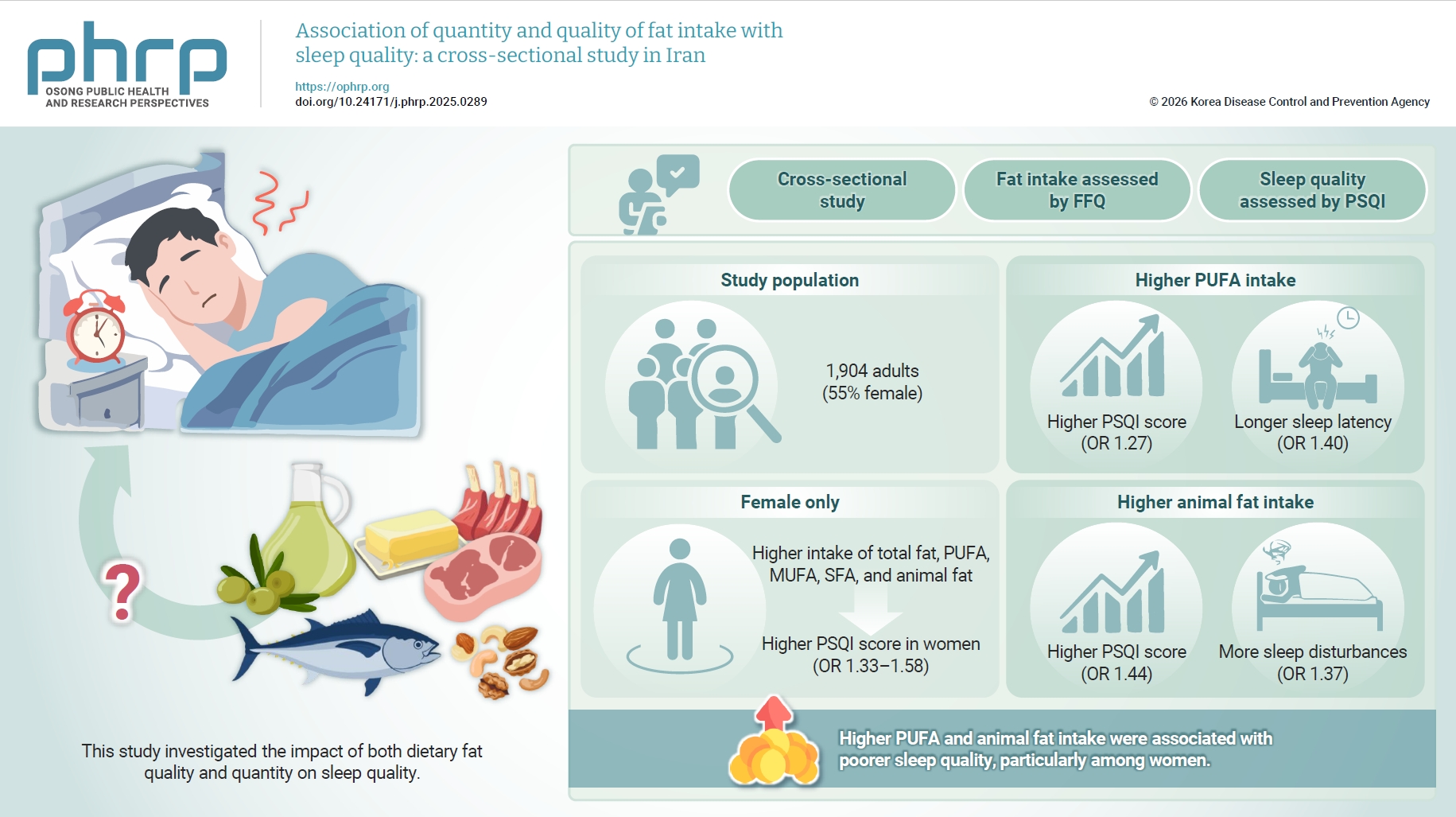
The association between dietary fat intake and sleep quality remains unclear. This study investigated the impact of both dietary fat quality and quantity on sleep quality.
Methods
In this cross-sectional study, participants completed a food frequency questionnaire and Pittsburgh Sleep Quality Index to assess quantity and quality of fat intake and sleep quality.
Results
A total of 1,904 participants (55% female) were included in the study. Participants in the highest tertile of polyunsaturated fatty acids (PUFA) intake, compared with those in the lowest tertile, had significantly higher total sleep quality scores (odds ratio [OR], 1.27; 95% confidence interval [CI], 1.01–1.62) and longer sleep onset latency (OR, 1.40; 95% CI, 1.08–1.83). Participants with higher animal fat intake exhibited higher total sleep quality scores (OR, 1.44; 95% CI, 1.09–1.89) and increased sleep disturbances (OR, 1.37; 95% CI, 1.02–1.83). Among women, those in the highest tertile compared with the lowest tertile showed increased odds of higher total sleep quality scores with total fat (OR, 1.37; 95% CI, 1.04–1.82), PUFA (OR, 1.41; 95% CI, 1.07–1.87), monounsaturated fatty acids (OR, 1.44; 95% CI, 1.09–1.90), saturated fatty acid (OR, 1.33; 95% CI, 1.01–1.77), and animal fat (OR, 1.58; 95% CI, 1.18–2.11).
Conclusion
These findings suggest that higher intakes of PUFA and animal fat are associated with higher total sleep quality scores. When stratified by sex, higher intake of total fat and unsaturated fats was associated with higher total sleep quality scores in women only.
  • 1,715 View
  • 72 Download
Analysis of factors influencing hemorrhagic fever with renal syndrome and its prediction in Weifang, China from 2013 to 2021
Hui Zhang, Wan-Ying Zhao, Yan-Qing Yang, Xue-Yan Guo, Yi-Han Shi, Qi-Yong Liu, Jing Li
Osong Public Health Res Perspect 2025;16(6):575-585.
Published online December 16, 2025
DOI: https://doi.org/10.24171/j.phrp.2025.0367
Analysis of factors influencing hemorrhagic fever with renal syndrome and its prediction in Weifang, China from 2013 to 2021
Objectives
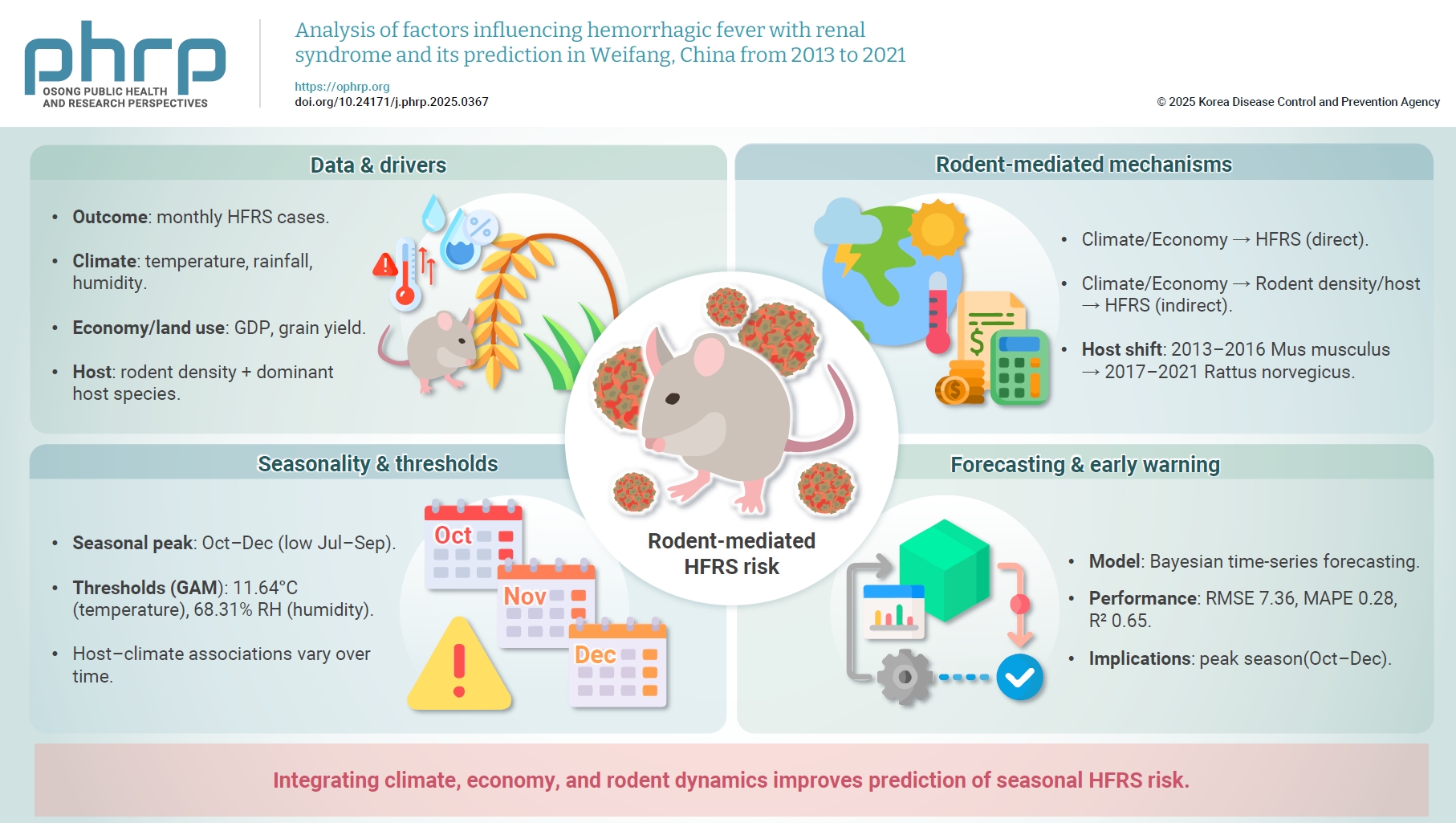
This study aimed to analyze the epidemiology and trends of hemorrhagic fever with renal syndrome (HFRS) in Weifang, China (2013–2021) and to guide prevention strategies.
Methods
The study examined the prevalence and incidence trends of HFRS in Weifang (2013–2021). Spearman correlation and wavelet analysis were employed to explore variable relationships and their associations with HFRS incidence. Generalized additive models (GAMs) were used to identify key risk factors, while structural equation modeling (SEM) quantified direct and indirect pathways influencing HFRS transmission. Finally, Bayesian time-series models were applied to predict future HFRS risk.
Results
Weifang reported 2,118 HFRS cases, which displayed distinct seasonality. Spearman correlation linked economic factors (gross domestic product [GDP], crop area, grain output, green space) and meteorological factors (temperature, pressure) to incidence (r>0.8). Wavelet analysis identified Mus musculus (2013–2016) and Rattus norvegicus (2017–2021) as dominant reservoirs, with temperature, precipitation, and humidity correlating with incidence. GAMs revealed a U-shaped relationship between rodent density and HFRS and an inverted U-shaped relationship between temperature (threshold, 11.64 °C) and HFRS. SEM highlighted the direct and indirect effects of climate via rodent density, mirrored by economic factors (e.g., GDP). Bayesian models effectively predicted HFRS (root mean square error, 7.36; mean absolute percentage error, 0.28; R2=0.65).
Conclusion
Climate, economic, and anthropogenic factors drive the spread of HFRS. Prevention strategies should integrate local economic conditions with meteorological and anthropogenic factors. Bayesian time-series modeling effectively predicts HFRS trends, supporting precision prevention strategies.

Citations

Citations to this article as recorded by  Crossref logo
  • Epidemiological characteristics and spatiotemporal heterogeneity of hemorrhagic fever with renal syndrome in the Jiaodong Peninsula region, China, 2019–2025
    Xiaofang Guo, Ti Liu, Ruixiao Li, Xueying Tian, Yuwei Zhang, Xiaotong Shi, Qing Duan, Renpeng Li, Zengqiang Kou
    Frontiers in Public Health.2026;[Epub]     CrossRef
  • Drivers of Viral Spillover: An Examination of How Pathogens Spread
    Elenoire Sole, Giulia Montalbano, Giuseppe Motta, Maria Maddalena Pansera, Angelina Midiri, Mariarita Iacopino, Paolo Liotta, Giuseppe Mancuso, Carmelo Biondo
    Pathogens.2026; 15(9): 901.     CrossRef
  • 2,193 View
  • 91 Download
  • 2 Web of Science
  • Crossref

Short Communication

Early detection of dengue through rapid diagnostic testing at airport quarantine: a case study from the Republic of Korea (2022–2024)
Kee Hun Do, Jae Wook Oh
Osong Public Health Res Perspect 2025;16(6):586-592.
Published online October 29, 2025
DOI: https://doi.org/10.24171/j.phrp.2025.0254
Early detection of dengue through rapid diagnostic testing at airport quarantine: a case study from the Republic of Korea (2022–2024)
Objectives
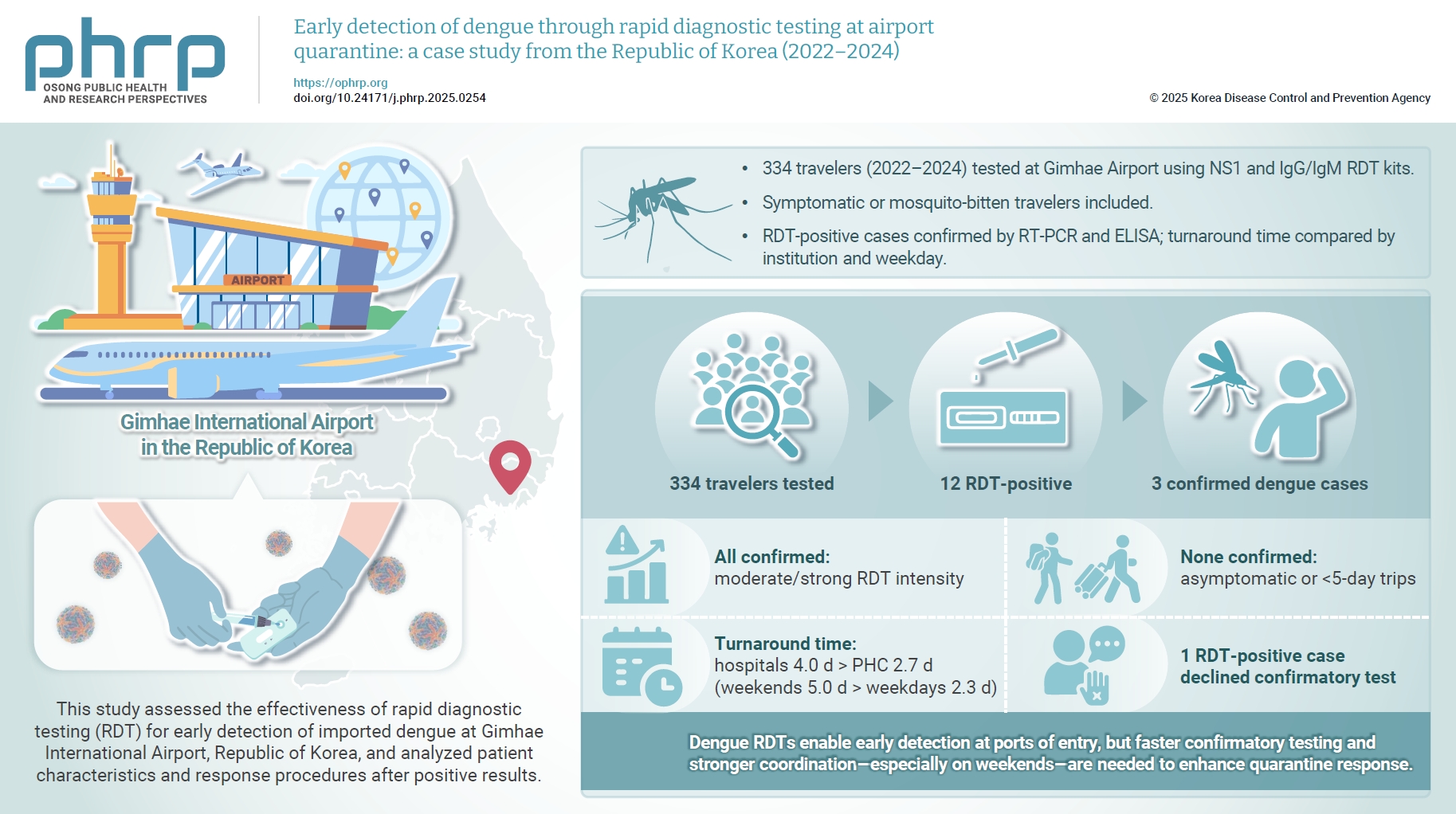
This study evaluated the effectiveness of rapid diagnostic testing (RDT) for the early detection of imported dengue cases at Gimhae International Airport in the Republic of Korea, and analyzed patient characteristics and response processes following positive results.
Methods
From 2022 to 2024, 334 individuals underwent RDT at the airport. Testing was performed for travelers presenting with dengue-like symptoms or recent mosquito bites. Two dengue RDT kits (NS1 and immunoglobulin G/M) were used, and confirmatory tests—including real-time reverse transcription polymerase chain reaction and enzyme-linked immunosorbent assays—were performed for RDT-positive cases. Time intervals between sample collection and diagnostic confirmation were compared by institution type and day of the week.
Results
Of the 334 cases tested, 12 yielded positive RDT results, and 3 were confirmed as dengue. No confirmed cases were identified among asymptomatic travelers or those with travel durations shorter than 5 days. All 3 confirmed cases showed moderate or higher RDT intensity. The confirmatory results were negative for all 7 marginally positive cases. The average turnaround time for diagnostic confirmation was 4.00 days in hospitals versus 2.71 days in public health centers. Samples collected on weekdays produced faster results (2.33 days) than those collected across weekends (5.00 days). One individual with a strong RDT-positive result declined confirmatory testing.
Conclusion
RDT is a valuable tool for detecting dengue at ports of entry. However, timely confirmatory diagnosis requires improved inter-agency coordination and logistical systems, particularly for weekend operations. These findings offer practical insights for strengthening quarantine-based infectious disease control.
  • 1,987 View
  • 73 Download

Original Articles

The impact of digital literacy on older adults’ self-rated health, depression, and life satisfaction: a cross-sectional study using 2023 National Survey of Older Koreans
Objectives
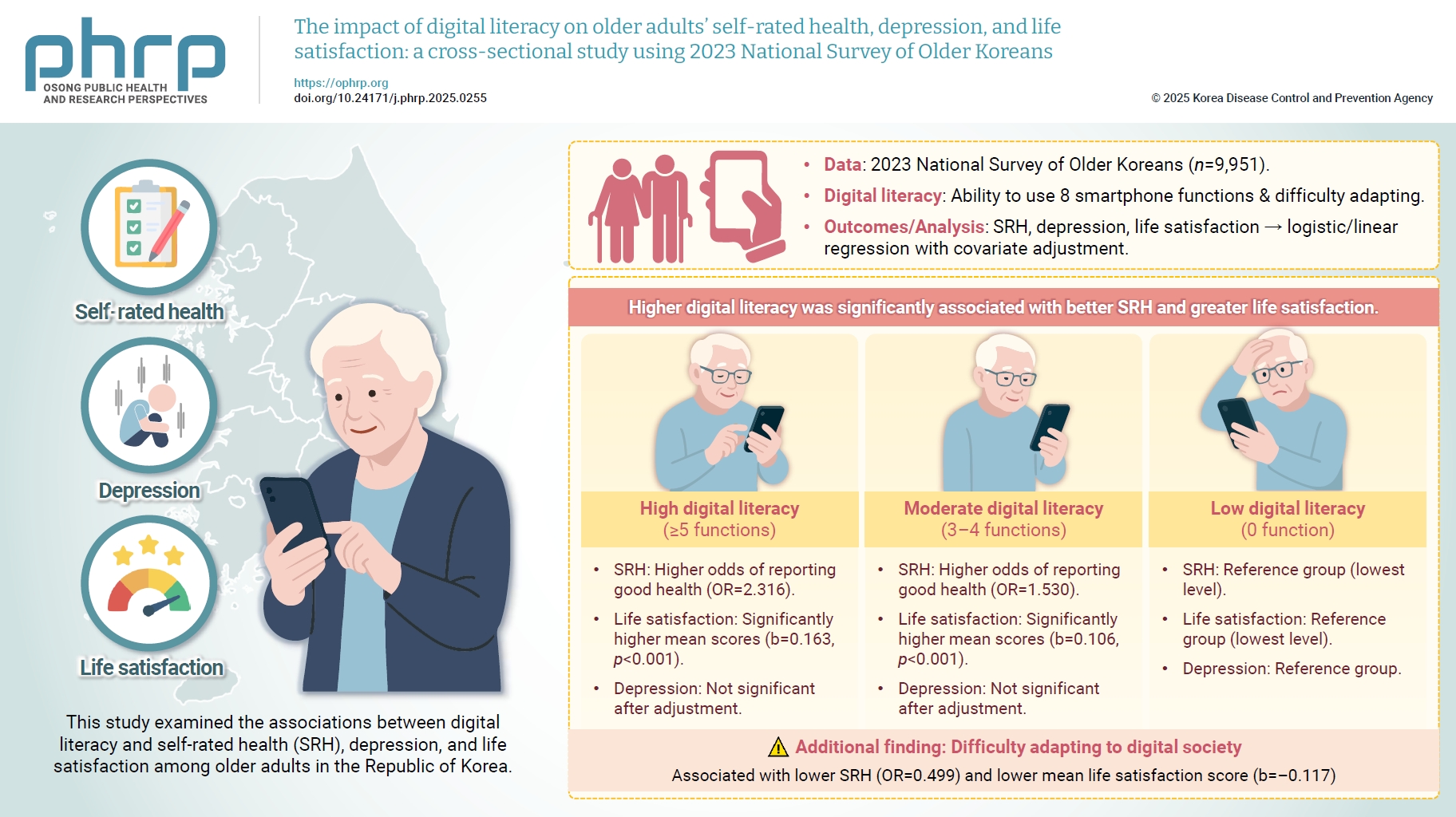
This study examined the associations between digital literacy and self-rated health (SRH), depression, and life satisfaction among older adults in the Republic of Korea.
Methods
Data were obtained from the 2023 National Survey of Older Koreans (n=9,951). Digital literacy was evaluated based on participants’ ability to use 8 smartphone functions and their perceived difficulty adapting to a digital society. Dependent variables included SRH, depression (measured using the short form of Geriatric Depression Scale), and life satisfaction (assessed through a composite score across 7 domains). Multiple logistic regression was applied for SRH and depression, while linear regression was conducted for life satisfaction, adjusting for sociodemographic and health-related covariates.
Results
Higher digital literacy was significantly associated with better SRH and greater life satisfaction. Compared to participants with no digital skills, those with moderate or high digital literacy had higher odds of reporting good SRH and significantly higher life satisfaction scores. Older adults who reported difficulty adapting to a digital society demonstrated significantly lower SRH and life satisfaction. However, after adjusting for covariates, the association between digital literacy and depression was not statistically significant.
Conclusion
Higher digital literacy is linked to better SRH and greater life satisfaction. Moreover, digital literacy reduced the explanatory power of socioeconomic variables, suggesting that it serves as an important behavioral determinant. These findings underscore the importance of promoting digital literacy as a means of improving health equity and well-being in aging populations.

Citations

Citations to this article as recorded by  Crossref logo
  • The Effect of Digital Literacy on Depression Among Older Adults With Chronic Diseases: The Moderating Role of Self-Rated Health
    Hyein Seo, Subin Yu
    The International Journal of Aging and Human Devel.2026; 103(4): 480.     CrossRef
  • Digital device use and disparities in health literacy among older adults
    Heeran Chun, Cheong-Seok Kim, Il-Ho Kim
    Korean Journal of Health Education and Promotion.2026; 43(2): 87.     CrossRef
  • Impact of an Interaction-Oriented, Information and Communication Technology-Based Community Care Service on Nutritional Status and Dietary Behavior of Community-Dwelling Older Adults: A Quasi-Experimental Study
    Seojin Yun, Seulgi Lee, Eun Young Lee, Kirang Kim
    Preventive Nutrition and Food Science.2026;[Epub]     CrossRef
  • Predicting longitudinal depressive symptom trajectories among older Chinese adults with chronic health conditions: An interpretable machine learning study
    Zhan Yu, Anao Zhang, Kaipeng Wang, Qiuling An, Meiyan Chen, Yuting Wang, Zeqiang Wang
    International Psychogeriatrics.2026; : 100270.     CrossRef
  • Sustaining Social Connection in a Super-Aged Society: Changes in the Association Between Social Ties and Life Satisfaction Among Korean Older Adults, 2011–2023
    Seonmi Choi, Junghyun Kim
    Sustainability.2026; 18(18): 9449.     CrossRef
  • Digital Ageism and Ageism Among Middle-Aged and Older Adults and the Mediating Role of Expectations Regarding Aging: A Cross-Sectional Study
    Gahye Kim, Aeri Jung
    Research in Community and Public Health Nursing.2026; 37: 403.     CrossRef
  • Disaggregating Digital Competence: Social Activity Participation and Depressive Symptoms Among Korean Older Adults
    Young-Mi Jung, NakHyeok Choi
    Behavioral Sciences.2026; 16(10): 1742.     CrossRef
  • The impact of digitalisation on the development of physical activity of older people (through the example of European Union countries)
    Zhaxat Kenzhin, Tursynzada Kuangaliyeva, Assem Aitkaliyeva, Yerbol Myrzabossynov, Aigerim Zhunussova, Odiljon Dadabayev
    Frontiers in Public Health.2026;[Epub]     CrossRef
  • 3,977 View
  • 172 Download
  • 4 Web of Science
  • Crossref
Deep learning-based prognosis of major adverse cardiac events in patients with acute myocardial infarction: a retrospective observational study in the Republic of Korea
Objectives
This study developed deep neural network (DNN) models capable of accurately classifying major adverse cardiac events (MACE) in patients with acute myocardial infarction (AMI) after hospital discharge, across 3 follow-up intervals: 1, 6, and 12 months. Methods: DNN models were constructed to predict post-discharge MACE across 4 categories. Multiple traditional machine learning models were implemented as controls to benchmark the performance of our DNN approach. All models were evaluated based on their ability to predict MACE occurrence during the specified follow-up periods. Results: The DNN models demonstrated superior predictive performance over conventional machine learning methods, achieving high accuracies of 0.922, 0.884, and 0.913 for the 1-month, 6-month, and 12-month follow-up periods, respectively. Conclusion: The high accuracy of our DNN models highlights their practical advantages for AMI diagnosis and guidance of follow-up treatment. These models can serve as valuable decision support tools, enabling clinicians to optimize the overall management of AMI patients and potentially enhance their hospitalization experience.

Citations

Citations to this article as recorded by  Crossref logo
  • Artificial intelligence and biohealth: the Republic of Korea’s emerging priorities in health care R&D
    Jong-Koo Lee
    Osong Public Health and Research Perspectives.2025; 16(4): 309.     CrossRef
  • 3,140 View
  • 106 Download
  • Crossref
Prevalence and determinants of medication adherence in Moroccan patients with type 2 diabetes: a multicenter cross-sectional study
Maryem Arraji, Nadia Al Wachami, Younes Iderdar, Fatima Zahra Bouchachi, Karima Boumendil, Mohamed Chahboune
Osong Public Health Res Perspect 2025;16(4):392-405.
Published online July 9, 2025
DOI: https://doi.org/10.24171/j.phrp.2025.0014
Prevalence and determinants of medication adherence in Moroccan patients with type 2 diabetes: a multicenter cross-sectional study
Objectives
This study was performed to evaluate the prevalence of medication adherence and its determinants among Moroccan patients with type 2 diabetes mellitus. Methods: A multicenter cross-sectional survey was conducted from February to June 2024, involving 584 patients from the Casablanca-Settat and Rabat-Sale-Kenitra regions of Morocco. Medication adherence was assessed using the general medication adherence scale. Associations between independent variables and adherence were analyzed using chi-square tests and multivariate logistic regression. Results: Medication adherence was observed in 96.2% of participants. Multivariate analysis revealed significantly lower medication adherence among patients using 2 or more oral antidiabetic drugs (adjusted odds ratio [aOR], 0.026; 95% confidence interval [CI], 0.001–0.642; p=0.026) and those with a diabetes duration of 11 to 15 years (aOR, 0.037; 95% CI, 0.001–0.956; p=0.047). Conclusion: Despite a high overall adherence rate, patients on dual or polytherapy and those with longer disease duration exhibited lower adherence in multivariate analysis. Targeted interventions are needed to improve adherence in these high-risk groups.
  • 3,222 View
  • 119 Download
  • 1 Web of Science
Design and evaluation of a multi-epitope subunit vaccine against human norovirus using an immunoinformatics approach
Zxcy L. Nonog, Edward C. Banico, Ma. Easter V. Sajo, Pablo V. Serrano, Fredmoore L. Orosco
Osong Public Health Res Perspect 2025;16(3):236-251.
Published online April 25, 2025
DOI: https://doi.org/10.24171/j.phrp.2024.0349
Design and evaluation of a multi-epitope subunit vaccine against human norovirus using an immunoinformatics approach
Objectives
This study aimed to identify safe, conserved, and highly immunogenic epitopes from all proteins of human-infecting norovirus (NoV) and to design a multi-epitope subunit vaccine construct from these epitopes using an immunoinformatics approach. Additionally, the vaccine construct was evaluated using both sequence- and structure-based assessments.
Methods
Conserved fragments were identified from all proteins of human-infecting NoV, and B and T lymphocyte epitopes were subsequently predicted using multiple epitope prediction tools. The selected epitopes were linked to form a multi-epitope construct, incorporating various adjuvants in the design. Vaccine constructs with different adjuvants were analyzed for their physicochemical properties and immune simulation profiles, and the optimal combination was selected as the final vaccine candidate for further study. Finally, molecular docking and dynamics simulations were performed to visualize the interaction between the construct and a host immune receptor.
Results
Twenty-two safe, conserved, and highly immunogenic epitopes were identified from all human-infecting NoV proteins. The construct adjuvanted with 50S ribosomal protein L7/L12 (50SrpL7/L12) was chosen as the final vaccine candidate due to its optimal physicochemical properties and favorable immune simulation profile. Furthermore, the construct exhibited high binding affinity and a stable interaction with toll-like receptor 4).
Conclusion
The multi-epitope subunit vaccine designed in this study shows promise as a potential NoV vaccine candidate for human immunization. Further in vitro and in vivo experiments are warranted to validate these findings.

Citations

Citations to this article as recorded by  Crossref logo
  • A multi-epitope pan-betacoronavirus vaccine construct predicted to induce broad-spectrum and durable immune responses: an immunoinformatics approach
    Anabella Margareth Arapa, Trina Ekawati Tallei, Rinaldi Idroes, Fatimawali, Elly Juliana Suoth, Maghfirah Savitri, Ahmad Akroman Adam, Beivy Jonathan Kolondam, Chika Yamada, Rosy Iara Maciel de Azambuja Ribeiro, Amama Rani, Moon Nyeo Park, Youdiil Ophinn
    Frontiers in Bioinformatics.2026;[Epub]     CrossRef
  • A Multi-Domain Approach for Designing of Novel Epitopes-Based Vaccine Against Chandipura Virus
    Alhanouf I. Al-Harbi, Raed Amer Ali Alsahoo, Asad Ullah, Sajjad Ahmad
    Journal of Pharmaceutical Innovation.2026;[Epub]     CrossRef
  • Immunoinformatics-based design of artificial chimeric proteins as universal vaccine candidates against foot-and-mouth disease virus serotypes A, O, and SAT2
    Alyaa Elrashedy, Mohamed Nayel, Akram Salama, Ahmed Zaghawa, Mohamed E. Hasan
    Scientific Reports.2026;[Epub]     CrossRef
  • Immunoinformatics-guided design of a multi-epitope mRNA vaccine candidate against Western Equine Encephalitis virus
    Elijah Kolawole Oladipo, Boluwatife Ayobami Irewolede, Stephen Toluwanimi Gbadero, Favour Adebimpe Adebisi, Noor-Al-Hudah Nurudeen, Emmanuel Ololade Oyediran, Rukayat Romoke Tajudeen, Taiwo Dorcas Akinpelu, Christiana Iyanuoluwa Kolapo, Balqis Ajoke Adeji
    The Veterinary Journal: Pharmacology & Toxicology.2026; 1(4): 100019.     CrossRef
  • 6,108 View
  • 143 Download
  • 3 Web of Science
  • Crossref

Review Article

The prevalence of tobacco, alcohol, stimulant, khat, and cannabis use among school-going students in African and Arab countries: a systematic review and meta-analysis
Chaimaa El Moubchiri, Mohamed Chahboune, Morad Guennouni, Abderraouf Hilali
Osong Public Health Res Perspect 2025;16(1):28-41.
Published online December 13, 2024
DOI: https://doi.org/10.24171/j.phrp.2024.0204
The prevalence of tobacco, alcohol, stimulant, khat, and cannabis use among school-going students in African and Arab countries: a systematic review and meta-analysis
Objectives
The objectives of this review and meta-analysis were twofold: first, to determine the prevalence of substance use among school-going children in Arab and African countries; and second, to highlight the considerable influence of variables such as the nation’s region and the timeframe of the study on the prevalence of substance use.
Methods
Research was sourced from Science Direct, Scopus, Web of Science, Google Scholar, and PubMed. Thirty-seven articles were incorporated in accordance with the PRISMA guidelines. This review included studies published from 2013 to 2023. The statistical meta-analysis was performed using Comprehensive Meta-Analysis ver. 3 software. Across 37 studies, the total number of study participants was 73,508.
Results
The meta-analysis revealed that tobacco was the most commonly used substance, with a prevalence of 16% (95% confidence interval [CI], 12.7%–20.02%). This was closely followed by alcohol, which had a prevalence of 15% (95% CI, 10.5%–22.8%), stimulants at 11.4% (95% CI, 7.4%–17%), khat at 10% (95% CI, 5.7%–15%), and cannabis at 8% (95% CI, 3.3%–18.4%). Notably, alcohol was the only substance that showed an increasing trend in prevalence from before to after 2019, rising from 13.3% (95% CI, 6.2%–26.1%) to 17% (95% CI, 10.2%–27%) (p<0.001). Additionally, the prevalence of substance use varied significantly between Arab and African countries (p<0.001).
Conclusion
Although the prevalence of substance use among school-going populations has significantly decreased over time, with the exception of alcohol, it is imperative that both African and Arab countries implement comprehensive measures and stringent laws to address the production and marketing of substances.

Citations

Citations to this article as recorded by  Crossref logo
  • Association of Substance Use Pattern and Family Factors With Use-Related Problems According to Arabic Drug Abuse Screening Test-10: A Cross-Sectional Study
    Hussam Aly Sayed Murad, Marwan Bakarman
    Substance Use: Research and Treatment.2026;[Epub]     CrossRef
  • 12,413 View
  • 234 Download
  • 1 Web of Science
  • Crossref

Brief Report

Safety of the bivalent COVID-19 mRNA booster vaccination among persons aged over 18 years in the Republic of Korea
Seok-Kyoung Choi, Seontae Kim, Mijeong Ko, Yeseul Heo, Tae Eun Kim, Yeonkyeong Lee, Juyeon Jang, Eunok Bahng
Osong Public Health Res Perspect 2024;15(6):542-549.
Published online October 29, 2024
DOI: https://doi.org/10.24171/j.phrp.2024.0194
Safety of the bivalent COVID-19 mRNA booster vaccination among persons aged over 18 years in the Republic of Korea
Objectives
The aim of this study was to disseminate information about the safety of bivalent coronavirus disease 2019 (COVID-19) mRNA booster vaccines administered to adults in the Republic of Korea.
Methods
Two databases were used to assess the safety of COVID-19 booster doses of Pfizer BA.1, Pfizer BA.4/5, Moderna BA.1, and Moderna BA.4/5 vaccines for adults aged 18 years and older. Adverse events (AEs) were analyzed using data reported to the web-based COVID-19 vaccination management system (CVMS) and a self-reported text-message survey.
Results
Between October 11, 2022 and March 30, 2023, the CVMS received reports of 2,369 (93.7%) non-serious AEs from vaccinated adults, along with 158 (6.3%) serious AEs, which included 5 cases of anaphylaxis and 33 deaths. From October 11, 2022 to January 27, 2023, 40,022 people aged 18 and older responded to a survey conducted via text message. The booster doses were associated with fewer local and systemic AEs compared to the original vaccines. After receiving the bivalent vaccine, the most commonly reported AEs were pain at the injection site, headache, fatigue, and myalgia.
Conclusion
Overall, bivalent vaccines exhibited fewer AEs compared to the original vaccines. The majority of AEs were non-serious, and serious AEs were rare among adults aged 18 years and older following vaccination with the Pfizer and Moderna bivalent vaccines.

Citations

Citations to this article as recorded by  Crossref logo
  • Cross-neutralizing antibody responses among individuals with or without bivalent vaccine: a six-month prospective cohort study
    Hye Hee Cha, Ji Yeun Kim, Seung Beom Kim, Junho Cha, Ji-Soo Kwon, Woori Kim, Ju Yeon Son, Choi Young Jang, Min-Chul Kim, So Yun Lim, Sung-Han Kim
    The Korean Journal of Internal Medicine.2026; 41(3): 516.     CrossRef
  • Safety of COVID-19 mRNA-1273 booster doses in Asian populations: A literature review of post-marketing observational studies
    Chris Clarke, Daina Esposito, Veronica Urdaneta, Piyali Mukherjee, Amanda K. Buttery
    Human Vaccines & Immunotherapeutics.2026;[Epub]     CrossRef
  • 3,932 View
  • 76 Download
  • 2 Web of Science
  • Crossref

Original Articles

Associations of type and intensity of social participation with depression, self-rated health, and life satisfaction among community-dwelling older adults in the Republic of Korea: a nationwide cross-sectional study
Objectives
Social activities are important and influential factors for healthy aging. However, limited information is available regarding the associations of the type and intensity of social participation with health and well-being. This study aimed to investigate how various types of social activities are associated with several dimensions of health outcomes. Methods: This cross-sectional study utilized data from the Seventh Korean Longitudinal Study of Aging, which included 5,526 adults aged 60 years and older. Multivariate linear regression analysis was employed to analyze the associations of social activities with depression, self-rated health, and life satisfaction. Additionally, subgroup analyses by sex and age were performed. Results: Among the participants, 73.5% reported involvement in at least 1 of the 4 types of social engagement. After adjustment for all covariates, individuals who participated in any social activity reported better self-rated health and higher life satisfaction compared to those who did not participate. However, the intensity of engagement in different social activities had varying impacts on subjective health outcomes. An increased level of participation was associated with a lower rate of depression and improved self-rated health. However, no significant differences were observed in the relationship between the intensity of participation in activities (with the exception of alumni societies or family councils) and life satisfaction. Conclusion: This study suggests that to improve their health, older adults in the Republic of Korea should not only engage in social activities but also do so actively and regularly.

Citations

Citations to this article as recorded by  Crossref logo
  • Impact of Depression on Self-Rated Health Status among Community-Dwelling Older Adults: Moderating Effects of Subjective Social Status and Formal Social Participation Using Data from the Ninth Korean Longitudinal Study of Aging (2022)
    Sohee Jung, Eunhee Yang, Soyoung Cha, Wonhee Baek
    Journal of Fundamental Nursing Science.2026; 33(1): 147.     CrossRef
  • Disaggregating Digital Competence: Social Activity Participation and Depressive Symptoms Among Korean Older Adults
    Young-Mi Jung, NakHyeok Choi
    Behavioral Sciences.2026; 16(10): 1742.     CrossRef
  • Gender differences in advanced activities of daily living: evidence from the longitudinal study of health and aging in Mexico 2012–2018
    Martha A. Sánchez-Rodríguez, Mariano Zacarías-Flores, Lesly Estefanía Castañeda-Sánchez, Víctor Manuel Mendoza-Núñez
    Frontiers in Aging.2025;[Epub]     CrossRef
  • The Associations Between Physical Activity, Body Perception, and Self-Rated Health in Korean Adults: An Analysis of the 2023 Korean Community Health Survey
    Geun-Kook Kim, Su-Yeon Roh, Sung-Ho Hwang
    Medicina.2025; 61(11): 1898.     CrossRef
  • 6,354 View
  • 135 Download
  • 2 Web of Science
  • Crossref
The association between living arrangements and health-related quality of life in Korean older people: a nationwide repeated cross-sectional study
Eunok Park, Philip Larkin, Zee-A Han
Osong Public Health Res Perspect 2024;15(3):221-228.
Published online May 23, 2024
DOI: https://doi.org/10.24171/j.phrp.2023.0273
The association between living arrangements and health-related quality of life in Korean older people: a nationwide repeated cross-sectional study
Objectives
This study investigated the association between living arrangements and healthrelated quality of life (HRQoL) in older people. Methods: A secondary analysis was conducted of 6,153 participants (aged ≥60 years) from the seventh Korean National Health and Nutrition Examination Survey (2016 to 2018). HRQoL was measured using the 3-level version of the EuroQol 5-dimensional questionnaire. The chi-square test, t-test, and multiple regression were used, applying sampling weights for the analysis. Results: The proportion of respondents living alone was 18.0%, with a higher prevalence among women and older age groups (p<0.001). The overall HRQoL was lower in groups living alone than in groups living with others (p<0.001). Older people living alone showed higher impairments in all dimensions of the 3-level version of the European Quality of Life 5-Dimensional Questionnaire (EQ-5D-3L) than those living with others, including mobility (p<0.001), self-care (p<0.001), usual activities (p<0.001), pain/discomfort (p<0.001), and depression/anxiety (p<0.001). Problems with mobility were most prevalent (42.8%), followed by pain/ discomfort (41.9%) in respondents living alone. Living alone was significantly associated with a lower HRQoL index score (b=–0.048, p<0.001) after adjusting for age, gender, education, exercise, perceived stress, and perceived health status. Conclusion: Living alone was negatively associated with HRQoL. Based on this study, future care planning for older people should consider their living arrangements. The need to strengthen and expand care programs targeting those living alone should also be addressed.

Citations

Citations to this article as recorded by  Crossref logo
  • Quality of life in later years: A comprehensive review of elderly well-being in India
    Sandhya Bharathi Shanmugasundaram, Pitchaimani Govindharaj, Srihari Ramamoorthy, Vijayalakshmi Purusothaman
    International Journal of Noncommunicable Diseases.2026; 11(2): 82.     CrossRef
  • Factors Related to Quality of Life Among Older Adults with Family Care Vulnerability in Semi-Urban Areas of Thailand
    Arun Boonsang, Laksanee Boonkhao, Nittaya Chakhamrun, Aree Butsorn, Sanga Tubtimhin, Pongsak Rattanachaikunsopon, Sanguansin Ratanalert
    Journal of Multidisciplinary Healthcare.2026; Volume 19: 1.     CrossRef
  • Occupational Balance, Quality of Life, and Recovery Among Older Mental Health Service Users—A Cross-Sectional Study
    Carina Tordai, Steven M. Schmidt, Elisabeth Argentzell, Mona Eklund
    Occupational Therapy In Health Care.2026; : 1.     CrossRef
  • Association between health-related quality of life and noncommunicable diseases in South Korea
    Seungjae Byun, Kyeongeun Kim, Min Seong Kim, Guillaume Fond, Laurent Boyer, Guillermo F. López Sánchez, Jiseung Kang, Dong Keon Yon
    Medicine.2026; 105(37): e50564.     CrossRef
  • Preventing depression in older adults with chronic illnesses through the SMART Elderly Program: a quasi-experimental study in Central Thailand
    Phongsakorn Toopboochakorn, Nanthawan Nilpayak, Phornphimon Hotarat, Wanida Jaroensuk, Phannathat Tanthanapanyakorn
    Korean Journal of Family Medicine.2026; 47(5): 405.     CrossRef
  • Convergent validity, reliability and responsiveness of the AP-7D and EQ-5D-5L based on the survey for the general people in five countries: a new cultural-specific preference-based measure developed in east and southeast asia
    Yuta Suzuki, Takeru Shiroiwa, Tatsunori Murata, Emi Kamono, Yasuhiro Morii, Takashi Fukuda
    Health and Quality of Life Outcomes.2025;[Epub]     CrossRef
  • 5,107 View
  • 115 Download
  • 6 Web of Science
  • Crossref

Review Article

Psychiatric adverse events associated with the COVID-19 vaccines approved in the Republic of Korea: a systematic review
Seungeun Ryoo, Miyoung Choi, Nam-Kyong Choi, Hyoung-Shik Shin, Jun Hee Woo, Byung-Joo Park, Sanghoon Oh
Osong Public Health Res Perspect 2024;15(2):107-114.
Published online March 28, 2024
DOI: https://doi.org/10.24171/j.phrp.2023.0325
Psychiatric adverse events associated with the COVID-19 vaccines approved in the Republic of Korea:  a systematic review
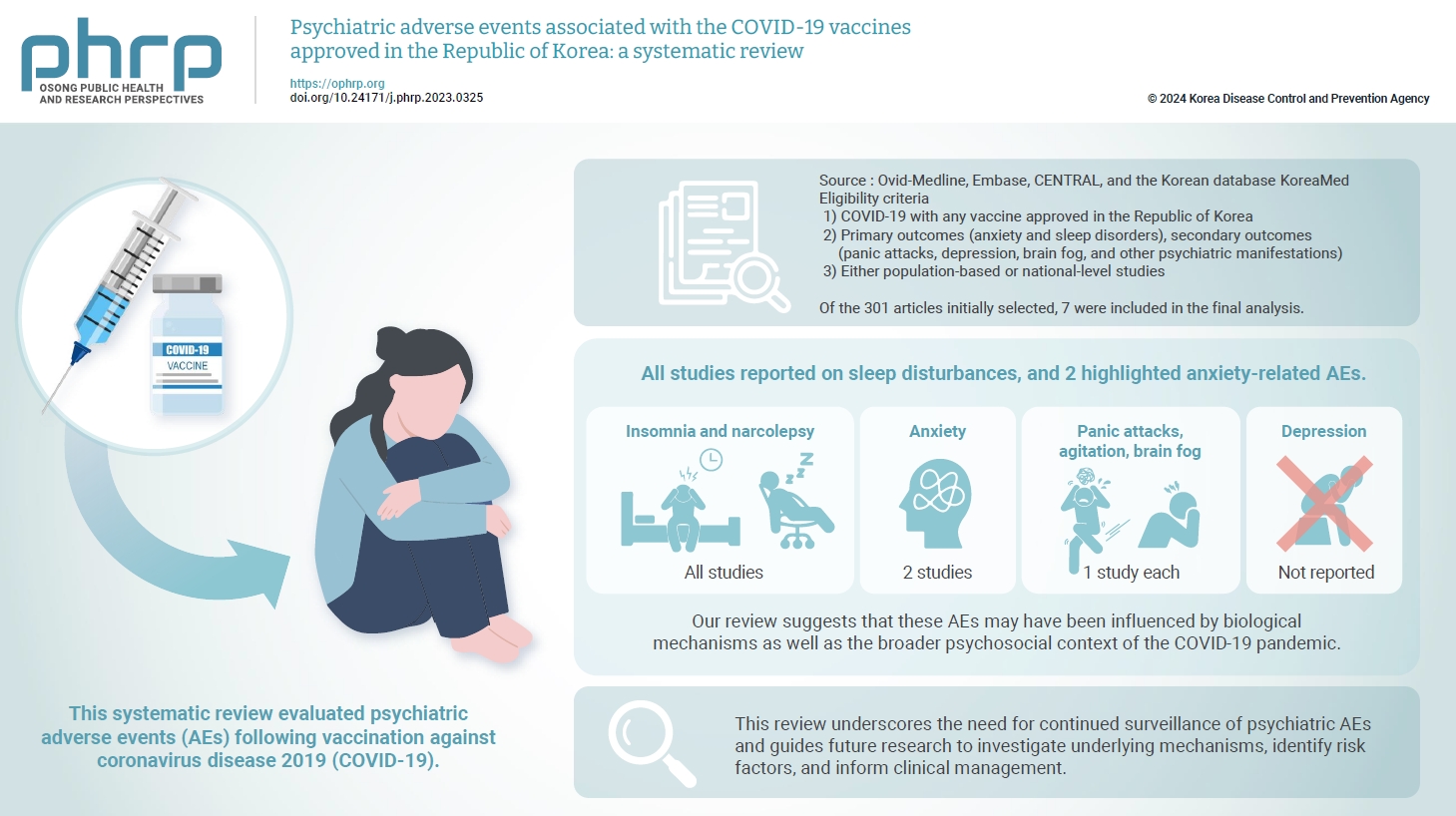
This systematic review evaluated psychiatric adverse events (AEs) following vaccination against coronavirus disease 2019 (COVID-19). We included studies that reported or investigated psychiatric AEs in individuals who had received an approved COVID-19 vaccine in the Republic of Korea. Systematic electronic searches of Ovid-Medline, Embase, CENTRAL, and KoreaMed databases were conducted on March 22, 2023. Risk of bias was assessed using the Risk of Bias Assessment Tool for Non-randomized Studies 2.0. The study protocol was registered in the International Prospective Register of Systematic Reviews (CRD42023449422). Of the 301 articles initially selected, 7 were included in the final analysis. All studies reported on sleep disturbances, and 2 highlighted anxiety-related AEs. Sleep disorders like insomnia and narcolepsy were the most prevalent AEs, while depression was not reported. Our review suggests that these AEs may have been influenced by biological mechanisms as well as the broader psychosocial context of the COVID-19 pandemic. Although this study had limitations, such as a primary focus on the BNT162b2 vaccine and an observational study design, it offered a systematic, multi-vaccine analysis that fills a critical gap in the existing literature. This review underscores the need for continued surveillance of psychiatric AEs and guides future research to investigate underlying mechanisms, identify risk factors, and inform clinical management.

Citations

Citations to this article as recorded by  Crossref logo
  • Risk of anxiety disorders and insomnia following COVID-19 vaccination
    Haerin Cho, Joon Hyung Jung, Hwoyeon Seo, Won Chul Shin, Jung-Ick Byun, Suvin Park, Na-Young Jeong, Sanghoon Oh, Nam-Kyong Choi
    Journal of Psychiatric Research.2026; 192: 109.     CrossRef
  • A review of the scientific literature on experimental toxicity studies of COVID-19 vaccines, with special attention to publications in toxicology journals
    Jose L. Domingo
    Archives of Toxicology.2024; 98(11): 3603.     CrossRef
  • 25,973 View
  • 209 Download
  • 4 Web of Science
  • Crossref

Original Article

Effect of Paxlovid in COVID-19 treatment during the periods of SARS-CoV-2 Omicron BA.5 and BN.1 subvariant dominance in the Republic of Korea: a retrospective cohort study
Dong-Hwi Kim, Min-Gyu Yoo, Na-Young Kim, So Young Choi, Minjeong Jang, Misuk An, Se-Jin Jeong, Jungyeon Kim
Osong Public Health Res Perspect 2024;15(2):137-149.
Published online March 28, 2024
DOI: https://doi.org/10.24171/j.phrp.2023.0230
Effect of Paxlovid in COVID-19 treatment during the periods of SARS-CoV-2 Omicron BA.5 and BN.1 subvariant dominance in the Republic of Korea:  a retrospective cohort study
Objectives
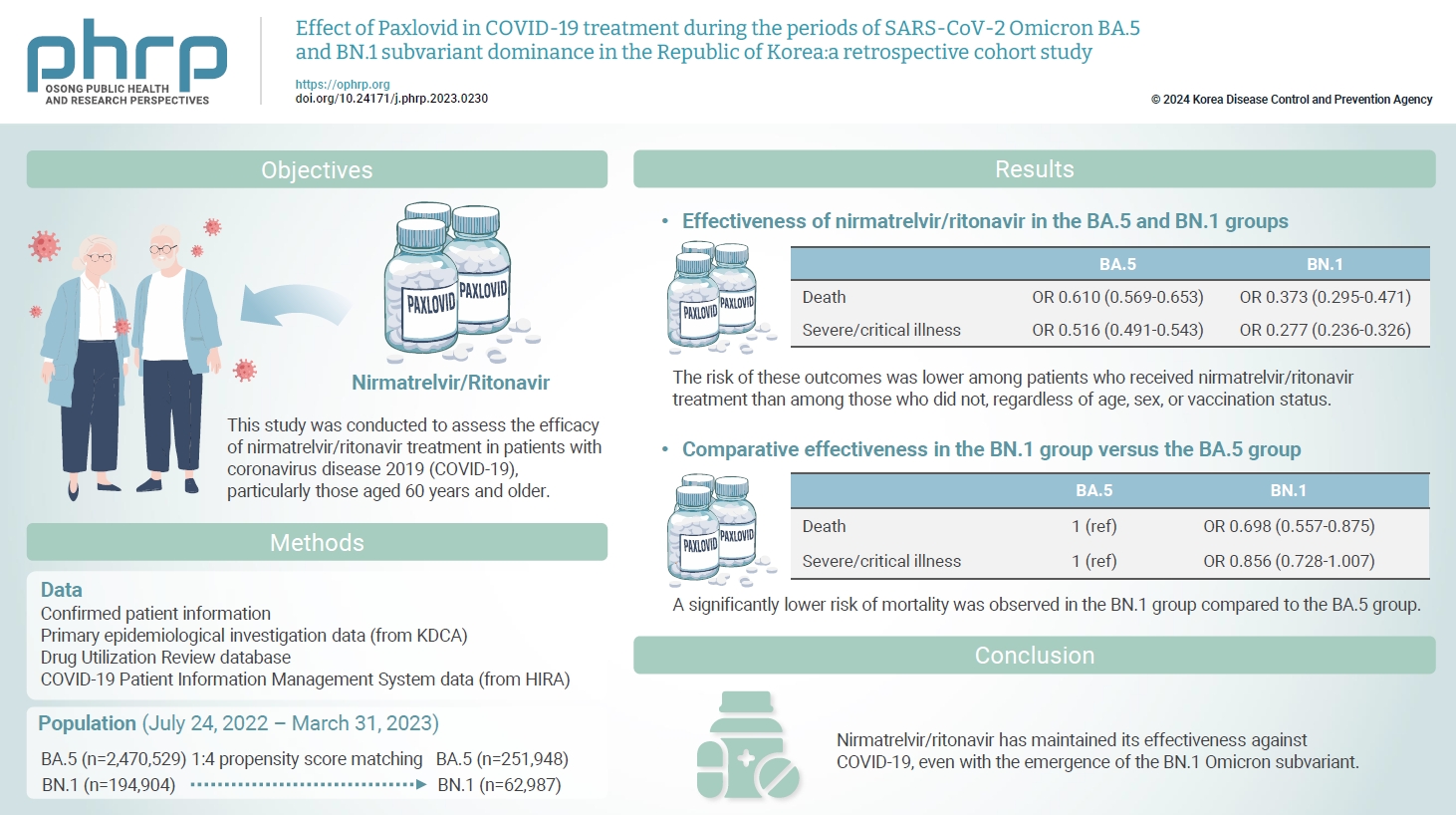
This study was conducted to assess the efficacy of nirmatrelvir/ritonavir treatment in patients with coronavirus disease 2019 (COVID-19), particularly those aged 60 years and older. Using real-world data, the period during which the BN.1 Omicron variant was dominant was compared to the period dominated by the BA.5 variant. Methods: In this retrospective cohort study, data were collected regarding 2,665,281 patients infected with severe acute respiratory syndrome coronavirus 2 between July 24, 2022, and March 31, 2023. Propensity score matching was utilized to match patients who received nirmatrelvir/ ritonavir in a 1:4 ratio between BN.1 and BA.5 variant groups. Multivariable logistic regression analysis was employed to assess the effects of nirmatrelvir/ritonavir within these groups. Results: Compared to the prior period, the efficacy of nirmatrelvir/ritonavir did not significantly differ during the interval of Omicron BN.1 variant dominance in the Republic of Korea. Among patients treated with nirmatrelvir/ritonavir, a significantly lower risk of mortality was observed in the BN.1 group (odds ratio [OR], 0.698; 95% confidence interval [CI], 0.557–0.875) compared to the BA.5 group. However, this treatment did not significantly reduce the risk of severe or critical illness, including death, for those in the BN.1 group (OR, 0.856; 95% CI, 0.728–1.007). Conclusion: Nirmatrelvir/ritonavir has maintained its effectiveness against COVID-19, even with the emergence of the BN.1 Omicron subvariant. Consequently, we strongly recommend the administration of nirmatrelvir/ritonavir to patients exhibiting COVID-19-related symptoms, irrespective of the dominant Omicron variant or their vaccination status, to mitigate disease severity and decrease the risk of mortality.

Citations

Citations to this article as recorded by  Crossref logo
  • Effectiveness of Nirmatrelvir/Ritonavir for Outpatients in the Era of Omicron, Vaccination, and Previous Infection: A Meta-analysis
    Mark Ebell, Peter Kurotschka
    Journal of General Internal Medicine.2026; 41(12): 3516.     CrossRef
  • Severity of COVID-19 Omicron Variants: A Global Systematic Review
    Deepa Malhotra, Rajeev M. Nepal, Irini Zografaki, Moe H. Kyaw, Pinelopi Nikolopoulou, Rodrigo Sini de Almeida, Santiago M. C. Lopez, Stephen Wiblin, Fraser Williams, Sophie Pope, Isabelle Whittle, Fiona Pearson, Daniel Curcio
    Infectious Diseases and Therapy.2026; 15(7): 1827.     CrossRef
  • Nirmatrelvir/Ritonavir Efficacy in Immunocompetent Patients with Confirmed Omicron Variant of Severe Acute Respiratory Syndrome Coronavirus 2: An Updated Systematic Review and Meta-analysis
    Elnaz Khani, Hoda Afsharirad, Ali Taghizadeh Yadegari, Meysam Zarezadeh, Hila Asham, Hossein Bannazadeh-Baghi, Taher Entezari-Maleki
    Journal of Research in Pharmacy Practice.2026;[Epub]     CrossRef
  • 4,477 View
  • 104 Download
  • 3 Web of Science
  • Crossref

Brief Report

JYNNEOS vaccine safety monitoring in the Republic of Korea, 2022: a cross-sectional study
Jaeeun Lee, Seunghyun Lewis Kwon, Jinhee Park, Hyuna Bae, Hyerim Lee, Geun-Yong Kwon
Osong Public Health Res Perspect 2023;14(5):433-438.
Published online October 18, 2023
DOI: https://doi.org/10.24171/j.phrp.2023.0182
JYNNEOS vaccine safety monitoring in the Republic of Korea, 2022: a cross-sectional study
Objectives
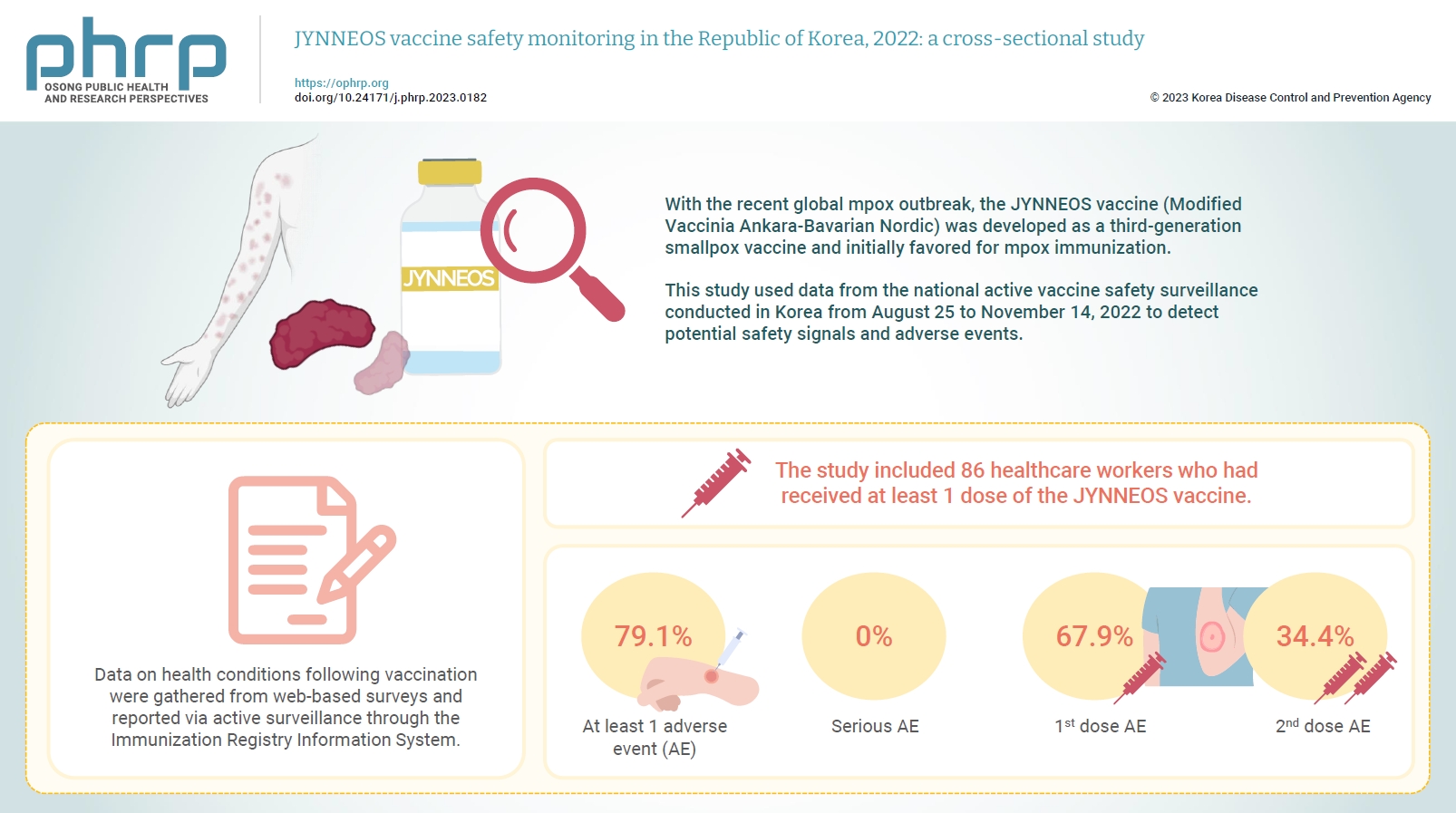
With the recent global mpox outbreak, the JYNNEOS vaccine (Modified Vaccinia Ankara-Bavarian Nordic) was developed as a third-generation smallpox vaccine and initially favored for mpox immunization. Vaccine-associated side effects contribute to vaccine hesitancy. Consequently, tracking adverse events post-immunization is crucial for safety management. This study used data from the national active vaccine safety surveillance conducted in Korea from August 25 to November 24, 2022 to detect potential safety signals and adverse events. Methods: Data on health conditions following vaccination were gathered from web-based surveys and reported via active surveillance through the Immunization Registry Information System. This follow-up system functioned via a text message link, surveying adverse events and health conditions beginning on the second day post-vaccination. Information about specific adverse events, including both local and systemic reactions, was collected. Results: The study included 86 healthcare workers who had received at least 1 dose of the JYNNEOS vaccine. Among the respondents, 79.1% reported experiencing at least 1 adverse event, with the majority being local reactions at the injection site. The incidence of adverse events was higher following the first dose (67.9%) than after the second dose (34.4%). The most frequently reported adverse event for both doses was mild pain at the injection site. Conclusion: The study provides crucial information on the safety of the JYNNEOS vaccine, demonstrating that most adverse events were manageable and predominantly localized to the injection site. Nonetheless, additional research is needed on the safety of various vaccine administration techniques and the vaccine’s effects on broader demographics.

Citations

Citations to this article as recorded by  Crossref logo
  • Enhanced Immunogenicity and Affinity with A35R-Fc-Based Chimeric Protein Compared to MPXV A35R Protein
    Shimeng Bai, Yanxin Cui, Qibin Liao, Hongyang Yi, Zhonghui Liao, Gengwei Zhang, Fenfang Wu, Hongzhou Lu
    Viruses.2025; 17(1): 116.     CrossRef
  • The Role of Adverse Event Follow-Up in Advancing the Knowledge of Medicines and Vaccines Safety: A Scoping Review
    Vijay Kara, Florence Van Hunsel, Andrew Bate, Eugène van Puijenbroek
    Drug Safety.2025; 48(9): 977.     CrossRef
  • Potential of MRNA vaccines for mpox prevention: current evidence and future directions
    Toufik Abdul-Rahman, Ogungbemi Evelyn Faith, Oyinbolaji Akinwande Ajetunmobi, Hala Ibrahim Thaalibi, Chinelo Geraldine Ikele, Gargi Gautam, Faith Olanrewaju Omotayo, Poulami Roy, Alhazan Amir Adebayo, Muslimat Abolore Mojeed, Tolulope Taiwo Kareem, Halima
    Annals of Medicine & Surgery.2025; 87(9): 5650.     CrossRef
  • Adverse Reactions After Intradermal Vaccination With JYNNEOS for Mpox in Korea
    So Yun Lim, Yu Mi Jung, Yeonjae Kim, Gayeon Kim, Jaehyun Jeon, BumSik Chin, Min-Kyung Kim
    Journal of Korean Medical Science.2024;[Epub]     CrossRef
  • First Nationwide Mpox Vaccination Program in the Republic of Korea: Implications for an Enhanced Public Health Response
    Seunghyun Lewis Kwon, Minju Song, Wonkyung Lee, Jeeyeon Shin, Su-Yeon Lee, Sang-Gu Yeo, Minjeong Kim, Sanggyun Jeong, Joonku Park, Dongwoo Lee, Sookyoung Lim
    Journal of Korean Medical Science.2024;[Epub]     CrossRef
  • Global perspectives on smallpox vaccine against monkeypox: a comprehensive meta-analysis and systematic review of effectiveness, protection, safety and cross-immunogenicity
    Hao Liu, Wenjing Wang, Yang Zhang, Fuchun Wang, Junyi Duan, Tao Huang, Xiaojie Huang, Tong Zhang
    Emerging Microbes & Infections.2024;[Epub]     CrossRef
  • 5,086 View
  • 81 Download
  • 7 Web of Science
  • Crossref

Original Articles

Effects of an arteriovenous fistula stenosis prevention program in patients receiving hemodialysis
Haegyeong Lee, Gyuli Baek, Eunju Lee
Osong Public Health Res Perspect 2023;14(4):279-290.
Published online August 9, 2023
DOI: https://doi.org/10.24171/j.phrp.2023.0101
Effects of an arteriovenous fistula stenosis prevention program in patients receiving hemodialysis
Objectives
To increase the efficiency of hemodialysis, an appropriate vascular pathway must be created, and its function must be maintained. This study aimed to identify the effects of an arteriovenous fistula (AVF) stenosis prevention program on upper muscular strength, blood flow, physiological indexes, and self-efficacy among patients receiving hemodialysis.
Methods
The participants were patients receiving hemodialysis at Keimyung University Dongsan Medical Center in Daegu, Republic of Korea. They were divided into experimental and control groups based on the day of the week they received hemodialysis at the outpatient department and included 25 participants each. The study was conducted for 8 weeks.
Results
The AVF stenosis prevention program was effective in improving upper extremity muscle strength (F=15.23, p<0.001) and blood flow rate (F=36.00, p<0.001). As a result of the program, the phosphorus index level, which is a physiological indicator in hemodialysis patients, decreased (F=8.64, p<0.001). Encouragement and support through text messages and practice lists also resulted in an increase in self-efficacy (F=18.62, p<0.001).
Conclusion
The AVF stenosis prevention program in this study resulted in an increase in upper extremity muscle strength through grip strength exercises and was effective in preventing AVF stenosis by increasing the blood flow rate.

Citations

Citations to this article as recorded by  Crossref logo
  • Matrix Metalloproteinase-9 as a Marker for Arteriovenous Fistula Stenosis in Chronic Kidney Disease
    Muhamad Taufik Ismail, Jumadi Sihura, Diandra Nisitasari, Balqis Khoirunnisa, Tinanda Tarigan, Yohanes William, I. Putu Aditio Artayasa, Galih Ramadhan, Afif Ramadhan, Rizkan Triatmaja, Nabila Assakinah, Laely Amalia, Yulia Wardhani, Hariadi Hariawan, Met
    International Journal of Angiology.2026;[Epub]     CrossRef
  • Observation of patency rates in patients with arteriovenous fistula stenosis treated with paclitaxel-coated high-pressure balloon angioplasty
    Wenbin Mao, Xiaoping Li
    Langenbeck's Archives of Surgery.2026;[Epub]     CrossRef
  • Scope review of self-management intervention for arteriovenous fistula in hemodialysis patients
    Yi Pan, Huimin Dong, Jie Yu, Xiaoping Wu
    Frontiers in Public Health.2026;[Epub]     CrossRef
  • 5,937 View
  • 246 Download
  • 3 Web of Science
  • Crossref
Prevalence and patterns of adverse events following childhood immunization and the responses of mothers in Ile-Ife, South West Nigeria: a facility-based cross-sectional survey
Olorunfemi Akinbode Ogundele, Funmito Omolola Fehintola, Mubarak Salami, Rahmat Usidebhofoh, Mary Aderemi Abaekere
Osong Public Health Res Perspect 2023;14(4):291-299.
Published online July 27, 2023
DOI: https://doi.org/10.24171/j.phrp.2023.0071
Prevalence and patterns of adverse events following childhood immunization and the responses of mothers in Ile-Ife, South West Nigeria: a facility-based cross-sectional survey
Objectives
This study aimed to examine the prevalence and pattern of adverse events following childhood immunization and the responses of mothers in Ile-Ife, South West Nigeria.
Methods
This descriptive cross-sectional study was conducted among 422 mothers of children aged 0 to 24 months attending any of the 3 leading immunization clinics in Ile-Ife, Nigeria. The respondents were selected using the multi-stage sampling technique. Data were collected using a pretested structured interviewer-administered questionnaire and analyzed using IBM SPSS ver. 26.0. The chi-square test was used to test associations, while binary logistic regression was used to determine the predictors of mothers’ responses to adverse events following immunization (AEFIs). A p-value of <0.05 was considered statistically significant.
Results
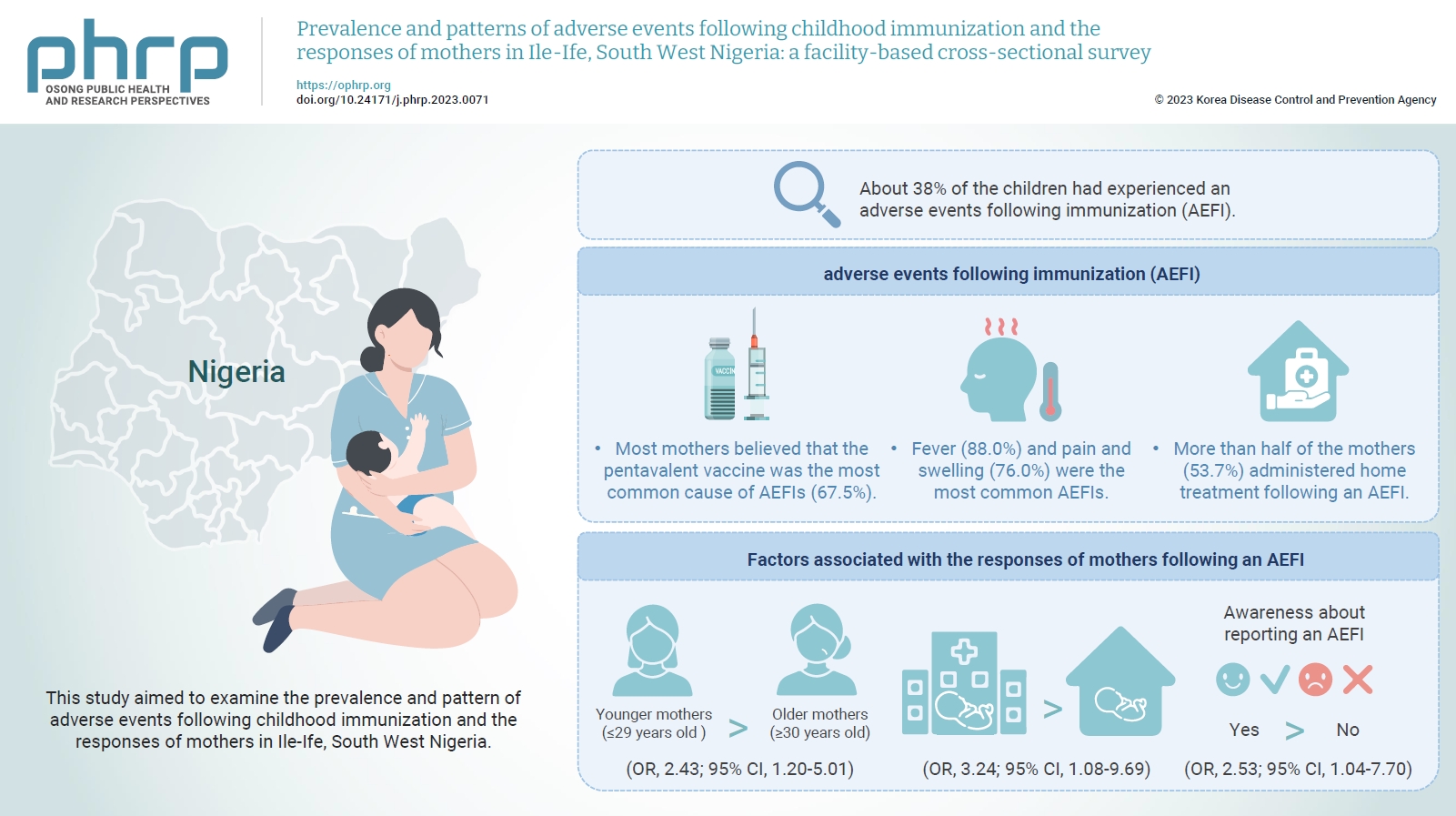
The mean age of the respondents was 29.99±5.74 years. About 38% of the children had experienced an AEFI. Most mothers believed that the pentavalent vaccine was the most common cause of AEFIs (67.5%). Fever (88.0%) and pain and swelling (76.0%) were the most common AEFIs. More than half of the mothers (53.7%) administered home treatment following an AEFI. Younger mothers (odds ratio [OR], 2.43; 95% confidence interval [CI], 1.20–5.01), mothers who delivered their children at a healthcare facility (OR, 3.24; 95% CI, 1.08–9.69), and mothers who were knowledgeable about reporting AEFIs (OR, 2.53; 95% CI, 1.04–7.70) were most likely to respond appropriately to AEFIs.
Conclusion
The proportion of mothers who responded poorly to AEFIs experienced by their children was significant. Therefore, strategies should be implemented to improve mothers’ knowledge about AEFIs to improve their responses.

Citations

Citations to this article as recorded by  Crossref logo
  • A comprehensive evaluation of the AEFI surveillance system in Ethiopia: An insight from a national study
    Admas Abera, Behailu Hawulte, Tesfaye Gobena, Lemma Demissie Regassa, Saba Hailu, Ahmed Mohammed, Berhanu Fikadie Endehabtu, Mulumebet Abera Wordofa, Keneni Gutema Negeri, Girma Taye, Michael Tarekegn, Binyam Tilahun, Mesoud Mohammed, Naod Wondirad, Kibro
    Journal of Global Health Economics and Policy.2026;[Epub]     CrossRef
  • Análisis epidemiológico de eventos adversos graves posteriores a la vacunación en Colombia, 2019-2023
    Cristhian Camilo Martinez Torres, Diana Marcela Russy Roa
    Salud Javeriana.2026;[Epub]     CrossRef
  • Perception of healthcare administrators on the impediments of optimizing adverse events following immunization e-Reporting in Nigeria
    Grace Fubara Erekosima, Saheed Dipo Isiaka, Folake Oni, Ahmed Rufai Garba, Oluchi Bassey, Stephen Olabode Asaolu, Olugbemisola Wuraola Samuel, Genevieve Ozioko, Oluwafisayo Azeez Ayodeji, Euphemia Chigekwu Agomuo, Irene Odira Okoye, Sidney Sampson, Precio
    PLOS One.2025; 20(8): e0331093.     CrossRef
  • Advancing Immunization in Africa: Overcoming Challenges to Achieve the 2030 Global Immunization Targets
    Olalekan Okesanya, Gbolahan Olatunji, Noah Olaleke, Mba Mercy, Ayodele Ilesanmi, Hassan Kayode, Emery Manirambona, Mohamed Ahmed, Bonaventure Ukoaka, Don Lucero-Prisno III
    Adolescent Health, Medicine and Therapeutics.2024; Volume 15: 83.     CrossRef
  • 7,592 View
  • 243 Download
  • 2 Web of Science
  • Crossref
Results of contact tracing for SARS-CoV-2 Omicron sub-lineages (BA.4, BA.5, BA.2.75) and the household secondary attack risk
Mi Yu, Sang-Eun Lee, Hye Young Lee, Hye-jin Kim, Yeong-Jun Song, Jian Jeong, Ae Kyung Park, Il-Hwan Kim, Eun-jin Kim, Young-Joon Park
Osong Public Health Res Perspect 2023;14(3):173-179.
Published online June 22, 2023
DOI: https://doi.org/10.24171/j.phrp.2022.0285
Results of contact tracing for SARS-CoV-2 Omicron sub-lineages (BA.4, BA.5, BA.2.75) and the household secondary attack risk
Objectives
This study aimed to assess the contact tracing outcomes of severe acute respiratory syndrome coronavirus 2 (SARS-CoV-2) Omicron sub-lineages BA.4, BA.5, and BA.2.75 within Republic of Korea, and to generate foundational data for responding to future novel variants.
Methods
We conducted investigations and contact tracing for 79 confirmed BA.4 cases, 396 confirmed BA.5 cases, and 152 confirmed BA.2.75 cases. These cases were identified through random sampling of both domestically confirmed and imported cases, with the goal of evaluating the pattern of occurrence and transmissibility.
Results
We detected 79 instances of Omicron sub-lineage BA.4 across a span of 46 days, 396 instances of Omicron sub-lineage BA.5 in 46 days, and 152 instances of Omicron sub-lineage BA.2.75 over 62 days. One patient with severe illness was confirmed among the BA.5 cases; however, there were no reports of severe illness in the confirmed BA.4 and BA.2.75 cases. The secondary attack risk among household contacts were 19.6% for BA.4, 27.8% for BA.5, and 24.3% for BA.2.75. No statistically significant difference was found between the Omicron sub-lineages.
Conclusion
BA.2.75 did not demonstrate a higher tendency for transmissibility, disease severity, or secondary attack risk within households when compared to BA.4 and BA.5. We will continue to monitor major SARS-CoV-2 variants, and we plan to enhance the disease control and response systems.

Citations

Citations to this article as recorded by  Crossref logo
  • Severity of COVID-19 Omicron Variants: A Global Systematic Review
    Deepa Malhotra, Rajeev M. Nepal, Irini Zografaki, Moe H. Kyaw, Pinelopi Nikolopoulou, Rodrigo Sini de Almeida, Santiago M. C. Lopez, Stephen Wiblin, Fraser Williams, Sophie Pope, Isabelle Whittle, Fiona Pearson, Daniel Curcio
    Infectious Diseases and Therapy.2026; 15(7): 1827.     CrossRef
  • Monitoring the 2023 Omicron waves in Morocco: Trends in incidence, variants, and testing disparities
    El Kamouni Youssef, Almaggoussi Rim, Arsalane Lamiae, Merabet Moad, El Youbi Mohammed, Zouhair Said
    IJID Regions.2026; 20: 100948.     CrossRef
  • Impact of disease severity, age, sex, comorbidity, and vaccination on secondary attack rates of SARS-CoV-2: a global systematic review and meta-analysis
    Dewan Md. Sumsuzzman, Yang Ye, Zhen Wang, Abhishek Pandey, Joanne M. Langley, Alison P. Galvani, Seyed M. Moghadas
    BMC Infectious Diseases.2025;[Epub]     CrossRef
  • Replication kinetics and infectivity of SARS-CoV-2 Omicron variant sublineages recovered in the Republic of Korea
    Jeong-Min Kim, Dongju Kim, Jee Eun Rhee, Cheon Kwon Yoo, Eun-Jin Kim
    Osong Public Health and Research Perspectives.2024; 15(3): 260.     CrossRef
  • 5,081 View
  • 89 Download
  • 4 Web of Science
  • Crossref

Review Article

Carbapenem resistance in critically important human pathogens isolated from companion animals: a systematic literature review
Angie Alexandra Rincón-Real, Martha Cecilia Suárez-Alfonso
Osong Public Health Res Perspect 2022;13(6):407-423.
Published online December 16, 2022
DOI: https://doi.org/10.24171/j.phrp.2022.0033
This study aimed to describe the presence and geographical distribution of Gram-negativebacteria considered critical on the priority list of antibiotic-resistant pathogens publishedby the World Health Organization, including carbapenem-resistant Enterobacteriaceae,carbapenem-resistant Acinetobacter spp., and carbapenem-resistant Pseudomonas aeruginosa.A systematic review of original studies published in 5 databases between 2010 and 2021 wasconducted, including genotypically confirmed carbapenem-resistant isolates obtained fromcanines, felines, and their settings. Fifty-one articles met the search criteria. Carbapenemresistant isolates were found in domestic canines and felines, pet food, and on veterinarymedical and household surfaces. The review found that the so-called “big five”—that is, the5 major carbapenemases identified worldwide in Enterobacterales (New Delhi metallo-βlactamase, active-on-imipenem, Verona integron-encoded metallo-β-lactamase, Klebsiellapneumoniae carbapenemase, and oxacillin [OXA]-48-like)—and the 3 most importantcarbapenemases from Acinetobacter spp. (OXA-23-like, OXA-40-like, and OXA-58-like) hadbeen detected in 8 species in the Enterobacteriaceae family and 5 species of glucose nonfermenting bacilli on 5 continents. Two publications used molecular analysis to confirmcarbapenem-resistant bacteria transmission between owners and dogs. Isolating criticallyimportant human carbapenem-resistant Gram-negative bacteria from domestic canines andfelines highlights the importance of including these animal species in surveillance programsand antimicrobial resistance containment plans as part of the One Health approach.

Citations

Citations to this article as recorded by  Crossref logo
  • Reducing carbapenemase-producing Gram-negative bacilli in high-risk veterinary hospital units through targeted infection prevention and control
    Chavin Leelapsawas, Chutirat Torsahakul, Nicole Sirisopit Mehl, Krishaporn Kradangnga, Parinya Sroithongkham, Rusmin Indra, Parnkaew Wannamala, Luksika Keerativitayanant, Rungtip Chuanchuen, Pattrarat Chanchaithong
    Research in Veterinary Science.2026; 204: 106120.     CrossRef
  • Monitoring antimicrobial resistance trends and emerging carbapenemases in Enterobacterales causing companion animal infections: a four-year study
    Laura Fernandes, Joana Moreira da Silva, Juliana Menezes, Cátia Marques, Cátia Caneiras, Constança Pomba
    Veterinary Microbiology.2026; 316: 110987.     CrossRef
  • Clinical audit on antimicrobial stewardship effectiveness in reducing antimicrobial‐resistant bacterial colonisation in hospitalised horses
    Karen Mazzola, Aliai Lanci, Silvia Piva, Viviana Schisa, Jole Mariella, Raffaele Scarpellini, Francesca Freccero, Erica De Carolis, Fabio Tumietto, Carolina Castagnetti
    Equine Veterinary Journal.2026;[Epub]     CrossRef
  • Beyond companionship: Current practices and future perspectives in antimicrobial resistance surveillance among companion animals
    Raffaele Scarpellini, Silvia Piva
    Research in Veterinary Science.2026; 209: 106275.     CrossRef
  • Epidemiology and characterization of carbapenemase gene alleles expressed by Enterobacterales recovered from Nairobi river surface water and local input sources in Nairobi, Kenya
    Rael J. Too, Briton M. Kavulavu, George C. Gitao, Lilly C. Bebora, Dixie F. Mollenkopf, Samuel Kariuki, Thomas E. Wittum
    Total Environment Microbiology.2026; 2(3): 100094.     CrossRef
  • Multilevel surveillance of antimicrobial resistance in Escherichia coli and Klebsiella pneumoniae from companion animals: Evidence from a Veterinary University Hospital before and after EU Regulation 2022/1255
    R. Scarpellini, M. Giunti, F. Dondi, C. Agnoli, L. Pisoni, S. Del Magno, A. Foglia, I. Magagnoli, E. Esposito, E. Mondo, F. Tumietto, S. Piva
    Veterinary Microbiology.2026; 319: 111081.     CrossRef
  • Survey-based risk factors and genomic characterization of oral and oropharyngeal Enterobacterales carriage in humans and companion animals: a One Health study
    W. Cooper Brookshire, K. Taylor Hellmann, D. Ashley Robinson, Keun Seok Seo
    Frontiers in Veterinary Science.2026;[Epub]     CrossRef
  • NDM-5-plasmid diversity in multiple international high-risk Escherichia coli clones associated with canine and feline extraintestinal infections
    Pattrarat Chanchaithong, Parinya Sroithongkham, Chavin Leelapsawas, Komkiew Pinpimai, Jitrapa Yindee, Alexandra Collaud, Vincent Perreten
    Veterinary Microbiology.2025; 301: 110338.     CrossRef
  • Staphylococcal skin infection isolates from dogs without recent antibiotic exposure are 100% susceptible to clindamycin
    W. Cooper Brookshire, Larry D. Ballard, Vernon C. Langston, Joo Youn Park, Keun-Seok Seo
    Frontiers in Veterinary Science.2025;[Epub]     CrossRef
  • The European Union summary report on antimicrobial resistance in zoonotic and indicator bacteria from humans, animals and food in 2022–2023

    EFSA Journal.2025;[Epub]     CrossRef
  • Zoonotic potential of uropathogenic Escherichia coli lineages from companion animals
    Nicolas Jousserand, Frédéric Auvray, Camille Chagneau, Laurent Cavalié, Christelle Maurey, Amandine Drut, Rachel Lavoué, Eric Oswald
    Veterinary Research.2025;[Epub]     CrossRef
  • Genomic analyses of Escherichia coli ST410 harbouring the blaOXA-181 carbapenemase gene from companion animals and humans in Switzerland
    Yvonne Spahr, Patrice Nordmann, Javier E Fernandez, Laurent Poirel, Andrea Endimiani, Vincent Perreten
    Journal of Applied Microbiology.2025;[Epub]     CrossRef
  • WGS-based characterization of trans-sectoral OXA-48-producing Escherichia coli in Switzerland
    Valentina Donà, Patrice Nordmann, Javier E. Fernandez, Laurent Poirel, Jacqueline Findlay, Simone Schuller, Sonja Kittl, Helene Rohrbach, Andrea Endimiani, Vincent Perreten
    One Health Advances.2025;[Epub]     CrossRef
  • Analysis of the Concordance Between the Use of Phenotypic Screening Tests with the β-Lactamase Gene Profile in Selected Gram-Negative Bacteria
    Patrycja Głowacka, Izabela Marczuk, Patrycja Wójcicka, Monika Ogórkiewicz, Marta Ciesielska, Dorota Żakowska, Paweł Rutyna, Anna Koszczyńska, Marta Łączyńska, Natalia Podsiadły, Emilia Paziewska, Beata Cieśluk-Olchowska
    Antibiotics.2025; 14(12): 1275.     CrossRef
  • First report of a blaNDM-5-carrying Escherichia coli sequence type 12 isolated from a dog with pyometra in Japan
    Kazuki Harada, Tadashi Miyamoto, Michiyo Sugiyama, Tetsuo Asai
    Journal of Infection and Chemotherapy.2024; 30(9): 938.     CrossRef
  • The European Union summary report on antimicrobial resistance in zoonotic and indicator bacteria from humans, animals and food in 2021–2022

    EFSA Journal.2024;[Epub]     CrossRef
  • Epidemiological analysis and prevention strategies in response to a shigellosis cluster outbreak: a retrospective case series in an alternative school in the Republic of Korea, 2023
    Yeongseo Ahn, Sunmi Jin, Gemma Park, Hye Young Lee, Hyungyong Lee, Eunkyung Shin, Junyoung Kim, Jaeil Yoo, Yuna Kim
    Osong Public Health and Research Perspectives.2024; 15(1): 68.     CrossRef
  • Carbapenem Resistance in Animal-Environment-Food from Africa: A Systematic Review, Recommendations and Perspectives
    Komla Dossouvi, Ayawovi Selom Ametepe
    Infection and Drug Resistance.2024; Volume 17: 1699.     CrossRef
  • Identification of blaOXA-23 gene in resistant Pseudomonas aeruginosa strains isolated from cows and humans in Basra province, Iraq
    Alyaa Sabti Jasim, Abeer Laily Mohammed, Wameedh Hashim Abbas, Hanaa Khaleel Ibraheim, Hasanain A.J. Gharban
    Veterinary World.2024; : 1629.     CrossRef
  • The European Union Summary Report on Antimicrobial Resistance in zoonotic and indicator bacteria from humans, animals and food in 2020/2021

    EFSA Journal.2023;[Epub]     CrossRef
  • Resistome-based surveillance identifies ESKAPE pathogens as the predominant gram-negative organisms circulating in veterinary hospitals
    Flavia Zendri, Cajsa M. Isgren, Jane Devaney, Vanessa Schmidt, Rachel Rankin, Dorina Timofte
    Frontiers in Microbiology.2023;[Epub]     CrossRef
  • Unveiling the emergence of multidrug-resistant pathogens in exotic pets from France: a comprehensive study (2017-2019)
    Sandro Cardoso, Aurélie Le Loc’h, Inês Marques, Anabela Almeida, Sérgio Sousa, Maria José Saavedra, Sofia Anastácio, Eduarda Silveira
    One Health & Implementation Research.2023; 3(4): 161.     CrossRef
  • 12,800 View
  • 261 Download
  • 22 Web of Science
  • Crossref

Original Article

Menstrual hygiene management and its determinants among adolescent girls in low-income urban areas of Delhi, India: a community-based study
Suneela Garg, Nidhi Bhatnagar, Mongjam Meghachandra Singh, Saurav Basu, Amod Borle, Yamini Marimuthu, Falak Azmi, Yomri Dabi, Indu Bala
Osong Public Health Res Perspect 2022;13(4):273-281.
Published online August 31, 2022
DOI: https://doi.org/10.24171/j.phrp.2022.0127
Objectives
Menstrual hygiene management (MHM) in developing countries is linked to human rights, social justice, and the education and empowerment of young girls. The objective of this study was to assess menstrual hygiene practices and their determinants among adolescent girls, including school dropouts, and the effects of pad distribution programs in urban resettlement areas of Delhi, India.
Methods
A cross-sectional study was conducted from March 2019 to February 2020 in urban resettlement colonies and 2 villages of Delhi among 1,130 adolescent girls aged 10 to 19 years, who were interviewed face to face.
Results
In total, 954 participants (84.4%) used only disposable sanitary pads, 150 (13.3%) used both sanitary pads and cloths, and 26 (2.3%) used only cloths (n=1,130). Most school-going girls utilized the scheme for pad distribution, but only two-thirds of the girls who were out of school utilized the scheme. In the adjusted analysis, girls with lower educational status, those who had dropped out of school, and those from the Muslim religious community were more likely to use cloths for MHM.
Conclusion
More than 4 out of 5 adolescent girls in Delhi in low-income neighborhoods preferred sanitary pads for MHM. The government free pad scheme reached near-universal utilization among school-going girls (97%), but the subsidized pad scheme for girls who did not attend school was insufficiently utilized (75%).

Citations

Citations to this article as recorded by  Crossref logo
  • Advancements in Health Promotion within Schools: A Scoping Review and Bibliometric Analysis (2018–2023)
    Anujyoti Sonowal, Alaka Omprakash Chandak, Manesh Muraleedharan
    Journal of Indian Association for Child and Adoles.2026; 22(2): 106.     CrossRef
  • Menstruation physiology knowledge and hygiene practices among adolescent girls from rural and urban backgrounds: a comparative study
    Indu Khare, Ruchi Kalra
    International Journal of Reproduction, Contracepti.2026; 15(3): 891.     CrossRef
  • Challenges in menstrual health service delivery to girls and young women in Mumbai slums: provider perspectives
    Paramita Majumdar, Shireen J. Jejeebhoy, Aparajita Chattopadhyay
    Culture, Health & Sexuality.2026; : 1.     CrossRef
  • Shifting Preferences: Assessing Women’s Behavioral Intentions to Adopt Menstrual Cups
    Melisa Rudolph Menezes, Swathi K S, Pallavi Upadhyaya, Brayal D Souza
    Trends in Psychology.2026;[Epub]     CrossRef
  • Menstrual hygiene practices and WASH practices among women residing in an urban slum in Delhi: a community-based study
    Sahdev Santra, Nitin Panwar, Sahil Dhama, Abin K. Rajan, Parth Singhal, Anita Verma
    International Journal Of Community Medicine And Pu.2026; 13(9): 4984.     CrossRef
  • The combined role of education and wealth in menstrual health: Evidence from Bangladesh
    Mohammad Hridoy Patwary, Md Tazvir Amin, Sumaiya Nusrat, Md Mahabubur Rahman, Alison Parker
    PLOS One.2026; 21(10): e0346457.     CrossRef
  • Menstrual Hygiene in Adolescent Girls: Findings from a Survey in the Urban Government Schools, Visakhapatnam, India
    Vandana Valluri, Saivaishnavi Attili, Phani Krishna Chamarty, Tejaswi Prabhanjana, Murali Santosh
    Preventive Medicine: Research & Reviews.2025; 2(1): 20.     CrossRef
  • Understanding of menstruation among school going adolescent girls in Delhi: a cross-sectional study
    Divya P. Wangoo, Srishti Yadav, Sahil Goyal, Priya Kataria, Chandrika Agarwal
    International Journal Of Community Medicine And Pu.2025;[Epub]     CrossRef
  • Menstrual hygiene practices among rural adolescent girls in a north Karnataka village: a cross-sectional study
    Rachel Sushmita Daniel, Pooja Todalabagi
    International Journal Of Community Medicine And Pu.2025; 12(2): 857.     CrossRef
  • Period poverty: Menstrual information, product selection, and disposal among urban female nursing students in Bangladesh
    Md Nahid Uz Zaman, Risa Takashima, Akira Sai, Taro Yamauchi
    Health & Place.2025; 93: 103467.     CrossRef
  • Menstrual hygiene practices, determinants, and association with reproductive tract infection in India: a large repeated cross-sectional analysis (2015–2021)
    Mrunali Zode, Baani Sodhi, Saurav Basu
    Journal of Biosocial Science.2025; 57(3): 385.     CrossRef
  • “I know your problems; take your bag and go home”: a qualitative study using the social-ecological model to understand drivers of suboptimal school and social participation among secondary schoolgirls in Northwest Tanzania
    Yovitha Sedekia, Saidi Kapiga, Onike Mcharo, John Luwayi, Siwema Keya Sasi, Clare Tanton, Belen Torondel, Jennifer Rubli, Giulia Greco, Philip Ayieko, Elialilia Okello
    BMC Public Health.2025;[Epub]     CrossRef
  • Assessment of Menstrual Hygiene Practices and Their Determinants Among Adolescent Girls in Urban Slums of India: A Community-Based Cross-Sectional Study
    Shubhanshu Gupta, Anshika Agarwal, Amita Sharma, Puneet Agrawal
    Cureus.2025;[Epub]     CrossRef
  • Beyond the Bin: A critical review and strategic framework for sustainable menstrual waste management in India
    Hema Sudhakar
    Social Sciences & Humanities Open.2025; 12: 102226.     CrossRef
  • Age-based patterns of menstrual hygiene practices among domestic workers in Kolkata: a correspondence analysis
    Suparna Ghosh, Baidyanath Pal, Amit Kumar Kisku
    Discover Public Health.2025;[Epub]     CrossRef
  • Factors Associated with Exclusive Use of Hygienic Methods during Menstruation among Adolescent Girls (15–19 Years) in Urban India: Evidence from NFHS-5
    Doli Roy, Nuruzzaman Kasemi, Manik Halder, Malasree Majumder
    Heliyon.2024; 10(8): e29731.     CrossRef
  • Enhancement of Health-related Quality of Life among School-going Adolescent Girls with Improvement in Menstrual Hygiene Knowledge and Practices
    Akanksha Goyal, Sunita Agarwal
    Archives of Medicine and Health Sciences.2024; 12(1): 73.     CrossRef
  • Menstrual practice needs among college going women in Coimbatore district, India: an analytical cross-sectional study
    Vijayakumar Ramya, Mohan Kumar, Jeevithan Shanmugam, N. Seetharaman, Sushmitha Mahanshetty, Srihari Dhandapani, P. Aparnavi, Thavansree Durairaj, Ramesh Rathinamoorthy
    Discover Public Health.2024;[Epub]     CrossRef
  • Determination of menstrual hygiene management and genital hygiene behaviors of students: A university example from Turkey
    Aytül Hadımlı, Ayşenur Akan, Güzin Kardeş, Buket Akkurt, Birsen Karaca Saydam
    Revista da Escola de Enfermagem da USP.2024;[Epub]     CrossRef
  • Menstrual Hygiene Problems and Challenges Faced by Adolescent Females in Rural Areas: A Narrative Review
    Vijiya Kashyap, Sonali G Choudhari
    Cureus.2023;[Epub]     CrossRef
  • Perceived difficulties in maintaining menstrual hygiene practices among indigenous adolescents during seasonal water scarcity periods in Bandarban hill district of Bangladesh: A cross-sectional study
    Imdadul Haque Talukdar, M.A. Rifat, Plabon Sarkar, Nobonita Saha, Mesfin Kassaye Tessma, Md. Ibrahim Miah
    International Journal of Hygiene and Environmental.2023; 254: 114268.     CrossRef
  • Menstrual hygiene practices among adolescent women in rural India: a cross-sectional study
    Aditya Singh, Mahashweta Chakrabarty, Shivani Singh, Rakesh Chandra, Sourav Chowdhury, Anshika Singh
    BMC Public Health.2022;[Epub]     CrossRef
  • 16,272 View
  • 711 Download
  • 14 Web of Science
  • Crossref

Review Article

Social determinants of adherence to COVID-19 preventive guidelines: a comprehensive review
Zahra Jorjoran Shushtari, Yahya Salimi, Sina Ahmadi, Nader Rajabi-Gilan, Marzieh Shirazikhah, Akbar Biglarian, Ali Almasi, Mohammad Ali Mohammadi Gharehghani
Osong Public Health Res Perspect 2021;12(6):346-360.
Published online December 21, 2021
DOI: https://doi.org/10.24171/j.phrp.2021.0180
Social determinants of adherence to COVID-19 preventive guidelines: a comprehensive review
Adherence to coronavirus disease 2019 (COVID-19) preventive guidelines (ACPG) is an important strategy to control the COVID-19 pandemic effectively. The present study aimed to identify and summarize the social determinants of ACPG among the general population. A comprehensive review was performed from December 2019 to February 2021 through searching electronic databases. Two independent reviewers assessed and selected relevant studies. Next, the characteristics and main findings of the included studies were summarized. Finally, the World Health Organization’s conceptual framework of social determinants of health was used to synthesize the identified social determinants of ACPG. Forty-one of 453 retrieved articles met the inclusion criteria. The study results showed different patterns of ACPG among various communities. Furthermore, 84 social determinants were identified and categorized into structural and intermediary determinants. ACPG is a set of complex behaviors associated with different individual sociodemographic and behavioral characteristics; living and working conditions; COVID-19 knowledge, attitudes, and risk perceptions; exposure to sources and information level; leisure activities; social support; trust; social norms; psychosocial well-being; socio-economic position; and the socio-economic and political context. Interventions to promote ACPG among the general population should consider the identified social determinants of ACPG.

Citations

Citations to this article as recorded by  Crossref logo
  • Health communication and social media: Asian perspective
    Subhan Afifi, Aris Yaman, I Gede Mahatma Yuda Bakti, Sik Sumaedi
    Global Knowledge, Memory and Communication.2026; 75(5-6): 2203.     CrossRef
  • Flattening the curve: Factors associated with engagement in health protective behaviors at the onset of the COVID-19 pandemic among Black individuals from predominantly low-income backgrounds
    Jennifer McDonald, Matthew Figueroa, Juliet Cushing, Austen McGuire, Yo Jackson
    Journal of Health Psychology.2026; 31(2): 832.     CrossRef
  • Microbial contamination of medicines, medical devices, cosmetics, child and personal care products: a comprehensive review of secondary contamination risks in home-use settings
    Katia Iskandar, Loïc Marchin, Christine Roques
    Frontiers in Microbiology.2026;[Epub]     CrossRef
  • The impact of COVID-19 infection experience on risk perception and preventive behaviour: a cohort study
    Michio Murakami, Mei Yamagata, Asako Miura
    Epidemiology and Infection.2026;[Epub]     CrossRef
  • Associations of health beliefs and worry with COVID-19 protective behaviors among lung cancer patients
    Marcia F Burns, Ellen Krueger, Nasser Hanna, Gregory A Durm, DuyKhanh P Ceppa, Shadia I Jalal, Thomas J Birdas, Kenneth A Kesler, Lawrence H Einhorn, Catherine E Mosher
    Journal of Health Psychology.2025; 30(11): 2927.     CrossRef
  • ISO 50001 based energy management system: a bibliometric perspective
    Marlina Pandin, Sik Sumaedi, Aris Yaman, Meilinda Ayundyahrini, Nina Konitat Supriatna, Nurry Widya Hesty
    International Journal of Energy Sector Management.2024; 18(6): 1938.     CrossRef
  • Impact of long COVID-19 on posttraumatic stress disorder as modified by health literacy: an observational study in Vietnam
    Han Thi Vo, Tien Duc Dao, Tuyen Van Duong, Tan Thanh Nguyen, Binh Nhu Do, Tinh Xuan Do, Khue Minh Pham, Vinh Hai Vu, Linh Van Pham, Lien Thi Hong Nguyen, Lan Thi Huong Le, Hoang Cong Nguyen, Nga Hoang Dang, Trung Huu Nguyen, Anh The Nguyen, Hoan Van Nguye
    Osong Public Health and Research Perspectives.2024; 15(1): 33.     CrossRef
  • Influence of Cognitive Factors on Adherence to Social Distancing and the Use of Masks during the COVID-19 Pandemic by Young Adults: A Systematic Review
    Marina Almeida-Silva, Graça Andrade, Tamara Luis, Margarida Santos, Ana Grilo
    Social Sciences.2024; 13(5): 275.     CrossRef
  • Effects of User Experience in Automated Information Processing on Perceived Usefulness of Digital Contact-Tracing Apps: Cross-Sectional Survey Study
    Tim Schrills, Lilian Kojan, Marthe Gruner, André Calero Valdez, Thomas Franke
    JMIR Human Factors.2024; 11: e53940.     CrossRef
  • Challenges faced by migrant populations in complying with public health measures during the COVID-19 pandemic in Malaysia: A qualitative study
    Tharani Loganathan, Amirah Zafirah Zaini, Watinee Kunpeuk, Rapeepong Suphanchaimat, Huso Yi, Aysha Farwin, Hazreen Abdul Majid
    BMJ Public Health.2024; 2(2): e000923.     CrossRef
  • The relationship between awareness, attitude and compliance with eight preventive behavior protocols of Covid-19 among students
    Roya Yavari, Farid Zayeri, Nastaran Keshavarz Mohammadi, Alireza Zali
    Payesh (Health Monitor) Journal.2024; 23(4): 615.     CrossRef
  • Sociodemographic differences in the response to changes in COVID-19 testing guidelines
    Shambhavi Sharma, Huiqi Li, Jesper Löve, Chioma Nwaru, Magnus Gisslén, Sara Byfors, Niklas Hammar, Anton Nilsson, Jonas Björk, Fredrik Nyberg, Carl Bonander
    European Journal of Public Health.2024; 34(6): 1066.     CrossRef
  • Change in prevalence of smoking during the first year of the COVID-19 pandemic among middle-aged and older adults in Canada: a cohort study of the Canadian Longitudinal Study on Aging
    Jayati Khattar, Urun Erbas Oz, Vanessa De Rubeis, Margaret de Groh, Ying Jiang, Lauren Griffith, Laura N Anderson
    BMJ Public Health.2024; 2(2): e001175.     CrossRef
  • Cognitive predictors of COVID-19 mitigation behaviors in vaccinated and unvaccinated general population members
    Anna Hudson, Peter A. Hall, Sara C. Hitchman, Gang Meng, Geoffrey T. Fong
    Vaccine.2023; 41(27): 4019.     CrossRef
  • Utilisation of rehabilitation due to mental disorders during the SARS-CoV-2 pandemic: a difference-in-differences analysis
    Matthias Bethge, David Fauser, Pia Zollmann, Marco Streibelt
    BMC Psychiatry.2023;[Epub]     CrossRef
  • Perceptions about COVID-19 preventive measures among Ghanaian women
    Frank Kyei-Arthur, Martin Wiredu Agyekum, Grace Frempong Afrifa-Anane, Reuben Tete Larbi, Peter Kisaakye, Dario Ummarino
    PLOS ONE.2023; 18(4): e0284362.     CrossRef
  • Cognitive and Emotional Motivation to Explain Infection-Prevention Behaviors with Social Support as a Mediator During the COVID-19 Pandemic: A Nationwide Cross-Sectional Study in Korea
    Myonghwa Park, Keunyeob Oh, Hyungjun Kim, Xing Fan, Thi-Thanh-Thnh Giap, Rhayun Song
    Patient Preference and Adherence.2023; Volume 17: 1063.     CrossRef
  • Factors Influencing COVID-19 Prevention Behavior: A Community-based Cross-sectional Study
    Ernawaty Ernawaty, Nabilla Belqys Dherindri
    Open Access Macedonian Journal of Medical Sciences.2023; 11(E): 191.     CrossRef
  • The Impact of the COVID-19 Pandemic on Outcomes in Acute Pancreatitis: A Propensity Score Matched Study Comparing before and during the Pandemic
    Patricia Mihaela Rădulescu, Elena Irina Căluianu, Emil Tiberius Traşcă, Dorin Mercuţ, Ion Georgescu, Eugen Florin Georgescu, Eleonora Daniela Ciupeanu-Călugăru, Maria Filoftea Mercuţ, Răzvan Mercuţ, Vlad Padureanu, Costin Teodor Streba, Cristina Călăraşu,
    Diagnostics.2023; 13(14): 2446.     CrossRef
  • COVID-19 in social networks: unravelling its impact on youth risk perception, motivations and protective behaviours during the initial stages of the pandemic
    Marta Anson, Ksenia Eritsyan
    International Journal of Adolescence and Youth.2023;[Epub]     CrossRef
  • Bi-directional associations between mask usage and beliefs about reasons for masking before and after the downgrading of the legal status of COVID-19 in Japan: A longitudinal study
    Michio Murakami
    International Journal of Disaster Risk Reduction.2023; 97: 104072.     CrossRef
  • Geoepidemiological perspective on COVID-19 pandemic review, an insight into the global impact
    Alexandre Vallée
    Frontiers in Public Health.2023;[Epub]     CrossRef
  • The Effect of COVID-19 Pandemic on Using CTS and MRI in Iran: Evidence from an Interrupted Time Series Analysis
    Monireh Mahmood Pour-Azari, Nasim Badiee, Ali Kazemi Karyani, Shahin Soltani, Satar Rezaei
    Journal of Health Reports and Technology.2023;[Epub]     CrossRef
  • Association between social isolation and loneliness with COVID-19 vaccine uptake in Japan: a nationwide cross-sectional internet survey
    Tomohiko Ukai, Takahiro Tabuchi
    BMJ Open.2023; 13(11): e073008.     CrossRef
  • Exploration of factors associated with mask-wearing and hand disinfection in Japan after the coronavirus disease outbreak: A longitudinal study
    Michio Murakami, Mei Yamagata, Asako Miura
    International Journal of Disaster Risk Reduction.2023; 98: 104107.     CrossRef
  • Social Determinants of Adherence to COVID-19 Preventive Guidelines in Iran: A Qualitative Study
    Sina Ahmadi, Zahra Jorjoran Shushtari, Marzieh Shirazikhah, Akbar Biglarian, Seyed Fahim Irandoost, Toktam Paykani, Ali Almasi, Nader Rajabi-Gilan, Nafiul Mehedi, Yahya Salimi
    INQUIRY: The Journal of Health Care Organization, .2022;[Epub]     CrossRef
  • Determinants of observing health protocols related to preventing COVID-19 in adult women: A qualitative study in Iran
    Javad Yoosefi Lebni, Saeede Pavee, Mandana Saki, Arash Ziapour, Ahmad Ahmadi, Mehdi Khezeli
    Frontiers in Public Health.2022;[Epub]     CrossRef
  • Adherence to Coronavirus Disease 2019 Preventive Measures in a Representative Sample of the Population of the Canton of Vaud, Switzerland
    Audrey Butty, Nolwenn Bühler, Jérôme Pasquier, Julien Dupraz, Vincent Faivre, Sandrine Estoppey, Cloé Rawlinson, Semira Gonseth Nusslé, Murielle Bochud, Valérie D’Acremont
    International Journal of Public Health.2022;[Epub]     CrossRef
  • Quarantine preparedness – the missing factor in COVID-19 behaviour change? Qualitative insights from Australia
    Angela Davis, Stephanie Munari, Joseph Doyle, Brett Sutton, Allen Cheng, Margaret Hellard, Lisa Gibbs
    BMC Public Health.2022;[Epub]     CrossRef
  • The impact of COVID-19 pandemic on hospital admissions for nine diseases in Iran: insight from an interrupted time series analysis
    Sina Ahmadi, Ali Kazemi-Karyani, Nasim Badiee, Sarah Byford, Ali Mohammadi, Bakhtiar Piroozi, Satar Rezaei
    Cost Effectiveness and Resource Allocation.2022;[Epub]     CrossRef
  • Psychosocial Determinants of Hand Hygiene, Facemask Wearing, and Physical Distancing During the COVID-19 Pandemic: A Systematic Review and Meta-analysis
    Wei Liang, Yanping Duan, Feifei Li, Ryan E Rhodes, Xiang Wang, Dehiwala Liyanage Ishanka Harshani Kusum Peiris, Lin Zhou, Borui Shang, Yide Yang, Julien S Baker, Jiao Jiao, Wei Han
    Annals of Behavioral Medicine.2022; 56(11): 1174.     CrossRef
  • 17,107 View
  • 208 Download
  • 32 Web of Science
  • Crossref

Original Articles

Validity and reliability of the Health-Related Quality of Life Instrument with 8 Items (HINT-8) in Korean breast cancer patients
Juyoung Kim, Min-Woo Jo, Hyeon-Jeong Lee, Sei-Hyun Ahn, Byung Ho Son, Jong Won Lee, Sae Byul Lee
Osong Public Health Res Perspect 2021;12(4):254-263.
Published online August 5, 2021
DOI: https://doi.org/10.24171/j.phrp.2021.0005
Objectives
This study evaluated the validity and reliability of the Health-Related Quality of Life Instrument with 8 Items (HINT-8) in postoperative breast cancer patients in South Korea.
Methods
The study included 300 breast cancer patients visiting a tertiary hospital. We measured health-related quality of life (HRQoL) using the HINT-8, the 5-level EQ-5D version (EQ-5D-5L), and the Functional Assessment of Cancer Therapy-Breast (FACT-B). Discriminatory ability, known-group validity, and convergent validity were assessed. Reliability was evaluated with the Cohen kappa, weighted kappa, and intraclass correlation coefficient (ICC).
Results
The EQ-5D-5L indexes (p<0.001) and EQ visual analogue scale (VAS) scores (p<0.001) were significantly higher in subjects with no problems in each item of the HINT-8 than in those with problems. The FACT-B total scores were also higher in subjects without problems on the HINT-8. Older age, lower education level, and comorbidities were associated with a lower HINT-8 index. The HINT-8 index was correlated with the EQ-5D-5L index and the EQ VAS, with correlation coefficients of 0.671 (p<0.001) and 0.577 (p<0.001), respectively. The correlation coefficients between the HINT-8 and the FACT-B ranged from 0.390 to 0.714. The ICC was 0.690 (95% confidence interval, 0.580–0.780).
Conclusion
The HINT-8 showed appropriate validity for capturing HRQoL in postoperative breast cancer patients.

Citations

Citations to this article as recorded by  Crossref logo
  • Association between obstructive sleep Apnea–Related factors and HINT-8 utility scores in adults: a secondary analysis of the 2023 Korea National health and nutrition examination survey (KNHANES)
    Mima Park, Seon-Ha Kim
    Quality of Life Research.2026;[Epub]     CrossRef
  • Factors associated with unmet healthcare needs among community-dwelling older adults in South Korea: a cross-sectional study using KNHANES 2023
    Heeyoung Hwang, Kyeongmin Jang
    BMC Geriatrics.2026;[Epub]     CrossRef
  • Psychometric properties of the health-related quality of life instrument with 8 items: a systematic review and meta-analysis
    Tai-Kyung Lee, So-Young Lee, Eun Cho
    Health and Quality of Life Outcomes.2026;[Epub]     CrossRef
  • Cost-Effectiveness of Pharmacopuncture Versus Conventional Acupuncture for Insomnia: An RCT-Based Economic Evaluation with a Markov Model
    Eun Cho, Ji-Eun Lee, Jung-Hwa Lim, Jae-Hyok Lee, Chan-Young Kwon, Bo-Kyung Kim
    Neurology and Therapy.2026; 15(3): 1357.     CrossRef
  • Association Between Oral Frailty and Health Indicators Using Data from the 2023 Korea National Health and Nutrition Examination Survey: A Cross-Sectional Study
    Seol-Hee Kim
    Healthcare.2026; 14(14): 2113.     CrossRef
  • Association between generalized anxiety disorder and health-related quality of life
    Jiseon Kim, Yeonjin Lee, Sangshin Park
    Annals of General Psychiatry.2026;[Epub]     CrossRef
  • Frailty Components as Moderators of the Subjective Cognitive Decline–Depressive Symptoms Association: A Sex-Stratified Population-Based Study
    Eun Sook Lee, Nam Joo Je, Yeong-Mi Seo
    Healthcare.2026; 14(16): 2495.     CrossRef
  • Network analysis of quality of life among young and middle-aged Korean cancer survivors
    Yoonjung Kim, Dahee Wi, Eunjin Kim, Jiae Lee
    Asia-Pacific Journal of Oncology Nursing.2025; 12: 100684.     CrossRef
  • Validation of the health-related quality of life instrument with 8 items for assessing health-related quality of life in patients with oropharyngeal cancer: a comparison with the EQ-5D-5L
    Gyeong-U Hong, Bon Seok Koo, Min-Ju Kim, Woo-Jeong Sim, Ah-Yeon Lee, Ji-Eun An, Su-Yeon Yu, Sei Young Lee, Soo Hyun Lee
    Health and Quality of Life Outcomes.2025;[Epub]     CrossRef
  • Physical Fitness and Health-Related Quality of Life Among North Korean Defectors: Focusing on the Jangmadang and Arduous March Generations
    Do-Hee Kim, Jung-Woo Oh, Yeon-Soo Kim, Yunmin Han, Younghwan Choi, Joo-Young Lee
    Journal of The Korean Society of Living Environmen.2025; 32(6): 753.     CrossRef
  • Health-related quality of life of premenopausal young breast cancer survivors undergoing endocrine therapy
    Kyungmi Lee, Hye Suk Jun
    European Journal of Oncology Nursing.2024; 68: 102496.     CrossRef
  • Smartphone application-based rehabilitation in patients with chronic respiratory and cardiovascular diseases
    Chiwook Chung, Ah-Ram Kim, Dongbum Kim, Hee Kwon, Seong Ho Lee, Il-Young Jang, Min-Woo Jo, Do-Yoon Kang, Sei Won Lee
    Scientific Reports.2024;[Epub]     CrossRef
  • Health‐related quality of life instrument with 8 items to measure health‐related quality of life among family caregivers of people with dementia: A pilot validation study
    Eunjeong Choi, Hyun‐Ju Seo, IL Han Choo, Seong Min Kim, Jeong Min Park, Yu Mi Choi
    Public Health Nursing.2024; 41(5): 1210.     CrossRef
  • Exploring Long-Term Determinants and Attitudes Toward Smartphone-Based Commercial Health Care Applications Among Patients With Cancer
    Yae Won Tak, Ye-Eun Park, Seunghee Baek, Jong Won Lee, Seockhoon Chung, Yura Lee
    JCO Clinical Cancer Informatics.2024;[Epub]     CrossRef
  • Willingness to pay for integrative healthcare services to treat sleep disturbances: Evidence from a nationwide survey
    Min Kyung Hyun
    European Journal of Integrative Medicine.2023; 58: 102223.     CrossRef
  • Internal Structure of the Health-Related Quality of Life Instrument with 8-Items in a Nationally Representative Population
    Eun-Hyun Lee
    Journal of Korean Academy of Nursing.2023; 53(3): 359.     CrossRef
  • Factors influencing health-related quality of life for young single-person households: the mediating effect of resilience
    Soo Jin Lee, Sujin Lee, Xianglan Jin
    Journal of Korean Biological Nursing Science.2023; 25(3): 160.     CrossRef
  • Smartphone application-based rehabilitation in patients with chronic respiratory and cardiovascular diseases: a randomised controlled trial study protocol
    Chiwook Chung, Ah-Ram Kim, Il-Young Jang, Min-Woo Jo, Seongho Lee, Dongbum Kim, Hee Kwon, Do-Yoon Kang, Sei Won Lee
    BMJ Open.2023; 13(9): e072698.     CrossRef
  • Health-related quality of life among cancer patients and survivors and its relationship with current employment status
    Woorim Kim, Kyu-Tae Han, Seungju Kim
    Supportive Care in Cancer.2022; 30(5): 4547.     CrossRef
  • Associations between Food Groups and Health-Related Quality of Life in Korean Adults
    Shamirah Nabbosa, Sunghee Lee
    Nutrients.2022; 14(17): 3643.     CrossRef
  • Validity of the Health-Related Quality of Life Instrument with 8 Items (HINT-8) in the Korean Elderly: A Cross-Sectional Study
    Seon-Ha Kim, Miok Kim
    Journal of Korean Gerontological Nursing.2022; 24(3): 248.     CrossRef
  • 13,322 View
  • 197 Download
  • 18 Web of Science
  • Crossref
Sex differences in weight perception and weight gain among Black college students in the USA
Jounghee Lee, Jaesin Sa, Jean-Philippe Chaput, James Heimdal, Beatrice Nelson, Beom-Young Cho, Elizabeth Kwon
Osong Public Health Res Perspect 2021;12(2):96-104.
Published online April 29, 2021
DOI: https://doi.org/10.24171/j.phrp.2021.12.2.07
Objectives
The aims of this study were to examine the prevalence of overweight/obesity and to explore sex differences in body weight perceptions and correlates of weight gain among Black students at 2 historically Black colleges and universities (HBCUs) in the USA.
Methods
Participants completed a paper-based survey, and their height and weight were measured (67% completion rate).
Results
The overweight and obesity rates were 33.8% and 26.9%, respectively. More females than males accurately assessed their weight (<italic>p</italic><0.05). Body weight underestimation was associated with male sex, excellent/very good perceived overall health, and not being informed by a doctor of having overweight or obesity (<italic>p</italic><0.01). Higher odds of ≥5% weight gain were related to female sex, living on campus, and not being informed by a doctor of having overweight or obesity (<italic>p</italic><0.05).
Conclusion
Given the high overweight and obesity rates among Black students, HBCUs in the USA should develop intervention strategies for the prevention and management of overweight and obesity. College health educators at HBCUs need to provide regular check-ups or health screenings that help male students perceive their weight accurately and prevent weight underestimation. It is important for HBCUs to monitor and address weight gain among Black students as early as possible.

Citations

Citations to this article as recorded by  Crossref logo
  • Relationships between nutritional intake, appetite regulation, and mental health with body composition among female college students with overweight and obesity
    Qiang Wang, Soh Kim Geok, Mahmoud Danaee, Wan Ying Gan, Wang Li Zhu, Yi Qiang Mai, Sheng Yao Luo
    Frontiers in Psychology.2025;[Epub]     CrossRef
  • Sociodemographic factors associated with weight perception of adolescents: A systematic review and meta‐analysis
    Kaihan Yang, Anqi Zhao, Yujie Xie, Zhanyi Xu, Yubinxin Peng, Haiyang Tang
    Journal of Child and Adolescent Psychiatric Nursin.2023; 36(2): 95.     CrossRef
  • Análisis de la relación entre el Índice de Masa Corporal y la somnolencia diurna en universitarios mexicanos.
    Candelario Rodríguez-Pérez, Santa Dolores Carreño-Ruíz, Rosa Felicitas Ortiz Ojeda, Abisag Antonieta Avalos Lázaro
    Revista Española de Nutrición Humana y Dietética.2023; 27(3): 205.     CrossRef
  • 12,558 View
  • 162 Download
  • 3 Web of Science
  • Crossref
Use of Menstrual Sanitary Products in Women of Reproductive Age: Korea Nurses’ Health Study
Hansol Choi, Nam-Kyoo Lim, Heeja Jung, Oksoo Kim, Hyun-Young Park
Osong Public Health Res Perspect 2021;12(1):20-28.
Published online February 1, 2021
DOI: https://doi.org/10.24171/j.phrp.2021.12.1.04
<sec> <title>Objectives</title> <p>The use of menstrual hygiene products and its effect on women’s health remains under studied. Patterns of menstrual hygiene product use and the rationale behind choices among Korean women aged 18–45 years were examined.</p></sec> <sec> <title>Methods</title> <p>This cross-sectional study was a part of the Korea Nurses’ Health Study. A total of 20,613 nurses participated, and 8,658 nurses participated in Module 7 which included a menstrual hygiene products-related survey. The data were collected through the mobile survey using a self-reported questionnaire. Participants’ use of menstrual hygiene products and related characteristics were analyzed using frequency (percentage) or mean (SD).</p></sec> <sec> <title>Results</title> <p>The most common types of menstrual hygiene products across all age groups were disposable menstrual pads (89.0%), followed by cloth menstrual pads (4.5%), tampons (4.2%), and only 1.6% used a menstrual cup. Disposable menstrual pads were the most common across all age groups, but in those aged under 30 years this was followed by tampon use (6%). The most important criteria when choosing a menstrual hygiene product was comfort for disposable menstrual pads (31.3%) and tampons (41.5%), natural ingredients or organic products for cloth menstrual pads (51.4%), and custom fit for the menstrual cup (50.7%). However, for all menstrual hygiene products (except cloth menstrual pads), there was a higher proportion of anxiety than perception of safety, and low awareness of toxic shock syndrome.</p></sec> <sec> <title>Conclusion</title> <p>It is important for women to use menstrual hygiene products with confidence. More research is needed to better understand potential health effects of menstrual hygiene products.</p></sec>

Citations

Citations to this article as recorded by  Crossref logo
  • Sanitation and hygiene practices of secondary school students from Mtwara town in Tanzania
    Obadia Kyetuza Bishoge, Ademola Kabir Aremu, Dickson Dare Ajayi, Sayoki Godfrey Mfinanga
    International Journal of Health Promotion and Educ.2026; 64(1): 55.     CrossRef
  • Prevalence of menstrual cup usage among reproductive-age women in asian countries: a systematic review and meta-analysis
    Surama Manjari Behera, Priyamadhaba Behera, Deb Kumar Pal, Vikas Yadav, Anjusha Ranjith, Venkatarao Epari, Binod Kumar Patro, Susmita Dora, Srikanta Kanungo, Jyotiranjan sahoo, Meena Som
    BMC Women's Health.2026;[Epub]     CrossRef
  • Comparison of menstrual blood and endometrial biopsy as specimens in the diagnosis of female genital tuberculosis: a systematic review
    Usha Nayak, Tejaswini Baral, Sonal Sekhar Miraj, Mohan K Manu, Muralidhar D Varma, Sandeep Samethadka Nayak, Jyothsna Manikkath
    BMC Infectious Diseases.2026;[Epub]     CrossRef
  • Measuring menstrual hygiene in high-income countries: A scoping review
    Mintesnot Tenkir Teni, Jamirah Abdul-Haqq, Edvanio Fernandes, Anne Sebert Kuhlmann
    Women's Health.2026;[Epub]     CrossRef
  • The relationship between women’s awareness of sustainable menstrual cups, their menstrual attitudes, and genital hygiene behaviors: a cross-sectional study
    Aynur Ataman Kufacı, Funda Erol, Tuba Yılmaz Bulut, Hurmus Kuzgun
    BMC Women's Health.2026;[Epub]     CrossRef
  • Integrating experimental data and mechanistic modeling to assess potential lead exposure from tampon use
    Corie A Ellison, Patrick R Doyle, Christina A Haven, Denise M McClenathan, Cindy M Obringer, Kara E Woeller
    Toxicological Sciences.2026;[Epub]     CrossRef
  • From Legal Recognition to Lived Reality: A Review of Transgender Healthcare in Post-2019 India
    Yadamala Sreenivasulu, Rachana S Pillai
    Journal of Social Inclusion Studies.2026; 12(1): 81.     CrossRef
  • A sustainable development of hygiene materials: innovations in bio-based materials, functional improvements and waste management systems
    Arunkumar Nallasamy, Monisha Periyasamy, Krithikadevi Paramasivam, Mohana Marimuthu, Murugan Veerapandian
    Journal of Material Cycles and Waste Management.2026; 28(5): 3902.     CrossRef
  • In vitro metal leaching from tampons under simulated vaginal and menstrual pH conditions
    Gillian S. Kaneshiro, Daysi Martinez, Heidi Hannoush, Marianthi Anna Kioumourtzoglou, Jenni A. Shearston, Nancy Reame, Kristen Upson, Kathrin Schilling
    AJOG Global Reports.2026; 6(4): 100686.     CrossRef
  • Health-driven choices: Brand equity, genital hygiene behavior, and menstrual product preferences among women
    Özen İnam, Belis Gülay, Tuğba Bozdemir
    Health Marketing Quarterly.2026; : 1.     CrossRef
  • Menstrual hygiene management among girls and women refugees in Africa: a scoping review
    Alexis Harerimana, Gugu Mchunu, Julian David Pillay
    Conflict and Health.2025;[Epub]     CrossRef
  • Cupping the future: highlighting the importance of menstrual cups and the prevailing challenges to its use in Pakistani women
    Yumna Khabir, Turba Naz, Mahnoor Rehan Hashmi, Nimrah Iqbal, Waseem Sajjad
    Discover Public Health.2025;[Epub]     CrossRef
  • Menstrual product use patterns in a large digital cohort in the United States: variations by sociodemographic, health, and menstrual characteristics
    Zifan Wang, Elizabeth Peebles, Donna D. Baird, Anne Marie Z. Jukic, Allen J. Wilcox, Christine L. Curry, Tyler Fischer-Colbrie, Jukka-Pekka Onnela, Michelle A. Williams, Russ Hauser, Brent A. Coull, Shruthi Mahalingaiah
    American Journal of Obstetrics and Gynecology.2025; 233(3): 184.e1.     CrossRef
  • Integrating demographic insights into menstrual product choices: a study through the lens of Engel–Kollat–Blackwell Model
    Anushka Mehar, Yamini
    Health Education.2025; 125(4): 409.     CrossRef
  • Pengaruh Environmental Knowledge, Green Advertising, dan Environmental Concern terhadap Green Purchase Intention pada Produk Pembalut Kain
    Rachela Putri Hanasti, ANDI MUHAMMAD SADAT, ANNISA LUTFIA
    JAE (JURNAL AKUNTANSI DAN EKONOMI).2025; 10(2): 204.     CrossRef
  • Sustainable Choices: Menstrual Cup Awareness and Acceptance among Rural Women in Dakshina Kannada, Karnataka: A Community-based Cross-sectional Study
    Pooja Devadiga, Mackwin Kenwood Dmello
    Journal of Datta Meghe Institute of Medical Scienc.2025; 20(3): 598.     CrossRef
  • Impactos ambientais e sanitários dos absorventes descartáveis: Uma revisão sistemática da literatura
    Heloísa Assami, Igor Matheus de Souza Fellipe, Maria Bianca Cabrera, Leonardo Miguel Guzzoni, Felipe Nakamura Bassani, Luciana Cristina Soto Herek
    Research, Society and Development.2025; 14(11): e116141150019.     CrossRef
  • Beyond the Bin: A critical review and strategic framework for sustainable menstrual waste management in India
    Hema Sudhakar
    Social Sciences & Humanities Open.2025; 12: 102226.     CrossRef
  • Menstrual hygiene management practices among girls aged 9 to 17 years in Mathioya Sub-County, Murang’a County
    Janet Nyarenchi, Mary Amatu, Josphiine Mutembei
    African Journal of Science, Technology and Social .2025; 4(2): 65.     CrossRef
  • From Convenience to Controversy: The Untold Stories of Feminine Hygiene Products
    Hina Samreen, Falak Shad Memon, Hira Mujahid
    Pakistan Journal of Gender Studies.2025; : 33.     CrossRef
  • MIMA 2.0 - Compact and portable Multifunctional IoT integrated Menstrual Aid
    Kumar J. Jyothish, Shreya Shivangi, Amish Bibhu, Subhankar Mishra, Sulagna Saha
    Internet of Things.2024; 25: 101075.     CrossRef
  • Knowledge, attitude, and practice of menstrual hygiene at a medical and health sciences university ‎
    Rajani Dube, Huma Zaidi, Shehla Shafi Khan
    Journal of Advanced Pharmacy Education and Researc.2024; 14(1): 63.     CrossRef
  • Gynecological and Obstetric Crisis in Gaza Conflict Area: A Call for Action
    Ibraheem Alkhawaldeh, Hamza Alsalhi, Mostafa Moawad, Yasmeen Jamal Alabdallat
    JAP Academy Journal.2024;[Epub]     CrossRef
  • Examining menstrual health experiences in Philadelphia, PA: A qualitative investigation
    Allison R Casola, Oriana Pando, Lynette Medley, Brianna Kunes, Nya McGlone, Olivia Rea
    Women's Health.2024;[Epub]     CrossRef
  • Exploring Menstrual Hygiene Practices and Awareness of Menstrual Cups Among Nursing Professionals: A Cross-Sectional Survey
    Medha Davile, Neha Gangane, Mubashshera F Khan, Shalini Dange, Shuchita Mundle
    Cureus.2024;[Epub]     CrossRef
  • Korea Nurses’ Health Study and the health of reproductive-aged women: a cohort profile
    Chiyoung Cha, Heeja Jung, Sue Kim, Jung Eun Lee, Kwang-Pil Ko, Eunyoung Cho, Hyun-Young Park, Joong-Yeon Lim, Bo Mi Song, Sihan Song, Soojin Park, Aram Cho
    Epidemiology and Health.2024; 46: e2024048.     CrossRef
  • Development and validation of a survey instrument for reusable sanitary products toward sustainable menstrual hygiene
    Vysakh Kani Kolil, Krishnashree Achuthan
    Scientific Reports.2024;[Epub]     CrossRef
  • Parental education, embarrassment, and sanitation facilities influence menstrual product choices among female nursing students in Bangladesh
    Md. Nahid Uz Zaman, Akira Sai, Sikopo Nyambe, Taro Yamauchi
    Journal of Water, Sanitation and Hygiene for Devel.2024; 14(10): 1003.     CrossRef
  • Reusable period products: use and perceptions among young people in Victoria, Australia
    Caitlin Ramsay, Julie Hennegan, Caitlin H. Douglass, Sarah Eddy, Alexandra Head, Megan S. C. Lim
    BMC Women's Health.2023;[Epub]     CrossRef
  • Exploratory systematic review and meta-analysis on period poverty
    Gayathri Delanerolle, Xiao-Jie Yang, Heitor Cavalini, Om P Kurmi, Camilla Mørk Røstvik, Ashish Shetty, Lucky Saraswat, Julie Taylor, Sana Sajid, Shanaya Rathod, Jian-Qing Shi, Peter Phiri
    World Journal of Meta-Analysis.2023; 11(5): 196.     CrossRef
  • Key findings on women’s reproductive health: the Korea Nurses’ Health Study
    Chiyoung Cha, Heeja Jung
    Korean Journal of Women Health Nursing.2023; 29(2): 81.     CrossRef
  • Nonconventional Menstrual Hygiene Products and its Usage among Reproductive age Group Women in India – A Cross-Sectional Study
    Dharmaraj Rock Britto, Neethu George, Abdul Malik Shagirunisha Rizvana, Josephin Shalini Ratchagar, Tamilarasan Muniyapillai, Karthikeyan Kulothungan
    Journal of Datta Meghe Institute of Medical Scienc.2023; 18(3): 357.     CrossRef
  • Assessment of knowledge, attitudes, and practices regarding menstruation and menstrual hygiene among early-reproductive aged women in Bangladesh: a cross-sectional survey
    Abu Bakkar Siddique, Sudipto Deb Nath, Mahfuza Mubarak, Amena Akter, Sanjida Mehrin, Mst Jemi Hkatun, Antara Parvine Liza, M. Ziaul Amin
    Frontiers in Public Health.2023;[Epub]     CrossRef
  • Uncovering the Influence of Marketing Strategies on Menstrual Health Management During Covid-19 in Indonesia
    Rosita Widjojo, Siska Purnama Manurung, Ayu Hidayah Aslamiah, Angelica Jolie
    Gazdaság és Társadalom.2023; 16(2): 101.     CrossRef
  • Use and perceptions on reusable and non-reusable menstrual products in Spain: A mixed-methods study
    Laura Medina-Perucha, Tomàs López-Jiménez, Anna Sofie Holst, Constanza Jacques-Aviñó, Jordina Munrós-Feliu, Cristina Martínez-Bueno, Carme Valls-Llobet, Diana Pinzón Sanabria, Mª Mercedes Vicente-Hernández, Anna Berenguera, Muhammad Shahzad Aslam
    PLOS ONE.2022; 17(3): e0265646.     CrossRef
  • Women’s attitudes toward certification logos, labels, and advertisements for organic disposable sanitary pads: results from a multi-city cross-sectional survey
    Hayeon Kim, Jinyoung Jung, Yun-Kyoung Song, Taegwon Chang, Sungmin Park, Jiwon Park, Kyungim Kim
    BMC Women's Health.2022;[Epub]     CrossRef
  • 21,613 View
  • 442 Download
  • 25 Web of Science
  • Crossref
Primary Healthcare Under Transformation in 3 Eastern European Countries: Quality Satisfaction as Rated by Students
Sviatlana Ahiyevets, Andrei Shpakou, Joanna Baj-Korpak, Ewa Kleszczewska, Katarzyna Rzatkiewicz, Krzysztof Mancewicz, Valentina Stetsenko, Semen Stetsenko
Osong Public Health Res Perspect 2020;11(5):286-295.
Published online October 22, 2020
DOI: https://doi.org/10.24171/j.phrp.2020.11.5.04
<sec> <title>Objectives</title> <p>This study aimed to determine the reasons for student dissatisfaction with the quality of primary healthcare (PHC) in countries under healthcare system transformation (Belarus, Poland, and Ukraine) to identify reserves and make improvements.</p></sec> <sec> <title>Methods</title> <p>A comparative multipopulation survey was translated, verified, and completed during face-to-face interviews during March 2019 to May 2019. There were 700 Humanities students included in this study to determine satisfaction with the quality of PHC provided by the family doctor. Satisfaction was assessed according to the availability of the doctor, the level of organization of the institution, the service process, the quality of the interaction with the doctor, adherence to the rights of patients, and any additional financial expense incurred by the patient.</p></sec> <sec> <title>Results</title> <p>Politeness and attentiveness of doctors were rated highly. Dissatisfaction was associated with the negative attitude of medical personnel towards the patient. One in 10 respondents replied that medical confidentiality was not observed. More than 65% of students had paid for diagnostic tests/or treatments, and some respondents from Poland and Ukraine were asked by the doctor to pay for services without a receipt.</p></sec> <sec> <title>Conclusion</title> <p>Dissatisfaction with the quality of PHC in countries under transformation of the health system was largely due to ethical aspects of the doctor-patient relationship. Therefore, ethical standards need to be upheld and patients need to be aware of these standards using medical education materials covering the moral aspects of the relationship between medical personnel and patient.</p></sec>

Citations

Citations to this article as recorded by  Crossref logo
  • The perception of outpatient care quality by healthcare users in Ukraine
    Valentyna Anufriyeva, Milena Pavlova, Tetiana Stepurko, Wim Groot
    International Journal of Healthcare Management.2024; 17(1): 25.     CrossRef
  • Satisfaction with primary health care in Ukraine in 2016–2020: A difference-in-differences analysis on repeated cross-sectional data
    Valentyna Anufriyeva, Milena Pavlova, Tetiana Chernysh (Stepurko), Wim Groot
    Health Policy.2023; 137: 104916.     CrossRef
  • 10,469 View
  • 189 Download
  • 2 Web of Science
  • Crossref
Relationship Between Assertion and Aggression with Addiction Potential: A Cross-Sectional Study in 2019
Mohammad Amiri, Zakieh Sadeghi, Elham Sadeghi, Ahmad Khosravi
Osong Public Health Res Perspect 2020;11(4):231-238.
Published online August 31, 2020
DOI: https://doi.org/10.24171/j.phrp.2020.11.4.12
<sec> <title>Objectives</title> <p>This study aimed to determine the relationship between assertion and aggression with addiction potential among students in Shahroud University of Medical Sciences.</p></sec> <sec> <title>Methods</title> <p>In this cross-sectional study conducted in 2019, 500 students of Shahroud University of Medical Sciences, were selected by multistage random sampling, for a study using the Addiction Potential Scale, and Assertion and Aggression Questionnaires. Data were analyzed using ANOVA, Chi-square, <italic>t</italic> test, Pearson’s correlation coefficient, and the linear regression model.</p></sec> <sec> <title>Results</title> <p>The mean scores of addiction potential, aggression, and assertion were 32.7 ± 17.2, 41.5 ± 12.9 and 139.4 ± 22.3, respectively. In this study, 38.8% (<italic>N</italic> = 194) of students had high aggression and 76.8% (<italic>N</italic> = 384) had high assertion. In the regression model, aggression, history of drug and addictive substances abuse, history of tobacco use, and history of alcohol abuse were significantly related to addiction potential (<italic>p</italic> ≤ 0.05). There was a negative relationship between assertion and addiction potential so that with one-unit increase in the assertion score, the addiction potential score decreased by −0.11.</p></sec> <sec> <title>Conclusion</title> <p>Given the direct relationship between aggression and addiction potential, and since more than three-quarters of the students had moderate to high aggression, it is necessary to pay more attention to this issue. Interventions may play an important role in improving the current situation.</p></sec>

Citations

Citations to this article as recorded by  Crossref logo
  • Exploring the dual mediators of anxiety and depression: How mobile phone addiction shapes aggressive behaviour among Chinese medical students in Anhui
    Lijun Zhu, Zhengmei Fang, Mengyun Huang, Jiani Tong, Long Hua, Zhiyin Pan, Pu Dong, Yan Chen, Yuelong Jin, Yingshui Yao
    Acta Psychologica.2025; 259: 105347.     CrossRef
  • The Dark Triad and aggression among drug abstainers: a moderated mediation model of self-control and physical exercise
    Li-Shuang Chen, Ying Yao, Ming-Sheng Xiong
    BMC Psychiatry.2024;[Epub]     CrossRef
  • Identifying the Factors Influencing the Completion of Institutional Detoxification Period Among Patients with Substance Use Disorder in Iraq
    Sarah Hazem Muslim , Ali Azeez Al-Jumaili, Hadeer Akram Al-Ani
    Al-Rafidain Journal of Medical Sciences ( ISSN 278.2024; 7(2): 202.     CrossRef
  • Perceived personality traits and parenting styles on addiction potentiality among nursing students
    Sabah Ali Mohammed Elsisi, Mona Hamdy Mostafa, Mohamed Abd El-Fattah Khalil, Sayeda Mohamed
    Egyptian Nursing Journal.2023; 20(1): 138.     CrossRef
  • From emotional intelligence to suicidality: a mediation analysis in patients with borderline personality disorder
    Mohsen Khosravi, Fahimeh Hassani
    BMC Psychiatry.2022;[Epub]     CrossRef
  • Addiction Potential and its Correlates Among Medical Students
    Mohammad Amiri, Ahmad Khosravi, Reza Chaman, Zakieh Sadeghi, Elham Sadeghi, Mehdi Raei
    The Open Public Health Journal.2021; 14(1): 32.     CrossRef
  • Exploring the Influence of Parenting Style on Adolescents’ Maladaptive Game Use through Aggression and Self-Control
    Hyeon Gyu Jeon, Sung Je Lee, Jeong Ae Kim, Gyoung Mo Kim, Eui Jun Jeong
    Sustainability.2021; 13(8): 4589.     CrossRef
  • 11,854 View
  • 134 Download
  • 4 Web of Science
  • Crossref
Epidemiological Characteristics of Field Tick-Borne Pathogens in Gwang-ju Metropolitan Area, South Korea, from 2014 to 2018
Jung Wook Park, Seung Hun Lee, Gi Seong Lee, Jin Jong Seo, Jae Keun Chung
Osong Public Health Res Perspect 2020;11(4):177-184.
Published online August 31, 2020
DOI: https://doi.org/10.24171/j.phrp.2020.11.4.06
<sec> <title>Objectives</title> <p>The importance of tick-borne diseases is increasing because of climate change, with a lack of long-term studies on tick-borne pathogens in South Korea. To understand the epidemiological characteristics of tick-borne diseases, the monthly distribution of field ticks throughout the year was studied in South Korea between May 2014 and April 2018 in a cross sectional study.</p></sec> <sec> <title>Methods</title> <p>The presence of various tick-borne pathogens (<italic>Rickettsia</italic> species, <italic>Borrelia</italic> species, <italic>Anaplasma phagocytophilum</italic>) was confirmed by using polymerase chain reaction, to provide information for a prevention strategy against tick-borne pathogenic infections, through increased understanding of the relationship between seasonal variation and risk of infection with <italic>Rickettsia</italic> species. This was performed using logistic regression analysis (SPSS 20, IBM, USA) of the data obtained from the study.</p></sec> <sec> <title>Results</title> <p>During the study period there were 11,717 ticks collected and 4 species identified. <italic>Haemapysalis longicornis</italic> was the most common species (<italic>n</italic> = 10,904, 93.1%), followed by <italic>Haemapysalis flava</italic> (<italic>n</italic> = 656, 5.6%), <italic>Ixodes nipponensis</italic> (<italic>n</italic> = 151, 1.3%), and <italic>Amblyomma testudinarium</italic> (<italic>n</italic> = 6, 0.05%) The results of this cross-sectional study showed that <italic>Haemapysalis flava</italic> carried a higher risk of transmission of <italic>Rickettsia</italic> species than other tick species (<italic>p</italic> < 0.05).</p></sec> <sec> <title>Conclusion</title> <p>In conclusion, due attention should be paid to preventing tick-borne infections in humans whilst engaged in outdoor activities in Spring and Autumn, particularly in places where there is a high prevalence of ticks.</p></sec>

Citations

Citations to this article as recorded by  Crossref logo
  • Long-term ecological surveillance of hard ticks (Acari: Ixodidae) and SFTSV in Dangjin, South Korea (2018–2024)
    Hyeon Jun Shin, Jun Yang Jeong, Chan Eui Hong, Hyeok Lee, Kyoung Won Lee, Wook-Gyo Lee, Jie Eun Park, Dae Kwon Song, Cho-I. Moon, Hee Ju Hwang, Yong Seok Lee
    Parasites & Vectors.2026;[Epub]     CrossRef
  • Comparative Genomics of Two Newly Sequenced Rodent-Derived and One Previously Reported Tick-Derived Borrelia garinii Strains from South Korea Reveals Plasmid Variation and Virulence Gene Diversity
    Hyungsuk Kang, Yeon-Joo Choi, Ji-Young Park, Kwangjun Lee, Won-Jong Jang
    Pathogens.2025; 14(11): 1182.     CrossRef
  • Distribution and pathogen prevalence of field-collected ticks from south-western Korea: a study from 2019 to 2022
    Kwang gon Kim, Da jeong Hwang, Jung wook Park, Mi geum Ryu, Yujin Kim, So-Jin Yang, Ji-Eun Lee, Gi seong Lee, Ju Hye Lee, Ji sun Park, Jung mi Seo, Sun-hee Kim
    Scientific Reports.2024;[Epub]     CrossRef
  • Molecular Identification of Spotted Fever Group Rickettsiae in Ticks in the Republic of Korea
    Ji-Ye Seo, Jin-Seo Park, Hee-Il Lee, Jung-Won Ju
    Pathogens.2024; 13(7): 575.     CrossRef
  • Whole genome sequence and comparative genomic analysis of novel Rickettsia koreansis strain CNH17-7 isolated from human
    Taeuk Kang, Yeon-Joo Choi, Jeoungyeon Kim, Hye-Jin Park, Won-Jong Jang
    European Journal of Clinical Microbiology & Infect.2024; 43(10): 1909.     CrossRef
  • Effective Methods of Estimation of Pathogen Prevalence in Pooled Ticks
    Gerardo Fracasso, Marika Grillini, Laura Grassi, Francesco Gradoni, Graziana da Rold, Michela Bertola
    Pathogens.2023; 12(4): 557.     CrossRef
  • Applying next generation sequencing to detect tick-pathogens in Dermacentor nuttalli, Ixodes persulcatus, and Hyalomma asiaticum collected from Mongolia
    Graham A. Matulis, Jira Sakolvaree, Bazartseren Boldbaatar, Nora Cleary, Ratree Takhampunya, B. Katherine Poole-Smith, Abigail A. Lilak, Doniddemberel Altantogtokh, Nyamdorj Tsogbadrakh, Nitima Chanarat, Nittayaphon Youngdech, Erica J. Lindroth, Jodi M. F
    Ticks and Tick-borne Diseases.2023; 14(5): 102203.     CrossRef
  • Molecular Detection of Anaplasma phagocytophilum and Ehrlichia Species in Ticks Removed from Humans in the Republic of Korea
    Yu-Jung Kim, Ji Ye Seo, Seong Yoon Kim, Hee Il Lee
    Microorganisms.2022; 10(6): 1224.     CrossRef
  • Molecular Detection and Phylogeny of Tick-Borne Pathogens in Ticks Collected from Dogs in the Republic of Korea
    A-Tai Truong, Jinhyeong Noh, Yeojin Park, Hyun-Ji Seo, Keun-Ho Kim, Subin Min, Jiyeon Lim, Mi-Sun Yoo, Heung-Chul Kim, Terry A. Klein, Hyunkyoung Lee, Soon-Seek Yoon, Yun Sang Cho
    Pathogens.2021; 10(5): 613.     CrossRef
  • iSeq 100 for metagenomic pathogen screening in ticks
    Ju Yeong Kim, Myung-hee Yi, Alghurabi Areej Sabri Mahdi, Tai-Soon Yong
    Parasites & Vectors.2021;[Epub]     CrossRef
  • Molecular Identification of Borrelia spp. from Ticks in Pastures Nearby Livestock Farms in Korea
    Haeseung Lee, Seung-Hun Lee, SungShik Shin, Dongmi Kwak
    Insects.2021; 12(11): 1011.     CrossRef
  • 11,771 View
  • 154 Download
  • 13 Web of Science
  • Crossref
Annual Fluctuation in Chigger Mite Populations and Orientia Tsutsugamushi Infections in Scrub Typhus Endemic Regions of South Korea
Seong Yoon Kim, Byoungchul Gill, Bong Gu Song, Hyuk Chu, Won Il Park, Hee Il Lee, E-hyun Shin, Shin-Hyeong Cho, Jong Yul Roh
Osong Public Health Res Perspect 2019;10(6):351-358.
Published online December 31, 2019
DOI: https://doi.org/10.24171/j.phrp.2019.10.6.05
<sec> <title>Objectives</title> <p>Chigger mites are vectors for scrub typhus. This study evaluated the annual fluctuations in chigger mite populations and <italic>Orientia tsutsugamushi</italic> infections in South Korea.</p></sec> <sec> <title>Methods</title> <p>During 2006 and 2007, chigger mites were collected monthly from wild rodents in 4 scrub typhus endemic regions of South Korea. The chigger mites were classified based on morphological characteristics, and analyzed using nested PCR for the detection of <italic>Orientia tsutsugamushi</italic>.</p></sec> <sec> <title>Results</title> <p>During the surveillance period, the overall trapping rate for wild rodents was 10.8%. In total, 17,457 chigger mites (representing 5 genera and 15 species) were collected, and the average chigger index (representing the number of chigger mites per rodent), was 31.7. The monthly chigger index was consistently high (> 30) in Spring (March to April) and Autumn (October to November). The mite species included <italic>Leptotrombidium pallidum</italic> (43.5%), <italic>L. orientale</italic> (18.9%), <italic>L. scutellare</italic> (18.1%), <italic>L. palpale</italic> (10.6%), and <italic>L. zetum</italic> (3.6%). <italic>L. scutellare</italic> and <italic>L. palpale</italic> populations, were relatively higher in Autumn. Monthly <italic>O. tsutsugamushi</italic> infection rates in wild rodents (average: 4.8%) and chigger mites (average: 0.7%) peaked in Spring and Autumn.</p></sec> <sec> <title>Conclusion</title> <p>The findings demonstrated a bimodal pattern of the incidence of <italic>O. tsutsugamushi</italic> infections. Higher infection rates were observed in both wild rodents and chigger mites, in Spring and Autumn. However, this did not reflect the unimodal incidence of scrub typhus in Autumn. Further studies are needed to identify factors, such as human behavior and harvesting in Autumn that may explain this discordance.</p></sec>

Citations

Citations to this article as recorded by  Crossref logo
  • From black plates to backyard animals: Chigger communities associated with wild and domestic hosts and the environment in a rural village setting
    Kittipong Chaisiri, Sirikamon Koosakulnirand, Chuanphot Thinphovong, Areeya Kriengudom, Kamonchanok Bunmee, Rawadee Kumlert, Praveena Rajasegaran, Pipat Soisook, Abdulloh Samoh, Anamika Kritiyakan, Youseuf Suliman, Michel de Garine-Wichatitsky, Benjamin L
    International Journal for Parasitology: Parasites .2026; : 101309.     CrossRef
  • Epidemiological Trends and Environmental Influences on Scrub Typhus in South Korea from 2001 to 2023
    Chaewon Kim, Nam-Hyuk Cho
    Journal of Bacteriology and Virology.2025; 55(1): 42.     CrossRef
  • Severe Scrub Typhus with Acute Kidney Injury: Urine PCR Evidence from an East Coast Malaysian Cluster
    Siti Ramli, Nuridayu Arifin, Mohd Ismail, Shirley Hii, Nur Sulaiman, Ernieenor Lah, Nik Nik Abdul Aziz
    Tropical Medicine and Infectious Disease.2025; 10(8): 208.     CrossRef
  • Seasonal dynamics and niches of three vector chigger species at a focus of scrub typhus in southwest China
    Yan Lv, Peng-Wu Yin, Xian-Guo Guo, Rong Fan, Cheng-Fu Zhao, Zhi-Wei Zhang, Ya-Fei Zhao, Lei Zhang
    Frontiers in Veterinary Science.2025;[Epub]     CrossRef
  • 2024년 털진드기 밀도 감시 결과
    현승 이, 정원 주, 희일 이
    Public Health Weekly Report.2025; 18(49): 1969.     CrossRef
  • Infestation, Community Structure, and Seasonal Dynamics of Chiggers on Small Mammals at a Focus of Scrub Typhus in Northern Yunnan, Southwest China
    Yan Lv, Peng-Wu Yin, Xian-Guo Guo, Rong Fan, Cheng-Fu Zhao, Zhi-Wei Zhang, Ya-Fei Zhao, Lei Zhang
    Insects.2025; 17(1): 31.     CrossRef
  • Changes in seasonality and sex ratio of scrub typhus: a case study of South Korea from 2003 to 2019 based on wavelet transform analysis
    Jeehyun Kim, Penelope Vounatsou, Byung Chul Chun
    BMC Infectious Diseases.2024;[Epub]     CrossRef
  • Habitat Type-Based Assemblage and Distribution Prediction of Small Mammals and Chigger Mites (Acari: Trombiculidae) in Chuncheon City, Republic of Korea
    Kiyoon Kim, Jusun Hwang, Kyungmin Kim, Kwangbae Yoon, Daehyun Oh, Yungchul Park
    Animals.2024; 14(23): 3433.     CrossRef
  • Orientia, Rickettsia, and the microbiome in rodent attached chiggers in North Carolina, USA
    Elise A. Richardson, Reuben Garshong, Kaiying Chen, Dac Crossley, Bryan S. Mclean, Gideon Wasserberg, Charles S. Apperson, R. Michael Roe, Loganathan Ponnusamy, Roman R. Ganta
    PLOS ONE.2024; 19(12): e0311698.     CrossRef
  • Eco-epidemiology of rodent-associated trombiculid mites and infection with Orientia spp. in Southern Chile
    María Carolina Silva de la Fuente, Caricia Pérez, Constanza Martínez-Valdebenito, Ruth Pérez, Cecilia Vial, Alexandr Stekolnikov, Katia Abarca, Thomas Weitzel, Gerardo Acosta-Jamett, Jessica N. Ricaldi
    PLOS Neglected Tropical Diseases.2023; 17(1): e0011051.     CrossRef
  • Comparison of Chiggers (Acari: Trombiculidae, Leeuwenhoekiidae) on Two Sibling Mouse Species, Apodemus draco and A. ilex (Rodentia: Muridae), in Southwest China
    Yu Guo, Xian-Guo Guo, Wen-Yu Song, Yan Lv, Peng-Wu Yin, Dao-Chao Jin
    Animals.2023; 13(9): 1480.     CrossRef
  • Epidemiological characteristics of cases with scrub typhus and their correlation with chigger mite occurrence (2019–2021): A focus on case occupation and activity locations
    Se‐Jin Jeong, Jin‐Hwan Jeon, Kyung won Hwang
    Entomological Research.2023; 53(7): 247.     CrossRef
  • Prevalence of chigger mites and Orientia tsutsugamushi strains in northern regions of Gangwon-do, Korea
    Soojin Kim, In Yong Lee, Sezim Monoldorova, Jiro Kim, Jang Hoon Seo, Tai-Soon Yong, Bo Young Jeon
    Parasites, Hosts and Diseases.2023; 61(3): 263.     CrossRef
  • Infestation and distribution of chiggers on the Anderson's white‐bellied rats in southwest China
    Yu Guo, Xian‐Guo Guo, Pei‐Ying Peng, Yan Lv, Rong Xiang, Wen‐Yu Song, Xiao‐Bin Huang
    Veterinary Medicine and Science.2023; 9(6): 2920.     CrossRef
  • Seroprevalence and Genotypic Characterization of Orientia tsutsugamushi in Febrile Pediatric Patients Admitted in Tertiary Care Hospital of Chennai, South India
    Rajagopal Murali, Sivasambo Kalpana, Panneerselvam Satheeshkumar, Prabu Dhandapani
    Journal of Pure and Applied Microbiology.2023; 17(4): 2232.     CrossRef
  • Infestation and seasonal fluctuation of chigger mites on the Southeast Asian house rat (Rattus brunneusculus) in southern Yunnan Province, China
    Yan Lv, Xianguo Guo, Daochao Jin, Wenyu Song, Peiying Peng, Hao Lin, Rong Fan, Chengfu Zhao, Zhiwei Zhang, Keyu Mao, Tijun Qian, Wenge Dong, Zhihua Yang
    International Journal for Parasitology: Parasites .2021; 14: 141.     CrossRef
  • Nationwide Incidence of Chigger Mite Populations and Molecular Detection of Orientia tsutsugamushi in the Republic of Korea, 2020
    Min-Goo Seo, Bong-Goo Song, Tae-Kyu Kim, Byung-Eon Noh, Hak Seon Lee, Wook-Gyo Lee, Hee Il Lee
    Microorganisms.2021; 9(8): 1563.     CrossRef
  • 13,336 View
  • 263 Download
  • Crossref
<sec> <title>Objectives</title> <p>This study compared the socioeconomic status, medical use and expenditures for infants (1–5 years), juveniles (6–12 years), and adolescents (13–19 years) with a chronic condition or disease to determine factors affecting health spending.</p></sec> <sec> <title>Methods</title> <p>Data from 3,677 minors (< 20 years old, without disabilities) were extracted from the Korea Health Panel (2015) database.</p></sec> <sec> <title>Results</title> <p>Minors with chronic conditions or diseases were older (juveniles, and adolescents; <italic>p</italic> < 0.001), and included a higher proportion of Medicaid recipients (<italic>p</italic> = 0.004), a higher use of hospital outpatient care (<italic>p</italic> < 0.001), and higher medical expenditure (<italic>p</italic> < 0.001) compared to minors without chronic conditions or diseases. Boys were more likely to have a chronic condition or disease than girls (<italic>p</italic> = 0.036). Adolescents and juveniles were more likely than infants to have a chronic condition or disease (<italic>p</italic> = 0.001). Medicaid recipients were more likely to have a chronic condition or disease than those who were not Medicaid recipients (<italic>p</italic> = 0.008). Minors who had been hospital outpatients were more likely to have a chronic condition or disease, compared with minors who had not been an outpatient (<italic>p</italic> = 0.001). Having a chronic condition or disease, was a factor increasing medical expenditure (<italic>p</italic> = 0.001). Medical expenditure was higher in infants than in juveniles and adolescents (<italic>p</italic> = 0.001). Infants had higher rates of medical use when compared with juveniles and adolescents (<italic>p</italic> = 0.001).</p></sec> <sec> <title>Conclusion</title> <p>These findings suggest that systematic health care management for minors with chronic conditions or diseases, is needed.</p></sec>

Citations

Citations to this article as recorded by  Crossref logo
  • Household income and maternal education in early childhood and activity-limiting chronic health conditions in late childhood: findings from birth cohort studies from six countries
    Nicholas James Spencer, Johnny Ludvigsson, Yueyue You, Kate Francis, Yara Abu Awad, Wolfgang Markham, Tomas Faresjö, Jeremy Goldhaber-Fiebert, Pär Andersson White, Hein Raat, Fiona Mensah, Lise Gauvin, Jennifer J McGrath
    Journal of Epidemiology and Community Health.2022; 76(11): 939.     CrossRef
  • 9,787 View
  • 169 Download
  • Crossref
Interaction Between Smoking Cigarettes and Alcohol Consumption on Sexual Experience in High School Students
Soo Jeong Kim, Kyoung Won Cho
Osong Public Health Res Perspect 2019;10(5):274-280.
Published online October 31, 2019
DOI: https://doi.org/10.24171/j.phrp.2019.10.5.03
<sec> <title>Objectives</title> <p>This study aimed to analyze nationwide representative data from the 11<sup>th</sup> Korean Youth Health Risk Behavior Web-Based Survey to determine whether factors including socio-demographics, smoking and alcohol consumption, were factors related to high school students that had experienced sexual intercourse.</p></sec> <sec> <title>Methods</title> <p>A total of 33,744 students (17,346 boys and 16,398 girls) in 1<sup>st</sup>, 2<sup>nd</sup>, and 3<sup>rd</sup> grade at high school were analyzed. SPSS complex samples methods were used for analyses. Socio-demographic and health risk behaviors (type of region of residence, family structure, and economic status, student academic achievement, gender, high school grade, pocket money, student smoking, alcohol consumption, and having engaged in sexual intercourse) were considered as independent variables.</p></sec> <sec> <title>Results</title> <p>There were 3.6% of girls and 9.9% of boys in high school that were sexually active. This behavior and the average number of cigarettes smoked daily, and alcohol consumed weekly, represented a dose-response relationship, after considering confounding factors. Compared with students that did not smoke or consume alcohol, smoking 1–9 cigarettes per day and consuming 1–6 cups of alcohol and group “smoking more than 10 cigarettes per day and consuming more than 7 cups of alcohol, had a 5.94 and 22.25 higher risk of having had sexual intercourse, respectively.</p></sec> <sec> <title>Conclusion</title> <p>Cigarette smoking and alcohol consumption were associated with an increased likelihood of high school students engaging in sexual intercourse.</p></sec>

Citations

Citations to this article as recorded by  Crossref logo
  • The relationship between risky sexual behaviors and sexual health literacy and self-esteem in young women
    Sevil Cicek Ozdemir, Esra Cevik
    Revista da Associação Médica Brasileira.2025;[Epub]     CrossRef
  • Sexual risk behaviour and its associated factors among university students in Malaysia
    Fadzilah Mohamad, Khairatul Nainey Kamaruddin, Nur Amirah Shibraumalisi, Sharifah Najwa Syed Mohamad, Syifa Mohd Azlan, Rahima Dahlan, Irmi Zarina Ismail, Hayati Kadir Shahar, Nurainul Hana Shamsuddin
    Discover Social Science and Health.2025;[Epub]     CrossRef
  • Differences in adolescent sexual risk-taking profiles and sexually transmitted infections in adulthood by justice systems involvement: a multigroup latent class analysis
    Sharefa Duhaney, Gia Barboza-Salerno, Georgia Sasser
    Discover Public Health.2025;[Epub]     CrossRef
  • Assessment of Sexual Risk Behavior and Mental Health Status Among Urban Slum Dwellers in Bangladesh: A Cross‐Sectional Study
    Abu Bakkar Siddique, Nishat Tamanna Omi, Md Zannatur Nayem, Maruf Hasan, Debesh Gobinda Paul, Meraj Hossain, Most. Nowsin Tasnim, Suraia Akter, Bohnny Debnath, Mahmudur Rahman
    Health Science Reports.2025;[Epub]     CrossRef
  • Factors associated with adolescents’ sexual experience based on the biopsychosocial model: a cross-sectional study using the Korea Youth Risk Behavior Web-based Survey (KYRBS)
    Ka Young Kim, Hye Young Shin
    BMJ Open.2022; 12(11): e066307.     CrossRef
  • DETERMINANTS OF PREMARITAL SEXUAL BEHAVIOR AMONGST ADOLESCENTS IN INDONESIA
    Nadhirul Mundhiro, Ridhwan Fauzi, Mohammad Ainul Maruf, Nurfadhilah Nurfadhilah
    Jurnal Biometrika dan Kependudukan.2021; 10(1): 86.     CrossRef
  • 15,411 View
  • 89 Download
  • Crossref
The Relationship Between Health-Promoting Lifestyle and Its Related Factors with Self-Efficacy and Well-Being of Students
Mohammad Amiri, Reza Chaman, Ahmad Khosravi
Osong Public Health Res Perspect 2019;10(4):221-227.
Published online August 31, 2019
DOI: https://doi.org/10.24171/j.phrp.2019.10.4.04
<sec> <title>Objectives</title> <p>Unhealthy lifestyles among young people are seriously related to incapacity and health problems in adulthood. The aim of this study was to determine the importance of a health-promoting lifestyle and its association with self-efficacy and well-being.</p></sec> <sec> <title>Methods</title> <p>In this cross-sectional study, a sample of 500 students from Shahroud University of Medical Sciences (Shahroud, Iran) were randomly selected in 2017. The Persian versions of Health-Promoting Lifestyle Profile, Self-Efficacy Scale, and WHO-5 Well-Being Index were used.</p></sec> <sec> <title>Results</title> <p>Among the participants, 34% of students had an abnormal imaginable well-being, and 68% of students had high self-efficacy. The mean score of a health-promoting lifestyle was 127.47 ± 19.78, which is interpreted as moderate, and the mean score of physical activity was 14.10 ± 4.95, which is poor. There was a significant relationship between well-being, and self-efficacy with health-promoting lifestyle. Age, gender, educational level, place of residence, student employment, self-efficacy, and well-being were associated with students’ lifestyles.</p></sec> <sec> <title>Conclusion</title> <p>A health-promoting lifestyle of students in this study was moderate and they did not have an acceptable level of physical activity. The direct effect of well-being, and self-efficacy on lifestyle, revising students’ curriculums to improve their health behaviors, and general health indicators, can all lead to the enhancement of health-promoting lifestyles.</p></sec>

Citations

Citations to this article as recorded by  Crossref logo
  • Health-promoting lifestyle as a predictor of well-being in Honduran university students: a structural equation modeling approach with mental health and sleep quality as mediators
    Marcio Alexander Castillo-Díaz, Carlos Alberto Henao Periañez
    Frontiers in Psychology.2026;[Epub]     CrossRef
  • Association of Lifestyle Patterns With Depressive and Anxiety Symptoms Among Chinese Adolescents: A Mediating Effect of Mental Health Literacy
    Xue Zeng, Wenyan Tan, Zhitao Tang, Yunfei Ke, Hongbo He, Shi-Bin Wang, Marie Kristin Manthey
    Depression and Anxiety.2026;[Epub]     CrossRef
  • Network analysis of well-being, perceived stress, and self-efficacy among Indian college students
    Md Ishraf, Sayma Jameel, Mohammad Ghazi Shahnawaz, Arsh Islam, Usama Rehman, Mohd Faijullah Khan, Pragyendu Yadhuvanshi
    Current Psychology.2026;[Epub]     CrossRef
  • Physical activity and health-promoting lifestyles in adults with chronic diseases: serial indirect associations through subjective well-being and self-efficacy in multiethnic areas of Yunnan, China
    Hanglin Yu, Zhaozhi Liu, Hansen Li, Haodong Tian, Li Peng
    Frontiers in Public Health.2026;[Epub]     CrossRef
  • Relationship Between Problematic Internet Use and Health Literacy with Health-Promoting Lifestyle among Students
    Sajad Javanbakht, Faeze Sobhanifar, Reza Ahmadi Jirandeh, Mohsen Vahedi, Abolfazl Rahgoi
    International Journal of Preventive Medicine.2026;[Epub]     CrossRef
  • Health-promoting lifestyle among nurses working at tertiary care public hospitals Karachi: a cross-sectional study
    Ameer Ullah Khan, Abdur Rasheed
    BMC Nursing.2026;[Epub]     CrossRef
  • The Combined Mediating Effects of Classroom Environment and Student Engagement on the Relationship Between Student Efficacy and Student Wellbeing: Path Analysis
    Deljie Madanlo, Eugenio Jr. Guhao
    Psychology and Education: A Multidisciplinary Jour.2026; 61(2): 235.     CrossRef
  • Self‐Efficacy, Healthy and Sustainable Lifestyle, and Life Satisfaction: An Integrated Model Accounting for Self‐Reported Recreational Physical Activity Participation Status in Veterinary Students
    Sevim Güllü, Alp Emre Yıldız, Maciej Witkowski, Hasan Hüseyin Arı, Ozan Gündemir
    Veterinary Medicine and Science.2026;[Epub]     CrossRef
  • E-health literacy and health-promoting behaviors among nursing students in China: the mediating role of self-efficacy
    Xi Chen, Huang Xiao
    Psychology, Health & Medicine.2025; 30(8): 1757.     CrossRef
  • The Italian Version of the New General Self-Efficacy Scale (NGSES): Structural Validity, Psychometric Properties, and Measurement Invariance
    Alessandro Alberto Rossi, Stefania Mannarini, Federica Taccini, Gianluca Castelnuovo, Giada Pietrabissa
    Journal of Clinical Medicine.2025; 14(6): 1988.     CrossRef
  • Estilo de vida entre universitários: um desafio para os futuros profissionais da saúde
    Gabriel Oliveira Mota, Danilo Duarte Costa, Lucas Almeida de Carvalho, Ana Clara Leite, Barbara Guimarães Sapori Lage, Maria Tereza Carvalho Almeida
    Revista Brasileira de Educação Médica.2025;[Epub]     CrossRef
  • Lifestyle among college students: a challenge for future health professionals
    Gabriel Oliveira Mota, Danilo Duarte Costa, Lucas Almeida de Carvalho, Ana Clara Leite, Barbara Guimarães Sapori Lage, Maria Tereza Carvalho Almeida
    Revista Brasileira de Educação Médica.2025;[Epub]     CrossRef
  • The lifestyle of international students in Poland during the COVID-19 pandemic
    Olena Kulykovets, Julita Szlachciuk, Hanna Górska-Warsewicz, Irena Ozimek, Trang Nguyen
    Central European Management Journal.2025; 33(3): 368.     CrossRef
  • Üniversite Öğrencilerinin Sağlık Okuryazarlık Durumu ile Sağlıklı Yaşam Biçimi Davranışlarının İncelenmesi
    Mehmet Ali Şen, Ümmügülsüm Arslan, Ahmet Tanrıkulu
    Akdeniz Medical Journal.2025; 11(2): 198.     CrossRef
  • Relationship Between Professional Ethics and Organizational Commitment With Self-Efficacy in Faculty Members
    Fatemeh Karbin, Arezou Karampourian, Salman Khazaei, Reza Mohammadi
    Avicenna journal of Care and Health in Operating R.2025; 3(3): 92.     CrossRef
  • Health-promoting Lifestyle and Predicting Anxiety Caused by COVID-19 In Medical Sciences Students
    Mohammad Amiri, Zahra Mehmannavaz Mikal, Elham Sadeghi, Ahmad Khosravi
    The Open Public Health Journal.2024;[Epub]     CrossRef
  • Feasibility and outcomes of a community-based, mobile health system-monitored lifestyle intervention in chronic stroke: A pilot study
    Juhee Kim, Young-Hyeon Bae, Seung Hee Ho, Hyungjoo Lee, Hyukyoung Park
    Technology and Health Care.2024; 32(4): 2159.     CrossRef
  • WhatsApp‐based intervention for people with type 2 diabetes: A randomized controlled trial
    Esmaeel Yaagoob, Regina Lee, Michelle Stubbs, Fatimah Shuaib, Raja Johar, Sally Chan
    Nursing & Health Sciences.2024;[Epub]     CrossRef
  • Investigating the Anxiety Caused by COVID-19 and its Relationship with the Self-efficacy and General Health in Iranian Nurses
    Mohammad Amiri, Abolfazl Jamalzadeh, Ahmad Khosravi
    The Open Public Health Journal.2024;[Epub]     CrossRef
  • Psychological distress, health-promoting lifestyle and sociodemographic factors in Honduran university students: a structural equation model
    Marcio Alexander Castillo-Díaz, María Candelaria Martínez, Carlos Alberto Henao Periañez, Dilcia Sauceda-Acosta
    Health Promotion International.2024;[Epub]     CrossRef
  • The effect of an educational intervention on healthy lifestyle knowledge and behaviour among middle-aged women
    Maryam Mohammadi, Sahar Mohammadnabizadeh, Leila Mowlaei, Ali Ramezankhani, Fatemeh Rakhshan, Mahsa Soleimanzadeh
    Health Education Journal.2024; 83(7): 747.     CrossRef
  • Investigating the Effectiveness of the Health-promoting Lifestyle Educational Program on Suicidal Thoughts in Healthcare Workers
    Elaheh Abiri, Rasoul Raesi, Maryam Haji Ghasem Kashani
    The Open Public Health Journal.2024;[Epub]     CrossRef
  • The Association of Self-efficacy with Self-care Behaviors, Anxiety, and Academic Motivation in Iranian Medical Sciences Students
    Mohammad Amiri, Elham Sadeghi, Ayda Parvane, Ahmad Khosravi
    The Open Public Health Journal.2024;[Epub]     CrossRef
  • The impact of health promotion training on university students’ health perceptions, healthy lifestyle behaviors, and risky behaviors
    Bahar Kefel¡ Çol, Ayşe Gümüşler Başaran, Burcu Genç Köse
    Frontiers in Psychology.2024;[Epub]     CrossRef
  • Context matters: criticism and accommodation by close others associated with treatment attitudes in those with anxiety
    Olivia A. Merritt, Karen Rowa, Christine L. Purdon
    Behavioural and Cognitive Psychotherapy.2023; 51(1): 21.     CrossRef
  • The well-being of Iranian adult citizens; is it related to mental health literacy?
    Seyed Mohammad Hossein Mahmoodi, Maryam Rasoulian, Elaheh Khodadoust, Zahra Jabari, Sahar Emami, Masoud Ahmadzad-Asl
    Frontiers in Psychiatry.2023;[Epub]     CrossRef
  • Context is belangrijk: kritiek en accommodatie door naasten in relatie tot de behandelattitude van mensen met angstklachten
    Olivia A. Merritt, Karen Rowa, Christine L. Purdon
    Gezinstherapie Wereldwijd.2023; 34(3): 262.     CrossRef
  • Health-promoting lifestyle and its determining factors among students of public and private universities in Iran
    Mohammad Amiri, Mehdi Raei, Elham Sadeghi, Leila Keikavoosi-Arani, Ahmad Khosravi
    Journal of Education and Health Promotion.2023;[Epub]     CrossRef
  • Physical Exercise Pattern for Undergraduate Students and Its Importance in the Quality of Life, Well-Being, and Future Patient Orientation
    André Souza Leite Vieira, Simony Lira Nascimento, Tamiris Aparecida de Moraes Fiorato, Laura Cintra Vinchi, Fernanda Garanhani Surita
    Journal of Lifestyle Medicine.2023; 13(2): 110.     CrossRef
  • Health‐promoting behaviors and self‐efficacy among nursing students in times of uncertainty
    Rita Doumit, Maha Habre, Rebecca Cattan, Joelle Abi Kharma, Beena Davis
    Worldviews on Evidence-Based Nursing.2022; 19(6): 500.     CrossRef
  • Hemşirelik Öğrencilerinin Sağlıklı Yaşam Biçimi Davranışları ve Sağlık Okuryazarlık Düzeyleri
    Şenay AKGÜN, Hümeyra HANÇER TOK, Duygu OZTAŞ
    Gümüşhane Üniversitesi Sağlık Bilimleri Dergisi.2021; 10(2): 247.     CrossRef
  • Lifestyle in Female Teachers: Educational Intervention Based on Self‐Efficacy Theory in the South of Fars Province, Iran
    Fariba Abbasi, Leila Ghahremani, Mahin Nazari, Mohammad Fararouei, Zakieh Khoramaki, Matteo Curcuruto
    BioMed Research International.2021;[Epub]     CrossRef
  • Studying the Effect of Nurses' Health-Promoting Behaviors on Nursing Care Quality
    Younghui Hwang, Jihyun Oh
    Journal of Integrative Nursing and Palliative Care.2021; 2(2): 14.     CrossRef
  • Investigation of Health-Promoting Lifestyle and its Determinants Among Students of Medical Sciences in Iran
    Mohammad Amiri, Ahmad Khosravi, Niloofar Aboozarzadeh, Leila Khojasteh, Zakieh Sadeghi, Mehdi Raei
    The Open Public Health Journal.2020; 13(1): 627.     CrossRef
  • Study of the Relationship Between Self-Efficacy, General Health and Burnout Among Iranian Health Workers
    Mohammad Amiri, Hassan Vahedi, Seyed Reza Mirhoseini, Ahmad Reza Eghtesadi, Ahmad Khosravi
    Osong Public Health and Research Perspectives.2019; 10(6): 359.     CrossRef
  • 11,928 View
  • 321 Download
  • Crossref
Factors Influencing Exposure to Secondhand Smoke: Passive Inhalation in Student Nurses
Sun-A Park, Do-Hoon Lee, Hee-Su Lim
Osong Public Health Res Perspect 2019;10(2):78-84.
Published online April 30, 2019
DOI: https://doi.org/10.24171/j.phrp.2019.10.2.06
<sec> <title>Objectives</title> <p>To examine the factors affecting passive exposure to secondhand smoke (SHS) in non-smoking student nurses.</p></sec> <sec> <title>Methods</title> <p>A cross-sectional study was performed in 196 college students who had not smoked cigarettes in the past 12 months. Urinary cotinine levels were examined to identify exposure to SHS, and social factors were identified that influenced exposure to SHS, including requests that smokers extinguish cigarettes. Logistic regression analysis was used to predict the factors influencing SHS.</p></sec> <sec> <title>Results</title> <p>Urinary cotinine measurements showed that 32 students (16.3%) were exposed to SHS. Risk factors that increased exposure to SHS affected 80 students (40.8%) in the previous 7 days. Students who were exposed to SHS were 4.45-times more likely to have increased urinary cotinine levels than those who were not exposed. Students who asked others to extinguish their cigarettes were 0.34 times less likely to test positive than those who did not.</p></sec> <sec> <title>Conclusion</title> <p>Urinary cotinine was a useful biomarker for identifying exposure to SHS, with respect to the influence of demographic, health-related, and smoking-related factors. In non-smoking nursing students, avoiding exposure to SHS was attributed to self-assertive behavior by requesting smokers to extinguish cigarettes.</p></sec>

Citations

Citations to this article as recorded by  Crossref logo
  • Second hand smoke attributable disease burden in 204 countries and territories, 1990–2021: a systematic analysis from the Global Burden of Disease Study 2021
    Zheng Su, Ying Xie, Zhenxiao Huang, Anqi Cheng, Xinmei Zhou, Min Wang, Xin Xia, Tingfen Ji, Liang Zhao, Zhao Liu, Dan Xiao, Chen Wang
    Respiratory Research.2025;[Epub]     CrossRef
  • 9,247 View
  • 79 Download
  • Crossref
Effects of Smoking Cessation Intervention Education Program Based on Blended Learning among Nursing Students in South Korea
Sook-Hee Choi, Yun-Hee Kim
Osong Public Health Res Perspect 2018;9(4):185-191.
Published online August 31, 2018
DOI: https://doi.org/10.24171/j.phrp.2018.9.4.07
<sec> <title>Objectives</title> <p>This study was conducted to evaluate whether a “smoking cessation intervention” education program based on blended learning, was effective in improving nursing students’ perceived competence and motivation to perform a smoking cessation intervention for smokers.</p></sec> <sec> <title>Methods</title> <p>A quasi-experimental, pretest–posttest design was conducted. The smoking cessation intervention education program based on blended learning, was administered to the experimental group (<italic>n</italic> = 23) in 5 sessions, consisting of 2 courses of an e-learning program and 1 course of a face-to-face learning program per session. The control group (<italic>n</italic> = 21) received the opportunity to participate in an e-learning program as well as receiving material of a face-to-face learning program, after completion of the smoking cessation intervention education program.</p></sec> <sec> <title>Results</title> <p>The experimental group showed significant differences in autonomous motivation (<italic>t</italic> = −6.982, <italic>p</italic> < 0.001), controlled motivation (<italic>t</italic> = −3.729, <italic>p</italic> = 0.001), and perceived competence compared to the control group (<italic>t</italic> = −3.801, <italic>p</italic> < 0.001).</p></sec> <sec> <title>Conclusion</title> <p>This study showed that a smoking cessation intervention education program adopting blended learning, was significantly effective in enhancing nursing students’ autonomous motivation and perceived competence to conduct a smoking cessation intervention. Further studies are needed to confirm longitudinal effects of this program.</p></sec>

Citations

Citations to this article as recorded by  Crossref logo
  • Systematic literature review on the effects of blended learning in nursing education
    Ruowei Wang, Arumugam Raman
    Nurse Education in Practice.2025; 82: 104238.     CrossRef
  • Development and evaluation of virtual simulation for smoking cessation counseling education program for nursing students
    Eun-Hye Lee, Sung-Rae Shin
    BMC Nursing.2025;[Epub]     CrossRef
  • Effectiveness of debriefing after a short training on brief tobacco intervention for nursing students: A randomized clinical trial
    Antonio Jesús Ramos-Morcillo, César Leal-Costa, María Suárez-Cortés, Alonso Molina-Rodríguez, María Ruzafa-Martínez
    Nurse Education in Practice.2025; 86: 104393.     CrossRef
  • Educational interventions promoting modifiable lifestyle behaviours for cardiovascular disease in pre-registration nursing students: a scoping review
    Laura Creighton, Gemma Caughers, Gary Mitchell, James McMahon, Lis Neubeck, Donna Fitzsimons
    BMC Nursing.2025;[Epub]     CrossRef
  • The learning outcomes of smoking cessation training in undergraduate nursing students: A systematic review
    Guowen Zhang, Jie Zhou, Tzu Tsun Luk, Veronica Suk Fun Lam, Zhuangyan Yao, Man Ping Wang, Yee Tak Derek Cheung
    Nurse Education in Practice.2024; 75: 103907.     CrossRef
  • Effectiveness of digital tools for smoking cessation in Asian countries: a systematic review
    Khang Wen Goh, Long Chiau Ming, Yaser Mohammed Al-Worafi, Ching Siang Tan, Andi Hermansyah, Inayat Ur Rehman, Zahid Ali
    Annals of Medicine.2024;[Epub]     CrossRef
  • E-Learning Experiences Among Nursing Students: A Scoping Review
    Adam Marawa'a
    Advances in Medical Education and Practice.2024; Volume 15: 369.     CrossRef
  • A Self-Applied Psychological Treatment for Gambling-Related Problems via The Internet: A Pilot, Feasibility Study
    Laura Diaz-Sanahuja, Carlos Suso-Ribera, Ignacio Lucas, Susana Jiménez-Murcia, Cintia Tur, Patricia Gual-Montolio, Macarena Paredes-Mealla, Azucena García-Palacios, Juana María Bretón-López
    Journal of Gambling Studies.2024; 40(3): 1623.     CrossRef
  • The effectiveness of a motivational text-messaging program for smoking cessation after coronary angioplasty: a quasi-experimental study
    Mohammad Sadegh Mobaraki, Zahra Khademian, Fatemeh Shirazi
    BMC Research Notes.2023;[Epub]     CrossRef
  • Investigation of Postgraduate Theses on Using of Web-Based Education in Nursing Education
    Hüsne YÜCESOY, Nülüfer ERBİL
    Middle Black Sea Journal of Health Science.2023; 9(3): 403.     CrossRef
  • Efficacy of a blended learning programme in enhancing the communication skill competence and self-efficacy of nursing students in conducting clinical handovers: a randomised controlled trial
    Jessie Yuk Seng Chung, William Ho Cheung Li, Ankie Tan Cheung, Laurie Long Kwan Ho, Joyce Oi Kwan Chung
    BMC Medical Education.2022;[Epub]     CrossRef
  • Effect of flipped learning-based smoking cessation intervention education program for nursing students in South Korea
    Yein Lee, Yunhee Kim
    The Journal of Korean Academic Society of Nursing .2022; 28(2): 147.     CrossRef
  • Effectiveness of Diabetes Nursing Course Designed With Hybrid Learning Pedagogy: A Pilot Study
    Gülten OKUROĞLU, Şule ALPAR ECEVİT
    Clinical and Experimental Health Sciences.2022; 12(2): 507.     CrossRef
  • Covid-19 ile Hemşirelik Eğitiminde Yeni Bir Yaklaşım: Harmanlanmış Öğrenme
    Elif KOCAAĞALAR AKİNCE, Duygu Ceren GÜNGÖR, Nilay ÖZKÜTÜK, Fatma ORGUN
    Uluslararası Sosyal Bilimler Akademi Dergisi.2022; 4(10): 975.     CrossRef
  • Impact of tobacco cessation education on behaviors of nursing undergraduates in helping smoker to quit smoking
    Li Zhang, Xian Huang, Tao Luo, Li Jiang, Mei Jiang, Han Chen
    Tobacco Induced Diseases.2021; 19(July): 1.     CrossRef
  • Blended learning in undergraduate nursing education – A scoping review
    Don M. Leidl, Lauren Ritchie, Neda Moslemi
    Nurse Education Today.2020; 86: 104318.     CrossRef
  • Comparing student achievement in traditional learning with a combination of blended and flipped learning
    Suhaila Halasa, Nimer Abusalim, Mohammad Rayyan, Rose E. Constantino, Omayah Nassar, Huda Amre, Moayad Sharab, Insirah Qadri
    Nursing Open.2020; 7(4): 1129.     CrossRef
  • 12,806 View
  • 180 Download
  • Crossref
Effects of Physical Activity on Depression in Adults with Diabetes
Deok-Ju Kim
Osong Public Health Res Perspect 2018;9(4):143-149.
Published online August 31, 2018
DOI: https://doi.org/10.24171/j.phrp.2018.9.4.02
<sec> <title>Objectives</title> <p>The purpose of this study was to identify the current state of physical activity in adults with diabetes and to investigate the effect of physical activity on depression.</p></sec> <sec> <title>Methods</title> <p>The present study was conducted using data from the 2<sup>nd</sup> year of the 6<sup>th</sup> Korea National Health and Nutritional Examination Survey. From the total of 7,550 individuals, 418 adults diagnosed with diabetes were selected as participants, and their physical activity and depression levels were examined.</p></sec> <sec> <title>Results</title> <p>The physical activity status of the participants showed that they did not usually engage in physical activities at work, and only a few participants were involved in moderate intensity physical leisure activity. Apart from walking for 10 minutes each day, which accounted for 1/3 of the participants, most of the participants did not engage in specific forms of exercise. An examination of the effects of physical activity on depression revealed that moderate intensity physical activity at work and leisure influenced depression. In terms of demographic characteristics, gender, occupation, income quintile, and subjective health status were all found to affect depression.</p></sec> <sec> <title>Conclusion</title> <p>For elderly (60 years or older) patients with diabetes, which accounted for the majority of the diabetic population, a systematic leisure program and professional education are necessary to help them to manage stress and depression in daily life. Additionally, provision of community and family support should encourage regular, moderate intensity exercise and promote lifestyle changes to encourage increased physical activity.</p></sec>

Citations

Citations to this article as recorded by  Crossref logo
  • Physical activity is associated with depression and depressive symptoms in US adults with diabetes: a cross-sectional study
    Damián Pereira-Payo, Carmen Galán-Arroyo, Jorge Pérez-Gómez, Marco Batista
    Psychology, Health & Medicine.2026; : 1.     CrossRef
  • A cross-sectional study on the effects of physical activity on hand grip strength in type 2 diabetes mellitus patients
    Praveena Meyyazhagan, Thamaraiselvi Kanagaraj, Nachal Annamalai
    Journal of Basic and Clinical Physiology and Pharm.2025; 36(1): 27.     CrossRef
  • The Effect of Leisure-Time Exercise on Mental Health Among Adults: A Bibliometric Analysis of Randomized Controlled Trials
    Karuppasamy Govindasamy, Masilamani Elayaraja, Abderraouf Ben Abderrahman, Koulla Parpa, Borko Katanic, Urs Granacher
    Healthcare.2025; 13(5): 575.     CrossRef
  • Optimizing Physical Activity Strategies for Older Adults with Diabetes
    Hyeon-Jin Yu, Doyoun Hong, Kyuho Kim, Ji Hye Heo, Dong-Hyeok Cho, Yoshitaka Hashimoto, Jae-Seung Yun
    Diabetes & Metabolism Journal.2025; 49(6): 1178.     CrossRef
  • Association of Physical Activity and Sleep Metrics with Depression in People with Type 1 Diabetes
    Abdullah Al-Ozairi, Mohammad Irshad, Husain Alsaraf, Jumana AlKandari, Ebaa Al-Ozairi, Stuart Gray
    Psychology Research and Behavior Management.2024; Volume 17: 2717.     CrossRef
  • The mediating role of depression on the link between physical activity and health-related quality of life among people with diabetes: A cross-sectional study
    Djoko Priyono, Sanghee Kim, Md. Feroz Kabir
    PLOS ONE.2024; 19(12): e0312774.     CrossRef
  • Influence of Depression on Health Behavior (Daily Smoking, Binge Drinking, Walking, Skipping Breakfast) among Korean Adults: Based on the KNHANES
    Su Yeon Jeong
    Journal of Health Informatics and Statistics.2024; 49(4): 325.     CrossRef
  • Prevalence of comorbid depression and associated factors among hospitalized patients with type 2 diabetes mellitus in Hunan, China
    Rehanguli Maimaitituerxun, Wenhang Chen, Jingsha Xiang, Atipatsa C. Kaminga, Xin Yin Wu, Letao Chen, Jianzhou Yang, Aizhong Liu, Wenjie Dai
    BMC Psychiatry.2023;[Epub]     CrossRef
  • Barriers & facilitators to physical activity in people with depression and type 2 diabetes mellitus in Pakistan: A qualitative study to explore perspectives of patient participants, carers and healthcare staff
    Aatik Arsh, Saima Afaq, Claire Carswell, Karen Coales, Najma Siddiqi
    Mental Health and Physical Activity.2023; 25: 100542.     CrossRef
  • Moderating Effect of Grip Strength in the Association between Diabetes Mellitus and Depressive Symptomatology
    Diogo Veiga, Miguel Peralta, Élvio R. Gouveia, Laura Carvalho, Jorge Encantado, Pedro J. Teixeira, Adilson Marques
    Sports.2023; 12(1): 3.     CrossRef
  • Modeling the effects of physical activity, education, health, and subjective wealth on happiness based on Indonesian national survey data
    Bhina Patria
    BMC Public Health.2022;[Epub]     CrossRef
  • Triad of impairment in older people with diabetes-reciprocal relations and clinical implications
    A.H. Abdelhafiz, P.C. Davies, A.J. Sinclair
    Diabetes Research and Clinical Practice.2020; 161: 108065.     CrossRef
  • Association between exercise and health-related quality of life and medical resource use in elderly people with diabetes: a cross-sectional population-based study
    Chien-Cheng Huang, Chien-Chin Hsu, Chong-Chi Chiu, Hung-Jung Lin, Jhi-Joung Wang, Shih-Feng Weng
    BMC Geriatrics.2020;[Epub]     CrossRef
  • Challenges and Strategies for Diabetes Management in Community-Living Older Adults
    Alan J. Sinclair, Ahmed H. Abdelhafiz
    Diabetes Spectrum.2020; 33(3): 217.     CrossRef
  • 10,934 View
  • 176 Download
  • Crossref
Treatment with Sofosbuvir and Daclatasvir (with or without Ribavirin) Improves Patient Reported Outcomes in Hepatitis C
Lucas Pereira Jorge de Medeiros, Mario Barreto Correa Lima, Marcia Maria Amêndola Pires, Alessandra Mendonça Almeida Maciel, Renata Barboza Vianna Medeiros, Mariana Dermínio Donadel, Isabela Martins Becattini Pereira, Fábio Marchon Leão, Luiz Eduardo Amorim Correa Lima Pires, Helio Rzetelna, Carlos Eduardo Brandão-Mello
Osong Public Health Res Perspect 2018;9(2):50-58.
Published online April 30, 2018
DOI: https://doi.org/10.24171/j.phrp.2018.9.2.03
<sec> <title>Objectives</title> <p>To evaluate the impact of 3 treatment regimens upon health-related quality of life and work productivity using patient-reported outcomes (PROs) in chronic hepatitis C infected patients: sofosbuvir (SOF) + daclatasvir (DCV); SOF + DCV + ribavirin (RBV); SOF + simeprevir (SMV).</p></sec> <sec> <title>Methods</title> <p>4 questionnaires were used to evaluate PROs before, during and after treatment: Short Form-36 (SF-36), Chronic Liver Disease Questionnaire (CLDQ) - hepatitis C virus (HCV), Work Productivity and Activity Index, Functional Assessment of Chronic Illness Therapy-Fatigue (FACIT-F).</p></sec> <sec> <title>Results</title> <p>Of the global sample of 55 patients included in this study; SOF + DCV (<italic>n</italic> = 10); SOF + DCV + RBV (<italic>n</italic> = 29); SOF + SMV (<italic>n</italic> = 16) all had a statistically significant improvement in SF-36, CLDQ and FACIT-F scores during and post-treatment. No statistically significant differences in the PRO questionnaire values were observed between the distinct treatment regimens. The SOF and SMV patient groups presented higher mean PRO variations during and post-treatment, compared to the other groups: SF-36 functional capacity (16.1); SF-36 mental health (21.4); CLDQ activity (1.8); CLDQ emotional function (1.2); FACIT-F physical well-being (8.0); Total FACIT-F (21.6).</p></sec> <sec> <title>Conclusion</title> <p>Treatment with SOF + DCV, with or without RBV, results in an improved PRO similar to treatment with SOF + SMV in chronic hepatitis C patients.</p></sec>

Citations

Citations to this article as recorded by  Crossref logo
  • Health-related quality of life in people receiving opioid agonist treatment and treatment for hepatitis C virus infection
    Olav Dalgard, Alain H. Litwin, Oren Shibolet, Jason Grebely, Ronald Nahass, Frederick L. Altice, Brian Conway, Edward J. Gane, Anne F. Luetkemeyer, Cheng-Yuan Peng, David Iser, Isaias Noel Gendrano, Michelle M. Kelly, Barbara A. Haber, Heather Platt, Amy
    Journal of Addictive Diseases.2023; 41(3): 213.     CrossRef
  • Impact of sofosbuvir and daclastavir on health-related quality of life in patients co-infected with hepatitis C and human immunodeficiency virus
    Evy Yunihastuti, Fhadilla Amelia, Arini Ika Hapsari, Bramantya Wicaksana, Veritea Natali, Alvina Widhani, Andri Sanityoso Sulaiman, Teguh Harjono Karjadi
    Health and Quality of Life Outcomes.2021;[Epub]     CrossRef
  • Health-related quality of life and fatigue in patients with chronic hepatitis C with therapy with direct-acting antivirals agents interferon-free
    Raíssa Neves Fagundes, Lincoln Eduardo Villela Vieira de Castro Ferreira, Fábio Heleno de Lima Pace, Yury E. Khudyakov
    PLOS ONE.2020; 15(8): e0237005.     CrossRef
  • Efficacy and safety of sofosbuvir-based pangenotypic direct-acting antiviral agents for chronic hepatitis C patients without genotype determination
    Juan Li, Dong-Bo Wu, Wei Jiang, Xue-Bin Chen, Gui-Bao Xiao, Yong-Hong Wang, Meng-Lan Wang, Ya-Chao Tao, En-Qiang Chen
    Medicine.2020; 99(43): e22726.     CrossRef
  • 9,544 View
  • 54 Download
  • Crossref
Perception and Practice of Road Safety among Medical Students, Mansoura, Egypt
Randah Helal, Ghada El-Khawaga, Abdel-Hady El-Gilany
Osong Public Health Res Perspect 2018;9(1):25-31.
Published online December 31, 2017
DOI: https://doi.org/10.24171/j.phrp.2018.9.1.05
<sec> <title>Objectives</title> <p>To assess the knowledge and attitude of medical students towards road safety and to determine their driving behavior and its relation to different related factors.</p></sec> <sec> <title>Methods</title> <p>This cross-sectional study involved 480 medical students at Mansoura University, Egypt. A self-administered questionnaire was used to collect student personal data, knowledge about road safety, attitude towards road safety, and driving practices.</p></sec> <sec> <title>Results</title> <p>More than 40% of students experienced an injury in the previous year, mainly as a pedestrian (56%), and 15.2% practiced driving, although only 9.6% had a driving licence. Most of the students had correct road safety knowledge except for awareness that the safe time to read maps is when your vehicle is parked (44%), one should drive in the left lane (29.6%), and one should overtake from the right-hand lane only (25.8%). The majority of the students reported that road traffic injuries can be prevented (89.2%). The mean score of the driving practices of the students ranged from 0.66±1.04 to 2.44±6.28 and rural residents showed significantly higher score regarding errors and lapses.</p></sec> <sec> <title>Conclusion</title> <p>Good road safety knowledge and a favorable, low risk attitude, did not translate into improved road traffic behavior and this highlights the importance of stricter implementation of the existing rules and including road safety in medical education programs.</p></sec>

Citations

Citations to this article as recorded by  Crossref logo
  • Road Safety Awareness, Knowledge, and Driving Practices Among College Student Drivers at Saint Mary’s University
    Jeddalinne Mendoza, Karylle Charmaine Miner, Aubrey Nicole Pacis, Precious Gem Tayaban, Joseph Vincent Galvez, Kyle Angelo Danao, John Carlo Armando, Michelle Pagaduan, Eloisa Barbieto, Mary Joy Mendoza
    Psychology and Education: A Multidisciplinary Jour.2026; 55(8): 1036.     CrossRef
  • Achieving a first detailed understanding of risky (motor)cycling behavior among Vietnamese adolescents: Findings from video elicitation focus groups
    Nguyen Hoai Pham, Tú Anh Trinh, Ariane Cuenen, Davy Janssens, Geert Wets
    Journal of Transport & Health.2025; 44: 102129.     CrossRef
  • Interactive Social Media-Based Road Safety Education for University Students: Development and Validation
    Dina Lusiana Setyowati, Yuliani Setyaningsih, Chriswardani Suryawati, Daru Lestantyo, Robiana Modjo
    Journal of Road Safety.2025;[Epub]     CrossRef
  • Investigating medical student's attitudes about road accident risks: A cross‐sectional study
    Fariba Shahraki‐Sanavi, Seyed Mohammad Nasiraldin Tabatabaei
    Health Science Reports.2024;[Epub]     CrossRef
  • Risk Factors Related to Road Traffic Accidents in Phuket Province, Southern Thailand: a Confirmatory Factor Analysis
    Jinda Kongcharoen, Nutthajit Onmek, Seppo Karrila, Jariya Seksan
    Transactions on Transport Sciences.2022; 13(1): 17.     CrossRef
  • Effect of Educational Intervention on Road Safety Awareness and Practice among Medical Students in Chennai-A Cross-Sectional Study
    Swetha NB, Sujitha P, Ashni Bhandari
    National Journal of Community Medicine.2022; 12(10): 325.     CrossRef
  • Factors associated and knowledge on road traffic accidents, rules among private university students in Chengalpattu district, Tamil Nadu, India – A cross-sectional study
    G. Vijayakrishnan, P. Priyadharshini, Balaji Ramraj, V. V. Anantharaman
    Journal of Education and Health Promotion.2022;[Epub]     CrossRef
  • A STUDY ON BASIC KNOWLEDGE AND PRACTICES FOR ROAD TRAFFIC SAFETY MEASURES AMONG UNDERGRADUATE MEDICAL STUDENTS OF UTTAR PRADESH
    SOM NATH, SANDEEP KUMAR, KAMRAN JAVED NAQUVI, MANJUSHA NATH
    Asian Journal of Pharmaceutical and Clinical Resea.2022; : 110.     CrossRef
  • A cross-sectional study to assess the knowledge, attitude, and practices towards road traffic safety regulations among college going students of himalayan region, Uttarakhand, India
    Swati Sharma, Neha Sharma, Shaili Vyas, Jayanti Semwal
    Journal of Public Health and Primary Care.2020; 1(1): 30.     CrossRef
  • A study on awareness of road traffic accidents and their basic management among medical students of government medical college, Maharashtra, India
    Abhay Srivastava, Shruti Gaikwad, Pallavi Pagdal, Sudip Bhattacharya
    CHRISMED Journal of Health and Research.2019; 6(4): 216.     CrossRef
  • 9,459 View
  • 92 Download
  • Crossref
Associations between Social and Physical Environments, and Physical Activity in Adults from Urban and Rural Regions
Bongjeong Kim, Hye Sun Hyun
Osong Public Health Res Perspect 2018;9(1):16-24.
Published online December 31, 2017
DOI: https://doi.org/10.24171/j.phrp.2018.9.1.04
<sec> <title>Objectives</title> <p>This study investigates investigated the relationship between social and physical environments, and moderate to vigorous physical activity (MVPA) amongst adults in both rural and urban areas within Korea.</p></sec> <sec> <title>Methods</title> <p>A sample of 128,735 adults from the 2013 Community Health Survey (CHS) was analyzed using a multilevel logistic analysis.</p></sec> <sec> <title>Results</title> <p>Urban residents with higher satisfaction in public transportation satisfaction and rural residents with more access to sports parks, hiking trails, and bike cycle paths were more likely to be active. The MVPA of adults from rural areas correlated urban adults was uncorrelatedwith neighborhood factors, but that of rural adults was whereas no correlations were observed in adults from urban areas.</p></sec> <sec> <title>Conclusion</title> <p>These differences should be considered when developing interventions strategies to enhance adult physical activity in different communities.</p></sec>

Citations

Citations to this article as recorded by  Crossref logo
  • Quality of life trajectories among frail older adults in Korea: the role of social network factors
    Yeonsoo Shin, Giyeon Kim
    Aging & Mental Health.2026; : 1.     CrossRef
  • Multivariate analysis of frequency, duration and companionship in walking behaviors among adults over 50
    Hyunjun Hwang, Angela J. Haddad, Chandra R. Bhat
    Journal of Transport & Health.2025; 44: 102161.     CrossRef
  • The Associations Between Physical Activity, Body Perception, and Self-Rated Health in Korean Adults: An Analysis of the 2023 Korean Community Health Survey
    Geun-Kook Kim, Su-Yeon Roh, Sung-Ho Hwang
    Medicina.2025; 61(11): 1898.     CrossRef
  • 우리나라 성인 중강도 이상 신체활동 실천율의 변화 양상과 관련 요인
    윤실 고, 도현 박, 효정 배, 윤미 황, 은경 김, 찬수 박
    Public Health Weekly Report.2025; 18(43): 1652.     CrossRef
  • Associations Between the Built Environment and Physical Activity in Urban Asia: A Systematic Review
    Thitikorn Topothai, Chompoonut Topothai, Sarah Martine Edney, Shenglin Zheng, Zoey Tay, Viroj Tangcharoensathien, Falk Müller-Riemenschneider
    Journal of Physical Activity and Health.2025; : 1.     CrossRef
  • Built and natural environment correlates of physical activity of adults living in rural areas: a systematic review
    Christina Müller, Lisa Paulsen, Jens Bucksch, Birgit Wallmann-Sperlich
    International Journal of Behavioral Nutrition and .2024;[Epub]     CrossRef
  • Work till old age: an analysis of self-employment’s impact on depression among the older adults in China
    Li He, Jinxu Zhao, Man Li, Zhiyong Song, Yanling Ma, Zhixiong Yang
    Frontiers in Psychiatry.2024;[Epub]     CrossRef
  • Neighborhood Environmental Factors and Physical Activity Status among Rural Older Adults in Japan
    Kenta Okuyama, Takafumi Abe, Xinjun Li, Yuta Toyama, Kristina Sundquist, Toru Nabika
    International Journal of Environmental Research an.2021; 18(4): 1450.     CrossRef
  • Youth’s Physical Activity and Fitness from a Rural Environment of an Azores Island
    João Pedro Gouveia, Pedro Forte, Eduarda Coelho
    Social Sciences.2021; 10(3): 96.     CrossRef
  • The Changes in Obesity Prevalence and Dietary Habits in Korean Adults by Residential Area during the Last 10 Years — Based on the 4th (2007–2009) and the 7th (2016–2018) Korea National Health and Nutrition Examination Survey Data
    Da-Mee Kim, Kyung-Hee Kim
    Korean Journal of Community Nutrition.2021; 26(1): 37.     CrossRef
  • Regional Disparity in Adult Obesity Prevalence, and Its Determinants
    Bongjeong Kim
    Journal of Health Informatics and Statistics.2021; 46(4): 410.     CrossRef
  • Factors Affecting Activity Limitation in the Elderly: Data Processed from the Korea National Health and Nutrition Examination Survey, 2016
    Jong-Hoon Moon
    Osong Public Health and Research Perspectives.2019; 10(3): 117.     CrossRef
  • Corrigendum to “Associations between Social and Physical Environments, and Physical Activity in Adults from Urban and Rural Regions”[Osong Public Health Res Perspect 2018;9(1):16–24]
    Bongjeong Kim, Hye Sun Hyun
    Osong Public Health and Research Perspectives.2018; 9(5): 283.     CrossRef
  • 9,566 View
  • 82 Download
  • Crossref
Epidemiological Study on Candida Species in Patients with Cancer in the Intensive Care Unit
Young-ju Choi, Byeongyeo Lee, Sun-A Park
Osong Public Health Res Perspect 2017;8(6):384-388.
Published online December 31, 2017
DOI: https://doi.org/10.24171/j.phrp.2017.8.6.05
<sec><title>Objectives</title><p>Although cancer survival rates have increased, serious infection complications can arise in cancer patients. <italic>Candida</italic> can occur in various tissues and has significant effects on the prognosis of patients with cancer. Thus, we conducted an epidemiological study on <italic>Candida</italic> infections in patients with cancer admitted to the intensive care unit.</p></sec><sec><title>Methods</title><p>A retrospective study was conducted in adult patients with cancer admitted to the intensive care unit between January 1, 2013, and December 31, 2015. <italic>Candida</italic> infection status and predictive factors for mortality were examined in 634 patients.</p></sec><sec><title>Results</title><p>The predictive factors for mortality included the use of steroids, use of a central venous catheter or mechanical ventilator, and identification of <italic>Candida</italic> in the blood. Patients who stayed in the surgical and intensive care unit for more than 7 days had a lower risk of death than that in those with shorter days.</p></sec><sec><title>Conclusion</title><p>The present study shows that invasive procedures, bloodstream infections, and the use of steroids increase the risk of mortality in <italic>Candida</italic>-infected patients with cancer. To improve the quality of life and reduce mortality, further studies are needed on the factors affecting the risk of mortality associated with <italic>Candida</italic> infection.</p></sec>

Citations

Citations to this article as recorded by  Crossref logo
  • Ionic Liquids with Anti-Candida and Anticancer Dual Activity as Potential N-Myristoyltransferase Inhibitors
    Larysa Metelytsia, Maria Trush, Ivan Semenyuta, Sergiy Rogalsky, Oleksandr Kobzar, Larisa Kalashnikova, Volodymyr Blagodatny, Diana Hodyna
    Current Bioactive Compounds.2020; 16(7): 1036.     CrossRef
  • 7,140 View
  • 40 Download
  • Crossref
<sec><title>Objectives</title><p>This study aimed to analyze changes in hematologic parameters in the residents of the areas highly contaminated by the Hebei Spirit Oil Spill in 2007 and those who participated in the clean-up activities.</p></sec><sec><title>Methods</title><p>According to demographic characteristics, health status and behavior, and level of exposure to oil, we compared the hematologic results in 2009 and 2012 among 701 residents. The hematologic parameters were composed of white blood cell (WBC) count, and levels of hemoglobin, hematocrit (Hct), aspartate aminotransferase (AST), alanine aminotransferase (ALT), glucose, glycosylated hemoglobin (HbA1c), blood urea nitrogen (BUN), creatinine (Cr), total cholesterol (T-chol), high-density lipoprotein (HDL), and triglyceride (TG).</p></sec><sec><title>Results</title><p>Paired <italic>t</italic>-test revealed that the WBC count and levels of Hct, AST, ALT, glucose, and HbA1c significantly increased, whereas the BUN, Cr, HDL, and TG levels significantly decreased. Multiple linear regression modelling showed a relationship between the level of exposure to oil and temporal changes in Hct, glucose, HbA1c, and BUN levels.</p></sec><sec><title>Conclusion</title><p>Our results suggest a relationship between level of exposure to oil and changes in hematologic parameters over 3 years. Further studies should be conducted to determine the impact of oil spill on health such as the occurrence of diseases.</p></sec>

Citations

Citations to this article as recorded by  Crossref logo
  • Individual and mixture effects of BTEX occupational exposure with hematologic and hepatic profiles in petrochemical workers and the metabolic mechanism
    Rujian He, Hongjie Zhong, Chang He, Hailing Li, Zhanxiang Wang, Jing Zheng, Guiying Li, Taicheng An
    Journal of Environmental Sciences.2025; 154: 163.     CrossRef
  • Single and mixed effects of multiple volatile organic compounds exposure on hematological parameters in the U.S. adult population
    Yan Zhuang, Laifu Li, Yanqi Zhang, Xuna Liu, Beibei Zeng, Boxu Zhu, Fei Dai
    Chemosphere.2024; 355: 141825.     CrossRef
  • Technological disasters in Asia: Epidemiological profile from the year 2000 to 2021
    Andrea Fernández García, Rick Kye Gan, José Antonio Cernuda Martínez, Pedro Arcos González
    Public Health Nursing.2024; 41(6): 1544.     CrossRef
  • Latent Trajectories of Haematological, Hepatic, and Renal Profiles after Oil Spill Exposure: A Longitudinal Analysis
    Benjamin Atta Owusu, Apiradee Lim, Nitinun Pongsiri, Chanthip Intawong, Sunthorn Rheanpumikankit, Saijit Suksri, Thammasin Ingviya
    International Journal of Environmental Research an.2023; 20(4): 2871.     CrossRef
  • Haematological, renal, and hepatic function changes among Rayong oil spill clean-up workers: a longitudinal study
    Benjamin Atta Owusu, Apiradee Lim, Chanthip Intawong, Sunthorn Rheanpumikankit, Saijit Suksri, Thammasin Ingviya
    International Archives of Occupational and Environ.2022; 95(7): 1481.     CrossRef
  • Association between BTEX (benzene, toluene, ethylbenzene and xylene) concentration in ambient air with hematological and spirometric indices: a population-based study
    Hosna Moradkhani, Mostafa Leili, Jalal Puralajal, Ashraf Mazaheri Tehrani, Ayat Hossein Panahi, Mohammd Taghi Samadi, Sara Beheshtifar
    Human and Ecological Risk Assessment: An Internati.2022; 28(5-6): 490.     CrossRef
  • Combine effect of exposure to petrol, kerosene and diesel fumes: On hepatic oxidative stress and haematological function in rats
    Solomon E Owumi, Bidemi N Oladimeji, Tobiloba C Elebiyo, Uche O Arunsi
    Toxicology and Industrial Health.2021; 37(6): 336.     CrossRef
  • Associations between blood volatile organic compounds, and changes in hematologic and biochemical profiles, in a population-based study
    Sabit Cakmak, Christie Cole, Chris Hebbern, Julie Andrade, Robert Dales
    Environment International.2020; 145: 106121.     CrossRef
  • Developing Large-Scale Research in Response to an Oil Spill Disaster: a Case Study
    Richard K. Kwok, Aubrey K. Miller, Kaitlyn B. Gam, Matthew D. Curry, Steven K. Ramsey, Aaron Blair, Lawrence S. Engel, Dale P. Sandler
    Current Environmental Health Reports.2019; 6(3): 174.     CrossRef
  • Health effect research on Hebei Spirit Oil Spill (HEROS) in Korea: a cohort profile
    Myung Sook Park, Kyung-Hwa Choi, Seung-Hwa Lee, Jong-Il Hur, Su Ryeon Noh, Woo-Chul Jeong, Hae-Kwan Cheong, Mina Ha
    BMJ Open.2019; 9(8): e026740.     CrossRef
  • 8,268 View
  • 47 Download
  • Crossref
Comparative Analysis of the Trends in Medical Utilization of Cancer Inpatients in Korea
Hyun-Ju Lee, Sung-Soo Kim
Osong Public Health Res Perspect 2017;8(5):342-350.
Published online October 31, 2017
DOI: https://doi.org/10.24171/j.phrp.2017.8.5.08
<sec><title>Objectives</title><p>Cancer has attracted worldwide attention. The incidence and prevalence are increasing, and it is the main cause of death. The purpose of this study was to identify the characteristics of hospitalized cancer patients.</p></sec><sec><title>Methods</title><p>This study is a secondary data study using the Korean National Hospital Discharge In-depth Injury Survey Data conducted annually by the Korea Centers for Disease Control and Prevention. Using these data, we extracted inpatients who principal diagnosis is cancer for nine years from 2005 to 2013.</p></sec><sec><title>Results</title><p>According to the analysis, the annual trend of cancer inpatients is steadily increasing. In 2025, it is expected to increase to about 670,000 inpatients. A cancer diagnosis created a change in medical utilization depending on the characteristics of patients and hospital. Men are more at risk of cancer than women. The number of hospital beds and hospital days were inversely proportional to cancer inpatients. There was also a difference in the equity of medical utilization by region. Other cancer management policies should be based on sex.</p></sec><sec><title>Conclusion</title><p>Populations between the ages of 45 and 64 years should be a priority in cancer policy. Because of the long-term hospitalization of patients with death as the outcome, a terminal cancer patient care facility is needed. These conclusions can provide a basis for various health policies.</p></sec>

Citations

Citations to this article as recorded by  Crossref logo
  • Health-related quality of life by veterans RAND 12 and healthcare resource utilization in cancer patients with sleep disorders: insights from the Medical Expenditure Panel Survey
    Yuan Kao, Ying-Jia Lin, Shih-Feng Weng, Jhi-Joung Wang, I-Chen Lee, Chien-Cheng Huang
    Supportive Care in Cancer.2024;[Epub]     CrossRef
  • 6,610 View
  • 47 Download
  • Crossref
Body-related Perspectives and Weight Control Methods of Korean-Chinese Nursing School Students in Yanbian, China: A Pilot Study
Jounghee Lee, Meixiang Jin, Heejung Son, Wenying Cui
Osong Public Health Res Perspect 2017;8(4):275-281.
Published online August 31, 2017
DOI: https://doi.org/10.24171/j.phrp.2017.8.4.08
<sec><title>Objectives</title><p>This study aimed at identifying the current nutrition knowledge, body-related perspectives, and weight control behaviors of Korean-Chinese college students.</p></sec><sec><title>Methods</title><p>We conducted a pilot study by employing a healthy weight education program targeting Korean-Chinese nursing school students at the Yanbian University of Science and Technology in Yanbian, China.</p></sec><sec><title>Results</title><p>This pilot study included 40 participants (38 women and 2 men; mean age, 20.5 years). The current weight status of the participants was as follows: 7.9% underweight, 78.9% normal weight, 7.9% overweight, and 5.3% obese. However, nearly two-thirds of the participants were dissatisfied with their current body size (43.6% a little dissatisfied; 20.5% very dissatisfied). Fifty percent of the participants perceived their current body size as being either slightly fat (35.0%) or very fat (15.0%). The following unhealthy weight control methods were commonly used among the 24 participants who practiced weight control: (1) laxatives or diuretics (91.7%), (2) saunas or spas (87.5%), and (3) a one-food diet (79.2%). In addition, the nutrition knowledge of the participants increased by 24 points from 117 points (pretest) to 141 points (posttest) through the healthy weight education program.</p></sec><sec><title>Conclusion</title><p>The findings of this study indicate an urgent need to educate Korean-Chinese college students on healthy weight control methods and body-related perspectives.</p></sec>

Citations

Citations to this article as recorded by  Crossref logo
  • Predictors of Weight-Control Behavior in Healthy Weight and Overweight Korean Middle-Aged Women
    Ae-Kyung Chang, Sun-Hui Kim
    International Journal of Environmental Research an.2022; 19(12): 7546.     CrossRef
  • Epidemiology of health risk behavior among university students
    Tomires Campos Lopes, Gabriel Gastélum-Cuadras, Artur Luís Bessa de Oliveira, Gabriel El-Corab Esteves, Andréa Carmen Guimarães, João Rafael Valentim-Silva, Estélio Henrique Martin Dantas
    REVISTA CIÊNCIAS EM SAÚDE.2021; 11(2): 73.     CrossRef
  • Is undergraduate nursing education sufficient for patient’s nutrition care in today’s pandemics? Assessing the nutrition knowledge of nursing students: An integrative review
    Bobbi B. Laing, Jennifer Crowley
    Nurse Education in Practice.2021; 54: 103137.     CrossRef
  • 8,231 View
  • 44 Download
  • Crossref

Short Communication

What Makes Vietnamese (Not) Attend Periodic General Health Examinations? A 2016 Cross-sectional Study
Quan-Hoang Vuong, Quang-Hoi Vu, Thu-Trang Vuong
Osong Public Health Res Perspect 2017;8(2):147-154.
Published online April 30, 2017
DOI: https://doi.org/10.24171/j.phrp.2017.8.2.07
<sec><title>Objectives</title><p>General health examinations (GHE) have become an increasingly common measure for preventive medicine in Vietnam. However, little is known about the factors among Viet-namese people who attend or miss GHE. Budget or time constraints remain to be evaluated for better-informed policy making. This study investigates factors affecting behaviors in attending periodic GHE. The main objectives are as follows: (1) to explore empirical relationships between influencing factors and periodic GHE frequencies, and (2) to predict the probabilities of attending GHE under associated conditions.</p></sec><sec><title>Methods</title><p>The study used a 2,068-observational dataset, obtained from a Vietnamese survey in 2016. The analysis was then performed using the methods of baseline-category logits for establishing relationships between predictor and response variables.</p></sec><sec><title>Results</title><p>Significant relationships were found among the expenditure and time consumption, health priority and sensitivity to health data, insurance status, and frequency of GHE, with most <italic>p</italic>-values = 0.01.</p></sec><sec><title>Conclusion</title><p>Generally, people attended the GHE when they had the resources and health priorities (72.7% probability). Expenditure and time remain key obstacles to the periodic GHE. Health priority and health data are important in improving rates for GHEs. Health insurance should play a positive role in promoting the GHE.</p></sec>

Citations

Citations to this article as recorded by  Crossref logo
  • Multiple Chronic Conditions and Disability among Vietnamese Older Adults: Results from the Vietnamese Aging and Care Survey (VACS)
    Christina E. Miyawaki, Joshua M. Garcia, Kim N. Nguyen, Van Ta Park, Kyriakos S. Markides
    Journal of Racial and Ethnic Health Disparities.2024; 11(3): 1800.     CrossRef
  • Sex Differences and Psychological Factors Associated with General Health Examinations Participation: Results from a Vietnamese Cross-Section Dataset
    Quan-Hoang Vuong, Kien-Cuong P. Nghiem, Viet-Phuong La, Thu-Trang Vuong, Hong-Kong T. Nguyen, Manh-Toan Ho, Kien Tran, Thu-Hong Khuat, Manh-Tung Ho
    Sustainability.2019; 11(2): 514.     CrossRef
  • Health Care Payments in Vietnam: Patients’ Quagmire of Caring for Health versus Economic Destitution
    Andre Pekerti, Quan-Hoang Vuong, Tung Ho, Thu-Trang Vuong
    International Journal of Environmental Research an.2017; 14(10): 1118.     CrossRef
  • Psychological and Socio-Economic Factors Affecting Social Sustainability through Impacts on Perceived Health Care Quality and Public Health: The Case of Vietnam
    Quan-Hoang Vuong, Thu-Trang Vuong, Tung Ho, Ha Nguyen
    Sustainability.2017; 9(8): 1456.     CrossRef
  • 8,657 View
  • 45 Download
  • Crossref
Original Articles
Analysis of Hospital Volume and Factors Influencing Economic Outcomes in Cancer Surgery: Results from a Population-based Study in Korea
Jung-A Lee, So-Young Kim, Keeho Park, Eun-Cheol Park, Jong-Hyock Park
Osong Public Health Res Perspect 2017;8(1):34-46.
Published online February 28, 2017
DOI: https://doi.org/10.24171/j.phrp.2017.8.1.05
<sec><title>Objectives</title><p>To evaluate associations between hospital volume, costs, and length of stay (LOS), and clinical and demographic outcome factors for five types of cancer resection. The main dependent variables were cost and LOS; the primary independent variable was volume.</p></sec><sec><title>Methods</title><p>Data were obtained from claims submitted to the Korean National Health Insurance scheme. We identified patients who underwent the following surgical procedures: pneumonectomy, colectomy, mastectomy, cystectomy, and esophagectomy. Hospital volumes were divided into quartiles.</p></sec><sec><title>Results</title><p>Independent predictors of high costs and long LOS included old age, low health insurance contribution, non-metropolitan residents, emergency admission, Charlson score > 2, public hospital ownership, and teaching hospitals. After adjusting for relevant factors, there was an inverse relationship between volume and costs/LOS. The highest volume hospitals had the lowest procedure costs and LOS. However, this was not observed for cystectomy.</p></sec><sec><title>Conclusion</title><p>Our findings suggest an association between patient and clinical factors and greater costs and LOS per surgical oncologic procedure, with the exception of cystectomy. Yet, there were no clear associations between hospitals’ cost of care and risk-adjusted mortality.</p></sec>

Citations

Citations to this article as recorded by  Crossref logo
  • Impact of hospital volume on failure to rescue for complications requiring reoperation after elective colorectal surgery: multicentre propensity score–matched cohort study
    Marie T Grönroos-Korhonen, Laura E Koskenvuo, Panu J Mentula, Taina P Nykänen, Selja K Koskensalo, Ari K Leppäniemi, Ville J Sallinen
    BJS Open.2024;[Epub]     CrossRef
  • Volume-outcome relationships in laryngeal trauma processes of care: a retrospective cohort study
    David Forner, Christopher W. Noel, Matthew P. Guttman, Barbara Haas, Danny Enepekides, Matthew H. Rigby, S. Mark Taylor, Avery B. Nathens, Antoine Eskander
    European Journal of Trauma and Emergency Surgery.2022; 48(5): 4131.     CrossRef
  • Association between Stroke Quality Assessments and Mortality within 30 Days among Patients Who Underwent Hemorrhagic Stroke Surgeries in South Korea
    Mi-Na Lee, Wonjeong Jeong, Sung-In Jang, Sohee Park, Eun-Cheol Park
    Cerebrovascular Diseases.2022; 51(1): 82.     CrossRef
  • Impact of surgeon and hospital factors on length of stay after colorectal surgery systematic review
    Zubair Bayat, Keegan Guidolin, Basheer Elsolh, Charmaine De Castro, Erin Kennedy, Anand Govindarajan
    BJS Open.2022;[Epub]     CrossRef
  • Crucial areas of the economic analysis of public cancer care
    D. A. Andreev, K. I. Polyakova, A. A. Zavyalov, T. N. Ermolaeva, A. G. Fisun, A. D. Ermolaeva, V. A. Dubovtseva, T. E. Maksimova
    FARMAKOEKONOMIKA. Modern Pharmacoeconomic and Phar.2020; 12(4): 310.     CrossRef
  • Initial Diagnosis of Colorectal Cancer through Colonoscopy or Emergent Surgery-Clinicopathological Features that Support Early Screening
    Konstantinos A Paschos, A Chatzigeorgiadis
    Hellenic Journal of Surgery.2020; 92(2): 51.     CrossRef
  • What Matters in the Performance of a Medial Institution?
    Hae-Wol Cho, Chaeshin Chu
    Osong Public Health and Research Perspectives.2017; 8(1): 1.     CrossRef
  • 7,843 View
  • 46 Download
  • Crossref
Objectives
This study investigated the status of sexual identity, perceived stigma, stress, depression, and suicidal ideation and attempts. It also examined how sexual identity and “coming out” affect stress, depression, and suicidal ideation and attempts.
Methods
Suicidal ideation, psychological health status, and health-related behaviors were assessed using the Internet to maximize the confidentiality of the participants, men who have sex with men (MSM). The data were collected from a total of 873 MSM aged between 19 years and 59 years in 2014.
Results
Only 20.9% of the MSM had come out (18.0% voluntarily and 2.9% by others). The prevalences of perceived stress and depression among MSM were 46.7% and 42.7%, respectively, compared with 20.1% and 7.4% among general men. Approximately 32% of the MSM reported any suicidal ideation, and 3.3% had attempted suicide in the past year. The likelihood of suicidal ideation was significantly associated with being age 30–39 years [odds ratio (OR) = 1.8], high school or less (OR = 1.6), having been outed (OR = 5.2), feeling stressed (OR = 1.8), and feeling depressed (OR = 12.4) after sociodemographic factors and other perceptions were controlled for.
Conclusion
The present study provides evidence that MSM are at an elevated risk for suicidal ideation and attempts with high stress and depression. Some risk factors were specific to being gay or bisexual in a hostile environment.

Citations

Citations to this article as recorded by  Crossref logo
  • Sexual orientation, coming out and suicidal ideation in young French LGBP people
    Paul Martins, Baptiste Lignier, Thibault Chiarabini, Bénédicte Gohier, Catherine Potard
    L'Encéphale.2026; 52(2): 181.     CrossRef
  • Queer Aesthetics, Straight Markets: Disneyfication in the Korean Musical Dorian Gray: A New Musical (2016)
    Di Cotofan Wu
    The Journal of Popular Culture.2026; 59(2): 71.     CrossRef
  • Individualistic and Collectivistic Self-Esteem as Cultural Psychological Processes: Linking Cyberbullying Victimization, Internalized Homophobia, and Hopelessness
    Yeon Jae Hwang
    Journal of Cross-Cultural Psychology.2026;[Epub]     CrossRef
  • Exploring Socio-Political Factors and Quality of Life Among LGBT Individuals in India
    Archana Bhattacharyya, Koteshwar Ramesh Rakesh
    Journal of Homosexuality.2025; 72(13): 2702.     CrossRef
  • Building Trust and Inclusivity: Navigating Layered Stigma and Risk Communication for LGBTQ+ Individuals During COVID‐19 Outbreaks
    JungKyu Rhys Lim, Hyoyeun Jun, Victoria Ledford
    Journal of Contingencies and Crisis Management.2025;[Epub]     CrossRef
  • Mental health of sexual and gender minorities and its association with outings in Japan: A web‐based cross‐sectional study
    Yusuke Kanakubo, Yoshifumi Sugiyama, Eriko Yoshida, Takuya Aoki, Rieko Mutai, Takahiro Tabuchi, Masato Matsushima
    Psychiatry and Clinical Neurosciences.2025; 79(9): 572.     CrossRef
  • Stress of being outed to parents, LGBTQ family support, and depressive symptoms among sexual and gender diverse youth
    Peter S. McCauley, Alexander J. Del Farno, Antonia E. Caba, Benton M. Renley, Shaylynne Shuler, Lisa A. Eaton, Ryan J. Watson
    Journal of Research on Adolescence.2024; 34(1): 205.     CrossRef
  • High Interest in the Use of mHealth Platform for HIV Prevention among Men Who Have Sex with Men in Nepal
    Kamal Gautam, Kiran Paudel, Ali Ahmed, Manisha Dhakal, Jeffrey A Wickersham, Krishna C Poudel, Sherry Pagoto, Bibhav Acharya, Keshab Deuba, Pablo K Valente, Roman Shrestha
    Journal of Community Health.2024; 49(4): 575.     CrossRef
  • Health of Korean sexual and gender minorities: a narrative review of quantitative studies
    Heesung So, Ssirai Kim, Sun Young Lee
    The Ewha Medical Journal.2024;[Epub]     CrossRef
  • Age Differences in the Associations Between Outness and Suicidality Among LGBTQ+ Youth
    Brian A. Feinstein, Ethan H. Mereish, Mary Rose Mamey, Cindy J. Chang, Jeremy T. Goldbach
    Archives of Suicide Research.2023; 27(2): 734.     CrossRef
  • Psychological Status of Men Who Have Sex with Men during COVID-19: An Online Cross-Sectional Study in Western China
    Bing Lin, Jiaxiu Liu, Wei He, Haiying Pan, Xiaoni Zhong
    International Journal of Environmental Research an.2023; 20(2): 1333.     CrossRef
  • Social capital, perceived stress, and mental health of men who have sex with men in China: A cross-sectional study
    Xiaoyue Zhang, Ying Zhou, Kaili Zhang
    Frontiers in Psychology.2023;[Epub]     CrossRef
  • HIV-related stigma, depression and suicidal ideation among HIV-positive MSM in China: a moderated mediation model
    Jiaqi Fu, Xu Chen, Zhenwei Dai, Yiman Huang, Weijun Xiao, Hao Wang, Mingyu Si, Yijin Wu, Ling Zhang, Shu Jing, Xin Liu, Fei Yu, Guodong Mi, Xiao-You Su
    BMC Public Health.2023;[Epub]     CrossRef
  • Trends in Human Immunodeficiency Virus-Related Knowledge and Stigma among Men Who Have Sex with Men in the Republic of Korea from 2012 to 2022
    Aeree Sohn
    Healthcare.2023; 11(24): 3135.     CrossRef
  • HIV-Related Stigma, Sexual Identity, and Depressive Symptoms Among MSM Living With HIV in China: A Moderated Mediation Modeling Analysis
    Tianyue Mi, Guanghua Lan, Xueying Yang, Xiaoming Li, Shan Qiao, Zhiyong Shen, Yuejiao Zhou
    American Journal of Men's Health.2022;[Epub]     CrossRef
  • Sexual Minority Stigma, Sexual Orientation Concealment, Social Support and Depressive Symptoms Among Men Who have Sex with Men in China: A Moderated Mediation Modeling Analysis
    Changmian Ding, Xiangfan Chen, Wei Wang, Bin Yu, Huimin Yang, Xiaoyan Li, Shumin Deng, Hong Yan, Shiyue Li
    AIDS and Behavior.2020; 24(1): 8.     CrossRef
  • TRANSNATIONAL INTEREST CONVERGENCE AND GLOBAL KOREA AT THE EDGE OF RACE AND QUEER EXPERIENCES
    Patrick S. Thomsen
    Du Bois Review: Social Science Research on Race.2020; 17(2): 411.     CrossRef
  • Is Perceived Stigma in Clinical Settings Associated With Poor Health Status Among New York City’s Residents of Color?
    Prabal De, Alexis Pozen, Henna Budhwani
    Medical Care.2019; 57(12): 960.     CrossRef
  • Comparison of depression and anxiety between HIV-negative men who have sex with men and women (MSMW) and men who have sex with men only (MSMO): a cross-sectional study in Western China
    Ying Hu, Xiao-ni Zhong, Bin Peng, Yan Zhang, Hao Liang, Jiang-hong Dai, Juying Zhang, Xiao-hua Zhong, Ai-long Huang
    BMJ Open.2019; 9(1): e023498.     CrossRef
  • Transgender Women's Experiences with Stigma, Trauma, and Attempted Suicide in the Dominican Republic
    Henna Budhwani, Kristine R. Hearld, Adrienne N. Milner, Rebecca Charow, Elaine M. McGlaughlin, Mayra Rodriguez‐Lauzurique, Santo Rosario, Robert Paulino‐Ramirez
    Suicide and Life-Threatening Behavior.2018; 48(6): 788.     CrossRef
  • The Reciprocal Relationship between Suicidality and Stigma
    Bernardo Carpiniello, Federica Pinna
    Frontiers in Psychiatry.2017;[Epub]     CrossRef
  • Fallen Flowers
    Hae-Wol Cho, Chaeshin Chu
    Osong Public Health and Research Perspectives.2016; 7(5): 279.     CrossRef
  • 6,718 View
  • 42 Download
  • Crossref
High Tobacco Use among Presumptive Tuberculosis Patients, South India: Time to Integrate Control of Two Epidemics
Kunal Pradip Kanakia, Marie Gilbert Majella, Pruthu Thekkur, Gomathi Ramaswamy, Divya Nair, Palanivel Chinnakali
Osong Public Health Res Perspect 2016;7(4):228-232.
Published online August 31, 2016
DOI: https://doi.org/10.1016/j.phrp.2016.06.001
Objectives
Tobacco is an important risk factor for tuberculosis (TB) infection and TB disease. Identifying tobacco users and providing tobacco cessation services is expected to reduce the burden of TB. We assessed tobacco use among presumptive TB patients attending a tertiary hospital and their willingness to attend tobacco cessation services.
Methods
A cross-sectional study was conducted among presumptive TB patients attending a designated microscopy center of a tertiary hospital in South India. All presumptive TB patients aged ≥ 18 years attending the designated microscopy center were interviewed using a semistructured interview schedule. Data on presumptive TB patient's age, sex, tobacco use and forms of tobacco, attempts to quit tobacco since 1 year, and willingness to attend a smoking cessation clinic in tertiary hospital were captured. History of use of tobacco in the past 1 month was considered as “tobacco use.”.
Results
A total of 424 presumptive TB patients aged ≥ 18 years were interviewed. Tobacco use in the past 1 month was reported by 176 (41.5%, 95% confidence interval: 36.9–46.3%) presumptive TB patients. In total, 78 (18%) presumptive TB patients were eventually diagnosed with smear-positive pulmonary TB, of them 63 (80%) were tobacco users. Presumptive TB patients aged ≥ 30 years, male sex, and < 10 years of education were significantly associated with tobacco use. Of 176, a majority of 132 (75%) used some form of smoking. Of a total of 132 smokers, 70 (53%) were willing to avail of tobacco cessation services.
Conclusion
Tobacco use among presumptive TB patients was high. Considering the high willingness to quit among smokers, proven brief interventions to help quit smoking can be tried.

Citations

Citations to this article as recorded by  Crossref logo
  • Effect of tobacco use and nicotine dependence on the quality of sleep among tuberculosis patients: A cross-sectional study
    Tukaram Kendre, Rajat Mishra, Priyanka Guha, Gulshan Singh Rana, Krishna Pandey, Sameer Dhingra
    Clinical Epidemiology and Global Health.2025; 31: 101870.     CrossRef
  • Tobacco Troubles: Unraveling Tobacco's role in TB positivity among presumptive patients attending a taluka hospital in Karnataka, India
    Ankeeta Menona Jacob, Jeni Jacob, Avinash K. Shetty
    Clinical Epidemiology and Global Health.2025; 34: 102059.     CrossRef
  • Use of smokeless tobacco by patients with drug-sensitive pulmonary tuberculosis: The need for strengthening tuberculosis–tobacco collaborative in India
    ANTARA BANIK, MIHIR P. RUPANI, ATULKUMAR V. TRIVEDI, JIGNA D. DAVE
    The National Medical Journal of India.2025; 38: 138.     CrossRef
  • Prevalence of tobacco consumption among pulmonary tuberculosis patients and its correlation with tuberculosis incidence: a systematic review and meta-analysis in the Indian context
    Aninda Debnath, Ravindra Nath, Anubhav Mondal, Pankaj Chandrabhan Nathe, Jugal Kishore, Pranav Ish, Vidushi Rathi, Jagdish Kaur
    Monaldi Archives for Chest Disease.2025;[Epub]     CrossRef
  • Smoking cessation interventions in South Asian Region: a systematic scoping review
    Sajid Iqbal, Rubina Barolia, Pammla Petrucka, Laila Ladak, Rameesha Rehmani, Abdul Kabir
    BMC Public Health.2022;[Epub]     CrossRef
  • Influence of the systemic inflammatory response on the state of homeostasis of the body and its reactivity in patients with respiratory tuberculosis against the «background» of chronic obstructive pulmonary disease
    O. N. Brazhenko, A. V. Katicheva
    Tuberculosis and socially significant diseases.2021; 9(2): 38.     CrossRef
  • Tobacco use and nicotine dependence among newly diagnosed pulmonary tuberculosis patients in Ballabgarh tuberculosis unit, Haryana
    Rakesh Kumar, Shashi Kant, Ankit Chandra, Anand Krishnan
    Journal of Family Medicine and Primary Care.2020; 9(6): 2860.     CrossRef
  • A narrative review of facilitators and barriers to smoking cessation and tobacco-dependence treatment in patients with tuberculosis in low- and middle-income countries
    Kamila Zvolska, Alexandra Pankova, Iveta Nohavova, Rumana Huque, Helen Elsey, Melanie Boeckmann, Aziz Sheikh, Kamran Siddiqi, Eva Kralikova
    Tobacco Induced Diseases.2020;[Epub]     CrossRef
  • Effective Counseling: A Major Challenge of Tuberculosis Control Programme in Tackling the Dual Disease Burden of Tobacco Consumption among Tuberculosis Patients in India
    Bidhata Khatri, K.K. Shyamala, Nehal LNU, Supriya Tiwari
    Indian Journal of Respiratory Care.2020; 9(1): 77.     CrossRef
  • Characteristics and sputum conversion of tuberculosis (TB) patients in Kalutara, Sri Lanka
    Sumal Nandasena, Chaminda Senavirathna, Champa Munasinghe, Chapa Wijesena, Ridmi Sucharitharathna
    Indian Journal of Tuberculosis.2019; 66(1): 76.     CrossRef
  • Tuberculosis and cigarette smoke exposure: An update ofin vitroandin vivostudies
    Y. López-Hernández, C. E. Rivas-Santiago, J. A. López, G. Mendoza-Almanza, R. Hernandez-Pando
    Experimental Lung Research.2018; 44(2): 113.     CrossRef
  • 6,434 View
  • 42 Download
  • Crossref
Development of a Food Safety and Nutrition Education Program for Adolescents by Applying Social Cognitive Theory
Jounghee Lee, Soyeon Jeong, Gyeongah Ko, Hyunshin Park, Youngsook Ko
Osong Public Health Res Perspect 2016;7(4):248-260.
Published online August 31, 2016
DOI: https://doi.org/10.1016/j.phrp.2016.05.005
Objectives
The purpose of this study was to develop an educational model regarding food safety and nutrition. In particular, we aimed to develop educational materials, such as middle- and high-school textbooks, a teacher’s guidebook, and school posters, by applying social cognitive theory.
Methods
To develop a food safety and nutrition education program, we took into account diverse factors influencing an individual’s behavior, such as personal, behavioral, and environmental factors, based on social cognitive theory. We also conducted a pilot study of the educational materials targeting middle-school students (<i>n</i> = 26), high-school students (<i>n</i> = 24), and dietitians (<i>n</i> = 13) regarding comprehension level, content, design, and quality by employing the 5-point Likert scale in May 2016.
Results
The food safety and nutrition education program covered six themes: (1) caffeine; (2) food additives; (3) foodborne illness; (4) nutrition and meal planning; (5) obesity and eating disorders; and (6) nutrition labeling. Each class activity was created to improve self-efficacy by setting one’s own goal and to increase self-control by monitoring one’s dietary intake. We also considered environmental factors by creating school posters and leaflets to educate teachers and parents. The overall evaluation score for the textbook was 4.0 points among middle- and high-school students, and 4.5 points among dietitians.
Conclusion
This study provides a useful program model that could serve as a guide to develop educational materials for nutrition-related subjects in the curriculum. This program model was created to increase awareness of nutrition problems and self-efficacy. This program also helped to improve nutrition management skills and to promote a healthy eating environment in middle- and high-school students.

Citations

Citations to this article as recorded by  Crossref logo
  • The mediating association of food safety awareness between digital literacy and health status among Chinese rural residents: A cross-sectional study
    Xiaodong Zhang, Lin Wei, Bin Guo, Xue Xiao
    Food Research International.2026; 233: 119011.     CrossRef
  • The effect of a nutrition program based on the Health Behavior Interaction Model on primary school students’ nutritional attitudes and behaviors
    Ayşe Burcu Başçı, Oya Nuran Emiroğlu, Bilge Kalanlar
    Journal of Public Health.2025; 33(6): 1237.     CrossRef
  • Toward Sustainable Diets—Interventions and Perceptions Among Adolescents: A Scoping Review
    Adeline R Lanham, Jolieke C van der Pols
    Nutrition Reviews.2025; 83(2): e694.     CrossRef
  • Food Safety and Eating Habits in School Interventions with Adolescents: Integrative Review
    Francisco Clécio da Silva Dutra , Maria da Conceição dos Santos Oliveira Cunha, Emanoel Avelar Muniz, Juliana Freitas Marques, Virna Ribeiro Feitosa Cestari, Maria Veraci Oliveira Queiroz
    Revista de Gestão Social e Ambiental.2025; 19(7): e012859.     CrossRef
  • Health literacy enhancement through food guide and hygiene education: a study among Taiwanese students
    Tsai-Ju Chang, Yi-Ching Wu, Chi-Fai Chau
    Health Promotion International.2024;[Epub]     CrossRef
  • Chinese families' knowledge, attitudes, and practices regarding seizure management for children with epilepsy: a mixed-methods study
    Cui Cui, Shuangzi Li, Wenjin Chen, Hengyu Zhou, Xianlan Zheng
    Frontiers in Public Health.2023;[Epub]     CrossRef
  • Effect of a Health-Related Education Program on Food-Related Behaviors of Vulnerable Women in Zanjan: A Pilot Randomized Clinical Trial
    Jalal Hejazi, Sahar Nazari Darab Khani, Mohammad Masoud Vakili, Majid Aminzare
    Journal of Human Environment and Health Promotion.2023; 9(3): 146.     CrossRef
  • Analyzing consumer behaviour towards food and nutrition labeling: A comprehensive review
    K.M. Priya, Sivakumar Alur
    Heliyon.2023; 9(9): e19401.     CrossRef
  • Evaluating the Consistency Between Conceptual Frameworks and Factors Influencing the Safe Behavior of Iranian Workers in the Petrochemical Industry: Mixed Methods Study
    Azita Zahiri Harsini, Philip Bohle, Lynda R Matthews, Fazlollah Ghofranipour, Hormoz Sanaeinasab, Farkhondeh Amin Shokravi, Krishan Prasad
    JMIR Public Health and Surveillance.2021; 7(5): e22851.     CrossRef
  • Critical Consciousness of Food Systems as a Potential Lifestyle Intervention on Health Issues
    Sothy Eng, Carli Donoghue, Tricia Khun, Whitney Szmodis
    American Journal of Lifestyle Medicine.2020; 14(3): 258.     CrossRef
  • Development, Implementation, and Process Evaluation of a Theory-Based Nutrition Education Programme for Adults Living With HIV in Abeokuta, Nigeria
    Temitope K. Bello, Gerda J. Gericke, Una E. MacIntyre
    Frontiers in Public Health.2019;[Epub]     CrossRef
  • What matters for higher education success of private educational institutions? Senior students’ perceptions in Malaysia
    Jayaraman Krishnaswamy, Zarif Hossain, Mohan Kumar Kavigtha, Annamalai Nagaletchimee
    Journal of Applied Research in Higher Education.2019; 11(3): 616.     CrossRef
  • Augmented reality of traditional food for nutrition education
    Cica Yulia, H Hasbullah, E.E. Nikmawati, S.R. Mubaroq, Cep Ubad Abdullah, Isma Widiaty, Ade Gafar Abdullah, Asep Bayu Dani Nandiyanto
    MATEC Web of Conferences.2018; 197: 16001.     CrossRef
  • Decreasing the use of edible oils in China using WeChat and theories of behavior change: study protocol for a randomized controlled trial
    Rui Zhu, Xianglong Xu, Yong Zhao, Manoj Sharma, Zumin Shi
    Trials.2018;[Epub]     CrossRef
  • Chemicals as additives in food processing -a review
    KUMARESAN D, NITHYA SERMUGAPANDIAN, HEMASHREE S, RUBINI K R
    International Journal of Pharma and Bio Sciences.2017; : 276.     CrossRef
  • 7,426 View
  • 35 Download
  • Crossref
Does Skipping Breakfast and Being Overweight Influence Academic Achievement Among Korean Adolescents?
Yang Wha Kang, Jong-Hyock Park
Osong Public Health Res Perspect 2016;7(4):220-227.
Published online August 31, 2016
DOI: https://doi.org/10.1016/j.phrp.2016.05.004
Objectives
Health status and health behaviors are associated with academic achievement in children and adolescents. The purpose of this study was to investigate whether skipping breakfast and being overweight are related to academic achievement of Korean adolescents.
Methods
Cross-sectional data on a sample of 1,652 high-school seniors (942 males and 710 females) drawn from the 2004 Korea Education Employment Panel were analyzed.
Results
A higher proportion of males (15.3%) than females (6.1%) was overweight (<i>p</i> < 0.001); 37% of males and 41% of females reported skipping breakfast. Overall test scores were significantly higher for females than males (<i>p</i> < 0.05), and in language and foreign language subjects. However, both males and females who reported skipping breakfast had significantly lower scores in language, mathematics, and foreign language than those who did not report skipping breakfast. Overweight males had a lower probability than normal-weight males of having the highest language scores (OR = 0.52, <i>p</i> < 0.05), but there was no difference among females. Females who skipped breakfast had a lower probability of having the highest scores in language (OR = 0.41, <i>p</i> < 0.05), mathematics (OR = 0.24, <i>p</i> < 0.01), or foreign language (OR = 0.18, <i>p</i> < 0.01), while males had a lower probability of having the highest scores in language only (OR = 0.46, <i>p</i> < 0.05).
Conclusion
Skipping breakfast and being overweight are associated with poor academic achievement in Korean adolescents. Eating breakfast and weight control is being discussed as the overlooked factors that may influence better academic achievement.

Citations

Citations to this article as recorded by  Crossref logo
  • Obesity Was Associated With Learning Disabilities in Children and Adolescents Living in the USA
    Hong Gao, Qiang Fu, Qian Gao
    Acta Paediatrica.2025; 114(12): 3342.     CrossRef
  • The Impact of Skipping Breakfast on Academic Performance in Youths: A Meta-Analysis of Observational Studies
    Takahiro SEURA, Riko NAGAI, Sara YAMAZAKI, Kenichi BANDO, Misako SOGAWA
    Journal of Nutritional Science and Vitaminology.2025; 71(4): 339.     CrossRef
  • İstanbul ili Silivri ilçesi lise öğrencilerinde depresyon sıklığı ve ilişkili risk faktörleri
    Gülver GÜLEN, Ethem ERGİNÖZ, Cemal KOÇAK
    Türkiye Halk Sağlığı Dergisi.2022; 20(1): 90.     CrossRef
  • Predicting the academic performance of middle- and high-school students using machine learning algorithms
    Suchithra Rajendran, S Chamundeswari, Akhouri Amitanand Sinha
    Social Sciences & Humanities Open.2022; 6(1): 100357.     CrossRef
  • Predicting the Academic Performance of Middle- and High-School Students Using Machine Learning Algorithms
    Suchithra Rajendran, Akhouri Sinha, Chamundeswari Rajendran
    SSRN Electronic Journal .2022;[Epub]     CrossRef
  • Sociodemographic and clinical factors associated with breakfast skipping among high school students
    Ju‐Yeon Lee, Dahye Ban, Honey Kim, Seon‐Young Kim, Jae‐Min Kim, Il‐Seon Shin, Sung‐Wan Kim
    Nutrition & Dietetics.2021; 78(4): 442.     CrossRef
  • Effect of a nutritional education intervention on breakfast consumption among preparatory school students in Egypt
    Omnia S. Elseifi, Doaa M. Abdelrahman, Eman M. Mortada
    International Journal of Public Health.2020; 65(6): 893.     CrossRef
  • Impact of Dietary Patterns and Nutritional Status on the Academic Performance of Omani School Students
    Laila S. Al-Saadi , Amanat Ali , Mostafa I. Waly  , K.M. Al-Zuhaibi
    Journal of Pharmacy and Nutrition Sciences .2020; 10(3): 74.     CrossRef
  • Predictors of breakfast skipping among 14 to 16 years old adolescents in Jordan: The influential role of mothers
    Reem A. Ali, Nadin M. Abdel Razeq, Manal I. Al‐Kloub, Fatmeh A. Alzoubi
    International Journal of Nursing Practice.2019;[Epub]     CrossRef
  • Association among Executive Function, Physical Activity, and Weight Status in Youth
    Vaida Borkertienė, Arvydas Stasiulis, Birutė Zacharienė, Laura Kyguolienė, Rasa Bacevičienė
    Medicina.2019; 55(10): 677.     CrossRef
  • SOCIAL SUPPORT TO TEENAGER BREAKFAST BEHAVIOR (Study at Sidoarjo Islamic State Senior High School)
    Angga Satria Prayogo, Muji Sulistyowati
    Jurnal PROMKES.2019; 7(1): 105.     CrossRef
  • The association between obesity and academic performance in youth: a systematic review
    C. C. A. Santana, J. O. Hill, L. B. Azevedo, T. Gunnarsdottir, W. L. Prado
    Obesity Reviews.2017; 18(10): 1191.     CrossRef
  • Effects of Reading a Picture Leaflet on Rhythm for Enhancement of Morning-Typed Life in Japanese Infants
    Misako Kawamata, Ryota Kawasumi, Fujiko Tsuji, Nozomi Taniwaki, Takahiro Kawada, Teruki Noji, Milada Krejci, Miyo Nakade, Hitomi Takeuchi, Tetsuo Harada
    Psychology.2017; 08(11): 1621.     CrossRef
  • Study on Skipping Breakfast in Adolescents Classified by Household Type
    Jaehong Park, Soye You
    The Korean Journal of Community Living Science.2017; 28(2): 329.     CrossRef
  • 6,618 View
  • 42 Download
  • Crossref
Timing of Spermarche and Menarche are Associated with Physical Activity and Sedentary Behavior Among Korean Adolescents
Eun-Young Lee, Roman Pabayo, Ichiro Kawachi
Osong Public Health Res Perspect 2016;7(4):266-272.
Published online August 31, 2016
DOI: https://doi.org/10.1016/j.phrp.2016.04.010
Objectives
This study examined the timing of menarche and spermarche and their associations with physical activity (PA) and sedentary behavior (SB) after controlling for body mass index (BMI).
Methods
Multiple logistic regression analyses were conducted to determine whether the timing of menarche in girls and spermarche in boys is associated with PA and SB independent of BMI in a nationally representative sample of Korean adolescents (13–18 years; <i>N</i> = 74,186).
Results
After controlling for age, family economic status, and BMI, early timing of spermarche among boys was associated with a higher likelihood of engaging in PA and a lower likelihood of engaging in SB for < 2 hours during weekdays. By contrast, boys with late timing of spermarche were less likely to engage in PA and more likely to engage in SB for < 2 hours. Among girls, early or late timing of menarche was associated with a higher likelihood of engaging in PA and a lower likelihood of engaging in SB.
Conclusion
Timing of menarche in girls and spermarche in boys could be a marker for PA and SB among Korean adolescents. To promote PA and discourage SB among Korean adolescents, school-based, grade-specific interventions can be tailored by the absence or presence of menarche/spermarche.

Citations

Citations to this article as recorded by  Crossref logo
  • Secular Trends in the Median Age at Menarche and Spermarche Among Chinese Children From 2000 to 2019 and Analysis of Physical Examination Indicators Factor
    Jiajia Hu, Wenhao Han, Meng Zhou, Yixiao Geng, Junna Zhang, Fanke Zhou, Wencan Wu, Xiaolei Ban, Xiaomin Lou, Xian Wang
    American Journal of Human Biology.2025;[Epub]     CrossRef
  • Screen time and pubertal development: a systematic review and meta-analysis
    Erdenetuya Bolormaa, Yusra Mirghani Aljailani Fadhulalla, Hyun Jung Kim, Seung-Ah Choe
    Annals of Human Biology.2025;[Epub]     CrossRef
  • Secular trend and urban–rural disparity for age at spermarche among Chinese Han boys from 1995 to 2019
    Di Shi, Ning Ma, Yunfei Liu, Jiajia Dang, Panliang Zhong, Shan Cai, Peijin Hu, Jun Ma, Yi Song, Patrick W. C. Lau
    Acta Paediatrica.2023; 112(3): 529.     CrossRef
  • Association between healthy lifestyle pattern and early onset of puberty: based on a longitudinal follow-up study
    Yanhui Li, Di Gao, Manman Chen, Ying Ma, Li Chen, Jun Ma, Yanhui Dong
    British Journal of Nutrition.2022; 128(12): 2320.     CrossRef
  • Indicators of nutritional status and physical activity level as factors associated with the onset of menarche of ten year old girls from Zadar county, Croatia
    Donata Vidaković Samaržija, Marjeta Mišigoj-Duraković, Lara Pavelić Karamatić
    International Journal of Adolescent Medicine and H.2021; 33(3): 219.     CrossRef
  • Coming of age in the Netherlands: An osteological assessment of puberty in a rural Dutchpost‐medievalcommunity
    Alette Anne Blom, Rachel Schats, Menno L.P. Hoogland, Andrea Waters‐Rist
    American Journal of Physical Anthropology.2021; 174(3): 463.     CrossRef
  • Association between Early Spermarche and Suicide Attempts in Boys: the Korea Youth Risk Behavior Web-based Survey
    Young-Ji Lee, In-Young Ahn, Bong-Jo Kim, Cheol-Soon Lee, Boseok Cha, So-Jin Lee, Jiyeong Seo, Jae-Won Choi, Youn Jung Lee, Eunji Lim, Dongyun Lee
    Journal of Korean Medical Science.2021;[Epub]     CrossRef
  • Longitudinal effects of biopsychosocial variables on physical activity after menarche
    Mara L. SANTOS, Thaisys B. SIMÕES, Lilian A. MONTEIRO, Jefferson S. NOVAES, Helder M. FERNANDES
    Minerva Pediatrics.2021;[Epub]     CrossRef
  • Early menarche as a risk factor for suicidal ideation in girls: The Korea youth risk behavior web-based survey
    Dongyun Lee, In-Young Ahn, Chul-Soo Park, Bong-Jo Kim, Cheol-Soon Lee, Boseok Cha, So-Jin Lee, Ji-Yeong Seo, Jae-Won Choi
    Psychiatry Research.2020; 285: 112706.     CrossRef
  • The First Ejaculation: A Male Pubertal Milestone Comparable to Menarche?
    Jordan A. Chad
    The Journal of Sex Research.2020; 57(2): 213.     CrossRef
  • Mediating effect of sleep satisfaction on the relationship between stress and self-rated health among Korean adolescents: A nationwide cross-sectional study
    Jaeyoung Lee
    Children and Youth Services Review.2020; 109: 104717.     CrossRef
  • A Systematic Literature Review of Factors Affecting the Timing of Menarche: The Potential for Climate Change to Impact Women’s Health
    Silvia P. Canelón, Mary Regina Boland
    International Journal of Environmental Research an.2020; 17(5): 1703.     CrossRef
  • Exploring the relationship between adolescent biological maturation, physical activity, and sedentary behaviour: a systematic review and narrative synthesis
    Sarah A. Moore, Sean P. Cumming, Geremia Balletta, Katelynn Ramage, Joey C. Eisenmann, Adam D. G. Baxter-Jones, Stefan A. Jackowski, Lauren B. Sherar
    Annals of Human Biology.2020; 47(4): 365.     CrossRef
  • Inter-segment foot motion in girls using a three-dimensional multi-segment foot model
    Woo Young Jang, Dong Yeon Lee, Hae Woon Jung, Doo Jae Lee, Won Joon Yoo, In Ho Choi
    Gait & Posture.2018; 63: 184.     CrossRef
  • Meeting 24-Hour Movement Guidelines for Children and Youth and associations with psychological well-being among South Korean adolescents
    Eun-Young Lee, John C. Spence, Mark S. Tremblay, Valerie Carson
    Mental Health and Physical Activity.2018; 14: 66.     CrossRef
  • A moment of truth
    Hae-Wol Cho, Chaeshin Chu
    Osong Public Health and Research Perspectives.2016; 7(4): 211.     CrossRef
  • Biological and Social Determinants of Fertility Behaviour among the Jat Women of Haryana State, India
    Ketaki Chandiok, Prakash Ranjan Mondal, Chakraverti Mahajan, Kallur Nava Saraswathy
    Journal of Anthropology.2016; 2016: 1.     CrossRef
  • 6,609 View
  • 34 Download
  • Crossref
Comparing Performance Indicators of Obstetrics and Gynecology Ward at Yazd Educational Hospitals with Expected Limits of Indicators, 2015
Roohollah Askari, Milad Shafii, Najmeh Baghian
Osong Public Health Res Perspect 2016;7(3):197-204.
Published online June 30, 2016
DOI: https://doi.org/10.1016/j.phrp.2016.04.008
Objectives
The purpose of this study was to evaluate the performance indicators for obstetrics and gynecology wards in Iran.
Methods
This study was designed as a cross-sectional study and was carried out in obstetrics and gynecology wards of Afshar and Shahid Sadoughi hospitals in 2015. The information required for the performance indicators was gathered through questionnaires, statistical forms, and direct observation. In several tables, performance rating and performance status are presented using the Likert scale index based on the expected limits.
Results
According to the results of the categories of input indicators, the bed occupancy rate of Afshar Hospital’s obstetrics and gynecology ward was, at 83%, higher than expected (79%), and that in Shahid Sadoughi Hospital (at 69%) was lower than expected. For medicinal methods and nonmedicinal methods of pain alleviation, the index process at Afshar Hospital was much lower than expected (40%). In Afshar Hospital, patient satisfaction at discharge was about 66.74%.
Conclusion
Effective steps can be taken to improve the input and output criteria: allocating appropriate physical space, examining the reasons for low bed occupancy rate by using complex analytical models, and in order to study the reasons for large number of cesarean section childbirth, it was recommended to place more emphasis on training of pregnant mothers and to inform them about the side effects of cesarean section and advantages of natural childbirth.
  • 4,993 View
  • 25 Download
Association between Pollen Risk Indexes, Air Pollutants, and Allergic Diseases in Korea
Hoseob Kim, Yoonhyung Park, Kwanjun Park, Byoungin Yoo
Osong Public Health Res Perspect 2016;7(3):172-179.
Published online June 30, 2016
DOI: https://doi.org/10.1016/j.phrp.2016.04.003
Objectives
This study, different from the past researches, has been conducted in all age groups to understand the association between air pollutants, pollen risk indexes, and outpatients with allergic rhinitis (AR), asthma, and atopic dermatitis (AD).
Methods
Data on air pollutants, pollen risk indexes, and outpatients with each disease were collected from 2003 through 2011 to verify the association between them. All data are time-series materials that have been observed by time (day) and region, and are in a nonlinear shape. In particular, the total number of outpatients per day is a count data that had a Poisson distribution as the response variable. SAS 9.3 was used to make a statistical model, generalized additive model, with lag effects for the analysis.
Results
For allergic diseases during spring (April–May) and fall (September-October), a significant association was shown between the variables of air pollutants, pollens, and the number of outpatients. Especially, the estimates of NO<sub>2</sub> [AR (43.00967 ± 0.11284), asthma (52.01837 ± 0.06452), AD (52.01837 ± 0.06452), <i>p</i> < 0.001] in spring and SO<sub>2</sub> [AR (43.00967 ± 0.11284), asthma (52.01837 ± 0.06452), AD (52.01837 ± 0.06452), <i>p</i> < 0.001] in fall were highly significant and showed a positive association with all diseases.
Conclusion
Domestically and even internationally, various studies on the allergic diseases are being conducted. However, not many studies related to similar studies. In the need of creating grounds to back up these efforts, additional studies on allergic diseases, as well as researches utilizing pollen data, air pollution data, and claims data provided by the Health Insurance Corporation that has no problem in the representativeness of the data that have close relationships to the allergic disease will be needed.

Citations

Citations to this article as recorded by  Crossref logo
  • Air Pollution and Skin Diseases: A Systematic Review of Epidemiological Evidence
    Nidhi Singh, Tamara Schikowski, Jean Krutmann
    American Journal of Clinical Dermatology.2026; 27(2): 261.     CrossRef
  • Validation of the pollen resilience index as an integrated pollen–pollution–heat stress indicator for allergic rhinitis symptoms
    Ingrida Šaulienė, Laura Šukienė, Gintautas Daunys, Lukas Vaitkevičius, Odilija Rudzevičienė, Rūta Dubakienė, Edvinas Stonevičius
    Atmospheric Pollution Research.2026; 17(7): 103033.     CrossRef
  • Current status and challenges in climate change and chronic disease research in the Republic of Korea: A scoping review
    Sungeun Woo, Hansol Lee, Yuri Lee
    Journal of Climate Change Research.2026; 17(2): 341.     CrossRef
  • High tree pollen levels and low temperatures increased the utilization of atopic dermatitis-related medical services in children residing in a tropical urban area (San Juan, Puerto Rico)
    Eric Miranda-Valentin, Imar Mansilla-Rivera, Claudia P. Amaya-Ardila, Pablo A. Méndez-Lázaro, Loyda S. Torres-Berrios, Benjamín Bolaños-Rosero
    Aerobiologia.2025; 41(2): 101.     CrossRef
  • Allergic Asthma in the Municipalities of the Palynological Network of the Community of Madrid and Its Interrelation with the Concentration of Tree Pollen and Atmospheric Pollutants
    Javier Chico-Fernández, Esperanza Ayuga-Téllez
    Atmosphere.2025; 16(4): 425.     CrossRef
  • Climate Conditions, Weather Changes, and Air Pollutants and Atopic Dermatitis
    Megan Park, Samiha T. Mohsen, Talia Katz, Siddhartha Sood, Sheena Maureen T. Sy, Bram Rochwerg, Aaron M. Drucker
    JAMA Dermatology.2025; 161(8): 828.     CrossRef
  • Study of the Interrelations of the Concentrations of Six Tree Pollen Types and Six Atmospheric Pollutants with Rhinitis and Allergic Conjunctivitis in the Community of Madrid
    Javier Chico-Fernández, Esperanza Ayuga-Téllez
    Applied Sciences.2024; 14(7): 2965.     CrossRef
  • Trends in the Use of Air Quality Indexes in Asthma Studies
    Angie Daniela Barrera-Heredia, Carlos Alfonso Zafra-Mejía, Alejandra Cañas Arboleda, María José Fernández Sánchez, Liliana López-Kleine, Adriana Rojas Moreno
    Atmosphere.2024; 15(7): 847.     CrossRef
  • Relationship between periodontal disease and dizziness in Taiwanese adults: A nationwide population-based cohort study
    Fu-Mei Huang, Ci-Wen Luo, Shiuan-Shinn Lee, Yung-Chuan Ho, Yi-Ching Li, Yu-Chao Chang, Yu-Hsiang Kuan
    Medicine.2023; 102(8): e32961.     CrossRef
  • Air pollution and global healthcare use for atopic dermatitis: A systematic review
    R. P. Fadadu, E. Chee, A. Jung, J. Y. Chen, K. Abuabara, M. L. Wei
    Journal of the European Academy of Dermatology and.2023; 37(10): 1958.     CrossRef
  • Associations of particulate matter with atopic dermatitis and chronic inflammatory skin diseases in South Korea
    T. H. Park, S. Park, M. K. Cho, S. Kim
    Clinical and Experimental Dermatology.2022; 47(2): 325.     CrossRef
  • Association between Concentration of Air Pollutants and Prevalence of Inflammatory Sinonasal Diseases: A Nationwide Cross-sectional Study
    Munsoo Han, Soo Jeong Choi, Yujin Jeong, Kijeong Lee, Tae Hoon Lee, Sang Hag Lee, Tae Hoon Kim
    American Journal of Rhinology & Allergy.2022; 36(5): 649.     CrossRef
  • Outdoor Air Pollution and Indoor Window Condensation Associated with Childhood Symptoms of Allergic Rhinitis to Pollen
    Yingjie Liu, Chan Lu, Yuguo Li, Dan Norbäck, Qihong Deng
    International Journal of Environmental Research an.2022; 19(13): 8071.     CrossRef
  • Influence of environmental drivers on allergy to pollen grains in a case study in Spain (Madrid): meteorological factors, pollutants, and airborne concentration of aeroallergens
    Martha Cabrera, Javier Subiza, Enrique Fernández-Caldas, Belén Garzón García, Stella Moreno-Grau, José Luis Subiza
    Environmental Science and Pollution Research.2021; 28(38): 53614.     CrossRef
  • Short term physician visits and medication prescriptions for allergic disease associated with seasonal tree, grass, and weed pollen exposure across the United States
    Shubhayu Saha, Ambarish Vaidyanathan, Fiona Lo, Claudia Brown, Jeremy J. Hess
    Environmental Health.2021;[Epub]     CrossRef
  • Interactions Between Air Pollution and Pollen Season for Rhinitis Using Mobile Technology: A MASK-POLLAR Study
    Annabelle Bédard, Mikhail Sofiev, Sylvie Arnavielhe, Josep M. Antó, Judith Garcia-Aymerich, Michel Thibaudon, Karl Christian Bergmann, Ruta Dubakiene, Anna Bedbrook, Gabrielle L. Onorato, Isabella Annesi-Maesano, Jean-Louis Pépin, Daniel Laune, Stéphane Z
    The Journal of Allergy and Clinical Immunology: In.2020; 8(3): 1063.     CrossRef
  • Atmospheric pollutants and their association with olive and grass aeroallergen concentrations in Córdoba (Spain)
    Maria Pilar Plaza, Purificación Alcázar, José Oteros, Carmen Galán
    Environmental Science and Pollution Research.2020; 27(36): 45447.     CrossRef
  • The assessment of atmospheric conditions and constituents on allergenic pollen loads in Lithuania
    I. Sauliene, L. Sukiene, V. Kazlauskiene
    Journal of Environmental Management.2019; 250: 109469.     CrossRef
  • Luftverschmutzung und atopisches Ekzem
    Ursula Krämer, Heidrun Behrendt
    Der Hautarzt.2019; 70(3): 169.     CrossRef
  • Nasal epithelial barrier disruption by particulate matter ≤2.5 μm via tight junction protein degradation
    Renwu Zhao, Zhiqiang Guo, Ruxin Zhang, Congrui Deng, Jian Xu, Weiyang Dong, Zhicong Hong, Hongzhi Yu, Huiru Situ, Chunhui Liu, Guoshun Zhuang
    Journal of Applied Toxicology.2018; 38(5): 678.     CrossRef
  • The economics of urban afforestation: Insights from an integrated bioeconomic-health model
    Benjamin A. Jones, Shana M. McDermott
    Journal of Environmental Economics and Management.2018; 89: 116.     CrossRef
  • Urban Trees and Water Use in Arid Climates: Insights from an Integrated Bioeconomic-Health Model
    Benjamin A. Jones, John Fleck
    Water Economics and Policy.2018; 04(04): 1850022.     CrossRef
  • Prevalence of pollen‐induced allergic rhinitis with high pollen exposure in grasslands of northern China
    X.‐Y. Wang, T.‐T. Ma, X.‐Y. Wang, Y. Zhuang, X.‐D. Wang, H.‐Y. Ning, H.‐Y. Shi, R.‐L. Yu, D. Yan, H.‐D. Huang, Y.‐F. Bai, G.‐L. Shan, B. Zhang, Q.‐K. Song, Y.‐F. Zhang, T.‐J. Zhang, D.‐Z. Jia, X.‐L. Liu, Z.‐X. Kang, W.‐J. Yan, B.‐T. Yang, X.‐Z. Bao, S.‐H.
    Allergy.2018; 73(6): 1232.     CrossRef
  • Decomposition Analysis of the Factors that Influence Energy Related Air Pollutant Emission Changes in China Using the SDA Method
    Shichun Xu, Wenwen Zhang, Qinbin Li, Bin Zhao, Shuxiao Wang, Ruyin Long
    Sustainability.2017; 9(10): 1742.     CrossRef
  • 6,030 View
  • 37 Download
  • Crossref
Page of 2