Skip to contents Skip to Global Navigation Menu
  • KDCA
  • Contact us
  • E-Submission

PHRP : Osong Public Health and Research Perspectives

OPEN ACCESS. pISSN: 2210-9099. eISSN: 2233-6052

Page Path

85
results for

"Disease"

Article category

Keywords

Publication year

Authors

Funded articles

"Disease"

Original Articles

Long-term trends and post-pandemic deviations in cervical cancer burden in South India, 1990–2023: a Global Burden of Disease 2023 study
Indra Sivakumar, Jeevarathinam Thirumalai, Anees Ahmed Farooq Mohammed
Received March 13, 2026  Accepted July 22, 2026  Published online August 26, 2026  
DOI: https://doi.org/10.24171/j.phrp.2026.0252    [Epub ahead of print]
Objectives
Cervical cancer remains a major public health challenge in India despite advances in prevention through human papillomavirus (HPV) vaccination and screening. Although national estimates indicate gradual declines, marked regional disparities persist, and coronavirus disease 2019–related disruptions may have affected recent disease trajectories. This study assessed long-term trends, post-pandemic deviations, and progress toward World Health Organization (WHO) elimination targets in South India.
Methods
This population-based observational analysis used Global Burden of Disease Study 2023 estimates for women aged 30–69 years in South India from 1990 to 2023. Pre-pandemic trends and counterfactual projections were evaluated, and age-standardized incidence rates (ASRs) were descriptively compared with the WHO elimination threshold of ≤4 cases per 100,000 woman-years.
Results
Age-standardized cervical cancer incidence and mortality declined until the early 2010s but remained above national and global rates. Thereafter, declines stagnated and reversed. In 2023, incidence ranged from 26.1 per 100,000 women in Kerala to 65.8 in Telangana; all states exceeded the WHO threshold based on these ASRs. Observed rates exceeded counterfactual projections, but uncertainty envelopes included zero for every location and outcome. Thus, the findings are consistent with possible post-pandemic disruption to cervical cancer services rather than statistically demonstrated excess burden, and this ecological comparison cannot establish causality. Disability-adjusted life-year rates were highest among women aged 50–69 years.
Conclusion
South India appears to have experienced a recent loss of momentum in cervical cancer control. Strengthening HPV vaccination coverage, expanding screening, and improving the resilience of cancer prevention services are essential for accelerating progress toward elimination targets.
  • 605 View
  • 16 Download
Chikungunya fever among Japanese travelers: monthly and yearly trends in imported cases, 2011–2023
Ryuichi Yano, Hiroshi Nishiura
Received January 24, 2026  Accepted June 30, 2026  Published online August 14, 2026  
DOI: https://doi.org/10.24171/j.phrp.2026.0049    [Epub ahead of print]
Objectives
Chikungunya poses an increasing threat to people living in endemic areas and to travelers from non-endemic regions. This study descriptively characterized imported chikungunya cases in Japan and explored the relationship between local incidence in destination areas and infection risk among Japanese travelers.
Methods
First, the descriptive features of imported chikungunya cases in Japan from 2011 to 2023 were examined. Second, monthly and yearly trends in the incidence of imported chikungunya cases among Japanese travelers were compared by destination with incidence in the corresponding destination country. Third, destination-specific incidence among Japanese travelers was compared between high- and low-transmission seasons in each destination country.
Results
Of 155 imported chikungunya cases in Japan during 2011–2023, 112 (72.3%) were associated with travel to Myanmar, India, Indonesia, the Philippines, or Thailand. The yearly chikungunya importation rate among Japanese travelers returning from Indonesia and Thailand was correlated with the corresponding rate among local residents. The monthly incidence of imported cases during the high-transmission season was 12.3, 7.4, 12.0, and 4.0 times higher than that during the low-transmission season among travelers returning from Myanmar, India, Indonesia, and the Philippines, respectively.
Conclusion
The risk of imported chikungunya infection among Japanese travelers reflected the local epidemiology of chikungunya in destination countries, including both seasonal and long-term patterns. Imported-case data may support risk assessment in destination countries and contribute to traveler-specific prevention, improved diagnosis, and a reduced risk of autochthonous outbreaks.
  • 527 View
  • 17 Download

Brief Report

Genomic insight into a festival-linked foodborne outbreak caused by enterotoxigenic Staphylococcus aureus ST1-t321 in the Republic of Korea
Yu-Jin Park, Joohyun Han, Wooju Kang, Yeongeun Seo, Mooneui Hong, Soo Young Lee, Jaeil Yoo, Junyoung Kim, Eunkyung Shin
Received January 9, 2026  Accepted May 21, 2026  Published online July 23, 2026  
DOI: https://doi.org/10.24171/j.phrp.2026.0022    [Epub ahead of print]
Objectives
This study investigated a large-scale foodborne outbreak caused by Staphylococcus aureus during a local festival in the Republic of Korea and performed genomic and molecular epidemiological analyses using whole-genome sequencing (WGS).
Methods
Microbiological identification was performed using clinical, food, and environmental samples. Molecular characterization included pulsed-field gel electrophoresis (PFGE), multilocus sequence typing, and spa typing. WGS was conducted to evaluate clonal relatedness, virulence factors, and antimicrobial resistance genes.
Results
A total of 141 suspected cases and 18 laboratory-confirmed cases were identified, and 24 S. aureus isolates were recovered (18 from patients, 3 from food samples, and 3 from environmental samples). All 17 isolates included in the genomic analysis carried the sea and sec genes and belonged to ST1-t321, with pairwise differences of 8–33 SNPs, supporting a clonal origin. These isolates exhibited a previously unreported PFGE pattern (STAS16.170) in the Republic of Korea. Virulence profiling identified hemolysin genes (hlgA, hlgB, hlgC), leukocidin genes (lukD, lukE), and immune evasion genes (sak, scn). In addition, all isolates were methicillin-susceptible and lacked mecA and mecC.
Conclusion
This large-scale foodborne outbreak demonstrated that a single contaminated food source can result in widespread illness during mass gatherings. Genomic analysis clarified the clonal relatedness of the outbreak strains and highlighted the value of genomic surveillance for the early detection and prevention of S. aureus outbreaks.
  • 874 View
  • 8 Download

Viewpoint

Potential features of the next viral pandemic: the role of respiratory transmission
Berjas Abumsimir, Thamer Hamdan
Received December 14, 2025  Accepted May 27, 2026  Published online July 23, 2026  
DOI: https://doi.org/10.24171/j.phrp.2025.0581    [Epub ahead of print]
Determining exactly what the next pandemic will be is complex, However, by studying some common characteristics of previous viral pandemics, we can predict the general characteristics of the next pandemic. Here, we will explore next pandemic features, reviewing the past pandemics that have afflicted humanity and the factors that might make one viral pathogen more likely than others to cause a future pandemic. There are many factors that accelerate the occurrence of pandemics, including climate change, intensive human interaction in our modern world, and the threat to natural environments of viral reservoirs. By studying a set of requirements, the most important of which is that the virus be transmitted through respiration and air, and that it be able to be transmitted between humans, as well as its ability to undergo genetic mutations, we have identified a specific set of viruses that could potentially turn into future pandemics.
  • 2,000 View
  • 14 Download

Original Articles

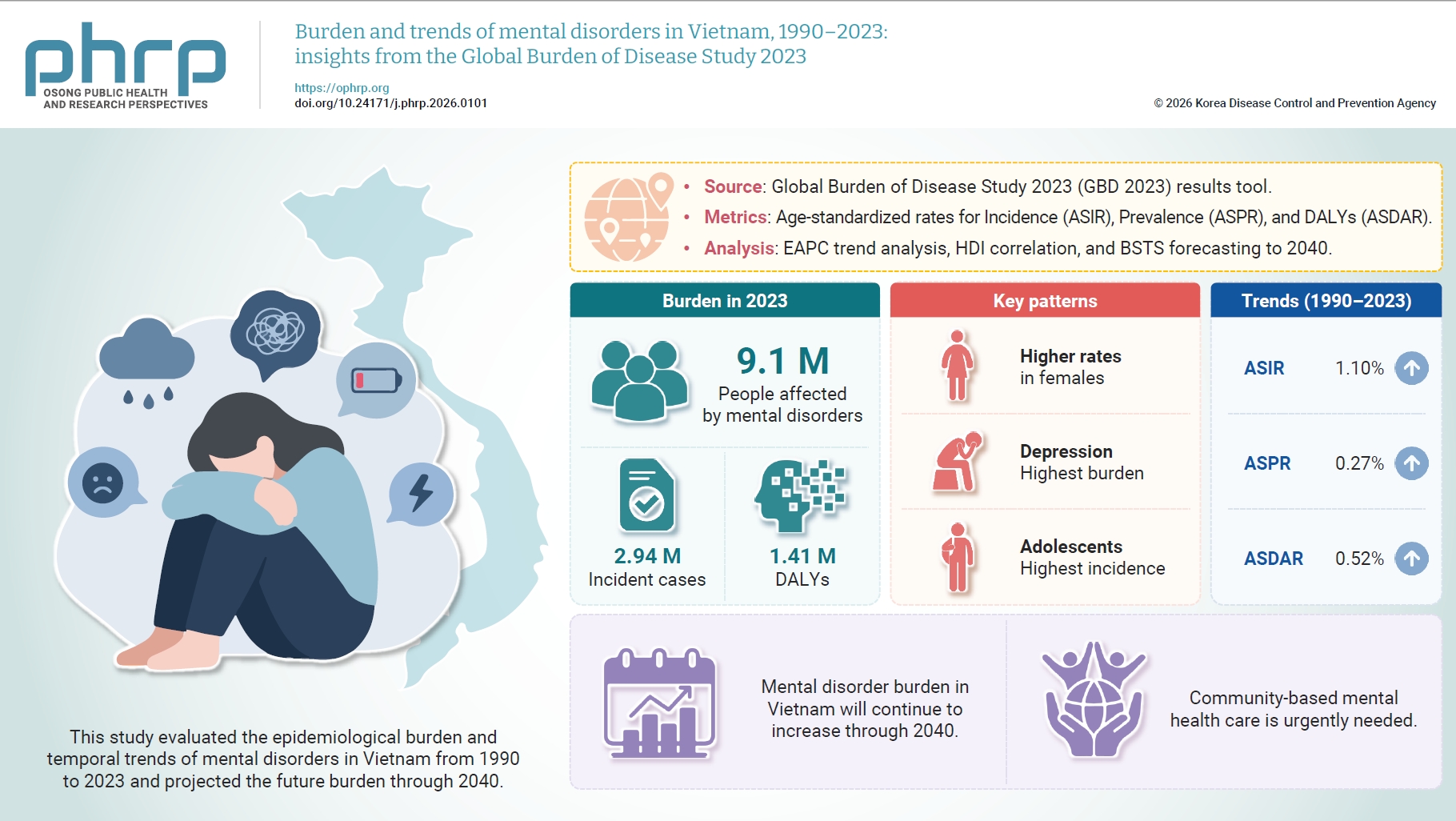
Burden and trends of mental disorders in Vietnam, 1990–2023: insights from the Global Burden of Disease Study 2023
Thanh Hoa Tran, Ngoc Thi Nhu Hoang
Osong Public Health Res Perspect 2026;17(4):337-350.
Published online June 23, 2026
DOI: https://doi.org/10.24171/j.phrp.2026.0101
Burden and trends of mental disorders in Vietnam, 1990–2023: insights from the Global Burden of Disease Study 2023
Objectives
This study evaluated the epidemiological burden and temporal trends of mental disorders in Vietnam from 1990 to 2023 and projected the future burden through 2040. Methods: Global Burden of Disease Study 2023 data were used to analyze the age-standardized prevalence rate (ASPR), age-standardized incidence rate (ASIR), and age-standardized disability-adjusted life-year rate (ASDAR) by age, sex, and diagnostic subtype. Temporal trends were quantified using the estimated annual percentage change (EAPC), and Pearson correlation analysis examined associations with Vietnam’s human development index (HDI). Bayesian structural time series (BSTS) models were used to forecast the burden through 2040. Results: In 2023, approximately 9.1 million individuals in Vietnam had mental disorders, with 2.94 million annual incident cases and 1.41 million disability-adjusted life-years. Depressive disorders ranked highest across all metrics, and females consistently had higher agestandardized rates than males. Age-standardized rates increased significantly from 1990 to 2023: ASIR, 1.10% EAPC (95% confidence interval [CI], 0.87%–1.33%); ASPR, 0.27% EAPC (95% CI, 0.21%–0.33%); and ASDAR, 0.52% EAPC (95% CI, 0.46%–0.58%). Mental disorder burden was strongly positively correlated with HDI (r =0.773–0.909, all p<0.001). BSTS models projected continued increases through 2040 (ASPR, 9,003.75; ASIR, 3,307.11; ASDAR, 1,408.05 per 100,000 population). Conclusion: Mental disorders constitute an escalating public health challenge in Vietnam, with the burden increasing steadily over 3 decades and projected to continue rising through 2040. Reorientation toward an integrated, community-based care model, alongside targeted workforce expansion and systematic integration of mental health services into primary care, is essential to mitigate this growing burden.
  • 4,602 View
  • 72 Download
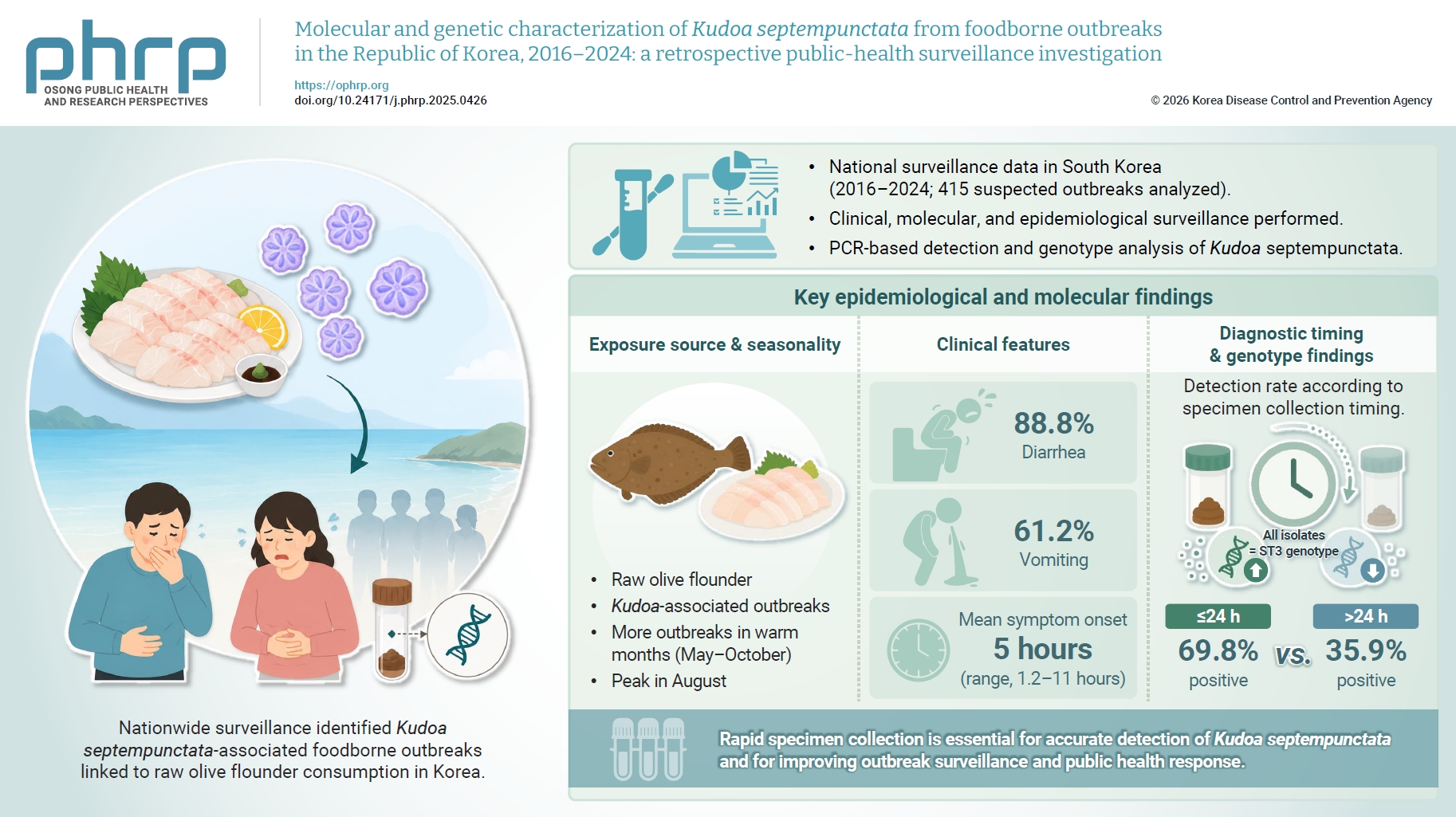
Molecular and genetic characterization of Kudoa septempunctata from foodborne outbreaks in the Republic of Korea, 2016–2024: a retrospective public-health surveillance investigation
Jong-Hoon Choi, Sung-Hee Hong, Cha-Yoon Kim, Ji-Young Kwon, Ji Ye Seo, Se-Jin Jeong, Tae Yun Kim, Jung-Won Ju, Hee-Il Lee
Osong Public Health Res Perspect 2026;17(4):300-309.
Published online May 14, 2026
DOI: https://doi.org/10.24171/j.phrp.2025.0426
Molecular and genetic characterization of Kudoa septempunctata from foodborne outbreaks in the Republic of Korea, 2016–2024: a retrospective public-health surveillance investigation
Objectives
Kudoa septempunctata is a marine myxosporean parasite implicated in seafood-borne acute gastroenteritis, predominantly associated with the consumption of raw olive flounder. This study aimed to characterize the molecular and genetic features of K. septempunctata-associated with foodborne outbreaks in the Republic of Korea from 2016 to 2024. Methods: We reviewed 415 suspected foodborne outbreaks reported through national surveillance between 2016 and 2024. Among these, 37 outbreaks with complete clinical, epidemiological, and laboratory data from 2020 to 2024—including K. septempunctata testing and genotyping—were analyzed in detail. Results: Diarrhea (88.8%) and vomiting (61.2%) were the most common symptoms. The detection rate of K. septempunctata was significantly higher in specimens collected ≤24 hours after raw fish consumption (69.8%) than in those collected > 24 hours after consumption (35.9%). Outbreak occurrence was higher during warmer months (May–October) than during other periods, although this difference was not statistically significant. All sequences obtained from patient specimens belonged to sequence type 3 (ST3) of K. septempunctata. Conclusion: Since 2020, the proportion of reported outbreaks associated with Kudoa has increased, indicating its continued public health relevance. The timing of specimen collection is a key determinant of K. septempunctata detection, as diagnostic yield declines significantly when specimens are collected more than 24 hours after exposure. These findings highlight the need for standardized rapid investigation protocols and an integrated surveillance system linking clinical data with seafood supply-chain information.
  • 1,775 View
  • 67 Download
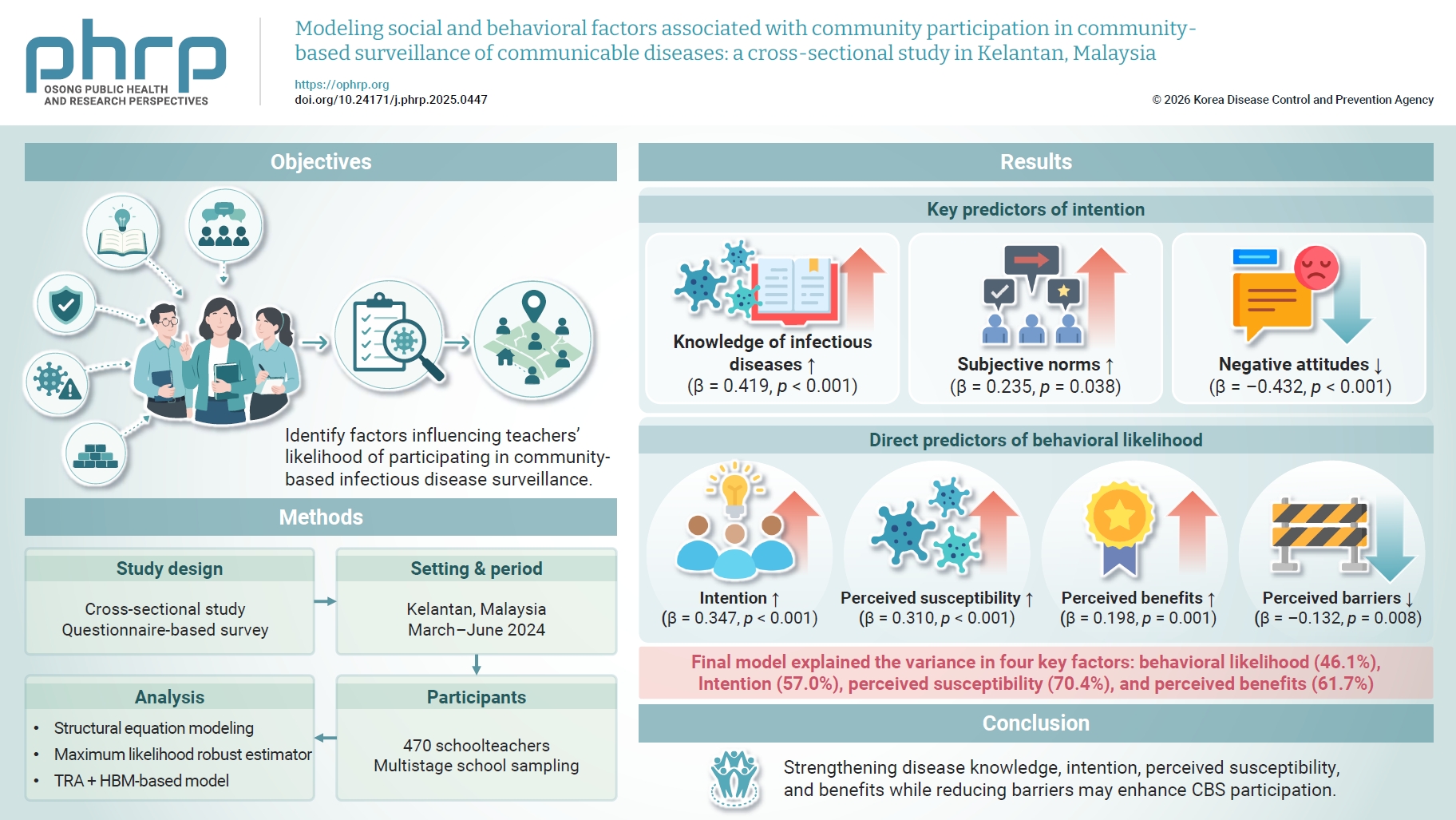
Modeling social and behavioral factors associated with community participation in community-based surveillance of communicable diseases: a cross-sectional study in Kelantan, Malaysia
Ahmed Azeez Hasan, Anis Kausar Ghazali, Norsa’adah Bachok, Najib Majdi Yaacob, Suhaily Mohd Hairon, Nur Amira Mohd Nadir, Fatimah Muhd Shukri
Osong Public Health Res Perspect 2026;17(3):229-241.
Published online May 11, 2026
DOI: https://doi.org/10.24171/j.phrp.2025.0447
Modeling social and behavioral factors associated with community participation in community-based surveillance of communicable diseases: a cross-sectional study in Kelantan, Malaysia
Objectives
This study examined the social and behavioral factors influencing community leaders’ participation in community-based surveillance (CBS) of infectious diseases. We hypothesized that knowledge, attitudes, and perceptions significantly predict the behavioral likelihood of engaging in CBS activities. Methods: A cross-sectional study was conducted among 470 schoolteachers in Kelantan, Malaysia, from March to June 2024. Participants were selected using multistage sampling, with random selection of schools followed by convenience sampling of teachers. Data were collected using the validated KAP-CBS-ID questionnaire, which was based on the Theory of Reasoned Action and Health Belief Model. Structural equation modeling was used to analyze relationships among the study variables with the maximum likelihood robust estimator. Results: The final model demonstrated good fit (comparative fit index, 0.921; standardized root mean square residual, 0.071; root mean square error of approximation, 0.040 [90% confidence interval, 0.036–0.044]). Ten significant path relationships were identified, explaining 46.1% of the variance in behavioral likelihood. Knowledge of infectious diseases (β=0.419, p<0.001), subjective norms (β=0.235, p=0.038), and negative attitudes (β=–0.432, p<0.001) significantly influenced intention. Behavioral likelihood was directly predicted by intention (β =0.347, p<0.001), perceived susceptibility (β=0.310, p<0.001), perceived benefits (β=0.198, p=0.001), and perceived barriers (β=–0.132, p=0.008). Self-efficacy showed significant indirect effects through perceived benefits (β=0.785, p<0.001) and perceived susceptibility (β=0.765, p<0.001). Conclusion: Knowledge and psychosocial factors significantly inf luence community engagement in CBS of infectious diseases. Public health interventions should address these interconnected determinants to strengthen early disease detection and reporting systems.
  • 1,425 View
  • 71 Download

Review Article

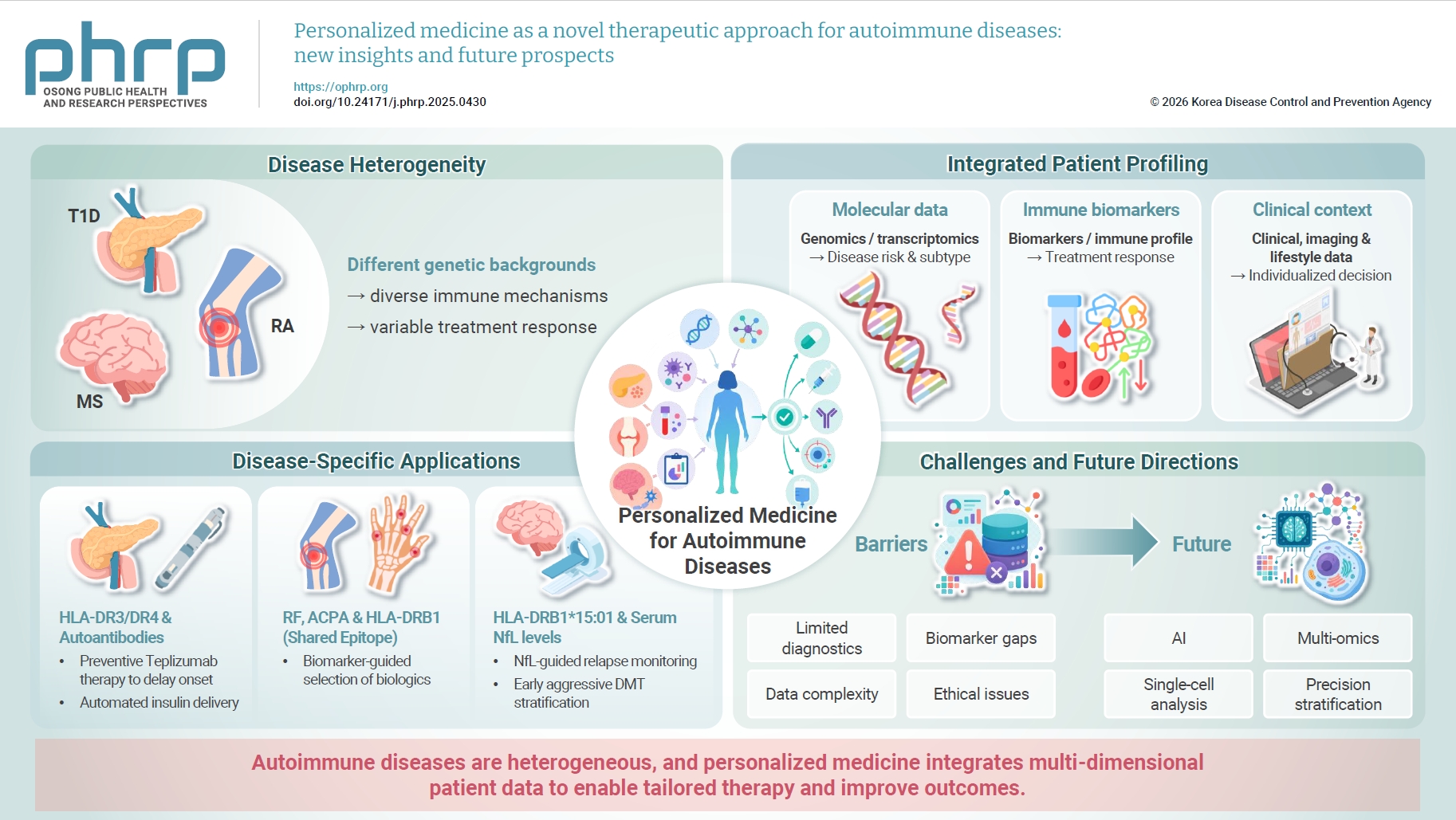
Personalized medicine as a novel therapeutic approach for autoimmune diseases: new insights and future prospects
Mahdi Nasiri-Ghiri, Yaghoob Foolad, Shirin Mahmoodi, Abdolmajid Ghasemian
Osong Public Health Res Perspect 2026;17(3):216-228.
Published online May 11, 2026
DOI: https://doi.org/10.24171/j.phrp.2025.0430
Personalized medicine as a novel therapeutic approach for autoimmune diseases: new insights and future prospects
Autoimmune diseases are caused by dysfunction of the immune system, leading to inappropriate attacks on healthy tissues. Because patients have diverse genetic predispositions and heterogeneous responses to therapy, personalized medicine (PM) offers an opportunity to improve treatment effectiveness. PM uses diagnostic assessments to tailor treatment through individualized medical interventions. PM may improve therapeutic precision beyond traditional trial-and-error approaches, reduce adverse consequences, and improve outcomes by integrating genomic and transcriptomic data. PM considers genetic and molecular landscapes, immunologic factors, epigenetic influences, and environmental exposures to assess treatment response. However, challenges remain related to diagnostic access, the slow pace of biomarker identification, technological limitations, sustained patient engagement, data management, and computational requirements. Nevertheless, continued efforts to improve understanding of disease pathophysiology, gene expression, and immune regulation—together with the application of novel technologies and machine learning—may advance PM-based therapies. Additional opportunities include drug–target modeling and exploratory singlecell–based approaches to clarify patient-specific therapeutic mechanisms. This review briefly introduces the potential of PM for type 1 diabetes, rheumatoid arthritis, and multiple sclerosis.
  • 1,928 View
  • 58 Download

Original Articles

A multi-city outbreak of Salmonella Enteritidis infections linked to bakery products, Republic of Korea
Da Seul Kim, Soon-Young Seo, Dong Hwi Kim, Yeon Hee Woo, Deborah Lee, Se Jeong Yang, Junyoung Kim, Eunkyung Shin, Byungsun Jung, Eunmi Lee, Min Jung Lee, Young-Joon Park
Osong Public Health Res Perspect 2026;17(1):61-71.
Published online February 10, 2026
DOI: https://doi.org/10.24171/j.phrp.2025.0467
A multi-city outbreak of Salmonella Enteritidis infections linked to bakery products, Republic of Korea
Objectives
In May 2025, clusters of salmonellosis were identified in 7 cities in the Republic of Korea, all associated with consumption of identical bakery products. This investigation aimed to characterize the outbreak, identify potential contributing factors, and inform strategies for preventing similar multi-facility foodborne outbreaks. Methods: A case series study was conducted among individuals who consumed Manufacturer H’s Product I and Product II on May 15–16, 2025 at 7 facilities (n= 1,235). Clinical specimens from symptomatic individuals, retained food samples, and environmental samples were collected and tested. Food-exposure histories were assessed, and active case finding was implemented across all supplied facilities. Traceback investigations were conducted at the manufacturer, distributor, and egg farms. Human and food isolates underwent pulsed-field gel electrophoresis (PFGE) and whole-genome sequencing (WGS). Results: A total of 323 cases met the outbreak case definition (attack rate, 26.2%), of which 48 were laboratory-confirmed. Salmonella Enteritidis was isolated from both clinical specimens and retained bakery products. PFGE patterns were indistinguishable between human and food isolates, and WGS demonstrated high genetic relatedness. These findings confirmed a common-source outbreak linked to the implicated bakery products. Conclusion: This outbreak underscores the value of integrating epidemiological investigation, active case finding, and molecular typing to identify common food vehicles in outbreaks involving widely distributed manufactured foods. Coordinated collaboration between public health and food safety authorities is essential for the effective detection, response, and prevention of multi-facility foodborne outbreaks.

Citations

Citations to this article as recorded by  Crossref logo
  • Salmonella Enteritidis Outbreak at a Remote Mining Camp, Omnogovi Province, Mongolia, March 2025
    Ariungerel Dashtseren, Seonghui Cho, Chiara Achangwa, Yeongseon Ko, Bryan Inho Kim, Sukhyun Ryu, Joon Sup Yeom
    Journal of Food Protection.2026; 89(11): 100923.     CrossRef
  • 2,932 View
  • 126 Download
  • 1 Web of Science
  • Crossref
Correlates and co-occurrence of risk factors for non-communicable diseases among adolescents in schools in Karnataka, India: a cross-sectional study
Tejaswini Bangalore Darukaradhya, Krishnamurthy Jayanna, Shivaraj Nallur Somanna, Sony Sequeira, Shalini Chandrashekar Nooyi
Osong Public Health Res Perspect 2026;17(1):83-93.
Published online February 10, 2026
DOI: https://doi.org/10.24171/j.phrp.2025.0204
Correlates and co-occurrence of risk factors for non-communicable diseases among adolescents in schools in Karnataka, India: a cross-sectional study
Objectives
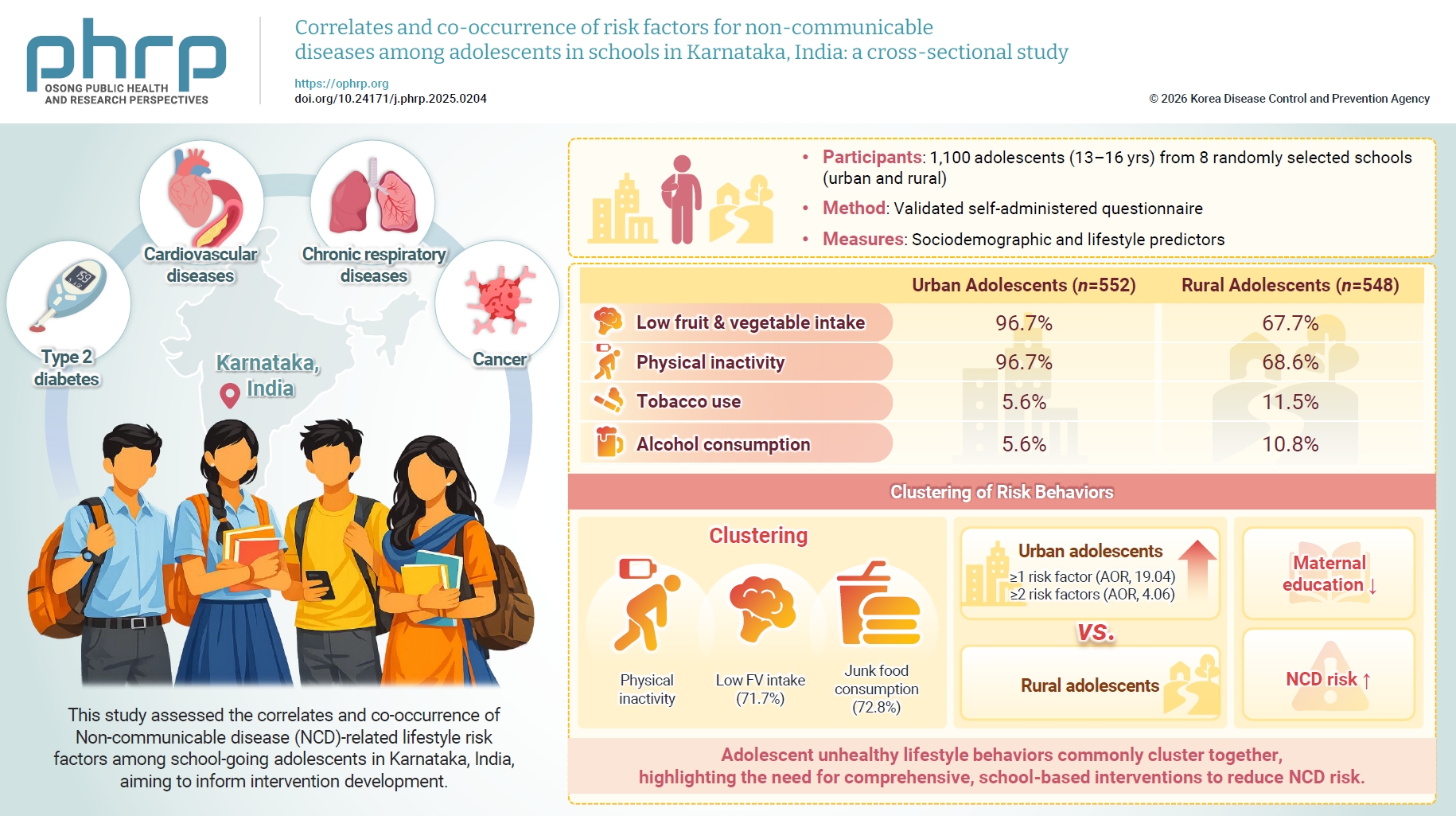
Non-communicable disease (NCD) risk among adolescents represents a growing concern due to modifiable, lifestyle-related behavioral risk factors. Early identification and control of these factors are essential for prevention. This study assessed the correlates and cooccurrence of NCD-related lifestyle risk factors among school-going adolescents in Karnataka, India, aiming to inform intervention development. Methods: Screening was conducted among 1,100 school adolescents aged 13–16 years from 8 randomly selected urban and rural schools in Karnataka. Data were collected using a validated self-administered questionnaire covering sociodemographic characteristics and social cognitive theory predictors of lifestyle practices. Descriptive statistics, chi-square tests, and logistic regression were employed. Results: Of the 1,100 adolescents surveyed, 552 and 548 were from urban and rural areas, respectively. Both groups reported high rates of insufficient fruit and vegetable (FV) intake (96.7% and 67.7%, respectively), inadequate physical activity (96.7% and 68.6%), tobacco use (5.6% and 11.5%), and alcohol consumption (5.6% and 10.8%). On logistic regression, urban adolescents were significantly more likely than rural peers to exhibit multiple behavioral risk factors, with 19-fold higher odds of having ≥1 factor (adjusted odds ratio [AOR], 19.04; p< 0.001) and 4-fold higher odds of having ≥2 (AOR, 4.06; p < 0.001). Parental (particularly maternal) education was associated with NCD risk (AOR, 1.82; p= 0.001). Physical inactivity significantly co-occurred with low FV intake (71.7%) and junk food consumption (72.8%). Conclusion: Unhealthy lifestyle behaviors among adolescents displayed significant cooccurrence, underscoring the critical need for comprehensive, theory-based school interventions to address multiple interconnected risk factors and mitigate the burden of NCDs.
  • 1,993 View
  • 107 Download
Crisis-driven innovation in the Republic of Korea's in vitro diagnostics industry: a pandemic case study
Minjoon Kim, Harry Jeong, Kwangsoo Shin
Osong Public Health Res Perspect 2026;17(1):33-49.
Published online January 28, 2026
DOI: https://doi.org/10.24171/j.phrp.2025.0313
Crisis-driven innovation in the Republic of Korea's in vitro diagnostics industry: a pandemic case study
Objectives
This study evaluated the effectiveness of government epidemic control policies centered on diagnostic testing and examined their impact on the in vitro diagnostics (IVD) industry. It also analyzed the complex interplay among policy interventions, epidemic dynamics, and the IVD industry’s value chain to identify key leverage points for managing future public health crises. Methods: A system dynamics (SD) model calibrated using national data from the Republic of Korea simulated the interactions between epidemic progression and the IVD value chain. We conducted a scenario analysis encompassing 6 policy interventions: research and development (R&D) investment, public–private collaboration, regulatory easing, diagnostic test performance, testing intensity, and social distancing. Results: Policies promoting investment, public–private collaboration, and regulatory easing accelerated the market entry of diagnostics, thereby reducing infections and deaths. However, these interventions were associated with lower overall industry revenue, attributable to increased market competition and a reduced patient population. A critical trade-off was noted: although regulatory speed is advantageous, using low-sensitivity diagnostics substantially worsened public health outcomes. Aggressive testing strategies and stringent social distancing were also confirmed to be effective in reducing both infections and mortality. Conclusion: This study provides a strategic framework for understanding interactions between pandemic control policies and the IVD industry. Sustained pre-crisis investment in R&D, public–private networks, and public health infrastructure is essential for effective pandemic preparedness. During a crisis, policymakers must carefully manage the critical trade-off between regulatory speed and diagnostic quality to ensure that rapid responses do not compromise public health outcomes.
  • 4,949 View
  • 70 Download
Time-series decomposition and modeling of dengue cases in Malaysia, 2022–2024: a nationwide observational study
Mohamad Afiq Amsyar Hamedin, Kamarul Imran Musa, Mohd Rahim Sulong
Osong Public Health Res Perspect 2026;17(1):50-60.
Published online January 27, 2026
DOI: https://doi.org/10.24171/j.phrp.2025.0397
Time-series decomposition and modeling of dengue cases in Malaysia, 2022–2024: a nationwide observational study
Objectives
This study aimed to examine the temporal dynamics of dengue cases in Malaysia from 2022 to 2024 using seasonal-trend decomposition and time-series modeling. Methods: Weekly dengue case counts from the national registry were analyzed across all states using seasonal-trend decomposition using LOESS (STL) to separate trend, seasonal, and irregular components. Autoregressive integrated moving average (ARIMA) and seasonal ARIMA (SARIMA) models were fitted to validate temporal structures, with model selection based on the Akaike information criterion (AIC), corrected AIC, and Bayesian information criterion. Diagnostic checks, including residual analysis and Ljung-Box testing, were performed to ensure model adequacy. Results: Dengue incidence showed marked heterogeneity across states. STL decomposition indicated that long-term trends contributed more strongly to case dynamics than seasonality in most states, although seasonal influences were significant in the states of Kedah and Kelantan. Seasonal peak timing varied between states, highlighting differences in epidemic cycles. ARIMA and SARIMA modeling confirmed that no single temporal structure could adequately represent all states; while some series were well fitted by simple ARIMA models, others required seasonal adjustments. Residual diagnostics demonstrated that the selected models were statistically adequate. Conclusion: Dengue dynamics in Malaysia are shaped by both trend and seasonal components, with considerable variation across states. Combining STL decomposition with ARIMA/SARIMA modeling strengthens the evidence base for state-specific forecasting and proactive vector control. Tailoring surveillance systems and interventions to local temporal patterns
  • 2,536 View
  • 156 Download
A confirmatory analysis of the knowledge, attitudes, and perceptions questionnaire for community-based surveillance of infectious diseases: a cross-sectional study in Malaysia
Ahmed Azeez Hasan, Anis Kausar Ghazali, Najib Majdi Yacoob, Norsa’adah Bachok, Suhaily Mohd Hairon, Nur Amira M. Nadir, Fatimah Muhd Shukri
Osong Public Health Res Perspect 2025;16(5):508-518.
Published online August 12, 2025
DOI: https://doi.org/10.24171/j.phrp.2025.0106
A confirmatory analysis of the knowledge, attitudes, and perceptions questionnaire for community-based surveillance of infectious diseases: a cross-sectional study in Malaysia
Objectives
This study aimed to validate the psychometric properties of the recently developed knowledge, attitudes, and perceptions questionnaire for community-based surveillance of infectious diseases (KAP-CBS-ID questionnaire), using confirmatory factor analysis (CFA) and item response theory (IRT).
Methods
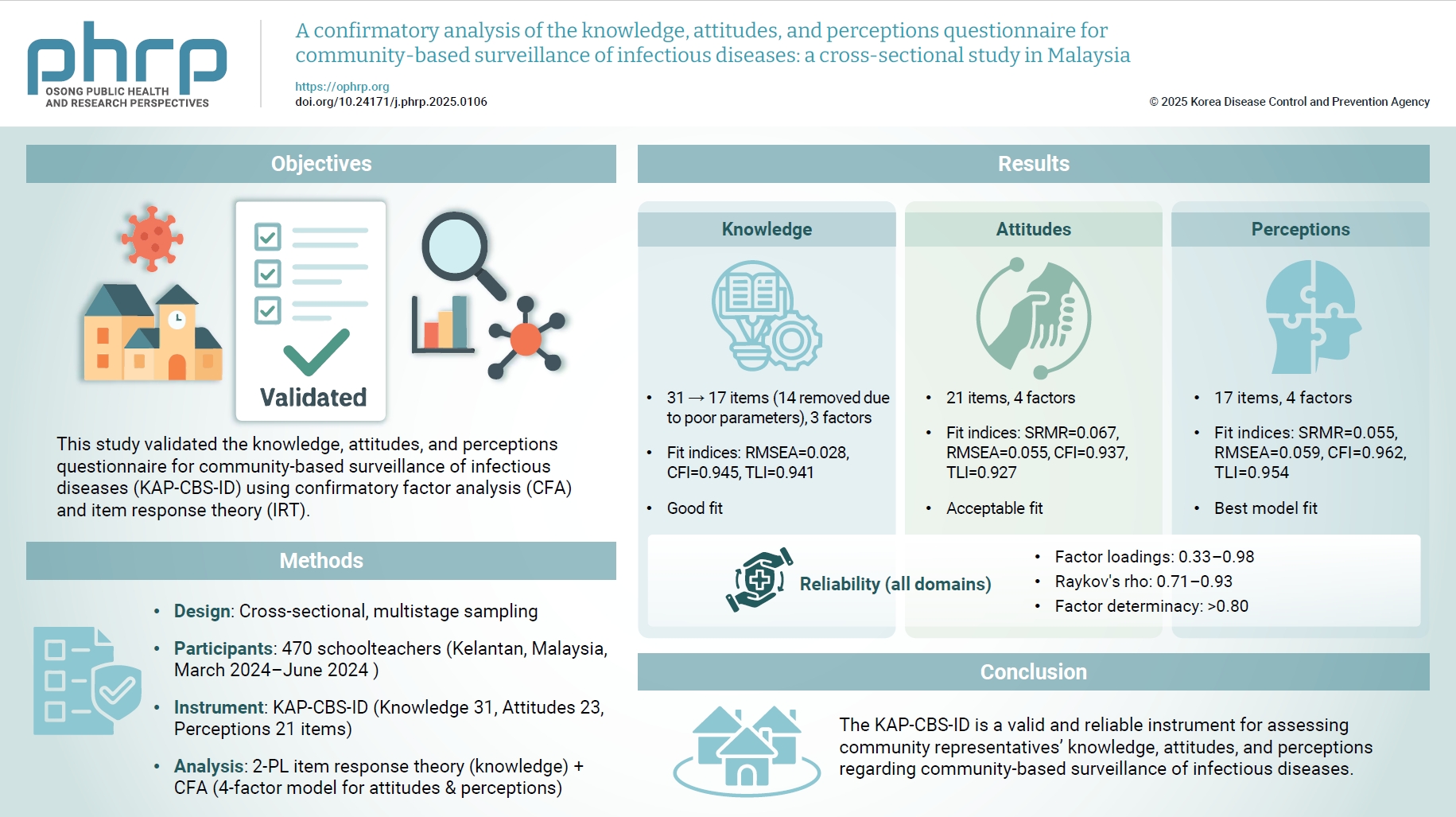
A cross-sectional study using multistage sampling recruited 470 schoolteachers from Kelantan, Malaysia. The self-administered KAP-CBS-ID questionnaire consists of 3 domains: knowledge (31 items), attitudes (23 items), and perceptions (21-items). Two-parameter logistic (2-PL) IRT analysis and CFA were performed to validate the knowledge section. For attitudes and perceptions sections, CFA proceeded using a 4-factor model to evaluate both model fit and construct validity.
Results
Two-PL IRT analysis of the knowledge section resulted in elimination of 14 items due to inadequate discrimination or difficulty parameters. The 3-factor CFA model demonstrated good fit indices for knowledge (root mean square error of approximation [RMSEA], 0.028; comparative fit index [CFI], 0.945; Tucker-Lewis index [TLI], 0.941) without any modifications. The attitudes section required re-specification, ultimately yielding 21 items across 4 factors with acceptable fit indices (standardized root mean square residual [SRMR], 0.067; RMSEA, 0.055; CFI, 0.937; TLI, 0.927). Similarly, the perceptions section was refined to 17 items across 4 factors, showing good model fit (SRMR, 0.055; RMSEA, 0.059; CFI, 0.962; TLI, 0.954). Factor loadings ranged from 0.33 to 0.98, while Raykov’s rho reliability estimates ranged from 0.71 to 0.93. Factor determinacy exceeded 80% for all factors.
Conclusion
The KAP-CBS-ID is a valid and reliable instrument for assessing community representatives’ knowledge, attitudes, and perceptions regarding community-based surveillance of infectious diseases.

Citations

Citations to this article as recorded by  Crossref logo
  • Modeling social and behavioral factors associated with community participation in community-based surveillance of communicable diseases: a cross-sectional study in Kelantan, Malaysia
    Ahmed Azeez Hasan, Anis Kausar Ghazali, Norsa’adah Bachok, Najib Majdi Yaacob, Suhaily Mohd Hairon, Nur Amira Mohd Nadir, Fatimah Muhd Shukri
    Osong Public Health and Research Perspectives.2026; 17(3): 229.     CrossRef
  • 2,499 View
  • 92 Download
  • 1 Web of Science
  • Crossref
Development and evaluation of the Korea Disease Control and Prevention Agency’s scenario-based training program for effective response to emerging infectious disease outbreaks
Mi Yu, Eun Kyoung Kim, Kyungnam Kim, Jin Lee, Jin Hwan Jeon, Soyeon Kim, Sangwon Lee, Yunhyung Kwon
Osong Public Health Res Perspect 2025;16(4):373-380.
Published online July 9, 2025
DOI: https://doi.org/10.24171/j.phrp.2025.0103
Development and evaluation of the Korea Disease Control and Prevention Agency’s scenario-based training program for effective response to emerging infectious disease outbreaks
Objectives
This study aimed to strengthen the core capabilities of epidemiological investigation and response teams (ERTs) at the Korea Disease Control and Prevention Agency, drawing on lessons learned from the Middle East respiratory syndrome and coronavirus disease 2019 pandemics. The primary objectives were to facilitate rapid and accurate data collection and analysis, improve communication skills, and simulate real-world on-site responses. Methods: The training program was developed using a scenario involving a novel infectious disease from the World Health Organization priority list entering a community. ERTs collected and analyzed epidemiological data and implemented control measures as they addressed the missions of the scenario. Improvement in competencies was assessed through self-evaluation surveys completed before and after training. Results: A total of 49 participants, including disease control officers, epidemiological investigation officers, researchers, and administrative officials, attended the training. Participant satisfaction with the training was high, scoring 6.4 out of 7, and the improvement in competency was statistically significant (pre-training score, 5.2; post-training score, 6.2; p<0.001). Conclusion: Scenario-based training can effectively enhance the capabilities of ERTs. Such training is essential, as emerging and re-emerging infectious diseases can exhibit unpredictable spread and potentially severe impacts. Therefore, developing diverse scenarios and conducting regular training sessions are necessary to improve the capacities of ERTs.

Citations

Citations to this article as recorded by  Crossref logo
  • 중앙 및 지자체역학조사반의 현장 역학조사 훈련 수요 조사
    유연 김, 미 유, 진 이, 호경 송, 은경 김
    Public Health Weekly Report.2026; 19(31): 1324.     CrossRef
  • 2,194 View
  • 83 Download
  • 1 Web of Science
  • Crossref

Short Communication

Subacute sclerosing panencephalitis incidence following measles elimination efforts in the Republic of Korea
Young Hwa Lee, Jung Hye Byeon, Cho Ryok Kang, Young June Choe, Jong-Koo Lee
Osong Public Health Res Perspect 2025;16(3):285-291.
Published online June 9, 2025
DOI: https://doi.org/10.24171/j.phrp.2025.0067
Subacute sclerosing panencephalitis incidence following measles elimination efforts in the Republic of Korea
Objectives
Subacute sclerosing panencephalitis (SSPE) is a rare but fatal neurodegenerative disease caused by persistent measles virus infection. After a significant measles outbreak in 2000–2001, the Republic of Korea implemented a nationwide measles elimination program, which led to a dramatic reduction in measles incidence. This study aimed to evaluate the impact of these measles elimination efforts on the incidence of SSPE in the Republic of Korea.
Methods
This nationwide, population-based retrospective cohort study identified patients newly diagnosed with measles and SSPE between 2007 and 2022, registered in the Health Insurance Review and Assessment Service (HIRA) and Korea Disease Control and Prevention Agency (KDCA) databases. Population-based incidence rates of measles and SSPE were calculated and compared annually.
Results
A total of 236 measles cases (HIRA data) and 1,168 measles cases (KDCA data), along with 2,736 SSPE cases, were diagnosed during the study period. Measles incidence significantly declined, reaching zero cases in 2021, while SSPE incidence displayed an upward trend, peaking in 2014. The mean age at SSPE onset was 21.2 years, with a marked male-to-female ratio of 13.0:1.
Conclusion
SSPE incidence was remarkably low in the post-outbreak period, likely attributable to successful measles control. This study underscores the critical importance of maintaining low measles incidence through sustained vaccination efforts, preventing SSPE and other measles-related complications.

Citations

Citations to this article as recorded by  Crossref logo
  • Measles subacute sclerosing panencephalitis in children: past and present
    G. P. Ivanova, N. V. Skripchenko, E. Yu. Skripchenk, O. V. Goleva, A. V. Astapova
    Rossiyskiy Vestnik Perinatologii i Pediatrii (Russ.2026; 71(4): 14.     CrossRef
  • Long-term survival (≥2 years) in subacute sclerosing panencephalitis: a systematic review of prolonged survivors
    Ravindra Kumar Garg, Shweta Pandey, Imran Rizvi, Sanjay Singhal
    encephalitis.2026; 6(4): 91.     CrossRef
  • The Republic of Korea’s health system at a turning point: from infectious disease threats to comprehensive reform
    Jong-Koo Lee
    Osong Public Health and Research Perspectives.2025; 16(3): 193.     CrossRef
  • Pan-Immune Inflammation Value and Clinical Outcomes in Subacute Sclerosing Panencephalitis: A Retrospective Study
    Bilge Özgör, Murat Çağlar Şahin, Işınsu Bıçakcıoğlu, Gül Yücel, Meral Karadağ, Serdal Güngör
    Viruses.2025; 18(1): 18.     CrossRef
  • 3,860 View
  • 81 Download
  • 2 Web of Science
  • Crossref

Original Article

The level of household food insecurity is associated with the risk of infectious diseases among toddlers in Indonesia: a cross-sectional study
Siti Masitoh, Tri Wurisastuti, Woro Riyadina, Sudarto Ronoatmodjo
Osong Public Health Res Perspect 2025;16(3):261-269.
Published online June 4, 2025
DOI: https://doi.org/10.24171/j.phrp.2025.0009
The level of household food insecurity is associated with the risk of infectious diseases among toddlers in Indonesia: a cross-sectional study
Objectives
This study investigated the correlation between food insecurity and infectious diseases among toddlers in Indonesia.
Methods
This research employed a cross-sectional study design using data from the 2021 Indonesian Nutrition Status Survey, which included a sample of 84,115 toddlers. Food insecurity levels were assessed using the food insecurity experience scale, developed by the Food and Agriculture Organization. The dependent variable, infectious disease, was defined as a toddler experiencing 1 or more of the following conditions: acute respiratory infections, diarrhea, pneumonia, measles, or worms. Multivariate analysis was conducted using multiple logistic regression to determine adjusted odds ratios (ORs).
Results
The findings indicate that 23.78% of toddlers experienced at least 1 infectious disease. While more than half of the respondents were food secure, 26.5% faced mild food insecurity, 13.6% moderate food insecurity, and 6.5% severe food insecurity. Toddlers from households experiencing mild, moderate, and severe food insecurity had higher risks of infectious diseases compared to those from food-secure households, with adjusted ORs of 1.367 (95% confidence interval [CI], 1.308–1.428), 1.490 (95% CI, 1.399–1.588), and 1.500 (95% CI, 1.374–1.638), respectively.
Conclusion
In conclusion, more severe food insecurity is correlated with an increased risk of toddlers suffering infectious diseases.

Citations

Citations to this article as recorded by  Crossref logo
  • From pantry to physiology: A narrative review linking food insecurity to biological dysfunction
    Liahm Blank, Joshua Khorsandi, Nicole Kang, Kaloyan Momchilov, Itai Blank, Kavita Batra
    Dialogues in Health.2026; 8: 100308.     CrossRef
  • Structural Equation Modelling of Socioeconomic Status on Malnutrition Among Urban Preschoolers: Multi-Group Analysis of Hungary and Indonesia
    Arie Dwi Alristina, Éva Kovács, Diyah Arini, Helga Judit Feith
    International Journal of Environmental Research an.2026; 23(7): 858.     CrossRef
  • Implementasi Gerakan Kebun Gizi Keluarga (GK2) Sebagai Upaya Ketahanan Pangan dan Gizi Keluarga di Desa Gading Watu, Kabupaten Gresik
    Noveansyah Maskur Nurgah, Dhuha Nuri Samsiyah, Shafa Dwi Candra Syahputra, Aisyah Rahmah Maulidiyah , Rambu Breathy Salwasty Ananda Tamu Rambu, Intan Adinda Putri, Nabil Habib Abdillah, Devita Astrid Renata, Nurul I.A. Cahyo Wibowo, Muchammad Bachrul Ulu
    Journal of Community Development.2026; 7(2): 1.     CrossRef
  • Prematurity and Low Birth Weight Among Food-Secure and Food-Insecure Households: A Comparative Study in Surabaya, Indonesia
    Arie Alristina, Nour Mahrouseh, Anggi Irawan, Rizky Laili, Alexandra Zimonyi-Bakó, Helga Feith
    Nutrients.2025; 17(15): 2479.     CrossRef
  • 6,919 View
  • 143 Download
  • 1 Web of Science
  • Crossref

Review Article

Global health security in the post-COVID-19 era: threats, preparation, and response
Chaeshin Chu
Osong Public Health Res Perspect 2025;16(2):116-125.
Published online April 4, 2025
DOI: https://doi.org/10.24171/j.phrp.2025.0037
Global health security in the post-COVID-19 era: threats, preparation, and response
Global health security threats in the post-coronavirus disease 2019 era include dense urban populations, increased human–animal proximity, migration driven by political or economic instability, climate change, humanitarian crises, antimicrobial resistance (AMR), and the misuse of biological research—including the accidental or intentional release of high-risk pathogens. The foundational preparation for these threats is to establish a robust, resilient public health system based on universal health coverage. The World Health Organization’s International Health Regulations must continue to promote global solidarity by maintaining core capacities such as surveillance, national laboratories, and epidemiological investigations of emerging infectious diseases, with timely reporting and information sharing within the global health security community. A One Health approach is essential for addressing AMR. Infection prevention and control must be enhanced to reduce healthcare-associated infections in medical facilities. Additionally, regulations concerning biosafety and biosecurity should address dual-use research of concern as well as the accidental or intentional release of highrisk pathogens from laboratories. Global health security is a collective responsibility because these threats know no borders and require coordinated action.

Citations

Citations to this article as recorded by  Crossref logo
  • The Role of Environmental and Climatic Factors in Accelerating Antibiotic Resistance in the Mediterranean Region
    Nikolaos P. Tzavellas, Natalia Atzemoglou, Petros Bozidis, Konstantina Gartzonika
    Acta Microbiologica Hellenica.2026; 71(1): 1.     CrossRef
  • Global health preparedness for biosecurity threats: a review of emerging technologies and solutions
    Omotade Adebimpe Ijarotimi, Adeyemi Akeem Amuda, Christopher Oluwatosin Omokanye, Mariam Amuda
    Frontiers in Public Health.2026;[Epub]     CrossRef
  • 11,374 View
  • 187 Download
  • 1 Web of Science
  • Crossref

Original Articles

Infectious disease research in the Association of Southeast Asian Nations region: a scientometric analysis
Joseph Christian Obnial, Catherine Joy Escuadra, Adriana Viola Miranda, Don Eliseo Lucero-Prisno, III
Osong Public Health Res Perspect 2024;15(4):329-339.
Published online August 2, 2024
DOI: https://doi.org/10.24171/j.phrp.2024.0058
Infectious disease research in the Association of Southeast Asian Nations region: a scientometric analysis
Objectives
This study compared the research output of Association of Southeast Asian Nations (ASEAN) countries to understand research trends and clarify past, present, and future patterns using scientometric techniques.
Methods
This scientometric study systematically mined health and social science publications from the Web of Science and Scopus databases using keywords associated with infectious disease. The analysis included only English-language articles and review articles by authors from any ASEAN country. Publication, citation, and text co-occurrence network analyses were performed. R Studio and VOSviewer enabled data management, analysis, and visualization.
Results
Searches identified 12,511 articles published between 1925 and 2022, with a notable increase in research publications since 2003. The leading journals on infectious disease were associated with established publishing houses, including BMC, BMJ, and The Lancet. The most-cited articles were primarily global burden of disease studies, with 7,367 citations. Among ASEAN countries, Thailand, Malaysia, and Singapore had the most publications and collaborative efforts on the topic. Analysis of keyword co-occurrence revealed clusters related to global health, dengue, bacterial studies, non-dengue viral topics, and diagnostics. Most early studies examined diagnostics, gene and sequencing methodologies, and virology; later, the focus shifted toward herbal and alternative medicine.
Conclusion
Recently, the research capacity of Southeast Asia has expanded dramatically, with substantial contributions from high-income countries. Intense cooperation between member states is essential, emphasizing the role of HICs in supporting their neighbors. Increased research efforts and collaboration must be dedicated to innovative approaches to combat persistent health conditions, along with emerging issues like climate change.

Citations

Citations to this article as recorded by  Crossref logo
  • Epidemiological Trends and Predictive Modeling of Dengue Fever in the Association of Southeast Asian Nations (ASEAN) Countries
    Qian Ren, Ruoxi Li, Xiaojun Liu, Wei Hao, Xiaojie Zhou, Meide Liu, Hongjiang Zhang, Xinying Feng, Xiaogui Li, Ziwen Zhao, Weiwei Hu, Jianjun Zhang, Zhenjiang Xin
    Tropical Medicine and Infectious Disease.2025; 10(12): 329.     CrossRef
  • Mangrove in Biodiversitas: A Systematic Review of Biodiversity, Blue Carbon, and Ecosystem Services in Southeast Asia (2020-2025)
    Rustam Anwar, Fitryane Lihawa, Dewi Wahyuni K Baderan, Marike Mahmud, Abdul Hafidz Olii, Hasim .
    International Journal of Research and Review.2020; : 51.     CrossRef
  • 5,367 View
  • 135 Download
  • 2 Web of Science
  • Crossref
Identifying risk factors for COVID-19 cluster infections in schools in the Republic of Korea: a case-control study
Jihyun Choi, Seongju Choi, Baigu Lee, Young-Joon Park, Sang Eun Lee
Osong Public Health Res Perspect 2024;15(4):375-382.
Published online July 11, 2024
DOI: https://doi.org/10.24171/j.phrp.2023.0351
Identifying risk factors for COVID-19 cluster infections in schools in the Republic of Korea: a case-control study
Objectives
No study has yet analyzed risk factors to determine whether students with confirmed coronavirus disease 2019 (COVID-19) infections may affect students at neighboring schools. Therefore, this study aimed to determine risk factors for COVID-19 transmission among schools within a community in the Republic of Korea.
Methods
An epidemiological investigation was conducted among 696 students and school staff members at 3 schools where COVID-19 clusters began on October 15, 2021. Interviews, visit history surveys, a facility risk assessment, and closed-circuit television were used to identify risk factors. The statistical significance of risk factors was also evaluated.
Results
We confirmed 129 cases (18.5%) among the individuals exposed to COVID-19 at the 3 schools, many of whom had a history of visiting the same multi-use facilities. The odds ratio of having visited multi-use facilities such as karaoke rooms was 1.90 (95% confidence interval, 1.03–3.50); the number of visits to a karaoke room and the visit durations were significantly higher among confirmed cases than non-confirmed cases (p=0.02 and p=0.03, respectively).
Conclusion
Having a history of visiting karaoke rooms often and spending a long time there were risk factors for COVID-19 infection and inter-school transmission. Thus, it is necessary to investigate the status of multi-use facilities frequently visited by adolescents and consider incorporating them into the scope of school quarantine to prevent infectious diseases at schools in a community.
  • 5,122 View
  • 88 Download
Periodontitis and non-communicable diseases in a Brazilian population, a cross-sectional study, Vila Velha-ES, Brazil
Gustavo Vital de Mendonça, Crispim Cerutti Junior, Alfredo Carlos Rodrigues Feitosa, Brígida Franco Sampaio de Mendonça, Lucia Helena Sagrillo Pimassoni
Osong Public Health Res Perspect 2024;15(3):212-220.
Published online June 27, 2024
DOI: https://doi.org/10.24171/j.phrp.2024.0021
Periodontitis and non-communicable diseases in a Brazilian population, a cross-sectional study, Vila Velha-ES, Brazil
Objectives
The objective of this study was to examine the hypothesis that periodontal disease is associated with chronic non-communicable diseases. Methods: In this cross-sectional study, we evaluated the periodontal health condition of the population, based on the community periodontal index, as well as the number of missing teeth and the presence of systemic health conditions. We quantified the association between oral health and the presence of chronic diseases using simple logistic regression, adjusting for confounding factors including age, smoking, and overweight. Results: The study population consisted of 334 volunteers, aged between 19 and 81 years. In patients over 45 years old, periodontal disease was found to be significantly associated with hypertension and diabetes. Furthermore, in female patients, periodontal disease was significantly associated with hypertension, diabetes, and cancer. Conclusion: Our findings indicate that periodontal disease is positively and significantly associated with both arterial hypertension and diabetes, independent of potential confounding factors.

Citations

Citations to this article as recorded by  Crossref logo
  • Comparative Antimicrobial and Antibiofilm Activity of Antiseptics and Commercial Mouthwashes Against Porphyromonas gingivalis ATCC 33277
    Marzena Korbecka-Paczkowska, Tomasz M. Karpiński, Marcin Ożarowski
    Journal of Clinical Medicine.2025; 14(24): 8909.     CrossRef
  • 5,376 View
  • 99 Download
  • 1 Web of Science
  • Crossref
Number of comorbidities and the risk of delay in seeking treatment for coronary heart disease: a longitudinal study in Bogor City, Indonesia
Sulistyowati Tuminah, Lely Indrawati, Woro Riyadina, Tri Wurisastuti, Alfons M. Letelay, Nikson Sitorus, Alifa S. Putri, Siti Isfandari, Irmansyah Irmansyah
Osong Public Health Res Perspect 2024;15(3):201-211.
Published online June 27, 2024
DOI: https://doi.org/10.24171/j.phrp.2023.0337
Number of comorbidities and the risk of delay in seeking treatment for coronary heart disease: a longitudinal study in Bogor City, Indonesia
Objectives
The aim of this study was to investigate the relationship between the number of patient comorbidities and the delays in seeking treatment for coronary heart disease (CHD). Methods: This longitudinal study utilized secondary data from the Non-Communicable Disease Risk Factor (NCDRF) cohort study conducted in Bogor City. Individuals who participated in the NCDRF cohort study and were diagnosed with CHD within the 6-year study period met the inclusion criteria. Respondents who were not continuously monitored up to the 6th year were excluded. The final sample included data from respondents with CHD who participated in the NCDRF cohort study and were monitored for the full 6-year duration. The final logistic regression analysis was conducted on data collected from 812 participants. Results: Among the participants with CHD, 702 out of 812 exhibited a delay in seeking treatment. The risk of a delay in seeking treatment was significantly higher among individuals without comorbidities, with an odds ratio (OR) of 3.5 (95% confidence interval [CI], 1.735–7.036; p<0.001). Among those with a single comorbidity, the risk of delay in seeking treatment was still notable (OR, 2.6; 95% CI, 1.259–5.418; p=0.010) when compared to those with 2 or more comorbidities. These odds were adjusted for age, sex, education level, and health insurance status. Conclusion: The proportion of patients with CHD who delayed seeking treatment was high, particularly among individuals with no comorbidities. Low levels of comorbidity also appeared to correlate with a greater tendency to delay in seeking treatment.

Citations

Citations to this article as recorded by  Crossref logo
  • Role of common mental disorders in uncontrolled hypertension: a longitudinal study in Bogor City, Indonesia
    Tri Wurisastuti, Indri Yunita Suryaputri, Rofingatul Mubasyiroh, Wahyu Pudji Nugraheni
    Korean Journal of Family Medicine.2026; 47(1): 81.     CrossRef
  • 2026 Heart Disease and Stroke Statistics: A Report of US and Global Data From the American Heart Association
    Latha P. Palaniappan, Norrina B. Allen, Zaid I. Almarzooq, Cheryl A.M. Anderson, Pankaj Arora, Christy L. Avery, Carissa M. Baker-Smith, Nisha Bansal, Maria E. Currie, Rebecca S. Earlie, Wenjun Fan, Jessica L. Fetterman, Bethany Barone Gibbs, Debra G. Hea
    Circulation.2026;[Epub]     CrossRef
  • Blood Glucose Variability and Postoperative Organ Function in Coronary Artery Bypass Grafting: A Prospective Cohort Study of Microcirculatory Perfusion and Oxygenation
    Arif Mansjoer, Idrus Alwi, Em Yunir, Dita Aditianingsih, Kuntjoro Harimurti, Alida Roswita Harahap, Dudy Arman Hanafy, Taufik Indrajaya, Suhendro Suwarto
    Journal of Cardiothoracic and Vascular Anesthesia.2026; 40(11): 3648.     CrossRef
  • Adherence to Inhalation Therapy Among COPD Patients: A Cross-Sectional Study in a Tertiary Hospital in Quito, Ecuador
    Juan Izquierdo-Condoy, Fernando Gualpa Álvarez, Estefania Morales-Lapo, Washington Arias Calvache, Jessica Bermúdez Moreira, Katherine Quinga-Chiguano, Esteban Ortiz-Prado
    International Journal of Chronic Obstructive Pulmo.2025; Volume 20: 399.     CrossRef
  • Prevalence of Electrocardiographic Abnormalities in Patients with Acute Pulmonary Embolism: A Systematic Review and Meta-Analysis
    Sarunsorn Krintratun, Wuttipong Srichuachom, Wachira Wongtanasarasin
    Journal of Clinical Medicine.2025; 14(13): 4750.     CrossRef
  • Prevalence and Factors Related to Pre-Hospital Delay in Young Patients with ST-Elevation of Myocardial Infarction (STEMI)
    Nooraniza Mohd Kassim, Rosna Abdul Raman, Soh Kim Lam
    Malaysian Journal of Medicine and Health Sciences.2025;[Epub]     CrossRef
  • 5,123 View
  • 116 Download
  • 3 Web of Science
  • Crossref

Data Profile

Establishment of a registry of clinical data and bioresources for rare nervous system diseases
Dayoung Kim, Sooyoung Kim, Jin Myoung Seok, Kyong Jin Shin, Eungseok Oh, Mi Young Jeon, Joungkyu Park, Hee Jin Chang, Jinyoung Youn, Jeeyoung Oh, Eunhee Sohn, Jinse Park, Jin Whan Cho, Byoung Joon Kim
Osong Public Health Res Perspect 2024;15(2):174-181.
Published online April 30, 2024
DOI: https://doi.org/10.24171/j.phrp.2023.0353
Establishment of a registry of clinical data and bioresources for rare nervous system diseases
Rare diseases are predominantly genetic or inherited, and patients with these conditions frequently exhibit neurological symptoms. Diagnosing and treating many rare diseases is a complex challenge, and their low prevalence complicates the performance of research, which in turn hinders the advancement of therapeutic options. One strategy to address this issue is the creation of national or international registries for rare diseases, which can help researchers monitor and investigate their natural progression. In the Republic of Korea, we established a registry across 5 centers that focuses on 3 rare diseases, all of which are characterized by gait disturbances resulting from motor system dysfunction. The registry will collect clinical information and human bioresources from patients with amyotrophic lateral sclerosis, spinocerebellar ataxia, and hereditary spastic paraplegia. These resources will be stored at ICreaT and the National Biobank of Korea. Once the registry is complete, the data will be made publicly available for further research. Through this registry, our research team is dedicated to identifying genetic variants that are specific to Korean patients, uncovering biomarkers that show a strong correlation with clinical symptoms, and leveraging this information for early diagnosis and the development of treatments.
  • 6,630 View
  • 114 Download

Original Articles

Epidemiological analysis and prevention strategies in response to a shigellosis cluster outbreak: a retrospective case series in an alternative school in the Republic of Korea, 2023
Yeongseo Ahn, Sunmi Jin, Gemma Park, Hye Young Lee, Hyungyong Lee, Eunkyung Shin, Junyoung Kim, Jaeil Yoo, Yuna Kim
Osong Public Health Res Perspect 2024;15(1):68-76.
Published online February 7, 2024
DOI: https://doi.org/10.24171/j.phrp.2023.0298
Epidemiological analysis and prevention strategies in response to a shigellosis cluster outbreak: a retrospective case series in an alternative school in the Republic of Korea, 2023
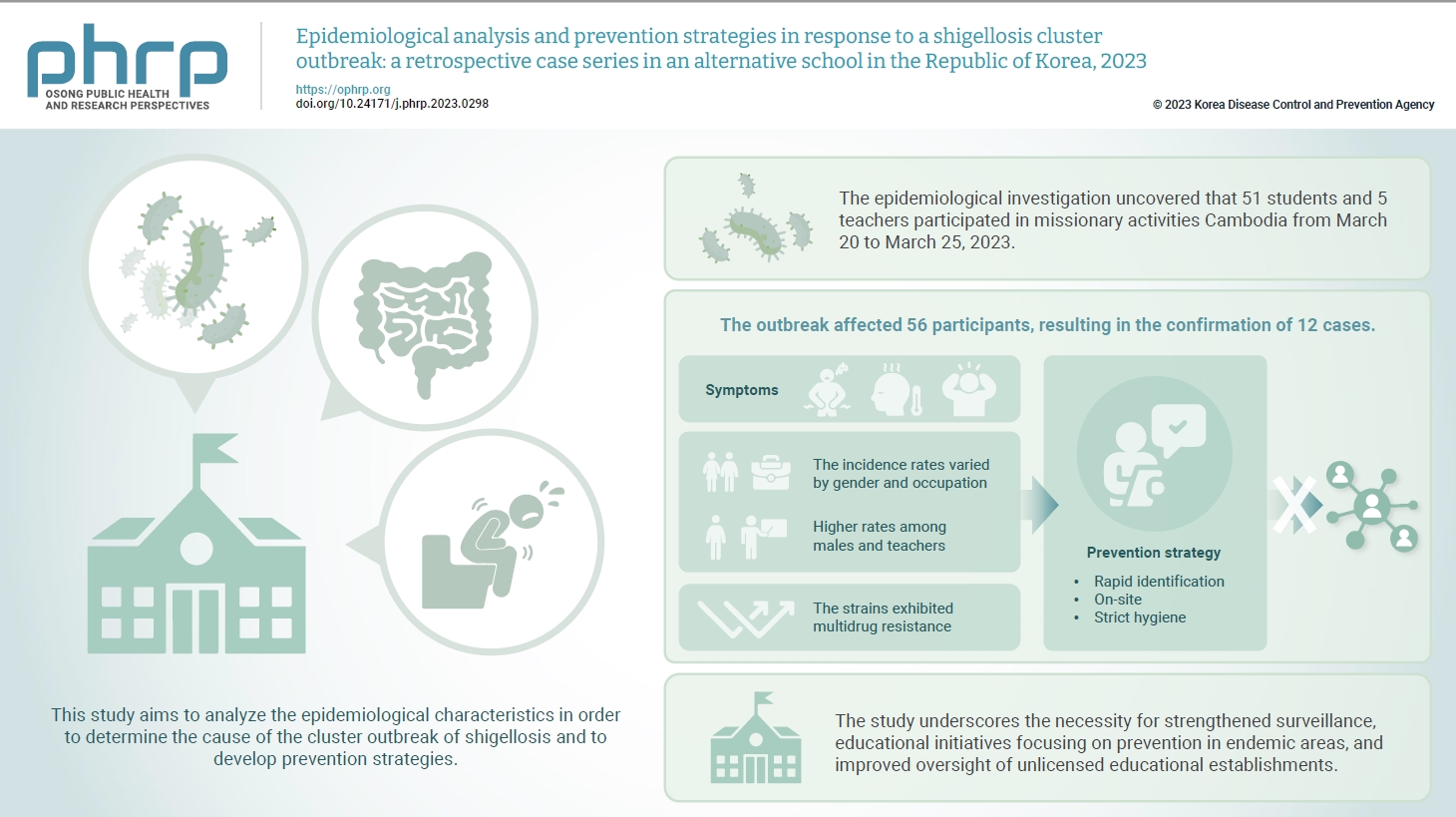
Objectives
In March 2023, an alternative school in the Republic of Korea reported 12 cases of shigellosis. This study aims to analyze the epidemiological characteristics in order to determine the cause of the cluster outbreak of shigellosis and to develop prevention strategies. Methods: This study focused on 12 patients with confirmed Shigella infection and investigated their demographics, clinical features, epidemiology, diagnostics, and antimicrobial susceptibility. Following the identification of Shigella, we conducted follow-up rectal smear cultures to manage patients, implementing isolation and control measures. Results: This study investigated the emergence of multidrug-resistant Shigella following missionary activities in Cambodia, documenting a cluster infection within an alternative school in Daejeon, the Republic of Korea. The outbreak affected 56 participants, resulting in the confirmation of 12 cases. The incidence rates varied by gender and occupation, with higher rates among males and teachers. All 12 cases demonstrated multidrug resistance. Challenges included delayed pathogen confirmation and suboptimal adherence to isolation criteria. The incident prompted revisions in the criteria for isolation release, focusing on symptom resolution. The study underscores the necessity for strengthened surveillance, educational initiatives focusing on prevention in endemic areas, and improved oversight of unlicensed educational establishments. Conclusion: Successful response strategies included swift situation assessment, collaborative efforts, effective infection control measures, and modified criteria for isolation release. Continued surveillance of multidrug-resistant strains is recommended, especially in regions with a high prevalence.

Citations

Citations to this article as recorded by  Crossref logo
  • A One Health Scoping Review of Antimicrobial Resistance in Cambodia: Evidence Mapping and Insights into Klebsiella pneumoniae
    Sao Puth, Chanroth Chhoung, Limmuy Hav, Chandy Rin, Kennarey Seang, Luis Sagaon-Teyssier, Vonthanak Saphonn
    Microorganisms.2026; 14(10): 2161.     CrossRef
  • Shigella flexneri Outbreak at a Rehabilitation Center: First Report from Saudi Arabia
    Khalifa Binkhamis, Sarah Alangari, Fatema Juma, Sahar Althawadi, Ahmed A. Al-Qahtani, Marie Fe F. Bohol, Fatimah S. Alshahrani, Fawzia Alotaibi
    Healthcare.2025; 13(9): 971.     CrossRef
  • 5,456 View
  • 127 Download
  • 1 Web of Science
  • Crossref
Characteristics and related factors of waterborne and foodborne infectious disease outbreaks before and after the onset of the COVID-19 pandemic (2017–2021) in the Republic of Korea: a descriptive study
Objectives
The incidence of waterborne and foodborne infectious diseases (WFIDs) continues to increase annually, attracting significant global attention. This study examined trends in WFID outbreaks in the Republic of Korea over the 5-year period before and during the coronavirus disease 2019 (COVID-19) pandemic and provided foundational data to establish measures for the prevention and control of WFID outbreaks. Methods: We analyzed 2,541 WFID outbreaks from 2017 to 2021 (42,805 cases) that were reported through the Integrated Disease Surveillance System of the Korea Disease Control and Prevention Agency. Outbreaks were defined as the occurrence of gastrointestinal symptoms in ≥2 individuals within a group with temporal and regional epidemiological associations. The related factors associated with WFID outbreaks during the observation period were statistically analyzed. Results: The total number of WFID outbreaks significantly decreased in 2020 during the COVID-19 pandemic and increased to the pre-pandemic level in 2021. Different patterns were observed for each pathogen. The incidence of Salmonella outbreaks more than doubled, while norovirus outbreaks decreased significantly. Conclusion: WFID outbreaks in the Republic of Korea showed different patterns before and during the COVID-19 pandemic, influenced by infection control measures and changes in dietary consumption patterns. Outbreaks of some diseases increased, but the infection control measures applied during the pandemic resulted in a significant decrease in the overall number of WFID outbreaks. This highlights the importance of strengthening the management strategies for outbreak prevention through hygiene inspections, long-term monitoring, education, and promotion by conducting multidimensional analyses to understand the complex related factors.

Citations

Citations to this article as recorded by  Crossref logo
  • Characteristics of Foodborne Outbreaks and Pathogen Distribution in Busan, 2025
    Sohyun Park
    Journal of Food Hygiene and Safety.2026; 41(3): 199.     CrossRef
  • Foodborne Illness-Related Diagnostic Coding and Healthcare-Utilization Patterns in South Korea, 2023: A Nationwide Claims-Based Descriptive Study
    Seeun Choi, Junjoeng Hwang, Min Sik Choi, Su-Jin Kang, Kiyon Rhew
    Healthcare.2026; 14(16): 2466.     CrossRef
  • Changes in the Epidemiological Trends of Waterborne and Foodborne Bacterial Pathogens in the Republic of Korea: Before and After the COVID-19 Pandemic, 2017–2025
    Mooneui Hong, Eunkyung Shin, Hyun Ju Jeong, Wooju Kang, Yeongeun Seo, Yu-Jin Park, Suyeon Kim, Junyoung Kim
    Journal of Infection and Public Health.2026; : 103402.     CrossRef
  • Advancing Toward a Data-Driven Food Risk Prediction System: Strategic Directions for Preventive Risk Management
    Jun-Hyeok Ham, Yeon-Jung Lee, Yu Jin Na, Soyoung Gwon, Mun-Gi Sohn, Hae-Yeong Kim
    Journal of Food Hygiene and Safety.2025; 40(3): 183.     CrossRef
  • Foodborne disease outbreaks before and during the COVID-19 pandemic in Jiangsu Province, China
    Qianrang Zhu, Wenqi Zong, Yucheng Wu, Ping Fu, Yue Dai
    One Health.2025; 21: 101154.     CrossRef
  • Clinical Characteristics and Antimicrobial Resistance Patterns of Salmonella typhimurium Enteritis in 81 Hospitalized Children: A Single-Center Retrospective Study
    Yaqing Liu, Lihua Xiao, Hangyu Zhu, Sunhe Hu, Yan Peng
    Jundishapur Journal of Microbiology.2025;[Epub]     CrossRef
  • Serotypes and antimicrobial resistance patterns of food-borne Salmonella isolates in the Jiaxing Region, China, from 2020 to 2024
    Xiaoqin Niu, Liping Tu, Qinlong Yu, Binbin Lu, Junhua Tian, Wei Wang, Bailong Hou, Weifeng Shen
    Journal of Global Antimicrobial Resistance.2025; 45: 294.     CrossRef
  • The One Health aspect of climate events with impact on foodborne pathogens transmission
    Igori Balta, Joanne Lemon, Ciara Murnane, Ioan Pet, Teodor Vintila, David McCleery, Todd Callaway, Alastair Douglas, Lavinia Stef, Nicolae Corcionivoschi
    One Health.2024; 19: 100926.     CrossRef
  • 5,402 View
  • 128 Download
  • 7 Web of Science
  • Crossref
Evaluation of COVID-19 vaccine effectiveness in different high-risk facility types during a period of Delta variant dominance in the Republic of Korea: a cross-sectional study
Min Jei Lee, Myung-Jae Hwang, Dong Seob Kim, Seon Kyeong Park, Jihyun Choi, Ji Joo Lee, Jong Mu Kim, Young-Man Kim, Young-Joon Park, Jin Gwack, Sang-Eun Lee
Osong Public Health Res Perspect 2023;14(5):418-426.
Published online October 19, 2023
DOI: https://doi.org/10.24171/j.phrp.2023.0188
Evaluation of COVID-19 vaccine effectiveness in different high-risk facility types during a period of Delta variant dominance in the Republic of Korea: a cross-sectional study
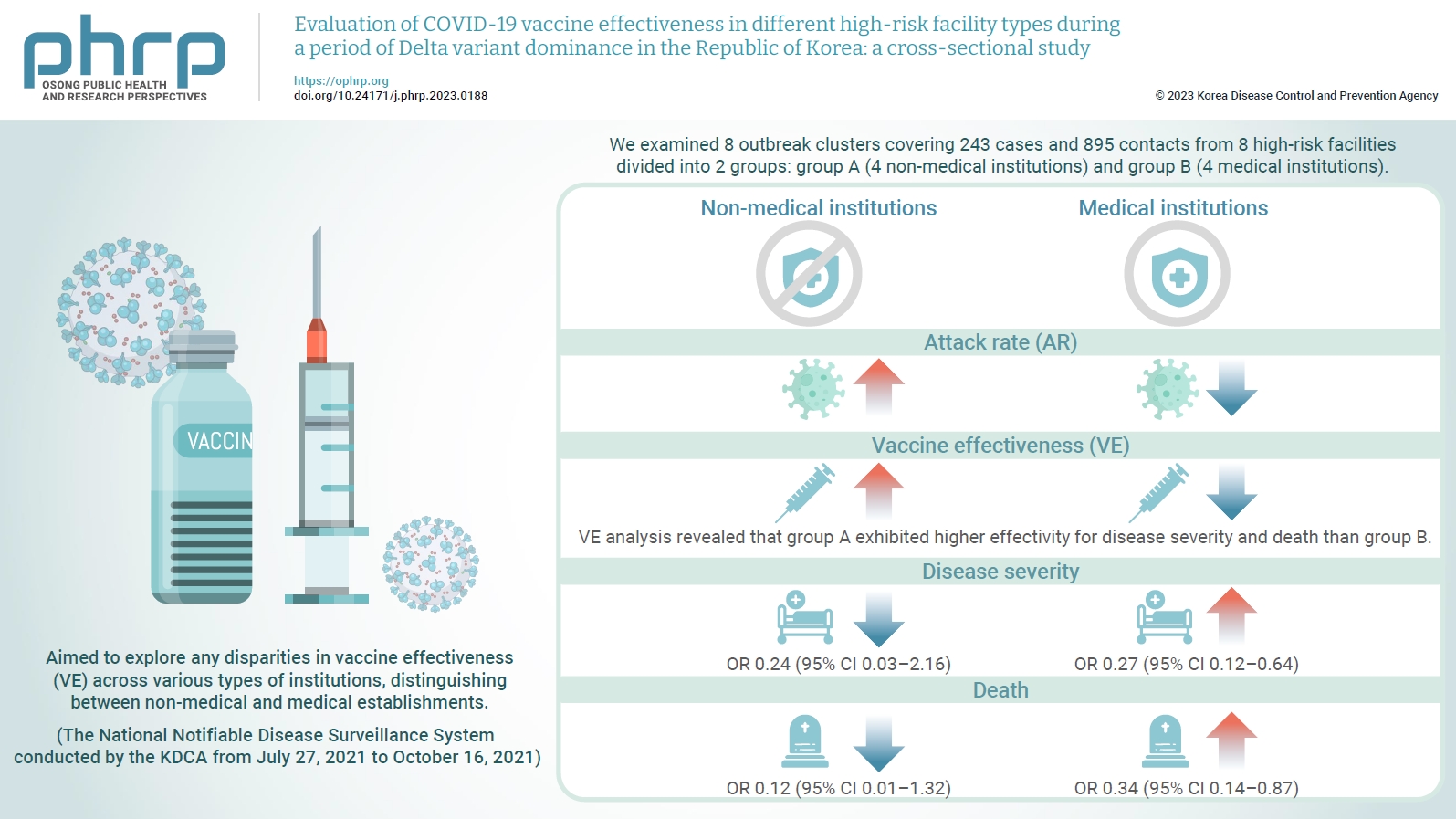
Objectives
We evaluated the effectiveness of coronavirus disease 2019 vaccination in high-risk facilities in the Republic of Korea during the period when the highly transmissible Delta variant was prevalent. Additionally, we aimed to explore any disparities in vaccine effectiveness (VE) across various types of institutions, specifically distinguishing between non-medical and medical establishments. Methods: We examined 8 outbreak clusters covering 243 cases and 895 contacts from 8 high-risk facilities divided into 2 groups: group A (4 non-medical institutions) and group B (4 medical institutions). These clusters were observed from July 27, 2021 to October 16, 2021 for the attack rate (AR) and VE with respect to disease severity. A generalized linear model with a binomial distribution was used to determine the odds ratio (OR) for disease severity and death. Results: AR was notably lower in group B (medical institutions). Furthermore, VE analysis revealed that group A exhibited higher effectivity for disease severity and death than group B. The OR for disease severity was 0.24 (95% confidence interval [CI], 0.03–2.16) for group A and 0.27 (95% CI, 0.12–0.64) for group B, with the OR for death at 0.12 (95% CI, 0.01–1.32) in group A and 0.34 (95% CI, 0.14–0.87) in group B. Conclusion: Although VE may vary across institutions, our findings underscore the importance of implementing vaccinations in high-risk facilities. Customized vaccination programs, tailored response plans, and competent management personnel are essential for effectively addressing and mitigating public health challenges.
  • 5,189 View
  • 80 Download
The risk associated with psychiatric disturbances in patients with diabetes in Indonesia (2018): a cross-sectional observational study video
Siti Isfandari, Betty Roosihermiatie, Sulistyowati Tuminah, Laurentia Konadi Mihardja
Osong Public Health Res Perspect 2023;14(5):368-378.
Published online October 18, 2023
DOI: https://doi.org/10.24171/j.phrp.2023.0144
The risk associated with psychiatric disturbances in patients with diabetes in Indonesia (2018): a cross-sectional observational study
Objectives
The global prevalence of psychiatric disturbances is rising, detrimentally affecting the quality of care and treatment outcomes for individuals, particularly those with diabetes.This study investigated the association of risk factors for psychiatric disturbances among productive-age patients with diabetes (ages 30−59 years), considering sociodemographic characteristics and co-existing diseases. The risk factors considered included sociodemographic factors (e.g., residence, age, sex, marital status, education, and occupation) and co-existing diseases (e.g., hypertension, heart disease, stroke, renal failure, rheumatism, asthma, and cancer). Methods: This cross-sectional study utilized data from the 2018 Indonesian National Health Survey (Riskesdas). The study population comprised respondents aged between 30 and 59 years who had diabetes and had completed the 20-question self-reporting questionnaire (SRQ-20). After the exclusion of incomplete SRQ-20 data, the sample included 8,917 respondents. Data were analyzed using logistic regression. Results: Approximately 18.29% of individuals with diabetes displayed symptoms indicative of psychiatric disturbances. After adjusting for sociodemographic factors such as age, sex, education level, occupation, marital status, and place of residence, patients with diabetes who had co-existing conditions such as hypertension, heart diseases, rheumatic disorders, asthma, or cancer had a higher risk for developing psychiatric disturbances than those with diabetes alone (adjusted odds ratio, 6.67; 95% confidence interval, 4.481−9.928; p<0.001). Conclusion: The elevated risk of psychiatric disturbances among patients with diabetes who had comorbidities underscores the importance of addressing mental health issues in the management of diabetes, especially in patients with concurrent disease conditions.

Citations

Citations to this article as recorded by  Crossref logo
  • The impact of dietary consumption on hypertension in indonesia: An analysis of indonesian health survey 2023
    Cici A. Yanti, Ratna Djuwita, Evi Martha, Besral, Debby Ratno Kustanto, Noor Mastura Mohd Mujar
    Journal of Education and Health Promotion.2025;[Epub]     CrossRef
  • Investigating the association between physical fitness and blood pressure among healthcare workers in Indonesia
    Wahyu Sulistiadi, Riswandy Wasir, Astriana, Badra Al Aufa, Sri Rahayu, Wasir Thalib, Fadilah Aulia Rahma
    Discover Social Science and Health.2024;[Epub]     CrossRef
  • Correction to “The risk associated with psychiatric disturbances in patients with diabetes in Indonesia (2018): a cross-sectional observational study” [Osong Public Health Res Perspect 2023;14(5):368–78]
    Siti Isfandari, Betty Roosihermiatie, Sulistyowati Tuminah, Laurentia Konadi Mihardja
    Osong Public Health and Research Perspectives.2023; 14(6): 530.     CrossRef
  • 6,107 View
  • 129 Download
  • 4 Web of Science
  • Crossref

Short Communications

Trends of legionellosis reported in Jeju Province, Republic of Korea, 2015–2022
Juyoung Park, Jong-Myon Bae
Osong Public Health Res Perspect 2023;14(4):321-327.
Published online August 21, 2023
DOI: https://doi.org/10.24171/j.phrp.2023.0145
Trends of legionellosis reported in Jeju Province, Republic of Korea, 2015–2022
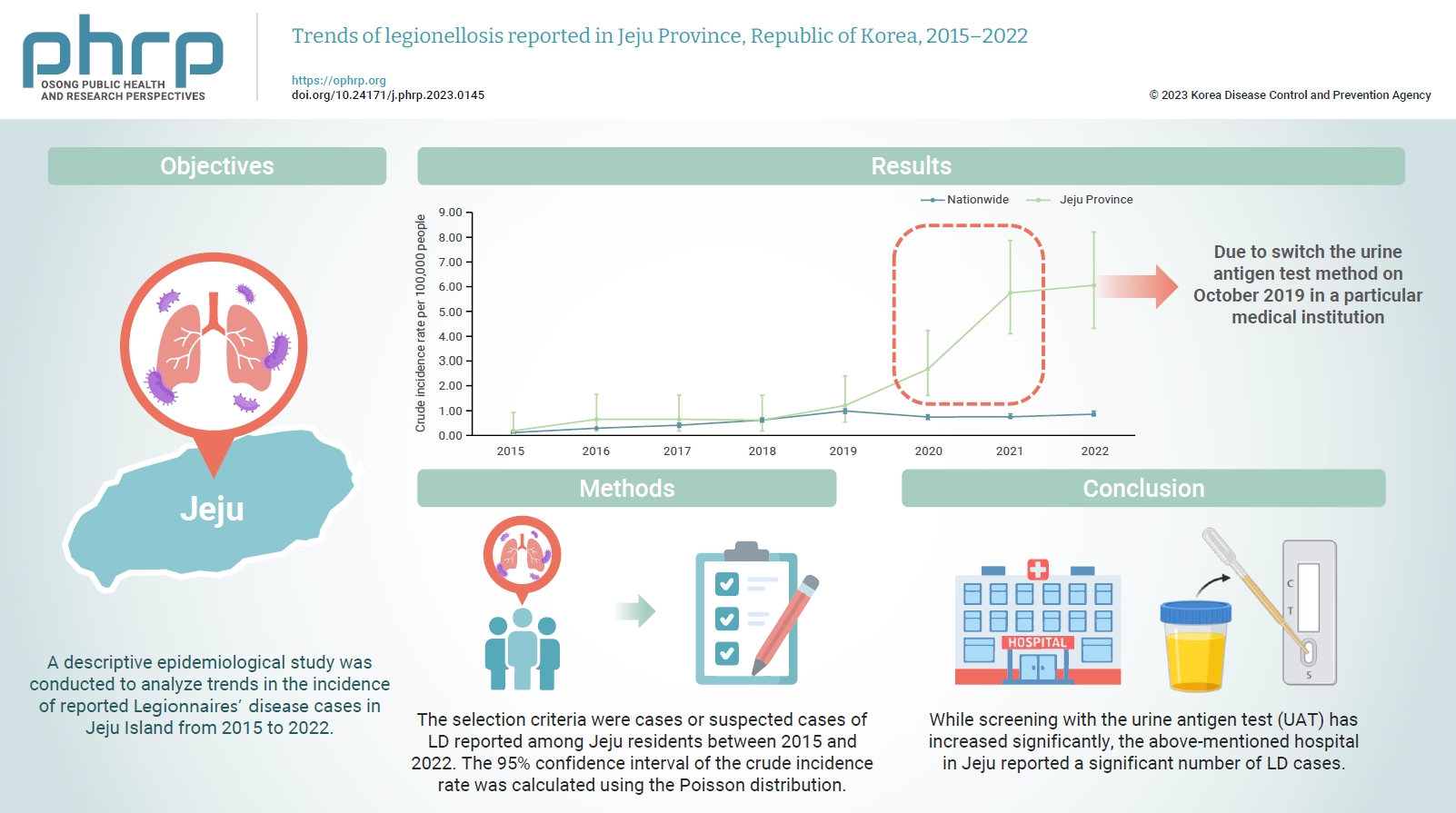
Objectives
The number of reported cases of Legionnaires’ disease (LD) in the Republic of Korea surged nationally in 2016; however, in 2022, this number was higher in Jeju Province than the previous national peak. A descriptive epidemiological study was conducted to analyze trends in the incidence of reported LD cases in Jeju Island from 2015 to 2022.
Methods
The data for this study were obtained from case reports submitted to the Korea Disease Control and Prevention Agency through its Disease and Health Integrated Management System. The selection criteria were cases or suspected cases of LD reported among Jeju residents between 2015 and 2022. The 95% confidence interval of the crude incidence rate was calculated using the Poisson distribution.
Results
Since 2020, the incidence rate of LD in Jeju has risen sharply, showing a statistically significant difference from the national incidence rate. A particular medical institution in Jeju reported a significant number of LD cases. Screening with the urine antigen test (UAT) also increased significantly.
Conclusion
Our findings indicate that the rapid increase in cases of LD in Jeju Province since 2020 was due to the characteristics of medical-care use among Jeju residents, which were focused on a specific medical institution. According to their clinical practice guidelines, this medical institution conducted UATs to screen patients suspected of pneumonia.
  • 4,020 View
  • 134 Download
Epidemiological characteristics of carbapenemase-producing Enterobacteriaceae outbreaks in the Republic of Korea between 2017 and 2022
Hyoseon Jeong, Junghee Hyun, Yeon-Kyeng Lee
Osong Public Health Res Perspect 2023;14(4):312-320.
Published online August 21, 2023
DOI: https://doi.org/10.24171/j.phrp.2023.0069
Epidemiological characteristics of carbapenemase-producing Enterobacteriaceae outbreaks in the Republic of Korea between 2017 and 2022
Objectives
We aimed to describe the epidemiological characteristics of carbapenemase-producing Enterobacteriaceae (CPE) outbreaks in healthcare settings in the Republic of Korea between 2017 and 2022.
Methods
Under the national notifiable disease surveillance system, we obtained annual descriptive statistics regarding the isolated species, carbapenemase genotype, healthcare facility type, outbreak location and duration, and number of patients affected and recommended interventions. We used epidemiological investigation reports on CPE outbreaks reported to Korea Disease Control and Prevention Agency from June 2017 to September 2022.
Results
Among the 168 reports analyzed, Klebsiella pneumoniae (85.1%) was the most frequently reported species, while K. pneumoniae carbapenemase (KPC, 82.7%) was the most common carbapenemase genotype. Both categories increased from 2017 to 2022 (p<0.01). General hospitals had the highest proportion (54.8%), while tertiary general hospitals demonstrated a decreasing trend (p<0.01). The largest proportion of outbreaks occurred exclusively in intensive care units (ICUs, 44.0%), and the frequency of concurrent outbreaks in ICUs and general wards increased over time (p<0.01). The median outbreak duration rose from 43.5 days before the coronavirus disease 2019 (COVID-19) pandemic (2017–2019) to 79.5 days during the pandemic (2020–2022) (p=0.01), and the median number of patients associated with each outbreak increased from 5.0 to 6.0 (p=0.03). Frequently recommended interventions included employee education (38.1%), and 3 or more measures were proposed for 45.2% of outbreaks.
Conclusion
In the Republic of Korea, CPE outbreaks have been consistently dominated by K. pneumoniae and KPC. The size of these outbreaks increased during the COVID-19 pandemic. Our findings highlight the need for continuing efforts to control CPE outbreaks using a multimodal approach, while considering their epidemiology.

Citations

Citations to this article as recorded by  Crossref logo
  • Microbiological and clinical impact of aminoglycosides on KPC-producing Klebsiella pneumoniae bacteraemia with aminoglycoside-modifying enzymes
    Jae Eun Seong, Sang Min Ahn, Min Han, Yong Seop Lee, Jung Ah Lee, Jae Hoon Kim, Jung Ho Kim, Jin Young Ahn, Su Jin Jeong, Nam Su Ku, Joon Sup Yeom, Hyukmin Lee, Jun Yong Choi
    Diagnostic Microbiology and Infectious Disease.2026; 114(1): 117111.     CrossRef
  • Early prediction of colonization by carbapenemase-producing enterobacterales at ICU admission using machine learning
    Ji Hun Kim, Eunmi Yang, Yun Woo Lee, Han-Sung Kim, Hyeonji Seo
    Scientific Reports.2026;[Epub]     CrossRef
  • Multidrug-resistant organism co-colonization in patients with discordant direct stool Xpert Carba-R and culture-based carbapenemase-producing Enterobacterales surveillance results
    Cheon-Hoo Jun, Si-Ho Kim, Hyoung Tae Kim, Yu Mi Wi
    Journal of Infection and Public Health.2026; 19(5): 103188.     CrossRef
  • Comparison of clinical outcomes of patients with serial negative surveillance cultures according to a subsequent polymerase chain reaction test for carbapenemase-producing Enterobacterales
    H. Seo, S. Kim, Y.W. Lee, H.S. Oh, H-S. Kim, Y.K. Kim
    Journal of Hospital Infection.2024; 146: 93.     CrossRef
  • Identifying Contact Time Required for Secondary Transmission ofClostridioides difficileInfections by Using Real-Time Locating System
    Min Hyung Kim, Jaewoong Kim, Heejin Ra, Sooyeon Jeong, Yoon Soo Park, Dongju Won, Hyukmin Lee, Heejung Kim
    Emerging Infectious Diseases.2024;[Epub]     CrossRef
  • Antimicrobial activity of ceftazidime-avibactam against KPC-2-producing Enterobacterales: a cross-combination and dose-escalation titration study with relebactam and vaborbactam
    Min Seo Kang, Jin Yang Baek, Jae-Hoon Ko, Sun Young Cho, Keon Young Lee, Young Ho Lee, Jinyoung Yang, Tae Yeul Kim, Hee Jae Huh, Nam Yong Lee, Kyungmin Huh, Cheol-In Kang, Doo Ryeon Chung, Kyong Ran Peck, Bobby G. Warren
    Microbiology Spectrum.2024;[Epub]     CrossRef
  • Performance comparison of BD Phoenix CPO detect panel with Cepheid Xpert Carba-R assay for the detection of carbapenemase-producing Klebsiella pneumoniae isolates
    Nazmiye Ülkü Tüzemen, Uğur Önal, Osman Merdan, Bekir Akca, Beyza Ener, Halis Akalın, Cüneyt Özakın
    BMC Microbiology.2024;[Epub]     CrossRef
  • 6,359 View
  • 233 Download
  • 6 Web of Science
  • Crossref

Review Article

Public health agencies’ use of social media for communication during pandemics: a scoping review of the literature
Babatunde Abiodun Balogun, Anne Hogden, Nenagh Kemp, Lin Yang, Maria Agaliotis
Osong Public Health Res Perspect 2023;14(4):235-251.
Published online August 9, 2023
DOI: https://doi.org/10.24171/j.phrp.2023.0095
Public health agencies’ use of social media for communication during pandemics: a scoping review of the literature
Public health agencies (PHAs) have increasingly incorporated social media into their communication mix during successive pandemics in the 21st century. However, the quality, timing, and accuracy of their health messages have varied significantly, resulting in mixed outcomes for communication, audience engagement, and pandemic management. This study aimed to identify factors influencing the effectiveness of pandemic-related health messages shared by PHAs on social media and to report their impact on public engagement as documented in the literature. A scoping literature review was conducted following a predefined protocol. An electronic search of 7 relevant databases and 5 grey literature repositories yielded 9,714 papers published between January 2003 and November 2022. Seventy-three papers were deemed eligible and selected for review. The results underscored the insufficiency of social media guidance policies for PHAs. Six themes were identified: message source, message topic, message style, message timing, content credibility and reliability, and message recipient profile. These themes encompassed 20 variables that could inform PHAs’ social media public health communication during pandemics. Additionally, the findings revealed potential interconnectedness among the variables, and this study concluded by proposing a conceptual model that expands upon existing theoretical foundations for developing and evaluating pandemic-related health messaging.

Citations

Citations to this article as recorded by  Crossref logo
  • Dynamics of public health messaging and healthcare activity in children during the 2022 iGAS surge: an observational study in England
    Alexandra L Creavin, Ruth Kipping, Alastair D Hay
    Journal of Public Health.2026; 48(1): 281.     CrossRef
  • Using Humor to Promote Directives: Public Service Announcements During a Protracted Crisis
    Babatunde A. Balogun, Lin Yang, Nenagh Kemp, Maria Agaliotis, Anne Hogden
    Health Communication.2026; 41(11): 1941.     CrossRef
  • Citizen engagement with information when adapting to health crises: four distinctive profiles
    Marilla Kortesalmi, Harri Jalonen, Valdemar R. V. Kallunki
    International Journal of Public Sector Management.2026; 39(5): 579.     CrossRef
  • Ethnopharmacy of Medicinal Plants in the Production of Ma'jun as Traditional Medicine in Blang Dalam Village, Darul Hikmah District, Aceh Jaya Regency
    Vera Maulida, Muhammad Ridhwan, Rubiah, Husna, Cut Morina Zubainur
    Jurnal Penelitian Pendidikan IPA.2026; 12(3): 59.     CrossRef
  • Planning and Implementing Social Media Communication in a Public Health Crisis: An Analytical Perspective
    Babatunde A. Balogun, A. Hogden, L. Yang, M. Agaliotis, N. Kemp
    Health Promotion Journal of Australia.2026;[Epub]     CrossRef
  • Misinformation Through the Lens of Dutch News Media and Public Health Authorities: Content Analysis of Topics and Narratives Present in Pandemic-Related Misinformation During COVID-19
    David Blanco-Herrero, Bas van den Putte, Toni G L A van der Meer
    JMIR Infodemiology.2026; 6: e91743.     CrossRef
  • Mapping risk communication practices in public health emergencies: a scoping review and comparison with Italian regional pandemic plans
    Erica De Vita, Guglielmo Arzilli, Francesco Gesualdo, Virginia Casigliani, Milena Pasquale, Gianluca Cruschelli, Federico Tecchio, Filippo Tosi, Andrea Davide Porretta, Diana Romersi, Cesare Buquicchio, Caterina Rizzo
    BMC Public Health.2026;[Epub]     CrossRef
  • Co‐Designing a Framework for Social Media Health Communication to Young People: A Participatory Research Study
    Melody Taba, Julie Ayre, Kirsten McCaffery, Diana Vassilenko, Ivan C. K. Ma, Tara Haynes, Julie Leask, Andrew Wilson, Carissa Bonner
    Health Expectations.2025;[Epub]     CrossRef
  • Living health-promotion campaigns for communities in the United States: Decentralized content extraction and sharing through AI
    Man-pui Sally Chan, Haesung Jung, Alex Morales, Angela Zhang, Devlin O’Keefe, Sarah Joseph, Anthony Hron, Janet Davis, Tito Terry, Tiffany Peterson, Corey Herrman, Melissa Phillips, Jennifer Osborne, Kelley G McBride, Martin Hensley, Adriana Todorov, Alai
    PNAS Nexus.2025;[Epub]     CrossRef
  • Paid Social Media Advertising on Vaping in Australia: A Descriptive Study Using Meta Ad Library
    Xiao Li, Robyn Gillespie, Alberto Nettel‐Aguirre, Lisa Gaye Smithers
    Health Promotion Journal of Australia.2025;[Epub]     CrossRef
  • 11,736 View
  • 306 Download
  • 9 Web of Science
  • Crossref

Original Articles

Risk factors for COVID-19 outbreaks in livestock slaughtering and processing facilities in Republic of Korea
Seongju Choi, Tae Jong Son, Yeon-Kyung Lee
Osong Public Health Res Perspect 2023;14(3):207-218.
Published online June 8, 2023
DOI: https://doi.org/10.24171/j.phrp.2023.0035
Risk factors for COVID-19 outbreaks in livestock slaughtering and processing facilities in Republic of Korea
Objectives
The goal of this study was to help prevent and control the spread of coronavirus disease 2019 (COVID-19) by identifying transmission routes and risk factors in livestock slaughtering and processing facilities (SPFs) and establishing an optimal intervention strategy for outbreaks.
Methods
This case series study was a demographic analysis of patients with confirmed COVID-19 associated with 5 SPFs in Korea between January and June 2021. Additionally, in a retrospective cohort study, the association between COVID-19 infection and risk factors was analyzed for SPFs at which outbreaks occurred.
Results
The COVID-19 attack rates were 11.2%, 24.5%, and 6.8% at 3 poultry SPFs (PSPFs) and 15.5% and 25.2% at 2 mammal SPFs (MSPFs). Regarding spatial risk factors, the COVID-19 risk levels were 12.1-, 5.2-, and 5.0-fold higher in the refrigeration/ freezing, by-product processing, and carcass cutting areas, respectively, than in the office area. The risk of COVID-19 infection was 2.1 times higher among employees of subcontractors than among employees of contractors. The COVID-19 risk levels were 5.3- and 3.0-fold higher in foreign workers than in native Korean workers in the PSPFs and MSPFs, respectively.
Conclusion
As the COVID-19 pandemic continues, a detailed policy for infectious disease prevention and control intervention is needed, without interrupting economic activities. Thus, we propose an ideal intervention plan to prevent COVID-19 through disinfection and preemptive testing and to block its transmission through effective contact management during outbreaks at SPFs.

Citations

Citations to this article as recorded by  Crossref logo
  • Mitigating COVID-19 in meat processing plants: what have we learned from cluster investigations?
    Pauline Kooh, Yvonnick Guillois, Michel Federighi, Mathilde Pivette, Anne-Laure Maillard, Ngoc-Du Martin Luong, Estelle Chaix
    Frontiers in Public Health.2024;[Epub]     CrossRef
  • 5,495 View
  • 79 Download
  • 1 Web of Science
  • Crossref
COVID-19 outbreak in a religious village community in Republic of Korea and risk factors for transmission
Jiae Shim, Eunju Lee, Eunyoung Kim, Yeonhwa Choi, Giseok Kang, Bryan Inho Kim
Osong Public Health Res Perspect 2023;14(2):110-118.
Published online April 5, 2023
DOI: https://doi.org/10.24171/j.phrp.2023.0002
COVID-19 outbreak in a religious village community in Republic of Korea  and risk factors for transmission
Objectives
This study aimed to assess the scale and transmission patterns of coronavirus disease 2019 (COVID-19) in a religious village community in South Korea, to determine the risk factors of transmission, and to evaluate vaccine effectiveness.
Methods
An epidemiological survey was conducted, and data were collected and analyzed from 602 villagers in the religious village community. Multivariate logistic regression analysis was used to identify the risk factors for COVID-19 transmission and to evaluate vaccine effectiveness.
Results
The outbreak attack rate was 72.1% (434/602). The attack rate was high among women in their 60s, the unemployed, residents living near religious facility (<500 m), and the unvaccinated. Age, the distance between religious facility and residences, and the absence of vaccination were identified as risk factors for transmission. Vaccine effectiveness was 49.0%, and the highest effectiveness was seen in the age group of 59 years or younger (65.8%).
Conclusion
This village community was isolated, with little communication with the outside world. However, the frequency of close contact between residents was relatively high, contributing to the spread of COVID-19 in the village even with relatively short exposure. Vaccination rates in the village community were also lower than those in the general public. Public health authorities should consider the potential impact of cultural factors, including religion, that could lead to the exponential spread of COVID-19 in closed village communities.

Citations

Citations to this article as recorded by  Crossref logo
  • Impact of disease severity, age, sex, comorbidity, and vaccination on secondary attack rates of SARS-CoV-2: a global systematic review and meta-analysis
    Dewan Md. Sumsuzzman, Yang Ye, Zhen Wang, Abhishek Pandey, Joanne M. Langley, Alison P. Galvani, Seyed M. Moghadas
    BMC Infectious Diseases.2025;[Epub]     CrossRef
  • Quantitative analysis of self-reporting and contact tracing in heterogeneous risk groups: a stochastic modeling study of the COVID-19 outbreak in Daegu, Korea
    Jiwon Han, Eunok Jung
    BMC Public Health.2025;[Epub]     CrossRef
  • Trends of fear and anger on YouTube during the initial stage of the COVID-19 outbreak in South Korea
    Jae-Joon Lee, Jongwoo Kim, Soo-Kyoung Lee
    BMC Public Health.2024;[Epub]     CrossRef
  • 6,238 View
  • 104 Download
  • 3 Web of Science
  • Crossref
The first reported hepatitis E outbreak in a food manufacturing factory: Korea, 2022
Hansol Yeom, Soonryu Seo, Youngsil Yoon, Jaeeun Lee, Myung-Guk Han, Deog-Yong Lee, Sun-Whan Park, Song A Park, Sook-Hyang Jeong, Jin Gwack
Osong Public Health Res Perspect 2023;14(1):15-22.
Published online February 22, 2023
DOI: https://doi.org/10.24171/j.phrp.2022.0305
The first reported hepatitis E outbreak in a food manufacturing factory: Korea, 2022
Objectives
On February 16, 2022, 12 cases of hepatitis E virus (HEV) infection were reported in a food manufacturing factory in Korea. The aim of this study was to identify additional cases and to determine the source of this HEV outbreak. Methods: This study was an in-depth investigation of 12 HEV immunoglobulin M (IgM)-positive cases and their demographic, clinical, and epidemiological characteristics. On-site specimens were collected from the environment and from humans, and a follow-up investigation was conducted 2 to 3 months after the outbreak. Results: Among 80 production workers in the factory, 12 (15.0%) had acute HEV infection, all of whom were asymptomatic. The follow-up investigation showed that 3 cases were HEV IgMpositive, while 6 were HEV IgG-positive. HEV genes were not detected in the HEV IgM-positive specimens. HEV genes were not detected in the food products or environmental specimens collected on-site. HEV was presumed to be the causative pathogen. However, it could not be confirmed that the source of infection was common consumption inside the factory. Conclusion: This was the first domestic case of an HEV infection outbreak in a food manufacturing factory in Korea. Our results provide information for the future control of outbreaks and for the preparation of measures to prevent domestic outbreaks of HEV infection.

Citations

Citations to this article as recorded by  Crossref logo
  • Current global estimates, risk factors, and knowledge gaps for Hepatitis E virus (HEV): A scoping review
    Md Koushik Ahmed, Hanna Maroofi, Madeleine Blunt, Alain Labrique, Carl Kirkwood, Kirsten Vannice, Kawsar R. Talaat, Julia Lynch, Brittany L. Kmush, David Safronetz
    PLOS Neglected Tropical Diseases.2026; 20(3): e0013980.     CrossRef
  • 4,919 View
  • 192 Download
  • 1 Web of Science
  • Crossref
Chronic kidney disease in Indonesia: evidence from a national health survey
Puti Sari Hidayangsih, Dwi Hapsari Tjandrarini, Noor Edi Widya Sukoco, Nikson Sitorus, Ika Dharmayanti, Feri Ahmadi
Osong Public Health Res Perspect 2023;14(1):23-30.
Published online February 14, 2023
DOI: https://doi.org/10.24171/j.phrp.2022.0290
Chronic kidney disease in Indonesia: evidence from a national health survey
Objectives
Several previous studies have stated that consuming certain foods and beverages might increase the risk of chronic kidney disease (CKD). This study aimed to examine the relationships of food and beverage consumption with other risk factors for CKD. Methods: Data sources included the 2018 Basic Health Research (Riskesdas) and the National Socio-Economic Survey (Susenas), which were analyzed using a cross-sectional design. The study samples were households from 34 provinces in Indonesia, and the analysis was performed with provincial aggregates. Data were analyzed using risk factor analysis followed by linear regression to identify relationships with CKD. Results: The prevalence of CKD in Indonesia was 0.38%. The province with the highest prevalence was North Kalimantan (0.64%), while the lowest was found in West Sulawesi (0.18%). Five major groups were formed from 15 identified risk factors using factor analysis. A linear regression model presented 1 significant selected factor (p=0.006, R2 =31%). The final model of risk factors included water quality, consumption of fatty foods, and a history of diabetes. Conclusion: Drinking water quality, fatty food consumption, and diabetes are associated with CKD. There is a need to monitor drinking water, as well as to promote health education and provide comprehensive services for people with diabetes, to prevent CKD.

Citations

Citations to this article as recorded by  Crossref logo
  • Syndemic analysis of stroke in Indonesia
    Andi Alfian Zainuddin, Rais Reskiawan A. Kadir, Nurul Qalby, Hedi Kuswanto, Andi Afdal Abdullah, Takuro Furusawa, Haerani Rasyid, Irawan Yusuf
    The Lancet Regional Health - Western Pacific.2026; 69: 101849.     CrossRef
  • Integrating Spirituality and Self-Transcendence in Chronic Kidney Disease Management: A Structural Equation Modeling Approach
    Siti Nurkholifah, Yurika Fauzia Wardhani, Minarti Minarti, Asep Hermawan, Eka Denis Machfutra, Doni Lasut
    Journal of Holistic Nursing.2026;[Epub]     CrossRef
  • Clinical characteristics, medication use, and mortality outcomes in pediatric chronic kidney disease: A retrospective study at national hospital in Jakarta
    Aprilita Rina Yanti Eff, Selvia Yuliana, Nadiya Nurul Afifah, Ade Heryana
    Journal of Advanced Pharmaceutical Technology & Re.2026; 17(2): 108.     CrossRef
  • Illness Perception and Social Support in Self-management Behavior of Older Adults with Chronic Diseases in Indonesia: A Cross-sectional Study
    Ira Suarilah, Joni Haryanto, Febi Fadilah Wanda Sari Zain, Intan Rismatul Azizah, Retno Indarwati, Dianis Wulan Sari
    Ageing International.2026;[Epub]     CrossRef
  • Mixed Matrix Membrane Based on Cellulose Acetate and Activated Carbon from Plastic Waste for Urea Removal in Spent Dialysate
    Saiful Saiful, Mirzalisa Mirzalisa, Muliadi Ramli, Mutia Farida
    Jurnal Rekayasa Kimia & Lingkungan.2026; 21(1): 11.     CrossRef
  • Enhanced detection of albumin-creatinine ratio in urine using gold nanoparticle-integrated 3D-connector microfluidic paper-based analytical devices for early diagnosis of chronic kidney disease
    Akhmad Sabarudin, Saidun Fiddaroini, Ahmad Luthfi Fahmi, Abdul Munir Roja’i, Isadora Evani Salsabila, Aulanni’am, Setyawan Purnomo Sakti, Hani Susianti
    Microchemical Journal.2025; 211: 113071.     CrossRef
  • The Effect of Intravenous Oxyhydrogen Nanobubble on Chronic Kidney Disease: Case Series
    Olly Indrajani, Aditya T. Hernowo, Christyanita P. Ekasari, Ricki Yudhanata, Sutiman B. Sumitro
    Clinical Therapeutics.2025; 47(9): e13.     CrossRef
  • Association between low-carbohydrate diet and chronic kidney disease in population with gestational diabetes mellitus history: based on the National Health and Nutrition Examination Survey database
    Junli Zhang, Youlian Dong
    Food & Nutrition Research.2025;[Epub]     CrossRef
  • Hubungan Lama Hemodialisa dengan Kualitas Hidup Pasien Chronic Kidney Disease yang Menjalani Hemodialisa di Rumah Sakit TK II
    Kadek Dheana Novitayani W, Ni Putu Dita Wulandari, I Made Dwie Pradnya Susila, I Nyoman Sutresna
    Journal Center of Research Publication in Midwifer.2025; 9(2): 85.     CrossRef
  • 16,358 View
  • 1,119 Download
  • 8 Web of Science
  • Crossref

Review Article

Effects of medication adherence interventions for older adults with chronic illnesses: a systematic review and meta-analysis
Hae Ok Jeon, Myung-Ock Chae, Ahrin Kim
Osong Public Health Res Perspect 2022;13(5):328-340.
Published online October 12, 2022
DOI: https://doi.org/10.24171/j.phrp.2022.0168
This systematic review and meta-analysis aimed to understand the characteristics of medication adherence interventions for older adults with chronic illnesses, and to investigate the average effect size by combining the individual effects of these interventions. Data from studies meeting the inclusion criteria were systematically collected in accordance with the Preferred Reporting Items for Systematic Reviews and Meta-Analysis guidelines. The results showed that the average effect size (Hedges’ g) of the finally selected medication adherence interventions for older adults with chronic illnesses calculated using a random-effects model was 0.500 (95% confidence interval [CI], 0.342−0.659). Of the medication adherence interventions, an implementation intention intervention (using face-to-face meetings and telephone monitoring with personalized behavioral strategies) and a health belief model–based educational program were found to be highly effective. Face-to-face counseling was a significantly effective method of implementing medication adherence interventions for older adults with chronic illnesses (Hedges’ g=0.531, 95% CI, 0.186−0.877), while medication adherence interventions through education and telehealth counseling were not effective. This study verified the effectiveness of personalized behavioral change strategies and cognitive behavioral therapy based on the health belief model, as well as face-to-face meetings, as medication adherence interventions for older adults with chronic illnesses.

Citations

Citations to this article as recorded by  Crossref logo
  • Impact of telemedicine on chronic disease patients: An overview of systematic reviews
    Kun Zhang, Yanhua Chen, Peicheng Wang, Yanrong He, Yanrong Du, Hailun Liang, Weiguo Zhu, Xiao Long, Leiyu Shi, Jiming Zhu
    Intelligent Medicine.2026; 6(2): 226.     CrossRef
  • Updating Interventions to Enhance Medication Adherence among Community-Dwelling Older Adults with Chronic Diseases
    Luu Thi Thuy, Nguyen Thi Yen Hoai, Diep Thi Tieu Mai
    Home Healthcare Now.2026; 44(1): 40.     CrossRef
  • Treatment Adherence and Persistence of Anti-Fibrotic Drugs in Real Life in Greece
    Georgia Kourlaba, Stylianos Ravanidis, Garyfallia Stefanou, Konstantinos Mathioudakis, Anastasios Tsolakidis, Dimitrios Zografopoulos
    Advances in Respiratory Medicine.2026; 94(1): 6.     CrossRef
  • Reasons for delayed medical treatment among cholelithiasis patients: a qualitative study based on the health belief model
    Min Jiang, Yajie Shi, Jiao Liu, Yan Liu, Yanzhang Tian, Fang He
    BMC Health Services Research.2026;[Epub]     CrossRef
  • Can We Predict Older Adults’ Long-Term Healthy Behavior Maintenance? Identifying the Optimal Machine Learning Model
    HeSen Li, WeiCheng Pan, Hong Chen, YiZhuo Hou
    International Journal of Human–Computer Interactio.2026; 42(20): 17782.     CrossRef
  • Medication adherence trajectories and association with risk factors and clinical outcomes in type 2 diabetes treatment
    Sara Mucherino, Valentina Orlando, Marcia Vervloet, Yvette Weesie, Liset van Dijk, Enrica Menditto, Yee Gary Ang
    PLOS One.2026; 21(2): e0342056.     CrossRef
  • Designing age-friendly interfaces and wearable–environment integrations to enhance medication adherence: a discrete choice experiment among older adults
    Jialin Qin, Zeyu Wu, Hao Zhang, Xiaopan Qi
    Frontiers in Medicine.2026;[Epub]     CrossRef
  • Psychosocial predictors of non-adherence to antihypertensive medication among Korean adults: A nationwide cross-sectional study
    Kunhee Han, Hwa Sun Kim, Young Lee, Chung-woo Lee, Muhammad Haroon Stanikzai
    PLOS One.2026; 21(3): e0345509.     CrossRef
  • Nurse-led interventions in enhancing outcomes for patients with tuberculosis: a scoping review
    Nita Arisanti Yulanda, Hidayat Arifin, Titan Ligita, Lestari Makmuriana, Alfi Syahri, Susanti Susanti, Komang Ardidhana Nugraha Putra, Andri Setiya Wahyudi, Somsak Thojampa, Tintin Sukartini
    Journal of Research in Nursing.2026;[Epub]     CrossRef
  • Bedside Cognitive Behavioral Therapy Techniques in Primary Care
    Meredith L.C. Williamson, Danielle L. Terry, Kaylee J. Jackson
    Primary Care: Clinics in Office Practice.2026; 53(2): 251.     CrossRef
  • Mobile health apps for older adults: real-world evidence on engagement and medication adherence
    Elyssa Wiecek, Scott Taylor, Hugo Rourke, Fiona Hammond, Noelia Amador-Fernandez
    Frontiers in Digital Health.2026;[Epub]     CrossRef
  • Medication adherence in older adults with chronic diseases: a scoping review of barriers, facilitators, and effective interventions
    Doris Cardona-Arango, Valeria Santacruz-Restrepo, Alejandra Rendón-Montoya, Juliana Madrigal-Cadavid, Alejandra Segura-Cardona, Jorge Iván Estrada-Acevedo
    Frontiers in Aging.2026;[Epub]     CrossRef
  • A pilot feasibility study of a tablet-based virtual community application with shared avatars for promoting health behavior change in older adult care facilities
    Kenji Nakamura, Keiichi Yamazaki, Akiko Yamazaki, Yoshiaki Ohyama
    Frontiers in Digital Health.2026;[Epub]     CrossRef
  • Chrono-modulated drug delivery systems for oncology: Mechanisms, translational evidence, and pharmaceutical innovations
    Santoshini Nayak, Rajat Kumar Kar, Prasanta Kumar Biswal, Ranjit Prasad Swain, Snehamayee Mohapatra
    Chronobiology International.2026; 43(11): 1728.     CrossRef
  • Medication Adherence Interventions for Older Adults: A National Mixed‐Methods Study of Implementation Across Italian Healthcare Settings
    Sara Mucherino, Luca Pasina, Manuela Casula, Monia Donati, Carlotta Lunghi, Elena Olmastroni, Valentina Orlando, Emanuel Raschi, Stefano Scotti, Marco Salluzzo, Elisabetta Poluzzi, Alessandro Nobili, Enrica Menditto
    Journal of the American Geriatrics Society.2026;[Epub]     CrossRef
  • Yaşlılarda ilaç uyumunun geliştirilmesine yönelik stratejiler
    Soner Mete, Kamuran Özdil
    Mersin Üniversitesi Sağlık Bilimleri Dergisi.2026; 19(2): 415.     CrossRef
  • Confronting finitude and treatment adherence in older adults with chronic diseases: a qualitative study
    Leovaldo Alcântara, Luís Midão, Elísio Costa, Constança Paúl
    BMC Geriatrics.2026;[Epub]     CrossRef
  • Adherencia terapéutica en pacientes con hipertensión arterial en segundo nivel de atención
    Vidal Marcelino Villanueva Pérez, Daniel Canaán Pérez, Diego Sánchez Rodríguez
    REDSA Revista Ecuatoriana de Desarrollo Social y A.2026; 1(3): 268.     CrossRef
  • Medication adherence in older people: Predictors and strategies for improvement
    Vladimir Petković, Jelena Horvat, Svitlica Brestovački
    Timocki medicinski glasnik.2025; 50(1-2): 32.     CrossRef
  • Educational intervention for mental health and health behaviors in elderly Iranian women randomized controlled trial
    Razieh Asadi, Mahin Nazari, Abdolrahim Asadollahi, Narges Mobasheri
    Scientific Reports.2025;[Epub]     CrossRef
  • Religious, Belief Medication, and Adherence Among Elderly with Chronic Diseases: A Multicenter Cross-Sectional Study in Papua, Indonesia
    AZ Izzah, DA Perwitasari, ES Sinaga, FE Appa, EI Sianturi
    Nigerian Journal of Clinical Practice.2025; 28(11): 1269.     CrossRef
  • EXAMINING PRESCRIPTION DRUG USE AND HEALTH CARE ACCESS AMONG OLDER ADULTS IN RURAL AREAS: A CROSS-SECTIONAL STUDY BASED ON THE HEALTH BELIEF MODEL
    Yağmur ÖZKAYA, Büşra DEMİR ÇETİNKAYA, Gülden HAKVERDİ, Eyüp Can POLAT, Gülbin ÖZÇELİKAY
    Turkish Journal of Geriatrics.2025;[Epub]     CrossRef
  • Health Behavior Change to Mitigate Dementia Risk: An Updated Review
    Victoria Sanborn, Jennifer D. Davis, Laura E. Korthauer
    Current Geriatrics Reports.2024; 13(3): 162.     CrossRef
  • Relationship Between Depression and Medication Adherence Among Chronic Disease Patients in the Middle East
    Abdulrahman O Alomar, Rakan H Khushaim, Shahad K Al-Ghanem, Abeer T Bin Jumaiah, Suhail M Albaqami, Lujain A Alleft, Eman A Abahussain
    Cureus.2024;[Epub]     CrossRef
  • Development and Preliminary Psychometric Testing of a Brief Tool to Measure Medication Adherence in Older Populations
    Paolo Iovino, Paola Obbia, Vincenzo De Luca, Clara Donnoli, Lola Patumi, Lisa Leonardini, Ernesto Palummeri, Manuela Ruatta, Anna Basso, Yari Longobucco, Laura Rasero, Giuseppe Liotta, Maddalena Illario
    Clinical Interventions in Aging.2024; Volume 19: 1765.     CrossRef
  • 29,628 View
  • 652 Download
  • 22 Web of Science
  • Crossref

Original Articles

Characteristics of COVID-19 outbreaks and risk factors for transmission at an army training center in South Korea from June to August 2021
U Jin Cho, Seongjin Wang, Seonju Yi, Yeon Hwa Choi, Eun-Young Kim, Jin A Kim, Sanghwan Bae, Jungyeon Yu, Jangkyu Choi, Young-Joon Park
Osong Public Health Res Perspect 2022;13(4):263-272.
Published online July 27, 2022
DOI: https://doi.org/10.24171/j.phrp.2022.0149
Objectives
It is crucial to establish the characteristics of coronavirus disease 2019 (COVID-19) outbreaks at army training centers to develop preventive measures. Therefore, this study aimed to determine the COVID-19 transmission patterns and risk factors in a sequence of outbreaks at an army training center from June to August 2021.
Methods
This study included 1,324 trainees at an army training center where outbreaks occurred from June to August 2021. The outbreak was qualitatively analyzed according to the period, attack rate, demographic characteristics, vaccination history, and living areas. An aerodynamic experiment was performed to evaluate aerosol transmission in living areas.
Results
Three outbreaks occurred at the army training center from June to August 2021. The first, second, and third outbreaks lasted for 32, 17, and 24 days, and the attack rates were 12.8%, 18.1%, and 8.9%, respectively. Confirmed cases were distributed in all age groups. Recruits and the unvaccinated were at higher risk for COVID-19. The aerodynamic experiment verified the possibility of aerosol transmission within the same living area.
Conclusion
COVID-19 transmission at army training centers should be minimized through quarantine and post-admission testing during the latency period as part of integrated measures that include facility ventilation, vaccination, indoor mask-wearing, and social distancing.

Citations

Citations to this article as recorded by  Crossref logo
  • Socioecological Model-based Factors Influencing Respiratory Infection Prevention Behaviors among Soldiers in an Army Training Center
    Eunbin Jeong, Sookyung Hyun
    Journal of Korean Public Health Nursing.2024; 38(2): 176.     CrossRef
  • COVID-19 outbreak in a religious village community in Republic of Korea and risk factors for transmission
    Jiae Shim, Eunju Lee, Eunyoung Kim, Yeonhwa Choi, Giseok Kang, Bryan Inho Kim
    Osong Public Health and Research Perspectives.2023; 14(2): 110.     CrossRef
  • Epidemiological Characteristics of a COVID-19 Outbreak in a Psychiatric Hospital in Chung-buk
    Se-Hyuk Jang, Young-Joon Park, Ji-Joo Lee, Woo-Jin Jung
    Healthcare.2023; 11(16): 2332.     CrossRef
  • 7,458 View
  • 155 Download
  • 2 Web of Science
  • Crossref
Objectives
We descriptively reviewed a coronavirus disease 2019 (COVID-19) outbreak at a nursing hospital in Gyeonggi Province (South Korea) and assessed the effectiveness of the first dose of the Oxford-AstraZeneca vaccine in a real-world population. Methods: The general process of the epidemiological investigation included a public health intervention. The relative risk (RR) of vaccinated and unvaccinated groups was calculated and compared to confirm the risk of severe acute respiratory syndrome coronavirus-2 (SARSCoV-2) infection, and vaccine effectiveness was evaluated based on the calculated RR. Results: The population at risk was confined to ward E among 8 wards of Hospital X, where the outbreak occurred. This population comprised 55 people, including 39 patients, 12 nurses, and 4 caregivers, and 19 cases were identified. The RR between the vaccinated and unvaccinated groups was 0.04, resulting in a vaccine effectiveness of 95.3%. The vaccination rate of the nonpatients in ward E was the lowest in the entire hospital, whereas the overall vaccination rate of the combined patient and non-patient groups in ward E was the third lowest. Conclusion: The first dose of the Oxford-AstraZeneca vaccine (ChAdOx1-S) was effective in preventing SARS-CoV-2 infection. To prevent COVID-19 outbreaks in medical facilities, it is important to prioritize the vaccination of healthcare providers.

Citations

Citations to this article as recorded by  Crossref logo
  • Preparing for Future Pandemics: Vaccine Effectiveness Against SARS-CoV-2 Variant in a High-Risk Hospital Environment—A Case Study From Vietnam
    Hien Thi Nguyen, Luong Huy Duong, Thai Quang Pham, Than Huu Dao, Kieu-Anh Thi Nguyen, Huyen Thi Nguyen, Nghia Duy Ngu, Duong Nhu Tran, Kim-Nhung Thi Le, Tung Son Trinh, H. Rogier van Doorn, Florian Vogt, Khanh Cong Nguyen
    Asia Pacific Journal of Public Health.2025; 37(8): 681.     CrossRef
  • COVID-19 Vaccination in Korea: Past, Present, and the Way Forward
    Eliel Nham, Joon Young Song, Ji Yun Noh, Hee Jin Cheong, Woo Joo Kim
    Journal of Korean Medical Science.2022;[Epub]     CrossRef
  • 9,448 View
  • 119 Download
  • 2 Web of Science
  • Crossref
Predictors of health-related quality of life in Koreans with cardiovascular disease
Jung-Hye Lim
Osong Public Health Res Perspect 2022;13(1):62-70.
Published online February 22, 2022
DOI: https://doi.org/10.24171/j.phrp.2021.0286
Predictors of health-related quality of life in Koreans with cardiovascular disease
Objectives
This study aimed to identify the predictors of health-related quality of life (HRQoL) in Korean adults with cardiovascular disease (CVD). Methods: This was a cross-sectional study with a stratified multistage probability sampling design. Data from the 2016 to 2019 Korea National Health and Nutrition Examination Survey (n=32,379) were used. Among the participants aged 19 years or older (n=25,995), 1,081 patients with CVD were extracted after excluding those with missing data and those who had cancer. The participants’ HRQoL was measured using the three-level EuroQoL Group’s five-dimension questionnaire (EQ-5D) scale. Data were analyzed using the t-test, one-way analysis of variance, and general linear regression for complex samples. Results: The most potent predictors of HRQoL in Korean adults with CVD were limited activity (β =−0.103, p <0.001), poor perceived health (β =−0.089, p <0.001), depression (β =−0.065, p<0.01), low household income (β=−0.033, p<0.05), unemployment (β=−0.023, p<0.05), and older age (β=−0.002, p<0.01), which explained 37.2% of the variance. Conclusion: Comprehensive interventions that address both physical and mental factors and social systems that provide financial help need to be implemented to improve the HRQoL of Korean adults with CVD.

Citations

Citations to this article as recorded by  Crossref logo
  • Association between obstructive sleep Apnea–Related factors and HINT-8 utility scores in adults: a secondary analysis of the 2023 Korea National health and nutrition examination survey (KNHANES)
    Mima Park, Seon-Ha Kim
    Quality of Life Research.2026;[Epub]     CrossRef
  • A comparison of health-related quality of life using the World Health Organization Quality of Life–BREF and 5-Level EuroQol-5 Dimensions in the Malaysian population
    Andrian Liem, Hui Jun Chih, Vithya Velaithan, Richard Norman, Daniel Reidpath, Tin Tin Su
    Osong Public Health and Research Perspectives.2025; 16(2): 126.     CrossRef
  • Assessment of health-related quality of life and health-seeking behavior in female cardiac patients in rural setting of Pakistan: A comprehensive cross-sectional analysis
    Amna Zeb, Faizan Ali Razzaq, Shahbaz Ahmad Zakki, Ijaz ul Haq, Muhammad Subhan Nazar, Ussama Hafeez
    Clinical Epidemiology and Global Health.2025; 34: 102096.     CrossRef
  • Factors associated with health-related quality of life in patients with coronary heart disease
    Febio Gutama, Melisa Intan Barliana, Irma Melyani Puspitasari
    Pharmacia.2022; 69(3): 771.     CrossRef
  • 8,687 View
  • 136 Download
  • 4 Web of Science
  • Crossref
Associations of pre-existing cardiovascular morbidity with severity and the fatality rate in COVID-19 patients: a systematic review and meta-analysis
Foad Alzoughool, Suhad Abumweis, Lo’ai Alanagreh, Manar Atoum
Osong Public Health Res Perspect 2022;13(1):37-50.
Published online February 18, 2022
DOI: https://doi.org/10.24171/j.phrp.2021.0186
Associations of pre-existing cardiovascular morbidity with severity and the fatality rate in COVID-19 patients: a systematic review and meta-analysis
Objectives
The aim of this study was to evaluate the association of pre-existing cardiovascular comorbidities, including hypertension and coronary heart disease, with coronavirus disease 2019 (COVID-19) severity and mortality. Methods: PubMed, ScienceDirect, and Scopus were searched between January 1, 2020, and July 18, 2020, to identify eligible studies. Random-effect models were used to estimate the pooled event rates of pre-existing cardiovascular disease comorbidities and odds ratio (OR) with 95% confidence intervals (95% CIs) of disease severity and mortality associated with the exposures of interest. Results: A total of 34 studies involving 19,156 patients with COVID-19 infection met the inclusion criteria. The prevalence of pre-existing cardiovascular disease in the included studies was 14.0%. Pre-existing cardiovascular disease in COVID-19 patients was associated with severe outcomes (OR, 4.1; 95% CI, 2.9 to 5.7) and mortality (OR, 6.1; 95% CI, 2.9 to 12.7). Hypertension and coronary heart disease increased the risk of severe outcomes by 2.6 times (OR, 2.6; 95% CI, 1.9 to 3.6) and 2.5 times (OR, 2.5; 95% CI, 1.7 to 3.8), respectively. No significant publication bias was indicated. Conclusion: COVID-19 patients with pre-existing cardiovascular comorbidities have a higher risk of severe outcomes and mortality. Awareness of pre-existing cardiovascular comorbidity is important for the early management of COVID-19.

Citations

Citations to this article as recorded by  Crossref logo
  • COVID-19 outcomes and persistent symptoms in patients with hypertrophic cardiomyopathy: association with pre-existing cardiovascular magnetic resonance phenotype
    Archit Singhal, Ellen Appleby, Owen Agnel, Paul Kolm, Brian C Case, Ryan L Wallace, Sarahfaye F Dolman, Nancy Geller, Dong-Yun Kim, Patrice Desvigne-Nickens, William Weintraub, Milind Y Desai, Raymond Y Kwong, John DiMarco, Carolyn Ho, Hugh Watkins, Chris
    Heart.2026; : heartjnl-2025-327169.     CrossRef
  • Chronic Conditions and Adherence to COVID-19 Preventive Measures in Pitt County, North Carolina
    London B. Grantham, Aaron M. Kipp, C. Suzanne Lea, Kristina L. Simeonsson
    AJPM Focus.2025; 4(4): 100359.     CrossRef
  • Asthma and clinical outcomes of COVID-19 in a community setting
    L. Jiao, D. Bujnowski, P. Liu, E. Bakota, L. Liu, Y. Ye, A. Dewangan, C.N. Duong, E. Kviten, S. Zaheer, A. Zangeneh, R. Roy, J. Floyd, J. Monroy, D. Wiltz-Beckham
    Public Health.2024; 226: 84.     CrossRef
  • Understanding factors affecting implementation success and sustainability of a comprehensive prevention program for cardiovascular disease in primary health care: a qualitative process evaluation study combining RE-AIM and CFIR
    Naomi Aerts, Kathleen Van Royen, Peter Van Bogaert, Lieve Peremans, Hilde Bastiaens
    Primary Health Care Research & Development.2023;[Epub]     CrossRef
  • New Scenarios in Heart Transplantation and Persistency of SARS-CoV-2 (Case Report)
    Lubov Mitrofanova, Igor Makarov, Andrey Gorshkov, Olga Vorobeva, Maria Simonenko, Anna Starshinova, Dmitry Kudlay, Tatiana Karonova
    Life.2023; 13(7): 1551.     CrossRef
  • Prognostic Factors of COVID‐19: An Umbrella Review Endorsed by the International Society for Pharmacoepidemiology
    Grammati Sarri, Wei Liu, Luke Zabotka, Andreas Freitag, Ravinder Claire, Grace Wangge, Jamie Elvidge, Dalia Dawoud, Dimitri Bennett, Xuerong Wen, Xiaojuan Li, Christopher T. Rentsch, Md Jamal Uddin, M. Sanni Ali, Mugdha Gokhale, Anouk Déruaz‐Luyet, Daniel
    Clinical Pharmacology & Therapeutics.2023; 114(3): 604.     CrossRef
  • Comorbidities in congenital heart disease: different patterns in childhood and adulthood
    Zhibao Ding, Jingai Zhu, Ye Ding, Chun Zhu
    BMC Cardiovascular Disorders.2023;[Epub]     CrossRef
  • 10,863 View
  • 151 Download
  • 7 Web of Science
  • Crossref
Laboratory investigations of herpes simplex virus-1 and -2 clinical samples in Korea
Eun Ju Oh, Young Sam Yuk, Jae Kyung Kim
Osong Public Health Res Perspect 2021;12(6):385-389.
Published online December 1, 2021
DOI: https://doi.org/10.24171/j.phrp.2021.0146
Objectives
Herpes simplex virus (HSV) infections have been reported in 60% to 95% of the adult population worldwide, making them one of the most common infectious conditions globally. HSV-1 and HSV-2 cause severe disease in immunocompromised patients. Therefore, the aim of this study was to provide information that could be used to reduce the incidence of genital herpes caused by HSV-1 and HSV-2.
Methods
From September 2018 to December 2020, 59,381 specimens were collected from outpatients across primary and secondary hospitals in Korea who requested U2Bio (Seoul, Korea) to conduct molecular biological testing of their samples for sexually transmitted infections. In this study, the positivity rates of HSV-1 and HSV-2 were analyzed according to age, sex, and specimen type.
Results
In the age-specific analysis of HSV-1, the highest positivity rate (0.58%) was observed in patients under 19 years of age, whereas the lowest positivity rate (0.08%) was observed in patients aged over 70 years. In the age-specific analysis of HSV-2, the highest positivity rate (2.53%) was likewise observed in patients under 19 years of age.
Conclusion
Our study identified differences in the infection rates of HSV-1 and HSV-2 depending on patients’ sex and age. These differences will be useful for improving disease prevention and control measures for HSV-1 and HSV-2.

Citations

Citations to this article as recorded by  Crossref logo
  • Nanomedicine in the development of vaccines against Herpesviridae: a narrative review
    Diana Hsin-Yu Lee, William Lee, Horacio Bach
    Nanomedicine.2026; 21(2): 305.     CrossRef
  • Laboratory Diagnostic Tests for Human Herpesvirus Infections
    Jayoung Kim, Seri Jeong, Hae In Bang, Hyun Soo Kim
    Laboratory Medicine Online.2025; 15(3): 188.     CrossRef
  • Epidemiological Characteristics of HSV-1 and HSV-2 in 177,599 Patients Based on PCR Testing in South Korea (2018–2022)
    Hyeong Ho Kim, Sung Hun Jang, Jeong Su Han, Jae-Sik Jeon, Jae Kyung Kim
    Pathogens.2025; 14(11): 1107.     CrossRef
  • Rapid diagnosis of herpes simplex virus 1 and 2 bloodstream infections utilizing a sample-to-answer platform
    Wei Zhen, Farah Sheikh, Dwayne A. Breining, Gregory J. Berry, Melissa B. Miller
    Journal of Clinical Microbiology.2024;[Epub]     CrossRef
  • Analysis of HSV1/2 Infection Reveals an Association between HSV-2 Reactivation and Pregnancy
    Sara Dovrat, Adar Shabat, Anat Yahav-Dovrat, Zvia Soufiev, Ella Mendelson, Ela Kashi-Zagdoun, Galia Rahav
    Viruses.2024; 16(9): 1370.     CrossRef
  • 16,901 View
  • 149 Download
  • 4 Web of Science
  • Crossref
Comparative study of the intestinal parasitism profiles between communities across the 5 municipalities of the Barranquilla metropolitan area, Colombia
Luz A. Sarmiento-Rubiano, Margarita Filott, Lucila Gómez, Marianella Suarez-Marenco, María C. Sarmiento, Jimmy E. Becerra
Osong Public Health Res Perspect 2021;12(5):333-341.
Published online October 20, 2021
DOI: https://doi.org/10.24171/j.phrp.2021.0181
Objectives
The aim of this study was to compare the rate of parasitism and intestinal parasitism profiles of children who live in relatively proximal communities across the 5 municipalities of the Barranquilla metropolitan area, Colombia.
Methods
In total, 986 fecal samples from children aged 1 to 10 were analyzed using a direct method (physiological saline and lugol) and the zinc sulfate flotation technique. A comparative analysis of the parasitism profiles between sampling locations (7 schools and 3 health centers providing growth and development services) was conducted using principal component analysis (PCA). The presence of Taenia solium antibodies was evaluated by the enzyme-linked immunosorbent assay method in 269 serum samples from the same group of children.
Results
The overall prevalence of intestinal parasitism was 57.6% (range, 42.1%–77.6%) across the sampling areas. The prevalence of helminthiasis was between 4.1% and 23.7%, and that of intestinal protozoa was between 38.2% and 73.5%. PCA showed that the parasite profiles of each sampling location shared no common characteristics. A total of 3.0% of the serum samples were positive for T. solium antibodies.
Conclusion
The intestinal parasitism profiles between relatively proximal sampling locations with similar geographic conditions were vastly different, indicating the need to study each small ecological niche on a localized scale to develop more cost-effective interventions for controlling intestinal parasitism.

Citations

Citations to this article as recorded by  Crossref logo
  • Prevalence of soil-transmitted helminths infection and associated risk factors among residents of Jigjiga town, Somali region, Eastern Ethiopia
    Abdlmenur Alewi Sedo, Ahmed Zeynudin, Tariku Belay, Mekdes Mekonen Belay, Ahmed Mohammed Ibrahim, Mohamed Omar Osman, Ramadan Budul Yusuf, Abdifatah Abdulahi, Alqeer Aliyo Ali
    PLOS ONE.2025; 20(1): e0317829.     CrossRef
  • The burden of intestinal parasitic infections in Antioquia, Colombia: Impact in childhood growth development and nutritional status
    Carolina Hernández-Castro, Sonia del Pilar Agudelo-López, Angélica Patricia Medina-Lozano, Diego López-García, Luis Alfonso García-Tuberquia, Jorge Humberto Botero-Garcés, María Cenelia Orozco-Peláez, Manuela Bolaños-Muñoz, Daniel Antonio Bejarano-Villafa
    Acta Tropica.2024; 251: 107119.     CrossRef
  • Prevalencia y diversidad de parásitos intestinales zoonóticos en perros domésticos en un área urbano en el Caribe colombiano
    Luz Adriana Sarmiento-Rubiano, Yina Garcia Toscano, Julieannie Paola Ruiz, Lucena Delgado Soraca, Alfonso Bettin Martínez, Jimmy Becerra Enríquez
    Revista Mexicana de Ciencias Pecuarias.2024; 15(4): 848.     CrossRef
  • An update on the distribution of Blastocystis subtypes in the Americas
    Paula Jiménez, Marina Muñoz, Juan David Ramírez
    Heliyon.2022; 8(12): e12592.     CrossRef
  • Frecuencia de parasitosis intestinal en escuelas primarias en Veracruz, México
    Vanessa Oceguera-Segovia, Gabriel Obed Martínez-Rodríguez, Janet Michelle Villafuerte-Ordaz, Xóchitl Magnolia Alanís-Reyes, Angel Alberto Puig-Lagunes
    Revista Mexicana de Pediatría.2022; 89(4): 146.     CrossRef
  • 10,068 View
  • 130 Download
  • 4 Web of Science
  • Crossref
Delays in the diagnosis and treatment of tuberculosis during the COVID-19 outbreak in the Republic of Korea in 2020
Jiyeon Yang, Yunhyung Kwon, Jaetae Kim, Yoojin Jang, Jiyeon Han, Daae Kim, Hyeran Jeong, Hyekyung Park, Eunhye Shim
Osong Public Health Res Perspect 2021;12(5):293-303.
Published online September 23, 2021
DOI: https://doi.org/10.24171/j.phrp.2021.0063
Delays in the diagnosis and treatment of tuberculosis during the COVID-19 outbreak in the Republic of Korea in 2020
Objectives
We investigated the impact of the coronavirus disease 2019 (COVID-19) pandemic on tuberculosis (TB) management in the Republic of Korea (ROK).
Methods
This retrospective cross-sectional study used nationwide ROK TB notification data (98,346 cases) from 2017 to 2020. The median time from the onset of TB symptoms to treatment initiation and the compliance rates with the required timing for notification and individual case investigations were measured and compared across periods and regions affected by the COVID-19 epidemic.
Results
TB diagnosis during the COVID-19 pandemic was delayed. The median time to TB treatment initiation (25 days) in 2020 increased by 3 days compared to that of the previous 3 years (22 days) (p<0.0001). In the outbreak in Seoul, Incheon, and Gyeonggi province during August, the time to TB diagnosis was 4 days longer than in the previous 3 years (p=0.0303). In the outbreak in Daegu and Gyeongbuk province from February to March 2020, the compliance rate with the required timing for individual case investigations was 2.2%p points lower than in other areas in 2020 (p=0.0148). For public health centers, the rate was 13%p lower than in other areas (80.3% vs. 93.3%, p=0.0003).
Conclusion
TB diagnoses during the COVID-19 pandemic in the ROK were delayed nationwide, especially for patients notified by public-private mix TB control hospitals. TB individual case investigations were delayed in regional COVID-19 outbreak areas (Daegu and Gyeongbuk province), especially in public health centers. Developing strategies to address this issue will be helpful for sustainable TB management during future outbreaks.

Citations

Citations to this article as recorded by  Crossref logo
  • Risk Factors Associated With Tuberculosis Diagnostic Delay in the Jiangsu Province, China (2011-2021): Spatiotemporal Database Analysis Study
    Yifan Tang, Cheng Chen, Mingming Chen, Kai Wang, Sifan Wang, Yi Lin, Qiao Liu, Chengxiu Ling, Tenglong Li, Limei Zhu
    JMIR Public Health and Surveillance.2026; 12: e80052.     CrossRef
  • Exploring the impact of the COVID-19 pandemic on the social determinants of tuberculosis in Addis Ababa, Ethiopia: a qualitative study
    Yeshewas Abaynew, Ahmed Ali, Girma Taye
    Discover Social Science and Health.2025;[Epub]     CrossRef
  • Trends in epidemiological characteristics of pulmonary tuberculosis among children and youth in Chinese mainland from 2019 to 2024: analysis of national surveillance data
    Eryong Liu, Yun Wang, Fang Yuan, Xichao Ou, Tao Li, Qinglin Meng, Yanlin Zhao
    BMC Public Health.2025;[Epub]     CrossRef
  • Managing Pulmonary Injury in Older Adults with Tuberculosis: The Role of Nursing Interventions
    Qin Zhang, Jing Guo, Haiying Lei, Qingfen Zhang
    Journal of Multidisciplinary Healthcare.2025; Volume 18: 7511.     CrossRef
  • A Review of the Impact of Patent Medicine Vendors in Driving Community Tuberculosis Case Finding in the COVID-19 Pandemic in Nigeria
    Arinze Emmanuel Ajogwu, Onwubiko Iheanyichukwu Samuel, Nnanyelugo Longinus Ochike, Uzoma Chidinma Ajegbo, Chinedu Paschal Maduka
    Matrix Science Medica.2024; 8(2): 33.     CrossRef
  • Tuberculosis: Republic of Korea, 2021
    Jinsoo Min, Hyung Woo Kim, Ju Sang Kim
    Tuberculosis and Respiratory Diseases.2023; 86(1): 67.     CrossRef
  • Prevalence and associated factors of diabetes mellitus among patients with tuberculosis in South Korea from 2011 to 2018: a nationwide cohort study
    Dawoon Jeong, Jeongha Mok, Doosoo Jeon, Hee-Yeon Kang, Hee Jin Kim, Hee-Sun Kim, Jeong Mi Seo, Hongjo Choi, Young Ae Kang
    BMJ Open.2023; 13(3): e069642.     CrossRef
  • Increased Healthcare Delays in Tuberculosis Patients During the First Wave of COVID-19 Pandemic in Korea: A Nationwide Cross-Sectional Study
    Jinsoo Min, Yousang Ko, Hyung Woo Kim, Hyeon-Kyoung Koo, Jee Youn Oh, Yun-Jeong Jeong, Hyeon Hui Kang, Kwang Joo Park, Yong Il Hwang, Jin Woo Kim, Joong Hyun Ahn, Yangjin Jegal, Ji Young Kang, Sung-Soon Lee, Jae Seuk Park, Ju Sang Kim
    Journal of Korean Medical Science.2022;[Epub]     CrossRef
  • Time trend prediction and spatial–temporal analysis of multidrug-resistant tuberculosis in Guizhou Province, China, during 2014–2020
    Wang Yun, Chen Huijuan, Liao Long, Lu Xiaolong, Zhang Aihua
    BMC Infectious Diseases.2022;[Epub]     CrossRef
  • Real-world association of adherence with outcomes and economic burden in patients with tuberculosis from South Korea claims data
    Sun-Hong Kwon, Jin Hyun Nam, Hye-Lin Kim, Hae-Young Park, Jin-Won Kwon
    Frontiers in Pharmacology.2022;[Epub]     CrossRef
  • The Impact of the COVID-19 Pandemic on Tuberculosis Case Notification and Treatment Outcomes in Eswatini
    Hloniphile Victory Masina, I-Feng Lin, Li-Yin Chien
    International Journal of Public Health.2022;[Epub]     CrossRef
  • Trends in incidences of newly notified tuberculosis in Jeju Province, Korea, 2017-2021
    Jinhee Kim, Nam-Hun Kang, Jong-Myon Bae
    Journal of Medicine and Life Science.2022; 19(3): 103.     CrossRef
  • 12,979 View
  • 245 Download
  • 14 Web of Science
  • Crossref
The current status of sexually transmitted infections in South Korean children in the last 10 years
Yumi Jang, Eunjung Oh
Osong Public Health Res Perspect 2021;12(4):230-235.
Published online August 4, 2021
DOI: https://doi.org/10.24171/j.phrp.2021.0046
The current status of sexually transmitted infections in South Korean children in the last 10 years
Objectives
This study aimed to determine the status of sexually transmitted infections (STIs) in children in South Korea between 2010 and 2019), as well as to establish preventive maintenance guidelines to reduce the incidence of STIs in children.
Methods
Data reports from 590 STI surveillance systems in community clinics, hospital-level medical institutions with urology or obstetrics/gynecology departments and public hospitals between 2010 and 2019 in the integrative disease management system of the Korea Disease Control and Prevention Agency as of December 2020 were analyzed.
Results
A total of 172,645 cases of STIs were reported over the 10-year period (2010–2019), of which 2,179 cases (1.26%) represented STIs in children below the age of 18 years. A higher incidence of infections was observed in girls (1,499 cases, 68.79%) than in boys (680 cases, 31.21%). The STIs that had the highest incidence were, in descending order, chlamydia (997 cases, 45.75%), gonorrhea (592 cases, 27.17%), genital warts (338 cases, 15.51%), genital herpes (250 cases, 11.47%), and chancroid (2 cases, 0.09%). In adolescents aged 14 to 17 years, chlamydia, genital herpes, and gonorrhea were most frequently reported. Genital warts, in particular, have been consistently reported in children below the age of 14 years.
Conclusion
Children must be protected legally and institutionally from sexual abuse. Specific management protocols for STIs in children must be established by local governments and associated organizations. National human papillomavirus vaccination programs should be expanded to include boys, and anti-STI educational efforts using modern media should be implemented.

Citations

Citations to this article as recorded by  Crossref logo
  • Consensus recommendations for testing of Chlamydia trachomatis, Neisseria gonorrhoeae, Trichomonas vaginalis , and Mycoplasma genitalium infections in the Asia-Pacific (APAC)—modified Delphi met
    David Whiley, Adilahtul Bushro Binti Zaini, Francesca Azzato, Gilho Lee, Hung-Chin Tsai, Opass Putcharoen, Stephane Wen-Wei Ku, Benson Yeo Koon Wee, Norliza Ibrahim, Ryoichi Hamasuna, Tran Thi Nhat Thien Trang, Seema Sood, Catriona S. Bradshaw
    International Journal of STD & AIDS.2026; 37(7): 709.     CrossRef
  • 10,848 View
  • 162 Download
  • 1 Web of Science
  • Crossref
Characteristics of hand-to-environment contact during indoor activities in daily life among Korean adults using a video-based observation method
Hyang Soon Oh, Mikyung Ryu, Youngran Yang
Osong Public Health Res Perspect 2021;12(3):187-195.
Published online June 8, 2021
DOI: https://doi.org/10.24171/j.phrp.2021.0006
Objectives
The aim of this study was to describe the characteristics of hand-to-environmental contact (HEC) and to identify the factors influencing HEC behavior in Korean adults’ indoor daily life.
Methods
Thirty participants were enrolled from January 14 to February 12, 2018 after providing informed consent for being videotaped. Data were collected by recording their indoor daily lives for 2 hours, resulting in 4,732 HEC cases. To ensure the accuracy and reliability of the HEC readings, 3 training sessions were conducted for the videotape readers. Rereading and verifying randomly selected data ensured the validity of intra- and inter-reader readings.
Results
The most frequent contact items were phones, papers, computer accessories, and furniture surfaces. The contact density (frequency-duration/min) was highest for category II (items occasionally shared by others, 56.8), followed in descending order by category I (items for individual use, 35.9), and category III (public use items, 3.4). Significant differences in contact density were found according to participants’ demographic characteristics.
Conclusion
As mobile phones were the most frequent contact item, regular and strict mobile phone cleansing or disinfection strategies are needed, in addition to preventative measures taken for category II and III items. Avoiding sharing personal items with others, refraining from unnecessary HEC, and maintaining strict hand hygiene are recommended.

Citations

Citations to this article as recorded by  Crossref logo
  • Developing a hand thermophysiological model to evaluate contact thermal sensation
    Yicong Li, Jinyuan Lou, Yi Gao, Xiang Zhou, Maohui Luo
    Building and Environment.2026; 304: 115020.     CrossRef
  • 8,546 View
  • 112 Download
  • 1 Web of Science
  • Crossref
Sex differences in the relationship between depression and cardiovascular disease risk: a nationwide study in Korea
Seol-bin Kim, Ihn Sook Jeong
Osong Public Health Res Perspect 2021;12(2):105-114.
Published online April 29, 2021
DOI: https://doi.org/10.24171/j.phrp.2021.12.2.08
Objectives
This study aimed to identify sex differences in the association between depression and the risk of developing cardiovascular disease (CVD).
Methods
A secondary analysis was conducted of data from the fifth to seventh waves (2010−2018) of the Korea National Health and Nutrition Examination Survey. The participants were adults aged 30−74 years who had no diagnosis of CVD. The CVD risk was calculated using the Framingham Risk Score algorithm. Multiple linear regression analysis was conducted to identify the association between depression and CVD risk using a complex sample design.
Results
The mean CVD risk was higher in males and females with current depression (14.72% vs. 6.35%, respectively) than in males without current depression (11.67% and 4.42%, respectively). Current depression showed a significant association with CVD risk after controlling for only health-related characteristics, but the significance disappeared in both males and females when demographic characteristics were additionally controlled.
Conclusion
The presence of depression was not associated with CVD risk regardless of sex after controlling for confounding factors. Further studies are recommended to investigate the relationship between depression and CVD risk in a larger sample of both males and females with depression.

Citations

Citations to this article as recorded by  Crossref logo
  • Sex-specific associations between depressive symptoms and cardiovascular risk among middle-aged and older adults without standard modifiable risk factors: Evaluating the ‘SMuRF-less but depressed’
    Lu Zhai, Jue-Ling Wei, Rong-Rui Huo, Xue-Mei You
    General Hospital Psychiatry.2026; 99: 43.     CrossRef
  • Sex-specific risks for cardiovascular disease across the specific depressive symptoms spectrum: A national prospective cohort study
    Yu-Hua Liu, Lu Zhai, Rong-Rui Huo, Cui Ma
    General Hospital Psychiatry.2025; 94: 37.     CrossRef
  • Sex Differences in the Association Between Depression and Incident Cardiovascular Disease
    Keitaro Senoo, Hidehiro Kaneko, Kensuke Ueno, Yuta Suzuki, Akira Okada, Katsuhito Fujiu, Taisuke Jo, Norifumi Takeda, Hiroyuki Morita, Kentaro Kamiya, Junya Ako, Koichi Node, Hideo Yasunaga, Issei Komuro
    JACC: Asia.2024; 4(4): 279.     CrossRef
  • Sex Differences in the Association of Depression Symptoms and Cardiovascular Disease in Adults in the United States
    Bhaskar Thakur, Chance Strenth, Elizabeth Mayfield Arnold, Frank David Schneider
    American Journal of Health Promotion.2024; 38(8): 1199.     CrossRef
  • 11,944 View
  • 124 Download
  • 4 Web of Science
  • Crossref
Seroprevalence of antibodies to SARS-CoV-2 and predictors of seropositivity among employees of a teaching hospital in New Delhi, India
Pragya Sharma, Rohit Chawla, Ritika Bakshi, Sonal Saxena, Saurav Basu, Pradeep Kumar Bharti, Meera Dhuria, S. K. Singh, Panna Lal
Osong Public Health Res Perspect 2021;12(2):88-95.
Published online April 29, 2021
DOI: https://doi.org/10.24171/j.phrp.2021.12.2.06
Objectives
Healthcare workers (HCWs) are at a high risk of contracting severe acute respiratory syndrome coronavirus 2 (SARS-CoV-2) due to the increased likelihood of clinical exposure during patient management. The study objective was to determine the seroprevalence of antibodies to SARS-CoV-2 and its predictors among hospital employees.
Methods
The cross-sectional study was conducted at a teaching hospital from August 2020 to September 2020 among 1,401 employees, including 1,217 HCWs, in New Delhi, India. The serum samples were examined for immunoglobulin G (IgG) antibodies to SARS-CoV-2 using the COVID Kavach-Anti-SARS-CoV-2 IgG Antibody Detection enzyme-linked immunosorbent assay kit. Data were collected electronically using the EpiCollect mobile platform. A <italic>p</italic><0.05 was considered to indicate statistical significance.
Results
A total of 169 participants (12.1%) had detectable IgG antibodies to SARS-CoV-2. The highest seropositivity rate was observed in the administrative staff (20.1%), while it was lowest among medical doctors (5.5%, <italic>p</italic><0.001). Male sex and ever having lived in a containment zone were independently associated with past infection with SARS-CoV-2.
Conclusion
The seroprevalence of SARS-CoV-2 infection in health workers may be lower than in the general population in New Delhi. However, non-pharmaceutical interventions were not associated with a reduction in the risk of acquisition of SARS-CoV-2.

Citations

Citations to this article as recorded by  Crossref logo
  • SARS-CoV-2 infection rates and associated risk factors in healthcare workers: systematic review and meta-analysis
    Amit Bansal, Mai-Chi Trieu, Emily M. Eriksson, Fan Zhou, Jodie McVernon, Karl Albert Brokstad, Rebecca Jane Cox
    Scientific Reports.2025;[Epub]     CrossRef
  • Socio-demographic and behavioural risk factors of SARS- CoV-2 seropositivity in rural tribal population of Tripura: A population based cross-sectional study
    Subrata Baidya, Shampa Das, Biraj K. Kalita, Tapan Majumder, Puneet Misra
    Journal of Family Medicine and Primary Care.2025; 14(9): 4047.     CrossRef
  • Serosurveillance of COVID-19 amongst health care workers in a teaching institution – A prospective cohort study in Puducherry district
    Muhamed Kamaludeen, Pajanivel Ranganadin, Agieshkumar Balakrishna Pillai, Arun Sugumaran
    Journal of Family Medicine and Primary Care.2024; 13(5): 1917.     CrossRef
  • Assessment of potential risk factors for COVID-19 among health care workers in a health care setting in Delhi, India -a cohort study
    Mridu Dudeja, Aqsa Shaikh, Farzana Islam, Yasir Alvi, Mohammad Ahmad, Varun Kashyap, Vishal Singh, Anisur Rahman, Meely Panda, Neetu Shree, Shyamasree Nandy, Vineet Jain, Amitava Mukherjee
    PLOS ONE.2023; 18(1): e0265290.     CrossRef
  • Seroprevalence of IgG antibodies against SARS-CoV-2 in India, March 2020 to August 2021: a systematic review and meta-analysis
    Nuzrath Jahan, Adarsha Brahma, Muthusamy Santhosh Kumar, Bhavani Shankara Bagepally, Manickam Ponnaiah, Tarun Bhatnagar, Manoj V Murhekar
    International Journal of Infectious Diseases.2022; 116: 59.     CrossRef
  • Risk Factors for COVID-19 Infection Among Healthcare Workers. A First Report From a Living Systematic Review and meta-Analysis
    Tafadzwa Dzinamarira, Sphamandla Josias Nkambule, Mbuzeleni Hlongwa, Malizgani Mhango, Patrick Gad Iradukunda, Itai Chitungo, Mathias Dzobo, Munyaradzi Paul Mapingure, Innocent Chingombe, Moreblessing Mashora, Roda Madziva, Helena Herrera, Pelagia Makanda
    Safety and Health at Work.2022; 13(3): 263.     CrossRef
  • Seroprevalence of SARS-CoV-2 and Risk Assessment Among Healthcare Workers at a Dedicated Tertiary Care COVID-19 Hospital in Delhi, India: A Cohort Study
    Pragya Sharma, Rohit Chawla, Saurav Basu, Sonal Saxena, Warisha Mariam, Pradeep Kumar Bharti, Shivani Rao, Neha Tanwar, Anisur Rahman, Mohammad Ahmad
    Cureus.2021;[Epub]     CrossRef
  • Leading from the Forefront: Role of Indian Association of Preventive and Social Medicine during the COVID-19 Pandemic in India
    Suneela Garg, Bratati Banerjee, Neelam Anupama Toppo, Amiruddin Kadri
    Health and Population: Perspectives and Issues.2021; 44(3): 167.     CrossRef
  • 10,259 View
  • 125 Download
  • 8 Web of Science
  • Crossref
Trends in recent waterborne and foodborne disease outbreaks in South Korea, 2015–2019
Sang Hyuk Lee, Jae-Won Yun, Ji Hee Lee, Yeon Haw Jung, Dong Han Lee
Osong Public Health Res Perspect 2021;12(2):73-79.
Published online April 29, 2021
DOI: https://doi.org/10.24171/j.phrp.2021.12.2.04
Objectives
This study analyzed trends in foodborne and waterborne diseases in South Korea between 2015 and 2019.
Methods
The data consisted of information on outbreaks of waterborne and foodborne infectious diseases reported through the Korea Centers for Disease Control and Prevention (KCDC) system. We analyzed the trends and epidemiological aspects of outbreaks by month, place of occurrence, and causative pathogens in this observational study.
Results
The number of outbreaks has steadily increased over the last 5 years, but the number of cases per outbreak has followed a decreasing trend. Incidence at daycare centers and preschools has been steadily increasing over consecutive years.
Conclusion
The steady number of patients and decreasing number of cases per outbreak, even as the number of outbreaks has been increasing, suggest that the KCDC’s professional management system is operating effectively. It is necessary to continue improving the objectivity and efficiency of the management system and to carefully examine the increasing number of outbreaks in smaller-scale group catering facilities, such as daycare centers and preschools. Outbreaks can be prevented by closely examining those caused by unidentified pathogens and group outbreaks caused by other diseases, identifying problems, and supplementing the management system.

Citations

Citations to this article as recorded by  Crossref logo
  • An epidemiological investigation of foodborne and waterborne disease outbreaks in Fars Province in Iran from 2020 to 2023
    Fatemeh Jafari, Mohammad Mohammadi Abnavi, Yahya Manoochehri, Masoud Ghanbarian, Hamed Karami
    One Health Bulletin.2026; 6(2): 89.     CrossRef
  • Waterborne Diseases in Algeria (2000–2023): Spatiotemporal Trends Analysis and Public Health Determinants
    Aissa Benikdes, Abdelkrim Hazzab, Khaled Korichi, Belaid Fatmi
    Water Environment Research.2026;[Epub]     CrossRef
  • Foodborne Illness-Related Diagnostic Coding and Healthcare-Utilization Patterns in South Korea, 2023: A Nationwide Claims-Based Descriptive Study
    Seeun Choi, Junjoeng Hwang, Min Sik Choi, Su-Jin Kang, Kiyon Rhew
    Healthcare.2026; 14(16): 2466.     CrossRef
  • Epidemiology Study of the Outbreak of Diseases Transmitted through Water and Food in Ardabil Province during the Years 2013-2022
    Abdollah Dargahi, Hamed Zandian, Arezoo Ghayeghi, Helia Gholizadeh, Saeed Amini, Mohammad Jafarzadeh
    The Open Public Health Journal.2025;[Epub]     CrossRef
  • Infectious foodborne disease outbreaks and sporadic cases in Saudi Arabia: A 2017–2023 trend analysis
    Amjad Alfaleh, Abdullah Alkattan, Abrar Alzaher, Khlood Sagor, Saud Almarshoud, Mona H. Ibrahim
    Infectious Diseases Now.2025; 55(5): 105079.     CrossRef
  • 2023–2024년 대구ㆍ경북 수인성 및 식품매개감염병 유행 현황
    슬 구, 숙현 김, 명재 황, 소영 박, 유경 김, 상연 조
    Public Health Weekly Report.2025; 18(24): 875.     CrossRef
  • Characteristics of Gastroenteritis Outbreaks Investigated in Singapore: 2018–2021
    Muhd Tarmidzi Fua’di, Benjamin Er, Sylvester Lee, Pei Pei Chan, Joanna Khoo, Desmond Tan, Huilin Li, Imran Roshan Muhammad, Pream Raj, Lalitha Kurupatham, Vernon Lee, Li Kiang Tan, Joanne Sheot Harn Chan, Angela Li, Kyaw Thu Aung
    International Journal of Environmental Research an.2024; 21(1): 64.     CrossRef
  • 2023년 하절기 수인성ㆍ식품매개감염병 비상방역 체계 운영 결과
    성찬 양, 소연 박, 선경 박, 지수 원, 형준 김, 진선 양
    Public Health Weekly Report.2024; 17(4): 149.     CrossRef
  • Prevalence of Salmonella spp. and Escherichia coli in the feces of free-roaming wildlife throughout South Korea
    Rahman M. Mafizur, Lim Sangjin, Park Y. Chul, Csaba Varga
    PLOS ONE.2024; 19(2): e0281006.     CrossRef
  • Characterization of Salmonella species from poultry slaughterhouses in South Korea: carry-over transmission of Salmonella Thompson ST292 in slaughtering process
    Yewon Cheong, Jun Bong Lee, Se Kye Kim, Jang Won Yoon
    Journal of Veterinary Science.2024;[Epub]     CrossRef
  • Ultrasensitive quantification of pathogens in milliliters of beverage by filtration-based digital LAMP
    Yuhua Yan, Tao Yang, Zisheng Luo, Dong Li, Li Li, Xingyu Lin
    Food Chemistry.2023; 408: 135226.     CrossRef
  • 2022년 하절기 수인성 및 식품매개감염병 비상방역체계 운영결과
    다슬 김, 인호 김, 형준 김, 지애 심, 지수 원, 진 곽
    Public Health Weekly Report.2023; 16(2): 36.     CrossRef
  • The Epidemiological and Clinical Characteristics of the Largest Outbreak of Enterohemorrhagic Escherichia coli in Korea
    Namwoo Heo, Jihee Lee, Yeonkyung Kim, Donghan Lee, Seok-Jae Heo, Yoon Soo Park, Jae-Won Yun, Yong Chan Kim
    Journal of Korean Medical Science.2023;[Epub]     CrossRef
  • Novel next generation sequencing panel method for the multiple detection and identification of foodborne pathogens in agricultural wastewater
    Dong-Geun Park, Joon-Gi Kwon, Eun-Su Ha, Byungcheol Kang, Iseul Choi, Jeong-Eun Kwak, Jinho Choi, Woojung Lee, Seung Hwan Kim, Soon Han Kim, Jeongwoong Park, Ju-Hoon Lee
    Frontiers in Microbiology.2023;[Epub]     CrossRef
  • Survival of murine norovirus and hepatitis A virus in bottled drinking water, strawberries, and oysters
    Ziwei Zhao, Md Iqbal Hossain, Soontag Jung, Zhaoqi Wang, Daseul Yeo, Mengxiao Song, Ae Min, Sunho Park, Changsun Choi
    Food Control.2022; 133: 108623.     CrossRef
  • Trends in gastrointestinal infections before and during non-pharmaceutical interventions in Korea in comparison with the United States
    Soyeoun Kim, Jinhyun Kim, Bo Youl Choi, Boyoung Park
    Epidemiology and Health.2022; 44: e2022011.     CrossRef
  • Molecular Identification of Bacillus Isolated from Korean Water Deer (Hydropotes inermis argyropus) and Striped Field Mouse (Apodemus agrarius) Feces by Using an SNP-Based 16S Ribosomal Marker
    Md-Mafizur Rahman, Sang-Jin Lim, Yung-Chul Park
    Animals.2022; 12(8): 979.     CrossRef
  • Trends in Acute Gastroenteritis through the Pathogen Surveillance System in Incheon Metropolitan City, 2018-2021
    Jung Hee Kim, Sung Min Song, Ju Hee Kim, Soo Min Lim, Su Jin Park, Hwa Jung Nam, Young Woo Gong, Mun Ju Kwon
    Journal of Bacteriology and Virology.2022; 52(2): 54.     CrossRef
  • 11,684 View
  • 238 Download
  • 14 Web of Science
  • Crossref

Brief Report

Operating a National Hotline in Korea During the COVID-19 Pandemic
Rok Song, Yuh Seog Choi, Jae Young Ko
Osong Public Health Res Perspect 2020;11(6):380-382.
Published online December 22, 2020
DOI: https://doi.org/10.24171/j.phrp.2020.11.6.06
<p>The importance of effective communication cannot be overestimated during a pandemic. The Korea Disease Control and Prevention Agency national 1339 hotline has been in operation since the Middle East respiratory syndrome coronavirus outbreak in 2016. The hotline is open 24 hours a day, 7 days a week, 365 days a year, and provides accurate, reliable information based upon the Korea Disease Control and Prevention Agency guidelines in response to queries. During the coronavirus disease 2019 (COVID-19) pandemic, the 1339 hotline received callers’ questions about symptoms and the implications of their actions regarding the epidemic. Through the 1339 hotline, callers received the up-to-date information that enabled them to protect themselves as well as others from COVID-19. This public service may have influenced on reduced risk of virus transmission in Korea.</p>

Citations

Citations to this article as recorded by  Crossref logo
  • Assessment of Qatar’s Health Care Community Call Center Efficacy in Addressing COVID-19 Pandemic Health Care Challenges: Cross-Sectional Study
    Muhammad Atif Waheed, Lolwa Al Mannai, Hanan Khudadad, Jamil Alenbawi, Mariama Aminata Mansaray, Samya Al Abdulla
    JMIR Formative Research.2024; 8: e42753.     CrossRef
  • Covid-19 hotlines, helplines and call centers: a systematic review of characteristics, challenges and lessons learned
    Maryam Eslami Jahromi, Haleh Ayatollahi, Ali Ebrazeh
    BMC Public Health.2024;[Epub]     CrossRef
  • Unbiased care, unequal outcomes: a nursing telehealth intervention reveals systematic inequities in COVID-19 care delivery
    Anthony Cheng, Kyle Hart, Andrea Baron, Emily Dollar, Brian Park, Jen DeVoe, Eric Herman, Julie Johnson, Deborah J. Cohen
    BMC Nursing.2024;[Epub]     CrossRef
  • Mental health concerns and network structures of psychological helpline help-seekers during the COVID-19 pandemic in China: Pandemic stage differences
    Lizu Lai, Jingqiang Tong, Yu-Tao Xiang, Lin Zhang, Zhihong Ren
    Journal of Affective Disorders.2023; 323: 444.     CrossRef
  • Emerging Health Disparities during the COVID-19 Pandemic
    Nour Mheidly, Nadine Y. Fares, Mohamad Y. Fares, Jawad Fares
    Avicenna Journal of Medicine.2023; 13(01): 060.     CrossRef
  • Reinventing Patient Support and Continuity of Care Using Innovative Physician-staffed Hotline: More than 60,000 Patients Served Across 15 Medical and Surgical Specialties During the First Wave of COVID-19 Lockdown in Qatar
    Mohamed Arafa, Walid El Ansari, Fadi Qasem, Abdulla Al Ansari, Mohammed Al Ateeq Al Dosari, Khalid Mukhtar, Mohamed Ali Alhabash, Khalid Awad, Khalid Al Rumaihi
    Journal of Medical Systems.2023;[Epub]     CrossRef
  • Role and effectiveness of telephone hotlines in outbreak response in Africa: A systematic review and meta-analysis
    Noah T. Fongwen, Almighty Nchafack, Hana Rohan, Jason J. Ong, Joseph D. Tucker, Nadine Beckmann, Gwenda Hughes, Rosanna W. Peeling, Felix Bongomin
    PLOS ONE.2023; 18(11): e0292085.     CrossRef
  • An Innovative Telemedicine Initiative From Sri Lanka: The Value of Volunteerism in a Resource-Constrained Scenario During the COVID-19 Pandemic
    Indika Karunathilake, Sajith Edirisinghe, Manuj Weerasinghe, B. J. C. Perera, Anver Hamdani, Rasnayaka Mudiyanse, Sanka Randenikumara, Dulmini de Silva, Dulanja Senanayake, Sarath Gamini De Silva, Kalyani Guruge, M. K. Ragunathan, Athula Sumathipala, Pali
    Asia Pacific Journal of Public Health.2022; 34(5): 557.     CrossRef
  • Epidemiology, clinical spectrum, viral kinetics and impact of COVID‐19 in the Asia‐Pacific region
    Kin On Kwok, Ying Huang, Margaret Ting Fong Tsoi, Arthur Tang, Samuel Yeung Shan Wong, Wan In Wei, David Shu Cheong Hui
    Respirology.2021; 26(4): 322.     CrossRef
  • Generic Logic Model for Coronavirus Disease-2019 Responses Based on the South Korean Experience
    Hae-ryoung Chun, Kyuhyun Yoon, Hana Kim, Eunsil Cheon, Jaeyoung Ha, Sangwoo Tak, Sung-il Cho
    Risk Management and Healthcare Policy.2021; Volume 14: 4765.     CrossRef
  • 10,007 View
  • 113 Download
  • 9 Web of Science
  • Crossref
Original Articles
Alarm Thresholds for Pertussis Outbreaks in Iran: National Data Analysis
Yousef Alimohamadi, Seyed Mohsen Zahraei, Manoochehr Karami, Mehdi Yaseri, Mojtaba Lotfizad, Kourosh Holakouie-Naieni
Osong Public Health Res Perspect 2020;11(5):309-318.
Published online October 22, 2020
DOI: https://doi.org/10.24171/j.phrp.2020.11.5.07
<sec> <title>Objectives</title> <p>The purpose of the current study was to determine the upper threshold number of cases for which pertussis infection would reach an outbreak level nationally in Iran.</p></sec> <sec> <title>Methods</title> <p>Data on suspected cases of pertussis from the 25<sup>th</sup> February 2012 to the 23<sup>rd</sup> March 2018 from the Center for Disease Control and Prevention in Iran was used. The national upper threshold level was estimated using the exponentially weighted moving average (EWMA) method and the Poisson regression method.</p></sec> <sec> <title>Results</title> <p>In total, 2,577 (33.6%) and 1,714 (22.3%) cases were reported in the Spring and Summer respectively. There were 1,417 (18.5%) and 1,971 (25.6%) cases reported in the Autumn and Winter, respectively. The overall upper threshold using the EWMA and the Poisson regression methods, was estimated as a daily occurrence of 8 (7.55) and 7.50 (4.48–11.06) suspected cases per 10,000,000 people, respectively. The daily seasonal thresholds estimated by the EWMA and the Poisson regression methods were 10, 7, 6, 8 cases and 10, 7, 7, 9 cases for the Spring, Summer, Autumn, and Winter, respectively.</p></sec> <sec> <title>Conclusion</title> <p>The overall and seasonal estimated thresholds by the 2 methods were similar. Therefore, the estimated thresholds of 6–10 cases in a day, per 10,000,000 people could be used to detect pertussis outbreaks and epidemics by health policymakers.</p></sec>

Citations

Citations to this article as recorded by  Crossref logo
  • Characteristics, clinical manifestations, and severe disease risk of Bordetella pertussis infection in children: a tNGS-based retrospective study
    Jiangyang Zhao, Lishai Mo, Xiaoying Chen, Junming Lu, Jielin Chen, Guangbing Liu, Cuihong Lu, Xuehua Hu, Qiang Huang, Wenting Tang, Jie Tan, Chunyun Fu
    International Journal of Infectious Diseases.2026; 170: 108941.     CrossRef
  • Burden of pertussis in infants in the Eastern Mediterranean Region and the impact of maternal vaccination: a systematic review
    Randa K. Saad, Yousef Khader, Flor M. Munoz, Faris Lami, Ezzeddine Mohsni, Nadine Haddad
    BMC Public Health.2025;[Epub]     CrossRef
  • Pertussis resurgence in iran: A systematic review and meta-analysis of seroimmunity and diagnostic evidence
    Parvaneh Sadeghimoghadam, Reza Sattarpour, Maryam Noori, Nasim Sattarpour, Ali Afkhaminia, Zeinab Sinaeifar, Amir Naddaf, Zahra Omidi
    BMC Infectious Diseases.2025;[Epub]     CrossRef
  • Immunogenicity and Safety of a Newly Developed Tetanus-Diphtheria Toxoid (Td) in Healthy Korean Adolescents: a Multi-center, Randomized, Double-blind, Active-Controlled Phase 3 Trial
    Ui Yoon Choi, Ki Hwan Kim, Jin Lee, Byung Wook Eun, Hwang Min Kim, Kyung-Yil Lee, Dong Ho Kim, Sang Hyuk Ma, Jina Lee, Jong-Hyun Kim
    Journal of Korean Medical Science.2021;[Epub]     CrossRef
  • 10,648 View
  • 100 Download
  • 4 Web of Science
  • Crossref
2019 Tabletop Exercise for Laboratory Diagnosis and Analyses of Unknown Disease Outbreaks by the Korea Centers for Disease Control and Prevention
Il-Hwan Kim, Jun Hyeong Jang, Su-Kyoung Jo, Jin Sun No, Seung-Hee Seo, Jun-Young Kim, Sang-Oun Jung, Jeong-Min Kim, Sang-Eun Lee, Hye-Kyung Park, Eun-Jin Kim, Jun Ho Jeon, Myung-Min Choi, Boyeong Ryu, Yoon Suk Jang, Hwami Kim, Jin Lee, Seung-Hwan Shin, Hee Kyoung Kim, Eun-Kyoung Kim, Ye Eun Park, Cheon-Kwon Yoo, Sang-Won Lee, Myung-Guk Han, Gi-Eun Rhie, Byung Hak Kang
Osong Public Health Res Perspect 2020;11(5):280-285.
Published online October 22, 2020
DOI: https://doi.org/10.24171/j.phrp.2020.11.5.03
<sec> <title>Objectives</title> <p>The Korea Centers for Disease Control and Prevention has published “A Guideline for Unknown Disease Outbreaks (UDO).” The aim of this report was to introduce tabletop exercises (TTX) to prepare for UDO in the future.</p></sec> <sec> <title>Methods</title> <p>The UDO Laboratory Analyses Task Force in Korea Centers for Disease Control and Prevention in April 2018, assigned unknown diseases into 5 syndromes, designed an algorithm for diagnosis, and made a panel list for diagnosis by exclusion. Using the guidelines and laboratory analyses for UDO, TTX were introduced.</p></sec> <sec> <title>Results</title> <p>Since September 9<sup>th</sup>, 2018, the UDO Laboratory Analyses Task Force has been preparing TTX based on a scenario of an outbreak caused by a novel coronavirus. In December 2019, through TTX, individual missions, epidemiological investigations, sample treatments, diagnosis by exclusions, and next generation sequencing analysis were discussed, and a novel coronavirus was identified as the causal pathogen.</p></sec> <sec> <title>Conclusion</title> <p>Guideline and laboratory analyses for UDO successfully applied in TTX. Conclusions drawn from TTX could be applied effectively in the analyses for the initial response to COVID-19, an ongoing epidemic of 2019 – 2020. Therefore, TTX should continuously be conducted for the response and preparation against UDO.</p></sec>

Citations

Citations to this article as recorded by  Crossref logo
  • Use of a pathogen X tabletop exercise to assess the operational response preparedness of an emerging infectious diseases research network
    Rachael Lee, Jennifer Hemingway-Foday, Nefer Batsuli, L. Danielle Wagner, Aaron Macoubray, Robert F. Garry, Christine K. Johnson, Kathryn A. Hanley, Nikos Vasilakis, Souleymane Mboup, Hongying Li, Cecilia A. Sánchez, Peter M. Rabinowitz, Robert F. Breiman
    Frontiers in Public Health.2025;[Epub]     CrossRef
  • Development and evaluation of the Korea Disease Control and Prevention Agency’s scenario-based training program for effective response to emerging infectious disease outbreaks
    Mi Yu, Eun Kyoung Kim, Kyungnam Kim, Jin Lee, Jin Hwan Jeon, Soyeon Kim, Sangwon Lee, Yunhyung Kwon
    Osong Public Health and Research Perspectives.2025; 16(4): 373.     CrossRef
  • Development and evaluation of a hybrid capture-based NGS panel for comprehensive detection of respiratory pathogens
    Jeong-Ah Kim, Jeong-Min Kim, Chaeyoung Lee, Il-Hwan Kim, Daehwan Lee, Heesoo Lee, Jaehwan Jeong, Eun-Jin Kim
    Scientific Reports.2025;[Epub]     CrossRef
  • Education Needs for Public Health Crisis Using an Importance-Performance Analysis and Borich Needs Assessment Model: Focused on Aircraft Quarantine Officials
    Jiyun Park, Gye Joung Yeom, Seok Hwan Kim
    Research in Community and Public Health Nursing.2025; 36: 361.     CrossRef
  • 10,758 View
  • 153 Download
  • 3 Web of Science
  • Crossref
Health-Related Quality of Life Based on Comorbidities Among Patients with End-Stage Renal Disease
Jieun Cha, Dallong Han
Osong Public Health Res Perspect 2020;11(4):194-200.
Published online August 31, 2020
DOI: https://doi.org/10.24171/j.phrp.2020.11.4.08
<sec> <title>Objectives</title> <p>The aim of this study was to investigate comorbidities in patients with end-stage renal disease, and to compare health-related quality of life (HRQOL) according to the type, and number of comorbidities.</p></sec> <sec> <title>Methods</title> <p>A total of 250 adults undergoing hemodialysis were recruited at local clinics. HRQOL was measured using the 12-item Medical Outcomes Study Short Form questionnaire. Data were analyzed using descriptive statistics, analysis of variance, and <italic>t</italic> test.</p></sec> <sec> <title>Results</title> <p>Around 70.8% of patients with end stage renal disease had 1 or more comorbidities, and the most common comorbidities were hypertension, diabetes, and cardiovascular disease. HRQOL was significantly different based on the number of comorbidities (F = 9.83, <italic>p</italic> < 0.001). The effect of comorbidities on the scores for mental health domains of the HRQOL questionnaire was not conclusive compared with the scores for the physical domain which were conclusive. Among the comorbidities, diabetes was associated with a lower quality of life.</p></sec> <sec> <title>Conclusion</title> <p>The customized management of diabetic and hypertensive patients is necessary for the early detection and prevention of chronic kidney disease, and slowing the progression of renal disease and managing cardiovascular risk factors is essential.</p></sec>

Citations

Citations to this article as recorded by  Crossref logo
  • Impact of Transcatheter Aortic Valve Replacement Volume on Outcomes in Patients With End-Stage Renal Disease
    Esteban Aguayo, Oh Jin Kwon, Mitchell Won, Saad Mallick, Troy Coaston, Amulya Vadlakonda, Kevin Tabibian, Yas Sanaiha, Richard J. Shemin, Peyman Benharash
    The Annals of Thoracic Surgery.2026; 121(3): 589.     CrossRef
  • PaCE CKD: A Multinational Survey of Health-Related Quality of Life in Patients with Chronic Kidney Disease and Caregivers
    Ricardo Correa-Rotter, Mai-Szu Wu, Richard Hull, Ciro Esposito, Helmut Reichel, Steven Chadban, Juan Jose Garcia Sanchez, Surendra Pentakota, Thames Kularatne, Simon Fifer, Hesham M. Elsayed
    Advances in Therapy.2026; 43(2): 791.     CrossRef
  • Depression, Anxiety, Stress Symptoms and Health-Related Quality of Life in Hemodialysis Patients: Cross-Sectional Findings from a Romanian Cohort
    Adriana-Luciana Luca, Felicia Militaru, Cristina Mariana Văduva, Ilie-Robert Dinu, Daniela Teodora Maria, Mădălina Iuliana Mușat, Virginia Maria Rădulescu, Ion Udriștoiu, Eugen Moța
    Medicina.2026; 62(2): 242.     CrossRef
  • The Effect of Wearable Technologies on Disease Management and Psychosocial Adaptation in Hemodialysis Patients: A Systematic Review
    Arzu Kavala, Tuğba ŞAHİN Tokatlioğlu
    Journal of Renal Care.2026;[Epub]     CrossRef
  • Impact of Medical Comorbidities on Respiratory-Related Patient-Reported Outcome Measures in Fibrotic Interstitial Lung Disease
    Joon Yong Moon, Madison Beenken, Teng Moua
    Journal of Clinical Medicine.2026; 15(3): 1051.     CrossRef
  • Health-related quality of life in patients on maintenance hemodialysis: Evidence from southern Iran using EQ-5D-5L and KDQOL-SF
    Hassan Karami, Neda Mohammadi, Maryam Shirvani Shiri, Najmeh Bordbar, Ali Mouseli, Reihaneh Taheri Kondar, Ali Rezvani, Mobina Vatankhah, Donovan Anthony McGrowder
    PLOS One.2026; 21(2): e0342155.     CrossRef
  • Transplantation and Employment Earnings in Kidney Transplant Recipients
    Daisy Thomas, Calvin Diep, Ella Huszti, Juan Pablo Diaz-Martinez, Duminda Wijeysundera, Christopher D. Witiw, Blayne A. Sayed, Karim S. Ladha
    JAMA Network Open.2026; 9(2): e2560157.     CrossRef
  • Factors Influencing the Quality of Self-Care among Continuous Ambulatory Peritoneal Dialysis Patients in Central Java, Indonesia: A Cross-Sectional Study
    Muhamad Syamsul Arif Setiyo Negoro, R Susanti, Yuni Wijayanti, Eram Tunggul Pawenang
    Korean Journal of Adult Nursing.2026; 38(1): 24.     CrossRef
  • Postoperative Outcomes Among Dialysis Patients Undergoing Surgery for Cervical Spine Trauma
    Muhammad Zulfiqar, Ved A. Vengsarkar, Elizabeth Driskill, Adam L. Shimer, Stephen D. Lockey
    Spine.2026; 51(7): 478.     CrossRef
  • Cost-effectiveness analysis of interprofessional collaboration in management of blood pressure in hemodialysis outpatients with end-stage renal disease
    Peri Peri, Azizah Nasution, Asrul Akmal Shafie, Alwi Thamrin Nasution
    Pharmacia.2026; 73: 1.     CrossRef
  • Factors influencing the development and implementation of a prehabilitation program for kidney transplant candidates: A mixed-methods contextual analysis
    Avril J. Haanstra, Yvonne van der Veen, Heleen Maring, Evelien E. Quint, Adelita V. Ranchor, Stefan P. Berger, Stephan J.L. Bakker, Evelyn J. Finnema, Coby Annema
    International Journal of Nursing Studies Advances.2026; 10: 100558.     CrossRef
  • Arteriovenous fistula creation results in cardiac dysfunction and remodeling in a uremic pig model
    Jamie Kane, Prabh Gurbaj Singh, Sreenivasulu Kilari, Gaurav Baranwal, Shreya Roy-Chowdhury, Atanu Naskar, Dan Montonye, Esther Lutgens, Ying Wang, Ahmed S. Negm, Jeremy D. Collins, Timmy Lee, Sanjay Misra
    American Journal of Physiology-Renal Physiology.2026; 330(6): F783.     CrossRef
  • Predictors of waiting time for deceased donor kidney transplantation in Thailand: a competing risks analysis
    Supasiri Ounjai, Natkamol Chansatitporn, Prasong Kitidumrongsuk, Supanit Nivatvongs, Oytip Nathalang
    Journal of Hematology and Transfusion Medicine.2026; 36(99): 1.     CrossRef
  • Determinants of Quality of Life Among Hemodialysis Patients: Roles of Associated Comorbidities, Smoking, Climate Change, and Residence
    Amany Gomaa Atia, Hani Jameel Hamad, Mohamed Ali Elsayed, Huda Badr Abd Elhamed, Hanaa Elsayed Elsayed Mohamed, Shimaa Galal El Sayed, Suraiya Saleem
    Journal of Nutrition and Metabolism.2026;[Epub]     CrossRef
  • Senolytic Changes in Murine Arteriovenous Fistulas with CKD
    Jamie Kane, Sreenivasulu Kilari, Alaura Lemieux, Prabh G. Singh, Nathaniel Anderson, Dominik Saul, Tamar Tchkonia, James L. Kirkland, Sanjay Misra
    Kidney360.2026; 7(7): 1489.     CrossRef
  • Real-world effectiveness and safety of difelikefalin for chronic kidney disease-associated pruritus: a systematic review
    Rocco Sheldon, Morya Wadodkar, Andrew Gan, Hung-Yeh Chien, Jyoti Baharani
    Renal Failure.2026;[Epub]     CrossRef
  • Comorbidity in kidney transplant recipients
    I. T. Murkamilov, I. S. Sabirov, V. V. Fomin
    Nephrology and Dialysis.2026; 28(3): 343.     CrossRef
  • A Scoping Review of Social Work Roles and Their Reported Impacts Across Chronic Kidney Disease and Kidney Failure Care
    Remona Ghuman, Joyce Mary, Alison MacLean, Eva Wang, Daniel Doh
    Health & Social Care in the Community.2026;[Epub]     CrossRef
  • Testosterone deficiency in men with end stage renal disease and kidney transplantation: a narrative review
    Nicholas A. Deebel, Ashley N. Matthew, Justin Loloi, Ari P. Bernstein, Nannan Thirumavalavan, Ranjith Ramasamy
    International Journal of Impotence Research.2025; 37(4): 271.     CrossRef
  • Predisposing, enabling, and need factors influencing health-related quality of life among people with metabolic syndrome
    Olajide A. Adekunle, Yun S. Wang, Ismaeel Yunusa, Marc L. Fleming, Enrique Seoane-Vazquez, Lawrence M. Brown
    Journal of the American Pharmacists Association.2025; 65(1): 102255.     CrossRef
  • Correlations Between Spirituality, Anxiety, and Depression in Hemodialysis Patients in Saudi Arabia: A Cross-Sectional Study
    Ahmad M. Rayani, Michael W. Smart, Salman M. Alreshidi, Yazan D. Al-Mrayat, Mirna Fawaz, Abdulaziz M. Alodhailah, Ebtsam A. Abou Hashish, Hamad G. Dailah, Mashael F. Dewan, Ali Alhaiti, Mohammad Rababa
    Journal of Religion and Health.2025; 64(4): 2558.     CrossRef
  • A continuous glucose monitoring device as a valuable tool for supporting diabetes care in haemodialysis patients: A qualitative interview study
    Sisse Heiden Laursen, Inger Vestergaard Kristensen, Hanne Ravn Larsen, Peter Vestergaard, Morten Hasselstrøm Jensen, Ole Kristian Hejlesen
    Nordic Journal of Nursing Research.2025;[Epub]     CrossRef
  • Anticoagulation in Patients with End-Stage Renal Disease: A Critical Review
    FNU Parul, Tanya Ratnani, Sachin Subramani, Hitesh Bhatia, Rehab Emad Ashmawy, Nandini Nair, Kshitij Manchanda, Onyekachi Emmanuel Anyagwa, Nirja Kaka, Neil Patel, Yashendra Sethi, Anusha Kavarthapu, Inderbir Padda
    Healthcare.2025; 13(12): 1373.     CrossRef
  • Factors Associated with Re-attendance at Emergency Departments Among Older Adults: A Cross-Sectional Analytical Study
    Saengdao Janda, Juree Sansuk
    INQUIRY: The Journal of Health Care Organization, .2025;[Epub]     CrossRef
  • Lifestyle Activities and their Impact on Patients Undergoing Hemodialysis in a National Guard Hospital in Saudi Arabia: A Cross-sectional Study
    Rasha Ahmed Fouad, Norah Hassan Alali, Madawi Abdullah Altulayhan, Bayan Abdullah Albasti, Njoud Khalid Saad Alobaid, Norah Adel Alhafith, May Yousef Abdulelah, Haneen Abdullah Almulhem, Manar Yasser Alyousef, Loga Priya Kaliyaperumal, Ghadah AlShaikh Mub
    Journal of Nursing Science and Professional Practi.2025; 2(2): 75.     CrossRef
  • Exploring the quality of life of end-stage kidney disease patients in Khartoum State, Sudan: a multicenter cross-sectional study
    Hiba Ali Elzaki Hajomer, Osama Ahmed Elkhidir, Sara Elawad, Ahmed Balla M. Ahmed, Shaima Omer Mohamed Elawad, Mohamed H. Elbadawi, Wael Atif Fadl Elhassan, Rafa Awad Gasimelseed Mohamed, Kamil Merghani Ali, Tahani Amin Mahmoud, Sarra Mohamed Kheir
    BMC Nephrology.2025;[Epub]     CrossRef
  • Necrotising Pneumonia in an Immunocompromised Patient with End-stage Renal Disease: A Case Study
    Mohamed Musthafa, Karthykeyan Natarajan
    National Journal of Emergency Medicine SEMI.2025; 3(2): 53.     CrossRef
  • Hematological-based immuno-inflammatory indices in dialysis-dependent chronic kidney disease patients: a single-center study
    Shimaa Abdelmoneem, Ayman Fathy Arafa, Maha E.A. Shoieb, Ahmed Embaby, Manal M. Easa, Samia Hussein, Wesam M.R. Ashour, Batoul A. Hegazy, Elsayed Anany Metwally
    The Egyptian Journal of Haematology.2025; 50(3): 648.     CrossRef
  • Experiences of Loss, Grief and Support Needs of Adults on Haemodialysis and Families: A Qualitative Explorative Study
    Jette Marcussen, Rikke Madsen, Ann Bonner, Jette Rude Nielsen, Hanne Agerskov
    Journal of Renal Care.2025;[Epub]     CrossRef
  • Real-world safety of difelikefalin for chronic kidney disease–associated pruritus: initial insights from a European managed access programme
    Joerg Latus, Gert Mayer, Carlos Narvaez, Marius Manu, Sara Jesus, Despina Ruessmann, Lucio Manenti
    Clinical Kidney Journal.2025;[Epub]     CrossRef
  • Comparison of Cardiorenal Syndrome and Heart Failure: A Preliminary Study of Clinical, Cognitive, and Emotional Aspects
    Maria Pagano, Anna Anselmo, Giuseppe Micali, Fabio Mauro Giambò, Francesco Speciale, Daniela Costanzo, Piercataldo D’Aleo, Antonio Duca, Alessia Bramanti, Marina Garofano, Placido Bramanti, Francesco Corallo, Irene Cappadona
    NeuroSci.2025; 6(4): 129.     CrossRef
  • Association between heart failure and arteriovenous access patency in patients with end-stage renal disease on hemodialysis
    Andrea T. Fisher, Bianca Mulaney-Topkar, Brian M. Sheehan, Manuel Garcia-Toca, Ehab Sorial, Michael D. Sgroi
    Journal of Vascular Surgery.2024; 79(5): 1187.     CrossRef
  • Left-Sided Pneumothorax in a Potential Kidney Transplant Recipient—A Surprise in the Surgical Ward: Case Report
    Zuzanna Jakubowska, Małgorzata Kępska-Dzilińska, Paweł Żebrowski, Michał Macech, Sławomir Nazarewski, Zbigniew Gałązka, Jolanta Małyszko
    Transplantation Proceedings.2024; 56(4): 992.     CrossRef
  • Efficacy of Benson's Relaxation Technique on Stress and Pain Among Patients Undergoing Maintenance Hemodialysis: A Systematic Review
    Haya Ibrahim Ali Abu Maloh, Kim Lam Soh, Seng Choi Chong, Siti Irma Fadhilah Ismail, Kim Geok Soh, Dima Ibrahim Abu Maloh, Mohannad Eid AbuRuz
    SAGE Open Nursing.2024;[Epub]     CrossRef
  • Psychometric and structural properties of the traditional Chinese version of the sleep condition indicator for patients undergoing hemodialysis
    Yu-Han Chang, Hsun-Hua Lee, Yi-Shu Liao, Ta-Wei Guu, Shu-Liu Guo, Faizul Hasan, Ya-Wen Jan, Hsin‑Chien Lee, Hsiao-Yean Chiu
    Sleep and Breathing.2024; 28(5): 2197.     CrossRef
  • A Comparative Study of the Epidemiology and Risk Factors of Chronic Kidney Disease Among Rural and Urban Residents in Peshawar, Pakistan
    Junaid Ali, Shahin Shah, Muhammad Nadeem, Abroo Mahmood, Umair Ahmad
    Cureus.2024;[Epub]     CrossRef
  • Eicosapentaenoic acid supplementation alleviates pruritus, enhances skin moisture, and mitigates depression in maintenance hemodialysis patients
    Ya-ling Lin, Chia-Liang Wang, Tsay-I Chiang
    Frontiers in Nephrology.2024;[Epub]     CrossRef
  • Health-related quality of life in Indonesian hypertension outpatients in Western, Central, and Eastern Indonesia measured with the Bahasa Indonesia version of EQ-5D-5L
    Bustanul Arifin, Elly Wahyudin, Iman Setiawan, Yuliet, Veni Hadju, Eva Niamuzisilawati, Makiyatul Munawwaroh, Fredrick Dermawan Purba, Listia
    Discover Medicine.2024;[Epub]     CrossRef
  • Occupational therapy for individuals with chronic kidney disease undergoing renal rehabilitation: A literature review
    Nikolaos Gerosideris, Symeon-Dimitrios Daskalou, Christina Ouzouni, Pinelopi Vlotinou, Ioanna-Giannoula Katsouri
    Brazilian Journal of Science.2024; 3(10): 16.     CrossRef
  • Association of systemic immune-inflammation index with all-cause and cardio-cerebrovascular mortality in individuals with diabetic kidney disease: evidence from NHANES 1999-2018
    Manhuai Zhang, Siyang Ye, Jianbo Li, Meng Zhang, Li Tan, Yiqin Wang, Peichen Xie, Huajing Peng, Suchun Li, Sixiu Chen, Qiong Wen, Kam Wa Chan, Sydney C. W. Tang, Bin Li, Wei Chen
    Frontiers in Endocrinology.2024;[Epub]     CrossRef
  • Quality of Life in End-Stage Renal Disease Patients Undergoing Hemodialysis and Its Affecting Factors in a Hemodialysis Unit of General Hospital Denpasar
    Agustina Nila Yuliawati, Pande Made Desy Ratnasari, Ni Luh Putu Satria Maharani
    Borneo Journal of Pharmacy.2023; 6(3): 320.     CrossRef
  • The Effect of Chronic Kidney Disease or End-stage Kidney Disease on Perioperative Outcomes and Healthcare Utilization in Patients Undergoing Bariatric Surgery
    Yung Lee, Léa Tessier, Audrey Jong, Adelia Padoan, Yasith Samarasinghe, Tyler McKechnie, Amber O. Molnar, Michael Walsh, Aristithes Doumouras, Jerry Dang, Matthew Kroh, Dennis Hong
    Obesity Surgery.2023; 33(5): 1476.     CrossRef
  • Navigating through the haemostatic paradox in kidney failure: A practical overview
    Jessica Caruana, Nicoletta Riva, Kevin Vella, Andrew Davenport, Alexander Gatt
    British Journal of Haematology.2023; 202(2): 230.     CrossRef
  • IgA nephropathy in adults with epidermolysis bullosa
    Manrup K Hunjan, Ajoy Bardhan, Natasha Harper, Dario Leonardo Balacco, Gerald Langman, Vijay Suresh, Adrian Heagerty
    Clinical and Experimental Dermatology.2023; 48(8): 920.     CrossRef
  • Comorbid Conditions in Kidney Transplantation: Outcome Analysis at King Abdulaziz Medical City
    Abdulrahman R Al Tamimi, Bader A Aljaafri, Fahad Alhamad, Sultan Alhoshan, Awatif Rashidi, Basayel Dawsari, Ziad A Aljaafri
    Cureus.2023;[Epub]     CrossRef
  • Duration of Hemodialysis and its Impact on Quality of Life
    Bushra Akram, Hafiz Shafique Ahmad, Muhammad Tahsin Akhtar, Ahmad Bilal, Khizra Iqbal
    Pakistan Journal of Health Sciences.2023; : 31.     CrossRef
  • Health Literacy and Change in Health-Related Quality of Life in Dialysed Patients
    Ivana Skoumalova, Andrea Madarasova Geckova, Jaroslav Rosenberger, Maria Majernikova, Peter Kolarcik, Daniel Klein, Andrea F. de Winter, Jitse P. van Dijk, Sijmen A. Reijneveld
    International Journal of Environmental Research an.2022; 19(2): 620.     CrossRef
  • Physical Activity and Health-Related Quality of Life of Patients on Hemodialysis with Comorbidities: A Cross-Sectional Study
    Yu-Hui Wu, Yu-Juei Hsu, Wen-Chii Tzeng
    International Journal of Environmental Research an.2022; 19(2): 811.     CrossRef
  • Disease Knowledge, Self-Efficacy, and Quality of Life in Patient With Hypertensive Nephropathy
    Yen-Yen Chen, Mei-Chen Lee, Shu-Fang Vivienne Wu, Yueh-Min Liu, Hui-Mei Chen
    Clinical Nursing Research.2022; 31(6): 1179.     CrossRef
  • The mediating effect of self‐efficacy in the relationship between mental health and quality of life in patients with hypertensive nephrology
    Mei‐Chen Lee, Yen‐Yen Chen, Chun‐Yi Tai, Shu‐Fang Vivienne Wu
    Journal of Advanced Nursing.2022; 78(9): 2827.     CrossRef
  • The relationship between grip strength with health-related quality of life and mortality in hemodialysis patients
    Clara S. A. Sugizaki, Hellen C. N. Rodrigues, Jéssica F. M. Ivo, Ana T. V. S. Freitas, Maria L. F. Stringhini, Sérgio A. R. Paiva, Marcos F. Minicucci, Maria R. G. Peixoto, Nara A. Costa
    Nutrire.2022;[Epub]     CrossRef
  • Factors Affecting Quality of Life in Hemodialysis Patients
    Ade Yonata, Nurul Islamy, Achmad Taruna, Lukman Pura
    International Journal of General Medicine.2022; Volume 15: 7173.     CrossRef
  • Health related quality of life of patients undergoing in-centre hemodialysis in Rwanda: a cross sectional study
    Gloria Shumbusho, Celestin Hategeka, Marianne Vidler, Jules Kabahizi, Marla McKnight
    BMC Nephrology.2022;[Epub]     CrossRef
  • The Short Form-6 Dimension (SF-6D) Validity and Reliability in Hemodialysis Patients
    Anisa Zulfa Fatihah, Tri Murti Andayani, Nanang Munif Yasin
    JURNAL FARMASI DAN ILMU KEFARMASIAN INDONESIA.2021; 8(2): 150.     CrossRef
  • 13,978 View
  • 236 Download
  • 46 Web of Science
  • Crossref
Page of 2